Pages

Thursday, July 06, 2006

Stupid Title List

Today, the arxiv gave me a new candidate for my Stupid Title List. Since we have been listing the last some days, here is another list. If you have futher suggestions, let me know :-)


  1. 10 = 6 + 4
    Author: Frank Tony Smith
    arXiv: hep-th/9908205
  2. log(M_Pl/m_3/2)
    Authors: Oscar Loaiza-Brito, Johannes Martin, Hans Peter Nilles, Michael Ratz
    arXiv: hep-th/0509158

  3. Brane Big-Bang Brought by Bulk Bubble
    Authors: Uchida Gen, Akihiro Ishibashi, Takahiro Tanaka
    Journal-ref: Phys.Rev. D66 (2002) 023519
    arXiv: hep-th/0110286

  4. The axis of evil
    Authors: Kate Land, Joao Magueijo
    arXiv: astro-ph/0502237
    Journal-ref: Phys.Rev.Lett. 95 (2005) 071301

  5. Local Pancake Defeats Axis of Evil
    Authors: Chris Vale
    arXiv: astro-ph/0509039

  6. Why Eppley and Hannah's Experiment Isn't
    Author: James Mattingly
    arXiv: gr-qc/0601127

  7. A Fly in the SOUP
    Authors: R. Holman, L. Mersini-Houghton
    arXiv: hep-th/0511112

  8. Waking the Colored Plasma
    Authors: Jörg Ruppert, Berndt Müller
    arXiv: hep-ph/0503158
  9. Much ado about nothing: a treatise on empty and not-so-empty spacetimes
    Authors: Damien Martin
    arXiv:gr-qc/0607022

  10. Unhiggsing the del Pezzo
    Authors: Bo Feng, Sebastian Franco, Amihay Hanany, Yang-Hui He
    arXiv: hep-th/0209228

  11. The Sybils' Advice on Charm (and tau Leptons)
    Authors: I.I. Bigi
    arXiv: hep-ph/0604038

  12. X & Y
    Authors: L. Maiani, F. Piccinini, A.D. Polosa, V. Riquer
    arXiv: hep-ph/0512082
  13. New Regions for a Chameleon to Hide
    Authors: Baruch Feldman, Ann E. Nelson
    arXiv: hep-ph/0603057
  14. Cosmological Supersymmetry Breaking and the Power of the Pentagon: A Model of Low Energy Particle Physics
    Author: T. Banks
    arXiv: hep-ph/0510159
  15. Remodeling the Pentagon After the Events of 2/23/06
    Authors: T. Banks
    arXiv: hep-ph/0606313
  16. Cosmic Strings - Dead Again?
    Author: Mark Hindmarsh
    arXiv: hep-ph/9806469

  17. Brane New World
    Authors: S.W. Hawking, T. Hertog, H.S. Reall
    Journal-ref: Phys.Rev. D62 (2000) 043501
    arXiv: hep-th/0003052

  18. Cloudshine: New Light on Dark Clouds
    Authors: Jonathan B. Foster, Alyssa A. Goodman
    Journal-ref: Phys.Rev. D62 (2000) 043501
    arXiv: astro-ph/0510624

  19. The Skyrmion strikes back: baryons and a new large N_c limit
    Authors: Aleksey Cherman, Thomas D. Cohen
    arXiv: hep-th/0607028
  20. How Bob Laughlin Tamed the Giant Graviton from Taub-NUT space
    Authors: B.A.Bernevig, J. Brodie, L. Susskind, N. Toumbas
    Journal-ref: JHEP 0102 (2001) 003
    arXiv: hep-th/0010105

  21. The Battle of Albuera, the FC Liverpool and the Standard Model
    Authors: I.I. Bigi
    arXiv: hep-ph/0603087

  22. Nutty Bubbles
    Authors: A.M. Ghezelbash, R.B. Mann
    Journal-ref: JHEP 0209 (2002) 045
    arXiv: hep-th/0207123

  23. Nuttier Bubbles
    Authors: Dumitru Astefanesei, Robert B. Mann, Cristian Stelea
    Journal-ref: JHEP 0601 (2006) 043
    arXiv: hep-th/0508162

  24. Deconstructing Noncommutativity with a Giant Fuzzy Moose
    Authors: Allan Adams, Michal Fabinger
    Journal-ref: JHEP 0204 (2002) 006
    arXiv: hep-th/0111079

  25. Escape From The Menace Of The Giant Wormholes
    Authors: Sidney R. Coleman, Ki-Myeong Lee
    Journal-ref: Phys. Lett. B 221:242,1989

  26. Superbanana Orbits in Stellarator Geometries
    Authors: J. A. Derr, J. L. Shohet
    Journal-ref: Phys. Rev. Lett. 43, 1730–1733 (1979)

  27. The mother of all protocols: Restructuring quantum information's family tree
    Authors: Anura Abeyesinghe, Igor Devetak, Patrick Hayden, Andreas Winter
    arXiv: quant-ph/0606225

  28. Walking in the SU(N)
    Authors: Dennis D. Dietrich, Francesco Sannino
    arXiv: hep-ph/0611341

  29. Higgs Pain? Take a Preon!
    Authors: J.-J. Dugne, S. Fredriksson, J. Hansson, E. Predazzi
    arXiv: hep-ph/9709227

  30. The Matrix Reloaded - on the Dark Energy Seesaw
    Authors: Kari Enqvist, Steen Hannestad, Martin S. Sloth
    arXiv: hep-ph/0702236

  31. A New Dimension Hidden in the Shadow of a Wall
    Author: Nemanja Kaloper
    arXiv: hep-th/0702206

  32. Decapitating Tadpoles
    Authors: Allan Adams, John McGreevy, Eva Silverstein
    arXiv: hep-th/0209226


Please note that I have not read most of the above papers, and I am not judging on the scientific content of these works.


Will be updated from time to time. Last update: Feb 28th 2007

Bra-Cat


(Hi Thomas, I hope this answers the question why I was googling women's underwear during the parallel session... You see, it was for purely scientific reasons.)

Wednesday, July 05, 2006

Top 5 / Top 50 Science Blogs

Lists seem to be very much en vogue these days: After Bee's Top Ten Lists of unsolved questions in theoretical physics and results in string theory and LQG, this week's edition of Nature features a list of top 5 science blogs. In the news section, the top 5 list there is even expanded to a top 50 list

According to Nature's rating method, which is based on Technorati's Blog Finder ranking, cosmicvariance is the top 4 science blog, with a global ranking as the 2,174th blog.

I did not quite expect backreaction to appear on the lists, even more so since it was not registered at technorati until 10 minutes ago. However, I was puzzled first that neither Lubos Motl's nor Peter Woit's blog did make it among the top 50 blogs. But then I realised that it was not the fault of their technorati ranking. Somehow the editors of Nature seem not to count them as science blogs...

Tuesday, July 04, 2006

A modern Stonehenge

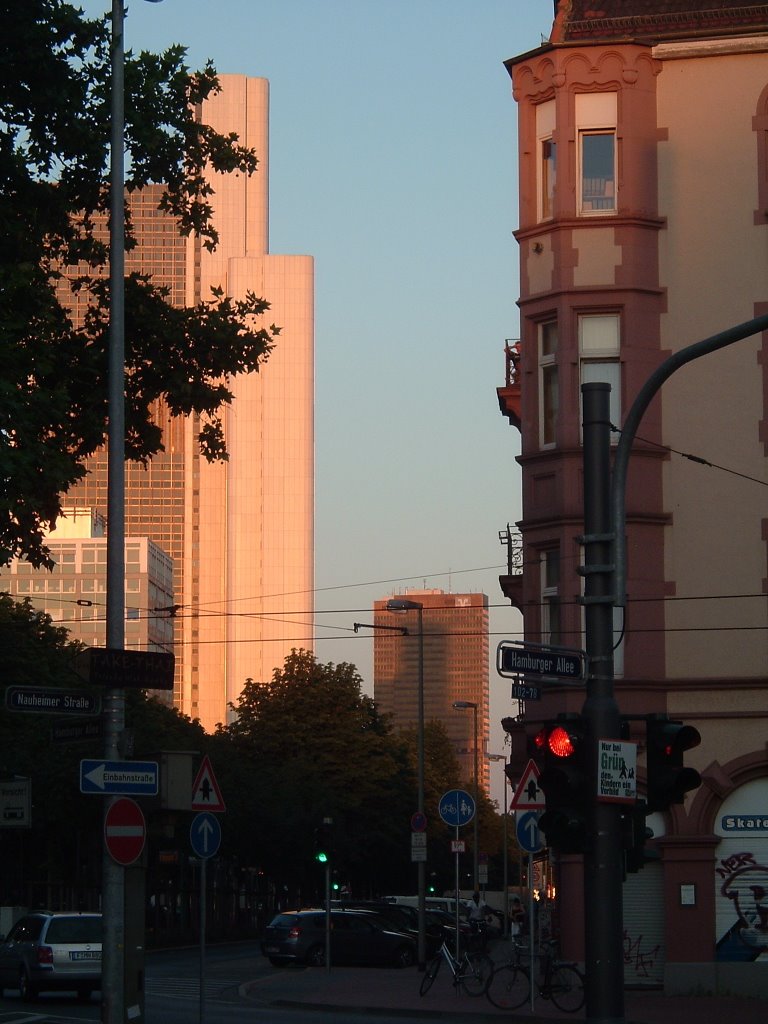
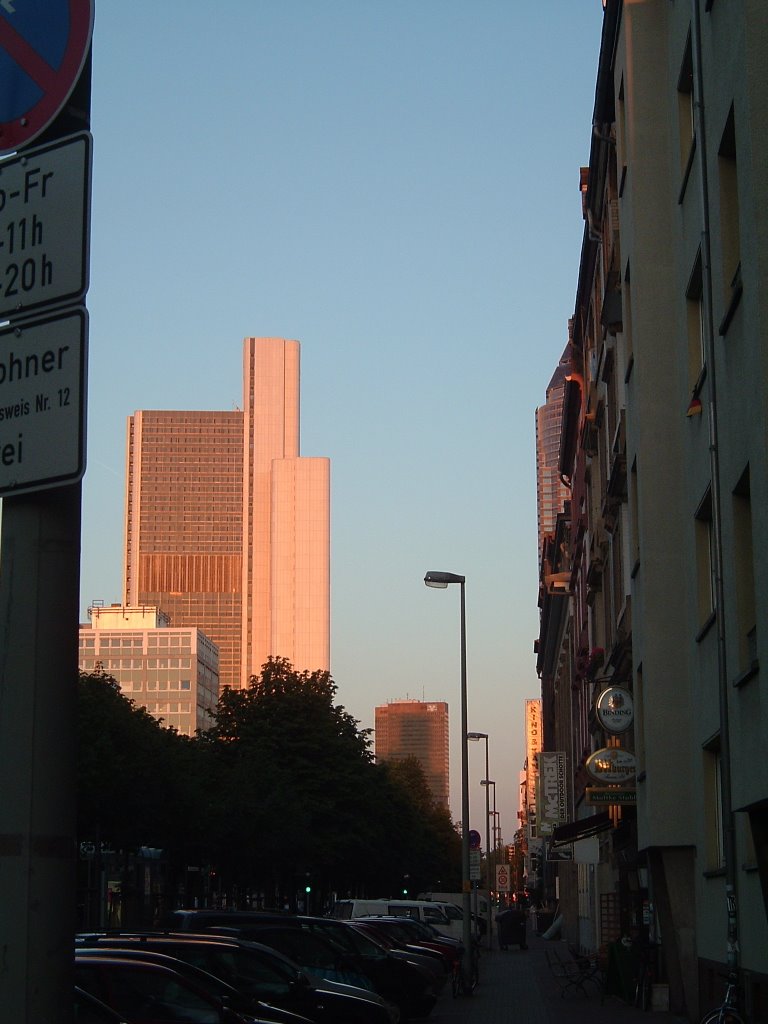
It was not in my first summer in Frankfurt that one evening in late June, just before sunset, I made a quite stunning observation: When walking home from the old physics institute, I saw, just by chance, a very remarkable shadow, which was cast by the low sun onto one of the bank towers in downtown Frankfurt. The shape of this shadow puzzled me. Then, I realised that it was cast by the tower of the Marriott hotel, a building with a very characteristic combination of three tall wings with different heights. I was fascinated, and stayed where I was, just watching the shadow wandering along the front of the bank tower. Before the shadow could leave this screen, the sun had disappeared below the horizon.

That was amazing. It seemed that just by some urbanistic coincidence, the shadow of the Marriott building could be used to indicate remarkably well the time of the summer solstice: Only around this time of the year, sunset is far enough in the Northwest, so that the shadow can reach the bank tower. Or was there a plan? Anyway, I felt some kind of archaic awe in view of this spectacle of nature.

Since that evening, I have tried to spot this event at least once each summer. Of course, the shadow appears on the bank tower not only at the exact day of the solstice, but during about three weeks around the longest day. However, I am convinced that it could be used easily to establish a calendar exact within a few days.

Last Monday was a very bright, sunny evening, and I decided to have my annual look at the spectacle, and to try to document it on photos. Sunset at the co-ordinates of Frankfurt (50.12 North, 8.68 East) is calculated by this JavaScript Sun Table Calculator to be at 21:38 MESZ (daylight savings time - 9:38 pm) on the 3rd of July. However, due to the range of the Taunus hills in the Northwest, it actually occurs 20 Minutes earlier than that, at about 21:20. At that time, the sun's altitude at is 1.4 degrees, and its azimuth is 305.3 degrees, in contrast to the nominal 308.7 degrees at sunset, which is calculated for the standard altitude at sunset of -0.83 degrees.

This azimuth is indeed in complete agreement with the angle that can be extracted from Frankfurt city maps:


Here, the upper left mark indicates the Marriott building, the lower right mark the location of the bank tower, at a distance of about 800 meters or half a mile. The line shows the direction of the shadow at sunset, with an azimuth of 306 degrees.

When I came home shortly after 8 pm on monday, I could witness another nice shadow display: About one hour before sunset, the Frankfurt Messeturm casts its characteristic pencil-shaped shadow on the very same bank tower that later shows the Marriott shadow:


You may recognise the street: the location of the photo is quite exactly where Bee was swaying the German colours two weeks ago.

Finally, one hour later, there it was, the spectacle of the Marriott shadow at midsummer:


With the last rays of sunlight, the complete shadow of the Marriott building seemed to fit just on the front of the bank tower.

Then, it was gone, together with the sun.

Sometimes, one hears the regret that living in a big city implies the loss of all authentic experience of nature. Fundamental awareness of the succession of seasons, for example, which was so important to our ancestors who built places like Stonehenge to fix these observations, would be forgotten in modern urban environments. I would argue that the contrary is true: Big cities with their skyscrapers and tall buildings offer manifold landmarks that allow to track the characteristic motion of the sun over the sky in the course of the year. Such events as the Marriott shadow may be overlooked easily in busy every-day city life, and, as it was the case for me, you may need some chance to spot them in the first place. But they are there.

You just have to open your eyes.

Top Ten

My invitation list to the wedding was a disaster. I listed several people twice with different nicknames, paired friends with partners they never had, and could neither recall the family names of my aunts, nor where they live. I listed my seat neighbor from 8th class, but forgot my brother-in-law. I gave up writing shopping lists. What is on them I don't forget anyhow, but instead I forget the list, my husband (I'm practising) finds it some weeks later, and then buys stuff we don't need.

Last year I had the insight that my talks desperately need improvement, and attempted to list all the important things I should keep in might when I speak in front of people. After chewing a pen for a very long time, what I finally wrote was 'Breathe Normally'. I consider this to be a successful list. It's pinned to the wall in my office.

However, as Marcus has tried to communicate to me repeatedly, lists pretend structured thought. This together with the recent posts by Christine about the top 10 lists for String Theory (ST) and Loop Quantum Gravity (LQG), inspired me to write down my own top 10 list of unsolved questions in physics. For completeness I will also briefly summarize Christine's lists, which I felt free to shorten and reinterpret to suit my needs. While writing this post, I further came across several more or less related links, that you also find below.

Since I am neither a string theorist nor working on LQG, this is kind of an agnostic outside view, and should be read as such.


My Top 10
Unsolved Questions in Theoretical Physics

    1) How can the apparent disagreement between general relativity (GR) and quantum gravity be resolved? Does it require to quantize gravity? If so, how? If not, see 2 and 3.

    2) Do black holes destroy information? If not, what happens to the matter that collapses to a black hole?

    3) Are there really singularities in GR (inside black holes/big bang)? If so, how can we understand what happens there? If not, how are they avoided?

    4) How can we explain the data (supernovae, WMAP) which seems to indicate that the universe is filled with dark energy. Is there really dark energy? If so, what is it? Why does it become important just now (coincidence problem)?

    5) How can we understand the rotation curves of galaxies, and the too large sizes of voids between galaxies. Does dark matter exist? If so, what is it made of?

    6) What happened in the very early stages of the universe? How can we solve the horizon/flatness/homogeneity problem? Did inflation really take place? If so, what is the inflaton? How does electroweak symmetry breaking work? Where does the baryon-antibaryon asymmetry come from?

    7) Why do we experience 3+1 dimensions? Are there extra dimensions? If so, why haven't we yet noticed them?

    8) Are the electroweak and strong interaction unified at high energies? If so, are the currently known particles of the standard model (SM) elementary? Are there more yet unobserved particles? Why are the parameters of the SM what they are and are they in yet unknown ways related to each other (or are they related to 1. or 6.?). Why are the gauge groups of the SM what they are?

    9) Can we understand quantization?

    10) What causes particles to have masses and why are these so much smaller than the Planck mass (and hence the gravitational interaction so weak, alias the hierarchy problem)?
I want to add that imo solving 3 will solve 2, and 9 will help with 1.


String Theory Top 10

This is a free interpretation of Lubos' list. For more details, references and links, please look up his post.

    ST 1) Absence of free non-dynamical continuous dimensionless parameters in the underlying equations.

    ST 2) Microscopic calculation of entropy of black holes and their other thermodynamical properties.

    ST 3) The equivalence between conformal field theories and quantum gravity in anti de Sitter space, i.e. AdS/CFT correspondence.

    ST 4) Unity of all consistent theories of quantum gravity in the maximal dimensions.

    ST 5) Natural embedding of realistic vacua with all desirable features, SM spectrum gauge groups, SUSY, grand unification, neutrino masses, solutions to numerous particle physics problems within the simplest N=1 vacua of string theory.

    ST 6) Matrix models and Matrix theory as alternative descriptions of second-quantized systems without second quantization, including the description of more complicated backgrounds such as 10D type IIA.

    ST 7) Mirror symmetry and physical methods to solve difficult questions in algebraic geometry, and geometrization of particle physics processes such as gaugino condensation

    ST 8) Detailed proofs that topology can change and description how it precisely occurs.

    ST 9) Framework that generates helpful new concepts and ideas that might be relevant in bottom-up phenomenology even without the exact rules of string theory such as large extra dimensions, warped dimensions, application of quiver theories (deconstruction etc.), and others.

    ST 10) Other implications for mathematics as encoded in topological string theory, a subsector of the full string theory

    ST 11) Other mechanisms showing the emergent character of space, other dualities such as K3-heterotic, new transitions, new massless states [...]

    ST 12) The existence of the landscape, a large enough set of metastable solutions that the cosmological constant can adjust to a value small enough as to allow organized structures


LQG Top 10

For details and references, look up Lee Smolin's paper or Christine's list. You also find extensive comments on that list at Lubos' post.

    LQG 1) The kinematical Hilbert space has been rigorously constructed. The Hilbert space of spatially diffeomorphism invariant (Hdiffeo) and gauge invariant states of a gauge field on a manifold Sigma has an orthonormal basis whose elements are in one to one correspondence with the diffeomorphism equivalence classes of embeddings of spin network into Sigma.

    LQG 2) Certain spatially diffeomorphism invariant observables have been constructed. The spectra have been computed. The area and volume operators can be promoted to genuine physical observables, by gauge fixing the time gauge so that at least locally time is measured by a physical field.

    LQG 3) Loop quantum gravity leads to a detailed microscopic picture of the quantum geometry of a black hole or cosmological horizon.

    LQG 4) Among the operators that have been constructed and found to be finite on Hdiffeo is the Hamiltonian constrain. Not only can the Wheeler deWitt equation be precisely defined, it can be solved exactly. Several infinite sets of solutions have been constructed, as certain superpositions of the spin network basis states, for all values of the cosmological constant.

    LQG 5) Evolution amplitudes corresponding to the quantization of the Einstein equations in 3 + 1 dimensions, are known precisely for vanishing and non-vanishing values of the cosmological constant, and for both the Euclidean and Lorentzian theories.

    LQG 6) Spin foam models with matter have been extensively studied in 2+1 dimensions. At least in 2 + 1 dimensions the scattering of matter coupled to quantum gravity is described by a version of deformed special relativity.

    LQG 7) Coupling to all the standard forms of matter fields are understood, including gauge fields, spinors, scalars and higher p-form gauge fields.

    LQG 8) Spin foam models appropriate for Lorentzian quantum gravity, called causal spin foams, have quantum analogues of all the basic features of general relativistic spacetimes. These include dynamically generated causal structure, light cones and a discrete analogue of multifingered time.

    LQG 9) For the case of non-vanishing cosmological constant, of either sign, there is an exact physical state, called the Kodama state, which is an exact solution to all of the quantum constraint equations, whose semiclassical limit exists. By studying excitations of these states one reproduces conventional quantum field theory, as well corrections to it which may be compared with experiment.

    LQG 10) The inverse cosmological constant turns out to be quantized in integral units, so that k = 6pi/G is an integer.


More Lists

You find a summary of unsolved problems in theoretical physics at Wikipedia

including problems I have never heard of, like the Corona heating problem.

Then there is the

which you also find in this paper.

For a refreshingly different list see N. David Mermin's article on this:

The best list I came across, with plenty of references and explanations, is the one by John Baez

I also recommend Warren Siegel's view on the


Conclusions

First, I notice that both ST and LQG claim to be a solution to 1.

LQG 1,2,4,5,7,8 and ST 5,6,7,8,10,11 deal with the theories themselves and do not address any of my problems.

Both (ST 2, LQG 3) also claim to be crucial regarding the understanding of black hole evaporation (2). If one of both has successfully explained what happens to the matter that plunges into the black hole, the good news hasn't yet reached me.

I promoted Joe Polchinski's point about the minimalness of free parameters in ST to ST 1, because for me it is the most attractive feature. Maybe then someone could please derive the parameters of the SM from that underlying equation and address point 8?

AdS/CFT (ST 2) is nice, but to my eyes it relates two things that don't say anything about 1-10. However, it is certainly useful to occupy hundreds of postdocs.

ST 4 seems to me a very bold claim, since nobody has ever shown me what a consistent theory of quantum gravity looks like.

LQG 2 addresses point 3.

ST 12 does not explain anything.

LQG 9 and 10 are interesting, but I don't see how they help with my unsolved questions.

ST 9 and LQG 6 allow to examine phenomenological implications, which could in turn help us to learn something about the structure of the underlying theory. LQG 9 in principle sounds nice, but there seems to be plenty of disagreement around it. One way or the other, it doesn't help with 1-10.

Finally, notice how carefully I avoided to call the above ST and LQG points 'results'.

I think this is enough structured thought for today. I am afraid I have successfully depressed myself.


Bottomline


In case of a sudden loss of brain pressure, intriguing tasks will drop down directly in front of you. Pull task towards you, tighten strap around your head. BREATHE NORMALLY.

Thursday, June 29, 2006

Wedding Photos

Very many thanks to all those who made our wedding day so enjoyable.

Thanks for not stomping on the train, for not hijacking the bride, and for teaching my husband that I never intended to become chancellor.

As promised, we put some of the photos online here.
You find more in this folder.

Very special thanks also to our best man and woman for signing in the right places.

And to the brothers for taking care of the organization.

And to the crew from Hotel am Rosenberg for the excellent buffet and the service.


Update July 9th: Much much more photos

I still can't believe I wore that dress a whole day!

Wednesday, June 28, 2006

Gravity's Relentless Pull

Have fun:

Gravity's Relentless Pull

An interactive, multimedia website about black holes for Education and Public Outreach

Authors: Roeland P. van der Marel (STScI), David Schaller (EduWeb), Gijs Verdoes Kleijn (Groningen Univ.)

astro-ph/0606601
We have created a website, called "Black Holes: Gravity's Relentless Pull", which explains the physics and astronomy of black holes for a general audience. The site emphasizes user participation and is rich in animations and astronomical imagery. It won the top prize of the 2005 Pirelli INTERNETional Awards competition for the best communication of science and technology using the internet. This article provides a brief overview of the site. The site starts with an opening animation that introduces the basic concept of a black hole. The user is then invited to embark on a journey from a backyard view of the night sky to a personal encounter with a singularity. This journey proceeds through three modules, which allow the user to: find black holes in the night sky; travel to a black hole in an animated starship; and explore a black hole from up close. There are also five "experiments" that allow the user to: create a black hole; orbit around a black hole; weigh a black hole; drop a clock into a black hole; or fall into a black hole. The modules and experiments offer goal-based scenarios tailored for novices and children. The site also contains an encyclopedia of frequently asked questions and a detailed glossary that are targeted more at experts and adults. The overall result is a website where scientific knowledge, learning theory, and fun converge. Despite its focus on black holes, the site also teaches many other concepts of physics, astronomy and scientific thought. The site aims to instill an appreciation for learning and an interest in science, especially in the younger users. It can be used as an aid in teaching introductory astronomy at the undergraduate level.

Tuesday, June 27, 2006

Science and Democracy II

Concerning the nature of men, my friends know me as a very optimistic and patient person. So, here is the continuation of my earlier post on

You also find an interesting, and remarkably reasonable, discussion at CV on Sean's post about Peter Woit's book and Lee Smolin's (upcoming) book


  1. Disclaimer
  2. Why now?
  3. My Concerns
  4. What now?


1. Disclaimer

I have to admit that I am not entirely happy about the way I was dragged into the discussion by Lubos, who concluded, based on a comment I made on his blog, that what I suggested would make any country 'scientifically inferior' and 'much like the Nazi Germany'.

Though the question of democracy in science is a topic I have annoyed my friends and colleagues with since at least my MS, I can't give you a working proposal. What I try to advocate is simply that we need a reasonable discussion how science in the 21st century works best. It is probably because of the books by Peter Woit (Subtitle: The failure of String Theory...) and Lee Smolin (Subtitle: The Rise of String Theory, The Fall of a Science,...) that the present discussion returns again and again (and again) towards the string theory community, and the group theory of string theorists.

Therefore, I want to start by saying that the reason for me being concerned about democracy in science was and is not the string theory community.

Instead, the reason for me becoming concerned was that I (and many in my generation) felt that research funding in Germany was severely dominated by nuclear physics and (considerably older) nuclear physicists. Generally, it was easy to continue ongoing projects, almost irrespective of outcome and prospect, whereas new research projects were very hard to establish.
    Side remark:
    I should add that the situation has improved since, even though there is lots left to do. I would attribute that to the sad fact that many of those young researchers who wanted to something new (e.g. physics beyond the standard model) went to the US. This problem was realized - maybe too late.
    However, taking the US as fashion guide is not a solution, neither in theoretical physics, nor in any other field. After some years in the US, I have the impression that the problem here is extreme in other ways. Where Europe tends to be too conservative, in the US hot topics keep coming and going, and the challenge of the game is to get on and off board fast enough.

The reason for me still being concerned also is not string theory, but the general question of whether our community has appropriately adjusted to the demands of the modern world.

So, this post is not about string theory.

In a comment over at Cosmic Variance, Eugene Stefanovich expressed this more clearly than I could ever have done:

Eugene Stefanovich on Jun 20th, 2006 at 1:13 pm
"Dear string theorists,

[...]
Please understand that these are not deeds of some evil antistringy types like Woit or Smolin. In the absence of deliverables, sooner or later the field would come to the same point even if Peter and Lee didn't write their books and blogs.[...] they are just messengers of the inevitable change. Please appreciate the fact that the message was delivered early and you have some time to make a graceful exit out of this situation. Don't shoot the messengers."


2. Why now?

As I pointed out in my earlier post, I think the present perception of the so-called-crisis in theoretical physics is not surprising. It is due to the changes that research has undergone during the last decades:
  • The increasing amount of people working together in larger groups
  • The large output of publications (papers as well as books, including popular science books)
  • The long time the education takes until you can contribute to the front of research
  • Or maybe just the fact that it takes only seconds to send an email - or to write a silly comment on a blog.

Then there are also the changes in the society that we are a part of, it's demands on scientists, and it's notion of progress. Money, power and being famous have replaced ancient values like wisdom and tranquility. These changes have not been accompanied by appropriate changes in the administration of our communities research.

But whether we like it or not, these changes have taken place.


3. My concerns

A phrase that has been used by Sean as well as by Lubos is the 'free market' of ideas which compete among each other until it is clear which one is the fittest and which survives.

But where do the ideas come from, and how is the 'freedom' of their competition guaranteed?

Always being the optimist, I actually agree that some self-regulating mechanism will eventually set in, and the so-called-crisis will be replaced by a so-called-revolution. It might however take quite some detours before this self-regulation sets in. Waiting for a market to collapse costs time, is a waste of effort, and money. Not to mention, that it is frustrating. It could very well be that the present discussion about string theory is such a case of delayed collapse, making it a prime example to analyze the failure of the present regulating process (or its absence).

    Side remark:
    To my eyes, the focus on string theory is a dominating topic mostly in the US-part of the community. I can't avoid having the impression that the quarrel strings/loops could well be translated into US/Canada. When I made my MS in Germany (in 2000), string theory was not at all a dominating topic in any regard, and it still isn't. I recall it was considered to be 'breadless' (brotlos) and detached from reality. A lecture on string theory held at my university was mostly attended by mathematicians. Around the same time, the maths department had seminars on Quantum Gravity about the Ashtekar formalism. This also was very suspicious for the physicists, simply because the mathematicians liked it (physicists and mathematicians hardly spoke to each other, as far as I know, they still don't).

    Meanwhile, I was sitting among nuclear physicists with the reality constraint to do 'butter-and-bread' physics, and sneaked out to the maths seminars every now and then, before we set up our group on LXDs. At latest by the time the RS model came up (98) it seemed pretty clear that the string-community was going to be deflated. It is surprising for me that it took from 98 until now to happen.

    I found another comment from someone who apparently shared this impression:

    EU on Jun 19th, 2006 at 3:35 pm
    "here in Europe the topic "failure of string theory?" is informally discussed since 8 years at least. Discussing this topic turned out to be much less dangerous than what I was alerted. Although a few string theorists prefer avoiding discussing this issue, most string theorists agree with the main points. The ones that successfully moved towards less stringy physics didn't kill their academic career."

In the comments to my previous post, I have been taught that Capitalism is an example how the free market works. However, the economical system needs a political counterbalance to guarantee the freedom, and the fairness of competition.

"What drives real progress of the society - and what was necessary for you to write your communist utopias today - has always been the free market of ideas and products. Exactly the things that you want to attack, deny, and abandon.

Best wishes

Lubos"

The reason why most political utopias fail is that they require an idealized, utopian type of humans, or maybe just inhuman humans.

The ideal scientist is a seeker for truth, driven by his love for science, and not by the distribution of research grants. Ideally, he or she follows the passion to understand nature, ideas that are compelling, beautiful, or otherwise just fascinating.

Most of those who have worked in theoretical physics know that in practice researchers are not entirely logical in their believes and convictions. At least I am sometimes quite irrational and stubborn. Sooner or later however, evidence or mathematical proof should sort out the crap. This process has worked for centuries, and it did so fairly well. In a certain sense this is natural selection -- no matter if achieved with or without method.

But the availability and quality of positions does without doubt influence people who work, or want to work, in theoretical physics.

a) The Hierarchy Problem:

For example let us have a look at an average non-ideal postdoctoral researcher in the 21st century. Being in an early stage of his education (meaning, less than 10 years after his MS), and due to the complexity of modern research, he is unlikely to have an overview on the whole field of theoretical physics. He might have his own ideas for research projects, but he needs a job. So, he looks for a field that seems interesting to him, and hopefully also has available positions. Let's assume he is lucky and gets a position.

If his supervisor tells him he wants him to investigate the stability of higher dimensional bumpy thingees in 7 dimension, will he say: "Uhm, well, we don't even know there are extra dimensions, how they are stabilized, or whether there are black holes in these extra dimensions. And, actually, I am not so into thingees. I'd rather think about why we live in 3+1 dimension?"

If his supervisor tells him to run code alpha-beta-pi with the k-factor set to 2.8, to leave out the results that don't fit the data and just keep those which do, because publications are needed for the grant a whole group is paid of. Will he say "I'd rather spend the next 10 years trying to find an analytical approach to non-perturbative QCD. I will probably fail, but thanks for paying me meanwhile."

He probably wouldn't.

He will of course have in mind to work for his employer for some time, but eventually to come back to his own ideas. After some years. Or after the next position. Or after that. Or after his first evaluation. Or after that.

I know many physicists, very many, who think so.

I know many physicists, who tell me they would rather work on something else than they do. Some have their own ideas, unfinished drafts in a drawer, some would prefer other fields which lack funding. Most feel the constant pressure to produce output in a fashionable field.

    For fairness I should add that almost all of them are under the age of 40. Those I know older than that seem to be constantly busy with lectures, administration, giving interviews, or writing books. (Forgot to mention, some of them have a life as well).

    Okay, I crudely exaggerate: please don't send me your list of exceptions, I am aware they exist. I hope you get the point.

This is what concerns me most: the large detour. The economical pressure on young researchers and the resulting conformity. The waste of time. The waste of ideas. Even though I don't like to hear it, it's a fact that the human brain has it's best time in the early to mid twenties. Why do we waste these best years?

Lee Smolin on Jun 22nd, 2006 at 1:59 pm
"[...]
Few think about these questions long and hard enough to get anywhere before the next “hot topic” takes everyone’s attention away.


This was a very productive style of research when high energy theory was driven by many new experimental results but it has clearly failed over the last 30 years to go beyond the standard model. [..]"


However, I also want to point out that guidance by a supervisor is one of the best ways to learn science. Some months ago, Petr Haijeck wrote to me in an email (and I hope he excuses that I cite it here):

"Of course, one could object that young people wishing to learn a craft are to serve for the first time their masters similarly as Tizian had to ground colours for Bellini. There is also something true in that. I think that there should be some equilibrium, but I do not know, how this could be achieved."

Neither do I. But I do think that the situation as it is now is not optimal. And that it can be improved.

b) The Backlash Problem

There is no point in switching from one extreme to the other, and repeating the same mistakes again and again. This is exactly what is likely to happen if we don't figure out what goes wrong, and how to avoid it in the future. I can already notice that there is a sometimes quite violent demand for instant falsifiability of theories, for closeness to experiment, etc.

I don't think pushing this too extreme is a good solution either. Phenomenological models might be more applied, but in some regards it's questionable what is there to learn from them. Just tuning some extra parameters to describe a data set is not what I think 'understanding' means.

Peter Woit on Jun 21st, 2006 at 1:47 pm
Steuard, [...]
I strongly disagree with your idea that the answer to overhyping string theory is to overhype other ideas. The respect that the public has for science is based on the fact that scientists have been able to sort out what is true about the world and what isn’t. If we decide that upholding standard scientific norms about this is less important than generating enthusiasm for what we do, we will ultimately destroy our credibility and turn science into science fiction, a subject which lots of people are enthusiastic about, but is very different indeed.


c) The Selection Problem:

Besides the above hierarchy and backlash problem, there are the apparent weaknesses in the selection process. Hiring decisions are currently in a non-negligible manner based on criteria like

  • Top-ranking university were the PhD was obtained
  • Renowned supervisors and letters from them
  • Numbers of publications in high-impact journals
  • Famous co-authors on these publications (which basically guarantees a high cite-index)
  • Or in generally: relations to influential people.

Taken together, this means also that the land of origin is an important factor. It also implies that it is complicated, if not impossible, to change the field after the PhD, because you will know nobody in the new field, have no connections, no letters, no publications anybody will know of. You are nobody, you have to start all over. This makes interdisciplinary work almost impossible, amplifies the specialization and incest in sub-fields.

A part of this problem is the quality of peer reviewed papers, i.e. the question in how far the publication list, or cite-index, actually is a measure for scientific excellence. However, though this is an important issue, taken alone, it won't solve the problem.


4. What now?

It is pretty obvious, isn't it? After all, we are scientists and know how to analyze problems. Here are my propositions:


  1. Formulate goals of research in theoretical physics.

    These are not static goals, but are necessarily influenced by sociological questions like Where do we come from?, What are we made of? etc. Questions that in one way or the other were the reasons why we studied physics in the first place, and we should not loose them out of sight.

  2. Formulate ways to best reach above goals by supporting researchers.

    • a) How:

      This means not only positions, but also the quality of available positions (e.g. contract length), technical support and equipment of institutions, libraries etc. One major point that is often neglected are grants for international cooperation (for the US-citizens, with 'international' I mean 'worldwide'). It has become hard, if not impossible, to do good research without inviting seminar speakers, travelling to conferences/workshops, working visits in maybe far away places. The importance of which is often underestimated.


    • b) Who:

      Investigate whether the currently applied criteria to select researchers are successful. Lee Smolin has more to say about this, so I will just give you a link to his Physics Today Article and ask you to think about it, if you haven't yet done so. If you have problems thinking on your own, read Lubos or Peter's comments, to jump start your brain.

  3. On a regularly base, evaluate current research fields as to their progress regarding the goals from point 1.

    I do not think evaluation merely by experts on a sub-field is a good way to objectively judge on progress in a wider sense as given by point 1., under consideration of points 2a) and 2b). As I mentioned earlier, I would find it a good idea to have an advisory committee to provide an annual report, and to make recommendations.

In my experience, most scientists are reasonable people, and act to their best believes to ensure progress in research. However, currently it is poorly understood how science works best in the 21st century, and I think it is necessary to formulate some guidelines. Not as laws, but as recommendations.


Thanks to everyone who took the time to contribute to the discussion, on this or other blogs.

Sunday, June 25, 2006

Black - Red - Gold


My younger brother just came back to Germany from a vacation in Sweden. He also said, he almost didn't recognize Germany! Within only a couple of weeks, German flags appeared everywhere. Flags are hanging out of windows, on street lamps, trees, and cars. (The latter apparently breaks off easily -- I have seen them frequently flying around on the Autobahn.) Yesterday, we drove through Frankfurt after the soccer game was over, and everywhere people were waving flags. Some wore them as skirts, some as capes, some knotted them around their dogs. I saw many people having flags painted to their cheeks.


In the stores you can literally buy everything in the national colors: T-shirts, bags, hats, caps, shoes, scarves. But we are lacking behind of the US - I haven't yet seen cookies in black-red-gold...


Temporarily the German flags were sold out. But Taiwan quickly delivered more...


To me this is really stunning. If you didn't grow up in Germany, it might be hard to believe, but before this summer, you could hardly find a national flag anywhere. I remember a comment on my post Excuse me


The one thing I noticed in West Germany and West Berlin in the 1980's, was that the German national flag was almost nowhere to be seen. [...] In other countries like America, England, France, etc ... the national flags were everywhere.


Indeed, if you had been driving around with a national flag on your car, you probably would have been stopped by the police and been asked if you have a problem. The national flag has been displayed so rarely, many people apparently didn't know which side is the upper one, some others bought Belgian flags instead.


Two days ago, I found in the Frankfurt Rundschau the article I had been waiting for. The delegate from the PDS (the former communist party) Julia Bonk call the flags a 'nationalist's symbol introduced through the back door' which 'causes suppression of those in our country who think different'.


Yesterday, we took off the flowers and balloons from the car and Stefan bought a flag to attach to his window. (At least he tried. He then noticed that he forgot his purse.) Some days ago, I just had to get a flag and walk through the streets with it. I admit I was kind of afraid someone would start accusing me to be a Nazi. Instead, I got smiles and cheers, people waved at me from cars and houses. A small child pointed at my flag and said: Daddy, what is that. And daddy said proudly: It's the German flag. It's black-red-gold.

I don't particularly like the colours of the German flag (I actually find the US flag much nicer), but it's great to see Germany in such a good mood.

Wednesday, June 21, 2006

Beautiful design

Among the many beautiful little things my future wife has brought along from her trips, one of the most remarkable souvenirs is a pair of small seashells she has found last week on the sandy beaches of Southern California. I have never seen clam shells like these before, although I have been collecting lots of them for myself at every occasion I have been at the seashore.


The shells have such a fine, creamy colour, with radiating lines painted in cafe au lait, and a beautiful shiny surface, they are just small little pieces of fine design no human artist could improve on.


If I got it right, these shells are a variety of shells of the Pismo clam (tivela stultorum), which is quite common in Southern California. Moreover, the mechanisms responsible for the formation of seashell patterns seem to be, in principle, understood. Complex, beautiful patterns can be reproduced by simple algorithms that model the growth of the shell and the spatio-temporal pattern of the deposition of pigments.

But the results are just marvellous.

Thank you, Bee :-)

Monday, June 19, 2006

World of Wonders

When I arrived at the airport in Frankfurt, I dropped into the next store to get a Coke. And there it was: the print version of Welt der Wunder (World of Wonders), with an article titled 'The worlds most dangerous experiment' about the creation of black holes at the LHC. Citing me as 'expert for mini black holes at the University of California, Santa Barbara' in a completely misleading context.

Some months ago, I gave an interview by phone to the journalist, Mirko Herr. He repeatedly asked me whether the mini black holes could possibly grow and swallow the whole earth. A catastrophe scenario he seemed to be very interested in. I patiently explained him that to our best knowledge this is extremely unlikely, and gave numerous arguments. Being a scientist, at being pushed, I said that the possibility can not be completely excluded. I mean, there is a certain possibility that the world might end tomorrow at 10:30 GMT, it's just extremely unlikely. Maybe time is just a finite coordinate and tomorrow we run out of it?

By reading the article, my worst expectations were confirmed. Apparently, he had heard my arguments before and was instead looking for someone to take the opposite site, and warn that the LHC is 'the worlds most dangerous experiment'. I explained him extensively why this is not the case.

Two weeks after the interview, he wrote me an email, explicitly saying that even though I told him the danger is minimal, he would like to know how a 'worst case scenario' looks like, as a 'Gedankenspiel' (game of thought).

Here is what I am cited with from my answer to this mail :

"Sollte es moeglich sein, dass das schwarze Loch mehr Masse aufnimmt, wird es schlicht wachsen, bis alles in erreichbarer Umgebung hinter dem Horizont verschwunden ist -inclusive dem LHC, Genf, der EU, China und den USA. Das passiert dann aber sehr schnell, und um meine naechste Einkommenssteuererklaerung muss ich mirdann keine Gedanken mehr machen."

The translation is roughly:

"Should it be possible that the black hole gains more mass, then it would grow until everyting in its sourrounding vanished behind the horizon, including the LHC, Geneva, the EU, China and the USA. At least, this will then happen very fast, and I don't have to worry about my next income tax return."

I looked up the email I sent him. What I wrote was: "Should it be possible that the black hole gains more mass THAN IT LOOSES, then it will grow... "

More important however, is the full context of the above quotation, in which I again explain quite lenghty the unlikeliness of the event. I attach the full text below (sorry, it is in German).

The second quotation attributed to me 'Es existiert in jedem Fall ein Risiko. Man kann ein Unglueck nicht mit letzter Gewissheit ausschliessen' ('There definitely is a risk. It is impossible to exclude a catastrophe completely'), caused my mother to look puzzled. Though I might have said something roughly like this in the context mentioned above, that it is just not possible to make 100% statements, I am reasonably sure that I never said this exact sentence. It is just not my vocabulary and not a choice of words I would have used.

I am very, very disappointed about the low scientific content of the whole article and it's dumb search for sensation. Though, I should add for fairness, Mirko Herr seemed to be quite a nice and reasonable man.

If you want to read a sensible popular article on mini black holes and extra dimensions, I can recommend the double-sided article which appeared recently in the Sunday edition of the FAZ: 'In anderen Dimensionen' (In other Dimensions), by Ulf von Rauchhaupt. In contrast to the article by Mirko Herr, the scientific quality of the FAZ article impressed me very much. It is clearly written without going into too many messy details, and it cites me with sentences I actually said, and in the correct context.

This will teach me to be more careful with journalists. Indeed, the journalistic world, is a world of wonders.

I also realized that for some reason or the other I did so far not write any post in my blog about the mini black holes, though I have been working on the topic for several years. I will do so in the next week.


Here is the full context of the above quotation in the article in Welt der Wunder:

Lieber Herr Mirko,

damit Sie das Gefahrenpotential richtig einschaetzen, moechte ich folgendes voranstellen: die Produktionschwarzer Loecher am LHC ist moeglich, falls es extra Dimensionen gibt (was nicht feststeht) und dieseausreichend gross sind (was nicht feststeht).

Wir wissen zwar nicht viel ueber den endgueltigen Zerfalldieser Loecher, koennen aber aus Hawkings Herleitung der Strahlung schwarzer Loecher deren Temperaturrecht verlaesslich angeben. Die Temperatur dieserkleinen schwarzen Loecher ist extrem hoch, ca 200 GeV(das sind etwa 2*10^12 Kelvin). Werden diese Objektein der Kollision produziert, so zerfallen sie direktim Kollisionsbereich, noch lange bevor sie die Detektorwand erreicht haben. Die typische Lebenzeitsind etwa 10 fm/c, oder 10^-22 Sekunden. Darin unterscheiden sie sich nicht viel von den meistenanderen 'Dingern', die in so einer Kollision produziert werden. Fast alles ist sehr kurzlebig, je schwerer, destokurzlebiger.

Selbst wenn ein solches Loch in Materie geraten sollte, so wird es nie mehr Energie aufnehmen koennen, als es durch die Verdunstung abgibt. Daher koennen diese winzigen Loecher auch nicht wachsen auf der Erde.Sie koennen auch nicht wachsen, in irgendeinem uns bekannten Medium (selbst die Dichte eines Neutronen-sternes, inetwa vergleichbar zu der des Quark Gluon Plasmas, ist nicht ausreichend).

Mir ist nicht ganz klar, wie Sie sich ein solchesGedankenspiel vorstellen? Sollte es moeglich sein, dass das schwarze Loch mehr Masse aufnimmt als abgibt, wird es schlicht wachsen, bis alles in erreichbarer Umgebung hinter dem Horizont verschwunden ist -inclusive dem LHC, Genf, der EU, China und den USA. Das passiert dann aber sehr schnell, und um meine naechste Einkommenssteuererklaerung muss ich mirdann keine Gedanken mehr machen.


Sollten Sie weitere Fragen haben, zoegern Sie nicht, mir zu schreiben.

Mit freundlichen Gruessen,

Sabine

Jet-lag

The first semi-conscious act after leaving a plane with a nine hour jet-lag was to fix my parents wireless. Something is seriously wrong with me. Maybe not even wrong. I noticed that Christine unfortunately removed her top-ten lists on String Theory and LQG, apparently due to a whole lot of annoying comments. This is really a pity, cause I did not have the time to completely read her posts, and follow the links, and was kind of looking forward to it.

I also noticed there is a discussion on CIP's blog, as well as a follow up on wolfgang's blog, based on comments in my post Science and Democracy, which circles around Lubos' state of mind. Considered the fact that my post tried to communicate that this is exactly what we do not need to discuss, I find this quite ironic.

Also, it seems that blogger still has some technical problems. I would like to strongly advise you to make a copy of your comments (at least into the clipboard) before you click 'submit'.

Besides this, I am currently in Germany which I hardly recognized. Every street corner and every second car has a German flag. I heard, they are sold out! It seems, after all, the Germans rediscovered their national pride. Apparently, it came in a soccer ball.


More after the jet-lag. Best,

B.


Note added: Christine put her lists back online. Here are the links

Sunday, June 18, 2006

Black Hole Bag

If my blog had categories then this would be a non-scientific post.

It's a Sunday and - again - I am sitting at an airport, this time waiting to be squeezed into a Boing 747 with what looks about 1 Million of Indians, currently dancing in the boarding area.

Today, a good friend sent me an email reminding me that I have only 5 days to go to my wedding. I realized, she is right. So, I decided it's about time to get in the mood, and bought a bridal magazine. Among other things, I learned that I can insure my wedding against rain, and the latest must-haves in dinnerware: contemporary collections enhanced by stylized designs to help me create dinner parties that reflect my personal style. Wow. I am very worried about my current personal style.

The magazine also has a countdown calendar! Some highlights from this:

  • 12 months: Choose a wedding theme and style, meet potential wedding consultants
  • 11 months: Research and interview florists
  • 10 months: Select and order your wedding gown, discuss attebdants' duties with your maid of honor and bridesmaids
  • 9 months: Register for gifts, dicide on food and liquor to be served at your reception
  • ...

... and so on, and so on. Can we make that days instead of months?

So far the only contribution I made to my wedding organization was to pick the dress. Scheduled between a visit at PI, a seminar in Frankfurt, and a conference in Paris, this was undoubtly the most entertaining event my mother had in the last month.

The shop assistants were horrified to hear that the wedding would already be in no more than four weeks. After we calmed them down, assuring that we would be uncomplicatd, they called two tailors. One of them one with needles pinned everywhere hardly spoke a word, but vanished every 30 minutes for a cirarrette break. The other a chatty women with an accent from Sachsen, whose eyes began gleaming when she saw me: She's tiny, she said, she will fit in EVERY dress. I was about to run away and marry in jeans.


They placed me on a stool, and dragged a dress over me. Great, I said, it's white, I take it! - Nonono, the assistants, both dressed in pink, said, you have to try this, and this and this. It went on for endless hours, in which they put me in and out of dresses, attached things to my hair, around my neck, and shoes on my feet, while my mother was served coffee and cookies. She had a really good time. I was tought how to sit in a dress, how to make turns with the full armor, and to never, never, never, move backwards.

The shop assistants found everything gorgeous, other customers made comments like: Isn't this absolutely LOVELY? or How cute! A postman who delivered a parcel remarked I look like Cinderella. I definitly felt more like the beast than the beauty.

After f-o-u-r hours we settled on the first dress. Then, one of the shop assistants placed a bag in my hand. I had never seen a bag so tiny before. It was white and a bit shiny. My patience was pretty exhausted, so I asked What the fuck am I supposed to put in this 'bag'? The assistant shrugged her shoulders and insisted, it looked nice. Cigarrets, the quiet tailor said. My mother vetod on that, I doubted the plural 's'. Tampons? the other assistant suggested, not very convincingly. A cell phone, the postman yelled from the back.

Actually, I thought, good point. It would look much better to have the cell in a bag than to attach it to the train or so. Yes! the chatty tailor giggled So her lover could call last minute!, my mother looked appropriately disgusted. I instead saw myself getting a call from my coworker, upset, because he had just scanned the arxiv, telling me that we have been scooped on our new paper. Then I would shout into the ceremony 'I DO, I DO, can you hurry up a bit, where do I sign?', and run away, looking for a wireless network.

Anyway, my mother decided for the bag. Now I read in this bridal magazine, what has to be in the brides bag:

'Don't leave for the ceremony without an emercency kit packed with essentials for tackling common wedding-day mishaps like torn hems or broken heels. Some must haves:

  • Double sided fabric tape
  • A small sewing kit
  • Superglue
  • Deodorant
  • Breath mints
  • Clear nail polish
  • Nail Kit
  • Band Aids and Painkillers
  • Tissues

To this we add the 'Emergency Beauty Kit: comb and brush, hair spray, nail glue, nail polish topcoat, pressed powder, mascara and lipstic.' Also, I am supposed to take off my glasses for the photos, these go in the bag as well. Together with the cell phone, cigaretts and tampons. Not to mention worldly stuff like purse, and keys, and the required legal documents (you want to make sure you marry the right person). And my memory stick, without which I never go anywhere, in case the new paper gets scooped...

All this seems to imply that it takes a black hole bag rather than a tiny, shiny, white bag. At least the interior needs infinite volume. So I googled for it. And guess what? Here it is, the black hole bag:


I also found the black hole vacuum cleaner, which I should maybe put on the gift list. That is, if I had registered for one around the time when men still dragged their women around on their hair or so.

When I think about it, the double sided tape acutally could be handy to stop the uncle from talking too much.


Note added: I have been told that 'I DO, can you hurry up!' is not exactly the right thing to say, but that I have to say 'Yes' loud and clearly. Not 'Sure', not 'I think so' or 'That's why I'm here'. It's like when you end up sitting on the plane in an emergency exit row. If you are willing and able to perform the required actions in case of an emergency, please say yes lound and clearly.

Friday, June 16, 2006

Impressions from the SUSY 06

The SUSY conference is always my favourite conference of the year. Despite the title indicating a closeness to sypersymmetry, the topics cover a very broad range - which means it is impossible to find a day completely covered with uninteresting talks and to go to the beach.

Besides sometimes technical supersymmetry and string-session, there are the phenomenological talks about Cosmology and collider physics. I myself favour the parallel sessions about models and alternatives, which are usually quite mixed up. My talk usually ends up being an alternative.


On Wednesday we had an evening plenary session about Naturalness. Naturally, this year the collider signatures are a hot topic, which was also addressed in an evening discussion yesterday. I can not avoid noticing that the closeness of the LHC start-up in 2007 seems to have triggered an increased output of predictions and simulations based on more and more models, which might or might not have something to do with susy, or string-theory. It's like the concern is either now or never, so lets publish some predictions as long as we are are not outruled. The recurring question is of course whether available data would actually allow to distinguish between various scenarios. The amount of work that goes into details of simulations of completely unconfirmed (and sometimes even unmotivated) models, is frightening.

The atmosphere this year is full of good vibes (definitly not those of the wireless which is rather mediocre), though the word 'landscape' is used very carefully, and most often in a defensive tone. I was not even able to depress people with my worst case scenario that they find nothing at the LHC, not even the Higgs. Instead, this morning we had a very good talk by James Rosenzweig (UCLA), about future prospects for the next generation accelerators. Among other things, he talked about the creation of high quality beams through plasma wave excitations with a laser. As he said: "Lasers cost only a few Million $, you can do this essentially at home."

This year, the conference is accompanied by a constant series of flashlights. It is impossible not to notice byen00 with the heavy equipment and the video camera, who seems to be present everywhere at anytime, a living proof for the existence of parallel universes. He has probably been to more talks than many of the participants, certainly to more than I. As I learned from the recent post on Cosmic Variance


he calls himself 'chimpanzee'. He told me he wouldn't do the reporting on scientific events for money, coz then it would stop being fun. You find the pictures


It's rather disturbing to be hit by a flashlight in the middle of a sentence! During my talk yesterday, I lost at least two sentences with every photo, and forgot about half of what I wanted to say. At least I finished in time, which I otherwise hardly ever manage.


Here is a photo taken at the reception on Tuesday evening. I can't quite remember what I said to have everyone look at me as if I am nuts. It might have been that I find it possible that gravity maybe just does not have to be quantized.


Note added: I just remembered that the discussion on the above photo turned towards blogging when byen joined us, and then inevitably spiraled towards Lubos. I caused the plain disbelieve you see on the other's faces by saying that I don't think Lubos is totally crazy.

Wednesday, June 14, 2006

Squeeze my brain

Here, in Newport Beach, the weather is gorgeous, the amount of talks is incredible, and the whole conference SUSY 2006 is very inspiring.

Among other things, this year's bag is equipped with a spare brain, which you can squeeze when things go anthropic.

Yesterday at the reception, I noticed a guy hanging around with a camera. He came up to us and asked "What's going on at the conference? LHC is coming, huh?". We said, "Yeah, that's about it." He said, "cool", turned around and filmed an empty table instead. This was about the most conclusive discussion about the status of physics I have had in the last years.

To find some of the pictures from the conference, go to

Or make a scenic detour and go two blogs this direction.

Monday, June 12, 2006

Science and Democracy

While I was sitting at the coast throwing stones into the ocean, it seems Lubos has written a very interesting post about an important topic: Science vs Democracy.

I don't quite share the perception of the so-called-crisis-in-theoretical-physics, but we are currently in a situation that requires adjustment to the changes that front research has made during the last decades. Without doubt, the number of people working in theoretical physics has increased a lot. Research fields have become more and more specific. It takes a long time to gain enough knowledge to be able to contribute to the front of research.

This has caused the community to fall apart into many distinct fields. Most often, people working on one field don't know much about other fields. Worse, I even noticed that the basic knowledge that postdocs should have, already begins to be filtered by the supervisor they had, or the topic they were focused on. This is not only annoying, but it also hinders progress.

Reading Lubos', Peter's and other blogs, following articles in newspapers, or recent books, it is pretty obvious that currently there is some controversy about which direction research in theoretical physics should take in the future. This is a question that most likely won't be answered by calling each other names in comments on blogger's posts.

It concerns me very much that this discussion is lead on such a level, without serious attempts to resolve the problem in a constructive way. Our work is based on the support of the society we live in. Research funding has to be distributed to the most promising researchers. These decisions have to be made based on something. These decisions ARE made on the basis of SOMETHING. But something is not good enough.

This is the context in which I mentioned the advisory committee. Not to decide on the number of critical dimensions, as Lubos indicates, but to decide which researchers and projects are worth supporting.

Besides this minor misunderstanding, Lubos essentially agrees on what I say.

Lubos: it is absolutely critical that scientists have the freedom to reveal the truth whatever it is and they are unconstrained by the pre-determined truth defined by someone else...

If that alone was the base on which researchers are supported, I would be very happy! However, one might keep in mind that 'truth' is something to search for in mathematics as well as in physics.

To clarify another statement:

Lubos: The blogger mentioned at the beginning has even proposed to establish "advisory committees" that would be deciding what research directions are promising and what conclusions about general questions that scientists are allowed to make and what conclusions they are not allowed to make. I just can't believe she's serious ...

I certainly never said someone should decide what conclusions scientists are allowed to make. I want to point out again that there ARE people deciding what research is promising in terms of financial support. It is definitely possible, and necessary, to improve this decision making process. It requires an objective analysis of what science is, what it should be, and how it can work best.

Lubos: The more specialized and advanced questions in science we try to answer, the more devastating effect the committees would have. It's simply because the very specialized topics in science are always correlated with very small groups of people who understand these things well.

I am very glad that Lubos understands the problem. Groups of people specialized on things they understand will most likely fail to appreciate important contributions outside their line of thought. Candidates picked on this level are most likely those which pursue research topics the group of people who understand these things well understands well. I.e. when things go wrong, they go really wrong.

Lubos: But it is completely crazy for deciding about highly difficult science questions.

To make this clear one more time: truth is not decided about by committees. When truth remains to be found, and resources are limited, decisions ought to be made where the resources go. How this can be done in a way that hopefully leads out of the so-called-crisis-in-theoretical-physics is exactly the discussion that we need.


Note added: This discussion originated from the comments on Lubos' post Dean of crackpots, Hitler's Pope, and string theory.

Sunday, June 11, 2006

SUSY 2006

Next week, I am in Newport Beach at the

14th International Conference on Supersymmetry and the Unification of Fundamental Interactions

or, short, the SUSY 06. I am looking forward to an interesting meeting, and hope to find some time (and some wireless) to report on it.

Since it's another rainy Sunday here in Santa Barbara, let me recommend a CD I bought recently:

Lights Out
Anti-Matter

"I'm just another casualty of casual insanity."

Wednesday, June 07, 2006

Talks on Planck 2006, Paris

Apparently, the world did not end yesterday. Too bad, I was really looking forward to it. Now I will have to pay all the past due bills that accumulated in my mailbox while I was away.

As I mentioned earlier, I was in Paris last week, on the Planck 2006. The conference was fairly well organized, everything went without major disasters. The only annoyance were the security scans at the entrance every morning, where some uniformed guys repeatedly looked through the trash in my backpack.

Here are some comments about my personal favourite talks:


Most interesting theory talk:

Keith Dienes
Temperature, Duality, And the Hagedorn Transition

Is based on the papers hep-th/0312216, hep-th/0312217, and hep-th/0507201 with Mike Lennek from the University of Arizona. The idea is roughly to find a formulation of thermodynamics that is compatible with string-theoretical expectations by construction. Remember how a finite temperature description is achieved in QFT. One goes from zero, T=0, temperature to a finite temperature, T>0, by compactifying a timelike coordinate on radius 1/T.
Now, to get stringy thermodynamics, assume that T-duality (symmetry under replacing the radius R with a dual radius ~ 1/R) holds for the compactified time-like coordinate. This consequently results in a duality under the replacement T -> Td2/T, where Td is some dual temperature.

However, standard thermodynamics unfortunately does not respect this duality. Instead, it is necessary to introduce a 'covariant' exterior derivative to generate thermodynamical quantities that respect the symmetry. Here, the covariant derivative just defined such that it respects the symmetry.

I will write more about this topic at some point because I really like it. Once the string-compatible thermodynamics is formulated, it provides a useful effective description of stringy effects at high temperatures. This in turn can be quite useful for cosmological implications.

I still wonder why this nice work has gotten so little attention.


Most interesting phenomenology talk:

Ann. E. Nelson
Mass Varying Neutrinos and Neutrino Oscillation Tests

Is based on the very readable paper Dark Energy from Mass Varying Neutrinos (astro-ph/0309800). The possibility that neutrino masses vary with the medium they propagate in has recently received increased attention. Though I don't particularly like this model, it is an interesting proposal.

The concept of the mass-varying neutrinos assumes a relation between neutrinos and the dark energy of the universe through a scalar field, the so-called acceleron. This implies then that the neutrino oscillation parameters in vacuum and a medium could be very different (this is not the standard MSW-effect).

Nelson discussed the implications of these models for neutrino phenomenology, for example in the sun, for cosmology, and astrophysics. Maybe most importantly, it could also explain the LSND data. However, she also pointed out that tests of mass-varying effects are very difficult, since the different experiments obtain data under different conditions, and little or no direct information is available on oscillation parameters in vacuum or air.

I should add that I personally don't like to fix problems by introducing additional, fairly unmotivated, scalar fields. Also, the precise predictions of the mass-varying neutrinos seems to be rather model dependent. For my taste, there are too many ambiguities in the
model.

However, in principle, the idea to connect the dark energy to the smallness of neutrino masses is nice, and it is a reasonable phenomenological model which is experimentally testable.


Most entertaining talk:

John March-Russell

Spoke about the always fascinating topic of TBA. Based on the paper Signals of Inflation in a Friendly String Landscape (astro-ph/0604254), it was a talk delivered with humor and an non-negligible amount of self-confidence.

Nevertheless, it left me with the impression that the consequence of the anthropic principle is that we now look for probability distributions of parameters that favor correlations we observe. Should it happen that a distribution has a high probability for correlations we don't observe, well, then we better look for another distribution. But in any case, there is no need to worry, coz the universe can always be just unlikely.

It seems to me that we have replaced looking for theories with looking for probability distributions. Given some distribution, hopefully motivated in one way or the other, a vacuum energy of value of so-and-so is with probability x correlated to a curvature of this-and-that value. But what do we learn from that?


Most deafening talk:

H. Nielsen
Fine Structure Constant relation and multi Point principle

Despite the enormous volume the talk was delivered in, I have not the slightest idea what it actually was about. I only vaguely recall that the speaker repeatedly mentioned some cheat, where he put factors 3 or 1/2 when necessary.

The lesson I learned from this talk is that with some accent, cheat sounds suspiciously like shit.