
Pages

Showing posts with label Papers. Show all posts

Saturday, February 26, 2022

An update on the status of superdeterminism with some personal notes

In December I put out a video on superdeterminism that many of you had asked for. I hesitated with this for a long time. As you have undoubtedly noticed, I don’t normally do videos about my own research. This is because I can’t lay out all the ifs and buts in a 10 minutes video, and that makes it impossible to meet my own scientific standards.

I therefore eventually decided to focus the video on the most common misunderstandings about superdeterminism, which is (a) that superdeterminism has something to do with free will and (b) that it destroys science. I sincerely hope that after my video we can lay these two claims to rest.

However, on the basis of this video, a person by name Bernado Kastrup chose to criticize my research. He afterwards demanded on twitter that we speak together about his criticism. I initially ignored him for several reasons.  

First of all, he got things wrong pretty much as soon as he started writing, showing that he either didn’t read my papers or didn’t understand them. Second, a lot of people pick on me because they want to draw attention to themselves and that’s a game I’m not willing to take part in. 

Third, Kastrup has written a bunch of essays about consciousness and something-with-quantum and “physicalism” which makes him the kind of person I generally want nothing to do with. Just to give you an idea, let me quote from one of his essays:
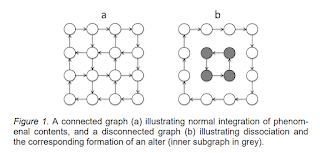
“Ordinary phenomenal activity in cosmic consciousness can thus be modelled as a connected directed graph. See Figure 1a. Each vertex in the graph represents a particular phenomenal content and each edge a cognitive association logically linking contents together.”
And here is the figure: 


Hence, in contrast to what Kastrup accused me of, the reason I didn’t want to talk to him was not that I hadn’t read what he wrote, but that I had read it.

The fourth and final reason that I didn’t want to talk to him is that I get a lot of podcast request, and I don’t reply to most of them simply because I don’t have the time.

I consulted on this matter with some friends and collaborators, and after that decided that I’d talk to Kastrup anyway. Mostly because I quite like Curt Jaimugal who offered to host the discussion and who I’d spoken with before. He’s a smart young man and if you take away nothing else from this blogpost, then at least go check out his YouTube channel which is well worth some of your time. Also, I thought that weeding out Kastrup’s understandings might help other people, too.

A week later, the only good thing I can report about my conversation with Kastrup is that he didn’t bring up free will, which I think is progress. Unfortunately, he didn’t seem to know much about superdeterminism even after having had time to prepare. He eventually ran out of things to say and then accused me of being “combative” after clearly being surprised to hear that an interaction with a single photon isn’t a measurement. Srsly. Go listen to it.

Instead of concluding that he’s out of his depth, he then wrote another blogpost in which he accused me of “misleading, hollow, but self-confident, assertive rhetoric”, claimed that “Sabine has a big mouth and seems to be willing to almost flat-out lie in order to NOT look bad when confronted on a point she doesn’t have a good counter for.” And, “Her rhetorical assertiveness is, at least sometimes, a facade that hides a surprising lack of actual substance.”

Keep in mind that this is a person who claimed to “model” the “phenomenal activity in cosmic consciousness” with 16 circles. Speak of lack of substance.

Lesson learned: I was clearly too optimistic about the possibility of rational discourse, and don’t think it makes sense to further communicate with this person.

Having said that, I gather that some people who watched the exchange were genuinely interested in the details, so I want to add some explanations that didn’t come across as clearly as I hoped they would.

First of all, the reason I am interested in superdeterminism has nothing whatsoever to do with physicalism or realism (I don’t know what these words mean to begin with). It’s simply that the collapse postulate in quantum mechanics isn’t compatible with general relativity because it isn’t local. That’s a well-defined mathematical problem and solving such problems is what I do for a living.

Note that simply declaring that the collapse isn’t a physical process doesn’t explain what happens and hence doesn’t solve the problem. We need to have some answer for what happens with the expectation value of the stress-energy-tensor during a measurement. I’m an instrumentalist; I am looking for a mathematical prescription that reproduces observations, one of which is that the outcome of a measurement is a detector eigenstate.

The obvious solution to this problem is that the measurement process which we have in quantum mechanics is an effective, statistical description of an underlying local process in a hidden variables theory. We know from Bell’s theorem (or its observed violations, respectively) that if a local theory underlies quantum mechanics then it has to violate statistical independence. That’s what is commonly called “superdeterminism”. In such theories the wave-function is an average description, hence not “real” or “physical” in any meaningful way.

So: Why am I interested in superdeterminism? Because general relativity is local. It is beyond me why pretty much everybody else wants to hold onto an assumption as problematic and unjustified as statistical independence, and is instead willing to throw out locality, but that’s the situation.

Now, the variables in this yet-to-be-found underlying theory are only “hidden” in so far as that they don’t appear in quantum mechanics; they may well be observable with suitable experiments. This brings up the question what a suitable experiment would be.

It is clear that Bell-type tests are not the right experiments, because superdeterministic theories violate Bell inequalities just like quantum mechanics. In fact, superdeterministic theories, since they reproduce quantum mechanics when averaged over the hidden variables, will give the same inequality violations and obey the same bounds as quantum mechanics. (Some people seem to find this hard to understand and try to impress me by quoting other inequalities than Bell’s. You can check for yourself that all those inequalities assume statistical independence, so they cannot be used to test superdeterminism.)

This is why, in 2011, I wrote a paper in which I propose a mostly model-independent test for hidden variables that relies on repeated measurements on non-commuting variables. I later learned from Chris Fuchs (see note at end of paper) that von Neumann made a similar proposal 50 years ago, but the experiment was never done. It still hasn’t been done.

A key point of the 2011 paper was that one does not need to make specific assumptions about the hidden variables. One reason I did this is that Bell’s theorem works the same way: you don’t need to know just what the hidden variables are, you just need to make some assumptions about their properties.

Another reason is, as I have explained in my book “Lost in Math”, that math alone isn’t sufficient to develop a new theory. We need data to develop the underlying hidden variables theory. Without that, we can only guess models and the chance that any one of them is correct is basically zero. 

This is why I did not want to develop a model for the hidden variables – it would be a waste of time. It didn’t work for phenomenology beyond the standard model and it won’t work here either. Instead, we have to identify the experimental range where evidence could be found, collect the data, and then develop the model.

Unfortunately and, in hindsight, unsurprisingly, the 2011 paper didn’t go anywhere. I think it’s just too far off the current mode of thinking in physics, which is all about guessing models and then showing that those guesses are wrong, a methodology that works incredibly badly. Nevertheless, I have since spent some time on developing a hidden variables model, but it’s going slowly, partly because I think it’s a waste of time (see above), but also because I am merely one person working four jobs while raising two kids and my day only has 24 hours.

However, in contrast to what Kastrup accuses me of, I have repeatedly and clearly stated that we do not have a satisfactory superdeterministic hidden variables model at the moment. I say this in pretty much all of my talks, it’s explicitly stated in my paper with Tim (“These approaches [...] leave open many questions and it might well turn out that none of them is the right answer.”). I also said this in my conversation with Kastrup. 

But I want to stress that the reason I (and quite possibly others too) didn’t write down a particular hidden variables model is not that it can’t be done, but that there are too many ways it could be done.

Next thing he got confused about is that two years ago, Sandro an I cooked up a superdeterministic toy model. The point of this model was not to say that it should be experimentally tested. We merely put this forward to demonstrate once and for all that superdeterministic models do not require “finetuning” or any “conspiracies”.

The toy model reproduces quantum mechanics exactly, but – in contrast to quantum mechanics – it’s local and deterministic, on the expense of violating statistical independence. Since it reproduces quantum mechanics it’s as falsifiable as quantum mechanics, hence the claim that superdeterminism somehow ruins science is arguably wrong. 

But besides this, it is a rather pointless and ad hoc toy model that I don’t think makes a lot of sense for a number of reasons (which are stated in the paper). Still, it demonstrates that of course if you want to then can define your hidden variables somehow. I should also mention that our model is certainly not the first superdeterministic hidden variables model. (See references in paper.)

There are a lot of toy models in quantum foundations like this with the purpose of shedding light on one particular assumption or another, and my model falls in this tradition. I could easily modify this model so that it would make predictions that deviate from quantum mechanics, so that one could experimentally test it. But the predictions would be wrong, so why would I do this.

Having said that, my thinking about superdeterminism has somewhat changed since 2011. I was at the time thinking about the hidden variables the way that they are usually portrayed as some kind of extra information that resides within particles. I have since become convinced that this doesn’t work, and that the hidden variables are instead the degrees of freedom of the detector. If that is so, then we do know what the hidden variables are, and we can estimate how likely they are to change. Hence, it becomes easier to test the consequences.

This is why in my later papers and in my more recent talks I mention a simpler type of experiment that works for this case – when the hidden variables are the details of the detector – specifically. I have to stress though that there are other models of superdeterminism which work differently and that can’t be tested this way.

Just what the evolution law looks like I still don’t know. I think it can’t be done with a differential equation, which is why I have been looking at path integrals. I wrote a paper about this with Sandro recently in which we propose new path-integral formalism that can incorporate the required type of evolution law. (It was just accepted for publication the other day.)

What we do in the paper is to define the formalism and show that it can reproduce quantum mechanics exactly – a finding I think is interesting in and by itself. As Kastrup said entirely correctly, there are no hidden variables in that paper. I don’t know why he thought there would be. The paper is just not about hidden variables theories. 

I have a number of ideas of how to include the detector degrees of freedom as hidden variables into the path integral. But again the problem isn’t that it can’t be done, but that there are too many ways it can be done. And in none of the ways I have tried can you still calculate something with the integral. So this didn’t really go anywhere – at least so far. It doesn’t help that I have no funding for this research.

I still think the best way forward would be to just experimentally push into this region of parameter space (small, cold system with quick repeated measurements on simple states) and see if any deviations from quantum mechanics can be found. However, if anyone reading is interested in helping with the path integral, please shoot me a note because I have a lot more to say than what’s in our papers.

Finally, I have given a number of seminars about superdeterminism, at least one of which is on YouTube here. I also some months ago did a discussion with Matt Leifer which is here. Leifer, I would say, is one of the leading people in the foundations of quantum mechanics at the moment. I may have some disagreements with him but he knows his stuff. You will learn more from him than from Kastrup.

In case you jumped over some of the more cumbersome paragraphs above, here is the brief summary. You can either go off the deep end and join people like Kastrup who complain about “physicalism”, claim that photons are observers, detectors can both click and not click at the same time, and other bizarre consequences you have to accept if you insist that quantum mechanics is fundamental. 

Or you conclude, like I have, that quantum mechanics is not a fundamental theory. In this case we just need to find the right experiment get a handle on the underlying physics. 

Saturday, January 15, 2022

Are warp drives science now?

[This is a transcript of the video embedded below. Some of the explanations may not make sense without the animations in the video.]


Warp drives are not just science fiction. Einstein’s theory of general relativity says they should be possible. Yes, that guy again!

A year ago I told you about some recent developments, and since then warp drives have been in the news several times. In one case the headlines claimed that a physicist had found a warp drive that makes faster than light travel possible without requiring unphysical negative energies. In another case you could read that a “warp drive pioneer” had discovered an “actual, real world warp-bubble”. Seriously? What does that mean? That’s what we’ll talk about today.

First things first, what’s a warp drive. A warp drive is a new method of travel. It brings you from one place to another not by moving you through space, but by deforming space around you. Alright. Easy enough. Just one thing. How do you do that?

Well, Einstein taught us that you can deform space with energy, so you surround yourself with a bubble of energy, which contracts the space before you and expands it behind you. As a result, the places where you want to go move closer to you. So you’re traveling, even though you didn’t move. Okay. But what’s that bubble of energy made of and where do you get it from? Yes, indeed, good question. That’s why no one has ever built an actual warp drive.

As I explained in my previous video, warp drives are solutions to Einstein’s equations of general relativity. So they are mathematically possible. But that a warp drive is a solution of general relativity does not mean it makes physical sense.

What Einstein’s equations tell you is just that a certain distribution of energy and mass goes along with a certain curved space-time. If you put in a distribution of energy and mass, you get out the curved space-time this would create. If you put in a curved space-time you get out the distribution of energy of mass that you would need to create it. There will always be some energy distribution for which your curved space-time is a solution. But in general those distributions of energy and mass are not physically possible.

There are three different types of weird stuff which we have never seen that can become necessary for warp drives. There is (a) stuff that has negative energy density, (b) stuff that has a weird gravitational behavior which can seem repulsive (c) stuff that moves faster than the speed of light.

The worst type of weird stuff is that with the negative energy density, not only because we’ve never seen that but also because it would make the vacuum unstable. If negative energies existed, one could make pairs of negative and positive energy particles out of nothing, in infinite numbers, which destroys literally everything. So if negative energy existed we wouldn’t exist. We’ll mark that with a red thumb down.

The repulsive stuff isn’t quite as bad. Indeed, physicists have a few theories for such repulsive stuff, though there is no evidence they actually exist. There is for example the hypothetical “inflaton field” which allegedly rapidly expanded our universe just after the big bang. This inflaton field, or rather its potential, can act gravitationally repulsive. And dark energy is also repulsive stuff, if it is stuff. And if it exists. Which it may not. But well, you could say, at least that stuff doesn’t destroy the universe so we’ll mark that with an orange thumb down.

Finally, superluminal stuff, so stuff that moves faster than light. This isn’t all that problematic other than that we’ve never seen it, so we’ll give it a yellow thumb down. It’s just that if you need stuff that moves faster than light to move stuff faster than light then that isn’t super useful.

Now that we have color coded problematic types of energy which makes us look super organized, let us look at whether warp drives require them. The best known warp drive solution dates back to 1994 and is named the “Alcubiere drive” after the physicist Miguel Alcubierre. The Alcubierre drive requires all of the above, negative energies, repulsive gravity, and superluminal stuff. That’s not particularly encouraging.

Now the big headlines that you saw in March last year were triggered by a press release from the University of Göttingen about the publication of a paper by Erik Lentz. Lentz claimed to have found a new solution for warp drives that does not require negative energies.

The paper was published in the journal Classical and Quantum Gravity, which is a specialized high quality journal. I have published quite a few papers there myself. I mention this because I have seen a few people tried to criticize Lentz’ paper by discrediting the journal. This is not a good argument, it’s a fine journal. However, this doesn’t mean the paper is right.

Lentz claims both in his paper and the press release that he avoided unphysical stuff by stitching together solutions that, to make a long story short, have fewer symmetries than the warp drives that were previously considered. He does not explain why or how this prevents negative energies.

Just one month later, in April 2021, another paper came out, this one by Shaun Fell and Lavinia Heisenberg. They made a similar claim like Lentz, namely that they’d found a warp drive solution that doesn’t require unphysical stuff by using a configuration that has fewer symmetries than the previously considered ones. The Fell and Heisenberg paper got published in the same journal and is mathematically more rigorous than Lentz’. But it didn’t come with a press release and didn’t make headlines.

Now, those new warp drive solutions, from Lentz and Fell and Heisenberg are in the same general class as the Alcubierre drive, which is called the Natario class, named after Jose Natario. In May last year, a third warp drive paper appeared, this one by Santiago, Schuster, and Visser. The authors claim to have proved that all warp drives in the Natario class require negative energies and are therefore not physical. So that means, the new solutions are all bad, bad, and bad.

Why the disagreement? Why do those people say it’s possible, and those prove it’s impossible. Well, in their paper, Santiago and coauthors point out that the other authors omitted a necessary check on their derivation. After that, Fell and Heisenberg revised their paper and now agree that their warp drive require negative energies after all. Lentz also revised his paper but still claims that he doesn’t need negative energies. It’s unclear at the moment how he wants to escape the argument in the Santiago paper.

Now, the Santiago paper has not yet gotten published in a journal. I’ve read it and it looks good to me but in all honesty I didn’t check the calculation. If this result holds up, you may think it’s bad news because they’ve ruled out an entire class of warp drives. But I think it’s good news because their proof tells us why those solutions don’t work.

Just to give you the brief summary, they show that these solutions require that the integral over the energy density is zero. This means if it’s non-zero anywhere, it has to be negative somewhere. If they’re correct, this would tell us we should look for solutions which don’t have this constraint.

Okay, so the situation with the new solution from Lentz isn’t entirely settled, but if the proof from the Santiago paper is right then Lentz’ solution also has a negative energy problem. The Santiago paper by the way does not apply to the more general class of warp drives from Bobrick and Martire, which I talked about in my earlier video. The issue with those more general warp drives is that they’re somewhat unspecific. They just say we need several regions with certain properties, but one doesn’t really know how to do that.

Those general warp drives can be divided into those that move faster than light and those that move slower than light. The ones that move faster than light still require stuff that moves faster than light, so they’re still problematic. The ones that stay below the speed of light however don’t seem to have any obvious physical problem. You might find it somewhat disappointing that a warp drive stays below the speed of light and I can see that. But look at it this way: if we could at least travel with nearly the speed of light that would already be great progress.

So the claim that Lentz found a warp drive solution which allows faster than light travel without negative energies is highly questionable. But what’s with the headlines that said someone had actually built a warp drive? Well that turns out to be just bad science communication.

In July last year, a paper was published by a group with the lead author Harold White. They had done a computer simulation of certain nanostructures. And in that simulation they found a distribution of energies similar to that of the Alcubierre drive. This can happen because on very short distances the Casimir effect can give rise to energy densities that are effectively negative. So, not only did they not actually build the thing, it was a computer simulation, it’s also an in-medium effect. It’s kind of like a simulation of a simulation and definitely not an “actual” warp drive.

Where does this leave us? The big picture is that warp drives are getting some serious attention from researchers who work on general relativity. I think this is a good development. We certainly have a long way to go, but as they say, every journey begins with a first step. I think warp drives are a possibility that’s worth investigating. If you want to work on warp drives yourself, check out Gianni Martire’s website, because he is offering research grants and tells me he has to get rid of the money fast.

Having said that, I think those people all miss the point. If you want to have a propulsion mechanism the relevant question isn’t whether there is some energy distribution that can move an object. The question is how efficiently can you convert the energy into motion. You want to know what it takes to accelerate something. At present those papers basically say if you throw out stuff that way, then the space-ship will go that way because momentum is conserved. And that is probably correct, but it’s not exactly a new idea.

Saturday, March 20, 2021

Whatever happened to Life on Venus?

[This is a transcript of the video embedded below.]


A few months ago, the headlines screamed that scientists had found signs of life on Venus. But it didn’t take long for other scientists to raise objections. So, just exactly what did they find on Venus? Did they actually find it? And what does it all mean? That’s what we will talk about today.

The discovery that made headlines a few months ago was that an international group of researchers said they’d found traces of a molecule called phosphine in the atmosphere of Venus.

Phosphine is a molecule made of one phosphorus and three hydrogen atoms. On planets like Jupiter and Saturn, pressure and temperature are so high that phosphine can form by coincidental chemical reactions, and indeed phosphine has been observed in the atmosphere of these two planets. On planets like Venus, however, the pressure isn’t remotely large enough to produce phosphine this way.

And the only other known processes to create phosphine are biological. On Earth, for example, which in size and distance to the Sun isn’t all that different to Venus, the only natural production processes for phosphine are certain types of microbes. Lest you think this means that phosphine is somehow “good for life”, I should add that the microbes in question live without oxygen. Indeed, phosphine is toxic for forms of life that use oxygen, which is most of life on earth. In fact, phosphine is used in the agricultural industry to kill rodents and insects.

So, the production of phosphine on Venus at fairly low atmospheric pressure seems to require life in some sense, which is why the claim that there’s phosphine on Venus is BIG. It could mean there’s microbial life on Venus. And just in case microbial life doesn’t excite you all that much, this would be super-interesting because it would give us a clue to what the chances are that life evolves on other planets in general.

So, just exactly what did they find?

The suspicion that phosphine might be present on Venus isn’t entirely new. The researchers first saw something that could be phosphine in two-thousand and seventeen in data from the James Clerk Maxwell Telescope, which is a radio telescope in Hawaii. However, this signal was not particularly good, so they didn’t publish it. Instead they waited for more data from the ALMA telescope in Chile. Then they published a combined analysis of the data from both telescopes in Nature Astronomy.

Here’s what they did. One can look for evidence of molecules by exploiting that each molecule reacts to light at different wave-lengths. To some wave-lengths, a molecule may not react at all, but others it may absorb because they cause the molecule to vibrate or rotate around itself. It’s like each molecule has very specific resonance frequencies, like if you’re in an airplane and the engine’s being turned up and then, at a certain pitch the whole plane shakes? That’s a resonance. For the plane it happens at certain wavelengths of sound. For molecules it happens at certain wave-lengths of light.

So, if light passes through a gas, like the atmosphere of Venus, then just how much light at each wave-length passes through depends on what molecules are in the gas. Each molecule has a very specific signature, and that makes the identification possible.

At least in principle. In practice… it’s difficult. That’s because different molecules can have very similar absorption lines.

For example, the phosphine absorption line which all the debate is about has a frequency of two-hundred sixty-six point nine four four Gigahertz. But sulfur dioxide has an absorption line at two-hundred sixty-six point nine four three GigaHertz, and sulfur dioxide is really common in the atmosphere of Venus. That makes it quite a challenge to find traces of phosphine.

But challenges are there to be met. The astrophysicists estimated the contribution from Sulphur dioxide from other lines which this molecule should also produce.

They found that these other lines were almost invisible. So they concluded that the absorption in the frequency range of interest had to be mostly due to phosphine and they estimated the amount with about seven to twenty parts per billion, so that’s seven to twenty molecules of phosphine per billion molecules of anything.

It’s this discovery which made the big headlines. The results they got for the phosphine amount from the two different telescopes are a little different, and such an inconsistency is somewhat of a red flag. But then, these measurements were made some years apart and the atmosphere of Venus could have undergone changes in that period, so it’s not necessarily a problem.

Unfortunately, after publishing their analysis, the team learned that the data from ALMA had not been processed correctly. It was not their fault, but it meant they had to redo their analysis. With the corrected data, the amount of phosphine they claimed to see fell to something between 1 and 4 parts per billion. Less, but still there.

Of course such an important finding attracted a lot of attention, and it didn’t take long for other researchers to have a close look at the analysis. It was not only that finding phosphine was surprising, not finding sulphur dioxide was not normal either; it had been detected many times in the atmosphere of Venus in amounts about 10 times higher than what the phosphine-discovery study claimed it was.

Already in October last year, a paper came out that argued there’s no signal at all in the data, and that said the original study used an overly complicated twelve parameter fit that fooled them into seeing something where there was nothing. This criticism has since been published in a peer reviewed journal. And by the end of January another team put out two papers in which they pointed out several other problems with the original analysis.

First they used a model of the atmosphere of Venus and calculated that the alleged phosphine absorption comes from altitudes higher than eighty kilometers. Problem is, at such a high altitude, phosphine is incredibly unstable because ultraviolet light from the sun breaks it apart quickly. They estimated it would have a lifetime of under one second! This means for phosphine to be present on Venus in the observed amounts, it would’ve to be produced at a rate higher than the production of oxygen by photosynthesis on Earth. You’d need a lot of bacteria to get that done.

Second, they claim that the ALMA telescope should not have been able to see the signal at all, or at least a much smaller signal, because of an effect called line dilution. Line dilution can occur if one has a telescope with many separate dishes like ALMA. A signal that’s smeared out over many of the dishes, like the signal from the atmosphere of Venus, can then be affected by interference effects.

According to estimates in the new paper, line dilution should suppress the signal in the ALMA telescope by about a factor 10-20, in which case it would not be visible at all. And indeed they claim that no signal is entirely consistent with the data from the second telescope. This criticism, too, has now passed peer review.

What does it mean?

Well, the authors of the original study might reply to this criticism, and so it will probably take some time until the dust settles. But even if the criticism is correct, this would not mean there’s no phosphine on Venus. As they say, absence of evidence is not evidence of absence. If the criticism is correct, then the observations, exactly because they probe only high altitudes where phosphine is unstable, can neither exclude, nor confirm, the presence of phosphine on Venus. And so, the summary is, as so often in science: More work is needed.

Saturday, March 06, 2021

Do Complex Numbers Exist?

[This is a transcript of the video embedded below.]

When the world seems particularly crazy, I like looking into niche-controversies. A case where the nerds argue passionately over something that no one knew was controversial in the first place. In this video, I want to pick up one of these super-niche nerd fights: Are complex numbers necessary to describe the world as we observe it? Do they exist? Or are they just a mathematical convenience? That’s what we’ll talk about today.

So the recent controversy broke out when a paper appeared on the preprint server with the title “Quantum physics needs complex numbers”. The paper contains a proof for the claim in the title, in response to an earlier claim that one can do without the complex numbers.

What happened next is that the computer scientist Scott Aaronson wrote a blogpost in which he called the paper “striking”. But the responses were, well, not very enthusiastic. They ranged from “why fuss about it” to “bullshit” to “it’s missing the point.”

We’ll look at the paper in a moment, but first I will briefly summarize what we’re even talking about, so that no one’s left behind.

The Math of Complex Numbers

You probably remember from school that complex numbers are what you need to solve equations like x squared equals minus 1. You can’t solve that equation with the real numbers that we are used to. Real numbers are numbers that can have infinitely many digits after the decimal point, like square root of 2 and π, but they also include integers and fractions and so on. You can’t solve this equation with real numbers because they’ll always square to a positive number. If you want to solve equations like this, you therefore introduce a new number, usually denoted “i” with the property that it squares to -1.

Interestingly enough, just giving a name to the solution of this one equation and adding it to the set of real numbers turns out to be sufficient to make all algebraic equations solvable. Doesn’t matter how long or how complicated the equation, you can always write all their solutions as a+ib, where a and b are real numbers. 

Fun fact: This doesn’t work for numbers that have infinitely many digits before the point. Yes, that’s a thing, they’re called p-adic numbers. Maybe we’ll talk about this some other time.

Complex numbers are now all numbers of the type a plus I time b, where a and b are real numbers. “a” is called the “real” part, and “b” the “imaginary” part of the complex number. Complex numbers are frequently drawn in a plane, called the complex plane, where the horizontal axis is the real part and the vertical axis is the imaginary part. i itself is by convention in the upper half of the complex plane. But this looks the same as if you draw a map on a grid and name each point with two real numbers. Doesn’t this mean that the complex numbers are just a two-dimensional real vector space?

No, they’re not. And that’s because complex numbers multiply by a particular rule that you can work out by taking into account that the square of i is minus 1. Two complex numbers can be added like they were vectors, but the multiplication law makes them different. Complex number are, to use the mathematical term, a “field”, like the real numbers. They have a rule both for addition AND for multiplication. They are not just like that two-dimensional grid.

The Physics of Complex Numbers

We use complex numbers in physics all the time because they’re extremely useful. There useful for many reasons, but the major reason is this. If you take any real number, let’s call it α, multiply it with I, and put it into an exponential function, you get exp(Iα). In the complex plane, this number, exp(Iα), always lies on a circle of radius one around zero. And if you increase α, you’ll go around that circle. Now, if you look only at the real or only at the imaginary part of that circular motion, you’ll get an oscillation. And indeed, this exponential function is a sum of a cosine and I times a sine function.

Here’s the thing. If you multiply two of these complex exponentials say, one with α and one with β, you can just add the exponents. But if you multiply two cosines or a sine with a cosine… that’s a mess. You don’t want to do that. That’s why, in physics, we do the calculation with the complex numbers, and then, at the very end, we take either the real or the imaginary part. Especially when we describe electromagnetic radiation, we have to deal with a lot of oscillations, and complex numbers come in very handy.

But we don’t have to use them. In most cases we could do the calculation with only real numbers. It’s just cumbersome. With the exception of quantum mechanics, to which we’ll get in a moment, the complex numbers are not necessary.

And, as I have explained in an earlier video, it’s only if a mathematical structure is actually necessary to describe observations that we can say they “exist” in a scientifically meaningful way. For the complex numbers in non-quantum physics that’s not the case. They’re not necessary.

So, as long as you ignore quantum mechanics, you can think of complex numbers as a mathematical tool, and you have no reason to think they physically exist. Let’s then talk about quantum mechanics.

Complex Numbers in Quantum Mechanics

In quantum mechanics, we work with wave-function, usually denoted Ψ, which are complex valued, and the equation that tells us what the wave-function does is the Schrödinger equation. It looks like this. You’ll see immediately, there’s an “i” in this equation, which is why the wave-function has to be complex valued.

However, you can of course take the wave-function and this equation apart into a real and an imaginary part. Indeed, one often does that, if one solves the equation numerically. And I remind you, that both the real and the imaginary part of a complex number are real numbers. Now, if we calculate a prediction for a measurement outcome in quantum mechanics, then that measurement outcome will also always be a real number. So, it looks like you can get rid of the complex numbers in quantum mechanics, by splitting the equation into a real and imaginary part, and that’ll never make a difference for the result of the calculation.

This finally brings us to the paper I mentioned in the beginning. What I just said about decomposing the Schrödinger equation is of course correct, but that’s not what they looked at in the paper, that would be rather lame.

Instead they ask what happens with the wave-function if you have a system that is composed of several parts, in the simplest case that would be several particles. In normal quantum mechanics, each of these particles has a wave-function that’s complex-valued, and from these we construct a wave-function for all the particles together, which is also complex-valued. Just what this wave-function looks like depends on which particle is entangled with which. If two particles are entangled, this means their properties are correlated, and we know experimentally that this entanglement-correlation is stronger than what you can do without quantum theory.

The question which they look at in the new paper is then whether there are ways to entangle particles in the normal, complex quantum mechanics that you cannot build up from particles that are described entirely by real valued functions. Previous calculation showed that this could always be done if the particles came from a single source. But in the new paper they look at particles from two independent sources, and claim that there are cases which you cannot reproduce with real numbers only. They also propose a way to experimentally measure this specific entanglement.

I have to warn you that this paper has not yet been peer reviewed, so maybe someone finds a flaw in their proof. But assuming their result holds up, this means if the experiment which they propose finds the specific entanglement predicted by complex quantum mechanics, then you know you can’t describe observations with real numbers. It would then be fair to say that complex numbers exist. So, this is why it’s cool. They’ve figured out a way to experimentally test if complex numbers exist!

Well, kind of. Here is the fineprint: This conclusion only applies if you want the purely real-valued theory to work the same way as normal quantum mechanics. If you are willing to alter quantum mechanics, so that it becomes even more non-local than it already is, then you can still create the necessary entanglement with real valued numbers.

Why is it controversial? Well, if you belong to the shut-up and calculate camp, then this finding is entirely irrelevant. Because there’s nothing wrong with complex numbers in the first place. So that’s why you have half of the people saying “what’s the point” or “why all the fuss about it”. If you, on the other hand, are in the camp of people who think there’s something wrong with quantum mechanics because it uses complex numbers that we can never measure, then you are now caught between a rock and a hard place. Either embrace complex numbers, or accept that nature is even more non-local than quantum mechanics.

Or, of course, it might be that that the experiment will not agree with the predictions of quantum mechanics, which would be the most exciting of all possible outcomes. Either way, I am sure that this is a topic we will hear about again.

Saturday, February 27, 2021

Schrödinger’s Cat – Still Not Dead

[This is a transcript of the video embedded below.]


The internet, as we all know, was invented so we can spend our days watching cat videos, which is why this video is about the most famous of all science cats, Schrödinger’s cat. It is really both dead and alive? If so, what does that mean? And what has recent research to say about it? That’s what we’ll talk about today.

Quantum mechanics has struck physicists as weird ever since its discovery, more than a century ago. One especially peculiar aspect of quantum mechanics is that it forces you to accept the existence of superpositions. That are systems which can be in two states at the same time, until you make a measurement, which suddenly “collapses” the superposition into one definite measurement outcome.

The system here could be a single particle, like a photon, but it could also be a big object made of many particles. The thing is that in quantum mechanics, if two states exist separately, like an object being here and being there, then the superposition – that is the same object both here and there – must also exist. We know this experimentally, and I explained the mathematics behind this in an earlier video.

Now, you may think that being in a quantum superposition is something that only tiny particles can do. But these superpositions for large objects can’t be easily ignored, because you can take the tiny ones and amplify them to macroscopic size.

This amplification is what Erwin Schrödinger wanted to illustrate with a hypothetical experiment he came up with in 1935. In this experiment, a cat is in a box, together with a vial of poison, a trigger mechanism, and a radioactive atom. The nucleus of the atom has a fifty percent chance of decaying in a certain amount of time. If it decays, the trigger breaks the vial of poison, which kills the cat.

But the decay follows the laws of quantum physics. Before you measure it, the nucleus is both decayed and not decayed, and so, it seems that before one opens the box, the cat is both dead and alive. Or is it?

Well, depends on your interpretation of quantum mechanics, that is, what you think the mathematics means. In the most widely taught interpretation, the Copenhagen interpretation, the question what state the cat is in before you measure it is just meaningless. You’re not supposed to ask. The same is the case in all interpretations according to which quantum mechanics is a theory about the knowledge we have about a system, and not about the system itself.

In the many-worlds interpretation, in contrast, each possible measurement outcome happens in a separate universe. So, there’s a universe where the cat lives and one where the cat dies. When someone opens the box, that decides which universe they’re in. But for what observations are concerned, the result is exactly the same as in the Copenhagen interpretation.

Pilot wave-theory, which we talked about earlier, says that the cat is really always in only one state, you just don’t know which one it is until you look. The same is the case for spontaneous collapse models. In these models, the collapse of the wave-function is not merely an update when you open the box, but it’s a physical process.

It’s no secret that I myself am signed up to superdeterminism, which means that the measurement outcome is partly determined by the measurement settings. In this case, the cat may start out in a superposition, but by the time you measure it, it has reached the state which you actually observe. So, there is no sudden collapse in superdeterminism, it’s a smooth, deterministic, and local process.

Now, one cannot experimentally tell apart interpretations of mathematics, but collapse models, superdeterminism, and, under certain circumstances, pilot wave theory, make different predictions than Copenhagen or many worlds. So, clearly, one wants to do the experiment!

But. As you have undoubtedly noticed, cats are usually either dead or alive, not both. The reason is that even tiny interactions with a quantum system have the same effect as a measurement, and large objects, like cats, just constantly interact with something, like air or the cosmic background radiation. And that’s already sufficient to destroy a quantum superposition of a cat so quickly we’d never observe it. But physicists are trying to push the experimental boundary for bringing large objects into quantum states.

For example, in 2013, a team of physicists from the University of Calgary in Canada amplified a quantum superposition of a single photon. They first fired the photon at a partially silvered mirror, called a beam splitter, so that it became a superposition of two states: it passed through the mirror and also reflected back off it. Then they used one part of this superposition to trigger a laser pulse, which contains a whole lot of photons. Finally, they showed that the pulse was still in a superposition with the single photon. In another 2019 experiment, they amplified both parts of this superposition, and again they found that the quantum effects survived, for up to about 100 million photons.

Now, a group of 100 million photons not a cat, but it is bigger than your standard quantum particle. So, some headlines referred to this as the “Schrödinger's kitten” experiment.

But just in case you think a laser pulse is a poor approximation for a cat, how about this. In 2017, scientists at the University of Sheffield put bacteria in a cavity between two mirrors and they bounced light between the mirrors. The bacteria absorbed, emitted, and re-absorbed the light multiple times. The researchers could demonstrate that this way, some of the bacterias’ molecules became entangled with the cavity, so that is a special case of a quantum superposition.

However, a paper published the following year by scientists at Oxford University argued that the observations on the bacteria could also be explained without quantum effects. Now, this doesn’t mean that this is the correct explanation. Indeed, it doesn’t make much sense because we already know that molecules have quantum effects and they couple to light in certain quantum ways. However, this criticism demonstrates that it can be difficult to prove that something you observe is really a quantum effect, and the bacteria experiment isn’t quite there yet.

Let us then talk about a variant of Schrödinger’s cat that Eugene Wigner came up with in the nineteen-sixties. Imagine that this guy Wigner is outside the laboratory in which his friend just opens the box with the cat. In this case, not only would the cat be both dead and alive before the friend observes it, the friend would also both see a dead cat and see a live cat, until Wigner opens the door to the room where the experiment took place.

This sounds both completely nuts as well as an unnecessary complication, but bear with me for a moment, because this is a really important twist on Schrödinger’s cat experiment. Because if you think that the first measurement, so the friend observing the cat, actually resulted in a definite outcome, just that the friend outside the lab doesn’t know it, then, as long as the door is closed, you effectively have a deterministic hidden variable model for the second measurement. The result is clear already, you just don’t know what it is. But we know that deterministic hidden variable models cannot produce the results of quantum mechanics, unless they are also superdeterministic.

Now, again, of course, you can’t actually do the experiment with cats and friends and so on because their quantum effects would get destroyed too quickly to observe anything. But recently a team at Griffith University in Brisbane, Australia, created a version of this experiment with several devices that measure, or observe, pairs of photons. As anticipated, the measurement result agrees with the predictions of quantum mechanics.

What this means is that one of the following three assumptions must be wrong:

1. No Superdeterminism.
2. Measurements have definite outcomes.
3. No spooky action at a distance.

The absence of superdeterminism is sometimes called “Free choice” or “Free will”, but really it has nothing to do with free will. Needless to say, I think what’s wrong is rejecting superdeterminism. But I am afraid most physicists presently would rather throw out objective reality. Which one are you willing to give up? Let me know in the comments.

As of now, scientists remain hard at work trying to unravel the mysteries of Schrödinger's cat. For example, a promising line of investigation that’s still in its infancy is to measure the heat of a large system to determine whether quantum superpositions can influence its behavior. You find references to that as well as to the other papers that I mentioned in the info below the video. Schrödinger, by the way, didn’t have a cat, but a dog. His name was Burschie.

Wednesday, February 24, 2021

What's up with the Ozone Layer?

[This is a transcript of the video embedded below.]

Without the ozone layer, life, as we know it, would not exist. Scientists therefore closely monitor how the ozone layer is doing. In the past years, two new developments have attracted their attention and concern. What have they found and what does it mean? That’s what we’ll talk about today.
 

First things first, ozone is a molecule made of three oxygen atoms. It’s unstable, and on the surface of Earth it decays quickly, on the average within a day or so. For this reason, there’s very little ozone around us, and that’s good, because breathing in ozone is really unhealthy even in small doses.

But ozone is produced when sunlight hits the upper atmosphere, and accumulates far up there in a region called the “stratosphere”. This “ozone layer” then absorbs much of the sun’s ultraviolet light. The protection we get from the ozone layer is super-important, because the energy of ultraviolet light is high enough to break molecular bonds. Ultra-violet light, therefore, can damage cells or their genetic code. This means, with exposure to ultraviolet light, the risk of cancer and other mutations increases significantly. I have explained radiation risk in more detail in an earlier video, so check this out for more.

You have probably all heard of the ozone “hole” that was first discovered in the 1980s. This ozone hole is still with us today. It was caused by human emissions of ozone-depleting substances, notably chlorofluorocarbons – CFCs for short – that were used, among other things, in refrigerators and spray cans. CFCs have since been banned, but it will take at least several more decades for the ozone layer to completely recover. With that background knowledge, let’s now look at the two new developments.

What’s new?

The first news is that last year we have seen a large and pronounced ozone hole over the North Pole, in addition to the “usual” one over the South Pole. This has happened before, but it’s still an unusual event. That’s because the creation of an ozone hole is driven by supercooled droplets of water and nitric acid which are present in polar stratospheric clouds, so clouds that you find on the poles in the stratosphere. But these clouds can only form if it’s cold enough, and I mean really cold, below about −108 °F or −78 °C. Therefore, the major reason that ozone holes form more readily over the South pole than over the North Pole is quite simply that the South Pole is, on average, colder.

Why is the South Pole colder? Loosely speaking it’s because there are fewer high mountains in the Southern hemisphere than in the Northern hemisphere. And because of this, wind circulations around the South Pole tend to be more stable; they can lock in air, which then cools over the dark polar winter months. Air over the North Pole, in contrast, mixes more efficiently with warmer air from the mid latitudes.

On occasion, however, cold air gets locked in over the North Pole as well, which creates conditions similar to those at the South Pole. This is what happened in the Spring of 2020. For five weeks in March and early April, the North Pole saw the biggest arctic ozone hole on record, surrounded by a stable wind circulation called a polar vortex.

Now, we have all witnessed in the past decade that climate change alters wind patterns in the Northern Hemisphere, which gives rise to longer heat waves in the summer. This brings up the question whether climate change was one of the factors contributing to the northern ozone hole and whether we, therefore, must expect it to become a recurring event.

This question was studied in a recent paper by Martin Dameris and coauthors, for the full reference, please check the info below the video. Their conclusion is that, so far, observations of the northern ozone hole are consistent with it just being a coincidence. However, if coincidences pile upon coincidences, they make a trend. And so, researchers are now waiting to see whether the hole will return in the Spring of 2021 or in the coming years.

The second new development is that the ozone layer over the equator isn’t recovering as quickly as scientists expected. Indeed, above the equator, the amount of ozone in the lower parts of the stratosphere seems to be declining, though that trend is, for now, offset by the recovery of ozone in the upper parts of the stratosphere, which proceeds as anticipated.

The scientists who work on this previously considered various possible reasons, from data problems to illegal emissions of ozone-depleting substances. But the data have held up, and while we now know illegal emissions are indeed happening, these do not suffice to explain the observations.

Instead, further analysis indicates that the depletion of ozone in the lower stratosphere over the equator seems to be driven, again, by wind patterns. Earth’s ozone is itself created by sunlight, which is why most of it forms over the equator where sunlight is the most intensive. The ozone is then transported from the equatorial regions towards the poles by a wind cycle – called the “Brewer-Dobson circulation” – in which air rises over the equator and comes down again in mid to high latitude. With global warming, that circulation may become more intense, so that more ozone is redistributed from the equator to higher latitudes.

Again, though, the strength of this circulation also changes just by random chance. It’s therefore presently unclear whether the observations merely show a temporary fluctuation or are indicative of a trend. However, a recent analysis of different climate-chemistry models by Simone Dietmüller et al shows that human-caused carbon dioxide emissions contribute to the trend of less ozone over the equator and more ozone in the mid-latitudes, and the trend is therefore likely to continue. I have to warn you though that this paper has not yet passed peer review.

Before we talk about what this all means, I want to thank my tier four supporters on Patreon. Your help is greatly appreciated. And you, too, can help us produce videos by supporting us on Patreon. Now let’s talk about what these news from the ozone layer mean.

You may say, ah, so what. Tell the people in the tropics to put on more sun-lotion and those in Europe to take more vitamin D. This is a science channel, and I’ll not tell anyone what they should or shouldn’t worry about, that’s your personal business. But to help you gauge the present situation, let me tell you an interesting bit of history.

The Montreal protocol from 1987, which regulates the phasing out of ozone depleting substances, was passed quickly after the discovery of the first ozone hole. It is often praised as a milestone of environmental protection, the prime example that everyone points to for how to do it right. But I think the Montreal Protocol teaches us a very different lesson.

That’s because scientists knew already in the 1970s, long before the first ozone hole was discovered, that chlorofluorocarbons would deplete the ozone layer. But they thought the effect would be slow and global. When the ozone hole over the South Pole was discovered by the British Antarctic Survey in 1985, that came as a complete surprise.

Indeed, fun fact, it later turned out that American satellites had measured the ozone hole years before the British Survey did, but since the data were so far off the expected value, they were automatically overwritten by software.

The issue was that at the time the effects of polar stratospheric clouds on the ozone layer were poorly understood, and the real situation turned out to be far worse than scientists thought.

So, for me, the lesson from the Montreal Protocol is that we’d be fools to think that we now have all pieces in place to understand our planet’s climate system. We know we’re pushing the planet into regimes that scientists poorly understand and chances are that this will bring more unpleasant surprises.

So what do those changes in the ozone layer mean? They mean we have to pay close attention to what’s happening.

Saturday, February 20, 2021

The Science of Making Rain

[This is a transcript of the video embedded below]


Wouldn’t it be great if we could control the weather? I am sure people have thought about this ever since there’ve been people having thoughts. But what are scientists thinking about this today? In this video we’ll look at the best understood case of weather control, that’s making rain by seeding clouds. How is cloud seeding supposed to work? Does it work? And if it works, is it a good idea? That’s what we’ll talk about today.

First things first, what is cloud seeding? Cloud seeding is a method for increasing precipitation, which is a fancy word for water that falls off the sky in any form: rain, snow, hail and so on. One seeds a cloud by spraying small particles into it, which encourages the cloud to shed precipitation. At least that’s the idea. Cloud seeding does not actually create new clouds. It’s just a method to get water out of already existing clouds. So you can’t use it to turn a desert into a forest – the water needs to be in the air already.

Cloud seeding was discovered, as so many things, accidentally. In nineteen-fourty-six a man named Vincent Schaefer was studying clouds in a box in his laboratory, but it was too warm for his experiment to work. So he put dry ice into his cloud box, that’s carbon dioxide frozen at about minus eighty degrees Celsius. He then observed that small grains of dry ice would rapidly grow to the size of snowflakes.

Schaefer realized this happened because the water in the clouds was supercooled, that means below freezing point, but still liquid. This is an energetically unstable state. If one introduces tiny amounts of crystals into a supercooled cloud, the water droplets will attach to the crystals immediately and freeze, so the crystals grow quickly until they are heavy enough to fall down. Schaefer saw this happening when sprinkles of solid dry ice fell into his box. He had seeded the first cloud. In the following years he’d go on to test various methods of cloud seeding.

Today scientists distinguish two different ways of seeding clouds, either by growing ice crystals, as Schaefer did, that’s called Glaciogenic seeding. Or by growing water droplets, which is called hygroscopic seeding.

How does it work?

The method that Schaefer used is today more specifically called the “Glaciogenic static mode”, static because it doesn’t rely on circulation within the cloud. There’s also a Glaciogenic dynamic mode which works somewhat differently.

In the dynamic mode, one exploits that the conversion of the supercoooled water into ice releases heat, and that heat creates an updraft. This allows the seeds to reach more water droplets, so the cloud grows, and eventually more snow falls. One of the substances commonly used for this is silver iodide, though there are a number of different organic and inorganic substances that have proved to work.

For hygroscopic seeding one uses particles that can absorb water that serve as condensation seeds to turn water vapor into large drops that become rain. The substances used for this are typically some type of salt.

How do you do it?

Seeding clouds in a box in the laboratory is one thing, seeding a real cloud another thing entirely. To seed a real cloud, one either uses airplanes that spray the seeding particles directly into the cloud, or targets the cloud with a rocket which gives off the particles, or one uses a ground-based generator that releases the particles slowly mixed with hot air, that rises up into the atmosphere. They do this for example in Colorado, and other winter tourism areas, and claim that it can lead to several inches more snow.

But does it work?

It’s difficult to test if cloud seeding actually works. The issue is, as I said, seeding doesn’t actually create clouds, it just encourages clouds to release snow or rain at a particular time and place. But how do you know if it wouldn’t have rained anyway?

After Schaefer’s original work in the nineteen-fifties, the United States launched a research program on cloud seeding, and so did several other countries including the UK, Canada, India, and Australia. But evidence that cloud seeding works didn’t come by for a long time, and so, in the late nineteen-eighties, funding into this research area drastically declined. That didn’t deter people from trying to seed clouds though. Despite the absence of evidence quite a few winter sport areas used cloud seeding in an attempt to increase snow fall.

But beginning around the turn of the millennium, interest in cloud seeding was revived by several well-funded studies in the United States, Australia, Japan, and China, for just to name a few. Quite possibly this interest was driven by the increasing risk of drought due to climate change. And today, scientists have much better technology to figure out whether cloud seeding works, and so, the new studies could finally deliver evidence that it does work.

Some of the most convincing studies used radar measurements to detect ice crystals in clouds after a plane went through and distributed the seeds. This was done for example in a 2011 study in Australia and also in a 2018 study in the northern part of the United States.

These radar measurements are a direct signature of seeding, glaciogenic seeding in this case. The researchers can tell that the ice crystals are caused by the seeding because the crystals that appear in the radar signal replicate the trajectory of the seeding plane, downwind.

From the radar measurements they can also tell that the concentration of ice crystals is two to three orders of magnitude larger than those in neighboring, not-seeded areas. And, they know that the newly formed ice-crystals grow, because the amount of radar signal that’s reflected depends on the size of the particle.

This and similar studies also contained several cross checks. For example, they seeded some areas of the clouds with particles that are known to grow ice crystals and others with particles that aren’t expected to do that. And they detected ice formation only for the particles that act as seeds. They also checked that the resulting snowfall is really the one that came from the seeding. One can do this by analyzing the snow for traces of the substance used for seeding.

Besides this, there are also about a dozen studies that evaluated statistically if there changes in precipitation from the glaciogenic static seeding. These come from research programs in the United States, Australia, and Japan. To get statistics, they monitor the unseeded areas surrounding the seeded region as an estimation of the natural precipitation. It’s not a perfect method of course, but done often enough and for long enough periods, it gives a reasonable assessment for the increase of precipitation due to seeding.

These studies typically found an increase in precipitation around 15% and estimated the probability that this increase happened just coincidentally with 5%.

So, at least for the seeding of ice crystals, there is now pretty solid evidence that it works better than a rain dance. For the other types of seeding it’s still unclear whether it’s efficient.

Please check the information below the video for references to the papers.

The world’s biggest weather modification program is China’s. The Chinese government employs an estimated 35,000 people to this end already, and in December 2020 they announced they’ll increase investments into their weather modification program five-fold.

Now, as we have seen, cloud seeding isn’t terribly efficient and for it to work, the clouds have to be already there in the first place. Nevertheless, there’s an obvious worry here. If some countries can go and make clouds rain off over their territory, that might leave less water for neighboring countries.

And the bad news is, there aren’t currently any international laws regulating this. Most countries have regulations for what you are allowed to spray into the air or how much, but cloud seeding is mostly legal. There is an international convention, the Environmental Modification Convention, that seventy-eight states have signed, which prohibits “the military and hostile use of environmental modification techniques.” But this can’t in any clear way be applied to cloud seeding.

I think that now that we know cloud seeding does work, we should think about how to regulate it, before someone actually gets good at it. Controlling the weather is an ancient dream, but, thanks to Vincent Schaefer, maybe it won’t remain a dream forever. When he died in 1993, his obituary in the New York Times said “He was hailed as the first person to actually do something about the weather and not just talk about it”.

Saturday, November 21, 2020

Warp Drive News. Seriously!

[This is a transcript of the video embedded below.]

As many others, I became interested in physics by reading too much science fiction. Teleportation, levitation, wormholes, time-travel, warp drives, and all that, I thought was super-fascinating. But of course the depressing part of science fiction is that you know it’s not real. So, to some extent, I became a physicist to find out which science fiction technologies have a chance to one day become real technologies. Today I want to talk about warp drives because I think on the spectrum from fiction to science, warp drives are on the more scientific end. And just a few weeks ago, a new paper appeared about warp drives that puts the idea on a much more solid basis.


But first of all, what is a warp drive? In the science fiction literature, a warp drive is a technology that allows you to travel faster than the speed of light or “superluminally” by “warping” or deforming space-time. The idea is that by warping space-time, you can beat the speed of light barrier. This is not entirely crazy, for the following reason.

Einstein’s theory of general relativity says you cannot accelerate objects from below to above the speed of light because that would take an infinite amount of energy. However, this restriction applies to objects in space-time, not to space-time itself. Space-time can bend, expand, or warp at any speed. Indeed, physicists think that the universe expanded faster than the speed of light in its very early phase. General Relativity does not forbid this.

There are two points I want to highlight here: First, it is a really common misunderstanding, but Einstein’s theories of special and general relativity do NOT forbid faster-than-light motion. You can very well have objects in these theories that move faster than the speed of light. Neither does this faster-than light travel necessarily lead to causality paradoxes. I explained this in an earlier video. Instead, the problem is that, according to Einstein, you cannot accelerate from below to above the speed of light. So the problem is really crossing the speed of light barrier, not being above it.

The second point I want to emphasize is that the term “warp drive” refers to a propulsion system that relies on the warping of space-time, but just because you are using a warp drive does not mean you have to go faster than light. You can also have slower-than-light warp drives. I know that sounds somewhat disappointing, but I think it would be pretty cool to move around by warping spacetime at any speed.

Warp drives were a fairly vague idea until in 1994, Miguel Alcubierre found a way to make them work in General Relativity. His idea is now called the Alcubierre Drive. The explanation that you usually get for how the Alcubierre Drive works, is that you contract space-time in front of you and expand it behind you, which moves you forward.

That didn’t make sense to you? Just among us, it never made sense to me either. Because why would this allow you to break the speed of light barrier? Indeed, if you look at Alcubierre’s mathematics, it does not explain how this is supposed to work. Instead, his equations say that this warp drive requires large amounts of negative energy.

This is bad. It’s bad because, well, there isn’t any such thing as negative energy. And even if you had this negative energy that would not explain how you break the speed of light barrier. So how does it work? A few weeks ago, someone sent me a paper that beautifully sorts out the confusion surrounding warp drives.

To understand my problem with the Alcubierre Drive, I have to tell you briefly how General Relativity works. General Relativity works by solving Einstein’s field equations. Here they are. I know this looks somewhat intimidating, but the overall structure is fairly easy to understand. It helps if you try to ignore all these small Greek indices, because they really just say that there is an equation for each combination of directions in space-time. More important is that on the left side you have these R’s. The R’s quantify the curvature of space-time. And on the right side you have T. T is called the stress-energy tensor and it collects all kinds of energy densities and mass densities. That includes pressure and momentum flux and so on. Einstein’s equations then tell you that the distribution of different types of energy determines the curvature, and the curvature in return determines the how the distribution of the stress-energy changes.

The way you normally solve these equations is to use a distribution of energies and masses at some initial time. Then you can calculate what the curvature is at that initial time, and you can calculate how the energies and masses will move around and how the curvature changes with that.

So this is what physicists usually mean by a solution of General Relativity. It is a solution for a distribution of mass and energy.

But. You can instead just take any space-time, put it into the left side of Einstein’s equations, and then the equations will tell you what the distribution of mass and energy would have to be to create this space-time.

On a purely technical level, these space-times will then indeed be “solutions” to the equations for whatever is the stress energy tensor you get. The problem is that in this case, the energy distribution which is required to get a particular space-time is in general entirely unphysical.

And that’s the problem with the Alcubierre Drive. It is a solution to a General Relativity, but in and by itself, this is a completely meaningless statement. Any space-time will solve the equations of General Relativity, provided you assume that you have a suitable distribution of masses and energies to create it. The real question is therefore not whether a space-time solves Einstein’s equations, but whether the distribution of mass and energy required to make it a solution to the equations is physically reasonable.

And for the Alcubierre drive the answer is multiple no’s. First, as I already said, it requires negative energy. Second, it requires a huge amount of that. Third, the energy is not conserved. Instead, what you actually do when you write down the Alcubierre space-time, is that you just assume you have something that accelerates it beyond the speed of light barrier. That it’s beyond the barrier is why you need negative energies. And that it accelerates is why you need to feed energy into the system. Please check the info below the video for a technical comment about just what I mean by “energy conservation” here.

Let me then get to the new paper. The new paper is titled “Introducing Physical Warp Drives” and was written by Alexey Bobrick and Gianni Martire. I have to warn you that this paper has not yet been peer reviewed. But I have read it and I am pretty confident it will make it through peer review.

In this paper, Bobrick and Martire describe the geometry of a general warp-drive space time. The warp-drive geometry is basically a bubble. It has an inside region, which they call the “passenger area”. In the passenger area, space-time is flat, so there are no gravitational forces. Then the warp drive has a wall of some sort of material that surrounds the passenger area. And then it has an outside region. This outside region has the gravitational field of the warp-drive itself, but the gravitational field falls off and in the far distance one has normal, flat space-time. This is important so you can embed this solution into our actual universe.

What makes this fairly general construction a warp drive is that the passage of time inside of the passenger area can be different from that outside of it. That’s what you need if you have normal objects, like your warp drive passengers, and want to move them faster than the speed of light. You cannot break the speed of light barrier for the passengers themselves relative to space-time. So instead, you keep them moving normally in the bubble, but then you move the bubble itself superluminally.

As I explained earlier, the relevant question is then, what does the wall of the passenger area have to be made of? Is this a physically possible distribution of mass and energy? Bobrick and Martire explain that if you want superluminal motion, you need negative energy densities. If you want acceleration, you need to feed energy and momentum into the system. And the only reason the Alcubierre Drive moves faster than the speed of light is that one simply assumed it does. Suddenly it all makes sense!

I really like this new paper because to me it has really demystified warp drives. Now, you may find this somewhat of a downer because really it says that we still do not know how to accelerate to superluminal speeds. But I think this is a big step forward because now we have a much better mathematical basis to study warp drives.

For example, once you know how the warped space-time looks like, the question comes down to how much energy do you need to achieve a certain acceleration. Bobrick and Martire show that for the Alcubiere drive you can decrease the amount of energy by seating passengers next to each other instead of behind each other, because the amount of energy required depends on the shape of the bubble. The flatter it is in the direction of travel, the less energy you need. For other warp-drives, other geometries may work better. This is the kind of question you can really only address if you have the mathematics in place.

Another reason I find this exciting is that, while it may look now like you can’t do superluminal warp drives, this is only correct if General Relativity is correct. And maybe it is not. Astrophysicists have introduced dark matter and dark energy to explain what they observe, but it is also possible that General Relativity is ultimately not the correct theory for space-time. What does this mean for warp drives? We don’t know. But now we know we have the mathematics to study this question.

So, I think this is a really neat paper, but it also shows that research is a double-edged sword. Sometimes, if you look closer at a really exciting idea, it turns out to be not so exciting. And maybe you’d rather not have known. But I think the only way to make progress is to not be afraid of learning more. 

Note: This paper has not appeared yet. I will post a link here once I have a reference.


You can join the chat on this video on Saturday 11/21 at 12PM EST / 6PM CET or on Sunday 11/22 at 2PM EST / 8PM CET.

We will also have a chat on Black Hole Information loss on Tuesday 11/24 at 8PM EST / 2AM CET and on Wednesday 11/25 at 2PM EST / 8PM CET.

Friday, January 24, 2020

Do Black Holes Echo?

What happens with the event horizon of two black holes if they merge? Might gravitational waves emitted from such a merger tell us if Einstein’s theory of general relativity is wrong? Yes, they might. But it’s unlikely. In this video, I will explain why. In more detail, I will tell you about the possibility that a gravitational wave signal from a black hole merger has echoes.


But first, some context. We know that Einstein’s theory of general relativity is incomplete. We know that because it cannot handle quantum properties. To complete General Relativity, we need a theory of quantum gravity. But progress in theory development has been slow and experimental evidence for quantum gravity is hard to come by because quantum fluctuations of space-time are so damn tiny. In my previous video I told you about the most promising ways of testing quantum gravity. Today I want to tell you about testing quantum gravity with black hole horizons in particular.

The effects of quantum gravity become large when space and time are strongly curved. This is the case towards the center of a black hole, but it is not the case at the horizon of a black hole. Most people get this wrong, so let me repeat this. The curvature of space is not strong at the horizon of a black hole. It can, in fact, be arbitrarily weak. That’s because the curvature at the horizon is inversely proportional to the square of the black hole’s mass. This means the larger the black hole, the weaker the curvature at the horizon. It also means we have no reason to think that there are any quantum gravitational effects near the horizon of a black hole. It’s an almost flat and empty space.

Black holes do emit radiation by quantum effects. This is the Hawking radiation named after Stephen Hawking. But Hawking radiation comes from the quantum properties of matter. It is an effect of ordinary quantum mechanics and *not an effect of quantum gravity.

However, one can certainly speculate that maybe General Relativity does not correctly describe black hole horizons. So how would you do that? In General Relativity, the horizon is the boundary of a region that you can only get in but never get out. The horizon itself has no substance and indeed you would not notice crossing it. But quantum effects could change the situation. And that might be observable.

Just what you would observe has been studied by Niayesh Afshordi and his group at Perimeter Institute. They try to understand what happens if quantum effects turn the horizon into a physical obstacle that partly reflects gravitational waves. If that was so, the gravitational waves produced in a black hole merger would bounce back and forth between the horizon and the black hole’s photon sphere.

The photon sphere is a potential barrier at about one and a half times the radius of the horizon. The gravitational waves would slowly leak during each iteration rather than escape in one bang. And if that is what is really going on, then gravitational wave interferometers like LIGO should detect echoes of the original merger signal.

And here is the thing! Niayesh and his group did find an echo signal in the gravitational wave data. This signal is in the first event ever detected by LIGO in September 2015. The statistical significance of this echo was originally at 2.5 σ. This means roughly one-in-a-hundred times random fluctuations conspire to look like the observed echo. So, it’s not a great level of significance, at least not by physics standards. But it’s still 2.5σ better than nothing.

Some members of the LIGO collaboration then went and did their own analysis of the data. And they also found the echo, but at a somewhat smaller significance. There has since been some effort by several groups to extract a signal from the data with different techniques of analysis using different models for the exact type of echo signal. The signal could for example be dampened over time, or it’s frequency distribution could change. The reported false alarm rate of these findings ranges from 5% to 0.002%, the latter is a near discovery.

However, if you know anything about statistical analysis, then you know that trying out different methods of analysis and different models until you find something is not a good idea. Because if you try long enough, you will eventually find something. And in the case of black hole echoes, I suspect that most of the models that gave negative results never appeared in the literature. So the statistical significance may be misleading.

I also have to admit that as a theorist, I am not enthusiastic about black hole echoes because there are no compelling theoretical reasons to expect them. We know that quantum gravitational effects become important towards the center of the black hole. But that’s hidden deep inside the horizon and the gravitational waves we detect are not sensitive to what is going on there. That quantum gravitational effects are also relevant at the horizon is speculative and pure conjecture, and yet that’s what it takes to have black hole echoes.

But theoretical misgivings aside, we have never tested the properties of black hole horizons before, and on unexplored territory all stones should be turned. You find a summary of the current status of the search for black hole echoes in Afshordi’s most recent paper.

Wednesday, January 08, 2020

Update January 2020

A quick update on some topics that I previously told you about.


Remember I explained the issue with the missing electromagnetic counterparts to gravitational wave detections? In a recent paper a group of physicists from Russia claimed they had evidence for the detection of a gamma ray event coincident with the gravitational wave detection from a binary neutron star merger. They say they found it in the data from the INTEGRAL satellite mission.

Their analysis was swiftly criticized informally by other experts in the field, but so far there is no formal correspondence about this. So the current status is that we are still missing confirmation that the LIGO and Virgo gravitational wave interferometers indeed detect signals from outer space.

So much about gravitational waves. There is also news about dark energy. Last month I told you that a new analysis of the supernova data showed they can be explained without dark energy. The supernova data, to remind you, are the major evidence that physicists have for dark energy. And if that evidence does not hold up, that’s a big deal because the discovery of dark energy was awarded a nobel prize in 2011.

However, that new analysis of the supernova data was swiftly criticized by another group. This criticism, to be honest, did not make much sense to me because they picked on the use of the coordinate system, which was basically the whole point of the original analysis. In any case, the authors of the original paper then debunked the criticism. And that is still the status today.

Quanta Magazine was happy to quote a couple of astrophysicists saying that the evidence for dark energy from supernovae is sound without giving further reasons.

Unfortunately, this is a very common thing to happen. Someone, or a group, goes and challenges a widely accepted result. Then someone else criticizes the new work. So far, so good. But after this, what frequently happens is that everybody else, scientists as well as the popular science press, will just quote the criticism as having sorted out the situation just so that they do not have to think about the problem themselves. I do not know, but I am afraid that this is what’s going on.

I was about to tell you more about this, but something better came to my mind. The lead author of the supernova paper, Subir Sakar is located in Oxford and I will be visiting Oxford next month. So, I asked if he would be in for an interview and he kindly agreed on that. So you will have him explain his work himself.

Speaking of supernovae. There was another paper just a few days ago that claimed that actually supernovae are not very good standards for standard candles, and that indeed their luminosity might just depend on the average age of the star that goes supernova.

Now, if you look at more distant supernovae, the light has had to travel for a long time to reach us, which means they are on the average younger. So, if younger stars that go bang have a different luminosity than older ones, that introduces a bias in the analysis that can mimic the effect of dark energy. Indeed, the authors of that new paper also claim that one does not need dark energy to explain the observations.

This gives me somewhat of a headache because these are two different reasons for why dark energy might not exist. Which raises the question what happens if you combine them. Maybe that makes the expansion too slow? Also, I said this before, but let me emphasize again that the supernova data are not the only evidence for dark energy. Someone’s got to do a global fit of all the available data before we can draw conclusions.

One final point for today, the well-known particle physicist Mikhail Shifman has an article on the arXiv that could best be called an opinion piece. It is titled “Musings on the current status of high energy physics”. In this article he writes “Low energy-supersymmetry is ruled out, and gone with it is the concept of naturalness, a basic principle which theorists cherished and followed for decades.” And in a footnote he adds “By the way, this principle has never been substantiated by arguments other than aesthetical.”

This is entirely correct and one of the main topics in my book “Lost in Math”. Naturalness, to remind you, was the main reason so many physicists thought that the Large Hadron Collider should see new particles besides the Higgs boson. Which has not happened. The principle of naturalness is now pretty much dead because it’s just in conflict with observation.

However, the particle physics community has still not analyzed how it could possibly be that such a large group of people for such a long time based their research on an argument that was so obviously non-scientific. Something has seriously gone wrong here and if we do not understand what, it can happen again.

Monday, December 16, 2019

The path we didn’t take


“There are only three people in the world who understand Superdeterminism,” I used to joke, “Me, Gerard ‘t Hooft, and a guy whose name I can’t remember.” In all honesty, I added the third person just in case someone would be offended I hadn’t heard of them.

What the heck is Superdeterminism?, you ask. Superdeterminism is what it takes to solve the measurement problem of quantum mechanics. And not only this. I have become increasingly convinced that our failure to solve the measurement problem is what prevents us from making progress in the foundations of physics overall. Without understanding quantum mechanics, we will not understand quantum field theory, and we will not manage to quantize gravity. And without progress in the foundations of physics, we are left to squeeze incrementally better applications out of the already known theories.

The more I’ve been thinking about this, the more it seems to me that quantum measurement is the mother of all problems. And the more I am talking about what I have been thinking about, the crazier I sound. I’m not even surprised no one wants to hear what I think is the obvious solution: Superdeterminism! No one besides ‘t Hooft, that is. And that no one listens to ‘t Hooft, despite him being a Nobel laureate, doesn’t exactly make me feel optimistic about my prospects of getting someone to listen to me.

The big problem with Superdeterminism is that the few people who know what it is, seem to have never thought about it much, and now they are stuck on the myth that it’s an unscientific “conspiracy theory”. Superdeterminism, so their story goes, is the last resort of the dinosaurs who still believe in hidden variables. According to these arguments, Superdeterminism requires encoding the outcome of every quantum measurement in the initial data of the universe, which is clearly outrageous. Not only that, it deprives humans of free will, which is entirely unacceptable.

If you have followed this blog for some while, you have seen me fending off this crowd that someone once aptly described to me as “Bell’s Apostles”. Bell himself, you see, already disliked Superdeterminism. And the Master cannot err, so it must be me who is erring. Me and ‘t Hooft. And that third person whose name I keep forgetting.

Last time I made my 3-people-joke was in February during a Facebook discussion about the foundations of quantum mechanics. On this occasion, someone offered in response the name “Tim Palmer?” Alas, the only Tim Palmer I’d heard of is a British music producer from whose videos I learned a few things about audio mixing. Seemed like an unlikely match.

But the initial conditions of the universe had a surprise in store for me.

The day of that Facebook comment I was in London for a dinner discussion on Artificial Intelligence. How I came to be invited to this event is a mystery to me. When the email came, I googled the sender, who turned out to be not only the President of the Royal Society of London but also a Nobel Prize winner. Thinking this must be a mistake, I didn’t reply. A few weeks later, I tried to politely decline, pointing out, I paraphrase, that my knowledge about Artificial Intelligence is pretty much exhausted by it being commonly abbreviated AI. In return, however, I was assured no special expertise was expected of me. And so I thought, well, free trip to London, dinner included. Would you have said no?

When I closed my laptop that evening and got on the way to the AI meeting, I was still wondering about the superdeterministic Palmer. Maybe there was a third person after all? The question was still circling in my head when the guy seated next to me introduced himself as... Tim Palmer.

Imagine my befuddlement.

This Tim Palmer, however, talked a lot about clouds, so I filed him under “weather and climate.” Then I updated my priors for British men to be called Tim Palmer. Clearly a more common name than I had anticipated.

But the dinner finished and our group broke up and, as we walked out, the weather-Palmer began talking about free will! You’d think it would have dawned on me then I’d stumbled over the third Superdeterminist. However, I was merely thinking I’d had too much wine. Also, I was now somewhere in London in the middle of the night, alone with a man who wanted to talk to me about free will. I excused myself and left him standing in the street.

But Tim Palmer turned out to not only be a climate physicist with an interest in the foundations of quantum mechanics, he also turned out to be remarkably persistent. He wasn’t remotely deterred by my evident lack of interest. Indeed, I later noticed he had sent me an email already two years earlier. Just that I dumped it unceremoniously in my crackpot folder. Worse, I seem to vaguely recall telling my husband that even the climate people now have ideas for how to revolutionize quantum mechanics, hahaha.

Cough.

Tim, in return, couldn’t possibly have known I was working on Superdeterminism. In February, I had just been awarded a small grant from the Fetzer Franklin Fund to hire a postdoc to work on the topic, but the details weren’t public information.

Indeed, Tim and I didn’t figure out we have a common interest until I interviewed him on a paper he had written about something entirely different, namely how to quantify the uncertainty of climate models.

I’d rather not quote cranks, so I usually spend some time digging up information about people before interviewing them. That’s when I finally realized Tim’s been writing about Superdeterminism when I was still in high school, long before even ‘t Hooft got into the game. Even more interestingly, he wrote his PhD thesis in the 1970s about general relativity before gracefully deciding that working with Stephen Hawking would not be a good investment of his time (a story you can hear here at 1:12:15). Even I was awed by that amount of foresight.

Tim and I then spent some months accusing each other of not really understanding how Superdeterminism works. In the end, we found we agree on more points than not and wrote a paper to explain what Superdeterminism is and why the objections often raised against it are ill-founded. Today, this paper is on the arXiv.


Thanks to support from the Fetzer Franklin Fund, we are also in the midst of organizing a workshop on Superdeterminism and Retrocausality. So this isn’t the end of the story, it’s the beginning.