Pages

Saturday, March 26, 2022

These Experiments Could Prove Einstein Wrong

[This is a transcript of the video embedded below. Some of the explanations may not make sense without the animations in the video.]


Einstein’s theory of general relativity has made countless correct predictions. And yet physicists are constantly trying to prove it wrong. Why? What would it be good for to prove Einstein wrong? And how could it be done? That’s what we’ll talk about today. First of all, I have to clarify that when I say “proving Einstein wrong”, I mean proving Einstein’s theory of general relativity wrong. Einstein himself has actually been wrong about his own theory, and not only once.

For example, he originally thought the universe was static, that it remained at a constant size. He changed his mind after learning of Hubble’s discovery that the light of distant galaxies is systematically shifted to the red, which is evidence that the universe expands. Einstein also at some point came to think that gravitational waves don’t exist, and argued that black holes aren’t physically possible. We have meanwhile found evidence for both.

I’m not telling you this to belittle Einstein. I’m telling you this because it’s such an amazing example for how powerful mathematics is. Once you have formulated the mathematics correctly, it tells you how nature works, and that may not be how even its inventor thought it would work. It also tells us that it can take a long time to really understand a theory.

General Relativity is now more than a century old, and so far its predictions have all held up. Light deflection on the sun, red shift in the gravitational field, expansion of the universe, gravitational waves, black holes, they were right, right, right, and right again, to incredibly high levels of precision. But still, most physicists are pretty convinced Einstein’s theory is wrong and that’s why they constantly try to find evidence that it doesn’t work after all.

The most important reason physicists think that general relativity must be wrong is that it doesn’t work together with quantum mechanics. General relativity is not a quantum theory, it’s instead a “classical” theory as physicists say. It doesn’t know anything about the Heisenberg uncertainty principle or about particles that can be in two places at the same time and that kind of thing. And this means we simply don’t have a theory of gravity for quantum particles. Even though all matter is made of quantum particles.

Let that sink in for a moment. We don’t know how matter manages to gravitate even though the fact that matter *does gravitate is the most basic observation about physics that we make in our daily life.

This is why most physicists currently believe that general relativity has a quantum version, often called “quantum gravity”, just that no one has yet managed to write down the equations for it. Another reason that physicists think Einstein’s theory can’t be entirely correct is that it predicts the existence of singularities, inside black holes and at the big bang. At those singularities, the theory breaks down, so general relativity basically predicts its own demise.

Okay, so we have some reason to think general relativity is wrong, but how can we find out whether that’s indeed the case? The best way to do this is by testing the assumptions that Einstein based his theory on. The most important assumption is that the speed of light is the same in all directions and everywhere in the universe. To be precise, that refers to the speed of electromagnetic radiation at all frequencies, not just in the range of visible light, and it’s the speed in vacuum, usually denoted c. The speed of light in a medium depends on the rest frame of the medium.

According to Einstein, the speed of light in vacuum doesn’t depend on the energy of the light or its polarization. If the speed depends on the energy, that’s called dispersion, and if it depends on the polarization that’s called birefringence. We know that these effects both exist in medium. If we’d also see them in vacuum, that would mean Einstein was wrong indeed.

The currently best experiments for this come from analyzing electromagnetic radiation from gamma ray bursts. This is mostly because gamma ray bursts are bright, short, and can be far away, often several billion light years. Moreover, they emit electromagnetic radiation up to really high energies. Since one knows that the light must have been emitted in the burst at about the same time regardless of its energy, one can then test whether it also arrives at the same time. If it doesn’t, that would be evidence that the speed of light depends on the energy.

Since the gamma ray bursts are so far away, even tiny differences in the speed of light can add up to a noticeable delay. The most recent data on this were published just a few months ago by a group from Oxford and Stockholm. So far there is no indication that Einstein was wrong. You already knew this of course because otherwise you’d have seen the headlines! But that’s one way it could happen.

In general relativity it further turns out that gravitational waves also move with the speed of light. This is quite difficult to test because it requires one to measure both gravitational waves and light from the same source. Even if you manage to do that, it’s difficult to tell whether they were really emitted simultaneously. There is really only one measurement of this at the moment, which is a gravitational wave event from August 2017.

This is believed to have been a merger of two neutron stars, and it was accompanied by an electromagnetic signal. The electromagnetic signal was detected by the Fermi and INTEGRAL spacecraft beginning at about 1.7 seconds after the gravitational wave event began.

This is compatible with what Einstein predicts. However, it is pretty much impossible to prove Einstein wrong this way. Because if the two signals do not arrive together you don’t know whether that’s because one arrived 5 years earlier, or will arrive 100 years later, or maybe because you just didn’t measure it because it was too weak. Indeed, so far none of the other observed gravitational wave events came with an electromagnetic counterpart, and no one’s claimed that this means Einstein was wrong.

So that’s not a very promising way to prove Einstein wrong. But gravitational waves offer another opportunity to do that. In Einstein’s theory of general relativity, the black hole horizon is not a physical thing. It’s just the location of a surface that, once you’re inside, you can’t get out. It’s really just a name we give to this boundary much like city limits. But if Einstein’s theory is not fundamentally correct, then the black hole horizon could have physical properties, for example created by quantum effects in that yet-to-be-found theory of quantum gravity.

If that was so, then the gravitational waves emitted from black hole mergers would look different from what Einstein predicts. Because if the horizon is a physical thing, then it can ring and that creates echoes, not of sound waves, but of gravitational waves. In the gravitational wave data, this would look like a regular repetition of the original signal with decreasing amplitude.

There are a number of people who have looked for those. Niayesh Afshordi and his group at Perimeter Institute, some people from the LIGO collaboration, and a few others. They actually did find a signal that looked like an echo in the previously mentioned gravitational wave event from August 2017. Depending on whom you ask, the statistical significance is between 2 and 4.2 sigma.

However, after analyzing the data some more, astrophysicists seem to have mostly agreed that the alleged echo didn’t have anything to do with the black hole horizon itself. Remember this was a neutron star merger. People from Luciano Rezolla’s group have argued what happened is that the collapse to a black hole was somewhat delayed. This looks like an echo, but only once, and is also why the electromagnetic signal came 1.7 seconds after the gravitational wave signal had started.

In a new paper which just appeared a few weeks ago, Niayesh’s group claims again they’ve found a signal of a black hole echo. They just can’t give up trying to prove Einstein wrong. This time they say they found it in a different gravitational wave event and at 2.6 sigma, so that’s about a 1 in 200 chance to be coincidence. Personally I think it’s very implausible that we will find evidence that Einstein was wrong in black hole signals, but it’s worth looking for.

Another way physicists try to find ways to prove general relativity wrong is by showing that it doesn’t correctly work together with quantum mechanics. The major challenge for doing this is that in the experiments that we have been able to do so far, we either measure quantum effects, but then the masses of the objects are so small that we can’t measure the gravitational field. Or we can measure the gravitational field, but then the objects are so massive we can’t measure their quantum effects.

So one of the ways to prove Einstein wrong is to bring more massive objects into quantum superpositions and then measure their gravitational field. If the gravitational field is also in a quantum superposition, then that means general relativity is out and Einstein wrong. This avenue is pursued for example by the group of Markus Aspelmeyer in Vienna.

A related idea is to show that gravity can cause entanglement. Entanglement is a quantum effect and if it can be caused by gravity, then this means gravity must have quantum properties too, which it can’t in Einstein’s theory. So that too would prove Einstein wrong. This is a good idea in principle, but I suspect that in practice it will be very, very difficult to show that the entanglement didn’t come about in other ways.

Another rather straight-forward test is to check whether the one-over-R-squared law holds at very short distances. Yes, that’s known as Newton’s law of gravity, but we also have it in general relativity. Whether this remains valid at short distances can be directly tested with high precision measurements. These are done for example by the group of Eric Adelberger in Washington DC.

This image shows the key component of their measuring device. These two parts are rotated against each other while the gravitational attraction between them is being measured. This creates a periodically changing force which is a really clever way to filter out noise. Their most precise measurement yet was published in 2020 and confirms that one-over-R-squared law is correct all the way down to 57 micrometers. So again, they didn’t find anything out of the order so far, but this is another way Einstein could turn out to be wrong. 

 Finally, one can test a key assumption underlying general relativity, which is the equivalence principle. The equivalence principle says loosely speaking that all objects should fall the same and, most importantly, that how fast they fall doesn’t depend on their mass. This is much easier to measure than the gravitational field of particles because when you test the equivalence principle you are looking for a difference.

You can make your life even easier by looking for a difference between two objects that are very similar except for their mass, like two different isotopes of the same atom. This has been done most recently by a group in Stanford, California who looked for a difference in how two isotopes of Rubidium fall in the gravitational field of Earth. Again you already know they didn’t find any violation of the equivalence principle because otherwise you’d have heard of it. But this too is a way that Einstein could turn out to be wrong.

What would it be good for to prove Einstein wrong? Well, first of all it would give us experimental guidance to develop a theory of quantum gravity, and that could help us understand the quantum properties of space and time, as well as what’s inside black holes or what happened at the big bang.

Many physicists also hope that it will shed light on other puzzles, such as dark matter and dark energy, or explain some nagging anomalous observations in cosmology, like the presence of too many large structures in the universe, which we talked about in an earlier video, or that different measurement of the Hubble rate don’t give the same results.

Personally I think the most promising way to prove Einstein wrong is the approach pursued by the group of Aspelmeyer. And if they succeed they’ll almost certainly win a Nobel Prize. But it’s quite possible that in the end the breakthrough will happen in a way that no one saw coming.


Saturday, March 19, 2022

These tiny robots could work inside your body

[This is a transcript of the video embedded below. Some of the explanations may not make sense without the animations in the video.]


When I grew up, one of my favorite movies was “Innerspace”, in which a man is miniaturized and, by accident, ends up inside somebody else’s body. We’re not going to shrink people to make them fit into blood vessels any time soon. But injecting tiny remote controlled robots into the human body isn’t all that far-fetched. What tiny robots are scientists working on? How far along is the technology? And, aside from leaving Rohin unemployed, what could they be good for? That’s what we’ll talk about today.

First things first, “tiny robots” isn’t a technical term. Scientists like to be more precise and talk about microbots or nanobots, for robots of the size of micrometers or nanometers. Just for reference, the width of a human hair is about a tenth of a millimeter. A micrometer is one hundred times smaller than a hair width. And a nanometer is one hundred thousand times smaller. So, yeah, that’s really really tiny. But some “tiny” robots are up to a few millimeters in size. I guess we should call those millibots. And then are xenobots. We’ll talk about those later.

You may think the problem with tiny robots is that they’re tiny. But actually that’s not the problem. Modern technology has been extremely successful at miniaturization, and I’m not talking about cellphones. Take a look at this image of a few gears next to a dust mite. That’s what I am talking about. We already have the technology to custom-build tiny things.

No, the problem with tiny robots is a different one. It’s that, regardless of whether the prefix is nano, micro, or xeno, at such small scales, different laws of physics become relevant. You can’t just take a human sized robot and scale it down, that makes no sense.

For tiny robots, forces like friction and surface tension become vastly more important than they are for us. That’s why insects can move in ways that humans can’t, like walking on water, or walking upside-down on the ceiling, or like, flying. Tiny robots can indeed fly entirely without wings. They just float on air like dust grains. Tiny robots need different ways of moving around, depending on their size and the medium they’re supposed to work in, or on.

There is another reason why tiny robots are more than just small versions of big robots, it’s that you need them in large numbers and they must be able to coordinate their tasks. Imagine for example you want to deliver drugs to cancer cells with robots of a size comparable to that of a cell. Well, then you need a lot of those robots just because there’s lots of cells in a tumor. A tumor of one cubic centimeter is typically made of some hundred million cells. That means, the production of these robots must be easy, cheap and fast.

But enough talk about the problems, let’s look at some robots that engineers have built.

Tiny robots often rely on flexible materials that can change shape. Here is an example of a little robot that’s a few millimeters long. It was developed by a group of researchers from the Max Planck Institute in Stuttgart, Germany. They published their results in Nature magazine in 2018.

This tiny robot is basically an elastic piece of silicone with some magnetic material added. Because of the magnetic material, one can use a magnetic field to bend and move it, in quite a variety of ways for which the group has taken inspiration from worms, caterpillars and jellyfish. The magnetic field they used has a strength of typically 10 milli Tesla. That’s strong, but not super strong, about several thousand times less than what you need for an MRI.

A few millimeters are still pretty large if you want to move around the human body. Here is another recent example of a robot that’s less than a tenth of a millimeter. It was developed by researchers at Cornell and Pennsylvania University. This tiny robot basically consists of a body that has a solar cell and four legs. If one illuminates the solar cell with laser pulses, then the legs move.

These robots can easily be mass produced using the same techniques that are currently used to mass produce microchips. The team estimates that for one US dollar, you could produce about a thousand of such robots, each equipped with a clock, sensors, and a programmable controller. To give you a sense of scale, these robots are so small that they can be sucked up injected with a syringe needle, which I’m sure will delight conspiracy theorists and anti-vaxers. The researchers hope that in the future their robots can operate with sunlight as power source.

That looks neat. Except, well, there isn’t a lot of sunlight in the human body. Indeed, how to get microbots in the desired place to do their job is maybe the biggest challenge at the moment. There are basically two ways to get it done. Either you use some kind of external control. That could be using magnetic or electric fields or ultrasound or lasers. Or you use some kind of self-propulsion mechanism.

An example of a self-propelled robot comes from two Japanese researchers who published a paper in 2019. Their tiny robot is basically a little tube that has an anode and a cathode, and those act on organic molecules which you would also find inside the human body. As a result, the robot moves forwards because momentum is conserved. It’s all physics!

Another method to move around a tiny robot is by pushing it with bacteria that themselves can be controlled with magnetic fields. Yes, there are bacteria that respond to magnetic fields, the species is called Magnetobacterium. This idea was put forward in 2006 by a group from the NanoRobotics Laboratory in Quebec, Canada. The magnetic field they used is half a Gauss, which is about an order of magnitude smaller than the field they used to bend the flexible millibot. Again that’s strong but not super strong. But this idea of bacteria-aided propulsion hasn’t been much further explored.

The major motivation for tiny robots is that one day they can be used to perform tasks in blood vessels or inside human tissue, to make surgeries less invasive or to entire avoid them. They might also be used to deliver drugs to a specific target to make a treatment more effective and protect the surrounding tissue. Besides this, they could passively collect data about their environment with very exact time and location markers. But these aren’t the only things tiny robots could be good for.

A team of researcher from the Czech Republic has for example developed a microbot that can capture and destroy microplastics. This robot is star-shaped and only about 4 micrometers in size, so that’s smaller than all the previous ones we have looked at. It is also powered by sunlight. In a paper published a few weeks ago the researchers show how their tiny robot gets stuck onto microplastic bits as soon as it touches them. The robot then accelerates the degradation of plastic.

Their test result numbers are not very impressive: In lab experiments, the robots reduced the weight of the plastics by only 3% in one week. Then again, this is just a proof of concept. Maybe one day we could release trillions of these robots at sea or wherever you want to clean and let them do the work for you.

Except, well, you might just swap microplastic pollution for microbot pollution. This is why Michael Sailor from the University of California San Diego has proposed to drill nanometer sized holes into tiny robots to make then less durable. They would then easily degrade within days or months, depending on the conditions, and decay into nontoxic silicon compounds.

Some researchers are thinking about robots differently. They combine biological materials, like parts of cells, with synthetic materials. These hybrid robots aren’t just promising because they allow researchers to use propulsion mechanisms that evolution has developed, but also because they can remedy another problem. It’s that robots in the human body may be attacked by the immune system. Hybrid robots which resemble cells or parts of cells can greatly alleviate this issue.

An example of a tiny hybrid robot that can swim through blood was developed by researchers at the University of California San Diego in 2018. Their goal was to use the robot to remove harmful bacteria and the toxins which the bacteria produce. Their robots have a size of about one micrometer, are powered by ultrasound, and can travel up to 35 micrometers per second.

They are made of gold nanowires coated with membranes from red blood cells and platelets. The gold nanowire responds to ultrasound, which allows the researchers to control where the robots go. The coating maintains much of the function of those cells, and therefore can absorb and neutralize toxins produced by bacteria.

The researchers have tested their tiny robots on blood samples contaminated with bacteria. After five minutes, the blood samples had three times less bacteria and toxins than untreated samples. Again this isn’t technology that will become common use any time soon, but it’s a promising proof of principle.

Finally, let’s talk about the xenobots. Xenobots are robots the size of a few tenths of a millimeter made from frog embryo cells. These cells are called Xenopus laevis, hence the name xenobots. This is a fairly new idea; it’s only been around since 2020.

The way it’s done is by using two types of cells: skin cells to create a barrier and heart muscle cells, which provide movement when they contract. Depending on how they are combined, the xenobot can perform different functions. This could be cleaning a medium of a certain substance, like microplastics or certain chemicals, or delivering drugs to a specific location, or clearing an obstructed artery.

A few weeks ago, a new paper appeared in the Proceedings of the National Academy of Sciences in which the authors presented for the first time xenobots capable of self-replication. The xenobots replicate by collecting cells and assembling them to new xenobots. Not really how we are used to self-replication from biology, but self-replication nevertheless.

But the production of these xenobots currently requires a lot of craftsmanship. It’s done by hand with a lot of cutting and twisting under the microscope, like an especially tiny form of microsurgery. This is clearly totally impractical for mass production, so until a cheap and easy technology has been developed to create xenobots, they’re not going to be of much use.

As you can see, tiny robots are a super-active research area at the moment, and the potential of this new technology is amazing. We will certainly come back with updates in the future, so don’t forget to subscribe.

Saturday, March 12, 2022

Is light pollution a real problem?

[This is a transcript of the video embedded below. Some of the explanations may not make sense without the animations in the video.]


For much of human history, light meant safety. Electric lights are today one of the hallmarks of civilization. But in recent years, activists have begun to complain about “light pollution” caused by too much or the wrong type of artificial light. In the French city of Rennes some young guys are running around at night turning off shop lights.

Is light pollution a real problem or just something that first world people complain about because they have nothing else to complain about? What could we do about it in any case? And how much of a problem are Elon Musk’s Starlink satellites really? That’s what we’ll talk about today.

This is a photo of the night sky in Patagonia. You can clearly see the Milky Way. If you took a photo with the same exposure at night in Barcelona, it would look like this. If you adjust the exposure so that it matches what we see with our own eyes, you’d see this. Artificial lights make the sky glow, you can’t see the Milky Way, and you barely see any stars.

And that’s what the night sky look like now above most cities in the developed world. Many who live there have never seen the Milky Way. During a major black out in Los Angeles in 1994, the police received numerous calls because people worried about this weird cloud in the night sky.

Alright, you may say, but most people have seen the Milky Way at some point. Yet few have seen the Zodiacal light or even know what it is. The Zodiacal light comes from sunlight that reflects off dust which floats around in the Solar System. The dust is probably mostly from Mars. The Zodiacal light, which you see in this photo, is sometimes called the “false dawn” because it can be mistaken for an upcoming sunrise. Fun fact: Brian May, lead guitarist of the band Queen, did his PhD in Astronomy about the Zodiacal light.

Light pollution is now incredibly common in the developed world. According to a paper from the Light Pollution Science and Technology Institute in Italy, by 2020, 60% of the population in Europe can’t see the Milky Way. In the USA that percentage is now at 78%. Light pollution is also the reason that astronomical observatories now must be located in isolated deserts, like the ones in northern Chile, or on island in the middle of the ocean, like Hawaii or the Canary Islands.

Okay, you may say, too bad for astronomers, but who really cares. Most of us can live very well without seeing the Milky Way. Indeed, but light pollution doesn’t just obscure our view of the night sky. Too much light, or the wrong kind of light, affects our circadian rhythm, our inner clock that regulates biological functions.

The circadian rhythm strongly relies on the input we receive from a certain type of photoreceptor in our eyes. That’s not the cones and rods, which are responsible for day and night vision, respectively. It’s a third type of photoreceptor that was only discovered in the 1990’s, called the intrinsically photosensitive retinal ganglion cell (ipRGC). It’s not involved in vision itself. Instead, it allows the body to use light as input to set the clock for the circadian rhythm. It is particularly sensitive to light at the blue end of the spectrum.

And if you mess with the input on those photoreceptors, the whole system gets messed up. According to a 2016 report from the American Medical Association scientists have found links between altered circadian rhythms and insomnia, depression, dementia, diabetes, heart disease and even cancer.

Now, that scientists have found links between this and that doesn’t always mean much, but some of those studies leave little doubt that light pollution has a major impact on our quality of life, and our health. For example, in a 2016 paper, researchers from Stanford University and NASA interviewed over 15 thousand Americans about the amount and quality of their sleep. Then they looked for correlations with nighttime light levels, using the GPS coordinates of the respondent’s homes and light data from satellites.

They found that living in areas with greater outdoor lights at night was associated with delayed bedtime and wake-up time, and increased daytime sleepiness. It also increased the dissatisfaction with sleep quantity and quality, all with a p-value smaller than 0.0001. That still wouldn’t count as a discovery in particle physics, but for medicine that’s an amazingly strong correlation.

In 2017, another American team of researchers published the results from a study that tracked the health of 100 thousand nurses for 22 years. They found that those who lived in places with more light at night were at an increased risk to develop breast cancer, even after accounting for individual and area risk. It was not a tremendously big increase, just 5% at 95% confidence level, but it wasn’t the first such finding.

A 2008 study in Israel had also found a link between light pollution and breast cancer. And a 2019 study in Spain, which followed several thousand people over 5 years, found that exposure to light pollution in the blue part of the spectrum specifically was associated with an increased risk of breast (+47%) and prostate cancer (+100%). It’s not that the light itself causes cancer, but rather, scientists think it’s that light pollution, by affecting the circadian rhythm, alters hormone levels, and the link between hormone levels and cancer risk is well established.

So too much light at night isn’t good for us, but it’s even worse for animals, especially birds. According to the United States Fish and Wildlife Service, light pollution kills between 5 and 50 million birds each year in North America alone. The major problem is that the glow above cities makes the birds think that sunrise is near, so they don’t get enough sleep, are chronically exhausted, and fall victim to predators or illness more easily.

Another animal that suffers from light pollution are sea turtles. When the baby turtles hatch on illuminated beaches, they walk towards the lights rather than towards the sea. There are also animals which hunt at night, like owls, which starve simply because their prey sees them coming.

And light pollution is constantly getting worse. A 2017 paper from researchers in Europe and America found that the area lighted at night increases by 2.2% per year worldwide, and in places where light pollution was already present its brightness increases also by 2.2% per year.

Okay, so we have seen that light pollution negatively affects health and quality of life, it isn’t good for animals either, and it’s getting worse. Now, the world certainly has larger problems than that, but on balance light pollution is fairly easy to fix with a little advance planning. That basically means, cities must watch out what lights they install.

In many places the old, yellowish light bulbs are now being replaced with modern white LEDs. They are cheap, energy efficient, and last long. Their light emission is also much more focused, so they can be directed downward, which reduces the upward glow. That’s better for birds and star lovers. So far, so good.

But unfortunately, the new LEDs also emit much more light in the blue spectrum. And according to the report from the American Medical Association which I mentioned previously, these blue-rich LED street lights appear to be five times more disruptive to our sleep cycle than the old street lights.

It would be better to use LEDs that emit more on the yellow end, such as narrow band amber LED (NAB-LED). Their emission spectrum is also, as the name says, fairly narrow, so it can be more easily filtered out of images which makes astronomers happy. At present these LEDs are much more expensive than the blue-white ones, so this is not a common choice. As so often, we’ll have to decide whether the improvement in life quality is worth the money.

Now what’s with Elon Musk’s Starlink satellites? While those also cause light pollution in some sense, they are really an entirely different problem. Musk’s company now has about 1900 of those satellites in orbit. They are aiming for a licence to make that as much as 30,000. These satellites provide worldwide internet access which covers literally the entire globe. But astronomers hate them.

The Starlink satellites are fairly small but they fly low, at “just” 340 kilometers of height. They can be seen like the moon because they reflect sunlight. And because they fly so low they are brighter than the satellites higher up. The biggest problem with the Starlink satellites however is that they can autonomously change their orbits, so astronomers can’t schedule observations to avoid them.

For example, in November 2019 astronomers at the Cerro Tololo International Observatory in Chile were capturing an image of the night sky. Or at least they were trying. That’s what came out. The satellites are so bright that they even show up in the observatory webcam!

Elon Musk isn’t the only one who wants to occupy low orbits, he’s just the first one. There’s also Amazon Kuiper, Samsung, OneWeb, India Astrotech, and two dozen more companies. In the long run we might end up with as much as 100000 satellites. Connie Walker from the International Astronomical Union said in a recent interview with the BBC: "By the end of a decade, more than 5,000 satellites will be above the horizon at any given time at a typical dark-sky observatory location. A few 100 to several 1,000 of these satellites will be illuminated by the Sun.”

In 2020 researchers from the European Southern Observatory published a paper in which they estimate the impact of these new satellite fleets on their astronomical observations in the visible and infrared. The satellites are a real problem in the two hours before and after sunrise and, as you expect, are more of a problem for images that capture a large part of the sky than for small parts. ESO estimates that between 1 and 40% of images will be affected during the first and last hours of the night.

Another observatory, the Zwicky Transient Observatory in Southern California, reported that already in late 2020 about 6% of their images were affected. By August 2021 the share of affected images had increased to 18%, and they expect that by the time Starlink reaches 10,000 satellites all their images will contain trails from the satellites.

Last month, the International Astronomical Union announced they’d founded the Centre for the Protection of the Dark and Quiet Sky from Satellite Constellation Interference. Its purpose is to lobby for legislation that makes the low earth orbit satellites less disruptive for astronomy. 

I am really torn on the issue. On the one hand I think that the global internet coverage which the satellites may bring is a blessing for many poor and remote regions of the planet. On the other hand, private companies should be a little more respectful to the scientific cultural good of astronomy. What do you think? Let me know in the comments.

Saturday, March 05, 2022

Did the early universe inflate?

[This is a transcript of the video embedded below. Some of the explanations may not make sense without the animations in the video.]


One of the most amazing discoveries of the past century has been that the universe expands. This is one of the insights physicists derived from Einstein’s theory of General Relativity. Yes, that guy again! But after this discovery, physicists made the theory more complicated. They added the hypothesis that not only does the universe expand, but that early on, right after the big bang, it expanded exponentially, blowing up space by 30 orders of magnitude in a fraction of a second.

This rapid exponential expansion in the early universe is called “inflation” and it does not follow from Einstein’s theory. Why did physicists add this complication? How does it work? And do we have any evidence that it’s actually correct? That’s what we’ll talk about today. Did the early universe inflate?

In the popular science media, inflation is sometimes presented as if it was established fact. It isn’t. Its status is similar to that of particle dark matter. They are both unconfirmed hypotheses. But while most physicists agree that particle dark matter has yet to be empirically confirmed, opinions about inflation are extremely polarized.

On the one hand you have people like Alan Guth, one of the inventors of inflation theory, arguing that the theory has made many correct predictions and that evidence speaks for it. On the other hand, you have people like Paul Steinhardt, interestingly enough also one of the inventors of inflation, who argue that inflation doesn’t make any predictions and isn’t even science. In an essay some years ago, Steinhardt together with Anna Ijjas and Avi Loeb wrote “inflationary cosmology, as we currently understand it, cannot be evaluated using the scientific method.”

Which side is right? They’re both right and they’re both wrong. Stay with me for some minutes and I hope it’ll start making sense.

The major disagreement between the two sides is philosophical, and we have to get this out of the way before we can talk about the science.

Guth, and most of his colleagues really, argue that physicists have used models of inflation to make predictions which were later confirmed, such as some properties of the large scale structure and the cosmic microwave background, notably the scalar spectral index which is somewhat smaller than one, and that space is on average flat, to good precision. This agrees with observation and they think this is evidence in favor of inflation. Steinhardt’s side holds against this that inflation models really predicted anything so that *those predictions which turned out to fit to observations can’t speak in favor of inflation.

On that count, Steinhardt’s people are clearly correct. Just because someone made a correct prediction doesn’t mean they have a good scientific theory. They may just have been lucky. And if you make sufficiently many different predictions, the chance that one of them later fits to observations is very high. Predictions are really overrated. Whether a scientific theory is good or not has nothing to do with the time at which one does a calculation with it. What matters instead is how much data you can correctly explain with it, so Guth’s argument doesn’t hold water.

What Steinhardt’s people are arguing in an nutshell is that inflation is such a flexible hypothesis that it can be made to fit any data. To see why they say this, let us have a look at how inflation works. You conjecture that in the early universe there was no matter but a new type of field called the inflaton field. The inflaton field has a potential energy and it has an initial condition. This potential energy and the initial condition – here comes the problem – are described by a bunch of parameters and functions.

The potential energy gives rise to the exponential expansion of the universe. But as the universe expands, the field sheds its potential energy. And when it’s done with that, the field decays into the normal particles of the standard model. And dark matter, if you think it exists. Which it may not. In any case, the inflaton field disappears so we can’t see it today. And once the inflaton field is gone, you take what’s left and from this you calculate what we should observe.

So the way inflation works is that you put in some parameters, initial values, and functions and out come numbers for what we should measure. There are literally hundreds of models for inflation and each makes somewhat different predictions.

Steinhardt and his people now argue, that regardless of what we observe, you can always fumble together an inflationary model that would fit to the observations. Therefore, the idea has no predictive power.

Guth and his side have two answers to this which actually contradict each other. First, you often hear them claim that inflation has made unambiguous predictions, as I said earlier, that the spectral index is somewhat smaller than one and that the curvature density of space is small today, indeed so small that at present it’s consistent with zero.

Problem is, this is patently untrue. If you look at the old literature, before we had the data, it’s easy enough to find inflationary models that predicted a spectral index larger than one. And inflation doesn’t predict the curvature at all. Inflation merely decreases the initial value that you picked for the curvature. But for any value that we observe today, there is *some initial value.

The second answer you will hear from the defenders of inflation is that, yes, we have a lot of inflationary models and they predict anything, so, contradicting the first argument. But we just determine the correct parameters and the potential from observations and that’s the same we do with the standard model of particle physics. For example, in a recent podcast to which I leave you a link below, Alan Guth made the following claim.
“It is certainly true that there are many different versions of inflation which you describe well, that depends on what you assume about the potential energy function for the inflaton field. That could be models there are models with many inflaton fields, more complicated potentials and interactions between them. So there’s a large variety there. But that’s exactly the same situation as one has in quantum field theory and how it relates to the standard model of particle physics.”
Another example, in response to the SciAm article by Steinhardt and coauthors, a group of cosmologists wrote a letter. This letter was signed by a lot of big shots in the field, Alan Guth and Andrei Linde and David Kaiser, but also Steven Weinberg and Frank Wilczek and Ed Witten. They wrote
“the testability of a theory in no way requires that all its predictions be independent of the choice of parameters. If such parameter independence were required, then we would also have to question the status of the Standard Model, with its empirically determined particle content and 19 or more empirically determined parameters.”
It is correct of course that for a theory to be testable not all its predictions have to be independent of the parameters. But it does require that you predict more data points than you have parameters. A scientific theory requires that you get more out than you put in, otherwise you don’t explain anything, you’re overfitting data.

And when it comes to fitting data, the situation for inflation is not remotely comparable to the standard model of particle physics. In particle physics, those 19 parameters explain literally terabytes of data. This means it’s a model with extraordinarily high explanatory power. But for inflation, the data you’re trying to predict comes down to a few numbers. In this case, the input of the models is actually more complicated than the output. This means they’re crappy models without explanatory power.

That you use the same procedure as for the standard model is completely irrelevant. That in my understanding is what Steinhardt’s side claims. And they are clearly correct on this count, too. Inflation predicts anything, and no this is not standard scientific methodology. Standard scientific methodology would require you to stick with models that have explanatory power.

Steinhardt by the way argued exactly the opposite 20 years ago. The reason he changed his mind seems to have been that many cosmologists have argued that inflation leads to a multiverse and Steinhardt doesn’t like the multiverse. So now he has made up his own alternative to inflation which is a type of cyclic cosmology. This didn’t really do his argument any favor.

Not that Guth’s side did any better. Another “argument” which the defenders of inflation raised in their letter was this:
“According to the high-energy physics database INSPIRE, there are now more than 14,000 papers in the scientific literature, written by over 9,000 distinct scientists, that use the word “inflation” or “inflationary” in their titles or abstracts. By claiming that inflationary cosmology lies outside the scientific method, [Ijjas, Steinhardt, and Loeb] are dismissing the research of not only all the authors of this letter but also that of a substantial contingent of the scientific community.”
This argument sadly shows that social reinforcement is a real problem in physics. Some of the biggest names in the community signed up to what is basically an argument from popularity, clearly a logical fallacy. It’s because of arguments like this that people don’t trust scientists.

In any case, that’s it with the philosophy, now let’s talk about the science. I just told you why Steinhardt’s people are right, so now let me tell you why they’re wrong.

They’re wrong because that there are many physicists who have fumbled together complicated models for inflation is correct but beside the point. Of course it means there’s a colossal waste of time and money going on. But for what the science is concerned really you should ask whether there is *any* simple model of inflation from which you get out more than you put in. And the answer to this is yes. You just have to look at the right models and the right data.

The most impressive data which simple inflationary models explain is a peculiar correlation in the cosmic microwave background, that between the temperature and the E modes, called the ET correlation. Doesn’t really matter if you don’t exactly know what this is, the point is it’s something which has been observed, and it a non-trivial correlation in the data which you can calculate from bunch of simple inflationary models. These models are good explanations for observations.

An example of such a simple model that fits with all current data is Starobinski inflation. In this figure you see that it’s right in the middle of the experimentally allowed region. But some other simple models are good too.

That there are also many other models which don’t work doesn’t really matter. Unless I guess you’re one of the 9000 or so people who have published papers on that.

So to summarize. Guth is right in saying that inflation is good science. But he is wrong with the reason for why that’s the case. Steinhardt is right with pointing out that Guth’s argument doesn’t hold up. But his conclusion is wrong because there are other reasons for why inflation is good science.

However, that doesn’t mean inflation is right. Physicists have proposed many other theories for the early universe, for example cyclic cosmology, and those can also explain observations. And maybe in the end one of those other theories will be the better explanation. We’ll talk about some of those alternatives another time, so don’t forget to subscribe.

Saturday, February 26, 2022

Will the Big Bang repeat?

[This is a transcript of the video embedded below. Some of the explanations may not make sense without the animations in the video.]


This video is about Roger Penrose’s idea for the beginning of the universe and its end, conformal cyclic cosmology, CCC for short. It’s a topic that a lot of you have asked for ever since Roger Penrose won the Nobel Prize in 2020. The reason I’ve put off talking about it is that I don’t enjoy criticizing other people’s ideas, especially if they’re people I personally know. And also, who am I to criticize a Nobel Prize winner. on YouTube, out of all places.

However, Penrose himself has been very outspoken about his misgivings of string theory and contemporary cosmology, in particular inflation, and so in the end I think it’ll be okay if I tell you what I think about conformal cyclic cosmology. And that’s what we’ll talk about today.

First thing first, what does conformal cyclic cosmology mean. I think we’re all good with the word cosmology, it’s a theory for the history of the entire universe, alright. That it’s cyclic means it repeats in some sense. Penrose calls these cycles eons. Each starts with a big bang, but it doesn’t end with a big crunch.

A big crunch would happen when the expansion of the universe changes to a contraction and eventually all the matter is well, crunched together. A big crunch is like a big bang in reverse. This does not happen in Conformal Cyclic Cosmology. Rather, the history of the universe just kind of tapers out. Matter becomes more and more thinly diluted. And then there’s the word conformal. We need that to get from the thinly diluted end of one eon to the beginning of the next. But what does conformal mean?

A conformal rescaling is a stretching or shrinking that maintains all relative angles. Penrose uses that because you can use a conformal rescaling to make something that has infinite size into something that has finite size.

Here is a simple example of a conformal rescaling. Suppose you have an infinite two-dimensional plane. And suppose you have half of a sphere. Now from every point on the infinite plane, you draw a line to the center of the sphere. At the point where it pierces the sphere, you project that down onto a disk. That way you map every point of the infinite plane into the disk underneath the sphere. A famous example of a conformal rescaling is this image from Escher. Imagine that those bats are all the same size and once filled in an infinite plane. In this image they are all squeezed into a finite area.

Now in Penrose’s case, the infinite thing that you rescale is not just space, but space-time. You rescale them both and then you glue the end of our universe to a new beginning. Mathematically you can totally do that. But why would you? And what’s with the physics?

Let’s first talk about why you would want to do that. Penrose is trying to solve a big puzzle in our current theories for the universe. It’s the second law of thermodynamics: entropy increases. We see it increase. But that entropy increases means it must have been smaller in the past. Indeed, the universe must have started out with very small entropy, otherwise we just can’t explain what we see. That the early universe must have had small entropy is often called the Past Hypothesis, a term coined by the philosopher David Albert.

Our current theories work perfectly fine with the past hypothesis. But of course it would be better if one didn’t need it. If one instead had a theory from which one can derive it.

Penrose has attacked this problem by first finding a way to quantify the entropy in the gravitational field. He argued already in the 1970s, that it’s encoded in the Weyl curvature tensor. That’s loosely speaking part of the complete curvature tensor of space-time. This Weyl curvature tensor, according to Penrose, should be very small in the beginning of the universe. Then the entropy would be small and the past hypothesis would be explained. He calls this the Weyl Curvature Hypothesis. 

So, instead of the rather vague past hypothesis, we now have a mathematically precise Weyl Curvature Hypothesis. Like the entropy, the Weyl Curvature would start initially very small and then increase as the universe gets older. This goes along with the formation of bigger structures like stars and galaxies.

Remains the question how do you get the Weyl Curvature to be small. Here’s where the conformal rescaling kicks in. You take the end of a universe where the Weyl curvature is large, you rescale it which makes it very small, and then you postulate that this is the beginning of a new universe.

Okay, so that explains why you may want to do that, but what’s with the physics. The reason why this rescaling works mathematically is that in a conformally invariant universe there’s no meaningful way to talk about time. It’s like if I show you a piece of the Koch snowflake and ask if that’s big or small. These pieces repeat infinitely often so you can’t tell. In CCC it’s the same with time at the end of the universe.

But the conformal rescaling and gluing only works if the universe approaches conformal invariance towards the end of its life. This may or may not be the case. The universe contains massive particles, and massive particles are not conformally invariant. That’s because particles are also waves and massive particles are waves with a particular wavelength. That’s the Compton wave-length, which is inversely proportional to the mass. This is a specific scale, so if you rescale the universe, it will not remain the same.

However, the masses of the elementary particles all come from the Higgs field, so if you can somehow get rid of the Higgs at the end of the universe, then that would be conformally invariant and everything would work. Or maybe you can think of some other way to get rid of massive particles. And since no one really knows what may happen at the end of the universe anyway, ok, well, maybe it works somehow.

But we can’t test what will happen in a hundred billion years. So how could one test Penrose’s cyclic cosmology? Interestingly, this conformal rescaling doesn’t wash out all the details from the previous eon. Gravitational waves survive because they scale differently than the Weyl curvature. And those gravitational waves from the previous eon affect how matter moves after the big bang of our eon, which in turn leaves patterns in the cosmic microwave background. Indeed, rather specific patterns.

Roger Penrose first said one should look for rings. These rights would come from the collisions of supermassive black holes in the eon before ours. This is pretty much the most violent event one can think of and so should produce a lot of gravitational waves. However, the search for those signals remained inconclusive.

Penrose then found a better observational signature from the earlier eon which he called Hawking points. Supermassive black holes in the earlier eon evaporate and leave behind a cloud of Hawking radiation which spreads out over the whole universe. But at the end of the eon, you do the rescaling and you squeeze all that Hawking radiation together. That carries over into the next eon and makes a localized point with some rings around it in the CMB.

And these Hawking points are actually there. It’s not only Penrose and his people who have found them in the CMB. The thing is though that some cosmologists have argued they should also be there in the most popular model for the early universe, which is inflation. So, this prediction may not be wrong, but it’s maybe not a good way to tell Penrose’s model from others.

Penrose also says that this conformal rescaling requires that one introduces a new field which gives rise to a new particle. He has called this particle the “erebon”, named after erebos, the god of darkness. The erebons might make up dark matter. They are heavy particles with masses of about the Planck mass, so that’s much heavier than the particles astrophysicists typically consider for dark matter. But it’s not ruled out that dark matter particles might be so heavy and indeed other astrophysicists have considered similar particles as candidates for dark matter.

Penrose’s erebons are ultimately unstable. Remember you have to get rid of all the masses at the end of the eon to get to conformal invariance. So Penrose predicts that dark matter should slowly decay. That decay however is so slow that it is hard to test. He has also predicted that there should be rings around the Hawking points in the CMB B-modes which is the thing that the BICEP experiment was looking for. But those too haven’t been seen – so far.

Okay, so that’s my brief summary of conformal cyclic cosmology, now what do I think about it. Mostly I have questions. The obvious thing to pick on is that actually the universe isn’t conformally invariant and that postulating all Higgs bosons disappear or something like that is rather ad hoc. But this actually isn’t my main problem. Maybe I’ve spent too much time among particle physicists, but I’ve seen far worse things. Unparticles, anybody?

One thing that gives me headaches is that it’s one thing to do a conformal rescaling mathematically. Understanding what this physically means is another thing entirely. You see, just because you can create an infinite sequence of eons doesn’t mean the duration of any eon is now finite. You can totally glue together infinitely many infinitely large space-times if you really want to. Saying that time becomes meaningless doesn’t really explain to me what this rescaling physically does.

Okay, but maybe that’s a rather philosophical misgiving. Here is a more concrete one. If the previous eon leaves information imprinted in the next one, then it isn’t obvious that the cycles repeat in the same way. Instead, I would think, they will generally end up with larger and larger fluctuations that will pass on larger and larger fluctuations to the next eon because that’s a positive feedback. If that was so, then Penrose would have to explain why we are in a universe that’s special for not having these huge fluctuations.

Another issue is that it’s not obvious you can extend these cosmologies back in time indefinitely. This is a problem also for “eternal inflation.” Eternal inflation is eternal really only into the future. It has a finite past. You can calculate this just from the geometry. In a recent paper Kinney and Stein showed that this is also the case for a model of cyclic cosmology put forward by Ijjas and Steinhard has the same problem. The cycle might go on infinitely, alright, but only into the future not into the past. It’s not clear at the moment whether this is also the case for conformal cyclic cosmology. I don’t think anyone has looked at it.

Finally, I am not sure that CCC actually solves the problem it was supposed to solve. Remember we are trying to explain the past hypothesis. But a scientific explanation shouldn’t be more difficult than the thing you’re trying to explain. And CCC requires some assumptions, about the conformal invariance and the erebons, that at least to me don’t seem any better than the past hypothesis.

Having said that, I think Penrose’s point that the Weyl curvature in the early universe must have been small is really important and it hasn’t been appreciated enough. Maybe CCC isn’t exactly the right conclusion to draw from it, but it’s a mathematical puzzle that in my opinion deserves a little more attention.

An update on the status of superdeterminism with some personal notes

In December I put out a video on superdeterminism that many of you had asked for. I hesitated with this for a long time. As you have undoubtedly noticed, I don’t normally do videos about my own research. This is because I can’t lay out all the ifs and buts in a 10 minutes video, and that makes it impossible to meet my own scientific standards.

I therefore eventually decided to focus the video on the most common misunderstandings about superdeterminism, which is (a) that superdeterminism has something to do with free will and (b) that it destroys science. I sincerely hope that after my video we can lay these two claims to rest.

However, on the basis of this video, a person by name Bernado Kastrup chose to criticize my research. He afterwards demanded on twitter that we speak together about his criticism. I initially ignored him for several reasons.  

First of all, he got things wrong pretty much as soon as he started writing, showing that he either didn’t read my papers or didn’t understand them. Second, a lot of people pick on me because they want to draw attention to themselves and that’s a game I’m not willing to take part in. 

Third, Kastrup has written a bunch of essays about consciousness and something-with-quantum and “physicalism” which makes him the kind of person I generally want nothing to do with. Just to give you an idea, let me quote from one of his essays:
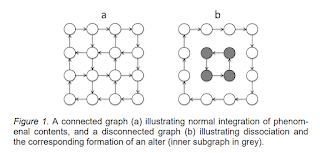
“Ordinary phenomenal activity in cosmic consciousness can thus be modelled as a connected directed graph. See Figure 1a. Each vertex in the graph represents a particular phenomenal content and each edge a cognitive association logically linking contents together.”
And here is the figure: 


Hence, in contrast to what Kastrup accused me of, the reason I didn’t want to talk to him was not that I hadn’t read what he wrote, but that I had read it.

The fourth and final reason that I didn’t want to talk to him is that I get a lot of podcast request, and I don’t reply to most of them simply because I don’t have the time.

I consulted on this matter with some friends and collaborators, and after that decided that I’d talk to Kastrup anyway. Mostly because I quite like Curt Jaimugal who offered to host the discussion and who I’d spoken with before. He’s a smart young man and if you take away nothing else from this blogpost, then at least go check out his YouTube channel which is well worth some of your time. Also, I thought that weeding out Kastrup’s understandings might help other people, too.

A week later, the only good thing I can report about my conversation with Kastrup is that he didn’t bring up free will, which I think is progress. Unfortunately, he didn’t seem to know much about superdeterminism even after having had time to prepare. He eventually ran out of things to say and then accused me of being “combative” after clearly being surprised to hear that an interaction with a single photon isn’t a measurement. Srsly. Go listen to it.


Instead of concluding that he’s out of his depth, he then wrote another blogpost in which he accused me of “misleading, hollow, but self-confident, assertive rhetoric”, claimed that “Sabine has a big mouth and seems to be willing to almost flat-out lie in order to NOT look bad when confronted on a point she doesn’t have a good counter for.” And, “Her rhetorical assertiveness is, at least sometimes, a facade that hides a surprising lack of actual substance.”

Keep in mind that this is a person who claimed to “model” the “phenomenal activity in cosmic consciousness” with 16 circles. Speak of lack of substance.

Lesson learned: I was clearly too optimistic about the possibility of rational discourse, and don’t think it makes sense to further communicate with this person.

Having said that, I gather that some people who watched the exchange were genuinely interested in the details, so I want to add some explanations that didn’t come across as clearly as I hoped they would.

First of all, the reason I am interested in superdeterminism has nothing whatsoever to do with physicalism or realism (I don’t know what these words mean to begin with). It’s simply that the collapse postulate in quantum mechanics isn’t compatible with general relativity because it isn’t local. That’s a well-defined mathematical problem and solving such problems is what I do for a living.

Note that simply declaring that the collapse isn’t a physical process doesn’t explain what happens and hence doesn’t solve the problem. We need to have some answer for what happens with the expectation value of the stress-energy-tensor during a measurement. I’m an instrumentalist; I am looking for a mathematical prescription that reproduces observations, one of which is that the outcome of a measurement is a detector eigenstate.

The obvious solution to this problem is that the measurement process which we have in quantum mechanics is an effective, statistical description of an underlying local process in a hidden variables theory. We know from Bell’s theorem (or its observed violations, respectively) that if a local theory underlies quantum mechanics then it has to violate statistical independence. That’s what is commonly called “superdeterminism”. In such theories the wave-function is an average description, hence not “real” or “physical” in any meaningful way.

So: Why am I interested in superdeterminism? Because general relativity is local. It is beyond me why pretty much everybody else wants to hold onto an assumption as problematic and unjustified as statistical independence, and is instead willing to throw out locality, but that’s the situation.

Now, the variables in this yet-to-be-found underlying theory are only “hidden” in so far as that they don’t appear in quantum mechanics; they may well be observable with suitable experiments. This brings up the question what a suitable experiment would be.

It is clear that Bell-type tests are not the right experiments, because superdeterministic theories violate Bell inequalities just like quantum mechanics. In fact, superdeterministic theories, since they reproduce quantum mechanics when averaged over the hidden variables, will give the same inequality violations and obey the same bounds as quantum mechanics. (Some people seem to find this hard to understand and try to impress me by quoting other inequalities than Bell’s. You can check for yourself that all those inequalities assume statistical independence, so they cannot be used to test superdeterminism.)

This is why, in 2011, I wrote a paper in which I propose a mostly model-independent test for hidden variables that relies on repeated measurements on non-commuting variables. I later learned from Chris Fuchs (see note at end of paper) that von Neumann made a similar proposal 50 years ago, but the experiment was never done. It still hasn’t been done.

A key point of the 2011 paper was that one does not need to make specific assumptions about the hidden variables. One reason I did this is that Bell’s theorem works the same way: you don’t need to know just what the hidden variables are, you just need to make some assumptions about their properties.

Another reason is, as I have explained in my book “Lost in Math”, that math alone isn’t sufficient to develop a new theory. We need data to develop the underlying hidden variables theory. Without that, we can only guess models and the chance that any one of them is correct is basically zero. 

This is why I did not want to develop a model for the hidden variables – it would be a waste of time. It didn’t work for phenomenology beyond the standard model and it won’t work here either. Instead, we have to identify the experimental range where evidence could be found, collect the data, and then develop the model.

Unfortunately and, in hindsight, unsurprisingly, the 2011 paper didn’t go anywhere. I think it’s just too far off the current mode of thinking in physics, which is all about guessing models and then showing that those guesses are wrong, a methodology that works incredibly badly. Nevertheless, I have since spent some time on developing a hidden variables model, but it’s going slowly, partly because I think it’s a waste of time (see above), but also because I am merely one person working four jobs while raising two kids and my day only has 24 hours.

However, in contrast to what Kastrup accuses me of, I have repeatedly and clearly stated that we do not have a satisfactory superdeterministic hidden variables model at the moment. I say this in pretty much all of my talks, it’s explicitly stated in my paper with Tim (“These approaches [...] leave open many questions and it might well turn out that none of them is the right answer.”). I also said this in my conversation with Kastrup. 

But I want to stress that the reason I (and quite possibly others too) didn’t write down a particular hidden variables model is not that it can’t be done, but that there are too many ways it could be done.

Next thing he got confused about is that two years ago, Sandro an I cooked up a superdeterministic toy model. The point of this model was not to say that it should be experimentally tested. We merely put this forward to demonstrate once and for all that superdeterministic models do not require “finetuning” or any “conspiracies”.

The toy model reproduces quantum mechanics exactly, but – in contrast to quantum mechanics – it’s local and deterministic, on the expense of violating statistical independence. Since it reproduces quantum mechanics it’s as falsifiable as quantum mechanics, hence the claim that superdeterminism somehow ruins science is arguably wrong. 

But besides this, it is a rather pointless and ad hoc toy model that I don’t think makes a lot of sense for a number of reasons (which are stated in the paper). Still, it demonstrates that of course if you want to then can define your hidden variables somehow. I should also mention that our model is certainly not the first superdeterministic hidden variables model. (See references in paper.)

There are a lot of toy models in quantum foundations like this with the purpose of shedding light on one particular assumption or another, and my model falls in this tradition. I could easily modify this model so that it would make predictions that deviate from quantum mechanics, so that one could experimentally test it. But the predictions would be wrong, so why would I do this.

Having said that, my thinking about superdeterminism has somewhat changed since 2011. I was at the time thinking about the hidden variables the way that they are usually portrayed as some kind of extra information that resides within particles. I have since become convinced that this doesn’t work, and that the hidden variables are instead the degrees of freedom of the detector. If that is so, then we do know what the hidden variables are, and we can estimate how likely they are to change. Hence, it becomes easier to test the consequences.

This is why in my later papers and in my more recent talks I mention a simpler type of experiment that works for this case – when the hidden variables are the details of the detector – specifically. I have to stress though that there are other models of superdeterminism which work differently and that can’t be tested this way.

Just what the evolution law looks like I still don’t know. I think it can’t be done with a differential equation, which is why I have been looking at path integrals. I wrote a paper about this with Sandro recently in which we propose new path-integral formalism that can incorporate the required type of evolution law. (It was just accepted for publication the other day.)

What we do in the paper is to define the formalism and show that it can reproduce quantum mechanics exactly – a finding I think is interesting in and by itself. As Kastrup said entirely correctly, there are no hidden variables in that paper. I don’t know why he thought there would be. The paper is just not about hidden variables theories. 

I have a number of ideas of how to include the detector degrees of freedom as hidden variables into the path integral. But again the problem isn’t that it can’t be done, but that there are too many ways it can be done. And in none of the ways I have tried can you still calculate something with the integral. So this didn’t really go anywhere – at least so far. It doesn’t help that I have no funding for this research.

I still think the best way forward would be to just experimentally push into this region of parameter space (small, cold system with quick repeated measurements on simple states) and see if any deviations from quantum mechanics can be found. However, if anyone reading is interested in helping with the path integral, please shoot me a note because I have a lot more to say than what’s in our papers.

Finally, I have given a number of seminars about superdeterminism, at least one of which is on YouTube here. I also some months ago did a discussion with Matt Leifer which is here. Leifer, I would say, is one of the leading people in the foundations of quantum mechanics at the moment. I may have some disagreements with him but he knows his stuff. You will learn more from him than from Kastrup.

In case you jumped over some of the more cumbersome paragraphs above, here is the brief summary. You can either go off the deep end and join people like Kastrup who complain about “physicalism”, claim that photons are observers, detectors can both click and not click at the same time, and other bizarre consequences you have to accept if you insist that quantum mechanics is fundamental. 

Or you conclude, like I have, that quantum mechanics is not a fundamental theory. In this case we just need to find the right experiment get a handle on the underlying physics. 

Saturday, February 19, 2022

Has quantum mechanics proved that reality does not exist?

[This is a transcript of the video embedded below. Some of the explanations may not make sense without the animations in the video.]


Physicists have shown that objective reality doesn’t exist. This is allegedly an insight derived from quantum mechanics. And not only this, it’s been experimentally confirmed. Really? How do you prove that reality doesn’t exist? Has it really been done? And do we have to stop saying “really” now? That’s what we’ll talk about today.

Many of you’ve asked me to comment on those headlines claiming that reality doesn’t exist. It’s a case in which physicists have outdone themselves in the attempt to make linear algebra sound mysterious. The outcome is patently absurd. In one article, Eric Calvacanti, a physicist who works in the foundations of quantum mechanics, writes: “If a tree falls in a forest and no one is there to hear it, does it make a sound? Perhaps not, some say.”

So what are those people talking about? The story begins in 1961 with the Hungarian physicist Eugene Wigner. Wigner was part of the second generation of quantum physicists. At his time, the mathematical basis of quantum mechanics had been settled and was experimentally confirmed. Now, physicists moved on to quantum field theory, which would eventually give rise to the standard model. But they still couldn’t make sense of what it means to make a measurement in quantum mechanics.

The way that quantum mechanics works is that everything is described by a wave-function, usually denoted psi. The change of the wave-function in time is given by the Schrödinger equation. But the wave-function itself isn’t measurable. Instead, from the wave-function you just calculate probabilities for measurement outcomes.

Quantum mechanics might for example predict that a particle hits the left side or the right side of a screen with 50% probability each. Before the particle hits the screen, it is in a “superposition” of those two states, which means it’s neither here nor there, instead it’s in some sense both here and there . But once you have measured the particle, you know where it is with 100 percent probability. This means after a measurement, you have to update the wave-function. This update is also called the “reduction” or “collapse” of the wave-function. What is a measurement? Quantum mechanics doesn’t tell you. And that’s the problem.

Wigner illustrated this problem with a thought experiment now known as “Wigner’s friend.” Suppose Wigner’s friend Alice is in a laboratory and does an experiment like the one we just talked about. Wigner waits outside the door. Inside the lab, the particle hits the screen with 50% probability left or right. When Alice measures the particle, the wave-function collapses and it’s either left or right. She then opens the door and tells Wigner what she’s measured.

But how would Wigner describe the experiment? He only finds out whether the particle went left or right when his friend tells him. So, according to quantum mechanics, Wigner has to assume that before he knows what’s happened, Alice is in a superposition of two states. One in which the particle went left and she knows it went left. And one in which it went right and she knows it went right.

The problem is now that according to Alice, the outcome of her measurement never was in a superposition, whereas for Wigner it was. So they don’t agree on what happened. Reality seems to be subjective.

Now. It’s rather obvious what’s going on, namely that one needs to specify what physical process constitutes a measurement, otherwise the prediction is of course ambiguous. Once you have specified what you mean by measurement, Alice will either do a measurement in her laboratory, or not, but not both. And in a real experiment, rather than a thought experiment, the measurement happens when the particle hits the screen, and that’s that. Alice is of course never in a superposition, and she and Wigner agree on what’s objectively real.

If that’s so obvious then why did Wigner worry about it? Because in the standard interpretation of quantum mechanics the update of the wave-function isn’t a physical process. It’s just a mathematical update of your knowledge, which you do after you have learned something new about the system. It doesn’t come with any physical change. And if Alice didn’t physically change anything then, according to Wigner, she must indeed herself have been in a superposition.

Okay, so that was Wigner’s friend in the 1960s. You can’t experimentally test this, but in 2016 Daniela Frauchinger and Renato Renner proposed another thought experiment that moved physicists closer to experimental test. This has been dubbed the “Extended Wigner’s Friend Scenario.”

In this thought experiment you have two Wigners, each of whom has a friend. We will call these the Wigners and the Alices. The Alices each measure one of a pair of entangled particles. As a quick reminder, entangled particles share some property but you don’t know which particle has which share. You may know for example that the particles spins must add up to zero, but you don’t know whether the left particle has spin plus one and the right particle spin minus one, or the other way round.

So the Alices each measure an entangled particle. Now the thing with entangled particles is that if their measurements don’t collapse the wave-function, then now the two Alices are entangled. Either the left one thinks the spin was up and the right one thinks it’s down, or the other way round. And then there’s the two Wigners, each of which goes to ask their friend something about their measurement. Formally this “asking” just means they do another measurement. Frauchinger and Renner then show that there are combinations of measurements in which the two Alices cannot agree with the two Wigners on what the measurement outcomes were.

Again the obvious answer to what happens is that the Alices either measured the particles and collapsed the wave-function or they didn’t. If they did, then their measurement result settles what happens. If they didn’t do it, then it’s the Wigners’ results which settle the case. Or some combination thereof, depending on who measures what. Again, this is only problematic if you think that a measurement is not a physical process. Which is insanity, of course, but that’s indeed what the most widely held interpretation of quantum mechanics says.

And so, Frauchinger and Renner conclude in their paper that quantum mechanics “cannot consistently describe the use of itself” because you run into trouble if you’re one of the Wigner’s and try to apply quantum mechanics to understand how the Alice’s used quantum mechanics.

You may find this a rather academic argument, but don’t get fooled, this innocent sounding statement is a super-important result. Historically, internal inconsistencies have historically been THE major cause of theory-led breakthroughs in the foundations of physics. So we’re onto something here.

But the Frauchinger-Renner paper is somewhat philosophical because they go on a lot about what knowledge you can have about other people’s knowledge. But in 2018, Caslav Brukner looked at the problem from a somewhat different perspective and derived a “No go theorem for observer independent facts.”

His formulation allows one to use the measurement of certain correlations in measurement outcomes to demonstrate that the observers in the extended Wigner’s friend scenario actually had measurement results which disagree with each other. If that was so, there would in certain cases be no “observer independent facts”. This is the origin of all the talk about objective reality not existing and so on.

And yeah it’s really just linear algebra. There aren’t even differential equations to be solved. I assure you I’m not saying this to be condescending or anything, I just mean to say, this isn’t rocket science.

Finally, in 2019, a group from Edinburgh actually measured those correlations which Brukner calculated. That’s the experimental test which the headlines are referring to. Now you may wonder who in Edinburgh played the role of the two Alices and the two Wigners? How did the Alices feel while they were in a superposition? Did the Wigners see any wave-functions collapse?

Well, I am afraid I have to disappoint you because the two Alices were single photons and the two Wigners were photo-detectors. That’s okay, of course, I mean, some of my best friends are photons too. But of course an interaction with a single photon doesn’t constitute a measurement. We already know this experimentally. A measurement requires an apparatus big enough to cause decoherence. If you claim that a single photon is an observer who make a measurement, that’s not just a fanciful interpretation, that’s nonsense.

The alleged mystery of all those arguments and experiments disappears once you take into account that a measurement is an actual physical process. But since quantum mechanics does not require you to define just what this process is, you can make contradictory assumptions about it and then more contradictions follow from it. It’s like you have assumed that zero equals one, and then show that a lot of contradictions follow from it.

So to summarize, no one has proved that reality doesn’t exist and no experiment has confirmed this. What these headlines tell you instead is that physicists slowly come to see that quantum mechanics is internally inconsistent and must be replaced with a better theory, one that describes what physically happens in a measurement. And when they find that theory, that will be the breakthrough of the century.

Saturday, February 12, 2022

Epic Fights in Science

[This is a transcript of the video embedded below. Some of the explanations may not make sense without the animations in the video.]


Scientists are rational by profession. They objectively evaluate the evidence and carefully separate fact from opinion. Except of course they don’t, really. In this episode, we will talk about some epic fights among scientists that show very much that scientists, after all, are only human. Who dissed whom and why and what can we learn from that? That’s what we’ll talk about today.

1. Wilson vs Dawkins

Edward Wilson passed away just a few weeks ago at age 92. He is widely regarded as one of the most brilliant biologists in history. But some of his ideas about evolution got him into trouble with another big shot of biology: Richard Dawkins.

In 2012 Dawkins reviewed Wilson’s book “The Social Conquest of Earth”. He left no doubt about his misgivings. In his review Dawkins wrote: 
“unfortunately one is obliged to wade through many pages of erroneous and downright perverse misunderstandings of evolutionary theory. In particular, Wilson now rejects “kin selection” [...] and replaces it with a revival of “group selection”—the poorly defined and incoherent view that evolution is driven by the differential survival of whole groups of organisms.”
Wilson idea of group selection is based on a paper that he wrote together with two mathematicians in 2010. When their paper was published in Nature magazine, it attracted criticism from more than 140 evolutionary biologists, among them some big names in the field. 

In his review, Dawkins also said that Wilson’s paper probably would never have been published if Wilson hadn’t been so famous. That Wilson then ignored the criticism and published his book pretending nobody disagreed with him was to Dawkins “an act of wanton arrogance”.

Dawkins finished his review: 
“To borrow from Dorothy Parker, this is not a book to be tossed lightly aside. It should be thrown with great force. And sincere regret.”
Wilson replied that his theory was mathematically more sound that of kin selection, and that he also had a list of names who supported his idea but, he said,
“if science depended on rhetoric and polls, we would still be burning objects with phlogiston and navigating with geocentric maps.”
In a 2014 BBC interview, Wilson said:
“There is no dispute between me and Richard Dawkins and never has been. Because he is a journalist, and journalists are people who report what the scientists have found. And the arguments I’ve had, have actually been with scientists doing research.”
Right after Wilson passed away, Dawkins tweeted: 
“Sad news of death of Ed Wilson. Great entomologist, ecologist, greatest myrmecologist, invented sociobiology, pioneer of island biogeography, genial humanist & biophiliac, Crafoord & Pulitzer Prizes, great Darwinian (single exception, blind spot over kin selection). R.I.P.”

2. Leibniz vs Newton

Newton and Leibniz were both instrumental in the development of differential calculus, but they approached the topic entirely differently. Newton came at it from a physical perspective and thought about the change of variables with time. Leibniz had a more abstract, analytical approach. He looked at general variables x and y that could take on infinitely close values. Leibniz introduced dx and dy as differences between successive values of these sequences.

The two men also had a completely different attitude to science communication. Leibniz put a lot of thought into the symbols he used and how he explained himself. Newton, on the other hand, wrote mostly for himself and often used whatever notation he liked on that day. Because of this, Leibniz’s notation was much easier to generalize to multiple variables and much of the notation we use in calculus today goes back to Leibniz. Though the notation xdot for speed and x double dot for acceleration that we use in physics comes from Newton.

Okay, so they both developed differential calculus. But who did it *first? Historians say today it’s clear that Newton had the idea first, during the plague years sixteen sixty-five and sixty-six, but he didn’t write it up until 5 years later and it wasn’t published for more than 20 years.

Meanwhile, Leibniz invented calculus in the mid 1670s. So, by the time word got out, it looked as if they’d both had the idea at the same time.

Newton and Leibniz then got into a bitter dispute over who was first. Leibniz wrote to the British Royal Society to ask for a committee to investigate the matter. But at that time the society’s president was… Isaac Newton. And Newton simply drafted the report himself. He wrote “we reckon Mr Newton the first inventor” and then presented it to the members of the committee to sign, which they did.

The document was published in 1712 by the Royal Society with the title Commercium Epistolicum Collinii et aliorum, De Analysi promota. In the modern translation the title would be “Newton TOTALLY DESTROYS Leibniz”.

On top of that, a comment on the report was published in the Philosophical Transactions of the Royal Society of London. The anonymous author, who was also Newton, explained in this comment: 
“the Method of Fluxions, as used by Mr. Newton, has all the Advantages of the Differential, and some others. It is more elegant ... Newton has recourse to converging Series, and thereby his Method becomes incomparably more universal than that of Mr. Leibniz.”
Leibniz responded with his own anonymous publication, a four page paper which in the modern translation would be titled “Leibniz OWNS Newton”. That “anonymous” text gave all the credit to Leibniz and directly accused Newton of stealing calculus. Leibniz even wrote his own History and Origin of Differential Calculus in 1714. He went so far to change the dates on some of his manuscripts to pretend he knew about calculus before he really did.

And Newton? Well, even after Leibniz died, Newton refused mentioning him in the third edition of his Principia.

You can read the full story in Rupert Hall’s book “Philosophers at war.”

3. Edison vs Tesla  

Electric lights came in use around the end of the 19th Century. At first, they all worked with Thomas Edison’s direct current system, DC for short. But his old employee Nicola Tesla had developed a competing system, the alternate current system, or AC for short. Tesla had actually offered it to Edison when he was working for him, but Edison didn’t want it.

Tesla then went to work for the engineer George Westinghouse. Together they created an AC system that was threatening Edison’s dominance on the market. The “war of the currents” began.

An engineer named Harold Brown, later found to be paid by Edison’s company, started writing letters to newspapers trying to discredit AC, saying that it was really dangerous and that the way to go was DC.

This didn’t have the desired effect, and Edison soon took more drastic steps. I have to warn you that the following is a really ugly story and in case you find animal maltreatment triggering, I think you should skip over the next minute.

Edison organized a series of demonstrations in which he killed dogs by electrocuting them with AC, arguing that a similar voltage in DC was not so deadly. Edison didn’t stop there. He went on to electrocute a horse, and then an adult elephant which he fried with a stunning 6000 volts. There’s an old still movie of this, erm, demonstration on YouTube. If you really want to see it, I’ll leave a link in the info below.

Still Edison wasn’t done. He paid Brown to build an electric chair with AC generators that they bought from Westinghouse and Tesla, and then had Brown lobby for using it to electrocute people so the general public would associate AC with death. And that partly worked. But in the end AC won mostly because it’s more efficient when sent over long distances.

4. Cope vs Marsh  

Another scientific fight from the 19th Century happened in paleontology, and this one I swear only involves animals that were already dead anyway.

The American paleontologists, Edward Cope and Othniel Marsh met in 1863 as students in Germany. They became good friends and later named some discoveries after each other.

Cope for example named an amphibian fossl Ptyonius marshii, after Marsh and, in return Marsh named a gigantic serpent Mosasaurus copeanus.

However, they were both very competitive and soon they were trying to outdo each other. Cope later claimed it all started when he showed Marsh a location where he’d found fossils and Marsh, behind Cope’s back, bribed the quarry operators to send anything they’d find directly to Marsh.

Marsh’s version of events is that things went downhills after he pointed out that Cope had published a paper in which he had reconstructed a dinosaur fossil but got it totally wrong. Cope had mistakenly reversed the vertebrae and then put the skull at the end of the tail! Marsh claimed that Cope was embarrassed and wanted revenge.

Whatever the reason, their friendship was soon forgotten. Marsh hired spies to track Cope and on some occasions had people destroy fossils before Cope could get his hands on them. Cope tried to boost his productivity by publishing the discovery of every new bone as that of a new species, a tactic which the American paleontologist Robert Bakker described as “taxonomic carpet-bombing.” Cope’s colleagues disapproved, but it was remarkably efficient. Cope would publish about 1400 academic papers in total. Marsh merely made it to 300.

But Marsh eventually became chief paleontologists of the United States Geological Survey, USGS, and used its funds to promote his own research while cutting funds for Cope’s expeditions. And when Cope still managed to do some expeditions, Marsh tried to take his fossils, claiming that since the USGS funded them, they belonged to the government.

This didn’t work out as planned. Cope could prove that he had financed most of his expeditions with his own money. He then contacted a journalist at the New York Herald who published an article claiming Marsh had misused USGS funds. An investigation found that Cope was right. Marsh was expelled from the Society without his fossils, because they had been obtained with USGS funds.

In a last attempt to outdo Marsh, Cope stated in his will that he’d donated his skull to science. He wanted his brain to be measured and compared to that of Marsh! But Marsh didn’t accept the challenge, so the world will never know which of the two had the bigger brain.

Together the two men discovered 136 species of dinosaurs (Cope 56 and Marsh 80) but they died financially ruined with their scientific reputation destroyed.

5. Hoyle vs The World

British astronomer Fred Hoyle is known as the man who discovered how nuclear reactions work inside stars. In 1983, the Nobel Prize in physics was given... to his collaborator Willy Fowler, not to Hoyle. Everyone, including Fowler, was stunned. How could that happen?

Well, the Swedish Royal Academy isn’t exactly forthcoming with information, but over the years Hoyle’s colleagues have offered the following explanation. Let’s go back a few years to 1974.

In that year, the Nobel Prize for physics went to Anthony Hewish for his role in the discovery of pulsars. Upon hearing the news Hoyle told a reporter: “Jocelyn Bell was the actual discoverer, not Hewish, who was her supervisor, so she should have been included.” Bell’s role in the discovery of pulsars is widely recognized today, but in 1974, that Hoyle put in a word for Bell made global headlines.

Hewish was understandably upset, and Hoyle clarified in a letter to The Times that his issue wasn’t with Hewish, but with the Nobel committee: “I would add that my criticism of the Nobel award was directed against the awards committee itself, not against Professor Hewish. It seems clear that the committee did not bother itself to understand what happened in this case.”

Hoyle’s biographer Simon Mitton claimed this is why Hoyle didn’t get the Nobel Prize: The Nobel Prize committee didn’t like being criticized. However, the British scientist Sir Harry Kroto, who won the Nobel Prize for chemistry in 1996, doesn’t think this is what happened.

Kroto points out that while Hoyle may have made a groundbreaking physics discovery, he was also a vocal defender of some outright pseudoscience, for example, he believed that the flu was caused by microbes that rain down on us from outer space.

Hoyle was also, well, an unfriendly and difficult man who had offended most of his colleagues at some point. According to Sir Harry, the actual reason that Hoyle didn’t get a Nobel Prize was that he’d use it to promote pseudoscience. He said
“Hoyle was so arrogant and dismissive of others that he would use the prestige of the Nobel prize to foist his other truly ridiculous ideas on the lay public. The whole scientific community felt that.”
So what do we learn from that? Well, one thing we can take away is that if you want to win a Nobel Prize, don’t spread pseudoscience. But the bigger lesson I think is that while some competition is a good thing, it’s best enjoyed in small doses.