Pages

Wednesday, November 27, 2013

Cosmic Bell

On the playground of quantum foundations, Bell’s theorem is the fence. This celebrated theorem – loved by some and hated by others – shows that correlations in quantum mechanics can be stronger than in theories with local hidden variables. Such local hidden variables theories are modifications of quantum mechanics which aim to stay close to the classical, realist picture, and promise to make understandable what others have argued cannot be understood. In these substitutes for quantum mechanics, the ‘hidden variables’ serve to explain the observed randomness of quantum measurement.

Experiments show however that correlations can be stronger than local hidden variables theories allow, as strong as quantum mechanics predicts. This is very clear evidence against local hidden variables, and greatly diminishes the freedom researchers have to play with the foundations of quantum mechanics.

But a fence has holes and Bell’s theorem has loopholes. These loopholes stem from assumptions that necessarily enter every mathematical proof. Closing all these loopholes by making sure the assumptions cannot be violated in the experiment is challenging: Quantum entanglement is fragile and noise is omnipresent.

One of these loopholes in Bell’s theorem is known as the ‘freedom of choice’ assumption. It assumes that the settings of the two detectors which are typically used in Bell-type experiments can be chosen ‘freely’. If the detector settings cannot be chosen independently, or are both dependent on the same hidden variables, this could mimic the observed correlations.

This loophole can be addressed by using random sources for the detector settings and putting them far away from each other. If the hidden variables are local, any correlations must have been established already when the sources were in causal contact. The farther apart the sources for the detector settings, the earlier the correlations must have been established because they cannot have spread faster than the speed of light. The earlier the correlations must have been established, the less plausible the theory, though how early is ‘too early’ is subjective. As we discussed earlier, in practice theories don’t so much get falsified as that they get implausified. Pushing back the time at which detector correlations must have been established serves to implausify local hidden variable theories.

In a neat recent paper, Jason Gallicchio, Andrew Friedman and David Kaiser studied how to use cosmic sources to set the detector, sources that have been causally disconnected since the big bang (which might or might not have been ‘forever’). While this had been suggested before, they did the actual work, thought about the details, the technological limitations, and the experimental problems. In short, they breathed the science into the idea.

    Testing Bell's Inequality with Cosmic Photons: Closing the Settings-Independence Loophole
    Jason Gallicchio, Andrew S. Friedman, David I. Kaiser
    arXiv:1310.3288 [quant-ph]

The authors look at two different types of sources: distant quasars on opposite sides of the sky, and patches of the cosmic microwave background (CMB). In both cases, photons from these sources can be used to switch the detectors, for example by using the photon’s arrival time or their polarization. The authors come to the conclusion that quasars are preferable because the CMB signal suffers more from noise, especially in Earth-based telescopes. Since this noise could originate in close-by sources, it would spoil the conclusions for the time at which correlations must have been established.

According to the authors, it is possible with presently available technology to perform a Bell-test with such distant sources, thus pushing back the limit on conspiracies that could allow hidden variable theories to deliver quantum mechanical correlations. As always with such tests, it is unlikely that any disagreement with the established theory will be found, but if a disagreement can be found, it would be very exciting indeed.

It remains to be said that closing this loophole does not constrain superdeterministic hidden variables theories, which are just boldly non-local and not even necessarily realist. I like superdeterministic hidden variable theories because they stay as close to quantum mechanics as possible while not buying into fundamental non-determinism. In this case it is the measured particle that cannot be prepared independently of the detector settings, and you already know that I do not believe in free will. This requires some non-locality but not necessarily superluminal signaling. Such superdeterministic theories cannot be tested with Bell’s theorem. You can read here about a different test that I proposed for this case.

Thursday, November 21, 2013

The five questions that keep physicists up at night

Image: Leah Saulnier.

The internet loves lists, among them the lists with questions that allegedly keep physicists up at night. Most recently I spotted one at SciAm blogs, About.com has one, sometimes it’s five questions, sometimes seven, nine, or eleven, and Wikipedia excels in listing everything that you can put a question mark behind. The topics slightly vary, but they have one thing in common: They’re not the questions that keep me up at night.

The questions that presently keep me up are “Where is the walnut?” or “Are the street lights still on?” I used to get up at night to look up an equation, now I get up to look for the yellow towel, the wooden memory piece with the ski on it, the one-eyed duck, the bunny’s ear, the “white thing”, the “red thing”, mentioned walnut, and various other household items that the kids Will Not Sleep Without.

But I understand of course that the headline is about physics questions...

The physics questions that keep me up at night are typically project-related. “Where did that minus go?” is for example always high on the list. Others might be “Where is the branch cut?”, “Why did I not run the scheduled backup?”, “Should I resend this email?” or “How do I shrink this text to 5 pages?”, for just to mention a few of my daily life worries.

But I understand of course that the headline is about the big, big physics questions...

And yes, there are a few of these that keep coming back and haunt me. Still they’re not the ones I find on these lists. What you find on the lists in SciAm and NewScientist could be more aptly summarized as “The 5 questions most discussed on physics conferences”. They’re important questions. But it’s unfortunate how the lists suggest physicists all more or less have the same interests and think about the same five questions.

So I thought I’d add my own five questions.

Questions that really bother me are the ones where I’m not sure how to even ask the question. If a problem is clear-cut and well-defined it’s a daylight question - a question that can be attacked by known methods, the way we were taught to do our job. “What’s the microscopic origin of dark matter?” or “Is it possible to detect a graviton?” are daylight questions that we can play with during work hours and write papers about.

And then there are the night-time questions.
  • Is the time-evolution of the universe deterministic, indeterministic or neither?

    How can we find out? Can we at all? And, based on this, is free will an illusion? This question doesn’t really fall into any particular research area in physics as it concerns the way we formulate the laws of nature in general. It is probably closest to the foundations of quantum mechanics, or at least that’s where it gets most sympathy.
  • Does the past exist in the same way as the present? Does the future?

    Does a younger version of yourself still exist, just that you’re not able to communicate with him (her), or is there something special about the present moment? The relevance of this question (as Lee elaborated on in his recent book) stems from the fact that none of our present descriptions of nature assigns any special property to the ever-changing present. I would argue this question is closest to quantum gravity since it can’t be addressed without knowing what space and time fundamentally are.
  • Is mathematics the best way to model nature? Are there systems that cannot be described by mathematics?

    I blame Max Tegmark for this question. I’m not a Platonist and don’t believe that nature ultimately is mathematics. I don’t believe this because it doesn’t seem likely that the description of nature that humans discovered just yesterday would be the ultimate one. But if it’s not then what is the difference between mathematics and reality? Is there anything better? If so, what? If not, what does this mean for science?
  • Does a theory of everything exist and can it be used, in practice (!), to derive the laws of nature for all emergent quantities?

    If so, will science come to an end? If not, are there properties of nature that cannot be understood or even modeled by any conscious being? Are there cases of strong emergence? Can we use science to understand the evolution of life, the development of complex systems, and will we be able to tell how consciousness will develop from here on?
  • What is the origin and fate of the universe and does it depend on the existence of other universes?

    That’s the question from my list you are most likely to find on any ‘big questions of physics’ list. It lies on the intersection of cosmology and quantum gravity. Dark matter, dark energy, black holes, inflation and eternal inflation, the nature and existence of space-time singularities all play a role to understand the evolution of the universe.
(It's not an ordered list because it's not always the same question that occupies my mind.)

I saw that Ashutosh Jogalekar at SciAm blogs also was inspired to add his own five mysteries to the recent SciAm list. If you want to put up your own list, you can post the link in this comment section, I will wave it through the spam filter.

Monday, November 18, 2013

Does modern science discourage creativity?

Knitted brain cap. Source: Etsy.

I recently finished reading “The Ocean at the End of the Lane” by Neil Gaiman. I haven’t read a fantasy book for a while, and I very much enjoyed it. Though I find Gaiman’s writing too vague to be satisfactory because the scientist in my wants more explanations, the same scientist is also jealous – jealous of the freedom that a fantasy writer has when turning ideas into products.

Creativity in theoretical physics is in comparison a very tamed and well-trained beast. It is often only appreciated if it fills in existing gaps or if it neatly builds on existing knowledge. The most common creative process is to combine two already existing ideas. This works well because it doesn’t require others to accept too much novelty or to follow leaps of thought, leaps that might have been guided by intuition that stubbornly refuses to be cast into verbal form.

In a previous post, I summed this up as “Surprise me, but not too much.” It seems to be a general phenomenon that can also be found in the arts and in music. The next big hits are usually small innovations over what is presently popular. And while this type of ‘tamed creativity’ grows new branches on existing trees, it doesn’t sow new seeds. The new seeds, the big imaginary leaps, come from the courageous and unfortunate few who often remain under-appreciated by contemporaries, and though they later come to be seen as geniuses they rarely live to see the fruits of their labor.

An interesting recent data analysis of citation networks demonstrated that science too thrives primarily on the not-too-surprising type of creativity.

In a paper published in Science last month, a group of researchers quantified the likeliness of combinations of topics in citation lists and studied the cross-correlation with the probability of the paper becoming a “hit” ( meaning in the upper 5th percentile of citation scores). They found that having previously unlikely combinations in the quoted literature is positively correlated with the later impact of a paper. They also note that the fraction of papers with such ‘unconventional’ combinations has decreased from 3.54% in the 1980s to 2.67% in the 1990, “indicating a persistent and prominent tendency for high conventionality.” Ack, the spirit of 1969, wearing off.

It is no surprise that novelty in science is very conservative. A new piece of knowledge has to fit with already existing knowledge. Combining two previous ideas to form a new one is such a frequently used means of creativity because it’s likely to pass peer review. You don’t want to surprise your referees too much.

And while this process delivers results, if it becomes the exclusive means of novelty production two problems arise. First, combining two speculative ideas is unlikely to result in a less speculative idea. It does however contribute to the apparent relevance of the ideas being combined. We can see this happening on the arxiv all the time, causing a citation inflation that is the hep-th version of mortgage bubbles. My (unpublished) last year’s comment on the black hole firewall has been cited 18 times by now. Yeah, I plead guilty.

But secondly, and more importantly, the mechanism of combining existing ideas is a necessary, but not a sufficient, creative process for sustainable progress in science.

This study also provides another example for why measures for scientific success sow the seeds of their own demise: It is easy enough to clutter a citation list with ‘unconventional’ combinations to score according to a creativity-measure based on the correlation found in the above study. But pimping a citation list will not improve science, it will just erode the correlation and render the measure useless in the long run. This is what I refer to as the inevitable deviation of primary goals from secondary criteria.

And creativity, I would argue, is even more difficult to quantify than intelligence.
  1. Novelty is subjective and depends on the amount of details you pay attention to (the ‘course-graining’ if you excuse me borrowing a physics expression). Of course your toddler’s scribbles are uniquely creative but to everybody besides you they look like every other toddler’s scribbles.
  2. Novelty depends on your previous knowledge. You might think highly of your friend’s crocheting of Lorentz manifolds until you find the instructions on the internet. “The secret to creativity,” Einstein allegedly said, “Is knowing how to hide your sources.” Or maybe somebody creatively assigned this quotation to him.
  3. The appreciation of creativity depends on the value we assign to the outcome of the creative process. You create a novel product every time you take a shit, but most of us don’t value this product very much.
  4. We expect intent behind creativity. A six-tailed comet might be both novel and of value, but we don’t say that the comet has been creative.
Taken together this means that besides being subjective, it’s not only the product that is relevant for the assessment of creativity, but also the process itself.

In this context, let us look at another recent paper that the MIT technology review pointed out. In brief, IBM cooked up a computer code that formulates new recipes based on combinations from a database of already existing recipes. Human experts judged the new recipes to be creative and, so I assume, eatable. Can this computer rightfully be called a ‘creativity machine’?

Well, as so often it’s a matter of definition. I have no problem with the automatization of novelty production, but I would argue that rather than computerizing creativity this pushes creativity up a level to the creation of the process of automatization. You don’t even need to look at IBM’s “creativity machine” to see this shift of creativity to a metalevel. There’s no shortage of books and seminars promising to teach you how to be more creative. Everybody, it seems, wants to be more creative and nobody asks what we’re supposed to do with all these creations. Creativity is the new emotional intelligence. But to me teaching or programming creativity is like planning spontaneity, a contradiction in itself.

Anyway, let’s not fight about words. It’s more insightful to think about what IBM’s creativity machine cannot do. It cannot, for example, create recipes with new ingredients because these weren’t in the database. Neither can it create new methods of food processing. And since it can’t actually taste anything, it would never notice eg how the miracle fruit alters taste perception. IBM’s creativity machine isn’t so much creative as that it was designed to anticipate what human experts think of as creative. And you don’t want to surprise the experts too much...

It is a very thought provoking development though and it lead me to wonder whether we’re about to see a level-shift in novelty production also in science.

Let me then come back to the question posed in the title. It’s not that modern science lacks creativity, but that the creativity we have is dominated by the incremental, not-so-surprising combination of established knowledge. There are many reasons for this - peer pressure, risk-aversity, and lack of time all contribute to the hesitation of researchers to try to understand other’s leaps of thought, or trying to convince others to follow their own leaps. Maybe what we need is really an increased awareness of the possible processes of creativity in science, so that we can go beyond ‘unconventional combinations’ in literature lists.

Wednesday, November 13, 2013

Physics in product ads

I've been trying to figure out a quick way to make an embeddable slideshow and to that end I collected some physics-themed product names that I found amusing. Hope this works, enjoy :)

Monday, November 11, 2013

Marc Kuchner about his book "Marketing for Scientists"

[My recent post about the marketing of science and scientists lead to a longer discussion on facebook. I offered Marc Kuchner, author of the mentioned book "Marketing for Scientists" a place to present his point of view here. My questions are marked with B, his replies with M.]


B: Who is your book aimed at and why should they read it?

M: Most of my readers are postdocs and graduate students, but Marketing for Scientists is for anyone with a scientific bent who is interested in learning the techniques of modern marketing.

B: You are marketing marketing for scientists as a service to others. I like that and have to say this was the main reason I read your book. Can you expand?

M: I think scientists need better tools to compete today in the marketplace of ideas. Only one out of ten American adults can correctly describe what a "molecule" is. But everybody knows who Sarah Palin is. The climate change deniers understand marketing perfectly well.

B: The point of tenure is to free researchers from the need to serve others and allow them to follow their interests without being influenced by peer pressure, public pressure or financial pressure. I think this is essential for unbiased judgement and that marketing, regardless of whether you call it a service to others, negatively affects scientific objectivity and renders the process of knowledge discovery inefficient. Your advice is good advice for the individual but bad advice for the community. What do you have to say in your defense?

Our community already uses marketing. Every proposal you submit, every scientific paper you write, and every presentation you give is a piece of marketing. But sometimes we scientists aren’t clear with ourselves that we are in fact marketing our work. We call it “networking” or “communication” or “grantsmanship” or what have you, hiding the true nature of our efforts. So first I like to peel back the taboos, take off the white gloves and take an honest look at the marketing we scientists already do.

Then I want every scientist to learn how to do it better—to learn how to use the latest and greatest marketing techniques. If you picture our community as competing only with each other for a fixed slice of the pie then of course you could get the impression that there’s nothing to be gained by improving our marketing savvy. But the science pie is not fixed. In America, it’s shrinking! We scientists need to update our marketing skills to widen the impact of science as a whole. That’s good for the whole community.

B: I am afraid that marketing and advertising will erode the public's trust in science and scientists and that this is already happening. Do you not share my concerns?

Indeed, nobody likes billboards and commercials. But the practice of marketing has changed since the era of Mad Men. I try to teach scientists how modern marketing means co-creating with the customer, being receptive to feedback, and being open and honest. Those are values that scientists have always had, values that build trust in today’s new companies (think Google, Apple, TOMS shoes). These values can help rebuild the public’s trust in science.

B: Are you available for seminars and how can people reach you?

Thanks, Sabine! For more information about the Marketing for Scientists book and the Marketing for Scientists workshops, go to www.marketingforscientists.com or email me at marc@marketingforscientists.com

Thursday, November 07, 2013

Big data meets the eye

Remember when a 20kB image took a minute to load? Back then, when dinosaurs were roaming the earth?

Data has become big.

Today we have more data than ever before, more data in fact than we know how to analyze or even handle. Big data is a big topic. Big data changes the way we do science and the way we think about science. Big data even led Chris Anderson to declare the End of Theory:
“We can stop looking for models. We can analyze the data without hypotheses about what it might show. We can throw the numbers into the biggest computing clusters the world has ever seen and let statistical algorithms find patterns where science cannot.”
That was 5 years ago. Theory hasn’t ended yet and it’s unlikely to end anytime soon. Because there is slight problem with Anderson’s vision: One still needs the algorithm that is able to find patterns. And for that algorithm, one needs to know what one is looking for to begin with. But pattern finding algorithms for big data are difficult. One could say they are a science in themselves, so theory better not ends before having found them.

Those of us working on the phenomenology of quantum gravity would be happy if we had data at all, so I can’t say the big data problem is big on my mind, but I have a story to tell. Alexander Balatsky recently took on a professorship in condensed matter physics at Nordita, and he told me about a previous work of his that illustrates the challenge of big data in physics. It comes with an interesting lesson.


Electron conducting bands in crystals are impossible to calculate analytically except for very simplified approximations. Determining the behavior of electrons in crystals to high accuracy requires three-dimensional many-body calculations of multiple bands and their interactions. It produces a lot of data. Big data.

You can find and download some of that data in the 3D Fermi Surface Database. Let me just show you a random example example of Fermi surfaces, this one being for a gold-indium lattice:


The Fermi-surface roughly speaking tells you how electrons are packed. Pretty in a nerdy way, but what is the relevant information here?

The particular type of crystal Alexander and his collaborators, Hari Dahal and Athanasios Chantis, were interested in are so-called non-centrosymmetric crystals which have a relativistic spin-splitting of the conducting bands. This type of crystal symmetry exists in certain types of semiconductors and metals and plays a role in unconventional superconductivity that is still a theoretical challenge. Understanding the behavior of electrons in these crystals may hold the key to the production of novel materials.

The many-body, many-bands numerical simulation of the crystals produces a lot of numbers. You pipe them into a file, but now what? What really is it that you are looking for? What is relevant for the superconducting properties of the material? What pattern finding algorithm do you apply?

Let’s see...


Human eyes are remarkable pattern
search algorithms. Image Source.
The human eye, and its software in the visual cortex, is remarkably good in finding patterns, so good in fact it frequently finds patterns where none exist. And so the big data algorithm is to visualize the data and let humans scrutinize it, giving them the possibility to interact with the data while studying it. This interaction might mean selecting different parameters, different axes, rotating in several dimensions, changing colors or markers, zooming in and out. The hardware for this visualization was provided by the Los Almos-Sandia Center for Integrated Nanotechnologies, VIZ@CINT; the software is called ParaView and shareware. Here, big data meets theory again.

Intrigued about how this works in practice, I talked to Hari and Athanasios the other day. Athanasios recalls:
“I was looking at the data before in conventional ways, [producing 2-dimensional cuts in the parameter space], and missed it. But in the 3-d visualization I immediately saw it. It took like 5 minutes. I looked at it and thought “Wow”. To see this in conventional ways, even if I had known what to look for, I would have had to do hundreds of plots.”
The irony being that I had no idea what he was talking about. Because all I had to look at was a (crappy print of) a 2-dimensional projection. “Yes,” Athanasios says, “It’s in the nature of the problem. It cannot be translated into paper.”

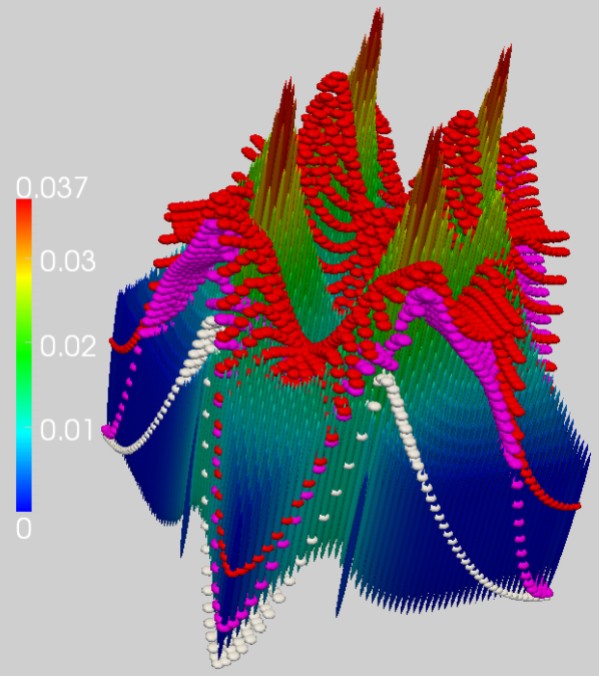
So I’ll give it a try, but don’t be disappointed if you don’t see too much in the image because that’s the reason d’être for interactive data visualization software.

3-d bandstructure of GaAs. Image credits: Athanasios Chantis.


The two horizontal axis in the figure show the momentum space of the electrons into the directions away from the high symmetry direction of the crystal. It has a periodic symmetry, so you’re actually seeing four times the same patch, and in the atomic lattice this pattern goes on to repeat. In the vertical direction, there are two different functions shown simultaneously. One is depicted with the height profile whose color code you see on the left and shows the energy of the electrons. The other function shown (rescaled) in the colored bullets, is the spin-splitting of three different conduction bands; you see them in (bright) red, white and pink. Towards the middle of the front, note the white band getting close to the pink one. They don’t cross, but instead they seem to repel and move apart again. This is called an anti-crossing.

The relevant feature in the data, the one that’s hard if not impossible to see in two dimensional projections, is that the energy peaks coincide with the location of these anti-crossings. This property of the conducting bands, caused by the spin-splitting in this type of non-centrosymmetric crystals, affects how electrons travel through the crystal, and in particular it affects how electrons can form pairs. Because of this, materials with an atomic lattice of this symmetry (or rather, absence of symmetry) should be unconventional superconductors. This theoretical prediction has meanwhile been tested experimentally by two independent groups. Both groups observed signs of unconventional pairing, confirming at a strong connection between noncentrosymmetry and unconventional superconductivity.

This isn’t the only dataset that Hari studied by way of interactive visualization, and not the only case where it wasn’t only helpful but necessary to extract scientific information. Another example is this analysis of a data set from the composition of the tip of a scanning tunnel microscope, as well as a few other projects he has worked on.

And so it looks to me that, at least for now, the best pattern-finding algorithm for these big data sets is the eye of a trained theoretical physicist. News about the death of theory, it seems, have been greatly exaggerated.

Thursday, October 31, 2013

Science Marketing needs Consumer Feedback

It’s been a while since I read Marc Kuchner’s book “Marketing for Scientists”. I hated the book as I’ve rarely hated a book. I did not write a review then because it was a gift from an, undoubtedly well-meaning, friend who reads my blog. As time passed though, I changed my mind. Let me explain.

Product advertising and marketing is the oil on the gears of our economies. Its original purpose is to inform the customers about products and help them to decide whether they fit their needs. But marketing today isn’t only about selling a product, it’s also about selling a self-image. What we decide to spend money on tells others what we consider important and which groups we identify with.

In the quest to attract customers, advertisements often don’t contain a lot of information, and sometimes they bluntly lie. And so we have laws protecting us from these lies, though their efficiency differs greatly from one country to the next as Microsoft learned the hard way.

Everybody knows adverts make a product appear better than it is in reality, that microwave dinners never look like they do on the images, lotions won’t remove these eye bags, and ergonomic underwear will not make you run any faster. The point is not that advertisements bend reality but as that advertisements work regardless, just by drawing attention and by leaving brand names in our heads – names that we’ll recognize later. The more money a company can invest into good advertisement, the more likely they are to sell.

It isn’t so surprising that capitalistic thought is increasingly applied not only to the economy but also to academic research. Today, tax-funded scientists, far from being able to dig into the wonders of nature unbiased and led by nothing but their interests, are required to formulate 5 year plans and demonstrate a quantifiable impact of their work. And so scientists are now also expected to market themselves, their research and their institution.

Scientific knowledge however isn’t a product like a candy bar. A candy bar isn’t right or wrong, it’s right for you or wrong for you, and whether it’s right or wrong for you depends as much on you as on the candy bar. But the whole scientific process works towards the end of objective judgment, towards finding out whether a research finding should be kept or tossed. Scientific knowledge is eventually either right or wrong and academic research should be organized to make this judgment as efficiently as possible.

Marketing science is not helpful to this end for several reasons:
  • It puts at advantage those who are either skilled at marketing or who can afford help. This doesn’t necessarily say anything about the quality of their research. It’s not a useful selection criterion if what you are looking for is good science. Those who shout the loudest don’t necessarily sell the best fish.
  • Marketing of science advertises the product (research results), while what people actually want to sell is the process (the scientist’s ability to do good research). It draws attention towards the wrong criteria.
  • It has a positive feedback loop that gradually worsens the problem. The more people advertise their work, the more others will feel the need to also advertise their work as well. This leads, as with advertisement of goods, to a decrease of objectivity and honesty until it eventually nears blunt lies.
  • It takes time away from research, thus reducing efficiency.
In quantum gravity phenomenology, you will frequently see claims that something has been derived when in fact it wasn’t derived, or that something is a result, when in fact it is an ad-hoc assumption. I am aware of course, such exaggerations are advertisements, made to convince the reader of the relevance of a research study. But they’re not helpful to the process of science and even worse for science communication.

That’s why I hated Kuchner’s book. Not because his marketing advice is bad advice, but because he didn’t consider the consequences. If all researchers had Marc Kuchner’s “sell yourself” attitude, we’d end up with a community full of good advertisers, not full of good scientists. It’s the inverse of the collective action problem: A situation in which we would all benefit from not doing something (advertising), but each individual would put themselves at a disadvantage when behaving differently (not advertising), and so we all continue to do it.

Here’s why I changed my mind.

Researchers market and advertise because they have to, owing to the very real pressure of the collective action problem. There are too many people and not enough funding. Marketing might not be a good factor to select for, but standing out for whatever reason puts you at an advantage. The more people know your name, the more likely they’ll read your paper or your CV, and that’s not a sufficient, but certainly a necessary condition for survival in academia. And then there’s people, like Kuchner, who make money with that survival pressure. Sad but true.

Yes, this is a bad development, but collective action problems are thorny. Complaining about it, I’ve come to conclude, will not solve the problem. But what we can do is work towards balance. What we need then is the equivalent of customer reviews and independent product tests –  what we need is a culture that encourages feedback and criticism.

Unfortunately presently feedback and criticism on other people’s work is not appreciated by the community. Criticism is typically voiced only on very popular topics, when even criticism on other’s work is advertisement of one’s own knowledge, think climate change, arsenic life, string theory. But it’s a very small fraction of researchers who spend time on this, and it’s only on a small fraction of topics. It’s insufficient.

A recent nature editorial notes that “Online discussion is an essential aspect of the post-publication review of findings” but
In recent years, authors and readers have been able to post online comments about Nature papers on our site. Few bother. At the Public Library of Science, where the commenting system is more successful, only 10% of papers have comments, and most of those have only one.”
This really isn’t surprising. Few bother because in terms of career development it’s a waste of time.

In contrast to the futile attempt of preventing researchers from advertising themselves and their work however, the balance can be improved by appreciating the work of those who provide constructive criticism. By noting the community benefit that comes from researchers who publicly comment on other’s publications, by inviting scientists to speak not only for their own original work, but for their criticism of other people’s work, and by not thinking of somebody as negative who points out flaws. Because that consumer feedback is the oil on the gears that we need to keep science running.

Tuesday, October 29, 2013

Interna

Mamasonnenbrille.
It’s not like nothing happened, I just haven’t had the time to keep you updated on our four-body problems.

Earlier this year, we had handed over the stalled case on our child benefits to an EU institution called “SOLVIT” that takes on problems with national institutions under EU regulations. Amazingly, they indeed solved our problem efficiently and quickly. And so, after more than two and a half years and an inch of paperwork, Stefan finally gets child benefits. Yoo-hoo! If you have any institutional problem with a family distributed over several EU countries, I can recommend you check out the SOLVIT website. I really wish though the Germans and the Swedes could converge on one paper punch pattern, then I wouldn’t have to keep two different types of folders.

She knows the numbers from
1 to 10, but not their order.
Lara and Gloria will turn 3 in December and so we are about to switch from daycare to Kindergarten. They both speak more or less in full sentences now and come up with questions like "Where do clouds go at night?" and "Mommy, are you wearing underwear?" They still refer to themselves by first name though rather than using “I”, and are struggling with German grammar. At daycare the kids sing a lot, which feeds them weird vocabulary that may be delivered spontaneously in unexpected situations, Butzemann! Tschingderassabum! Wo ist meine Zie-har-mo-ni-ka? The girls both love puzzles and Lego and the wooden railway. On occasion they now demand to sit on their potty, though the timing isn’t quite working yet.

Lara can't let go of the binky, but is
okay as long as it's in the vicinity.
I meanwhile have decided, after a long back and forth, that I’ll not attend next year’s FQXi conference. The primary reason is that I looked up the flight connections and the inconvenience of getting to Vieques Island exceeds my pain tolerance. I am very reluctant these days to attend any meeting that requires me to be away on weekends and that isn’t located in vicinity of a major international airport, thus adding to my travel time. Secondary reason is that I’m not particularly interested in the topic ("The Physics of Information"), and I can just see it degenerating into yet another black hole firewall discussion. At the same time I’m sorry to miss the meeting, because from all the conferences that I’ve attended the FQXi conferences were undoubtedly the most inspiring ones.

Speaking of pain tolerance, I ran a marathon last weekend. I’ve always wondered why people run marathons. Now that I have a finisher medal, I am still wondering why people do this to themselves. I really like running, but there were too many people and too much noise on these 42 km for me.

I admit I plainly didn’t know before my first 10k about a year ago that these races tend to have typically only 20% or so of female participants. (The Frankfurt marathon had 15%, though the recent numbers from the USA look better). I find this surprising given that most of the people I meet jogging in the fields tend to be women. Neither did I know until some months ago that women weren’t even allowed in marathons until the mid 1970s, for somewhat mysterious reasons that seem to go back to the (unpublished) beliefs of some (unnamed) physicians that the female body isn’t meant for long-distance running – a claim that nobody bothered to check until some women stood up and disproved it. It’s an interesting tale, about which you can read here.

In entirely different news, Nordita now spreads word about the wonders of theoretical physics on Twitter and on Facebook. These feeds are fed by Apostolos Vasileiadis, creator of the recently mentioned short film located at Nordita. If you share our love of physics, check it out and I hope we’ll not disappoint.

Also keep in mind this year’s deadline for program proposals is Nov 15. The Stockholm weather can’t compete with Santa Barbara, but I’m told our programs are better funded :o) Instructions for the application can be found on the Nordita homepage.

Friday, October 25, 2013

Metaphors and analogies: scientists’ friends or foes?

Metaphors are like men. If you take them
seriously the joke's on you.
The girls were about a year old and I was working from home. As I was reading yet another referee report that came with the preamble “we regret to inform you...,” I watched Gloria trying to push a square block through a round hole. We were really trying the same thing, I thought.

Decoding metaphors and using analogies is a prototypical right-brain task, a pattern finding that helps us get a grip on new situations quickly and that sheds new light on the familiar. Metaphors and analogies are omnipresent in literature and the arts, in humor and also in education. And popular science writing is full of it.

But relying on metaphors is like traveling to a new country and then heading to Starbucks. The very reason to do it is also what limits the experience. It’s familiar and easy to understand, but it prevents us from learning something new. This is why I have a love-hate relationship with Starbucks and other metaphors.

Love: Analogies and metaphors build on existing knowledge and thus help us to understand something quickly and intuitively.

Hate: This intuition is eventually always misleading. If a metaphor were exact, it wouldn’t be a metaphor.

And while in writing, art, and humor most of us are easily able to tell when an analogy ceases to work, in science it isn’t always so obvious.

When it comes to physics I can most often tell when an analogy fails to capture the actual science. But in other areas of science this sometimes is not clear to me. There are for example these artistic images that frequently accompany popular science accounts of new drugs or cancer treatments. You know, the ones with the molecules that fit like keys into locks of other molecules, or that cut through molecular bonds. I am reasonably sure that these explanations suggest a clarity of the underlying mechanism and structure that most often doesn’t quite exist in the actual data. But how much of it is science and how much of it is art is difficult for me to tell.

In a recent Nature comment “Mind the metaphor”, Eleonore Pauwels made a similar point:
“[I]n the late 1990s, computer scientists, physicists and engineers were fuelled by the idea that they might be able to direct cells in the same way that people program computers. In the laboratory, researchers started to use computing and engineering metaphors –switches, oscillators and logic gates, for instance – both to guide the design of synthetic constructs and to understand how natural systems function. Almost immediately, scientists were confronted with the uncertainties and constraints of engineering in the cellular context. Engineering concepts and metaphors could serve only as an inspiration...

Scientists using metaphors among themselves are often aware of, and even careful to point out, the subtleties that could be misconstrued. Problems tend to arise when metaphors are used outside the laboratory...

Faced with explaining the messy complexity and uncertainty of science to the public, it is understandable that scientists reach for metaphors. But [this] sends a message to policy-makers and laypeople that scientists can already make biological systems that are reliable and controllable. It widens rather than closes the gap between scientific realities and the expectations of policy-makers and the public.”
The same problem exists in physics, though at least in the area I work in there aren’t all that many implications for public policy. But I’ve seen it over and over again that people take analogies too seriously and start trying to build arguments on them. Suddenly a rubber sheet isn’t just an analogy for space-time, but it is space-time. The universe is an inflating balloon, the Higgs particle is a rumor, and entangled particles are shoes in parcels.

Except that, well, they’re not. The universe isn’t a clockwork and it’s not a drum either; the brain isn’t a computer, black holes are not cannibals and indeed not even black.

The main reason we use mathematics for scientific theories is that it’s a particularly clean way of thinking, uncluttered from what the right brain wants to associate. An electron isn’t a spinning top, it’s an element of a Hilbert space that transforms under the spinor representation of the Lorentz-group. There is really no metaphor that’ll do equally well. Feynman diagrams seem to be particularly prone to misinterpretation as many people believe they depict physical particles, while they are actually a handy short-notation for lengthy integrals.

But my uneasiness with metaphors and imagery goes beyond the communication issue.

If you spend some time with a set of equations, pushing them back and forth, you’ll come to understand how the mathematical relationships play together. But they’re not like anything. They are what they are and have to be understood on their own terms*.

Thus, as much as I value metaphors for the intuition that can serve as a guide to new ideas, I also mistrust them. We learn much more from the failure of metaphors than from their success.

I admired Gloria for her persistence in trying to push the square block through the round hole. Then Lara took the piece out of Gloria’s hand, opened the lid of the bucket and put the block in. Problem solved. If only it were so easy with my papers…

*That is unless you are onto a theory that is truly equivalent (‘dual’) to some other theory.

Monday, October 21, 2013

What is the viscosity of space-time?

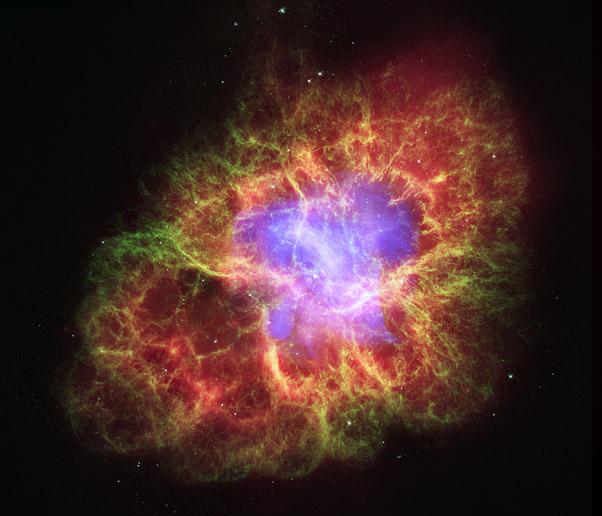
The Crab Nebula.
Image Source: Hyperphysics.
One of the most general expectations of quantum gravity is that space-time is not the smooth background of General Relativity, but instead a wildly fluctuating, bubbly, foamy mess. Seeing the quantum properties of space-time directly is not presently possible, but what we can see is whether the quantum gravitational behavior affects the way particles travel through space-time.

One way this could happen is by distorting paths so that photons of different frequency (energy) move at slightly different speeds. Such an effect is referred to as ‘dispersion’. Next to dispersion there is dissipation, which is basically energy loss into the background. While quantum gravitationally induced dispersion has received substantial attention during the last decade, dissipation hasn’t received as much love.

In a nice and straight-forward recent paper dissipation finally got some love from Liberati and Maccione
    Astrophysical constraints on Planck scale dissipative phenomena
    Stefano Liberati, Luca Maccione
    arXiv:1309.7296 [gr-qc]
They start with a general hydrodynamic ansatz that assigns space-time the properties of a fluid, notably a viscosity, which causes dissipation. The microscopic theory that would give rise to such a hydrodynamic behavior they leave unspecified and just ask what observable consequences a non-vanishing space-time viscosity would have. With this ansatz, they make an expansion of the dispersion relation and collect the dissipative (imaginary) contributions.

Then they look at observations of highly energetic photons from a distant source, the Crab nebula. If space-time was viscous, the photons would lose energy during their travel. Already the rather conservative estimate that the photons of the highest observed energies shouldn’t have lost more energy than they have left at arrival leads to very tight constraints. If the photons lose energy faster than that, the spectrum we receive on Earth would be highly distorted and pretty much incompatible with our knowledge of astrophysics.

This constraint from existing data clearly rules out Planck scale effects, ie effects that plausibly have a quantum gravitational origin, at first order. Better constraints can be obtained by drawing upon concrete astrophysical models for the typical energy of photons that are emitted, so it seems likely that in the future we will see even better constraints on this.

Much like with violations of Lorentz-invariance this is a case where nothing has been found. Yeah, Einstein was right, again. But this doesn’t mean that nothing has been learned. We’ve learned that any model for an emergent space-time that does not have a very small, almost vanishing, viscosity is clearly incompatible with observation.

Thursday, October 17, 2013

Physics World turns 25

The IOP's member magazine "Physics World" turns 25 and has an anniversary issue out. It's full of interesting articles, some more information about the content is on the Physics World Blog, and you can download the issue for free here. It contains a contribution from me on one of the "five biggest unanswered questions in physics" -- "Can we unify quantum mechanics and gravity?"

For the download you apparently have to agree to end up on a newsletter email list. If you don't want that but would like to read my piece, send a brief note to hossi at nordita dot org.

Tuesday, October 15, 2013

Shut up and let me think

I recently attended a conference on the foundations of quantum mechanics in Vienna. It was a very interesting and well organized event. The food was good, the staff efficient, and everybody got a conference bag with an umbrella.

I don’t normally have a lot to do with quantum foundations, especially not since I left Perimeter Institute. And so I learned many new things and got feedback on my paper. It was a useful meeting for me – but it was also a little strange.

Most of the feedback I got was people telling me they don’t believe in superdeterminism, wanting to know why I believe in it, not that I’m sure I do. Discussions turned towards final causes and theology. I’m a phenomenologist, I heard myself saying, I couldn’t care less what other people believe, I want to know how it can be tested. Faintly, I heard an echo of a conversation I had with Joao Magueijo at PI some years ago. Boy, I thought back then, does this guy get explosive when asked about his beliefs. Now I think he must have been spending too much time with the quantum foundations folks. Suddenly I’m very sympathetic to Joao’s attitude.

Quantum foundations polarizes like no other area in physics. On the one hand there are those actively participating who think it’s the most important thing ever but no two of them can agree on anything. And then there’s the rest who thinks it’s just a giant waste of time. In contrast, most people tend to agree that quantum gravity is worthwhile, though they may differ in their assessment of how relevant it is. And while there are subgroups in quantum gravity, there’s a lot of coherence in these groups (even among them, though they don’t like to hear that).

As somebody who primarily works in quantum gravity, I admit that I’m jealous of the quantum foundations people. Because they got data. It is plainly amazing for me to see just how much technological progress during the last decade has contributed to our improved understanding of quantum systems. May that be tests of Bell’s theorem with entangled pairs separated by hundreds of kilometers, massive quantum oscillators, molecule interferometry, tests of the superposition principle, weak measurements, using single atoms as a double slit, quantum error correction, or the tracking of decoherence, to only mention what popped into my head first. When I was a student, none of that was possible. This enables us to test quantum theory now much more precisely and in more circumstances than ever before.

This technological progress may not have ignited the interest in the foundations of quantum mechanics but it has certainly contributed to the field drawing more attention and thus drawing more people. That however doesn’t seem to have decreased the polarization of opinions, but rather increased it. The more attention research on quantum foundations gets, the more criticism it draws.

“Shut up and let me think” is the title of an essay by Pablo Echenique-Robba which you can find on the arxiv at 1308.5619 [quant-ph]. In his personal account Pablo addresses common arguments for why research on quantum foundations is a waste of time. I’ve encountered most of these and I largely agree with his objections. But let me add some points Pablo didn’t mention.

I do have my issues with much of what I’ve seen in quantum foundations. To begin with, most of it seems to be focused on non-relativistic quantum mechanics. That’s like trying to improve the traffic in NYC by breeding better horses. If you can’t make it Lorentz-invariant and second quantized I don’t know why I should think about it. More important, I can’t fathom what most of the interpretation-pokers are aiming at. It’s all well and fine with me to try to find another formulation for the theoretical basis of quantum theory. But in the end I want to see either exactly what the observable differences are or I want to see a proof of equivalence. Alas, there seems to be a lot of talk about, well, interpretations which do neither one nor the other. Again the phenomenologist lacks the motivation to think about it.

Despite these reservations I think that research on the foundations of quantum mechanics is of value, again for a reason that Pablo did not address in his paper, so I want to add.

I’ve been educated in the “shut up and calculate” philosophy with my profs preaching Feynman’s mantra that nobody understands quantum mechanics, so don’t bother trying. Needless to say I, as probably most students, was not so much deterred as encouraged by this, so we dug a little into the literature. If you dig, it gets into philosophy very quickly. That’s not necessarily a bad thing, but most students come around to realize they wanted to study physics, not philosophy, and they move on to calculate. I’m among those who feel comfortable with a mathematical framework that “just” delivers results and that can be used to describe nature. To me science is “just” about making good models.

But those who are criticizing research on the foundations of quantum mechanics on the ground that everything has been understood are dismissing a way to arrive at an improved description of nature, and they are dismissing it based on unjustified arrogance about their superior motives.

Science progresses by evaluating the use of models about nature in the form of specific hypotheses. What we call ‘scientific method’ are procedures that have proved efficient in creating good hypotheses and tests thereof. Not only do these methods change (hopefully improve) over time, what constitutes a ‘good’ hypothesis also depends on beliefs and social dynamics. In the end what matters is not how somebody arrived at a hypothesis, but whether it works. That’s the essence of scientific progress.

The action principle, gauge-symmetry, and unification, for example, have proved dramatically useful in the construction of theories. And that they have been useful in the past is a good reason to employ them in the future search for improved theories. The same goes for naturalness. A theory that isn’t ‘natural’ is typically believed to be incomplete and in need of improvement or at least additional explanation. Yet all that says is that it’s a criterion which researchers draw upon to arrive at better theories. There’s no proof that this will work. It’s a reasonable guess, that’s all. How reasonable depends on your attitude, your beliefs and on whether you think it’ll land you a job.

And so some may guess there is something to be gained by poking around on the foundations of quantum mechanics. You might not believe that the reasons for their interest are good reasons, much like I don’t believe in naturalness and others don’t believe in a theory of everything. But in the end it doesn’t matter. In the end what matters is not what motivated people to study some research question, but only whether it led to something.

My support for quantum foundations thus comes from a live-and-let-live attitude. Maybe studying the foundations of quantum theory will improve our understanding of the fundamental nature of reality. Maybe it won’t. I don’t understand most of their motivations. But then they don’t understand mine either.

Those who are dismissing quantum foundations as a waste of time I want to ask to consider the consequences of this research in fact revealing a different theory underlying quantum mechanics, one that allows us to manipulate quantum processes in novel ways. The potential is enormous. It’s not a stone that should be left unturned.

I’ll shut up now and let you think.

Friday, October 11, 2013

Should the Nobel Prize be given to collaborations and institutions?

It’s a grey and foggy Friday here. The clouds are hanging around like they’ve been out all night and even the leaves are too tired to jump off the trees. A cold is knocking on the door, or at least my brain is mush and I could need an excuse for that. There’s two guys in front of my window tearing off the balcony. If they don’t drink beer and watch me, they make noise and I’m rather unsuccessful in trying to ignore them. In summary, I’m pretty dysfunctional and in a pissy mood. You don’t want me to write a referee report on your paper in this condition.

To cheer me up, I decided I’ll go and disagree with Sean Carroll on something, just for the fun of it. Sean had a recent Op Ed piece in the NYT arguing that “in the future the [Nobel] prize committee should be allowed to consider institutions and collaborations as well as individuals.” It’s well written and worth a read, so have a look. I’ll grab a coffee and wait till you’re back.

There are three ways to approach the question whether the criteria for the Nobel Prize should be changed. One is to look at Alfred Nobel’s original will. He explicitly stated that the prizes be given to “persons”. But then it’s been a while. Second, one can try to guess whether Nobel would have wanted the criteria to be altered if he would be alive today. For me that’s too much psychology and I’ll leave that to somebody else. Third, we can ask whether it would be beneficial for science or for the communication of science and that seems to me the most fruitful approach.

Sean basically argues that science is a community enterprise and if one honors certain discoveries then credit should be given to everybody involved. Scientists take acknowledgement of contributions very, very seriously because it’s essentially what they live from. That’s the reason for long author lists. These lists keep getting longer as the topics we work on become more involved and the experiments become more complex.

However, science has always been a community enterprise. Every single discovery that has been made became possible only through the work of many others before and alongside those who put the pieces of the puzzle together.

Researchers who study the network dynamics of science refer to breakthrough events as ‘pivot points’. They’re combinations of existing knowledge that solve a problem and create a new basis for future research, not seldom founding entirely new fields. You might be interested to have a look at this paper that visualizes pivot points in citation networks with superstring theory as one example.

It has happened frequently in the history of science that major discoveries were made almost simultaneously by several people. That’s not a coincidence but due to the nature of breakthrough discoveries. They typically combine existing knowledge in just the right way. Having the right knowledge at the right time and seeing the potential of this combination is what makes a genius. And that’s what the Nobel Prize honors.

As I argued earlier, while scientists certainly work together, this collaboration is not a case of true collective intelligence. We don’t do distributed information processing in the communities. It’s still single people who contribute ideas and who hand them on to others who work on them and hand on their contributions and so on. It’s just that the interactions have gotten faster and involve more people who are better connected now than they were a century ago. It has become difficult and infinitely cumbersome to track all the small little contributions that people make.

The Nobel Prize, in my opinion, cannot give credits to everybody involved in a discovery because that’s futile. It should then focus on those on whose work was the basis of a new understanding of nature. It is a prize for persons and individual contributions. There are many scientific societies and foundations who give out prizes and awards and nobody ever complains that somebody gets such a prize when there’ve been many other people working on the same thing. That’s because it is understood that these awards are for persons and their dedication and foresight in the first place, and for the specific topic in the second place.

I don’t know anybody who went into science or pursued their research with the aim of winning a Nobel Prize. It is generally recognized that hard work and intelligence is necessary but not sufficient, and that it also takes a good dose of luck which is beyond our influence. So the Nobel Prize doesn’t actually serve as an incentive, or at least not much so. But the mere fact that the Nobel Prize is awarded to (a few) individuals documents the value of personal sacrifice. Giving such an honor to institutions is akin to doing away with private property in communism and believing that everybody cares for the well-being of the group as they do for their own. It doesn’t work because most people want to be recognized as individuals, not as members of collectives. That’s true also for scientists.

There is another reason why giving the Nobel Prize to collaborations or institutions is not a good idea. Nobel Prize winners like no other scientists become spokespeople for their field of research – and beyond. They are being heard. Nobel Prize winners play an important role in representing the interests of the scientific community. Granted, not all of them might live up to expectations, but I think that most of them are aware of the influence they suddenly acquire. Giving the prize to institutions would throw away this voice that scientists have to speak for them, and they don’t have many of these voices.

So I think the Nobel Prize committee is doing the right thing in giving the prize to persons. Because scientists want to be recognized as people, not as members of a collective.

It has started to rain and the balcony guys have packed their tools and left me with a semi-deconstructed balcony and empty beer bottles. Time to finally write these referee reports; keep the gear-wheels of the system turning.

Wednesday, October 09, 2013

Quantum Gravity in the Cosmic Microwave Background?

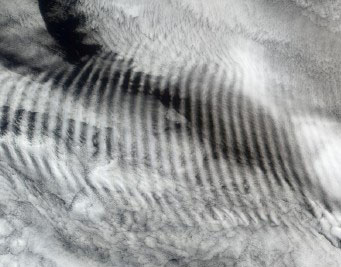
Gravity waves. They are pretty but have
nothing to do with gravitational waves.
Image Source: UWO.
Krauss and Wilczek recently posted a brief note on the arXiv. They present a dimensional argument that claims signatures of relic gravitational waves in the cosmic microwave background (CMB) would be evidence for quantum gravity.

Relic gravitational waves are perturbations of space-time created at the Big Bang. They cannot presently be directly detected, but if they exist they would affect the polarization of CMB photons. The Planck satellite mission is about to deliver data on CMB polarization, so Krauss and Wilczek’s is a very timely contribution.

While their dimensional argument is original and compelling in its simplicity, what they say is not particularly surprising and known to researchers familiar with the subject. The argument means essentially if there are no suitable matter sources that could cause space-time perturbations, then the only way relic gravitational waves can have been created is through quantum effects. That’s because it needs a mass scale to get the dimensions right and Newton’s constant will only give a mass-scale when suitably combined with Planck’s constant, thus indicating a quantum effect.

The argument however only works without matter that brings in anisotropic stress. It would still work if the matter was solely scalar fields because these don’t contribute to the anisotropic stress, but electromagnetic radiation could deliver such a contribution. Be that as it may, this means by a purely dimensional argument alone it is hard if not impossible to reverse the logical arrow, that being the question whether relic gravitational waves could have been created in a non-quantum fashion.

Few few people doubt that relic gravitational waves exist and are quantized. It would certainly be exciting to have evidence that this treatment of the early universe is correct, but it must be said that this is not evidence for what the community commonly refers to as quantum gravity.

“Quantum gravity” is normally meant to be the fundamental theory for the quantum nature of space and time. The quantization that is being used for gravity in the early universe is normally explicitly referred to as “perturbatively quantized gravity”. It is expected by all but a few dissidents that perturbatively quantized gravity is the correct effective limit of any theory of quantum gravity. The mere existence of such quantized perturbations thus tells us little. More telling is the spectrum of the perturbations which depends on what happened in the early universe, for example on whether there was a Big Bang or a Big Bounce, and that does indeed depend on the full theory of quantum gravity.

Evidence for relic gravitational waves would give strong support to the validity of perturbatively quantized gravitational waves (essentially quantum field theory in curved background), but it takes more than a dimensional argument to show that other models cannot produce the same observation. And even if that could be shown, the mere existence of the gravitational wave background does not teach us much about the non-perturbative theory of quantum gravity. Thus, Krauss and Wilczek’s argument makes a good point but its relevance for research in quantum gravity is limited.

Kudos to Jakub Mielczarek for helpful communication.

Bonus: Krauss at a recent discussion following his public lecture in Stockholm. Spot the American among the Swedes :p

Lawrence Krauss in Stockholm. Still from this YouTube Video.

Saturday, October 05, 2013

Women in Science. Again.

Thank you, you can stop sending me the link to the NYT article “Why Are There Still So Few Women in Science?” I assure you I saw it. It just didn’t seem to say anything we didn’t know already, so I wasn’t about to mention it. Alas, it seems to have triggered another wave of public commiseration about the alleged lack of women in the sciences, and it seems moreover I’m expected to have an opinion, so here you go.

I have a hard time believing this bemoaning of the current state of affairs is sincere. If Americans would take the issue seriously they’d have paid maternity leave to assure employers don’t think twice hiring women in their fertile years who haven’t yet reproduced. If you want more women in science, that’s where you should start, not with complaints about dress code schizophrenia. Everybody with half a brain knows that a pregnant or nursing woman will not be as productive as her testosterone fueled colleague. That’s not a bias, that’s capitalism.

Please don’t hold it against me that I published several papers during my parental leave – these were written much earlier and just submitted while I was learning how to ten-finger type with a baby or two hanging on my nipples.

Paid maternity leave and paid parental leave might not be sufficient, but necessary, hear me. And it’s not only the women who will benefit from this, but it’ll generally level the playing field for those who want to have children before the age of 40.

Having said that, I’m always uncomfortable to address the question of women in science, physics in particular. I’m not “women in physics”, I’m one woman in physics, and I don’t want to speak for others who have made experiences very different from mine. I don’t doubt that many women feel awkward in male-dominated environments or that they don’t like to stand out by wearing ‘feminine’ clothes or that they think it inappropriate if they get hit on by a colleague. But Eileen Pollack, who wrote the recent NYT piece, is similarly one woman in physics, so let me to add my own experience to the points she brings up just for balance.

I’ve never been a girly girl; quite possibly having three brothers played a role in that. My teachers constantly complained that I was too quiet, not social enough, did not speak up often enough, did not play with the other kids and was generally awkward around people. I spent a lot of time with books. I never had problems at school, unless you count that I was about as unsporty as you can be. As a teenager I was very into science fiction. And since I wanted to tell the science from the fiction, I piled up popular science books alongside this. You can extrapolate from here.

I studied math and physics primarily because I don’t understand people. People are complicated. They don’t make sense to me and I don’t know what to do with them. Which is probably why I don’t spend a lot of time thinking about whether or not my male colleagues behave appropriately. They don’t make sense either way. And the women, they make even less sense. Take in contrast a problem like black hole information loss or the recent firewall controversy. Clean, neat, intriguing. So much easier.

Yes, there’ve been some guys who’ve tried to pick me up on conferences but for what I understand of human mating rituals it’s the natural thing to happen among adults and I just say no thanks (the yes-thanks days are over, sorry). Indeed, there’ve been sexist jokes and I try to stay away from people who make them because such jokes come from brains preoccupied with differences between the male and female anatomy rather than the actual subject matter of the discussion. There have been the elderly guys who called me “little girl” and others who pat my shoulders. And yes, that’s probably the reason why I’m sometimes acting more aggressive than I actually am and why my voice drops by an octave when I’m trying to be heard by my male colleagues.

But by and large the men I work with are decent and nice guys and I get along with them just fine. Most of the time I’m not consciously taking note of them having a crinkly chromosome I don’t have, and my subconsciousness was not consulted for this blogpost. Yes they interrupt me when I speak and it’s annoying, but they interrupt each other as well, and I’ll admit that I too have developed the unfortunate habit of cutting off others, patience has never been my strong side. I still paint my toenails pink and I do have baby pictures in my office.

I’ve seen a bunch of do and don’t-do lists for men in academia when talking to their female colleagues. If you’d give me a set of do and don’t-do’s for how to deal with my male colleagues, I would decide it’s too complicated and just avoid talking to them all together. So I don’t think these lists are very helpful. I understand that everybody has their touchy points and they want others to respect them, but society has never worked by people giving instructions to others for how to treat them, so can we please just deal with each other as individuals?

Sure, I have a do and don’t-do wishlist for my male colleages as well. Here’s my biggest wish: Unless I know you (meaning we’ve met and talked at least a few times), don’t bring me in a situation where I have to be alone with you in a closed room. Because I’ve unfortunately made some bad experiences at an early age and a situation like this sets off a major alarm in my brain. Run, it says, get out of here. I’m really sorry about this because I’m sure you’re a nice guy and play table tennis with your kids every weekend, but my neural circuits insist you’re a potential threat. That’s my biggest Don’t. But I don’t actually expect you to know this, so I’ll forgive you.

I am aware I might be stepping on some toes here, but I’m not even sure that we really need more women in physics. Because it seems to me that most women are in fact not very interested in physics, especially in theoretical physics. Of course I think it’s a shame and there are almost certainly social and cultural reasons next to genetic ones, but this doesn’t make these reasons any less real. If some girl is uncomfortable taking on a job that has a male smell to it, I think this is an important factor for their decision and for them to be happy with their life.

The social and cultural aspects can be changed, though they change only slowly, and I appreciate all efforts into this direction. Especially when it comes to children’s education and role models I believe this can serve to spark interests that otherwise might have gone unnoticed. So I certainly approve of all means to raise interest in theoretical physics, generally and specifically among young women, but I don’t see the benefit of pushing women into professions they’re not comfortable with. Gender quotas don’t make any sense to me as they seem to make the situation worse rather than better by undermining the credibility of women that benefit from it. On the shortlist for my present job there were 5 people, 3 of them women. This gives me some faith that I wasn’t hired just so there would be at least one woman in the faculty here. That did play a role in my decision to move to Sweden and so did knowing that Sweden has laws regulating a decent maternity and parental leave. (Yes, I did have another offer which was better in some sense and worse in others, so it was not a simple decision.)

I do read the studies and so I know that by all chance I’ve been subject to stereotype bias and from what I read I have to conclude that most likely I sometimes judge other women unfairly myself. This bothers me a lot. I think the best we can do is be aware of these shortcomings and try to address them systematically when we can.

But what bothers me most about the perceived male-ness of theoretical physics is that I’m afraid some women who could find much happiness with the fundamental laws of nature or the evolution of the universe never seriously consider this as a potential profession. Part of the problem is that we, myself included, rarely if ever talk about what drives us into theoretical physics and what keeps us there.

If somebody asks me what I do, I’ll tell them about black holes or gamma ray bursts or the cosmic microwave background. I don’t tell them that even after all these years what amazes me so much about theoretical physics is doing a calculation and getting a result that describes observation, something that explains the world around us. Be that the energy levels of the hydrogen atom or the double-slit experiment, Compton-scattering or gravitational lensing – these little scribbles on a notebook capture a truth about the universe. How awesome is that? And where if not theoretical physics do you find this?

I fail to see how the fascination for this connection between math and the nature of reality is a male domain, and that’s what makes me think the present low fraction of women in theoretical physics is at least partly due to misinformation about what this job is all about. But first, please, the maternity leave.

Tuesday, October 01, 2013

Testing Conspiracy Theories

I'm about to fly to Vienna where I'll be attending a conference on Emergent Quantum Mechanics. I'm not entirely sure why I was invited to this event, but I suspect it's got something to do with me being one of the three people on the planet who like superdeterministic hidden variables theories, more commonly known as "conspiracy theories".

Leaving aside some loopholes that are about to be closed, tests of Bell's theorem rule out local hidden variables theories. But any theorem is only as good as the assumptions that go into it, and one of these assumptions is that the experimenter can freely chose the detector settings. As you know, I don't believe in free will, so I have an issue with this. You can see though why theories in which this assumption does not hold are known as "conspiracy theories". While they are not strictly speaking ruled out, it seems that the universe must be deliberately mean to prevent the experimentalists from doing what they want, and this option is thus often not taken seriously.

But really, this is a very misleading interpretation of superdeterminism. All that superdeterminism means is that a state cannot be prepared independently of the detector settings. That's non-local of course, but it's non-local in a soft way, in the sense that it's a correlation but doesn't necessarily imply a 'spooky' action at a distance because the backwards lightcones of the detector and state (in a reasonable universe) intersect anyway.

That having been said, you might like or not like superdeterministic hidden variables theories, the real question is if there is some way to test if that's how nature works, because one can't use Bell's theorem here. After some failed attempts, I finally came up with a possible test that is almost model-independent, and it was published in my paper "Testing super-deterministic hidden variables theories".

I actually wrote this paper in the hospital when I was pregnant. The nurses kept asking me if I'm writing a book. They were quite disappointed to be drowned in elaborations on the foundations of quantum mechanics rather than hearing a vampire story. In any case, in the expectation that the readers on this blog are somewhat more sympathetic to the question whether the universe is fundamentally deterministic or not, here a brief summary of the idea.

The central difference between standard quantum mechanics and superdeterministic hidden variables theories is that in the former case two identically prepared states can give two different measurement outcomes, while in the latter case that's not possible. Unfortunately, "identically prepared" includes the hidden variables and it's difficult to identically prepare something that you can't measure. That is after all the reason why it looks indeterministic.

However, rather than trying to prepare identical states we can try to make repeated measurements on the same state. For that, take two non-commuting variables (for example the spin or polarization in two different directions) and measure them alternately. In standard quantum mechanics the measurement outcomes will be non-correlated. In a superdeterministric hidden variables theory, they'll be correlated - provided you can make a case that the hidden variables don't change in between the measurements. The figure below shows an example for an experimental setup.

A particle (electron/photon) is bounced back and forth between
two mirrors (grey bars). The blue and red bars indicate measurements
of two non-commuting variables, only one eigenvalue passes, the
other leaves the system. The quantity to measure is the average time
it takes until the particle leaves. In a superdeterministic theory,
it can be significantly longer than in standard quantum mechanics.


The provision that the hidden variables don't change is the reason why the test is only 'almost' model independent, because I made the assumptions that the hidden variables are due to the environment (the experimental setup) down to the relevant scales of the interactions taking place. This means basically if you make the system small and cool and measure quickly enough you have a chance to see the correlation between subsequent measurements. I made some estimates (see paper) and it seems possible with today's technology to make this test.

Interestingly, after I had finished a draft of the paper, Chris Fuchs sent me a reference to a 1970 article by Eugene Wigner where, in a footnote, Wigner mentions Von Neumann discussing exactly this type of experiment:
“Von Neumann often discussed the measurement of the spin component of a spin-1/2 particle in various directions. Clearly, the possibilities for the two possible outcomes of a single such measurement can be easily accounted for by hidden variables [...] However, Von Neumann felt that this is not the case for many consecutive measurements of the spin component in various different directions. The outcome of the first such measurement restricts the range of values which the hidden parameters must have had before that first measurement was undertaken. The restriction will be present also after the measurement so that the probability distribution of the hidden variables characterizing the spin will be different for particles for which the measurement gave a positive result from that of the particles for which the measurement gave a negative result. The range of the hidden variables will be further restricted in the particles for which a second measurement of the spin component, in a different direction, also gave a positive result...”
Apparently there was a longer discussion with Schrödinger following this proposal, which could be summarized with saying that the experiment cannot test generic superdeterminism, but only certain types as I already said above. If you think about it for a moment, you can never rule out generic superdeterminism anyway, so why even bother.

I'm quite looking forward to this conference, to begin with because Vienna is a beautiful city and I haven't been there for a while, but also because I'm hoping to meet some experimentalists who can tell me if I'm nuts :p

Update: Slides of my talk are here.