Pages

Monday, September 30, 2013

Gauge Symmetry Violation (Short film)


Symmetry (Short Film) from Apostolos Vasileiadis on Vimeo.
A physics professor loses control over a false theory of his. A student is there to set things right.


Filmed at Nordita/AlbaNova or in tunnel system between the buildings respectively. Apparently some of the students here have, ehem, dark fantasies.

Thursday, September 26, 2013

The multiverse is not a paradigm and it’s not shifting anything.

Google “multiverse paradigm” and you get more than a thousand hits. According to Wikipedia a paradigm “describes distinct concepts or thought patterns”. Unfortunately, the multiverse is pretty much the opposite: There’s no distinct concept, but instead a variety of loosely related properties of existing theories that are being construed to have a common theme which, we are then told, is sign of an impending paradigm shift.

I’m starting to take offense in this forward defense. If the spread of multiversal “thought patterns” is sold as a paradigm shift, everybody opposed to the multiverse is discarded as being stuck in yesterday. It’s only the enlightened who are ahead of their time and understand the significance. I really don’t think there’s any paradigm here and certainly nothing is shifting. To see why, it’s helpful to distinguish two different classes of multiverses that are presently being discussed, usually thrown together.

1. The Multiverse of Disappointed Hopes

Science works by constructing models for real world systems. These models can then be used to understand what happens in the real world, and to make predictions. A theory is a map from a model to the real world. The model should not be confused with the theory itself. The theory is what tells you how to identify properties of the model with the real world. The model is the actual stand-in for the real world system.


Einstein’s General Relativity for example is a theory: it’s a prescription for how to deal with space-time and particles moving in it. A model is the space-time of a star or an approximately homogeneous matter distribution. It’s the theory of General Relativity, but the ΛCDM model. Likewise, there’s quantum field theory, and the standard model. Needless to say, not everybody uses this terminology all the time, but that’s how I want to use it.

Models and theories are not only used in physics and don’t necessarily have to be mathematical. Psychologists have models for human behavior that they apply to patients – the ‘real world’. A drawing is a model, in this case the “theory” that connects it to the real world comes for free with your visual cortex. A story is a model, the “theory” is your knowledge of the language that relates letters to real world objects or actions. And so on. The merit of mathematical models is that they have a very strict quality control, which is self-consistency.

And then there are toy models.

Toy models are models that do not have real world counterparts. It’s drawings of creatures that don’t exit or stories of people that have never lived. They’re playgrounds of creativity that can teach us lessons about the theory, which is why studying toy models is a very common and often fruitful exercise. There’s an infinite amount of such toy models. You could say there’s a whole multiverse of them, all these toy models that don’t map to any part of the universe we know. Asking whether what they describe is real is like asking if Harry Potter really exists because a story has been written about him. The difference between fantasy novels and physicist’s toy models is the size of the interested audience, but in spirit they’re the same exercises in creativity.


So, sure there are models that don’t describe the real world, in physics as well as in painting. That’s because mathematical consistency alone does not imply a model describes what we observe, much like using English does not imply you talk about real people. Additional requirements are needed besides consistency to construct a useful model, and these requirements are always agreement with observations, though this isn’t always explicitly phrased this way. When we assume Lorentz-invariance or renormalizability or absence of ghosts, these are physical requirements ultimately based on our experience.

This means a multiverse that you can get rid of by adding the requirement that the model needs to describe observation is neither new, nor surprising, nor something to worry about. It just means that mathematical consistency of whatever theory it is you’re dealing with is not sufficient to make a particular prediction. The string theory landscape is a multiverse of this type. The only reason people talk about this now is that many of them had been hoping string theory would make some requirements that one needs in the standard model unnecessary. Alas, these hopes were disappointed, though the last word might not be spoken yet.

Does it make sense to instead talk about probability distributions over the models you get when you refuse to use existing ties to observations, here specifically the values of certain parameters? No. Because that’s cherry picking the observations you want to neglect.

In the construction of the model there always enter many other observations that are being neglected if one considers such probability distributions, such as the number of (large) dimensions, Lorentz-invariance, or the existence of space-time to begin with – these are not requirements of mathematical consistency, these are physical requirements based on observations. If you wanted to be serious with asking for the probability of particular models, you should sample over all models, in the end over all that is mathematically consistent. You’d be left with Tegmark’s mathematical multiverse. And in that mathematical universe you’d have replaced the question “Which model describes the real world?” with “Where are we in the mathematical universe?” You don’t gain anything.


Once you have seen the power of mathematical models to describe natural systems, it is natural to ask if there is a mathematical model that describes “everything” we see. I believe there is. But people who search for a “theory of everything” today mean more than that. They want in particular a theory that delivers the parameters in the standard model. But even if that would be achieved, we would still have to use other axioms that are ultimately based on observations. So while it is worthwhile to try to find a simpler model that reduces the number of axioms, including values of parameters, we can never avoid using input from observation. If we do, we’ll end up with a multiverse which just tells us that mathematical consistency isn’t sufficient.

So if you have a multiverse that can be eliminated by the requirement that the model is consistent with observation, this isn’t a paradigm shift, it’s just disappointed hopes.

2. The multiverse package deal

But there’s a different type of multiverse, one that you cannot get rid of by requiring match to observation. It’s the case in which a theory applied to a model that describes a real world system necessarily maps into a space that is larger than what we observe. Eternal inflation and the many worlds interpretation of quantum mechanics are of this type. Or, more mundanely, there is nothing in ΛCDM that predicts the universe just ends beyond the distance that we can (presently) observe, so you have a multiverse beyond our observations.


This opens a can of interpretational worms because we can now endlessly discuss whether the not observable images of the map are real or not. Personally, I find this a rather fruitless debate about the meaning of the world ‘real’. To me a model is a tool to describe the real world and if it does that, and if it’s an improvement over other models, I don’t care if there are mathematical elements in the model that don’t correspond to real world observables. Mathematics is full of structures that for all we know don’t correspond to anything we observe anyway. I don’t see a reason why we must be able to observe them all.

But, no, I don’t think you should just shut up and calculate. Because we might be mistaken in thinking that what the theory predicts beyond our observable universe is indeed unobservable. Maybe we just haven’t asked the right questions and there are ways to observe it after all.

So it’s an interesting feature that theories can display, but it’s certainly not a new concept. There’s been a century of discussion about the presence of mathematical objects in quantum mechanics that for all we presently know are fundamentally non-observable. So if that’s a paradigm shift it’s one that has already happened long ago.

3. Wilzcek’s Multiversality

Frank Wilzcek recently had a paper on the arxiv titled “Multiversality”. The first half of the article is a nicely written general introduction, the second half is about axion cosmology and then the paper ends quite abruptly. The most interesting part of the paper are three positive answers to the question

“Are there aspects of observable reality, i.e. the universe, that can be explained by multiversality, but not otherwise?”


It is fruitful to look at the answers to gauge the depth of the existing arguments in favor of the multiverse:

“Yes – one is the apparent indeterminism of quantum mechanics, despite its deterministic equations.”

Wilczek claims here the apparent indeterminism of quantum mechanics can be explained by the many worlds interpretation but not otherwise. That’s an objectionable claim, in particular because the qualifier didn’t include anything about locality.
“Yes – the outrageously small, but non-zero, value of the dark energy density.”


Here he is claiming that there is no other way to explain the measured value of the dark energy density than anthropic reasoning and that anthropic reasoning necessarily implies a multiverse. There are many people who would object on the former and the latter is manifestly wrong. You don’t need a multiverse to do anthropic reasoning, see my post Misconceptions about the anthropic principle.

“Yes – the opaque and scattered values of many standard model parameters that are not subject to the discipline of selection.”
An interesting answer because it is phrased to suggest that the values of the standard model parameters are scattered to begin with. Even if they were however that wouldn’t force us to believe that any possible distribution of values actually exists in a more meaningful sense than Harry Potter exists.

Taken together, these answers tell you aptly just how weak the case for a multiverse really is.

Summary

We should distinguish between multiverses that you can eliminate by adding axioms to the theory that tie the model to the real world, and those that you can’t eliminate this way. The string theory landscape is of the former type, you “just” have to find the right vacuum, and good luck with finding that. Eternal inflation and the many worlds interpretation are of the latter type. In this case you get more than you asked for. One can interpret this type of multiverse as a calculation device which might have its uses. It might also turn out that these multiverses aren’t unobservable after all, so these ideas certainly merit some investigation. In any case however, there’s no paradigm shifting here.

Monday, September 23, 2013

Book Review: “You are not so Smart” by David McRaney

You Are Not So Smart: Why You Have Too Many Friends on Facebook, Why Your Memory Is Mostly Fiction, and 46 Other Ways You're Deluding Yourself
By David McRaney
Gotham; Reprint edition (November 6, 2012)

I know I said no more brain books, but this one’s been in the pipe. I’ll make this review short. McRaney in his book goes through 48 ‘brain bugs’ that are shortcomings of human cognition where evolutionary advantageous procedures are inappropriate to present-day situations. Having meanwhile read several books on the topic, I knew about 40 of these brain bugs and the rest are very similar to the ones I already knew.

What I was hoping for in McRaney’s book was some kind of structure, maybe a classification or categories, a big picture – some insight as to how it all ties together or where it’s going and what’s next. But the book is really just a selection of little essays, apparently the result of a blog by the same name, and that’s also what it reads like.

The 48 sections of the book do come with selected references and summaries of research studies that have been made, but a discussion of how well-established any particular result is and if there is maybe contradictory evidence is entirely lacking. Also lacking is space to address the question how these studies relate to behavior in the real world, what the evidence is for this, and, most important, if people change their behavior when being educated about shortcomings in their default mode of thinking.

In summary, the book is an easy read, but it’s not terribly insightful and somewhat uninspired. If you follow the popular cognitive science literature you’ll know pretty much everything that is in the book. The book might be useful for you however if you want to get a quick overview on what topics are presently being discussed in this area, without too much skepticsm or scientific background. Also, the essays all probably make good conversation starters.

Saturday, September 21, 2013

Dear Mr. President

Two weeks ago, Barak Obama visited Stockholm and spent half an hour or so on the KTH campus. Since Nordita is officially part of KTH, safety regulations went through the employee email list weeks in advance. Luckily I was away the great day. I was told later the Swedes were so successful scaring people off the impending traffic disaster that Stockholm was basically deserted during the President’s visit and elks were seen chewing licorice in front of the royal palace.

I flew back to Stockholm the following day. Lufthansa online check-in suffered an interesting technical glitch and produced a boarding pass for seat 1A business class. Yeah to software bugs. As I was sitting in the business class with leg space I don’t actually need (I’m not socialist, just short), I couldn’t help but wonder what, if I had 15 minutes, would I tell the President. Hell, what would you tell the man?

From the German perspective, the American political system looks strange, which is ironic given the history of Germany’s representative democracy. The strong role of the US President in particular and the focus on individuals rather than programs in general is the most obvious difference. Stranger even is that the political landscape in America is in practice a two party system. This has created a situation where, instead of different parties offering a spectrum of alternatives, the two parties morph to fit their potential clientele, or make it fit. And, needless to say, the wealthy part of the clientele lobbies for their interests, an influence that’s amplified by the almost complete lack of labor unions.

Yes, from a German perspective it seems strange that a country which values democracy so dearly practices it so badly. But then I’m not a political scientist, I just hope I know enough to put my two X in the right places on Sunday.

During the years I spent overseas, Academic America seemed to be overwhelmingly on the side of Obama’s Democratic Party. I recall many seminars in which an US American speaker would make jokes or political statements that clearly showed they were confident the majority of the audience would sympathize with their political views. And they were right of course. (Provided the audience was mostly American. These jokes don’t fly in Europe.) But during the last year I sense this support base faltering as the conditions for scientific research gradually worsen under Obama’s watch.

There are many things the man must shoulder and I’m sure they weigh heavily. Among all these weighty boulders, there’s a tiny little pebble that made me lose my faith the USA will overcome its anti-scientific congestion. It came with this headline:

    “Last month [March 2013], President Obama signed 600 pages of legislation to keep the government from shutting down, while shutting down much of the nation’s [political science] studies. Senator Tom Coburn (R-Okla.) secured Democrats’ approval for an amendment to the bill that eliminates the National Science Foundation’s political science studies, except those the NSF director deems relevant to national security or U.S. economic interests.”
By now, the NSF has cancelled the political-science grant cycle.

Dear Mr. President, how could you have let that happen?

Every major problem that this planet presently faces is primarily about organizing human life and negotiating complex problems with uncertain solutions. The existing political, social, and economic systems are insufficient to deal with these problems, and scientific knowledge is insufficiently integrated into decision making procedures. As societies and economies have become more interconnected, political institutions have not kept pace. The technology is there, the knowledge how to use it isn’t. This realization lies behind initiatives like the FuturITC and attempts to predict political unrest. Yes, that’s political science for you.

Today riots are organized on twitter, wars are led on YouTube, and election results predicted on online futures markets. Nobody knows what this means for the future of democracy. Do Facebook and Twitter help spread Democracy and Human Rights? Are the White House Petitions are good idea or do they just create noise? Yes, that’s political science for you. We all have too much information and not the faintest idea how to intelligently aggregate it and use it within our political systems. We need a scientific approach to institutional design. Trial and error is an archaic procedure that takes time that we don’t have, and errors have become too costly.

Just the situation to scrape funding for the political sciences, I see.

I am trying to imagine Angela Merkel suspends all governmental funding for political science. Germany is the land of the poets and thinker, the land of Kant, Hegel, Marx, Engels and Weber. Besides inventing compound nouns, Germans are also good with solidarity, strikes, and nudity. The Americans made very sure each German receives a solid education about the merits of democracy. I can see the outrage. I see the ‘68 students, now at retirement age, clogging the streets, “academic freedom” scrawled over their flopping breasts. “Censorship!” they shout. “Thoughts are free” they sing. Then the President of the United States calls. “Angie,” he says “Wtf?”

The great advantage of the American political system over the German one is however that the US President can only serve two terms, while the German chancellor can run till he or she drops dead.

Dear Mr President: I hope you tried a handful of the salty licorice that the Swedes chew down by the pound. Because that’d make you as sick as I feel when I read what American scientists must endure these days.

Tuesday, September 17, 2013

Quantum Gravity in Gamma Ray Bursts: Still Nothing

Small wavelength photons (blue) travel faster
than their long wavelength companions (red).
[Image Source]
Gamma ray bursts emit highly energetic photons that, by the time they reach us, have a long journey behind them. That makes these photons excellent candidates to test new physics: Because both the energies and the distance are extreme they potentially give us access to so-far undiscovered effects.

However, in contrast to supernova of type Ia, gamma ray bursts are one of a type – they’re not so much standard candles but surprise fireworks. That makes these photons not quite so excellent candidates to test new physics.

A story that dates back now more than a decade and that has been hailed as a ‘test of quantum gravity’ is that certain quantum gravitational effects could lead to an energy-dependence of the speed of light. In this case, photons of high energy would travel either faster or slower than the low energetic photons (depending on the sign of a parameter). Such an effect is not allowed by the presently established theories, and looking for a signal of an energy-dependent speed of light therefore tests deviations from Einstein’s theory.

Theoretically, there are two different ways this could happen, either by a breaking of Lorentz-invariance or by a deformation of Lorentz-invariance, and these cases have to be carefully distinguished. Both cases lead to an energy-dependent speed of light, but if Lorentz-invariance is broken, meaning there is a preferred restframe, then this would lead also to other effects that we should have seen already. This means if we do see such an unexpected effect in the emissions of gamma ray bursts, we’d know it’s not a breaking of Lorentz-invariance but a deformation. This would be considerably more exciting, but is also much more speculative.

My position on this has been, and still is, that a deformation of Lorentz-invariance is not well motivated and theoretically highly problematic, thus I don’t think an energy-dependent speed of light is plausible. But in the end the question is what the data says.

Data however is a reserved companion who just politely asks to be analyzed, and given that no two gamma ray bursts are alike it’s not at all clear how to do the analysis. It seems to me experimentalists are still poking around and trying out new methods. Occasionally a constraint comes out of this. The most recent constraint came out in two papers by Vlasios Vasileiou and a whole list of other people in no particular alphabetic order (if somebody can fill me in on the authorship order in that part of the community, please enlighten me).

To make a long story short, they propose three new ways to arrive at new bounds, all with advantages and disadvantages, and arrive at a bound that constrains new quantum gravitational effects to be beyond 7.6 times the Planck scale, at 95% confidence level. This means the new bound is both weaker and at a lower confidence level than the bound by Nemiroff et al that we previously discussed, so it’s non-news really. And that doesn’t even take into account that the more ways you try to extract a signal from the data, the less likely it will eventually be a real effect.

In a footnote in the discussion the authors of the new paper criticize the Nemiroff et al result basically for the same reasons that I put forward in my earlier blogpost: The constraint hinges very strongly on a few pairs of photons. But the advantage of the Nemiroff analysis is that it’s a clear and clean method that can rapidly increase to higher statistical relevance with more observations, provided we see just a couple more of such pairs. It merely relies on the statement that it’s quantifiably unlikely that a few photons arrive almost simultaneously if they weren't emitted simultaneously and traveled together – at the same speed. Unfortunately, the significance of that result could also decrease in relevance, and that for reasons that have nothing to do with the energy-dependence of the speed of light, just with the physics at the source.

The new approach in the Vasileiou et al paper is valuable however for trying to take into account an intrinsic dispersion of the source. But I think the great weakness of this bound is the same as the previous bounds: low statistics with results that strongly depend on one or a few gamma ray bursts. I doubt we’ll ever get rid of the possibility that source effects play a role unless red-shift is taken into account and different distances are sampled over. That’s because an energy-dependent speed of light should yield a stronger effect the farther away the source, while a source-dependent effect does not get stronger.

Either way, for me it’s a win-win situation :o) There’s either quantum gravity in the gamma ray burst measurements or there isn’t. If there is, it’s a huge boost for the field I work in. If not, I was right all along saying that there is no effect. At the moment however the situation isn’t entirely settled, so stay tuned.

Monday, September 16, 2013

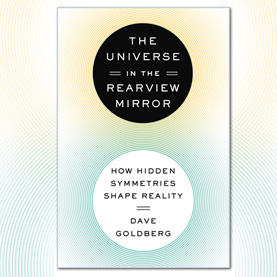
Book Review: The Universe in the Rearview Mirror

The Universe in the Rearview Mirror: How Hidden Symmetries Shape Reality
By Dave Goldberg
Dutton Adult (July 11, 2013)

In his new book “The Universe in the Rearview Mirror,” Dave Goldberg expounds the important role of symmetries in the fundamental laws of physics. He starts with the discrete operations of charge-conjugation, parity, and time inversion, and their combinations. After introducing the reader to Emmy Noether and her work, he discusses continuous symmetries, homogeneity and isotropy, as well as Lorentz-invariance before continuing with gravity. The later chapters deal with gauge symmetries and symmetry breaking. The book finishes with existing proposals for physics beyond the standard model, grand unification, supersymmetry, and the missing theory of quantum gravity.

Goldberg does a remarkably good job conveying a very technical topic in non-technical terms and with only a handful of equations (yes, E=mc2 among them). He works mostly with analogies and writes in an engagingly colloquial way with a large dose of humor, though some readers might find the high density of jokes more distracting than helpful*. The bibliography and the guide to further reading provide helpful references for the readers who wish more details, and the book also has a brief glossary.

Symmetries that “shape reality,” as the subtitle of the book says, are a vast topic of course. Goldberg has focused on these symmetries that (for all we know) shape reality on the most basic level. He does not (except for the purpose of a brief analogy) touch upon the much broader topic of emergent symmetry and order in condensed matter systems, or in other areas of physics and science more generally. This focus has the benefit that the book is relatively lean (291 pages, hardcover) and maintains its momentum, but the blurb could have been more descriptive.

On the downside, the book is confusingly structured and the reader who doesn’t bring prior knowledge might become frustrated in several places. For example the WMAP mission is mentioned in the first chapter, without explanation for what exactly it measures and without an image. The radiation of the cosmic microwave background is again introduced in the third chapter, without referral to the earlier mentioning of WMAP, and temperature anisotropies are briefly mentioned here. Temperature anisotropies are then again introduced at the end of this chapter and here the WMAP image finally appears (low-resolution black-white), alas without the image being mentioned in the text and without explanation for what it shows.

In fact, while the graphics that have specifically been produced to accompany the text are well done and helpful, the book also contains a number of images that are useless and only loosely connected to the text. An image on page 41 I guess shows the Venus transit which is mentioned in the text on this page, or maybe it shows an exercise to find one’s blind spot. On page 109, the reader encounters a Klein bottle and the only reason I can infer is that the next page mentions Emmy Noether “took classes with Hilbert and Klein.” An image on page 118 (no caption) shows Einstein arcs and the explanation in the text amounts to “massive bodies bend light”. The image on page 250 remained a mystery to me until I found it in the Wikipedia entry to “Sisyphus” (mentioned on that page).

The book is also confusing and unstructured in other ways. Goldberg begins to talks about “the elusive dark matter particle” (in itself a questionable phrase) in Chapter 9 without so much as mentioning what dark matter is or what evidence we have for it. He uses the Planck length in chapter 6, but only explains it in Chapter 10. The cosmological constant problem is introduced twice. The elaboration on the twin paradox somehow misses to spell out what the resolution of the paradox is. It is mentioned that inflation was proposed “to get around the horizon problem” but the reader is not actually told how inflation solves the problem. Evidence for inflation amounts to “we’re reasonably certain that it is [correct]”. Goldberg elaborates on the multiverse and later on the compactified dimensions of M-theory, but does not connect the two topics. He speaks about the entropy of matter in the early universe before explaining what happened in the early universe. On page 167/168, I came across the possibly most opaque motivation for quantum gravity that I’ve ever encountered. Luckily there is a considerably better one on page 269. A quotation from Stephen Hawking expressing the opinion that information is not lost in black holes is dumped onto the reader in a description of black holes as “entropy-producing machines” without so much as mentioning the black hole information problem.

I’ll not go down the full list of similar notes that I took while reading; you get the picture.

Goldberg has to be credited for making his text timely by referring to very recent works, for example he mentions Verlinde’s contribution on entropic gravity. This reference (the only reference on the topic) appears in a section on the arrow of time and at least I could not infer the direct connection, besides both having something to do with entropy. Goldberg uses Max Tegmark’s proposed level structure of the multiverse and in the last chapter on physics beyond the standard model we meet Garrett Lisi the surfer without university affiliation who allegedly stunned everybody with proposing his theory of everything. It somehow goes unmentioned that Lisi has PhD in physics. I’m picking at this point not because I don’t think the E8 root diagram is pretty, but because the reader is left with the unfortunate impression that surfing is all you need to understand modern physics. Towards the end of the book the reader can find a very good summary of the recent discovery of the Higgs particle and its relevance.

In summary, the book is valuable for the selection of topics and for conveying the relevance of symmetries in the laws of nature, but the execution leaves wanting. Sean Carroll’s two books for example cover a substantial part of the physics built upon Goldberg’s hidden symmetries, but the reader who does not bring prior knowledge about modern physics will learn a great deal more from Carroll’s more didactic approach. Goldberg however succeeds in inspiring a sense of awe for the power of symmetries, not at least because awesome seems to be one of his favorite words.

*Humor, of course, is always a matter of taste. So let me just say that messages like “science nerds… spend … many nights alone” or physicists don’t know how to dress elegantly and don’t get invited to dinner parties, strike me more as funny-peculiar than funny-ha-ha.

Thursday, September 12, 2013

Whatever happened to AdS/CFT and the Quark Gluon Plasma?

A decade ago, the AdS/CFT correspondence was celebrated as a possible description of the quark gluon plasma. RHIC measurements of heavy ion collisions at that time showed a surprisingly small viscosity that lead to a revision of the previous models. Excitingly, a small viscosity appears naturally in the gauge-theory dual of the AdS/CFT correspondence, nevermind that QCD is neither conformal nor supersymmetric. This development was all the more welcome as it served to demonstrate that string theory is not useless, as critics claimed, but that it can provide insights which improve our understanding of physical processes in the real world.

The gauge-gravity correspondence rapidly became a boom area in high energy physics. After the viscosity, people looked at other observables, notably the energy loss of particles going through the plasma. In highly energetic particle collisions, quarks are produced in pairs, but due to confinement individual quarks are never measured. What is measured instead are color-neutral hadrons that the quarks decay into and that are bundled into the direction of the original quarks. These bundles of hadrons are called jets and in the simplest case there are two of them with total momenta that are back-to-back correlated owing to their common origin from the quark pair.

In a heavy ion collision, one of the quarks may have to pass through the quark gluon plasma and thereby loses energy. This leads to what is known as ‘jet quenching’, a pair of back-to-back correlated jets where the total energy on one side is reduced. The energy loss in the plasma can and has been calculated in different models for heavy ion collisions. There are about a handful of such models, and in the days before the LHC all tried to get in their predictions for the jet quenching at LHC energies, the central question being how the energy loss scales with the increase in collision energy.

After the LHC heavy ion runs, it turned out the data do not agree very well with the scaling expected for energy loss from the AdS/CFT correspondence – in fact from all the models it was the worst prediction. As we discussed in an earlier post, AdS/CFT predicts too much energy loss, the plasma is too strongly coupled.

AdS/CFT confronts data. Image Credits: Thorsten Renk.
For details and references, please refer to this earlier post.

That the scaling doesn’t fit well with the data need not be too much of a worry because these scaling arguments were quite general and in reality the process of propagation through the quark gluon plasma isn’t quite as simple. But clearly the new data called on theoretical physicists working on AdS/CFT to study the observables and improve their model or to call it a failure and move on. Alas, nothing like that happened.

Since the LHC data came in, for two years or so, I’ve now been sitting through AdS/CFT talks that would inevitably be motivated by the low viscosity of the quark gluon plasma and the RHIC data, frog spawn picture and all. And every time I’d raise my hand at the end of the seminar and ask for the speaker’s opinion on the recent LHC data, expecting an update on the work on that matter and that there is no need to worry because the models can be improved to accommodate the data. Instead, it was like the LHC never happened. I don’t work in this field and don’t even follow the literature closely, but it seemed that I knew more about the problems with the LHC results than the people who got paid for talks motivated by yesterday’s data.

What they’d typically say is that nobody really expected AdS/CFT to make quantitative predictions. Alas, even the qualitative prediction, the mere slope of the curve, is wrong. The only prediction that is “qualitatively” correct is that there is some energy loss. Besides this, it’s all well and fine that a new model doesn’t make quantitative predictions, but that’s not a status that should become permanent.

It’s not that the data went entirely unnoticed. A few brave souls took on the issue. In this paper Ficnar, Norona and Gyulassy looked at the effects of higher derivative corrections to the gravity sector. It's somewhat ad-hoc, but apparently does reduce the energy loss. There is however no fit to the data and I’m not sure what this does to other observables. In another work, Ficnar also took into account a time-dependence of the configuration, but the conclusions with respect to the jet quenching and LHC data remain vague and amount to “a more thorough numerical analysis is needed.” In a recent paper, William Horowitz summarized the situation as follows:

“Despite significant efforts, AdS/CFT estimates for light quark and gluon energy loss are qualitative at best… it is difficult to imagine that a relatively sophisticated estimate of the suppression would be consistent with data.”

I was thus thrilled when I heard a talk by Stephen Gubser (about recent work with Ficnar) at a conference in Frankfurt this July, because he spoke about a possibility to improve the AdS/CFT model to accommodate the LHC data. Unfortunately, Gubser and collaborators don’t have a paper about this on the arXiv yet, so all I can do is refer you to the slides. My vague recollection is that he said one needs to take into account the momentum on the endpoints of the strings and that this does improve the scaling of the energy loss and fits considerably better with the LHC measurements. Though, if I recall correctly, getting the slope to match the data requires pushing the parameter into a range where one actually shouldn’t trust the model anymore. So in the end this might not solve the problem either.

If that explanation sounds like I don’t really understand the details it’s because I don’t really understand the details. I didn’t take notes, and two months later that’s as much as I can recall when looking at the slides and the Princeton professor has not been very communicative upon my inquiry. I thus just want to draw your attention to this development – if you’re interested in the topic, I recommend you have an eye on Ficnar and Gubser’s next arXiv uploads. For all I can tell, these guys are the only ones who take the issue seriously and so far it doesn’t sound too promising to me. If I’m missing some references, please let me know.

I don’t know enough about the topic to tell how likely it is that the AdS/CFT model can be improved to fit the data, and personally I find the applications to condensed matter systems better motivated. What annoys me about this situation is that people working in the field continue to decorate themselves with false achievements when they use the viscosity of the quark gluon plasma to justify the relevance of their own work and that of string theory by large.

It’s time the community comes clean and draws a conclusion. Either AdS/CFT cannot describe the quark gluon plasma, then please bury this episode in the history books and move on. Or it can, and then I expect to see a curve that fits on the LHC data. At the very least I want to hear it’s on the to-do list. Yes, the LHC really happened.


Sunday, September 08, 2013

The Limits of Science

There’s been some buzz going through the blogosphere, following an essay by Steven Pinker on “Scientism”. On the one side of the debate are those who believe scientism is a higher state of consciousness, and on the other side those who think it’s a scientifically transmitted disease with a symptomatic itch that shouldn’t be scratched publicly. And I think they all failed to address the main point: Where are the limits of science? And how do we find them?

If I read essays by philosophers and social scientists and other academics in what is vaguely considered “soft science” I often can’t but sense a certain ring of panic. The physicists are coming, is what I read, they’re planning to take over with mathematics. Then they rush to ensure themselves and everybody else that no, no, some things can’t be described by mathematics. This appeals to the public because nobody likes to be predictable and many people are afraid of math. The softies line with the masses and end up being the good guys for perpetuating cognitive illusions, while the physicists are marked delusional reductionists. Welcome to the 21st century.

Oh yes, the softies will admit, there are meanwhile many mathematical models in the social sciences, and neuroscience has already made some discussions about consciousness entirely redundant. But look, they’ll say, these can only tell you something about statistics (scary math word). Human behavior can’t be modeled mathematically. After all we’ve got free will (unproved). We understand the models about us (irrelevant). Humans are special (said the human), the brain is complex (whatever that means), and it’s got qualia (defined by being unmeasurable). And, most importantly, humans are not elementary particles. (Always good to finish an argument with a completely irrelevant statement that everybody must agree on.)

The problem with these elaborations, besides making me wonder what these people get paid for, is that we presently know of no reason why some observations, like human behavior, cannot be modeled mathematically. But neither does anybody know for sure that it is possible. What we do know however is that it certainly is not presently possible. And that’s what determines the limits of science: our present possibilities, what we can do in practice, and not unknown and quite possible unknowable principles.

It shouldn’t be relevant to my argument, because I’m telling you what matters is what we can do in practice and not what we can do in principle. But just so you don’t misread me: I don’t believe that everything can be described by mathematics (for reasons I’ve laid out here). I’m just saying that we presently don’t know of any reason why it should not possible to describe human behavior mathematically.

Personally, I think it is possible but useless in that such a model would in the best case be a copy of the real system and would not deliver predictions. It would be like trying to understand the sun by simulating it in true resolution and real time on a computer cluster. Then you can either watch the sun or your computer, but besides this you haven’t really gained anything. If you believe that we live in a matrix as study-objects, then we live here because it was not possible to find a simpler way to analyze behavior of human societies than just creating and watching them.

So much about my beliefs. But these are beliefs because we don’t know whether they’re true, and in any case these limits that might exist in principle are far beyond the limits that presently exist in practice.

And of course science has limits. It has limits because our understanding is incomplete. These limits of science aren’t fixed and they are constantly shifting as we learn more about the world that we live in. In that process, topics that were previously inaccessible to the scientific method become accessible, and that creates friction in the communities.

Imagine the world of knowledge as having a core of hard science, surrounded by a belt of soft science, that goes over into interpretations, narrative, opinions, speculations, and eventually fantasy. The hard core expands as we learn: What once was a matter of interpretation becomes measurable. What once seemed beyond computational possibility becomes computable. What once was merely a story becomes supported by evidence. Problems arise if researchers refuse to use the best scientific methods of the day in their field. Then they are simply acting unprofessionally. And when they notice they’ve missed the boat they panic.

Where are the limits of science right now? That’s the discussion that we should have. And it’s not an easy one.

Let me give you three examples of what’s presently off-limits for mathematical modeling.

One is history. You could in principle imagine that it was possible to create a model about human behavior, say, in war-times, that produces outcomes that we can observe today, for example how people expressed themselves in the literature. Then you could analyze the literature to draw conclusions about the circumstances back then. Needless to say, converting experience into writing is so difficult to model mathematically that nobody can do this, and nobody even knows if it is possible. So instead historians go and read the literature and study the paintings, and try to interpret them by taking into account as much as they know, most notably about being human, something that they can do better than any software or equation. At least for now.

The second one is personal identity. Nobody really knows what it takes for a human brain to create a sense of self-awareness and the experience of being an individual actor in possession of a body. Neuroscience has collected a lot of information on that matter, but we’re far off from being able to mathematically model these processes. Much of the literature on the subject is interpretation of data or case-studies. But wait some decades and I’m sure we’ll know much more about what enables “you” to think of “yourself”.

The third example is politics. One often hears that science can only deliver the facts, but humans still have to make the decisions because they have to take into account “morals” and “values” that are off-limits for science. This is however empty vocabulary. Values and morals are just simplifying concepts that arise in our cultures. They are in the first line words that primarily serve the purpose of communicating opinions. Morals and values change over time, people tend to interpret them individually differently, and they might regard them more or less helpful for their self-expression. But there is nothing – in principle! – that prohibits science from predicting the emergence of certain morals and values. Again though, in practice, nobody can do this.

And that’s why science cannot replace politics. Because when you express your opinion about a possible change, you are projecting yourself into the future and try to find out whether or not it would be an improvement. Or, in the Darwinian mindset, whether you’ll be more or less well adapted to your environment. For this projection you need to know some facts, and these facts science can provide – with errorbars. But what science cannot do is to project you and your experience into the future. The best way that we presently know to do this projection is to ask people to do it themselves. There are pitfalls to this, because we are not actually good at predicting what we will think in ten years from now. But presently it’s the best we can do.

The last example also tells you why it is important to know the present limits of science. Because it raises the question what we know about human decision making and whether we can use that knowledge to make better decisions.

In summary. Science has limits, but they change over time. Knowing where the present limits of science are is important because that’s where opinions and interpretations become relevant to decision making. Excuse me for publicly scratching my itches.

Tuesday, September 03, 2013

What is Special Relativity?

I got issues. Here’s one. I don’t like what people say about special relativity. Because we’re friends, special relativity and I.

I got issues with certain people in particular, those writing popular science books. Sometimes I feel like have to thank every physicist who takes the time to write a book. But, well, I got issues. Also, I got sunglasses and a haircut, see photo.

I presently read “The Universe in the Rearview Mirror” (disclaimer: free copy) and here we go again. Yet another writer who gives special relativity a bad name.

Here’s the issue.

Ask some theoretical physicist what special relativity is and they’ll say something like “It’s the dynamics in Minkowski space” or “It’s the special case of general relativity in flat space”. (Representative survey taken among our household members, p=0.0003). But open a pop science book and they’ll try to tell you special relativity applies only to inertial frames, only to observers moving with constant velocities.

Now, as with all nomenclature it’s of course a matter of definition, but referring to special relativity as being only good for inertial frames is a bad terminology, and not only because it doesn’t agree with the modern use of the word. The problem is that general relativity is commonly, both among physicists and in the pop sci literature, referred to as Einstein’s theory of gravity, rubber sheet and all. Einstein famously used the equivalence principle to arrive at his theory of gravity and that principle says essentially: “The effects of gravity are locally indistinguishable from acceleration in flat space.” With the equivalence principle, all you need to do is to take acceleration in flat space and glue it locally to a curved space, and voila there’s general relativity. I’m oversimplifying somewhat, all right, but if you know a thing or two about tensor bundles that’s essentially it.

The issue is, if you don’t know how to describe acceleration in flat space then the equivalence principle doesn’t gain you anything. So if you’ve been told special relativity works only for constant velocities, it’s impossible to understand all the stuff about angels pulling lifts and so on. You also mistakenly come to believe that to resolve the twin paradox you need to take into account gravity, which is nonsense.

Yes, historically Einstein first published special relativity for inertial frames, after all that’s the simplest case, and that’s where the name comes from. But the essence of special relativity isn’t inertial frames, it’s the symmetry of Minkowski space. It’s absolutely no problem to apply special relativity to accelerated bodies. Heck, you can do Galilean relativity for accelerated bodies! All you need is to know what a derivative is. You can also, for that matter, do Galilean relativity in arbitrary coordinate frames. In fact, most first semester exercises seem to consist basically of such coordinate transformation, or at least that’s my recollection. So don’t try to tell me that the ‘general’ of relativity has something to do with the choice of coordinates.

So yes, historically special relativity started out being about constant velocities. But insisting – more than 100 years later – that special relativity is about inertial frames, and only about inertial frames, is like insisting a telephone is a device to transfer messages about cucumber salad, just because that happened to be the first thing that ever went through a phone line. It’s an unnecessarily confusing terminology.

Since special relativity is busy boosting your rocket ships with laser cannons and so on, on her* behalf I want to ask you for somewhat more respect. Special relativity is perfectly able to deal with accelerated observers.


*German nouns come in three genders: male, female and neuter. Special relativity, or theory in general, is a female noun. Time is female, space is male. The singularity is female, the horizon is male. Intelligence is female, insanity male. Don’t shoot the messenger.

Friday, August 30, 2013

Should you write a science blog?

I get asked a lot how I keep up the blogging. It might be the second most asked question right after “What happened to your hair?” (Answer: It’s a natural disaster, get used to it.) The third frequently asked question, especially by students, is “Do you have any advice if I want to start blogging?” Yeah, I do, but I’m not sure you want to hear it.

I used to think there should really be more scientists blogging. That’s because for me science journalism not so much a source of information but a source of news. It tells me where the action is and points into a direction. If it seems interesting I’ll go and look up the references, but if it’s not a field close to my own I prefer if somebody who actually works on the topic offers an opinion. And I don’t mean a cropped sentence with a carefully chosen adjective and politically correct grammar. In some research areas, quantum gravity one of them, there really aren’t many researchers offering first-hand opinions. Shame on you.

So yeah, I think there should be more scientists blogging. But over the years I’ve seen quite a few of them starting to blog like penguins start to fly. If I had a penny for every deserted science blog I’ve seen I’d be wondering why some deranged British tourist stuffed their coins into my pockets. What’s so difficult about writing a blog, I hear you asking now. You’re asking the wrong person, said the flying penguin, but what blogger would I be if I only had opinions on things I know something about? So here’s my 5 cents (about 4.27 pennies).

As everybody in quantum gravity knows, first there’s the problem of time. So here’s

    Advice #1: Don’t start blogging if you don’t have the time.

Do you really want to invest the time you could be teaching your daughter basketball? Do you really think it’s more important than rewriting that grant proposal for the twentieth time? If you had the time to write a blog wouldn’t you rather use it to learn Chinese, train for a marathon, or become an expert in power napping? If you answered yes to any of these questions, thank you and good bye. Also, give me my money back. If you answered yes to all of these questions, I suggest you touch base with the local drug scene.

But how much time will it take, is your next question. Depends on your ambition of course, said the penguin and flapped her wings. You should produce at least one post a week if you ever want to get off the ground, which brings me to

    Advice #2: Don’t start blogging if you don’t like writing.

The less you like writing, the longer it will take and the more time becomes an issue. The more time becomes an issue, the more you’ll hate blogging and esp those people who seem to produce blogposts, seemingly effortlessly, 5 times a day, apparently while cooking for a family of twelve and jetting around the globe in a self-made, wooden plane sponsored by their three million subscribers.

Are you sure you like writing? No, I didn’t mean you gave it a thumb up on facebook. Are you really sure you like the process of converting thought into keyboard clatter? Ok, good start. But just because you like it doesn’t mean it’s easy.

I’ll admit it took me years to realize it, but evidently I have a lot of colleagues who fight with words. Did you notice that this blog has a second contributor? Yes, it does. It’s just that the frequency of my posts is a factor 300 or so higher than his. He can be forgiven for making himself rare because he’s got a full-time job and two kids and a wife who blogs rather than doing the laundry. But mostly the problem is that he’s fighting with words.

Words – Once upon a time I went to a Tai Chi class. The first class was also the last because I realized quickly that my back problem wasn’t up to the task of throwing people around. I used the opportunity though to punch the trainer straight into the solar plexus a second before he had finished his encouragement to do so. I hope he learned not to use more words than necessary. But I also took away a lesson, one that’s been useful for my writing: Don’t try to take hits frontally, deviate them and use the momentum. So here’s my

    Advice #3: Don’t be afraid of words.

Words aren’t your enemies. It they come at you, use their momentum and go with it. That’s easier said than done, I know, especially if you’re a scientist and have been trained to be precise and accurate and to decorate every sentence with 20 references and footnotes. But don’t think you actually have to be a good writer. Because most likely your readers aren’t good readers either, which is only fair. If you can really write well, you shouldn’t blog, you should… you should… write my damned grant proposal. What I mean is if you try to blog like you write research articles, you’ll almost certainly turn out to be a flying penguin, so don’t overthink it.

However, nobody is born flying, so here’s

    Advice #4: Be patient.

It takes time until you’re integrated into the blogosphere. You can help your integration by using social networks to make yourself, your expertise, and your blog known. Unless you are already well known in your field, it will probably take at least a year, more likely several years, till readership catches on. Until then, make contacts, make friends, learn from others, have fun. Above everything, don’t call a blogpost a blog, it’s mistaking the weather for the climate.

If you still think you want to write a blog, then go ahead. I honestly don’t think it takes more than that: Time, and a good relation to the written word, and patience. The main reason I’m still blogging is that I like writing and verbal TaiChi doesn’t take me a lot of effort. It arguably also helps that since 2006 I’ve been employed at pure research institutes and don’t have teaching duties, see advice #1.

Then let me address some worries. This might be more an issue for the, eh, more senior people, but it should be said

    Advice #5: Don't be afraid of the technology.

As with everything in life, you can make it arbitrarily complicated if you want, but as long as you have an IQ above 70 you'll find some way to blog. It really is not difficult. Another worry that newcomers seem to have is that they’ll run out of ideas, so let me assure you

    Advice #6: Don’t worry that you’ll run out of things to say.

Topics will come flying at you faster than you can get out of the way. There’s always somebody who’s said something about something that you also want to say something about. There’s always some science writer who got it so totally wrong. There’s always somebody’s seminar that was interesting and somebody’s paper that you just read. And if all of that fails, there’s always somebody who has thrown sexist comments around, ten things you wish you had known when you were twenty, and down at the very bottom of the list there’s blogging advice. So don’t worry, just take notes when you come across something interesting or have an idea for a blogpost. I pin post-its to my desk.

Yes, in principle you can fill your blog otherwise than with words. This might work if you have a lot of visual content, pictures, videos, infographics, applets, etc. Alas, the way things have developed the primarily visual stuff has migrated to other platforms and blogs are today the format primarily used for verbal content. And since the spread of twitter, facebook and Google+, sharing links with brief comments has also left the blogosphere. Blogging started out mostly being about writing, and it boomeranged back to this.

Having said that however, blogging of course isn’t only about writing, it’s also about reading. So here’s my

    Advice #7: Care about your readers.

They’ll give you feedback as to whether you’re expressing yourself clearly. If the comments don’t have any relation to the content of your posts, you’re not expressing yourself clearly enough. If insults pile up in your comment section, you’re expressing yourself too clearly. If you’re not getting any comments, see advice #4. However, please

    Advice #8: Don’t be afraid of your readers.

If everybody would like what you write, somebody would hate it just because everybody likes it, so it’s futile. If I’ve learned one thing from blogging, it’s that misunderstandings are unavoidable. They’re part of the process and that’s a two-way process. Just don’t take hits frontally, use their momentum. That misunderstanding really makes a good topic for your next blogpost, no?

You’ll have noticed that I didn’t say anything about content. That’s because the content is up to you. It really doesn’t matter all that much what you write because blog readers are self-selecting. The ones who’ll stay are the ones who like what you write. If it matters to you to attract a sizeable audience then you should spend some time thinking about content, but I’m not the right penguin to give advice on that. I basically just write what comes to my mind, minus some self-censorship for the sake of my readers’ sanity. You don’t really want to know how I lost my virginity, do you?

So should you write a science blog?

You and I both might think you should blog, but that’s wishful thinking. Be honest and ask yourself if you really want to write a blog. Without motivation it’ll be painful both for you and your readers. I wouldn’t want to eat in a restaurant where the cook hates cooking and I wouldn’t want to read a blog where the writer hates writing. If you’re not sure though, I want to encourage you to give it a try because writing might just change your life.

For me the blogging has been very useful, especially because it has taught me to quickly extract the main points of other people’s work and to coherently summarize them, which in return has made it much easier for me to recall this information later. I have also over the years made many friends through this blog, some of whom I have met in person and whose friendship I value very much. I see a lot of cynicism these days about the emptiness of social networking. But I appreciate social media for making it so much easier to stay in touch with people I know who have distributed all over the planet.

Homework assignment: Open the book closest to you on a random page and take the first noun that you see. Imagine it’s a chapter title in your autobiography. Write that chapter.

Wednesday, August 28, 2013

Can we test quantum gravity with gravitational bremsstrahlung?

When A falls into the black hole B
gets thermally distributed headache.
If Blogger had space for a subtitle it would be “A paper I can’t make up my mind about”. A few months ago a paper appeared on the arxiv that proposed to test quantum gravitational effects with neutrino oscillations.

    Quantum Gravity effect on neutrino oscillations in a strong gravitational field
    Jonathan Miller, Roman Pasechnik
    arXiv:1305.4430 [hep-ph]
Models in quantum gravity phenomenology span a spectrum that reaches from conservative but boring to interesting but flaky. This craziness factor is of course somewhat subjective, but the paper in question at first sight seemed to fall somewhere in the middle. In a nutshell, the authors are arguing that neutrino oscillation would be affected in the vicinity of black holes by interaction with gravitons and that this may cause a potentially observable phase distortion. For this they made the assumption that it’s the neutrino mass eigenstates (not flavor eigenstates) that couple to the graviton, and then they had some rather vague explanation that the type of this coupling would depend on the fundamental theory of gravity and thus could be used as a test.

Since it wasn’t originally really clear to me what assumption they made on top of perturbatively quantized gravity and why, I had a longer exchange with the authors in which they patiently answered my dumb questions. They updated the paper two months later and version two is a remarkable improvement over the first version. Alas, I’m still not sure the effect is real. But neither can I find a reason why it’s not real. Let me explain.

First, forget about the neutrino oscillation. That really isn’t so relevant, it’s just that neutrinos can deliver a particularly clean signal because they interact weakly with other stuff. Second, calling the gravitational field that they are concerned with a “strong” field is somewhat misleading. The term is commonly used to mean in the Planckian regime, but the field they talk about is that of a solar mass black hole close by the horizon. That’s strong compared to the field you just sit in, but still far off the Planckian regime. Also forget the stuff about collapse in the abstract, it doesn’t make much sense to me.

But then, note that while it’s often said that gravity is a weak interaction that’s a sloppy statement. Yes, that little fridge magnet and its electromagnetic interaction can overcome the gravitational pull of the whole planet Earth. But if you slam the door the magnet falls down, meaning the forces are quite comparable. How strong gravity is depends on how much mass you accumulate. In the paper the authors make the point that the cross-section for gravitational bremsstrahlung (that’s exchange of a virtual graviton and emission of a real graviton) is tiny for masses of elementary particles all right. But if you put in the mass of a solar mass black hole as one of the interacting ‘particles,’ the cross-section becomes comparable to that of other cross-sections in the standard model.

The original calculation of this cross-section goes back to a paper in the 60s. This is just perturbatively quantized gravity and besides the coupling constants, indices on the propagators, and polarization tensors very similar to the respective qed effect. Having said that, there’s no particular reason bremsstrahlung should be coherent or at least I don’t see one. This would mean then that a particle that passes by the black hole experiences a phase blurring, essentially because the background field is not in fact classical but because the interaction with the gravitational source is mediated by virtual gravitons. Or so the idea. Then they claim that this effect is large enough as to be potentially observable.

Having pulled out the origin of their proposed effect however, the paper suddenly moved to the very conservative end of the spectrum. On that conservative end, you typically find lots of effects that are almost certainly there, but way too small to be observable. If it was possible to find evidence for the quantization of the gravitational background field, evidence that virtual gravitons have been exchanged, this would be amazing.

However, my headache with the paper, which prevails in its revised version, is the following. Treating the black hole as a point particle is almost certainly a bad approximation. In some sense one might say a black hole is as close to a perfect point particle as we’ll ever get. But the distance in which the particle passes by the ‘point’ that is at the center of the black hole is large, much larger than the wavelength of the particle. It takes some time for the particle to pass by the horizon. It shouldn’t exchange one graviton at a fairly high energy (comparable to that of the neutrino in the black hole restframe with non-negligible probability) but it should exchange a lot of very low energy gravitons. This must be so simply because the equivalence principle prevents you from noticing anything on distance scales below the curvature radius. If this passage by the black hole was treated correctly, the effect would almost certainly get smaller. The question is how much smaller. It seems implausible it would vanish completely.

For me this also raises the question whether the cross-section would depend on what you believe is inside the black hole or at its horizon respectively. Eg if you’re a fuzzball fan, the coupling might look quite different than when you believe in baby universes. And let me not even get started on firewalls.

So I’m quite convinced that the effect is actually much smaller than they say, but this only raises the question just how small it is. I’m also not sure whether such an effect, if it exists, would be truly a sign for the quantization of the gravitational field. I mean, to first approximation the graviton exchange just has the effect that the particle moves on a geodesis. If you take into account that the particle itself is quantum and not a point particle, you should also notice some dispersion in a non-homogeneous background. But that’s not a signal for the quantization of the background, just for the quantum nature of the particle. Ie, it is conceivably possible that even if the effect is real, it’s not a signal for quantum gravity.

Having said that, if the particle acquires a phase-blurring as a correction from the quantum nature of the background field, the same effect should exist for charged particles passing by large charged objects in conceivable distance. Let me know if you have a useful reference.

The paper is now on the pile with unsettled cases...

Sunday, August 25, 2013

Can we measure scientific success? Should we?

My new paper.
Measures for scientific success have become a hot topic in the community. Many scientists have spoken out in view of the increasingly widespread use of these measures. They largely all agree that the attempt to quantify, even predict, scientific success is undesirable if not flawed. In this blog’s archive, you find me too banging the same drum.

Scientific quality assessment, so the argument goes, can’t be left to software crunching data. An individual’s promise can’t be summarized in a number. Success can’t be predicted on past achievements, look at all the historical counterexamples. Already Einstein said. I’m sure he said something.

I’ve had a change of mind lately. I think science need measures. Let me explain.

The problem with measures for scientific success has two aspects. One is that measures are used by people outside the community to rank institutions or even individuals for justification and accountability. That’s problematic because it’s questionable this leads to smart research investments, but I don’t think it’s the root of the problem.

The aspect that concerns me more, and that I think is the root of all evil, is that any measure for success feeds back into the system and affects the way science is conducted. The measure will be taken on by the researchers themselves. Rather than defining success individually, scientists are then encouraged to work towards an external definition of scientific achievement. They will compare themselves and others on these artificially created scales. So even if a quantifiable marker of scientific output was once an indicator for success, its predictive power will inevitably change as scientists work specifically towards it. What was meant to be a measure instead becomes a goal.

This has already happened in several cases. The most obvious examples are the number of publications or the number of research grants obtained. On the average, both are plausibly correlated with scientific success. And yet a scientist who increases her paper output doesn’t necessarily increase the quality of her research, and employing more people to work on a certain project doesn’t necessarily mean its scientific relevance increases.

A correlation is not a causation. If Einstein didn’t say that he should have. And another truth that comes courtesy of my grandma is that too much of a good thing can be a bad thing. My daughter reminds me we’re not born with that wisdom. If sunlight falls on my screen and I close the blinds, she’ll declare that mommy is tired. Yesterday she poured a whole bottle of body lotion over herself.

Another example comes from Lee Smolin’s book “The Trouble with Physics”. Smolin argued that the number of single authored papers is a good indicator for a young researcher’s promise. He’s not alone in this belief. Most young researchers are very aware that a single authored paper will put a sparkle on their publication list. But maybe a researcher with many single authored papers just a bad collaborator.

Simple measures, too simple measures, are being used in the community. And this use affects what researchers strive for, distracting them from their actual task of doing good research.

So, yes, I too dislike attempts to measure scientific success. But if we all agree that it stinks why are we breathing the stink? Why are not only funding agencies and other assessment ‘exercises’ using these measures, but why are scientists themselves using them?

Ask any scientist if they think the number of papers shows a candidate’s promise and they’ll probably say no. Ask if they think publications in high impact journals are indicators for scientific quality and they’ll probably say no. Look at what they do, and the length of the publication list and occurrence of high impact journals on that list is suddenly remarkably predictive of their opinion. And then somebody will ask for the h-index. The very reason that politically savvy researchers tune their score on these scales is that, sadly, it does matter. Analogies to natural selection are not coincidental. Both are examples of complex adaptive systems.

The reason for the widespread use of oversimplified measures is that they’ve become necessary. They stink, all right, but they’re the smallest evil among the options we presently have. They’re the least stinky option.

The world has changed and the scientific community with it. Two decades ago you’d apply for jobs by carrying letters to the post office, grateful for the sponge so wouldn’t have to lick all these stamps. Today you apply by uploading application documents within seconds all over the globe and I'm not sure they still sell lickable stamps. This, together with increasing mobility and connectivity, has greatly inflated the number of places researchers apply to. And with that, the number of applications every place gets has skyrocketed.

Simplified measures are being used because it has become impossible to actually do the careful, individual assessment that everybody agrees would be optimal. And that has lead me to think that instead of outright rejecting the idea of scientific measures, we have to accept them and improve them and make them useful to our needs, not to that of bean counters.

Scientists, in hiring committees or on some funding agency’s review panel, have needs that presently just aren’t addressed by existing measures. Maybe one would like to know what’s the overlap of some person’s research topics with those represented at a department? How often have they been named in acknowledgements? Do you share common collaborators? What administrational skills does the candidate bring? Is there somebody in my network who knows this person and could give me a firsthand assessment? Have they experience with conference organization? What’s their h-index relative to the typical h-index in a field? What would you like to know?

You might complain these are not measures for scientific quality and that’s correct. But science is done by humans. These aren’t measures for scientific quality, they’re indicators for how well a candidate might fit on an open position and into a new environment. And that, in return, is relevant for both their success and that of the institution.

Today, personal relations are highly relevant for successful applications. That is a criterion which sparks interest that is being used in absence of better alternatives. We can improve on that by offering possibilities to quantify, for example, the vicinity of research areas. This can provide a fast way to identify interesting candidates that one might not have heard of before.

And so I think “Can we measure scientific success?” is the wrong question to ask. We should ask instead what measures serve scientists in their profession. I’m aware there are meanwhile several alt-metrics being offered, but they don’t address the issue, they merely take into account more data sources to measure essentially the same.

That concerns the second aspect of the problem, the use of measures in the community. For what the first aspect is concerned, the use of measures by accountants who are not scientists themselves: The reason they use certain measures for success or impact is that they believe scientists themselves regard them useful. Administrators use these measures simply because they exist and because scientists, in lack of better alternatives, draw upon them to justify and account for their success or that of their institution. If you have argued that the value of your institute is in the amount of papers produced or conferences held, in the number of visitors pushed through or distinguished furniture bought, you’ve contributed to that problem. Yes, I’m talking about you. Yes, I know not using these numbers would just make matters worse. That’s my point: They’re a bad option, but still the best available one.

So what to do?

Feedback in complex systems and network dynamics have been studied extensively during the last decade. Dirk Helbig recently had a very readable brief review in Nature (pdf here) and I’ve tried to extract some lessons from this.
  1. No universal measures.
    Nobody has a recipe for scientific success. Picking a single measure bears a great risk of failure. We need a variety so that the pool remains heterogeneous. There is a trend towards standardized measures because people love ordered lists. But we should have a large number of different performance indicators.
  2. Individualizable measures.
    Measures must be possible to individualize, so that they can take into account local and cultural differences as well as individual opinions and different purposes. You might want to give importance to the number of single authored papers. I might want to give importance to science blogging. You might think patents are of central relevance. I might think a long-term vision is. Maybe your department needs somebody who is skilled in public outreach. Somebody once told me he wouldn’t hire a postdoc who doesn’t like Jazz. One size doesn’t fit all.
  3. Self-organized and network solutions
    Measures should take into account locations and connections in the various scientific networks, may that be social networks, coauthor networks or networks based on research topics. If you’re not familiar with somebody’s research, can you find somebody who you trust to give you a frank assessment? Can I find a link to this person’s research plans?
  4. No measure is ever final.
    Since the use of measures feeds back into the system, they need to be constantly adapted and updated. This should be a design feature and not an afterthought.
Some time between Pythagoras and Feynman, scientists had to realize that it had become impossible to check the accuracy of all experimental and theoretical knowledge that their own work depended upon. Instead they adopted a distributed approach in which scientists rely on the judgment of specialists for topics in which they are not specialists themselves; they rely on the integrity of their colleagues and the shared goal of understanding nature.

If humans lived forever and were infinitely patient then every scientists could trace down and fact-check every detail that their work makes use of. But that’s not our reality. The use of measures to assess scientists and institutions represents a similar change towards a networked solution. Done the right way, I think that measures can make science fairer and more efficient.

Wednesday, August 21, 2013

Physics Outreach Event at Kungsträdgården, Sep 7

Yes, there's Swedish Umlauts in the header. Our local readers might be interested to hear that Nordita will take part in the bi-annual outreach event "Fysik i Kungsan", which is scheduled for Sept 7, 11am to 5pm, at Kungsträdgården, Stockholm. Here are some impressions from two years ago:


If you're in the area, it would be nice to see you there! I'll be the audio stream for a poster on the question "What is Quantum Gravity" so that's your opportunity to ask me everything you ever wanted to ask. I'll be there only part of the day though, because some months ago I signed up for a 10k run that happens to be the same Saturday.

Sunday, August 18, 2013

Researchers and coffee consumption

You might have seen this collection of 40 world maps in your news feed recently. It's interesting and worth a look. When I scrolled down the list I thought it looks like the number of researchers (per million inhabitants) is correlated with the coffee consumption (in kg per capita). So I pulled down the data and plotted it in excel and here we go:

Coffee consumption vs number of researchers. The red dot is Germany.

I passionately hate excel and I have no idea how to convince it to give me a p-value, but I've seen worse correlations being published. More coffee consumption linked to more research!

If you want to play with the data, you can download the excel sheet here. I've left out Singapore from the table because I wasn't sure whether the entry "0" meant there's no data, or nobody in Singapore drinks coffee. I've made a second plot where I left out the 15 main coffee export countries (according to Wikipedia), but visually it doesn't make much of a difference so I'm not showing you the graph. (It's in the excel sheet.) According to chartsbin.com the data on researchers per million inhabitants is from the UNESCO Institute for Statistics, and the data on coffee consumption is from the World Resources Institute.

Don't take this too seriously. I'd guess that you'd find a similar correlation for many consume goods. It has some amusement value though :o)

Thursday, August 15, 2013

You are likely special and your friends probably not normal

Squaring the melon. Image source.
I think of myself as a very average person. I like the music on the radio and enjoy books on bestseller lists. I’m somewhat short but not unusually so, my reaction time is average for my age, and I look as old as I am.

Yes, I thought I was normal. Then I read that the average person is cognitively biased to think they’re special. Now I have a problem. I can either think I’m normal then I’m not, or I can think I’m special then I’m normal. Either way, I’m facing mental inconsistency. That shit bothers me. Is this normal?

Things you think about when stuck in small town traffic that’s suffered cardiac arrest by way of garbage truck blockage.

But, I thought, what are the odds of being normal?

Let’s take any variable with a normal distribution and define somebody as “normal” if within, say, a 2σ deviation of the mean. You are probably normal, by definition. Now let’s take N uncorrelated variables that are similarly distributed, like income, follicle density, number of friends on facebook, annual coffee consumption, amount of clothes owned, spectral distribution of these clothes, average number of words spoken per minute, time spent sleeping before the age of ten, and so on and so forth.

I’m sure you could list a few hundred such individual characteristics if somebody pointed a pun at your head. The probability that you’re average according to all characteristics is (0.95)N. This means if you look at about 400 different ways that people celebrate their individuality with, the probability that anybody is normal is less than one in a few billion.

This means there’s probably no normal person living on Earth today. In other words, it’s normal to be special.

That’s why the teenager from across the street’s got a million followers on YouTube, our downstairs neighbor wears shoes in two different sizes, and my colleague has meaningful conversations with moths. That’s why my older daughter is obsessed with boogers, that seventy year old just finished a marathon in 3 hours, the blonde woman is an undercover agent in search of pressure cookers, and the garbage truck driver can probably recite Goethe, backwards, in Latin. Which, for all I know, is exactly what he’s been doing instead of driving the damned truck.

Let’s not miss an educational opportunity here and mention that’s also why, if you analyze a dataset according to sufficiently many properties you’ll almost certainly eventually find something special about it. Or, if you study correlations between sufficiently many parameters you’ll eventually find a correlation. Being special really is normal.

And I - I have a particle data booklet in the glove box. What are the odds?

Monday, August 12, 2013

Book Review: “Information is Beautiful” by David McCandless

Information is Beautiful (New Edition)
By David McCandless
Collins (6 Dec 2012)

The more information, the more relevant it becomes to present it in human-digestible form, whence springs the flood of infographics in your news feed. There are good examples and bad examples of data visualization, and McCandless’ graphics are among the cleanest, neatest and well-designed ones that I’ve come across. McCandless describes himself as a “data journalist” and “information designer” and with that fills in a niche in the economic ecosystem that isn’t presently populated by many.

The book is a print-version of examples from his website. It’s not the kind of book you read front to back, but one that you browse through for the sake of curiosity, for distraction, or in search of a conversation topic. It does this job quite well; it also looks good, feels nice and is interesting. Some of the graphics in the book are however quite useless or seem to be based on data, or interpretation of data, that I find questionable. This is to say, the emphasis of these graphics is on design, not on science.

I got this book as a gift and spent a cozy afternoon with it on the couch, something I haven’t yet managed to achieve with digital media. (Not to mention that I’d rather have the kids wreck a book than a screen, should I fall asleep over it.) I’m more interested in the science of information than the design of information, and from the scientific side the graphics leave wanting. But they’re an interesting reflection on contemporary thought and I’d say the book is is well worth the price.

Monday, August 05, 2013

Are physicists hot or not?

It has become trendy to study scientists. Two weeks ago, a group of network researchers published a paper in “Scientific Reports” that aims to analyze in how far scientists pay attention to what is trendy.


The title is however misleading for several reasons.

The most obvious reason is that the analysis presented in the paper was performed exclusively on papers published in the Physical Review journals (in the years 1976-2009), meaning the word ‘scientists’ would better be replaced with ‘physicists’. Even that would be misleading though, because it’s questionable that papers published in the Physical Review are representative for the whole of physics. Physical Review is a high quality journal and it tends to be conservative. If your research is speculative or on a highly specialized topic then it might not be your journal of choice, or so a friendly editor will write before marking your manuscript as “no longer under consideration.” Besides this, the sample also includes the “rapid communication” Physical Review Letters with the declared policy that topics have to be “of broad interest” -- clearly not representative for physics by large, if you excuse the sarcasm.

But to understand what the authors mean with “hot”, let us look at what they have done. They quantify the physicists’ ‘tracing’ of hotness by the probability that the subject of a new paper depends on the number of papers already published on the topic. Topics are identified by the PACS number of the paper (a paper can thus belong to several fields). If new papers are not evenly distributed over existing topics, but those topics with many publications already are more likely to attract new ones than random chance would suggest, this is known as preferential attachment. It’s more commonly known as the “rich get richer effect” and can be quantified by fitting a power-law to the distribution.

The authors find that the physics papers in their sample do show preferential attachment, ie who has will be given. The effect is not as pronounced as for some social networks (eg Flickr) where similar studies have been done, but it clearly exists. They have further looked at the scaling in subsamples broken down by the country of origin of the first author and done the same analysis separately for a selection of four countries: Japan, China, Germany and the USA. They find that the preferential attachment is the strongest for China, followed by Japan, Germany, USA. Yes, that’s right. According to this study, Americans are less likely to follow “hot” topics than Germans.

In the introduction of the paper the authors remark “It is believed among many scientists that there are many more Chinese scientists that are followers than original thinkers compared with many other countries.” I find this an interesting statement for a scientific paper, seeing that it’s little more than spelling out a perceived stereotype. Though they may be forgiven their bleak view of Chinese scientists since, for all I can tell, the authors are all Chinese, or are at least working in China. They interpret the results of their study as confirming this stereotype.

It should be mentioned that the sample which the authors analyzed also contains comments, replies and errata that I’d have thought should be mostly evenly distributed over topics. I would guess if these were taken out the sample, the overall effect would increase somewhat.

But is this preferential attachment a sign that physicists follow “hot” topics?

What this analysis actually shows is that Physical Review preferably publishes papers on topics that already have a literature base. I wouldn’t call that tracing of “hotness”, I’d call it conservative. If you wanted to quantify how eager physicists are to jump on ‘hot’ topics, you’d have to measure how likely new papers are to be in rapidly growing fields, as opposed to fields with many publications already. And to add my own perceived stereotype, I’d be very surprised if you’d find the Germans jump faster than the Americans.

In summary, this study isn’t uninteresting but the interpretation of the data is highly misleading.