Pages

Friday, November 30, 2012

The Holey Grail and its Dual: From String Theory to Strange Metals

Quantum Gravity: The Holey Grail.
Jonathan Granot’s colloquium slides have an amusing typo rendering quantum gravity the “holey grail of physicists.” How appropriate, I thought, and many of these holes are black. But typo aside, how holy really is this grail to physicists? After all, other areas of physics have their own holey grails: quantum computing for example, or high temperature superconductivity.

High temperature superconductors are badly understood theoretically, yet this understanding might allow us one day to create superconducting materials that save energy by avoiding resistive losses in long distance power lines. Imagine the potential! (Alternatively, read this.)

Presently the temperature at which these materials become superconducting is “high” only to the physicist who spends his days playing with liquid nitrogen: The transition temperature below which superconductivity sets in, also called the critical temperature, is in all known cases below -70°C. (The value depends on properties of the material as well as external fields.)

“Normal” superconductivity is described by the theory of Bardeen, Cooper and Schrieffer. At low temperatures, but in the not-superconducting phases, these metals are well described as Fermi liquids. But metals who display high temperature superconductivity are an entirely different story, and one that is largely unwritten.

One thing we know from experiment is that high temperature superconductors are “strange metals” whose electric resistance in the normal, non-superconducting, phase increases linearly with the temperature rather than with the square of the temperature. The latter is what one finds for a Fermi liquid with weakly coupled quasi-particles. Thus, plausibly the reason for our lacking theoretical understanding is that strange metals are strongly coupled system, which are notoriously hard to understand. “But darling,” said the string theorist, “I can explain everything.” And so he puts a black hole into an Anti-DeSitter (AdS) space and looks at the boundary.

The celebrated AdS/CFT correspondence makes it possible to deal with strongly coupled systems by mapping them to a weakly coupled gravitational system in a space-time with one more dimension. This is computationally more manageable, or at least one hopes so. So far, this correspondence, also called “duality”, between the gravity in the AdS space and the strongly coupled theory on the boundary of this space (thus one dimension less) is an unproved conjecture put forward by Juan Maldacena. However, it has been extensively tested for a few cases and many people are confident that it captures a deep truth about nature (though they might disagree on the extent to which it holds). We previously discussed this idea here and here.

For a high-temperature superconductor, one puts a planar black hole in the AdS space and decorates it with some U(1) vector fields and a scalar field, φ, and then goes on to calculate the free energy for different configurations of the scalar field. For temperatures above a critical value, the free energy is minimal if the scalar field vanishes identically. However, if the temperature drops below this critical value, configurations with a non-vanishing scalar field minimize the free energy, so the system must make a transition. In the figure below, you see the free energy, F, (with some normalization) as a function of the temperature (again with some normalization) for the case of φ = 0 (dotted line) and a case with non-vanishing φ (solid line). The latter solution doesn’t exist for all values of the temperature. But note that when it exists, its free energy is lower than that of the φ=0 solution.

[Image credits: Hartnoll, Herzog and Horowitz]

For these different configurations one can then calculate thermodynamic quantities of interest, such as the electric conductivity (AC and DC) or heat conductivity, and… compare the results with actual measurements.

As you can tell already from my brief summary, this approach to understand strange metals is, presently, far too rough to give quantitative predictions. It can however describe qualitative behavior, such as the scaling of the resistance with temperature that is so puzzling. And that it does quite well!

A bunch of smart people have been studying the strange metal duals for a couple of years now, among others Subir Sachdev, Sean Hartnoll, Hong Liu (who wrote a recent article for Physics Today on the topic), Shamit Kachru, Gary Horowitz, and a group here at Nordita around Lárus Thorlacius.

An exciting recent development is that Horowitz et al added a lattice structure by a periodic boundary condition, which is a big step towards modeling more realistic systems. Amazingly, despite the simplicity of the model, they scaling they find for the optical conductivity (the ability of photons to pass through a material) as a function of the photon’s frequency is in excellent agreement with experiment. (See “Optical Conductivity with Holographic Lattices” Gary T. Horowitz, Jorge E. Santos and David Tong, arXiv:1204.0519 [hep-th]).

One of the side-effects of commuting from Heidelberg to Stockholm is that the door sign with my name spontaneously relocates when I’m not at the institute, and I acquire new office mates in this process. Which is how I came to talk to Blaise Goutéraux, who arrived at Nordita this fall.

Blaise is among the AdS/CFT correspondents of Nordita’s “subatomic” group. (In fact, at this point I seem to be the only one in this group who doesn’t have anything to do with bulks and branes.) Blaise has taken on another challenge in this area, which is to describe the landscape of holographic quantum critical points, from which the strange metallic behavior at finite temperature is believed to originate. For this, he is working with more complicated geometries that exhibit different scaling behaviors from AdS.

What do we learn from this? The AdS/CFT correspondence is a useful tool, and if you’ve got a hammer quantum critical points might start looking like nails. But the only reason we call the bulk theory gravitational is that we first encountered a theory of this type when we wanted to describe the gravitational interaction. Leaving aside this scientific history, in the end it’s just a mathematical model to calculate observables that can be compared to experiment. And that’s all fine with me.

The big question is however whether this approach will ever be able to deliver quantitative predictions. For this, a connection would have to be made to the microscopic description of the material, a connection to the theories we already know. While this is not presently possible, one can hope that one day it will be. Then one could no longer think of the duality as merely useful computational tool with an educated guess for the geometry – the bulk theory would have to be a truly equivalent description for whatever is going on with the lattice of atoms on the boundary. But the cases for which the AdS/CFT correspondence has been well tested are very different from the ones that are being used here, and the connection to string theory, the original inspiration for the duality, has almost vanished. It wouldn’t be the first time though that physicists’ intuitions are ahead of formal proof.

Saturday, November 24, 2012

Is a tabletop search for Planck scale signals feasible?

In a recent arxiv paper, Jacob Bekenstein from the Hebrew University of Jerusalem proposed a tabletop experiment to test Planck scale signals:

    Is a tabletop search for Planck scale signals feasible?
    Jacob D. Bekenstein
    arXiv:1211.3816 [gr-qc]

The idea is roughly the following: Take a single photon and spread its wavefunction by suitable lenses, then let it hit some macroscopic solid block, for example a crystal. Focus the photon and detect it.

Since the crystal has a refractive index, the photon has to discard momentum into it. This momentum will be evenly spread into the crystal, distributed by phonons, and be returned to the photon upon exit. Essentially, the block reacts not like single atoms but in one piece (though it cannot instantly do so, the distribution of momentum must take a finite amount of time).

If you give the crystal a momentum for the duration of the photon’s passage, it will move, but since it’s macroscopically heavy, it will move only a tiny distance. If you look at the shift of its center-of-mass, the distance it will move scales with the energy of the incoming photon over the mass of the block.

Bekenstein puts in the numbers and finds that with presently available technology, the energy of a single photon could be so tiny that the distance the crystal moves would have to be smaller than the Planck length. This, he argues would “occasionally be at odds with the non-smooth texture of spacetime on Planck scale.” If that is so, the photon would not be able to transverse the crystal, leading to an unexpected, and observable, decrease in the transmission probability.

He also estimates sources of noise that could move the block oh-so slightly and affect the probability of the photon trespassing, thus rendering the outcome inconclusive. Bekenstein argues that by cooling the block to some Kelvin, which is cold indeed but still feasible, the noise could be kept under control. This might seem implausible at first sight, but note that the thermal noise for the motion of the center-of-mass itself is not the problem because the photon spends only a very short time inside the crystal. The relevant question is whether the center-of-mass moves in that short duration. 

So far, so brilliant. The proposed experiment is an excellent example for a model-independent test. It is so model-independent in fact that I don’t know which model could be constrained by it.

The usual expectation from Planck-scale fluctuations is that they lead to a position uncertainty that cannot become smaller than the Planck length. This does not forbid you to move an item by distances less than the Planck length, it just tells you that the position of the crystal wasn’t defined to a precision better than the Planck length to begin with.

Now, if space-time was a discrete regular lattice with Planck-length spacing then you could not move the crystal, as a rigid block, by anything shorter than the Planck length. Already if the lattice isn’t regular, this is no longer true. But even if the lattice was regular, the crystal would have to be very rigid indeed, so as to not allow any relative shift among atoms that could account for the motion of the center-of-mass. For example, if your block has a number of particles about Avogadro’s number, 1023, and you move one out of 1015 of these atoms by a distance of 10-20 m (that’s less than the size of a proton and less than the LHC can probe), you’d move the center of mass by about a Planck length. Now I don’t know much about crystals, but it seems quite implausible to me that the effective description of phonons on the lattice should be sensitive to such tiny shifts at all (even worse if the block is not a crystal but some amorphous solid).

Besides this, I don’t understand how the “rejection” of the photon should come about if one took the path integral of all possible trajectories and scatterings in the crystal, none of which is sensitive to Planck scale effects.

In summary: The proposed table-top argument tests a quantity, the shift of the crystal’s center-of-mass, which is of the order Planck length. It is unclear however if there is any plausible model for the phenomenology of quantum gravity that would be constrained by this a measurement. Is a tabletop search for Planck scale signals feasible? Maybe. Is it possible with the proposed experiment? Probably not. Does it have to do anything with Planck mass black holes? No.

Monday, November 19, 2012

There's no free lunch - and no free news either

I read last week that the German daily newspaper "Frankfurter Rundschau" declared bankruptcy. While it's not the first and probably not the last newspaper to throw in the towel, this saddened me considerably because it's the newspaper I've grown up with. Some years ago, when back in Europe, I checked their website and found it confusing to useless. I never gave it a second look, and haven't bought a print issue since forever. So to make matters worse now I feel personally responsible for sinking a newspaper I actually thought was pretty good. I also haven't bothered you for a while with my terribly insightful diagrams, so here are two to depict the problem.


The first one shows the present situation of online news providers. We get the news "for free" because they're paid by advertisement revenue. But this money has to come from somewhere, so we pay for it with the product that's being advertised. Now nobody really likes all the advert clutter around or even covering the news, and advertisement techniques are shifting. The problem is then that if newspaper advertisement doesn't yield results, and companies cut it out of the cycle, they cut off your news feed with it. What bothers me even more is that long before this happens newspapers have a large incentive to produce content that increases the number of people clicking on adverts. It is questionable this benefits the quality of information.


The second diagram shows how the situation would look like if we'd manage to get over the idea that information is free. All content has to be produced somewhere by somebody and that somebody needs to live from something. It would make more sense to directly pay for news because the feedback loop isn't distorted by product sales. If you cut out the marketing here, you cut yourself off information about products and services, which would lead to incentives for more sensible advertisement rather than to incentives for more traffic-generating content aggregation.

Most providers of online news actually represent a mixture of these two cases, but the first case has become very dominant within the last decade or so. During the last years there has been a trend to subscriptions for online content, notably realized by the NYT paywall. Now the NYT is a very prominent newspaper with a large readership, and that it seems to be working for them doesn't mean it will be working for everybody. The problem is that the subscribers still pay, implicitly, for the advertisement cost with purchase of products. As long as there are news financed entirely or to a large extent by adverts, capitalism predicts people will prefer them (unless they are of considerably worse quality that is), and it will be very difficult for pay-for-content news providers to generate enough revenue.

Thursday, November 15, 2012

Book review: “Brain Bugs” by Dean Buonomano

Brain Bugs: How the Brain's Flaws Shape Our Lives
By Dean Buonomano
W. W. Norton & Company (August 6, 2012)


We have to thank natural selection for putting a remarkably well-working and energy-efficient computing unit between our ears. Our brains have allowed us to not only understand the world around us, but also shape nature to suit our needs. However, the changes humans have brought upon the face of the Earth, and in orbit around it, have taken place on timescales much shorter than those on which natural selection works efficiently. And with this comes the biggest problem mankind is facing today: We are changing our environment faster than we can adapt to it - evolution is lagging behind.

The human body did not evolve to sit in an office chair all day long, neither did we have time to adapt to an overabundance of food, travel over different time-zones, or writing a text-message while driving on a 6-lane highway. We have absolutely no experience in governing the lives of billions of people and their impact on ecological systems. These are not situations our brains are well suited to comprehend.

There are four ways to deal with this issue. First, ignore it and wait for evolution to catch up. Not a very enlightened approach as we might go extinct in its execution. Second, the Amish approach: keep the environment in a state that our brains evolved to deal with. Understandable, but not for the curious and not realistically what most people will sign up to. Third, tweak our brains and speed up evolution. Unfortunately, our scientific knowledge isn't yet sufficient for this, at least not without causing even larger problems. This then leaves Fourth: Learn about our shortcomings and try to avoid mistakes by recognizing and preventing situations in which we are prone to make errors of judgement.

I recently reviewed David Kahneman's book "Thinking, Fast and Slow", which focuses on a particular type of shortcoming in our judgement, that is that we're pretty bad in intuitively estimating risks and making statistic assessments. Dean Buonomano's book includes these biases that are focus of Kahneman's work, but offers a somewhat broader picture, covering other "brain bugs" that human have, such as memory lapses, superstition, phobias, and imitative learning. Buonomano is very clear in pointing out that all these "bugs" are actually "features" of our brains and beneficial in many if not most situations. But sometimes what is a useful feature, such as learning from others' mishaps, can go astray, as when watching the movie “Jaws” leaves people more afraid of being eaten by sharks than of falling victim to heart attacks.

Dean Buonomano is professor for neurobiology and psychology at UCLA. His book is easy to follow and well written. It moves forward swiftly, which I have appreciated very much because it turns out I knew almost everything that he wrote about already, a clear sign that I have too many subscriptions in my reader. The illustrations are sparse but useful, the endnotes are helpful, and the reference list is extensive.

I have only one issue to take with this book, which is that Buonomano leaves the reader with little indication on how well established the research is that he writes about. In some cases he offers neurological explanations for "brain bugs" that I suspect are actually quite controversial among specialists - it would be surprising if it wasn't so. He has an interesting opinion to offer on the origin of religious beliefs that he clearly marks as his own, but in other instances he is not as careful. Since I'm not an expert on the topic, but generally suspicious about results from fields with noisy data, small samples, and large media attention, I'm none the wiser for what the durability of the conclusions is concerned.

In summary: This book gives you a good overview on biases and shortcomings of the human brain in a well-written and entertaining way. You will not get a lot of details about the underlying scientific research, but this is partly made up for with a good reference list. I'd say this book deserves four out of five stars.

Monday, November 12, 2012

Thin Nematic Films: Liquid Beauty

Image source: arXiv:1010.0832 [cond-mat.soft]

No, it's not a moon passage in front of an exoplanet. It's a thin nematic film. Let me explain.

Between condensed matter physics and chemistry, between solids and liquids, there is soft condensed matter. Soft condensed matter deals with the behavior of materials like gels, glasses, surfactants, or colloids. Typically these are fairly large molecules, possibly floating in some substrate, and can assemble to even larger structures. Understanding this assembly, the existence of different phases, and also the motion of the molecules is mathematically challenging due to the complexity of the system.

But taking on this challenge is rewarding: Soft matter is all around you, from toothpaste over body lotion to salad dressing. It is even quite literally in your veins. One of the best known examples for soft matter however is probably not blood, but liquid crystals.

Liquid crystals are rod-like molecules whose chemical structure encourages them to collectively align. How well this works depends on variables in the environment, for example temperature and magnetic fields. Liquid crystal have different phases; the transition between them depends on these environmental variables. In the so-called nematic phase molecules are locally aligned but still free to move around, and the orientation might change over long distances.

To make the molecule orientations visible, one uses polarized light on a thin film of liquid crystals on some type of substrate and a polarization filter to take the image. The liquid crystal molecules change the polarization of the light depending on the molecules' orientation, so different light intensities become a measure for the orientation of the molecules.

For the images we are looking at here we have the substrate below the liquid crystal and air above it. These two different surfaces causes a conundrum for the molecules in the liquid crystal, because they would prefer to align parallel to the substrate, but vertical to the air surface. Now if the film is fairly thick - "thick" meaning a μm or more - the molecules manage to align along threads that bend to achieve this orientation, though there are the occasional topological defects in this arrangement, places where the molecules change orientation abruptly. This is what you see for example in the image blow

[Picture Credits: Oleg Lavrentovich from the Liquid Crystal Institute at Kent State University, for more pictures see here.]

But this behavior changes if the film becomes very thin, down to a tenth of a μm or so. Then, the competing boundary conditions from the two interfaces start getting in conflict with the molecules' desire to align, which breaks the symmetry in the plane of the liquid and leads to the formation of periodic structures, like the ones you see in the first image. In this example, the nematic film does not cover the whole area shown, but it's a drop that covers only the parts where you see the periodic structures. This has the merit that one can see that the orientation of the structure to the boundary is always perpendicular.

The typical molecules in these films are not very large. In the example here, it's 6CB with the chemical structure C19H21N. The size of this molecule is much smaller than the width of the film when the effect sets in, so this cannot be the relevant scale. The question at which width the instability sets in has been studied in this paper, where also the image was taken from. It's an intriguing effect that can teach us a lot about the behavior of these molecules, not to mention that it's pretty.

Thursday, November 08, 2012

CMB anisotropy, 13 years later

Sean wrote a wonderful post about the recent measurement of the anisotropies in the cosmic microwave background from the South Pole Telescope. I am so impressed by the data. To give you a visual impression on just how dramatically the measurements have improved, I've dug out an old plot from 1999. (Note the square root in the vertical axis though.)

Fig1: CMB power spectrum, 1999, data from Python (star) and Viper (box). Image source.
Fig 2: CMB power spectrum, 2012, data from WMAP7 and SPT.  Image source.
For more information about the CMB anisotropies, please refer to this or this earlier post.

Tuesday, November 06, 2012

Program: Run your own!

This month, we have a program on "Perspectives of Fundamental Cosmology" here at Nordita, which I've been organizing together with Martin Bojowald, Kristina Giesel and Mairi Sakellariadou. Since it's a format for scientific meetings that is not so common, I thought it would be worthwhile to tell you a few words about it.

The purpose of running a program is to get researchers together for an extended amount of time, to give them the opportunity not only to get to know each other and share their ideas, but also have the time and space to work on this ideas, discuss them, and to find new collaborators. A workshop or a conference is usually too short and the schedule too packed to really allow participants to have much constructive exchange. And in contrast to a school, the talks and lectures at the program are usually focused on a specific topic and its challenges. The programs are really meant to move a field forward, and to allow people to work on this actively. Though, if you have a student who is beginning his own research agenda, sending him or her to a program on the topic will make for a good start.

The programs at Nordita are very similar to the programs at the KITP in Santa Barbara, and in some cases a longer program goes together with a shorter workshop or conference on the same or a closely related topic.

Does the idea of getting together with likeminded researchers for 4 weeks in Stockholm to dig into a problem sound good to you? You can submit a proposal for your own program here; this year's deadline is November 15. The topic should be in theoretical physics or a closely related area of the natural science. If your proposal is selected, you'll get a grant to invite people and can basically arrange the schedule as you please. And let me not forget to mention that while Santa Barbara has the nicer beaches, Stockholm is arguably a more interesting place than Goleta.

If you want to know more about Nordita, check out our information brochure (pdf, 4.5 MB).

Friday, November 02, 2012

Interna

Gloria trying out my
running shoes.
Fall has come to Germany and with it a bunch of bad news. The grant application that I had written in spring didn't go through, and the Swedes want EUR 1,500 additional taxes for the calendar year 2011. My last grandparent died, so now another generation of my family is on the cemetery "watching radish from below" as the Germans say so aptly. Also our landlord died, unexpectedly, last month. Now his wife owns the building but she isn't up to dealing with the details and handed over responsibility to an apartment management company. We're awaiting the changes this might bring, and I for once am glad I insisted on writing down every little detail into the lease, thinking to myself: what if he dies and his wife can't recall what we agreed upon.

We're also fighting again with the German "Familenkasse" for our child benefits. They had informed us at the beginning of the year (after a full year of struggle with them) that Stefan would finally get the usual monthly rate, and that retroactive back to the girls' birth. Alas, after a few months they stopped paying and he never saw a cent for the first year. They didn't give any reason for this.

After we waited for some while to see if any information would trickle down our direction, I finally lost patience and spent an hour or so trying to get somebody on the phone. Amazingly enough, they have no waiting loop, but just disconnect you if all lines are busy. Yes, that's right, I actually had to call their number over and over again. And then all I got was a call-center where they evidently had no information in Stefan's files about what was going on. So much about German efficiency.

Upon my question if they could maybe connect me to the local office that was actually responsible for this nonsense they said, no they can't connect me and there's no way to reach them by phone, I can only appear there in person if I really want. Or my husband, respectively, as it's actually his application.

As much as I like my iPhone, it's a serious disadvantage that you can't slam down the receiver.

By coincidence I then came across a website of the European Union where they offer a service called SOLVIT whose sole purpose seems to be to help with this type of communication problem between national institutions of the European Union. So now I submitted our case. I heard from them within 24 hours and they promised they'll take on the problem. I'm curious if they'll manage to sort this out, stay tuned.

The kids meanwhile are having fun taking apart the furniture and pushing all buttons that they can get their hands on. Everything that beeps is particularly interesting, for example the microwave and the babyphone. To help align Lara's gaze she now has to wear an eye patch a few hours a day. We were expecting protest, but she doesn't seem to mind. The biggest problem is that it hurts when torn off. Needless to say, Gloria will cry and scream until she also gets an eye patch, which we put on her cheek. Stefan and I also sometimes wear one. Lara probably meanwhile thinks it's a strange kind of fashion.

Our November program on "Perspectives of Fundamental Cosmology" is starting on Monday, and the next weeks will be very busy for us. After that I hope things slow down towards the end of the year.

Lara with her eye patch.


Tuesday, October 30, 2012

ESQG 2012 - Conference Summary

Conference Photo: Experimental Search for Quantum Gravity 2012.

The third installment of our conference "Experimental Search for Quantum Gravity" just completed. It was good to see both familiar faces and new ones, sharing a common interest and excitement about this research direction. This time around the event was much more relaxing for me because most of the organizational work was done, masterfully, by Astrid Eichhorn, and the administrative support at Perimeter Institute worked flawlessly. In contrast to 2007 and 2010, this time I also gave a talk myself, albeit a short one, about the paper we discussed here.

All the talks were recorded and can be found on PIRSA. (The conference-collection tag isn't working properly yet, I hope this will be fixed soon. You'll have to go to "advanced search" and search for the dates Oct 22-26 to find the talks.) So if you have a week of time to spare don't hesitate to blow your monthly download limit ;o) In the unlikely event that you don't have that time, let me just tell you what I found most interesting.

For me, the most interesting aspect of this meeting was the recurring question about the universality of effective field theory. Deformed special relativity, you see, has returned in the reincarnation "relative locality" as to boldly abandon locality altogether after the problem could no longer be ignored. It still doesn't have, however, a limit to an effective field theory. A cynic might say "how convenient," considering that 5th order operators in Lorentz-invariance violating extensions of the standard model are so tightly constrained you might as well call them ruled out.

If you're not quite as cynic however, you might take into account the possibility that the effective field theory limit indeed just does not work. That, it was pointed out repeatedly -- among others by David Mattingly, Stefano Liberati and Giovanni Amelino-Camelia -- would actually be more interesting than evidence for some higher order corrections. If we find data that cannot be accommodated within the effective field theory framework, such as for example evidence for delayed photons without evidence for 5th order Lorentz-invariance violating operators, that would give us quite something to think about.

I agree: Clearly one shouldn't stop looking just because one believes to know nothing can be found. I have to add however that the mere absence of an effective field theory limit doesn't convince me there is none. I want to know why such a limit can't be made before I believe in this explanation. For all I know it might be absent just because nobody has made an effort to derive it. After all there isn't much of an incentive to do so. As the German saying goes: Don't saw on the branch you sit on. That having been said, I understand that it would be exciting, but I'm too skeptic myself to share the excitement.

A related development is the tightening of constraints on an energy-dependence of the speed of light. Robert Nemiroff gave a talk about his and his collaborator's recent analysis of the photon propagation time from distant gamma ray bursts (GRB). We discussed this paper here. (After some back and forth it finally got published in PRL.) The bound isn't the strongest in terms of significance, but makes it to 3σ. The relevance of this paper is the proposal of a new method to analyse the GRB data, one that, given enough statistics, will allow for tighter constraints. And, most importantly, it delivers constraints on scenarios in which the speed of highly energetic photons might be slower as well as on the case in which it might be faster than the photons with lower energy. And for an example on how that is supposed to happen, see Laurent Freidel's talk.

A particularly neat talk was delivered by Tobias Fritz who summarized a simple proof that a periodic lattice cannot reproduce isotropy for large velocities, and that without making use of an embedding space. Though his argument works so far for classical particles only, I find it interesting because with some additional work it might become useful to quantify just how well a discretized approach reproduces isotropy or, ideally, Lorentz-invariance, in the long-distance limit.

Another recurring theme at the conference was dimensional reduction at short distances which has recently become quite popular. While there are meanwhile several indications (most notably from Causal Dynamical Triangulation and Asymptotically Safe Gravity) that at short distances space-time might have less than three spatial dimensions, the ties to phenomenology are so far weak. It will be interesting to see though how this develops in the coming years, as clearly the desire to make contact to experiment is present. Dejan Stojkovic spoke on the model of "Evolving Dimensions" that he and his collaborators have worked on and that we previously discussed here. There has however, for all I can tell, not been progress on the fundamental description of space-time necessary to realize these evolving dimensions.

Noteworthy is also that Stephon Alexander, Joao Magueijo and Lee Smolin have for a while now been poking around on the possibility that gravity might be chiral, ie that there is an asymmetry between left- and right-handed gravitons, which might make itself noticeable in the polarization of the cosmic microwave background. I find it difficult to tell how plausible this possibility is, though Stephon, Lee and Joao all delivered their arguments very well. The relevant papers I think are this and this.

I very much enjoyed James Overduin's talk on tests of the equivalence principle, as I agree that this is one of the cases in which pushing the frontiers of parameter space might harbor surprises. He has a very readable paper on the arxiv about this here. And Xavier Calmet is among the brave who haven't given up hope on seeing black holes at the LHC, arguing that the quantum properties of these objects might not be captured by thermal decay at all. I agree with him of course (I pointed this out already in this post 6 years ago), yet I can't say that this lets me expect the LHC will see anything of that sort. More details about Xavier's quantum black holes are in his talk or in this paper.

As I had mentioned previously, the format of the conference this year differed from the previous ones in that we had more discussion sessions. In practice, these discussion sessions turned into marathon sessions with many very brief talks. Part of the reason for this is that we would have preferred the meeting to last 5 days rather than 4 days, but that wasn't doable with the budget we had available. So, in the end, we had the talks of 5 days squeezed into 4 days. There's a merit to short and intense meetings, but I'll admit that I prefer less busy schedules.

Wednesday, October 24, 2012

The Craziness Factor

Hello from Canada and sorry for the silence, I'm here for the 2012 conference on Experimental Search for Quantum Gravity, and the schedule is packed. As with the previous two installations of the conference, we have experimentalists and theorists mixed together, which has the valuable benefit that you actually get to speak to people who know what the data means.

I learned yesterday from Markus Risse for example that the Auger Collaboration has a paper in the making to fit the penetration depth data which has earlier been claimed could not be explained neither with protons nor heavier ions or compositions thereof. Turns out the data can be fitted with a composition of protons and ions after all, though we'll have to wait for the paper to learn how well this works.

Today I just want to pick up an amusing remark by Holger Müller from Berkeley, who gave the first talk on Monday, about his experiments in atom interferometry. He jokingly introduced the "Craziness Factor" of a model, arguing that the a preferred frame, and the thereby induced violations of Lorentz-invariance, have a small craziness factor.

Naturally, this lead me to wonder what terms contribute to the craziness factor. Here's what came to my mind:
    + additional assumptions not present in the Standard Model and General Relativity. Bonus: if these assumptions are unnecessary
    + principles and assumptions of the Standard Model and General Relativity dropped. Bonus: without noticing
    + problems ignored. Bonus: problems given a name
    + approach has previously been tried. Bonus: and abandoned, multiple times
    + additional parameters. Bonus: parameters with unnatural values, much larger or smaller than one, without any motivation
    + model does not describe the real world (Euclidean, 2 dimensions, without fermions, etc). Bonus: Failure to mention this.
    + each time the model is being referred to as "speculative," "radical" or "provocative". Bonus: By the person who proposed it.
    + model has been amended to agree with new data. Bonus: multiple times.
And here is what decreases the craziness factor:
    - problems addressed. Bonus: Not only the author worries about these problems.
    - relations learned, insights gained. Bonus: If these are new relations or insights, rather than reproductions of findings from other approaches.
    - Simplifications over standard approach. Bonus: If it's an operational, not a formal simplification.
    - Data matched. Bonus: Additional predictions made.
In practice, perceived craziness has a subjective factor. The more you hear about a crazy idea, the less crazy it seems. Or maybe your audience just gets tired objecting.

Friday, October 19, 2012

Turbulence in a 2-dimensional Box: Pretty

Physicists like systems with fewer than the three spatial dimensions that we are used to. Not so much because that's easier, but because it often brings in qualitatively new features. For example, in two dimensions vortices in a fluid fulfill a conservation law that does not hold in three dimensions.

The vorticity of a fluid is a local quantity that measures, roughly, the spinning around each point of a fluid. In a two dimensional system, the only spinning that can happen is around the axis perpendicular to the two dimensions of the system. That is, if you have fluid in a plane, the vorticity is a vector that is always perpendicular to the plane, so the only thing that matters is the length and direction of this vector. In two dimensions now, the integral of the vorticity is a conserved quantity, called the enstrophy.

Pictorially this means if you create a vortex - a point that is itself at rest but around which the fluid spins - you can only do that in pairs that spin in opposite direction.

This neat paper:
    Dynamics of Saturated Energy Condensation in Two-Dimensional Turbulence
    Chi-kwan Chan, Dhrubaditya Mitra, Axel Brandenburg
    Phys. Rev. E 85, 036315 (2012)
    arXiv:1109.6937 [physics.flu-dyn]
studies what happens if you put a 2-dimensional fluid in a box with periodic boundary conditions, and disturb it by a force that is random in direction but at a distinct frequency. Due to dispersion the energy that enters the system at the frequency of the driving force cascades down to longer wavelengths. However, in a box of finite size there's a longest wavelength that will fit in. So the energy "condenses" into this longest possible wavelength. At the same time, the random force creates turbulence that leads to the formation of two oppositely rotating vortices.

Below is a plot of the vorticity of the fluid in the box. The two white/red and white/blue swirls are the vortices.
Fig 1 from arXiv:1109.6937.
Pseudocolor plot of vorticity of fluid in 2-dimensional box,
showing condensation into long wavelength modes.
My mom likes to say "symmetry is the art of the stupid", and she's right in that symmetry all by itself is usually too strict to be interesting. Add a little chaos to symmetry however and you get a good recipe for beauty.

Wednesday, October 17, 2012

Book Review: "Soft Matter" by Roberto Piazza

Soft Matter: The stuff that dreams are made of
By Roberto Piazza
Springer (April 11, 2011)

Some months ago I had a conversation about nematic films. Or was trying to have. Unfortunately I didn't have the faintest clue what this conversation was about. Neither, to my shame, did I understand much of the papers on the subject. Then I came across a review of Roberto Piazza's book on "Soft Matter" and I thought it sounds like just what I need to learn some new vocabulary.

Roberto Piazza is professor for Condensed Matter Physics at the Politecnico di Milano, and his book isn't your typical popular science book. It is instead a funny mixture of popular science book and what you might find in a textbook introduction, minus the technical details. In some regards this mixture works quite well. For example, Piazza is not afraid to introduce terminology and even uses an equation here and there. In other regards however, this mixture does not work well. The book does introduce far too much terminology in a quite breathless pace. It's a case in which less would have been more.

The book covers a lot of terrain: Colloids, aerosols, polymers, liquid crystals, glasses and gels, and in the last chapter amino acids, proteins, and the basic functions of cells. The concepts are first briefly introduced and then in later chapters there are examples and more details. In principle this is a good structure. Unfortunately, the author has a tendency to pack the pages with too much information, information that isn't always conductive to the flow of the text, and doesn't spend enough time on clarifying the information he wants to get across, or that I believe he might have wanted to get across.

The text is accompanied by several color figures, which are in most cases helpful, but there could have been more, especially to show molecular structures that are often explained in words. The book comes with a glossary that is very useful. It does however not come with references or suggestions for further reading, so if the reader wants to know more about a topic, they are left on their own.

In summary, the book is a useful introduction to soft matter, but it isn't exactly a captivating read. Especially in the last chapter, where Piazza goes on about proteins and their functions - while constantly reminding the reader that he's not a biologist - I had to resist the temptation of skipping some pages. Not because the topic is uninteresting, but because the presentation is unstructured and wasteful on words, and thus wasteful on the reader's time.

That having been said, lack of structure and too many words is just the type of criticism you'd expect from a German about an Italian, so take that with a grain of salt ;o) And, yes, now I know what nematic films are. I'd give this book three out of five stars.

Thursday, October 11, 2012

PRL on "Testing Planck-Scale Gravity with Accelerators"

With astonishment I saw the other day that Phys. Rev. Lett. published a paper I had come across on the arxiv earlier this year:
I had ignored this paper for a simple reason. The author proposes a test for effects that are already excluded, by many orders of magnitude, by other measurements. The "Planck-Scale Gravity" that he writes about is nothing but 5th order Lorentz-invariance violating operators. These are known to be extremely tightly constrained by astrophysical measurements. And the existing bounds are much stronger than the constraints that can be reached, in the best case, by the tests proposed in the paper. We already know there's nothing to be found there.

The author himself mentions the current astrophysical constraints, in the PRL version at least, not in the arxiv version - peer review isn't entirely useless. But he omits to draw the obvious conclusion: The test he proposes will not test anything new. He vaguely writes that
"The limits, however, are based on assumptions about the origin, spatial or temporal distribution of the initial photons, and their possible interactions during the travel. Another critical assumption is a uniformly distributed birefringence over cosmological distances... In contrast to the astrophysical methods, an accelerator Compton experiment is sensitive to the local properties of space at the laser-electron interaction point and along the scattered photon direction."
He leaves the reader to wonder then what model he wants to test. One in which the vacuum birefringence just so happens to be 15 orders of magnitude larger at the collision point than anywhere else in space where particles from astrophysical sources might have passed through? Sorry, but that's a poor way of claiming to test a "new" regime. At the very least, I would like to hear a reason why we should expect an effect so much larger. Space-time here on Earth as well as in interstellar space is, for what quantum gravitational effects are concerned, essentially flat. Why should the results be so dramatically different?

I usually finish with a sentence saying that it's always good to test a new parameter regime, no matter how implausible the effect. In this case, I can't even say that, because it's just not testing a new parameter regime. The only good thing about the paper is that it drives home the point that we can test Planck scale effects. In fact, we have already done so, and Lorentz-invariance violation is the oldest example of this.

Here's one of the publication criteria that PRL lists on the journal website:
"Importance.
Important results are those that substantially advance a field, open a significant new area of research or solve–or take a crucial step toward solving – a critical outstanding problem, and thus facilitate notable progress in an existing field."
[x] Fails by a large amount.

Thanks to Elangel for the pointer.

Monday, October 08, 2012

Towards an understanding of the Sun's Butterfly Diagram

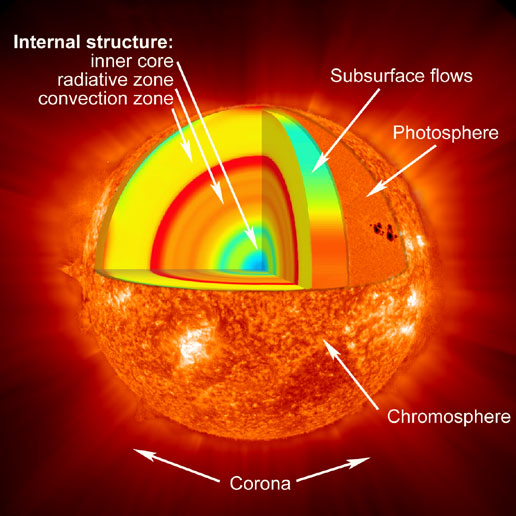
The layered structure of the sun.
Click to enlarge. Image credits: NASA
It's hot, round, and you're not supposed to stare at it: The Sun has attracted curiosity since we crawled out of the primordial pond. And even though we now have a pretty good idea of how the Sun does its job, some puzzles stubbornly remain. One of them is where sunspots form and how their location changes with the solar cycle. A recent computer simulation has now managed to reproduce a pattern that brings us a big step closer to understanding this.

The Sun spins about a fixed axis, but since it's not solid its rotation frequency is not uniform: At the visible surface, the equator rotates in about 27 days whereas close by the poles it takes 35 days. The plasma that forms the Sun is held together by its own gravitational pull with a density that is highest in the center. In this high density core, the sun creates energy by nuclear fusion. Around that core, there's a layer, the radiative zone, where the density is already too small for fusion, and the heat created in the core is just passed on outwards by radiative transfer. Further outside, when the density is even lower, the plasma then passes on the heat by convection, basically cycles of hot plasma moving upwards and cooler plasma moving downwards. Even further outside, there's the photosphere and the corona.

The physics of the convection zone is difficult because the motion of the plasma is turbulent, so it's hard to understand analytically and numerical simulations require enormous computing power. Some generic features are well understood. For example the granularity of the sun's surface comes about by a mechanism similar to Rayleigh–Bénard convection: In the middle of the convection cell there's the hot plasma rising and towards the outside of the cell there's the cooler plasma moving down again.


It also has been known since more than a century that sunspots are not only colder than the normal surface of the sun, but are also regions with strong magnetic fields. They arise in pairs with opposite magnetic polarity. Sunspot activity follows a cycle of roughly 11 years, after which polarity switches. So the magnetic cycle is actually 22 years, on the average.

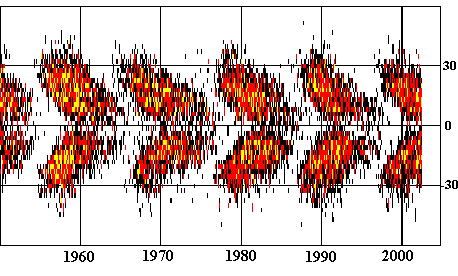
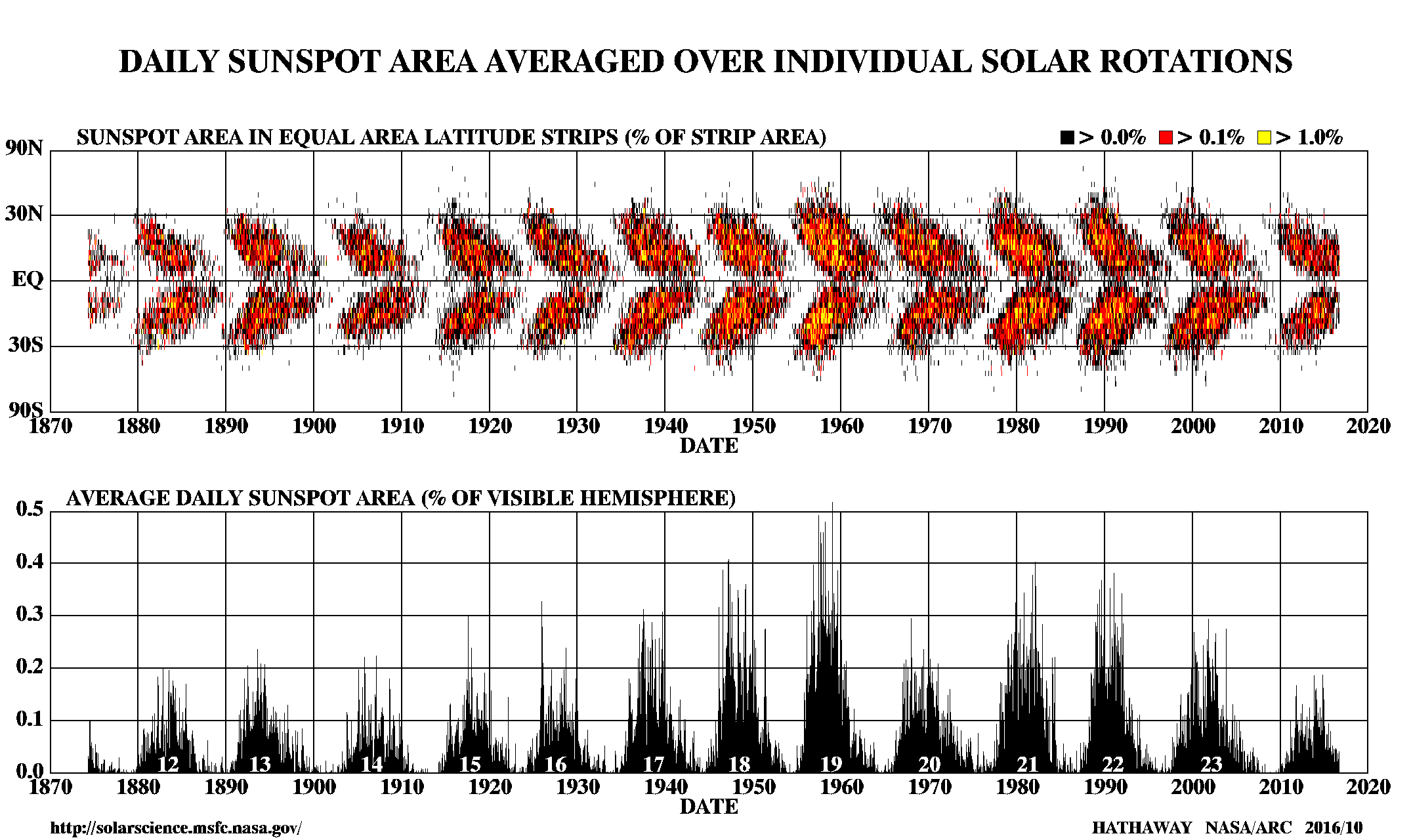
A big puzzle that has remained is why sunspots are created predominatly in low latitudes (below 30°N/above 30 S) and, over the course of the solar cycle, their production region moves towards the equator. When one plots the latitude of the sunpots over time, this creates what is known as the "Butterfly diagram", shown below


You can find a monthly update of the butterfly diagram on the NASA website. The diagram for the magnetic field strength follows the same pattern, except for the mentioned switch in polarity, see for example page 54 of this presentation. On the slide, note that in the higher latitudes the magnetic fields move towards the poles rather than towards the equator.

Numerical simulation of the convection zone have been made beginning already in the early 80s, but so far something always left the scientists wanting. Either the sunspots didn't move how they should or the rotation wasn't faster towards the equator, or the necessary strong and large-scale magnetic fields were not present, or something else just didn't come out right.

At Nordita in Stockholm, there's a very active research group around Axel Brandenburg, which has developed a computer code to simulate the physics of the convection zone. It's called the "pencil code" and is now hosted by Google code, for more information see here. Basically, it's an integration of the (non-linear) hydrodynamics equations that govern the plama with magnetic fields added. In the video below you see the result of a very recent simulation done with his collaborators in Helsinki:


The colors show the strength of the magnetic field (toroidal component), with white and blue being the strongest fields, blue for one polarity and white for the other. Two things you should be able to see in the video: First, the rotation is faster at the equator than at the poles, second, the spots of strong magnetic fields in low latitudes migrate towards the equator. One can't see it very well in the video, but in the higher latitudes the magnetic fields do move towards the poles, as they should. In the time-units shown in the top-left corner, about 600 time steps correspond to one solar cycle. A computation like this, Axel tells me, takes several weeks, run on 512 to 2048 cores.

Details on how the movie was made can be found in this paper
    Cyclic magnetic activity due to turbulent convection in spherical wedge geometry
    Petri J. Käpylä, Maarit J. Mantere, Axel Brandenburg
    arxiv: 1205.4719
The model has six parameters that quantify the behavior of the plasma. For some of these parameters, values that would be realistic in the sun are too large to be possible to simulate. So instead, one uses different values and hopes to still capture the essential behavior. The equations and boundary conditions can be found in the paper, see eqs (1)-(4) and (6)-(11).

The calculation doesn't actually simulate the whole convection zone, but only a wedge of it with periodic boundary conditions. In the video this wedge is just repeated. The poles are missing because there the coordinate system becomes pathological. In the part that they simulate, they use 128 x 256 x 128 points. A big assumption that goes on here is that the small scales, scales too small to be captured at this resolution, don't matter for the essential dynamics.

If you found the video was too messy, you can see the trend of the magnetic fields nicely in the figure below, which shows the average strength of the magnetic fields by latitude as a function of time.

Fig 3 from arxiv:1205.4719.


Not all is sunny of course. For example, if you gauge the timescale with the turnover time in the convection zone which can be inferred from other observatons, the length of the magnetic solar cycle is about 33 years instead of 22. And while the reason for the faster rotation towards the equator can be understood from the anisotropy of the turbulence (with longitudinal velocity fluctuations dominating over latitudinal ones), the butterfly trend is not (yet) analytically well understood. Be that as it may, I for certain am impressed how much we have been able to learn about the solar cycle despite the complicated turbulent behavior in the convection zone.

The original movie (in somewhat better resolution) and additional material can be found on Petri's website. Kudos to Axel and Amara for keeping me up to date on solar physics.

Thursday, October 04, 2012

ESQG 2012 Update

Our conference on "Experimental Search for Quantum Gravity" now has the schedule online. As you can see, this year's format is somewhat different from the previous installations. Based on Astrid's suggestions, we have only a few long talks and otherwise many discussions with short (10-15 min) contributions. I'm curious to see how this goes.

Personally, I find discussion sessions to be of limited use. Participants usually to like them for the social touch, but in my experience they tend to be dominated by always the same people who say always the same things. And I guess I just prefer prepared talks for they are usually better structured and convey information better. Which is why, if I add discussion sessions to a conference I'm organizing, I do my best to encourage participants and esp the discussion leaders to prepare some questions and arguments in advance. Maybe mixing discussions with the short contributions is a good way to avoid these pitfalls. Either way, I think it is worthwhile to try a different format.

Monday, October 01, 2012

Clearly foggy

"I am ... rather skeptical about "popular" science in general, in particular when I bump into those books pretending to address in "popular" language formidable mathematical conjectures, or esoteric concepts such as black holes, superstrings, and dark matter. Quite often, skimming through their first chapters, the non-professional reader gets the impression that everything is as clear as day, to realize well before the end that it is in fact quite a foggy day."

Sunday, September 30, 2012

Book review: “The Universe Within” by Neil Turok

The Universe Within: From Quantum to Cosmos (CBC Massey Lecture)
By Neil Turok
House of Anansi Press (October 2, 2012)

Neil Turok is director of Perimeter Institute and founder of the African Institute for Mathematical Sciences. His research is mostly in theoretical cosmology, and he has written a pile of interesting papers with other well-known physicists. Some weeks ago, I found a free copy of Turok’s new book “The Universe Within” in my mail together with a blurb praising it as “the most anticipated nonfiction book of the season” and a “personal, visionary, and fascinating work.” From the back cover, I expected the book to be about the relevance of basic research, physics specifically, and the advances blue sky research has brought to our societies.

You know me for arguing that we need knowledge for the sake of knowledge and it’s a mistake to justify all research by practical applications. To advance my own arguments, I thought I should read Turok’s book.

The book is to accompany the 2012 Massey Lectures that will be broadcast in November 2012.

Turok starts with the old Greeks, then writes about Leonardo da Vinci and Galileo, and lays out the development of the scientific method. He spends some time on Newton’s laws, electrodynamics, special relativity and general relativity. Since Turok’s own work is mostly in cosmology, it is not surprising that quite some space is dedicated to this. The standard model of particle physics appears here and there, and the recent discovery of the Higgs is mentioned. He goes to some length to explain path integrals with the action of the standard model coupled to general relativity, the one equation appearing in the book (without the measure), a courage that I think should be applauded. Turok makes clear he is not a fan of the multiverse. In the final chapter, he goes on to a general praise of basic research.

His explanations about physics are interwoven with his own experiences, growing up in South Africa, the challenges he faced, and the research he has done. This is all content well intentioned and sounds like a good agenda. Unfortunately, the realization of this agenda is poor.

The introductions into the basic physical concepts will be difficult to understand if one doesn’t know already what he is talking about. For example, he talks about inflation before he speaks about general relativity. He talks about the Planck length and the Hubble length without explaining the relevance. To make contact to Euclidean space, Turok wants to explain Minkowski-spacetime by using the “ict” trick that nobody uses anymore and will leave many readers confused. They will be left equally confused about the question how the wavefunction and the path integral is related to actually observable quantities. The reader should also better previously have heard about the multiverse, because that’s only mentioned in the passing to get across the author’s opinion.

The book has several photos and illustrations in color, including the “formula that summarizes all the known laws of physics”, but these are not referenced in the text. You better look at them in advance to know where they belong, or you have to guess while reading that there might be an image belonging to what you read.

The book is also repetitive in several places, where concepts that were introduced earlier, for example extra dimensions, reappear. “As I explained earlier” or similar phrases have been added in some instances, but the overall impression I got is that this book was written in pieces that were later put together sloppily. The picture presented is incoherent at best and superficial at worst. Rather than making a solid case for the relevance of basic research, Turok has focused on introducing the basics of modern physics with some historical background, and then talks mostly about cosmology. Examples of unpredictable payoff appear, in the form of electrodynamics, the transistor, and potentially quantum computing. But the cases are not well made in the sense that he doesn’t drive home the point that none of that research was aimed at producing the next better computer. And they’re not exactly very inspired choices either.

Turok’s argumentation is sometimes just weird or not well thought through. For example, to explain the merits of quantum computers, he writes:
“Quantum computers may also transform our capacities to process data in parallel, and this could enable systems with great social benefit. One proposal now being considered is to install highly sensitive biochemical quantum detectors in every home. In this way, the detailed medical condition of every one of us could be continuously monitored. The data would be transmitted to banks of computers which would process it and screen for signs of any risk.”
He does not add as much as one word on the question if this was desirable. This is pretty bad imo, because it suggests the image of a scientist who doesn’t care about ethical implications. (I mean: the question whether you want information about potentially uncurable diseases is already a topic of discussion today.) Another merit of quantum computers is apparently:
“With a quantum library, one might… be able to search for all possible interesting passages of text without anyone having had to compose them.”
Clearly what mankind needs. And here’s what, according to Turok, is the purpose of writing:
“Writing is a means of extracting ourselves from the world of our experience to focus, form, and communicate our ideas.”
One might maybe say so about scientific writing, at least in its ideal form. But the scientist in the writer seems to have taken over here. Another sentence that strikes me as odd is “I have been fascinated by the problem of how to enable young people to enter science, especially in the developing world.” I’m not sure “fascinating problem” is a particularly emphatic choice of words.

Other odd statements: “M-theory is the most mathematical theory in all of physics, and I won’t even try to describe it here.” He does anyway, but I’m left wondering what “most mathematical” is supposed to mean. Is it just an euphemism for “least practical relevance”? Another fluff sentence is “We are analog beings living in a digital world, facing a quantum future.” Turok also adds a sentence according to which one day maybe we’ll be able to harness dark energy. I can just see his inbox being flooded with proposals on exactly how to do that.

The last chapter of the book starts out quite promising, as it attempts to take on the question of what is the merit of knowledge for the sake of knowledge. Then I got distracted by a five pages long elaboration on “Frankenstein”. (He somehow places the origin of this novel in Italy, and forgets to mention that the Castle of Frankenstein is located in Germany, I pass by every time I visit my parents.) Then Turok seems to recall that the book is to appear with a Canadian publisher and suddenly adds a paragraph to praise the country:
“[T]oday’s Canada… compared to the modern Rome to its south, feels like a haven of civilization. Canada has a great many advantages: strong public education and health care systems; a peaceful, tolerant, and diverse society; a stable economy, and phenomenal natural resources. It is internationally renowned as a friendly and peaceful nation, and widely appreciated for its collaborative spirit and for the modest, practical character of its people.”
It’s not that I disagree. But it makes me wonder what audience he is writing for. The member of parliament who might have to sign in the right place so cash keeps flowing? But what bugs me most about “The Universe Within” is that Turok expresses his concerns about the current use of information technology, and then has nothing to add in terms of evidence that this really is a problem or any idea what can or should be done about it:
“Our society has reached a critical moment. Our capacity to access information has grown to the point where we are in danger of overwhelming our capacity to process it. The exponential growth in the power of or computers and networks, while opening vast opportunities, is outpacing our human abilities and altering our forms of communication in ways that alienate us from each other.”
Where is the evidence?
“We are being deluged with information through electric signals and radio waves, reduced to a digital, super-literal form that can be redistributed at almost no cost. The technology makes no distinction between value and junk.”
This isn’t a problem of technology, this is a problem of economy.
“The abundance and availability of free digital information is dazzling and distracting. It removes us from our own nature as complex, unpredictable, passionate people.”
According to Turok, the solution to this problem has something to do with the “ultraviolet-catastrophe”, I couldn’t quite follow the details. From a scientist, I would have expected a more insightful discussion. Not too long ago, Perimeter Institute had a really bright faculty member by name Michael Nielsen, who thought about the challenges and opportunities of information technology for science and what can be done about it. Turok does not only not explain what evidence it is that has him worried, he also doesn’t comment on any recent developments or suggestions. Maybe he should have spent some time talking to Nielsen.

So in summary, what can I say? This book strikes me as well intentioned, but sloppy and hastily written. If you are looking for a good introduction to the basic concepts of modern physics and cosmology, better read Sean Carroll’s book. If you are looking for a discussion of the challenges science and our societies are facing by rapid information exchange, better read Jaron Lanier’s book, or even Maggie Jackson’s book. If you want to know what the future of science might look like and what steps we should take to advance knowledge discovery, read Michael Nielsen’s book. And if you want to know how our societies economically benefit from basic research, read Mark Henderson’s book because he lists facts and numbers, even if they’re very UK-centric.

Neil Turok’s book might be interesting for you if you want to know something about Neil Turok. At least I found it interesting to learn something about his background, but it’s only a page here or there. I would give this book two out of five stars. That’s because I think he should be thanked for making the effort and taking the time. I hope though next time he gets a better editor.

Friday, September 28, 2012

10 effects you should have heard of

  1. The Photoelectric Effect

    Light falling on a metal plate can lead to emission of electrons, called the "photoelectric effect". Experiments show for this to happen the frequency of the light needs to be above a threshold depending on the material. This was explained in 1905 by Albert Einstein who suggested that the light should be thought of as quanta whose energy is proportional to the frequency of the light, the constant of proportionality being Planck's constant. Einstein received the Nobel Prize in 1921 "for his services to Theoretical Physics, and especially for his discovery of the law of the photoelectric effect."

    Recommended reading: Our post on the Photoelectric Effect and the Nobel Prize speech from 1921.


  2. The Casimir Effect

    This effect was first predicted by Hendrik Casimir who explained that, as a consequence of quantum field theory, boundary conditions that may for example be set by conducting (uncharged!) plates, can result in measurable forces. This Casimir force is very weak and can be measured only at very small distances.

    Recommended reading: Our post on the Casimir Effect and R. Jaffe's The Casimir Effect and the Quantum Vacuum.


  3. The Doppler Effect

    The Doppler effect, named after Christian Doppler, is the change in frequency of a wave when the source moves relative to the observer. The most common example is that of an approaching ambulance, where the pitch of the signal is higher when it moves towards you than when it moves away from you. This does not only happen for sound waves, but also for light and leads to red- or blueshifts respectively.

    Recommended reading: The Physics Classroom Tutorial.


  4. The Hall Effect

    Electrons in a conducting plate that is brought into a magnetic field are subject to the Lorentz force. If the plate is oriented perpendicular to the magnetic field, a voltage can be measured between opposing ends of the plate which can be used to determine the strength of the magnetic field. First proposed by Edwin Hall, this voltage is called the Hall voltage, and the effect is called the Hall effect. If the plate is very thin, the temperature low, and the magnetic field very strong, a quantization of the conductivity can be measured, which is also known as the quantum Hall effect.

    Recommended reading: Our post on The Quantum Hall Effect.


  5. The Meissner-Ochsenfeld Effect

    The Meissner-Ochsenfeld effect, discovered by Walther Meissner and his postdoc Robert Ochsenfeld in 1933, is the expulsion of a magnetic field from a superconductor. Most spectacularly, this can be used to let magnets levitate above superconductors since their field lines can not enter the superconductor. I assure you this has absolutely nothing to do with Yogic flying.

    Recommended watching: Amazing Physics on YouTube.


  6. Aharonov–Bohm Effect

    A charged particle in an electromagnetic field acquires a phase shift from the potential of the background field. This phase shift is observable in interference patterns and has been experimentally confirmed. The relevant point is that it's the potential that causes the phase, not the field. Before the Aharonov–Bohm effect one could question the physical reality of the potential.


  7. The Hawking Effect

    Based on a semi-classical treatment of quantum fields in a black hole geometry, Stephen Hawking showed in 1975 that black holes emit thermal radiation with a temperature inverse to the black hole's mass. This emission process of the black hole is called the Hawking Effect. This result has lead to a great progress in understanding the physics of black holes, and is still subject of research, see recent post at Cosmic Variance.

    Recommended reading: Black Hole Thermodynamics by David Harrison and P.K. Townsend's lecture notes on Black Holes.


  8. The Zeeman Effect/Stark Effect

    In the presence of a magnetic field, energy levels of electrons in atomic orbits that are usually degenerated (i.e. equal) can obtain different values, depending on their quantum number. As a consequence, spectral lines corresponding to transitions between these energy levels can split into several lines in the presence of a static magnetic field. This effect is named after the Dutch physicist Pieter Zeeman, who was awarded the 1902 physics Nobel prize for its discovery. The Zeeman effect is an important tool to measure magnetic fields in astronomy. For some historical reasons, the plain vanilla pattern of line splitting is called the Anomalous Zeeman effect.

    A related effect, the splitting of spectral lines in strong electric fields, is called the Stark Effect, after Johannes Stark.

    Recommended reading: HyperPhysics on the Zeeman effect and the Sodium doublet.


  9. The Mikheyev-Smirnov-Wolfenstein Effect

    The Mikheyev-Smirnov-Wolfenstein effect, commonly called MSW effect, is an in-medium modification of neutrino oscillation that can for example take place in the sun or the earth. It it a resonance effect that depends on the density of the medium and can significantly effect the conversion of one flavor into another. The effect is named after Stanislav Mikheyev, Alexei Smirnov and Lincoln Wolfenstein.

    Recommended reading: The MSW effect and Solar Neutrinos.


  10. The Sunyaev-Zel'dovich Effect

    The Sunyaev-Zel'dovich effect, first described by Rashid Sunyaev and Yakov Zel'dovich, is the result of high energy electrons distorting the cosmic microwave background radiation through inverse Compton scattering, in which some of the energy of the electrons is transferred to the low energy CMB photons. Observed distortions of the cosmic microwave background spectrum are used to detect the density perturbations of the universe. Dense clusters of galaxies have been observed with use of this effect.

    Recommended reading: Max Planck Society press release Crafoord Prize 2008 awarded to Rashid Sunyaev and The Sunyaev-Zel'dovich effect by Mark Birkinshaw.


  11. Bonus: The Pauli Effect

    Named after the Austrian theoretical physicist Wolfgang Pauli, the Pauli Effect is well known to every student of physics. It describes a spontaneous failure of technical equipment in the presence of theoretical physicists, who should therefore never be allowed on the vacuum pumps, lasers or oscilloscopes.

    Recommended reading: Our post Happy Birthday Wolfgang Pauli.

[This is a slightly updated and recycled post that originally appeared in March 2008.]

Wednesday, September 26, 2012

Interna

Seems I've been too busy to even give you the family update last month, so here's to catch up.

Lara and Gloria can meanwhile climb up and down chairs quite well, which makes life easier for me, except that they often attempt to climb upwards from there. They can now reach the light switches, and last week they learned to open doors so it's difficult now to keep them in a room. Their favorite pastime is presently hitting me with empty plastic bottles, which seems to be infinitely entertaining. They also have developed the unfortunate habit of throwing their toys in direction of my laptop screen.

The girls have increased their vocabulary with various nouns and can identify images in their picture books. They still haven't learned a single verb, though Stefan insists "cookie" means "look."

Gloria is inseparable from her plush moose, Bo. She takes him everywhere and sleeps with him. Since I'd really like to wash it on occasion, I've now bought a second one and we're doing our best to avoid she sees both at once. (We also have to maneuver carefully around the Arlanda Duty Free shop, where there sits a whole pile of them.) Gloria has developed a bad case of motion sickness in which she'll be sick after ten minutes on the road. We now got some medication from our pediatrician that seems to help, so our mobility radius has expanded again. Lara meanwhile is squinting and we'll have to do something about this.

Right now, they're sitting behind me with their Swedish-English picture book. I am often amazed how well they understand what we say, especially because Stefan and I don't speak the same accent and we both mumble one way or the other. I guess it's because I judge their progress by my lack of progress in learning Swedish. Last week I took a taxi in Stockholm, and this was the first time I had a taxi driver who was actually Swedish. Ironically I noticed that because he spoke British English that was at least to my ears basically accent free. He didn't even try to address me in Swedish. When I asked him about it he said, well, there's so few people on the planet for whom Swedish is useful that they don't expect others to speak it. The Swedes are just so damned nice to immigrants.

We were lucky to get two daycare places starting in January. It's a half-day place, but this will be quite a change for all of us.

The organization of the PI conference on Experimental Search for Quantum Gravity is going very well, thanks to Astrid Eichhorn who has done a great job. We now have a schedule that should appear on the website within the next days. We'll probably have most of the talks recorded, so it's something for all of you. The organization of the November program on Perspectives of Fundamental Cosmology is running a little behind, but it seems everything is slowly falling into place there too.

Besides this, I have been trying to convince my colleagues at Nordita to engage more in public outreach, as I think we're behind in making use of the communication channels the online world has to offer. I'm happy to report that we did get some funding approved by the board last week. Part of this will go into a few videos, another part will go to a workshop for science writers - an idea that goes back to a discussion I had with George Musser earlier this year. I'll let you know how this goes, and I'm open to suggestions for what else we could do. I think I don't have to explain you my motivation for doing this - I'd be preaching to the choir. So let me instead say that it can be difficult to get scientists to make a time commitment to anything that's not research, so the biggest constraint on the matter is personnel.