Pages

Monday, August 06, 2007

Garrett Lisi's Inspiration

Some weeks ago I asked Garrett Lisi to write a contribution to our Inspiration series. He suggested we instead do an interview by email. I found it a good idea because I thought it might be easier to keep these inspiration posts to a manageable length - after all, I could just stop asking, right?

B: Well, let me start with some introductory questions so readers know what they are dealing with. Ten words that describe Garrett Lisi?

    G: "Vell, Zaphod's just this guy, you know?"(I can't follow instructions)
B: Five things that are important in your life?
    G: Physics, love, and surfing. I'm only three dimensional -- and no, those aren't in order.
B: Complete these sentences: When I was 15 I thought I could ...
    ... get a girl to like me by showing off.
- Now I know ...
    ... all one really needs to do is listen.
- My biggest mistake was/is ...
    ... not listening.
- I dream of ...
    ... discovering a beautiful T.o.E. that kicks string theory's ass.
B: Well, next time a girl says ten words, try to listen.
    G: Ha!
B: Okay, so among all the possibilities to show off why physics and surfing?
    G: Because they're the hardest? No, actually, physics and surfing aren't about showing off. I've always been intrigued by the relationship between mathematics and nature. In school, we learn the math first, then later we learn some physics and see that the math relates to what happens in the world. Then we learn more complicated math -- calculus, group theory, differential geometry, and so on -- and see how this all connects up and describes how the universe works; it's quite wonderful. I got hooked. And the surfing... surfing really nice waves is simply the most fun one can have on this planet.

    We have these big brains, and a limited amount of time. So what to do? A lot of people spend their time making money, sometimes with the hope that they'll be able to do what they want after they make it. But you never get that time back. Theoretical physics is the most abstractly beautiful and challenging pursuit there is. It's what I want to spend my time thinking about, so that's what I do.

    But all thinking and no action would make for a dull life. So I surf.
    A lot.
B: Was that destiny, random choice or your physics teacher and her convincing arguments?
    G: Ha, no, my first highschool physics teacher once told my parents: "I'm afraid Garrett just won't ever get anywhere in physics." I remember arguing with him in class constantly -- at one point he stubbornly claimed the force of gravity grew stronger near the center of the earth. He was a chemist.

    As a kid I wanted to be an aerospace engineer. And I was very good at math. Turns out I was too good at math -- I got so interested in math and physics classes that I ditched engineering during my second year of college.

B: And what is the beauty that you are dreaming of?
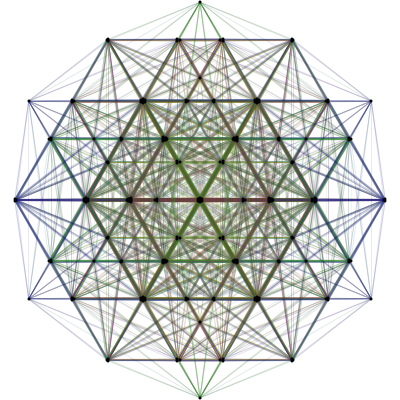
    G: Currently, this:

...

B: Sorry for the delay, E8 got stuck in PI's spam filter... Do you think beauty is in symmetry and simplicity, and should be our guide?
    G: I've always found symmetry and complexity to be beautiful. Not complexity in the "random mess" sense, but as a richness of structure... which belies an underlying simplicity. I think nature is a balance of simplicity and complexity in this funny way. Though I do follow one guide for theory building:

    "Make everything as simple as possible, but not simpler." - A. Einstein

B: Why then would you want to kick string theory's ass?
    G: Because I think it's probably not how nature works.

    We have two very good models in fundamental physics, general relativity and the standard model of particles and interactions. A T.o.E. is a theory that combines these two, reproducing them in some limit. (Whether a T.o.E. exists is a separate debate.) It's a hard thing to build, since the structure of these two theories seems very different. GR is fundamentally geometric, while QFT has algebra all over the place. Nevertheless, if you think there is a T.o.E., and you're guided by simplicity, then there should be a unified theory that gives both of these others.

    Now, string theory started out with these same motivations, and had a lot of initial success. Back in the eighties people thought the standard model particles were going to naturally come out of the theory at any moment. But they didn't. In order to match the known particles, people have had to build very elaborate structures of branes and orbifolds using all sorts of contrived assumptions and hundreds of parameters. At this point, string theory is a giant kludge, much messier than the structure of the standard model it's supposed to describe. Because of this, I have to think it's probably just not how nature works.

    Now, I would never dictate what other physicists should work on. And I even think string theory is still promising enough that it's good for some people to work on it. It's just not for me. What I've been working on recently, as a T.o.E., is a theory that combines all fields of the standard model and gravity in a purely geometric Yang-Mills theory with a single connection.

B: As much as I think your approach towards a ToE is very interesting, I have to say to me that a connection looks neither simple nor beautiful.
    Yah, I used to feel that way too -- we see all this messy algebra. But what is a Lie group? It's just a large manifold, with a shape and symmetries described by vector fields -- the Lie algebra elements. A connection and its curvature is a description of how this shape twists around our four dimensional spacetime. And that's all there is to it -- it's purely geometric. This isn't the way physicists usually think of a connection, but mathematicians have been thinking of it this way for at least fifty years, and they've been having a lot of fun.

B: So isn't beauty a very subjective requirement?
    G: Yes, it is. But, you know, what makes us physicists and not philosophers is that, at least in principle, our theories need to agree with experiments.

B: You're living on an island, and keep your distance to the academical networks. Do you think that solitude and silence are necessary to our understanding of nature's ways?
    G: To a degree, yes. But mostly I spend time in Maui because it's beautiful and the surf is good. And although I work on my own, my wonderful girlfriend is usually around, painting or knitting. And I have friends to hang out with occasionally. Ideally, I think what one needs in life is balance. I like to spend a few hours a day working on physics in silence, and a few hours playing outside or goofing off.

    I've been thinking about what the ideal scientific work environment would be, and the best thing I've been able to come up with is a Science Hostel. I envision a large house where theorists could live and work on their stuff alone or in groups while having their meals and living space provided. The idea is to give researchers time, with an easily accessible but undemanding social atmosphere, and as little responsibility as possible. And, of course, it would have to be somewhere beautiful -- with good hiking and other things to do outside. For the past year I've been living near Lake Tahoe -- a great environment for thinking and playing. Anywhere in the mountains would probably be good for a Science Hostel -- even better if it's next to a good ski hill. :)

    The reason I've been out of the scientific network isn't because I thought it was bad, but because I didn't fit in it. I love differential geometry, GR, and QFT, but I don't care for strings. Ten years ago, when I got my Ph.D., the only postdoc positions available in these overlapping areas were in string theory. So, since I had some money saved up, I moved to Maui to work on the puzzle on my own, and learned how to windsurf. Now, ten years later, string theory isn't doing so well and there are starting to be other opportunities in foundational physics. The LQG community has grown significantly -- and they're a wonderful group of people. Also, the FQXi foundation liked what I was doing enough to give me a nice grant. So I felt the time was right to leave my quiet island and start talking with people.
B: Okay, thanks, I think this is sufficient. According to my estimate the attention span of the average blog reader is about 100 words. But most skip the middle section and read the bottomline. So, do you have some last words?
    G: Ah, an epitaph...
    Do what you love.


Garrett Lisi is a wandering surfer-physicist, working on nomothetic unification while searching for the perfect wave. After graduating UCLA at the top of his class and getting his Ph.D. from UC San Diego, Garrett took off for Maui to windsurf and do physics on his own. Last year Garrett won a research grant from FQXi, which he spent on food, a laptop, and a new snowboard. His work on unifying general relativity and the standard model as an E8 principal bundle was featured as a recent This Week's Find by John Baez . Impatient with the slow progress of technology, Garrett has been manually uploading his brain to the web as an open-source theoretical research wiki: Deferential Geometry. He also blogs occasionally at FQXi blogs and has a semi-secret personal journal. Garrett recently presented his work at conferences in Mexico and Iceland, is currently hopping around California, and is looking forward to visiting the Perimeter Institute in October.


See also the previous contributions to the inspiration-series byand my related guest post at Asymptotia 'Sabine Hossenfelder: My Inspiration' (most of these are also available as pdf-file).


TAGS: ,

Sunday, August 05, 2007

Daydreaming

As a PS to my earlier post about the wandering mind, here is a survey by Malia Mason, a psychologist at Columbia University, who wants to know where your mind wanders. She'll tell you afterwards how your daydreams compare with others

(12 questions, takes about 3 minutes). My results:

You spend more time than the average individual ‘lost in thought’ or mind-wandering.

The 'average individual' taking the survey that is. I suspect the amount of mind-wandering is only partly psychologically triggered, and strongly influenced by our culture and values of the society we live in. The busier our lives get, the less time and opportunity there is for daydreaming. People get fired for it!

You spend quite a bit of time engaged in ‘mental time travel’. In other words, you spend a significant amount of time thinking of events and people that are removed from the present.

Baryogenesis? The endstate of black hole evaporation? If I had half an hour with GWB I'd tell him...

You spend more time than most people considering events that are going to happen in the distant future.

Predictions, folks, predictions...

You are a social butterfly! You tend to think about your interactions with other people more than the average daydreamer while absorbed in internal thought.

I tend to think somebody has drawn a wrong conclusion from a probably correct statement. The only way in which I'm a social butterfly is that I wish I could fly away.

Your daydreams are less visual than the average daydreamer. You tend to ‘see’ people, places and events ‘in your head’ less than most do.

Well, they had no question that referred to equations...

Your daydreams are more creative than most.

I occasionally wonder though exactly what they create besides confusion.

Thursday, August 02, 2007

The Right not to Know

"The Right not to Know" was a highly discussed topic in the German newspapers last week (this week it's been replaced by the raise in milk prizes - just to let you know what's on the German mind these days). Anyway, I initially only saw the headline of that article and had several hours to wonder what it was about before I actually read it. (An interesting exercise btw that I recommend to the reader.)

To begin with, let me clarify that mystery: the discussion was in this case whether patients who suffer from potentially lethal medical conditions have the right not to know about these, and refuse a preventive medical checkup. My opinion on this is very case dependent. I definitely give you the right to die unexpectedly, but if you've been growing that funny thing in your face with twenty years solarium, and pretend not to notice it's been turning purple lately, then don't expect me to pay for your pain treatment if you don't drop dead as unexpectedly as you wished. (The situation is of course different if the medical checkup itself carries risks, or if you're suffering from something that has very little chances to be cured anyhow.)

    If one could predict the day you will die, would you want to know?

Anyway, I'll leave that question to you to consider next time you're sitting in the waiting room. Instead I want to tell you where my thoughts were running to with the Right not to Know. I don't have a TV and unless I'm at my mother's place I hardly ever read a (printed) newspaper. The information density in that part of the world I live in is so high what is important reaches me anyhow. People sometimes ask me: but don't you want to know? Fact is, there are many things I'd rather not know.

Every time I open a newspaper I read headlines like "38 year old man kills his two children, burns down the house with his mother in law, and hangs himself", "man kills wife in love triangle", "women kills 5 people and herself at an US post-office" (the latter happened to be next door at this time). My head is full with photos from wars around the world, mothers holding their dead children, men missing body parts, blood stained shirts, children searching through piles of dead bodies for their relatives. I am probably not the only one who still has the videos from 9/11 running in her head on trigger. And the recent details about the series of almost-accidents in German nuclear power plants, did I really want to know that?

    If someone prefers not to know what reality looks like, will you insist he has to know and be unhappy about it?
In fact, there is the prevailing hypothesis of depressive realism, according to which depressed people are those who actually see the world how it 'really' is. And who'd want that?

Now you can argue I have a duty to inform myself about the country I live in (milk prizes? Wait - actually, I don't even live in this country, so make that the world I live in). Be a responsible citizen, well educated who KNOWS what is happening to have a reasonable and INFORMED opinion about the war in what-was-the-name-again? My duty? My right?

Let me go a step even further. Since I'm a scientist, I want to ask that same question about scientific insights: Would you grant someone the Right not to Know that his genetic code indicates at 99% CL he'll most likely develop Huntington's disease [1]. If it was possible to predict, would you grant someone the Right not to Know statistical data indicates at 99% CL she'll never make a top mathematician? If someone proved there is no afterlife (whatever that means), do you have the Right not to Know? (And, speaking of afterlife, do I have the Right not to Know what Jehovah's witnesses think will happen to my allegedly immortal soul after Armageddon or whatever they call it?)

Does someone have the Right not to Know our solar system is only one of many in the universe and not exceptional in any regard; the Right not to Know the earth is older than 20,000 years [2]? The Right not to Know all the cruelties in the history of mankind? Do you have a Right not to Know your military kills innocent people, farting could cause global warming, and these potato crisps you like so much have proven to cause cancer in animal tests?

    What right would I have to insist you realize that love is just a chemical reaction?
And it's all about sex anyhow.

Knowledge, so said Francis Bacon, is power. Understanding helps you master your life, rational thinking is an evolutionary advantage, ignorance of the way the world works will be cured by natural selection. These are all the good reasons that came into my mind why every 'sane' person would want to know about the evolution of the species and the elementary constituents of matter. But in many cases this argument does not quite hold. In how far is the presently available knowledge really relevant for our lives? Knowing that the current data shows the universe presently undergoes accelerated expansion is definitely an advantage for my life. But it might not be tremendously relevant for Mike who stamps my passport in Chicago (sorry, Mike).

Plus, knowledge isn't necessarily an evolutionary advantage. If you sit in front of your laptop all day, scan newstickers and blog about, say, global warming your chances to reproduce aren't the best. More seriously, rational thinking takes time and energy, doesn't necessarily contribute to happiness, and can drive your supervisor nuts. In many cases, it's an advantage to live with good faith in semi-rational believes (true love exists), and not to question everything all the time: You might open the box, just to find that curiosity killed the cat.

However. Unfortunately, very little people consciously just don't know things, but fill in blanks with believes and made-up custom explanations. In which case passively not knowing the truth can turn into actively denying the truth. You see where I am heading?

    How much ignorance of facts can a society take?

But what good is a right to know or not to know without knowing what one should know or doesn't want to know? Do I really need to know 20 ways the world could end tomorrow, or that Britney Spears vomited all over her Gucci dress?

Most people consciously or unconsciously filter the information they gather - how else was it possible to deal with all these news and rumors that surround us every day? Every one of us needs to divide the information overflow into relevant, irrelevant and marginal. Should this ordering be left to Google?

The world wide web collects an increasing amount of statements that are just plain wrong. There is no qualified rating available on all this information. The number of links, comments, or diggs is far off being a reliable factor - yet one that people count on. We presently have no tools to deal with all that knowledge [3]. So what all these random thoughts lead me to was the conclusion we'd actually not need a Right not to Know, but a right of information - including the possibility to filter and ban misinformation [4].

Project the present infotainment ten years into the future and we'll drown in an international sea of semi-fictitious news, unqualified commentaries, and people who echo these back and forth (in this regard it is interesting to note what psychological research tells us about the power of repetition). I certainly don't want to interfere with the freedom of speech, neither with the democratic/anarchic characteristics of the internet (that I actually put my hopes on). Say whatever you want to - just make sure it's clear this is your opinion [5], add your sources, your qualifications, don't blur the boundary between fiction as fact, and mind the frontiers of knowledge.
    "The greatest obstacle to discovering the shape of the earth, the continents, and the oceans was not ignorance but the illusion of knowledge."

~Daniel J. Boorstin

Epilogue: Today the headline is the US credit crisis . Good to know that "The American economy is the most creative and enterprising and productive system ever devised." ~ G.W. Bush


[1] And if you do, would you grant his family members the Right not to Know he will become sick, and can they sue him if he tells them nevertheless?)
[2] With 'knowing' I don't only mean you hear the statement - which is hard to omit -, but learn about the details, data, facts and scientific conclusions.
[3] And don't give me that argument how the collective corrects misinformation, I don't want to end up with an information soup that has survived by minimizing objections. Wikipedia is an useful source to collect established knowledge, but it doesn't hold a patent on the truth.
[4] About 15 years ago I wrote a petition for the Jusos/SPD that suggested a right of information (and made sure no privacy/patent rights were violated). It failed mostly due to lack of interest. I'm still waiting for them to come back to the topic which I believe will only become more important.
[5] German law says websites needs to have a contact/author information.

Wednesday, August 01, 2007

Auenland

Most Germans believe to know that the Saarland, named after the Saar river, is an industrial region of coal and steel, quite poor now because of the decline of these industries, that it has something to do with France (or is it actually part of it?), and that it provides a convenient unit of area.

There is some truth to most of these points: Every child in Saarland learns at school that about 1 million people live here on an area of 50 × 50 = 2.500 km² (about 1000 square miles, a bit smaller than Rhode Island). In the first half of last century, the Saar region changed several times between France (or French administration) and Gemany, but since 50 years now, the Saarland has been part of the Federal Republic of Germany. And no, French is not the native language of the Saarländer. Coal and steel industries, once the important pillar of the local economy, have vanished during the last years. One of the disused steel mills, the Völklinger Hütte, now features on the UNESCO World Heritage List, and the last coal mines will be closed by 2018.


But even though the former industrial regions along the Saar river valley are very densely populated, the Saarland has never been at all a dusty and rusty region, but, on the contrary, very green. Most visitors are pleasantly surprised to find a landscape of gentle hills, with small villages interspersed between meadows, fields, and woods. That's especially so in the northern parts of the Saarland, where I grew up.


I am happy that also Bee has taken to the charme of this region. When we visited my mother over last weekend, she told me that she had been reminded of Auenland, home of the Hobbits in Middle Earth, since she had first seen it.

In case you want to come to Auenland, where she has taken the above photos (click to enlarge), you have to travel to here.

Saturday, July 28, 2007

Consistency

I am guilty of frequently using physics speech in daily life, an annoying habit I also noticed among many of my colleagues [1]. You'll find me stating "My brain feels very Boltzmannian today", or "The customer density in this store is too high for my metastable mental balance". I have a friend who calls Chinese take out "the canonical choice" and another friend who, when asked whether he had made a decision, famously explained "I don't yet want my wave-function to collapse". My ex-boyfriend once called it "the physicist's Tourette-syndrome" [2].

One of my favourite physics-speech words is self-consistent. Self-consistency is tightly related to nothing. You know, that "nothing" that causes your wife to conclude her whole life is a disaster, we're all going to die in a nuclear accident, her glasses vanished (again!), and btw that's all your fault (obviously). But if you ask her what's the matter. Well, nothing.
    "There's nothing I hate more than nothing
    Nothing keeps me up at night
    I toss and turn over nothing
    Nothing could cause a great big fight
    Hey -- what's the matter?
    Don't tell me nothing."

~Edie Brickell, Nothing


1. Self-consistent

Science is our attempt to understand the world we live in. We observe and try to find reliable rules upon which to build our expectations. We search for explanations that are useful to make predictions, a framework to understand our environment and shape our future according to our needs. If our observations disagree with our rules, or observations seemingly disagree with each other (I swear I left my glasses in the kitchen), we are irritated and try to find a mistake. Something being in contradiction with itself [3] is what I mean with not self-consistent (What's the matter? - Nothing!).

On a mathematical basis this is very straight forward. E.g. If you assume my mood is given by a real valued continuous function f on the compact interval [now, then] with f(now)f(then) smaller than 0, this isn't self-consistent with the expectation it can do so without having a zero [4]. For more details on my mood, see sidebar.

Self-consistency is a very powerful concept in theoretical physics: if one talks about a probability, that probability better should not be larger than one. If one starts with the axioms of quantum mechanics, it's not self-consistent to talk about a particle's definite position and momentum. The speed of light being observer independent is not compatible with Galileo invariance and the standard addition law for velocities. Instead, self-consistency requires the addition law to be modified. This lead Einstein to develop Special Relativity.

A particularly nice example comes from multi-particle quantum mechanics, where an iterative approach can be used to find a 'self-consistent' solution for the electron distribution e.g. in a crystal or for an atom with many electrons (see self-consistent field method or Hartree-Fock method). A state of several charged particles will not be just a tensor product of the single particles, since the particles interact and influence each other. One starts with the tensor product as a 'guess' and applies the 'rules' of the theory. That is, by solving the Schrödinger equation with the mean- field potential which effectively describes the interaction, a new set of single particle wave functions can be computed. This result will however in general not agree with the initial guess: it is not self-consistent. In this case, one repeats the procedure with using the result as an improved guess. Given that the differential equations behave nicely, this iterative procedure leads one to find a fixed point with the properties that the initial distribution agrees with the resulting one: it is self-consistent.

A similar requirement holds for quantum corrections. A theory that is subject to quantum corrections but whose initial formulation does not take into account the existence of such extra terms is strictly speaking not self-consistent (see also the interesting discussion to our recent post on Phenomenological Quantum Gravity).

There are some subtleties one needs to consider, most importantly that our knowledge is limited in various regards. Self-consistency might only hold under certain assumptions or in certain limiting regimes, like small velocities (relative to the speed of light), large distances (relative to the Planck length) or at energies below a certain threshold. Likewise, not being self-consistent might be the result of having applied a theory outside these limits (typically, using an expansion outside a radius of convergence). In some cases (gravitational backreaction), violations of self-consistency can be negligible.

However, one might argue if it is possible at all to arrive at such a disagreement then at least one of the assumptions was unnecessary to begin with, and could have been replaced by requiring self-consistency. Unfortunately, this is often more easily said than done -- physics is not mathematics. We rarely start with writing down a set of axioms which one could check for self-consistency. Instead, in many cases one starts with little more than a patchwork of hints, and an idea how to connect them. Self-consistency in this case is somewhat more subtle to check. My friends and I often kill each others ideas by working out nonsensical consequences. Here, at least as important as self-consistency is that a theory in physics also has to be consistent with observation.

2. Consistent with Observation

The classical Maxwell-Lorentz theory is self-consistent. However, it is in disagreement with the stability of the atom. According to the classical theory, an electron circling around the nucleus should radiate off energy. The solution to this problem was the development of quantum mechanics. The inconsistency in this case was one with observation. Without quantizing the orbits of the electron, atoms would not be stable, and we would not exist.

This requirement is specific to sciences that describe the real world out there. Such a theory can be 'wrong' (not consistent with observation) even though it is mathematically sound. Sometimes however, these two issues get confused. E.g. in a recent Discover issue, Seth Lloyd wrote:


    "The vast majority of scientific ideas are (a) wrong and (b) useless. The briefest acquaintance with the real world shows that there are some forms of knowledge that will never be made scientific [...] I would bet that 99.8 percent of ideas put forth by scientists are wrong and will never be included in the body of scientific fact. Over the years, I have refereed many papers claiming to invalidate the laws of quantum mechanics. I’ve even written one or two of them myself. All of these papers are wrong. That is actually how it should be: What makes scientific ideas scientific is not that they are right but that they are capable of being proved wrong."

~Seth Lloyd, You know too much


The current issue now had a letter in reply to this article:

    "I was taken aback by Seth Lloyd's assertion that "99.8 percent of ideas put forth by scientists are [probably] wrong" and even more so by his statement that "of the 0.2 percent of ideas that turn out to be correct ... [t]he great majority of them are relatively useless." His thesis omits a basic trait of what we call science -- that it is a continuous fabric, weaving all provable knowledge together [...] we do science for a science sake, because a fundamental principle of science is that we never know when a discovery will be useful"

~Eric Fisher, Springfield, IL.


Well, the majority of my scientific ideas are definitely (a) wrong and (b) useless, but these usually don't end up in a peer review process. However, the reply letter apparently referred to the word 'correct' as 'provable knowledge', and to science as the 'weave' of all that knowledge. It might indeed be that the mathematical framework of a theory that is not consistent with observation turns out to be useful later but that doesn't change the fact that this idea is 'wrong' in the meaning that it does not describe nature. Peer review today seems to be mostly concerned with checking self-consistency, whereas being non-consistent with observation is ironically increasingly tolerated as a 'known problem'. Like, the CC being 120 orders of magnitude too large is a known problem. Oohm, actually the result is just infinity. But, hey, you've turned your integration contour the wrong way, the result is not infinity, but infinity + 2 Pi.

The requirement of consistency with observation was for me the main reason to chose theoretical physics over maths. The world of mathematics, so I found, is too large for me and I got lost in following runaway thoughts, or generalizing concepts just because it was possible. It is the connection to the real world, provided by our observations, that can guide physicists through these possibilities and lead the way. (And, speaking of observations and getting lost, I'd really like to know where my glasses are.)

3. Self-contained

Unlike maths, theoretical physics aims to describes the real world out there. This advantageous guiding principle can also be a weakness when it comes to the quantities we deal with. Mathematics deals with well defined quantities whose properties are examined. In physics one wants to describe nature, and the exact definitions of the quantities are in many cases subject of discussion as well. Consider how our understanding of space and time has changed over the last centuries!

In physics it has often happened that concepts of a theory's constituents only developed with the theory itself (e.g. the notion of a tensor or the Fock-space). As such it happens in physics that one can deal with quantities even though the framework does not itself define them. One might say in such a case the theory is incomplete, or not self-contained.

Due to this complication, I've known more than one mathematician who frowned upon approaches in theoretical physics as too vague, whereas physicists often find mathematical rigour too constraining, and instead prefer to rely on their intuition. Joe Polchinski expressed this as follows:

    "[A] chain of reasoning is only as strong as its weakest step. Rigor generally makes the strongest steps stronger still - to prove something it is necessary to understand the physics very well first - and so it is often not the critical point where the most effort should be applied. [A]nother problem with rigor [is]: it is hard to get it right. If one makes one error the whole thing breaks, whereas a good physical argument is more robust."

~Joe Polchinski, Guest Post at CV


When it comes to formulating an idea, physicists often set different priorities than mathematicians. In some cases it might just not be necessary to define a quantity because one can sit down and measure it (e.g. the PDFs). Or, one can just leave a question open (will be studied in a forthcoming publication) and get a useful theory nevertheless. All of our present theories leave questions open. Despite this being possible, it is unsatisfactory, and the attempt to make a theory self-contained has lead to many insights throughout the history of science.

Newton's dynamics deals with forces, yet there is nothing in this framework that explains the origin of a force. It contains masses, yet does not explain the origin of masses. Maxwell's theory provides an origin of a force (electromagnetic). It has a source term (J), yet it does not explain the dynamics of the source term. This system has to be closed, e.g. with minimal coupling to another field whose dynamics is known. The classical Maxwell-Lorentz theory does this, it is self-contained and self-consistent. However, as mentioned above, this theory is not consistent with observation. Today we know the sources for the electromagnetic field are fermions, they obey the Dirac equation and Fermi statistic. However, if you look at an atom close enough you'll notice that quantum electrodynamics alone also isn't able to describe it satisfactory...

Besides the existence of space and time per se, the number of space-time dimensions is one of these open questions that I find very interesting. It has most often been an additional assumption. An exception is string theory where self-consistency requires space-time to have a certain number of dimensions. However - if it also contains an explanation why we observe only three of them, nobody has yet found it. So again, we are left with open questions.

4. Simple and Natural [5]

The last guiding principle that I want to mention is simplicity, or the question whether one can reduce a messy system of axioms and principles to something more simple. Is there a way to derive the parameters of the standard model from a single unified approach? Is there a way to derive the axioms of quantization? Is there a way to derive that our spacetime has dimension three, or Lorentzian signature?

In my opinion, simplicity is often overrated compared to the first three points I listed. We tend to perceive simplicity as elegance or beauty, concepts we strive to achieve, but these guidelines can turn out to be false friends. If you can find your glasses, look around and you'll notice that the world has many facettes that are neither elegant nor simple (like my husband impatiently waiting for me to finish). Even if you'd expect the underlying laws of nature to be simple, you'll still have to make the case that a certain observable reflects the elementary theory rather than being a potentially very involved consequence of a complex dynamical system, or an emergent feature. A typical example are the average distances of planets from the sun, a Sacred Mystery of the Cosmos that today nobody would try to derive from a theory of first principles (restrictions apply).

Also, we tend to find things simpler the more familiar we are with them, up to the level of completely forgetting about them (did you say something?). E.g. we are so used to starting with a Lagrangian that we tend to forget that its usefulness rests on the validity of the action principle. It is also quite interesting to note that researchers who are familiar with a field often find it 'simple' and 'natural'... I therefore support Tommaso's suggestions to renormalize simplicity to the generalized grandmother.

In this regard I also want to highlight the argument that one can allegedly derive all the parameters in the standard model 'simply' from today's existence of intelligent life. Notwithstanding the additional complication of 'intelligent', could somebody please simply explain 'existence' and 'life'?

Bottomline

Much like classical electrodynamics, Einstein's field equations too have a source term whose dynamics one needs to know. The system can be closed with an equation of state for each component. This theory is self-consistent [6], and it is consistent with all available observations. It reaches its limits if one asks for the microscopic description of the constituents. The transition from the macro- to the microscopic regime can be made for the sources of the gravitational field, but not also for the coupled gravitational field (oh, and then there's the CC, but this is a known problem).

Two theories that yield the same predictions for all observables I'd call equivalent (if you don't like that, accept it as my definition of equivalence.) But our observations are limited, and unlike the case of classical electrodynamics not being consistent with the stability of the atom, there is presently no observational evidence in disagreement with classical gravity.

For me this then raises the question:
    Is there more than one theory that is self-consistent, self-contained and consistent with all present observations?

In a recent comment, Moshe remarked:"To paraphrase Ted Jacobson, you don't quantize the metric for the same reason you don't go about quantizing ocean waves." That sounds certainly reasonable, but if I look at water close enough I will find the spectral lines of the hydrogen atom and evidence for its constituents. And their quantization. To me, this just doesn't satisfactory solve the question what the microscopic structure of the 'medium', here space-time, is.

And what have we learned from all this...?

Let me go back to the start: If you ask a question and the answer is 'Nothing', you most likely asked the wrong question, or misunderstood the answer.

Ah... Stefan found my glasses (don't ask).

See also: Self-Consistency at The Reference Frame


[1]This habit is especially dominant -- and not entirely voluntarily -- among the not native English speakers, whose vocabulary naturally is most developed in the job related area.
[2] Unintentional cursing and uttering of obscenities, called Coprolalia, is actually only a specific feature of the Tourette syndrom.

[3] However, some years ago I was taught the word 'self-consistency' in psychology has a different meaning, it refers to a person accumulating knowledge from his/her own behaviour. A person whose thoughts and actions are in agreement and not in contradiction is called 'clear'. (At least in German. I couldn't find any reference to this online, and I'm not a psychologist, so better don't trust me on that.).
[4] See:
Bolzano's theorem.
[5] "Woman on Window", by F.L. Campello.
For more, see here.
[6] Note that this theory is self-consistent at arbitrary scales as long as you don't ask for the microscopic origin of the sources.


TAGS: , ,

Sphere

The most spherical object ever made...


...is used for the gyroscopes in NASA's Gravity Probe B. Launched in April 2004, Gravity Probe B tests two effects predicted by Einstein's theory: the geodetic effect and the frame-dragging (see here for a brief intro).

In order for Gravity Probe B to measure these tiny effects, it must use a gyroscope that is nearly perfect—one that will not wobble or drift more than 10-12 degrees per hour while it is spinning.

"A nearly-perfect gyroscope must be nearly perfect in two ways: sphericity and homogeneity. Every point on its surface must be exactly the same distance from the center (a perfect sphere), and its structure must be identical from one side to the other [...]

After years of research and development, Gravity Probe B produced just such a gyroscope. It is a 1.5-inch sphere of fused quartz, polished and “lapped” to within a few atomic layers of perfect sphericity. A scan of its surface shows that only .01 microns separate the highest point from the lowest point. Transform the gyroscope into the size of the Earth and its highest mountains and deepest ocean trenches would be a mere eight feet from sea level!"

[Source]

Thursday, July 26, 2007

FIAS, the Frankfurt Institute for Advanced Studies

This week, I was again at the new campus of my old university. The science departments of the Johann Wolfgang Goethe University are all moving out of downtown Frankfurt into the fields of Niederursel, where new buildings keep springing up at an extraordinary rate. One of these new buildings is especially eye-catching with its bright-red finish.


This is the new building of FIAS, the Frankfurt Institute for Advanced Studies, and it's interesting not only because of its colour - it's one of the first public research institutes in Germany financed to a large extent by the money of private sponsors.

Universities in Germany have traditionally been financed by public money of the state and federal governments, and they usually don't have large funds at their own. Frankfurt University is a bit special in this respect, since it has been founded in 1914 by wealthy Frankfurt citizens. While today it is a publicly funded university as it is common in Germany, there is a strong tradition of private sponsoring of research and higher education.

So, a few years ago, theoretical physicist Walter Greiner and neuroscientist Wolf Singer started using their connections to raise private funds to establish a new kind of institute, which was supposed to be legally independent, but closely connected to the university and its science departments. It should bring together theorists from such diverse areas as biology, chemistry, neuroscience, physics, and computer science in order to address problems all revolving around a common theme: The study of structure formation and self-organization in complex systems.


This was the beginning of FIAS.

Today, there are more than 50 scientists, guests and students working together on cooperative phenomena on length scales ranging from quarks in colour superconductivity and heavy ion collisions over atoms in atomic clusters and macromolecules to cells in the immune system and the brain. Details and more links can be found on the pages of the FIAS scientists.

The training of graduate students is organized in a Graduate School. Last summer, I was involved in the compilation of a brochure presenting the FIAS, and I was fascinated by the really inspiring atmosphere among the students, who come from all over the world and form very diverse scientific backgrounds, but were always involved in interesting discussions.

In September, the FIAS is supposed to move into the new, red building, which was built for the institute by a private sponsor, the Giersch Foundation. There, FIAS scientist will have a place to work and think - it will be interesting to follow the outcome of this kind of "experiment".


TAGS: ,

Tuesday, July 24, 2007

Don't fart

Okay, it's unlikely you visit this blog to hear my opinion about farting, but I just read this article in New Scientist

How the obesity epidemic is aggravating global warming
(Issue June 30th - July6th, p. 21)

which is the most ridiculous fart line up of weak links designed to support a specific opinion that I've come across lately. The argumentation of the author, Ian Roberts (a professor of public health in London), is roughly: if you're fat you are wasting energy. Either by storing fat such that it can't even be used as bio fuel, or by moving it around with the help of gasoline powered transportation devices.

To begin with, despite of what the title says, the author does not actually talk about global warming, but about wasting energy. The connection between both is just assumed in the first sentence with 'we know humans are causing [global warming]', and not even once addressed after this. On the other hand, also the connection between wasting energy and obesity is constructed to make the point that you should loose weight to save the earth:

"[...] it is becoming clear that obese people are having a direct impact on the climate. This is happening through their lifestyles and the amount and type of food they eat, and the worse the obesity epidemic gets the greater its impact on global warming."

Well, if one wants to criticize a lifestyle, then one should criticise a lifestyle, but not add several associative leaps after that. Let us start with asking what exactly is a 'waste' of energy? Using energy for purposes that do not necessarily improve our well-being could generally be considered a waste. That goes for breaking a cellphone (consider all the energy needed to produce it), browsing the web the whole day (your home wireless doesn't run on vacuum energy) as well as for unnecessary consumption of food for whose production energy was needed.

However, whether that food is actually eaten or thrown away is completely irrelevant in this context. Also, on an equal footing one can argue that the mere presence of diet products damages the climate: it takes energy to produce and transport them, but the energy gain after consumption is lowered. Is there any reason to waste energy on producing diet coke when one can as well drink water? And while we're at it, is there any reason to go jogging every morning - isn't that just a waste of energy? Come to think about it, civilization itself seems to be a waste of energy.

The article goes on arguing

"[...] his greater bulk and higher metabolic rate will cause him to feel the heat more in the globally warmed summers, and he will be the first to turn on the energy intensive air conditioning."

If one argues that overweight people turn on the AC more often because they sweat more easily, one might want to take into account that underweight (or generally sickly) people tend to turn on the heating more often. People who suffer from back pain, arthritis and shortness of breath might use their car more often (as the article states), but this must not necessarily be a cause of obesity. The only thing one can state is that being healthy and well adapted to the part of the world you live in minimizes the additional energy needed to survive and feel comfortable (how 'needed' relates to 'actually used' is a completely different question).

I am definitely in favor of more sidewalks, of increased awareness for health risks caused by obesity, and I totally agree that we should save energy. But I would appreciate a scientific discussion of these issues, and not a mixed up mesh of several issues all drowned in politcal correctness.

In a similar spirit I read last week several articles claiming "Meat is murder on the environment" or likewise, a 'conclusion' based on a paper "Evaluating environmental impacts of the Japanese beef cow–calf system by the life cycle assessment method" (published in Animal Science Journal 78 (4), 424–432)

"a kilogram of beef is responsible for the equivalent of the amount of CO2 emitted by the average European car every 250 kilometres"

Being a vegetarian myself, I could give you a good number of reasons to drop the meat, but nothing you wouldn't find online in some thousand other places, so let me just focus on the issue at hand. If you want to save energy with the food you buy and eat, the most important factor to consider is origin and transportation.
  • Your apple from New-Zealand, labeled 'bio' or not, doesn't tunnel to you. In fact you could say since, unlike beef, vegetables and friuts consist mostly of water, the amount of gasoline needed per energy content (joule) of transported food is higher for greens. So, preferably buy stuff that was not transported all around the globe whenever you can.
  • If you buy products from countries where slash and burn is still practiced, you're damaging the environment more than if you support your local farmer - even if he's somewhat more expensive than Safeway.
  • And, needless to say, don't buy stuff you don't need. Each time you have to throw something away, you are throwing away all the energy that was necessary to produce it. That doesn't only go for food, but for everything else including wrappings.

I want to add that much like cows, human flatulence as well release methane, which is said to contribute to global warming. So maybe we should consider a national anti-fart campaign? Regarding the vegetarian factor, also please note that "The cellulose in vegetables cannot be digested, therefore vegetarians produce more gas than people with a mixed diet." [source]

The bottomline of this writing is: don't construct or publish ridiculous cross-relations that are scientifically doubtful for a catchy headline.

See also: Global Warming

Monday, July 23, 2007

This and That

  • I am very proud to report that I eventually managed to install a recent-comments-box in the sidebar!! Thanks go via several detours back to Clifford.


  • Flip has an excellent post on The Braneworld and the Hierarchy in the Randall Sundrum (I) model


  • Hey America, Germany is catching up.


  • Idea of the day: I suggest that journals which reject more than 70% of submitted manuscripts should offer a consolidation gift. What I have in mind is a shirt saying "My manuscript went to PRD and all I got was this lousy T-shirt".


  • Ever felt like your brain is too small? Think twice (if you have capacity left): Man with tiny brain shocks doctors


  • Coincidentally, I came across the German version of Lee Smolin's book Warum gibt es die Welt? (Life of the Cosmos), which I found somewhat disturbing (I mean, even more than the English version). Among other things (that concern Japanese surfer) I learned that New York is the largest city on the planet (such the re-translation). Apologies to the translator*, but should you consider buying that book, I strongly recommend the English version (to read the original sentence go to amazon, and search inside for "irrelevant content" - amazingly the result is only one hit).


  • Quotation of the day:

    "The days come and go like muffled and veiled figures sent from a distant friendly party, but they say nothing, and if we do not use the gifts they bring, they carry them as silently away."

    Ralph W. Emerson, in Society and Solitude [Vol 7], Chapter VII: Works and Days


* It turned out my husband knows him personally. It's a small world...

Sunday, July 22, 2007

GZK cutoff confirmed

In an earlier post, Bee explained the physics behind the GZK (Greisen, Zatsepin and Kuzmin) cutoff: protons traveling through outer space will - when their energy crosses a certain threshold - no longer experience the universe as transparent. If their energy is high enough, the protons can scatter with the omnipresent photons of the Cosmic Microwave Background, and create pions. As a result, their mean free paths drops considerably and only very little of them are expected to reach earth. This threshold for photopion production for ultra high energetic protons is known as the GZK cutoff.

The presence of this cutoff had been observed by the HiRes cosmic ray array (Observation of the GZK Cutoff by the HiRes Experiment, arXiv:astro-ph/0703099), but had been disputed by the results from the Japanese detector AGASA (Akeno Giant Air Shower Array) which caused excitement when it failed to see the cut-off in data obtained up to 2004. A third experiment, the Pierre Auger Observatory on the plains of the Pampa Amarilla in western Argentina, which started taking data last year, now settled the question:

"If the AGASA had been correct, then we should have seen 30 events [at or above 1020 eV], and we see two," says Alan Watson, a physicist from the University of Leeds, U.K., and spokesperson for the Auger collaboration [source]. According to Watson, the data also suggests that these highest energy rays comprise protons and heavier nuclei, the latter of which don't feel the GZK drag.

The results were announced on the 30th International Cosmic Ray Conference in Merida, Yucatan, Mexico, and had a brief mentioning in Nature. The Nature article also points out that there is prospect of identifying the regions of the sources of the highest energetic particles, but these data are preliminary. "Unless I talk in my sleep, even my wife doesn't know what these regions are", as Watson was quoted in Nature.

And of course, now that there is new data, somebody is around to claim one needs an even larger experiment to understand it: "Now we understand that above the GZK cutoff there are ten times less cosmic rays than we thought 10 years ago, so we may need a detector ten times as big as Auger," says Masahiro Teshima of the Max Planck Institute for Physics in Munich, Germany, who worked on AGASA and is working on the Telescope Array [source].

The recent paper by the Pierre Auger collaboration with more details was on the arxiv last week:
    The UHECR spectrum measured at the Pierre Auger Observatory and its astrophysical implications
    T.Yamamoto, for the Pierre Auger Collaboration, arXiv:0707.2638

    Abstract: The Southern part of the Pierre Auger Observatory is nearing completion, and has been in stable operation since January 2004 while it has grown in size. The large sample of data collected so far has led to a significant improvement in the measurement of the energy spectrum of UHE cosmic rays over that previously reported by the Pierre Auger Observatory, both in statistics and in systematic uncertainties. We summarize two measurements of the energy spectrum, one based on the high-statistics surface detize. The large sample of data collected so far has led to a significant improvement in the measurement of the energy spectrum of UHE cosmic rays over that previously reported by the Pierre Auger Observatory, both in statistics and in systematic uncertainties. We summarize two measurements of the energy spectrum, one based on the high-statistics surface detector data, and the other of the hybrid data, where the precision of the fluorescence measurements is enhanced by additional information from the surface array. The complementarity of the two approaches is emphasized and results are compared. Possible astrophysical implications of our measurements, and in particular the presence of spectral features, are discussed.


The upper end of the cosmic ray energy spectrum as measured by the Pierre Auger Observatory: The black dots represent data points, the blue and red curves are expectations derived from different models for the composition and energy distribution of the cosmic ray particles, all based on well-established physics including the GZK cutoff mechanism. Two events cannot be understood as stemming from protons, but may well be explained by heavier nuclei. (Figure from T. Yamamoto, The UHECR spectrum measured at the Pierre Auger Observatory and its astrophysical implications, ICRC'07; Credits: Auger Collaboration, technical information)

More plots and data can be found on the websites of the Pierre Auger Observatory.


TAGS: ,

Saturday, July 21, 2007

The LHC at Nature Insight

With less than a year to go before the start of the Large Hadron Collider at CERN, there has been a lot of media coverage about this huge collider lately - see e.g. at NYT, The New Yorker, and of course Bee's post The World's Largest Microscope.

Much more in-depth information on the physics, the history, and the engineering aspects of the LHC can be found in this week's Nature Insight: The Large Hadron Collider. Unfortunately, a subscription is required for the full content, but two interesting articles are freely available:

How the LHC came to be, by former CERN Director-General Chris Llewellyn Smith, on the political and organisational struggles involved with the building such an international, multi-billion euro machine, and Beyond the standard model with the LHC, by CERN theorist John Ellis (the guy with the penguins - see page 5), on the different options on possible new physics that might be discovered at the LHC.

Have a nice weekend!


TAGS: ,

Wednesday, July 18, 2007

Phenomenological Quantum Gravity

[This is the promised brief write-up of my talk at the Loops '07 in Morelia, slides can be found here, some more info about the conference here and here.

When I submitted the title for this talk, I actually expected a reply saying "Look. This is THE international conference on Quantum Gravity. We already have ten people speaking about phenomonelogy - could you be a bit more precise here?". But instead, I found myself joking I am the phenomenology of the conference. Therefore, I added a somewhat extended motivation to my talk which I found blog-suitable, so here it is.]


The standard model (SM) of particle physics [1] is an extremely precise theory and has demonstrated its predictive power over the last decades. But it has also left us with several unsolved problems, question that can not be answered - that can not even be addressed within the SM. There are the mysterious whys: why three families, three generations, three interactions, three spatial dimensions? Why these interactions, why these masses, and these couplings? There are the cosmological puzzles, there is dark matter and dark energy. And then there is the holy grail of quantum gravity (see also: my top ten unsolved physics problems).

There are two ways to attack these problems. The one is a top-down approach. Stating with a promising fundamental theory one tries to reach common ground and to connect to the standard model from a reductionist approach. The difficulty with this approach is that not only one needs that 'promising candidate for the fundamental theory', but most often one also has to come up with a whole new mathematical framework to deal with it. Most of the talks on the conference [2] were top down approaches. The other way is to start from what we know and extend the SM in a constructivist approach. Examples for that might be to take the SM Lagrangian and just add all kinds of higher order operators, thereby potentially giving up symmetries we know and like. The difficulty with this approach is to figure out what to do with all these potential extensions, and how to extract sensible knowledge about the fundamental theory from it.

I like it simple. Indeed, the most difficult thing about my work is how to pronounce 'phenomenology' (and I've practiced several years to manage that). So I picture myself somewhere in the middle. People have called that 'effective models' or 'test theories'. Others have called it 'cute' or 'nonsense'. I like to call it 'top-down inspired bottom-up approaches'. That is to say, I take some specific features that promising candidates for fundamental theories have, add them to the standard model and examine the phenomenology. Typical examples are e.g. just asking what the presence of extra dimensions lead to. Or the presence of a minimal length. Or a preferred reference frame. You might also examine what consequences it would have if the holographic principle or entropy bounds would hold. Or whether stochastic fluctuations of the background geometry would have observable consequences.

These approaches do not claim to be a fundamental theory of their own. Instead, they are simplified scenarios, suitable to examine certain features as to whether their realization would be compatible with reality. These models have their limitations, they are only approximations to a full theory. But to me, in a certain sense physics is the art of approximation. It is the art of figuring out what can be neglected, it is the art of building models, and the art of simplification.

    "Science may be described as the art of systematic over-simplification."

~Karl Popper


But.

One can imagine more beyond the standard model than just QG! So, if we are talking about phenomenology of quantum gravity we'll have to ask what we actually mean with that. To me, quantum gravity is the question how we can reconcile the apparent disagreements between classical General Relativity (GR) and QFT. And I say 'apparent' because nature knows how quantum objects fall, so there has to be a solution to that problem [3]. To be honest though, we don't even know that gravity is quantized at all.

I carefully state we don't 'know' because we've no observational evidence for gravity to be quantized whatsoever. (The fact that we don't understand how a quantized field can be coupled to an unquantized gravitational field doesn't mean it's impossible.) Indeed one can be sceptical about whether it's observable at all. This is reflected very aptly in the below quotation from Freeman Dyson, which I think is deliberately provocative and basically says my whole field of work doesn't exist:

    "According to my hypothesis, the gravitational field described by Einstein's theory of general relativity is a purely classical field without any quantum behavior [...] If this hypothesis is true, we have two separate worlds, the classical world of gravitation and the quantum world of atoms, described by separate theories. The two theories are mathematically different and cannot be applied simultaneously. But no inconsistency can arise from using both theories, because any differences between their predictions are physically undetectable."

~Freeman Dyson [Source]


Well. Needless to say, I do think there there is phenomenology of QG that is in principle observable, even though we might not yet be able to observe it. And I do think that observing it will lead us a way to QG.

However, there are various scenarios that could be realized at Planckian energies. Gravity could be quantized within one or the other approach. Also, higher order terms in classical gravity could become important. Or, there could be semi-classical effects coming into the game. Now one tries to take some insights from these approaches, leading to the above mentioned phenomenological models. Already here one most often has a redundancy. That is, various scenarios can lead to the same effect. E.g. modified dispersion relations, or the Planck scale being a fundamental limit to our resolution are effects that show up in more than one approach. In addition, there's a second step in which these models are then used to make predictions. Again, various models, even though different, could yield the same predictions. That's what I like to call the 'inverse problem': how can we learn something about the underlying theory of quantum gravity from potential signatures?

In the figure below I stress 'new and old' phenomenology because a sensible model shouldn't only be useful to make new predictions, it should also reproduce all that stuff we know and like. I have a really hard time to take seriously a model that doesn't reproduce the standard model and GR in suitable limits.


Now here are some approaches in this category of 'top down inspired buttom up approaches' that I find very interesting (for some literature, see e.g. this list):

(And possibly we can maybe soon add macroscopic non-locality to that list, an interesting scenario that Fotini, Lee and Chanda are presently looking into.)

However, whenever one works within such a model one has to be aware of its limitations. E.g. the models with large extra dimensions are in my opinion such a case in which has been done what sensibly could be done. And now we'll have to turn on the LHC and see. After the original ideas had been outlined, many people began to build more and more specific models with a lot of extra features. It's not that I don't find that interesting, but it's somewhat besides the point. To me it's like building a house and worrying about the color of the curtains before the first brick has been laid.

Now, all of the approaches I've mentioned above are attempts to get definitive signatures of QG, but so far none of these predictions on its own would be really conclusive. Take e.g. a possible modification of the GZK cutoff - could have been 'new' physics, but not clear which, or maybe just some ununderstood 'old' physics, like the showers not being created by protons from outside our galaxy as generally assumed?

So, my suggestion to make progress in this regard is to construct models that are suitable to investigate observables in varios different areas. In such a way, we could be able to combine predictions and make them more conclusive. Think about the situation with GR at the beginning of the last century: It predicted a perihelion precession of Mercury, but there were other explanations like an additional planet, a quadrupole moment of the sun, or maybe a modification of Newtonian gravity. It took another observable - in this case light deflection by the sun - that was predicted within the same framework, and confirmed GR was the correct description of nature [4]. And please note, a factor 2 mattered here [5].

I personally am very optimistic about the future progress in quantum gravity - and that not only because it's hard to beat Dyson's pessimism. I think it doesn't matter where we start from, may it be a top-down, a buttom-up approach or somewhere in the middle. I also think it doesn't matter which direction each of us starts into. The history of science tells us that there often are various different ways to arrive at the same conclusion. A particularly nice example is how Schrödinger's wave formulation and Heisenberg's matrix approach turned eventually out to be part of the same theory.

I think as long as we listen to what our theories tell us, if we take into account what nature has to say, are willing to redirect our research according to this - and if we don't get lost in distractions along the way, then I think we have good chances to find a way to quantum gravity. And this finally solves the mystery of the quotation on the last slide of my talk:

    'The problem is all inside your head' she said to me
    The answer is easy if you take it logically
    I’d like to help you in your struggle to be free
    There must be fifty ways to [quantum gravity]


[1] In my notation the SM includes General Relativity.
[2] The exception being the very recommendable talk on
Effective Quantum Gravity by John F. Donoghue.
[3] Though 3 years living in the US have tought me there's actually no such thing as a 'problem' - it's called a challenge. One just has to like them, eh?
[4] Admittedly, what the measurement actually said was not as straight forward as one would have wished. I leave it to my husband to elaborate on this interesting part of the history of science.
[5] The resulting deviation can be reproduced in the Newtonian approach up to a factor 1/2.


TAGS: , ,

PS on Zeitgeist...


More at xkcd.com

Tuesday, July 17, 2007

AvH's 10 point plan

The Alexander von Humboldt Foundation is the master of science networking among the German non-profit foundations. If you've managed to get one of their scholarships you become part of their brotherhood for a lifetime, including a membership card - Unfortunately I don't know about the secret handshake, since I've never even applied. The largest drawback of their scholarships is that one can only apply to a host who is also a member (Humboldtianer!), which was the reason for me to choose the German Academic Exchange Service (DAAD) instead.

However, I've just found that AvH came up with a ten point plan of recommendations "for making Germany more attractive for international cutting-edge researchers". Their suggestions make a lot of sense to me and I find the press release worth mentioning. Even though some of it (2./7.) addresses specifically German problems, especially the points 9. and 10. apply to many other countries as well, so does 4., and 3. is generally a good idea (that I too have mentioned repeatedly, and in my opinion an issue that will become more important the more complex and global the scientific community becomes). Let us hope that all these pretty word-ideas will have concrete consequences in the not to far future.

For the full text, see here. In brief the points are:

1. More jobs for scientists and scholars

On average, German professors supervise 63 students. This is more than twice as many as the average at top-rank international universities.

2. Academic careers need planning certainty: establishing tenure track as an option for junior researchers

German universities must take measures to plan the career stage between a doctorate and a secure professorship and make it compatible internationally. On the pattern of the Anglo-Saxon tenure track, clear, qualifying steps should be defined at which decisions are made about remaining at an institution.

3. Career support as an advisory and supervisory task of academic managers

Senior academics as well as university and/or institute directors must play an active role in human resources development for their junior researchers. Young scientists and scholars need careers advice.

4. Promoting early independence by taking risks in financing research

By international comparison, young academics in Germany have less scope for decision-making and action. Funding programmes for early, independent research must be strengthened. Especially for researchers at an early stage in their careers, procedures should be profiled for research work involving an unknown risk factor.

5. Making recruitment and appointments more professional

Appointment procedures must have an open outcome and be transparent. To this end, commissions charged with appointments must include external or independent expert reviewers. Good academics should be appointed quickly. Internationally respected universities can no longer afford to take years over appointments, particularly as universities and research establishments now actively have to recruit junior researchers internationally to a much greater extent than they did in the past.

6. Dissolve staff appointment schemes and adapt management structures

Rigid staff appointment schemes must make way for flexible appointment options, or be dissolved. Independent junior research group leaders must be put on a par with junior professors within the universities and in collaborations between universities and non-university research establishments.

7. Creating special regulations for collective wage agreements in the academic sector

According to many of those involved, the new wage agreement for the public service sector is not commensurate with appropriate remuneration for academic and non-academic staff at non-university and university research establishments. By comparison with other pay-scales, it is not competitive, either nationally or internationally, it restricts mobility, and its rigid conditions do not take account of the special features of academic life.

8. Internationally competitive remuneration

It must be ensured that cutting-edge researchers can be offered internationally competitive remuneration. The framework for allocating remuneration to professors currently valid at universities leaves too little scope for this.

9. Internationalising social security benefits

Internationally mobile researchers often have to accept major disadvantages or financial losses with regard to pension rights.

10. Increasing transparency and creating an attractive working environment

Includes:
  • Academic employers in Germany must be put in a position to offer organisational and financial support for removal and relocation which is already the norm in other countries, especially when top-rank academic personnel are appointed.
  • Child-care facilities for internationally mobile researchers at universities and non-university research establishments must be expanded quickly and extensively. International appointments in Germany still often fail because there is a lack of child-care facilities.
  • Careers advice and support for (marital) partners seeking employment as well as so-called dual career advice or support for academic couples are required to attract internationally mobile researchers. Examples from abroad indicate that this does not necessarily mean concrete job offers ( which are often difficult to find), rather, intelligent counselling can satisfy many people's needs.
Related: See also The LHC Theory Initiative, The Terrascale Alliance, Temporary Display, and Temporary Display - Contd.