Pages

Wednesday, February 22, 2012

Pragmatic Paradigms

I used to consider myself a pragmatist. But some months ago I learned that pragmatism is an American school of thought, which threw me into an identity crisis. Germany is after all "das Land der Dichter und Denker," the country of poets and thinkers. I'm not living up my ancestry. Clearly, I have to reinvent myself. The Free Will Function is testimony to my try. There doesn't seem to be much that is less pragmatic than debating the existence of free will. Except possibly the multiverse.

My attitude towards the landscape problem had been based on pragmatic neglect. I can't figure out what this discussion is good for, so why bother? The landscape problem, in one sentence, is that a supposedly fundamental theory does not only deliver the description of the one universe we inhabit but of many, maybe infinitely many, universes in addition. The collection of all these universes is often called the multiverse.

There are many versions of such multiverses, Max Tegmark has layered them in 4 levels and Brian Greene has written a book about them. String theory infamously won't let its followers ignore the inelegant universes, but everybody else can still ignore the followers. At least that was my way to deal with the issue. Until I heard a talk by Keith Dienes.

Dienes has been working on making probabilistic statements about properties of possible string theory vacua, and is one of the initiators and participants of the "string vacuum project."Basically, he and his collaborators have been random sampling models and looked how often they fulfilled certain properties, like how often did one get the standard model gauge groups or chiral fermions, and where these features statistically correlated. I can't recall the details of that talk, you can either watch it here or read the paper here. But what I recall is the sincerity with which Dienes expressed his belief that, if the landscape is real, then in the end probabilistic statements might be the only thing we can do. There won't be no other answer to our questions. Call it a paradigm change.

Dienes might be wrong of course. String theory might be wrong and its landscape a blip in the history of physics. But that made me realize that I, as many other physicists, favor a particular mode of thinking, and the landscape problem just doesn't fit in. So what if he's right, I thought, would I just reject the idea because I've been educated under an outdated paradigm?

Now, realizing that I'm getting old didn't make me a multiverse enthusiast. As I argued in this earlier post, looking for a right measure in the landscape, one according to which we live in a likely place, isn't much different from looking for some other principle according to which the values of parameters we measure are optimal in some sense. If that works, it's fine with me, but I don't really see the intellectual advantage of believing in the reality of the whole parameter space.

So while I remain skeptic of the use of the multiverse, I had to wonder if not Dienes is right, and I am stuck with old-fashioned, pragmatic paradigms.

I was trying to continue to ignore string theorists and their problems. Just that, after trying for some while, I had to admit that I think Tegmark and Greene are right. The landscape isn't a problem of string theory alone.

As I've argued in this post, every theory that we currently know has a landscape problem because we always have to make some assumptions about what constitutes the theory to begin with. We have to identify mathematical objects with reality. Without these assumptions, in the end the only requirement that is left is mathematical consistency, and that is not sufficient to explain why we see what we see; there is too much that is mathematically consistent which does not describe our observation. All theories have that problem, it's just more apparent with some than with others.

Normally I just wouldn't care but, if you recall, I was trying not to be so pragmatic. This then leaves me two options. I can either believe in the landscape. Or I believe that mathematics isn't fundamentally the right language to describe nature.

While I was mulling over German pragmatism and the mathematical effectiveness of reason, Lee Smolin wrote a paper on the landscape problem

The paper excels in the use of lists and bullet points, and argues a lot with principles and fallacies and paradigms. So how could I not read it?

Lee writes we're stuck with the Newtonian paradigm, a theme that I've heard Paul Davies deliver too. We've found it handy to deal with a space of states and an evolution law acting on it, but that procedure won't work for the universe itself. If you believe Lee, the best way out is cosmological natural selection. He argues that his approach to explain the parameters in the standard model is preferable because it conforms to Leibniz' principle of sufficient reason:
    Principle of Sufficient Reason.
    For every property of nature which might be otherwise, there must be a rational reason which is sufficient to explain that choice.

That reason cannot be one of logical conclusion, otherwise one wouldn't need the principle. Leibniz explains that his principle of sufficient reason is necessary "in order to proceed from mathematics to physics."

Lee then argues basically that Leibniz's principle favors some theories over others. I think he's both right and wrong. He is right in that Leibniz's principle favors some theories over others. But he's wrong in thinking that there is sufficient reason to apply the principle to begin with. The principle of sufficient reason itself has a landscape problem, and it is strangely anthropocentric in addition.

As Leibniz points out the "sufficient reason" cannot be a strictly logical conclusion. For that one doesn't need his principle. The sufficient reason can eventually only be a social construct, based on past observation and experience, and it will be one that's convincing for human scientists in particular. It doesn't help to require the sufficient reason to be "rational," this is just another undefined adjective.

Take as an example the existence of singularities. We like to think that a theory that results in singularities is unphysical, and thus cannot fundamentally be a correct description of nature. For many physicists, singularities or infinite results are "sufficient reason" to discard a theory. It's unphysical, it can't be real: That is not a logical conclusion, and exactly the sort of argument that Leibniz is after. But, needless to say, scientists don't always agree on when a reason is "sufficient." Do we have sufficient reason to believe that gravity has to be quantized? Do we have sufficient reason to believe that black holes bounce and create baby universes? Do we have sufficient reason to require that the Leibniz cookie has exactly 52 teeth?

Do we have any reason to believe that a human must be able to come up with a rational reason for a correct law of nature?

The only way to remove the ambiguity in the principle of sufficient reason would be to find an objective measure for "sufficient" and then we're back to scratch: We have no way to prefer one "sufficiency" over the other, except that some work better than others. As Popper taught us, one can't verify a theory. One can just not falsify it and gain confidence. Yet how much confidence is "sufficient" to make a reason "rational" is a sociological question.

So in the end, one could read Leibniz principle as one of pragmatism.

That way reassured in my German pragmatism, I thought going through this argument might not have been very useful, but at least it will make a good blogpost.

Saturday, February 18, 2012

Kate Findlay's LHC Quilts

Via George Musser via Symmetry Magazine come these wonderful images of quilts by artist Kate Findlay who let herself be inspired by LHC physics.


Read the full article here.

Thursday, February 16, 2012

Pre-Print Peer Review

Nature news titled recently that "Rebel academics ponder how to break free of commercial publishers". The rebels would be better off if they'd read this blog, because we have discussed here a solution to their problem!

The solution is Pre-Print Peer Review (PPPR). The idea is a simple as obvious: Scientists and publishers likewise would benefit if we'd just disentangle the quality assessment from the selection for journal publication. There is no reason why peer review should be tied to the publishing process, so don't. Instead, create independent institutions (ideally several) that mediate peer review. These institutions may be run by scientific publishers. In fact, that would be the easiest and fastest way to do it, and the way most likely to succeed because the infrastructure and expertise is already in place.

The advantages of PPPR over the present system are: There is no more loss of time (and thereby cost) by repeated reviews in different journals. Reports could be used with non-peer-reviewed open access databases, or with grant applications.

Editors of scientific journals could still decide for themselves if they want to follow the advice of these reports. Initially, it is likely they will be skeptical and insist on further reports. The hope is that over time, PPPR would gain trust, and the reports would become more widely accepted.

In contrast to more radical options, PPPR has a good chance of success because it is very close to the present system and would work very similar. And it is of advantage for everybody involved.

I have a longer outline of the idea here, comments and suggestions are very welcome!

Tuesday, February 14, 2012

Updated science symbol

Following some suggestions in the comments, I have made an updated version of the science symbol. I've added a hint of arrows to the circle and a touch of color. I think it looks much better now, more dynamic.

You can also have that carved in stone...


Pendolski suggested to add something in the middle to represent knowledge. I was thinking that in the middle you can add a symbol to your specific profession. You might for example want to point out that you're not just a scientist, but a rocket scientist.


If you like the symbol, feel free to use it. I'm using Corel Draw, you can download the source file here. You will probably need the fonts Life BT and Book Antiqua.

Sunday, February 12, 2012

Does science need a universal symbol?

Paul Root Wolpe is on the search for a universal symbol for science. He must be serious, because he has set up a Facebook page. Though one can't say the success of that page is overwhelming.

I'm not sure we really need a universal symbol for science, but I don't think it would harm either. Either way, once the question was in my head, it got me thinking what would make a good symbol for science. Here's what I came up with:


It has the merit that you can put some electron orbits around it, or a galaxy in the middle. Here is somebody else who has made a suggestion. It looks a little illuminati-ish to me though ;o) Something else that crossed my mind is to use an existing symbol, for example ∀ ("for all").

What do you think, would a symbol for science come in handy? Would you put it on your bumper?

Thursday, February 09, 2012

When I grow up I want to be a physicist

The other day I talked to a young women who is about to finish high school, so the time is coming to decide what education to pursue after that. What does a theoretical physicist actually do?, she asked. And while I was babbling away, I recalled how little I knew myself what a physicist does when I was a young student.

Of course I knew that professors give lectures. And I had read a bunch of popular science books and biographies, from which I concluded that theoretical physics requires a lot of thinking. The physicists I had read about, they also wrote many books, and articles and, most of all, letters. They really wrote a lot of letters, these people. There also was the occasional mentioning of a conference, where talks had to be given. And I could have learned from these historical narratives that, even back then, the physicists moved a lot, but I blamed that on one or the other war. I never asked who organized these conferences or hired these people.

While one could say that my family is scientifically minded, when I grew up I didn't know anybody who worked in scientific research or in academia who I could have asked what their daily life looks like. Today, it is easier for young people with an interest in science to find out what a profession entails in practice, and if you are thinking about a career in science, I really encourage you too look around. Piled higher and deeper has documented the sufferings of PhD students as humorously as aptly, and postdocs from many areas of science write blogs. When I finished high school, I didn't even know what a postdoc is! At the higher career levels, bloggers are still sparse, but they are there, and they tell you what theoretical physicists do.

Yes, they give lectures. They also give seminars, and attend seminars. They write articles and read articles, and review articles. They also write the occasional book, though that isn't very common in the early career stages. They attend conferences and workshops, and also organize conferences and workshops. They travel a lot. They sit in committees for all sorts of organizational and administrational purposes.

To some extend, the books I had read contained a little of all of that. What they did not tell me anything about was one thing that theoretical physicists today spend a lot of time on: writing proposals. They write and write and write proposals, to fund their own research or their research group, their students and postdocs, or their conferences, or maybe just their own book, or long-term stays. If you want to be a theoretical physicist, you better get used to the idea that a big part of your job will consist of asking for money, again and again and again. And then, somebody also has to review these proposals...

You will not be surprised to hear that theoretical physicists do no longer write a lot of letters. I don't know how their email frequency compares to that of the general population, but this touches on one aspect of research in theoretical physics that you read about very, very little on blogs. That is how tightly knit the community really is, and how much people talk to each other and exchange ideas.

At least on the blogs that I read, it's like an unwritten code. You don't blog about conversations with your peers, except possibly under special circumstances (like for an interview). Most of these conversations are considered private and sharing inappropriate, even if confidentiality was not explicitly asked for. I think this is good because there needs to be room for privacy. However, this might give the reader a somewhat distorted picture of what research looks like. It is really a lot about exchanging ideas, it is a lot about asking questions, and about building up on other people's argument. A lot of research is communication with colleagues. So, if you try to catch a taste of theoretical physics from reading blogs, keep in mind that most bloggers will not pull their nonblogging colleagues into a public discussion.

Oh, yes, and in the remaining time - the time not spent on reading papers, sitting in seminars, organizing conferences or writing proposals or reports or blogging - in that time, they think.

If you are considering to become a scientist: Check out this wonderful tumblr site that shows you some photos of real scientists!

Tuesday, February 07, 2012

The Free Will Function

Last year's FQXi conference was a memorable event for me. Not only because it doesn't happen all that often that my conversation partners abandon their arguments to hurry away and find some more of these pills against motion sickness. But also because I was reassured that I am not the only physicist with an interest in questions that might become relevant only so far into the future that the time spent on them rests precariously on the edge between philosophy and insanity.

Scott Aaronson (who blogs at Shtetl-Optimized) went ahead and gave a talk about free will (summarized by George Musser here), which in return encouraged me to write up my thoughts on the topic, though I've still hidden them in physics.hist-ph (which I previously didn't even know exists!):

So, here's the executive summary.

In my previous post on free will, I explained that I don't buy the explanation that in a deterministic universe, or one with a random element, free will exists as an emergent property. If you call something free will that emerges from the fundamentally deterministic or probabilistic laws that we know, then I can't prevent you from doing that, but there isn't anything free to your will anymore. If free will is as real as a baseball, then you have as much freedom in making decisions as a baseball has to change its trajectory in Newtonian mechanics, namely none.

You might seek comfort in the fact that it is quite plausible that nobody can predict what you are doing, but this isn't freedom, it's just that nobody is able to document your absence of freedom. If your "will" is a property of a system that emerges from some microscopic laws, its laws might be for all practical purposes unknown, but in principle they still exist. If time evolution is deterministic, any choice that you make now strictly followed from an earlier state of the universe. If time evolution has a probabilistic element, as in quantum mechanics, then choices that you make now must not necessarily follow from earlier times, but you didn't have any choice either because the non-deterministic ingredient was just random.

Needless to say, I have greatly simplified. Notably, I've omitted everything about consciousness and the human brain. Look, I'm a particle physicist, not a neurologist. The exact working of the brain and the question whether quantum mechanics is relevant for biological processes don't change anything about the actual root of the problem: There is no room for anything or anybody to make a decisions in the fundamental laws of Nature that we know.

One way out of this problem is to believe in what is known as "strong emergence." That would be if the laws of the macroscopic emergent systems (e.g. "you") do not follow from the microscopic laws. The only people I have met who managed to make sense of this idea are philosophers. There is presently no formal way to achieve such a behavior and there is no known example how this could work. (We discussed here a paper that made an attempt into this direction, but note that the assumption of an infinite rather than a large system is crucial for that to work.) But yes, finding an example for strong emergence would be a possibility. Just that I couldn't find one.

My paper is much simpler than that. In my paper I just pointed out that there exist time evolutions that are neither deterministic nor probabilistic, certainly not in practice but also not in principle. Functions that do that for you are just functions physicists don't normally deal with. The functions that we normally use are solutions to differential equations. They can be forward-evolved or they can't and that is exactly the problem. Yet, there are lots of functions which don't fall in this category. These are functions can can be forward evolved, yet you have no way to ever find out how. They are deterministic, yet you cannot determine them.

Take for example a function that spits out one digit of the number π every second, but you don't know when it started or when it will end. You can record as much output from that function as you want, you'll never be able to tell what number you get in the next second: π is a transcendental number; every string that you record, no matter how long, will keep reappearing. If you don't know that the number is π you won't even be able to find out what number the algorithm is producing.

The algorithm is well-defined and it spits out numbers in a non-random fashion that, if you'd know the algorithm, is perfectly determined. But even if somebody monitors all output for an arbitrarily long amount of time to an arbitrarily good precision, it remains impossible to predict what the next output will be. This has nothing to do with chaos, where it's the practical impossibility of measuring to arbitrary precision that spoils predictability: Chaos is still deterministic. The same initial conditions will always give the same result, you just won't be able to know them well enough to tell. Chaos too doesn't allow you to make a choice, it just prevents you from knowing.

But what if you'd make your decisions after a function like the one I described? Then your decisions would not be random, but they wouldn't be determined by the state of the universe at any earlier time either (nor at any later time for that matter). You need to have your function to complete the time evolution, which is why I call it the "Free Will Function."

This is far too vague an idea to be very plausible, but I think it is interesting enough to contemplate. If you would like to believe in free will, yet your physics training has so far prevented you from making sense of it, maybe this will work for you!

If you found this interesting, George Musser has storified the topic, so you can continue reading.

Sunday, February 05, 2012

The Hoganmeter

Almost three years ago, I wrote about Craig Hogan's holographic noise. If you look up Hogan's papers on the arXiv, you'll see that he has been on the topic of holographic noise at least since 2004. His time came in 2009, when the GEO600 gravitational wave interferometer detected unexplained excess noise, just at the right frequency to be "holographic." New Scientist reported.

Unfortunately, the GEO600 noise vanished after a new readout method was employed by the collaboration. Hogan corrected his prediction for the noise by finding a factor in his calculation, so that the noise was no longer in the GEO600 range.

But that wasn't the end of the story. Craig Hogan is a man with a mission - a holographic mission. Last year, I mentioned that Hogan got a grant to follow his dreams and is now building his own experiment at Fermilab, the "Holometer," especially designed to detect the holographic noise. (Which might or might not have something to do with holographic foam. More likely not.)

In the February issue, Scientific American's cover story asks the questionn "Is Space Digital?" The article by Michael Moyer reports on Hogan's Holometer. I really like Scientific American. Look, we have a subscription to the PRINT version, do I need to say more? But this is the worst article I've ever read in this magazine.

To begin with, it is entirely uncritical, and one doesn't actually learn anything about the, in principle quite interesting, question whether space may be digital. One doesn't even learn why the question is interesting. But even worse is that the article is also factually wrong in several places. You can read there for example:
"[Hogan] begins by explaining how the two most successful theories of the 20th century - quantum mechanics and general relativity - cannot possibly be reconciled. At the smallest scales, both break down into gibberish."

Where to start? Moyer probably meant "quantum field theory" rather than "quantum mechanics." One might forgive that, since this simplification is often made in science journalism.

I am more puzzled that Hogan allegedly explained quantum field theory and general relativity cannot possibly be reconciled. Last time I looked there were literally thousands of people working on such a reconciliation; they would surely be interested to learn of Hogan's insight. Therefore, I doubt that this is what Hogan was saying, especially since his experiment is supposed to test for such a reconciliation. More likely, he was laying out the main difficulties in quantizing gravity. Which brings me to the next misleading statement: one might say indeed that gravity breaks down at small distances, which could mean all from the formation of singularities at high densities to the breakdown of the perturbative expansion. But it's news to me that quantum mechanics "breaks down to gibberish" at short scales.
"The Planckscale is not just small - it is the smallest."

Depends on whether you are talking about the Planck length or the Planck mass!
"The laws of quantum mechanics say that any black hole smaller than a Planck length must have less than a single quantum of energy."

The laws of quantum mechanics don't say anything about black holes. And probably neither Hogan nor Moyer have ever heard of monsters.

And then I came to this sentence:
"[P]hysicists mostly agree that the holographic principle is true"

Micheal Moyer's evidence comes from talking to Craig Hogan and Leonard Susskind. He also quotes Jacob Bekenstein, Raphael Bousso and Herman Verlinde.

I am always stunned how easily science writers lose perspective. The vast majority of physicists work in condensed matter physics, nuclear and atomic physics, solid state physics, plasma physics, optics or quantum optics, and astrophysics, half of them in experiment. The idea that space may be digital is a fringe idea of a fringe idea of a speculative subfield of a subfield. I'm not saying it's not interesting. I'm just saying if you'd actually go and ask a representative sample of physicists, I guess you'd find that most don't care about the holographic principle and wouldn't agree on any statement about it.

Anyway, the best part of Moyer's article is a quotation by Hogan about the motivations for his experiment:
"It's a slight cheat because I don't have a theory."

Indeed, if you look at the Holometer website, you find an extensive list of two articles, both unpublished, one of which scores with 25 revisions in 2 years.

Hogan is also quoted with saying
"Things have been stuck for a long time. How do you unstick things? Sometimes they get unstuck with an experiment."

That is true and exactly the reason why I am working on the phenomenology of quantum gravity! But normally, before investing money into an experiment, it is worthwhile to check if not the hypothesis that would lead to a signal in the experiment would also lead to other effects that we should already have seen. Unfortunately, this is difficult to tell without a theory! The criticism in my post from three years ago was essentially that Hogan's scenario breaks Lorentz invariance, and we know that Lorentz-invariance violation is very tightly constrained already. Maybe there is a way to avoid the already existing constraints, but I'd really like to know how.

I admit that I admire Hogan for his passion, perseverance, and also his honesty to admit that he doesn't exactly know what he's doing or why, just that he feels like it has to be done. He is the archetypal American with a hands-on, high-risk, high-gain attitude. He also looks good on the photo in the Scientific American article, is director of the Fermilab Center for Particle Astrophysics, and probably doesn't care a lot about peer review.

Of course I hope he succeeds, because I really want to see some positive evidence for quantum gravity phenomenology in my lifetime!

And hey, you know, I too have an idea for an experiment that can revolutionize our understanding of the world. And mine did even get published.

Thursday, February 02, 2012

No evidence for spacetime foam

It goes under the name spacetime-foam or fuzz, or sometimes graininess or, more neutral, fluctuations: The general expectation that, due to quantum gravitational effects, spacetime on very short distance scales is not nice and smooth but, well, fuzzy or grainy or foamy.

If that seems somewhat fuzzy to you, it's because it is. Absent an experimentally verified and generally accepted theory of quantum gravity, nobody really knows what exactly spacetime foam looks like. A case for the phenomenlogists then! And, indeed, over the decades several models have been suggested to describe spacetime's foamy, fuzzy grains, based on a few simple assumptions. The idea is not that these models are fundamentally the correct description of spacetime but that they can, ideally, be tested against data, so that we can learn something about the general properties that we should expect the fundamental theory to deliver.

One example for such a model, going back to Amelino-Camelia in 1999, is that spacetime foam causes a particle to make a random walk in the direction of propagation. For each step of distance of the Planck length, lP, the particle randomly gains or loses another step. This is a useful model because random walks in one dimension are very well understood. Over a total distance L that consists of N =L/lP steps, the average deviation from the mean is the length of the step times the square root of the number of steps. Thus, over a distance L, a particle deviates a distance

where I have put in a dimensionless constant α - for a quantum gravitational effect, we would expect it to be of order one. See also the below figure for illustration and keep in mind that c=1 on this blog

While simple, this model is not, and probably was never meant to be, particularly compelling. Leaving aside that it's not Lorentz-invariant, there is no good reason why the steps should be discrete or be aligned in one direction. One might have hoped that this general idea would be worked out to become somewhat more plausible. Yet that never happened because this model was ruled out pretty much as soon as it was proposed. The reason is that if you consider the detection of lightrays from some source, the deviation from the normal propagation on the light-cone will have the effect of allowing different phases of the emitted light to arrive at once. The average phase blur is

If the phase blur is comparable to 2π, interferences would be washed out. See below figure for illustration

As it happens however, interference patterns, known as Airy rings, can be observed on objects as far as some Gpc away from earth. If you put in the numbers, for such a large distance and α ≈ 1 the phase should be entirely smeared out. To the right you see an actual image of such a distant quasar from the Hubble Space Telescope (Figure 3 from astro-ph/0610422). You can clearly see the interference rings. And there goes the random walk model.

There is a similar model going back to Wheeler and later Ng and Van Dam, that the authors have called the "holographic foam" model. (Probably because everything holographic was chic in the late 1990s. Except for the general scaling it has little to do with holography.) In any case, the main feature of this model is that the deviation from the mean goes with the 3rd root, rather than the square root, of N. Thus, the effects are smaller.

It is amazing though how quickly smart people can find ways to punch holes in your models. Already in 2003 it was pointed out, that with some classical optic formulas from the late 19th century, modern telescopes allow to set much tighter bounds. Roughly speaking, the reason is that a telescope with diameter D focuses a much larger part of the light's wavefront than just one wavelength λ. The telescope is very sensitive to phase-smearing all over its opening. Telescopes are for example sensitive to air turbulences, a problem that the Hubble Space Telescope does not have.

The sensitivity of a telescope to such phase distortions can be quantified by a pure number known as the "Strehl ratio." The closer the Strehl ratio is to 1, the closer the telescope's images are to those of an ideal telescope, showing a point-like sources as a perfect Airy patterns. A non-ideal telescope will cause an image degradation, most importantly a smearing of the intensity. The same effect would be caused by the holographic space-time fuzz. Thus, up to the telescope's limit on image quality, the additional phase distortion would be observable: it lowers the Strehl ratio of images of very far-away objects such as quasars. (Though, if it was observed, one wouldn't know exactly what its origin is.)

The relevant point is that, using the telescope's sensitivity to image degradation, one gains an additional factor of D/λ ≈ 108. In their paper:

the authors have presented an analysis of the images of 157 high-redshift (z > 4) quasi-stellar objects. They found no blurring. With that, also the holographic foam model is ruled out. Or, to be precise, the parameter α is constrained into a range that is implausible for quantum gravitational effects.

As it is often the case in the phenomenology of quantum gravity, the plausible models are difficult, if not impossible, to constrain by data. And the implausible ones nobody misses when they are ruled out. This is a case of the latter.

Thanks to Neil for reminding me of that paper.


PS: We were not able to find a derivation for the exact expression for the phase blurring as a function of the Strehl ratio, Eq. (5), that is used in the paper. We got so far that it's called the Marechal approximation. If you know of a useful reference, we'd be interested!

Monday, January 30, 2012

Wolfgang Pauli, 1931, not so dry

In 1931, Wolfgang Pauli went for a long-term stay to Ann Arbor, Michigan. In Ann Arbor, Pauli gave lectures and met, among others, with Otto Laporte, George Uhlenbeck and Arnold Sommerfeld. In the summer 1931, the USA suffered from heat and prohibition. In a letter from July 1st, 1931 to his student Rudolf Peierls, Pauli wrote:
"[T]rotz Gelegenheit zum Schwimmen leide ich sehr unter der großen Hitze hier. Unter der "Trockenheit" leide ich aber gar nicht, da Laporte und Uhlenbeck ausgezeichnet mit Alkohol versorgt sind (man merkt die Nähe der kanadisehen Grenze). Physik (und Physiker) gibt es hier sehr viel, aber ich finde sie zu formal..."

"Despite the opportunity to swim, I suffer from the heat. I do not suffer however from the "dryness," since Laporte and Uhlenbeck have an excellent supply of liquor (one notices the vicinity of the Canadian border). One finds here a lot of physics (and physicists), but most I find too formal..."
Evidently, the supply was ample since, in a letter from later that summer, Pauli reported:
"Dummerweise bin ich neulich (in etwas angeheitertem Zustand) so ungünstig über eine Treppe gefallen, daß ich mir die Schulter gebrochen habe und nun im Bett liegen muß, bis die Knochen wieder ganz sind - sehr langweilig."

"Unfortunately, the other day I fell (somewhat tipsy) on the stairs and broke my shoulder. Now I have to lie in bed till the bones have healed - very boring."

Since drinking was illegal, the official reason for his accident was that he slipped on the tiles at the swimming pool. In the image to the right, you see Pauli with his broken shoulder. Click to enlarge. Image source: CERN archive. Text source: "Wolfgang Pauli: Scientific Correspondence with Bohr, Einstein, Heisenberg a.o." Volume II: 1930-1939, edited by Karl von Meyenn, Springer-Verlag (1985).

Sunday, January 29, 2012

Interna

Our two lovely girls have learned to walk!


Gloria has fallen in love with a plush moose that I bought at the Stockholm airport. When I was pregnant, I gave it to Stefan "for practice," and since then the moose has patiently waited for its cue. It came when Gloria learned to point with her index finger. If her Swedish friend is in sight, she excitedly points and says "Da! Da! Da!" and, if one lets her, she takes the plush moose everywhere.

Lara has learned to drink with a straw, but my efforts to teach Gloria the same have so far been futile. Gloria is generally more picky with things that go into her mouth; she clearly doesn't like vegetables, and every other day refuses to drink juice. On the upside, she has learned that cardboard isn't edible, a lesson that I hope Lara learns before she has eaten up all picture books. We upgraded Lara to the next cloths size; she is now noticeably taller than her sister.

Next week, the babies are scheduled for the meningococcal vaccination, and then we're through with the first round of all the standard vaccinations: diphtheria, tetanus, pertussis, polio, streptococcus pneumoniae, haemophilus influenzae type b, hepatitis b, measles, mumps, rubella and varicella.

I am always shocked when I read about parents who aren't vaccinating their children. I thought that's a problem which exists only in the USA, but our pediatrician puzzled me last year by beginning our first appointment with a forward defense against arguments we hadn't intended to lead.

After some reading, I learned that about 3-5% of Germans believe vaccinations are unnecessary or harmful. UNICEF estimates that in 2009 in Germany the national coverage with the first measles vaccination was 96%. In the USA it was 92%. The basic reproduction number R of measles is estimated to be 12-18. Measles are one of the most contagious diseases known. The percentage of people that have to be immune to prevent a spread of the infection is roughly 1-1/R, for measles that's more than 93%; for mumps and rubella about 80%. However, not everybody who is vaccinated becomes immune.

Too few people know that the reason why the measles, mumps, and rubella (MMR) vaccination is repeated at least once is not that an individual's immunization is improved, but that in at least 5% of all cases the vaccination fails entirely. Our pediatrician said, 5% is what the vaccine producers are claiming, what he sees in practice is 20-30%. One of the probable reasons is that the MMR vaccine has to be kept cold, and any mistake along the delivery line makes the vaccine ineffective. The follow-up vaccination is supposed to bring down the failure rate, 1-(5/100)(5/100) > 0.99, or so the idea. But more realistically 0.96 (1-(20/100)(20/100)) ≈ 92% in Germany, or ≈ 88% in the USA.

And so, measles are far from going extinct and smaller outbreaks still happen. Sadly enough, even in Germany, people still die from measles. The case reported in the article is particularly tragic: A young boy, whose parents refused vaccination, fell sick with measles and, in the doctor's waiting room, infected 6 children, some too young to have been vaccinated; one died.

Ah, I am lecturing again, even though this was supposed to be a family-update post, sorry ;o)

So back on topic, Gloria and Lara had only mild side-effects from the vaccinations. We have exchanged the backward facing baby car seats with forward facing seats, and the girls can now enjoy watching the cars go by, while we can enjoy watching the babies watching. I didn't know how much I hated the backward facing seats till they were gone.

And I should stop referring to Lara and Gloria as "the babies" because they are now officially toddlers.

Wednesday, January 25, 2012

The Planck length as a minimal length

The best scientific arguments are those that are surprising at first sight, yet at second sight they make perfect sense. The following argument, which goes back to Mead's 1964 paper "Possible Connection Between Gravitation and Fundamental Length," is of this type. Look at the abstract and note that it took more than 5 years from submission to publication of the paper. Clearely, Mead's argument seemed controversial at this time, even though all he did was to study the resolution of a microscope taking into account gravity.

For all practical purposes, the gravitational interaction is far too weak to be of relevance for microscopy. Normally, we can neglect gravity, in which case we can use Heisenberg's argument that I first want to remind you of before adding gravity. In the following, the speed of light c and Planck's constant ℏ are equal to one, unless they are not. If you don't know how natural units work, you should watch this video, or scroll down past the equations and just read the conclusion.

Consider a photon with frequency ω, moving in direction x, which scatters on a particle whose position on the x-axis we want to measure (see image below). The scattered photons that reach the lens (red) of the microscope have to lie within an angle ε to produces an image from which we want to infer the position of the particle.

According to classical optics, the wavelength of the photon sets a limit to the possible resolution Δx But the photon used to measure the position of the particle has a recoil when it scatters and transfers a momentum to the particle. Since one does not know the direction of the photon to better than ε, this results in an uncertainty for the momentum of the particle in direction xTaken together one obtains Heisenberg's uncertainty principle
We know today that Heisenberg's uncertainty principle is more than a limit on the resolution of microscopes; up to a factor of order one, the above inequality is a fundamental principle of quantum mechanics.

Now we repeat this little exercise by taking into account gravity.

Since we know that Heisenberg's uncertainty principle is a fundamental property of nature, it does not make sense, strictly speaking, to speak of the position and momentum of the particle at the same time. Consequently, instead of speaking about the photon scattering off the particle as if that would happen in one particular point, we should speak of the photon having a strong interaction with the particle in some region of size R (shown in the above image).

With gravity, the relevant question now will be what happens with the measured particle due to the gravitational attraction of the test particle.

For any interaction to take place and subsequent measurement to be possible, the time elapsed between the interaction and measurement has to be at least of the order of the time, τ, the photon needs to travel the distance R, so that τ is larger than R. (The blogger editor has an issue with the "larger than" and "smaller than" signs, which is why I avoid using them.) The photon carries an energy that, though in general tiny, exerts a gravitational pull on the particle whose position we wish to measure. The gravitational acceleration acting on the particle is at least of the orderwhere G is Newton's constant which is, in natural units, the square of the Planck length lPl. Assuming that the particle is non-relativistic and much slower than the photon, the acceleration lasts about the duration the photon is in the region of strong interaction. From this, the particle acquires a velocity of vaRThus, in the time R, the aquired velocity allows the particle to travels a distance of LGω.

Since the direction of the photon was unknown to within ε, the direction of the acceleration and the motion of the is also unknown. Projection on the x-axis then yields the additional uncertainty ofCombining this with the usual uncertainty (multiply both, then take the square root), one obtainsThus, we find that the distortion of the measured particle by the gravitational field of the particle used for measurement prevents the resolution of arbitrarily small structures. Resolution is bounded by the Planck length, which is about 10-33cm. The Planck length thus plays the role of a minimal length.

(You might criticize this argument because it makes use of Newtonian gravity rather than general relativity, so let me add that, in his paper, Mead goes on to show that the estimate remains valid also in general relativity.)

As anticipated, this minimal length is far too small to be of relevance for actual microscopes; its relevance is conceptual. Given that Heisenberg's uncertainty turned out to be a fundamental property of quantum mechanics, encoded in the commutation relations, we have to ask then if not this modified uncertainty too should be promoted to fundamental relevance. In fact, in the last 5 decades this simple argument has inspired a great many works that attempted exactly this. But that is a different story and shall be told another time.

To finish this story, let me instead quote from a letter that Mead, the author of the above argument, wrote to Physics Today in 2001. In it, he recalls how little attention his argument originally received:
"[In the 1960s], I read many referee reports on my papers and discussed the matter with every theoretical physicist who was willing to listen; nobody that I contacted recognized the connection with the Planck proposal, and few took seriously the idea of [the Planck length] as a possible fundamental length. The view was nearly unanimous, not just that I had failed to prove my result, but that the Planck length could never play a fundamental role in physics. A minority held that there could be no fundamental length at all, but most were then convinced that a [different] fundamental length..., of the order of the proton Compton wavelength, was the wave of the future. Moreover, the people I contacted seemed to treat this much longer fundamental length as established fact, not speculation, despite the lack of actual evidence for it."

Sunday, January 22, 2012

A real thought experiment that shows virtually nothing

Two weeks ago, we discussed Hannah and Eppley's thought experiment. Hannah and Eppley argued that a fundamental theory that is only partly quantized leads to contradictions either with quantum mechanics or special relativity; in particular we cannot leave gravity unquantized.

However, we also discussed that this thought experiment might be impossible to perform in our universe, since it requires a basically noiseless system and detectors more massive than we have mass available. Unless you believe in a multiverse that offers such an environment - somewhere -, this leaves us in a philosophical conundrum, since we conclude that any contradiction in Hannah and Eppley's thought experiment is unobservable, at least for us. And if you do believe in a multiverse, maybe gravity is only quantized in parts of it.

So you might not be convinced and insist that gravity may remain classical. Here I want to examine this option in more detail and explain why it is not a fruitful approach. If you know a thing or two about semi-classical gravity, you can skip the preliminaries.


Preliminaries

If gravity remained classical, we would have a theory that couples a quantum field to classical general relativity (GR). GR describes the curvature of space-time (denoted R with indices) that is caused by distributions of matter and energy, encoded in the so-called "stress-energy-tensor" (denoted T with indices). The coupling constant is Newton's constant G.

In a quantum field theory, the stress-energy-tensor becomes an operator that acts on elements of the Hilbert-space. But in the equations of GR, one can't just replace the classical stress-energy-tensor with a quantum operator, since the latter has non-vanishing commutators that the former doesn't have. Since both would have to be equal to a tensor-valued function of the classical background, this will not work. Instead, we have to take the classical part of the operator that is it's expectation value, in some quantum state, denoted as usual by the bra-kets

This is called semi-classical gravity; quantum fields coupled to a classical background. Why, you might ask, don't we just settle for this?

To begin with, semi-classical gravity doesn't actually solve the problems that we were expecting quantum gravity would solve. In particular, semi-classical gravity is the origin rather than the solution of the black-hole information loss problem. It also doesn't prevent singularities (though in some cases it might help). But, you might argue, maybe we were just expecting too much. Maybe the answers to these problems lie entirely elsewhere. That semi-classical gravity doesn't help us here doesn't mean the theory isn't viable, it just means it doesn't do what we wanted it to do. This explains a certain lack of motivation for studying this option, but isn't a good scientific reason to exclude it.

Okay, you have a point here. But semi-classical gravity doesn't only not solve any problems, it brings with it a bunch of new problems. To begin with, the expectation value of the stress-energy-tensor is divergent and has to be regularized, a problem that becomes considerably more difficult in curved space. This is a technical problem which has been studied for some decades now, and that actually with great success. While some problems remain, you might take the point of view that they will be addressed sooner or later.

But a much more severe problem with the semi-classical equations is the measurement process. If you recall, the expectation value of a field that is in a superposition of states that are with probability 1/2 here, and with probability 1/2 there, has to be updated upon measurement. Suddenly then, the particle and its expectation value are with probability 1 here or there. This process violates local conservation of the expectation value of the stress-energy-tensor. But this local conservation is built into GR: It is necessarily always identically fulfilled. This means that semi-classical gravity can't be valid during the measurement. But still, you might insist, we haven't understood the measurement in quantum mechanics anyway, and maybe the theory has to be modified suitably during measurement, so that in fact the conservation law can be temporarily violated.

You are really stubborn, aren't you?

So you insist, but I hope the latter problem illuminated just how absurd semi-classical gravity is if you think about a quantum state in a superposition of different positions, eg a photon that went through a beam splitter. Quantum mechanically, it had 50% chance to go this or that way. But according to semi-classical gravity, its gravitational field went half both ways! If the photon went left, its gravitational field went half with the photon, and half to the right. Surely, you'd think there must be some way to experimentally exclude this absurdity?


Page and Geilker's experiment

Page and Geilker set out in 1981 to show exactly that, the absurdity of semi-classical gravity with a suitably designed experiment. The most amazing thing about their study is that it got published in PRL, for the experiment is absurd in itself.

Their reasoning was as follows. Consider you have a Cavendish-like setup, consisting of two pairs of massive balls connected by rods, see image below (you are looking at the setup from above)

The one rod (grey) hangs on a wire that has a mirror attached to it, so you can measure its motion by tracking the position of a laser light shining onto the mirror. The other rod (not shown) connecting the two other balls (blue) will be turned to bring the balls into one of two positions A or B. The gravitational attraction between the balls will cause the wire to twist into one of two directions, as indicated by the arrows.

Or so you think if you know classical gravity. But if the blue balls are in a quantum superposition of A and B, then the gravitational attraction of the expectation value of their mass distribution on the grey balls cancels, the wire doesn't twist, and the laser light doesn't move.

To bring the grey balls into a superposition, Page and Geilker used a radioactive sample that decayed with some probability within 30 seconds, and about with equal probability within a longer time-span after this. Depending on the outcome of the decay, the blue balls remain in position A or assume B. The mirror moved, they concluded the gravitational field of the balls can't have been the expectation value of the superpositions A and B, thus semi-classical gravity is wrong.

Well, I hope you saw Schrödinger's cat laughing. While the decay of a radioactive sample is a purely quantum mechanical process, the wavefunction is long decohered by the time the rod has been adjusted. The blue balls have no more been in a quantum superposition than Schrödinger's cat ever was in a superposition of dead and alive.

This begs the question then if not Page and Geilker's experiment can be realized de facto. The problem is, as always with quantum gravity, that the gravitational interaction is very weak. The heaviest masses that can be brought into a superposition of different locations, presently molecules with some thousand GeV, still have gravitational fields far too weak to be measurable. More can be said about this, but that deserves another post another time.


Bottomline

Semi-classical gravity is not considered a fundamentally meaningful description of Nature for theoretical reasons. These are good and convincing reasons, yet semi-classical gravity has stubbornly refused experimental falsification. This tells you just how frustrating the search for quantum gravity phenomenology can be.

Wednesday, January 18, 2012

The Academic Dollar

I didn't know whether to laugh or to cry when I read this article:

The authors are two economists and the above article proposes an improvement to the current publication system in academia. They propose to introduce a virtual currency, the "Academic Dollar" (A$), that would be traded among editors, authors, and reviewers and create incentives for each involved party to improve the quality of articles.

The idea to measure scientific quality by one single parameter, currency in a market economy, is not new. It has been proposed before, in various forms, to rate scientific papers or ideas by monetary value. The problem with this is twofold. First, the scientific community is global and incomes differ greatly from one institution to the next. If money would influence the rating of scientific quality, the largest influence would rest in the wealthy nations' most wealthy institutions. Second, market economies deal very poorly with intangible, long-term, public benefits, which is exactly why most of basic research is tax-funded. It is thus questionable that a neo-liberal reformation of academic culture would be beneficial.

The introduction of an Academic Dollar that could be exchanged according to its own rules circumvents these problems, so it is an interesting idea. Prufer and Zetland motivate their study as follows
"The [auction market for journal articles] quantifies academic output through A$ income, and academics need an accurate measure now more than ever. Long ago, decisions on professional advancement depended on subjective factors. These were replaced over time by "objective" factors such a publication or citation counts. As publication has grown more important, the number of submitted papers has increased... [T]he multiplication of titles has made measurement (and professional decisions) more difficult. Neither tenure candidates nor committees are happy with current evaluation methods; they need a simple indicator."

In more detail, what the authors suggest is the following: The scientist writes a paper and submits it to a journal auction market where editors bid for the papers. The winning bid gets the permission to send the paper to peer review. If it passes peer review satisfactorily, and the editor decides to publish it, the bid in A$ goes to the authors, editors, and referees of the articles that are cited in the auctioned paper.

Let me repeat this so you don't miss the relevant part: the A$ does not go to the author, it goes to the authors, editors and referees of the cited articles. Authors and referees are obliged to reassign their A$ to any editor they chose within one year to close the circle.

The vision is that
"It is a simple step to sum an individual's A$ income... to get an accurate signal of academic productivity. This signal could facilitate decisions on tenure, promotion, grants, and so on."
Five questions that sprang to my mind immediately:

First, I know plenty of researchers who have strong dislikes of certain journals and refuse to work with them. This point the authors address, if I understood correctly, with a "handicap" that the scientist can put on certain journals that would disable or make it more difficult for an editor of these journals to make a bid.

Second, what about self-citations? They write they just wouldn't count them.

Third, where does the A$ come from and who decides who gets what? This is addressed in the article with one bracketed sentence "The initial allocation of A$ may be in proportion to subscribers, citations, impact factor, or some other variable." I am not sure that will be sufficient. There will be a loss of A$ from people who don't care to 'reassign them' for example because they are leaving academia, and a further decrease of the available A$ per person just because the number of scientists is increasing.

Fourth, if the A$ is worth real money because it is relevant for tenure decisions and grants, somebody who has no need for the virtual money will go and trade it for real money. In other words, there'll be a black market for A$, not to mention the problem of smart people hacking the software. The authors write that "The fixed supply of A$, reallocation norm and trading costs are likely to limit the importance of cash in an A$ black market." I think they'd be surprised.

Five, what about editors who are also authors? Are they supposed to have two different accounts of A$ and not mingle them? I couldn't find anything in the paper about this, but suppose this can be addressed somehow.

Prufer and Zetland have added to their paper a calculation of Pareto efficiency, to show that their proposal is beneficial for everybody involved. For this, they have assumed that the quality of a scientific article is a single-valued universal parameter whose optimization is equally well-defined as the optimization of the most cost efficient way to run a factory.

But my biggest problem with the authors proposal is one that we have discussed previously at this blog (for example here). Any measure that is universal streamlines the way research is pursued. Since your measure is in the best case a rough estimate for long-term success, this amplifies behavior that optimizes currently fashionable measures rather than contributes to scientific knowledge in the first line. It might be saving hiring committees time in the short run, but it will cost the community much more time in the long run.

I have preached it many times, and here it is once again: There is no substitute for scientists' judgement. There is no shortcut and there is no universal measure that could improve or replace this individual and, yes, fallible judgement. The individual assessment of quality and potential impact, possibly centuries into the future, if you'd really want to parameterize it, would lie in a very high dimensional space whose dimensions represent very many continuous parameters. If one attempts to project these opinions onto a one-dimensional axis, the universal measure, one inevitably loses information, and optimization becomes dependent on the choice of measure and thus, ultimately ambigious and questionable in its use. At the very least, we should make sure there are several projections and several criteria for what constitutes an "optimal" scientist.

The trend towards use of simple measures is nothing but a way to delegate responsibility for decisions, till they are diluted enough so that one can just go an blame an anonymous "system."

It is far from my intention to make fun of serious and well worked-out proposals to improve the shortcomings of the current academic system, and I find this is a good try. This proposal however has serious shortcomings itself, and it would make a good example for Verschlimmbesserung ;op

Monday, January 16, 2012

Molecei

During the last 50 years, physicists made remarkable progress in creating materials that would not exist on Earth without scientists. Custom designed materials that react to temperature, vibrations, humidity or electric currents, absorb or reflect light in desired ways, absorb or repel liquids where needed, stick or don’t stick, hopefully where you want them, are but a few examples.

The maybe most important development in our ability to create new materials have been a large variety of semi-conductors that are instrumental to many now common gadgets, and high temperature superconductivity though, at typically 70 K, the temperatures at which these materials become superconducting is “high” only compared to outer space (or to a physicist who spent too many of his days with liquid Helium).

The most amazing new developements are graphene nano-structures, light yet strong, thin yet impermeable, with high thermal conductivity (possibly directed), high conductivity, and large capacity for hydrogen storage. Nanotechnology has also many potential medical applications that are currently being explored, but enough for now with the praise of modern science.

With that in mind, let us fast forward in time, into the unknown. Imagine our understanding and technical expertise would allow us to do what we do today with atoms to the constituents of atomic nuclei (the protons and neutrons, collectively called “nucleons”). Imagine we could build structures of nucleons that do not occur in nature, structures that are to nuclei what molecules are to atoms. Let us call them “molecei.”

Humans have already brought into existence formations of nucleons that do not occur in nature. By colliding very heavy nuclei, particle physicists have created ever heavier elements. Most recently, the super-heavy elements darmstadtium (Ds), roentgenium (Rg) and copernicium (Cn) with atomic number 110, 111 and 112 have been added to the periodic table. For practical purposes however, these nuclei are not particularly useful because they are very short-lived. It has long been conjectured however, that at even higher atomic numbers, the lifetimes might increase again.

With today’s knowledge of the forces acting in atomic nuclei, and with presently existing technology, it is not possible to create molecei, and maybe they are fundamentally not possible. But if you had asked alchemists 400 years ago what they thought about wires with memory, aerogel, liquid crystals, and ferrofluids, they’d have declared it either magic or impossible. As history has demonstrated over and over again, even experts often fail to properly distinguish the possible from the impossible. So let us be daring, and leave behind the academic carefulness for a moment to speculate what we could do with molecei.

If a positively charged nucleus has a difficult shape, as it would be with molecei, strange and uncommon electron orbits would be the consequence. Electrons might be very loosely bound or highly degenerate, allowing for astonishing optical and electric properties, possibly including superconductivity at room temperature.

The more complicated the shape of a molecei, the more excitations it would have, which would dramatically affect the ability of phonons to propagate. This could cause a medium doted with molecei to have acoustic, and thermal properties the world has never seen, from perfect soundproofing to liquids with enormous heat capacity.

The maybe most exciting possibility is that suitably designed molecei might enable interactions between atomic nuclei that normally require extreme temperatures or densities. Molecei could act as catalysts for nuclear reactions much like molecules can act as catalysts for chemical reactions; it is the old dream of cold nuclear fusion that could solve all our energy problems – provided it does not take more energy to produce the molecei to begin with.

Finally, molecei would be the next step in our ability to design miniature tools and to unravel nature’s secrets on even smaller distances.

Thursday, January 12, 2012

Away Note

I'll be in Stockholm during the next days for the Nordita Winterschool 2012. I have some issues with the Internet connection in the Stockholm apartment because the provider cuts me off if it hasn't been used for a while. So chances are I'll be offline. In other words, don't worry if you don't hear from me for a while. Back next week.

Monday, January 09, 2012

Eppley and Hannah's thought experiment

We have many reasons to believe that our present knowledge of the fundamental laws of nature is incomplete. Not only because it is unaesthetic that classical general relativity and the quantum field theories of the standard model stand conceptually apart. More pressing is that general relativity, under very general circumstances, brings with it the formation of singularities, and without quantizing gravity black hole evaporation seems incompatible with quantum mechanics. More trivial and, in my opinion, also more pressing is that we don't know what is the gravitational field of a superposition of quantum states, think double slit: Quantum mechanics tells us we know that the particle is neither here nor there, and yet both at once, completely described by its wave-function. In general relativity however its gravitational field is classical and has to have distinct properties. It has to be either here or there, and cannot be both at once.

Eric Hannah and Kenneth Eppley in 1977 presented a thought experiment that illuminated nicely why coupling a quantized to an unquantized field inevitably spells trouble, published in their article "The necessity of quantizing the gravitational field." The experiment is deceptively simple. You prepare a quantum particle in a state with a well-known momentum (in some direction). It doesn't necessarily have to be a momentum eigenstate, but something with a small momentum uncertainty. From Heisenberg's uncertainty principle, we know then that its position uncertainty will be large. Now you measure the position of the particle with a classical gravitational wave.

If gravity wasn't quantized, gravitational waves wouldn't have to fulfill the relation p = ℏk, which was famously shown to hold for photons by Einstein, using the photoelectric effect. It would then be possible to prepare a gravitational wave with a small wavelength (high frequency) but small momentum. If you use this gravitational wave to measure the position of the quantum particle, there are, so argue Hannah and Eppley, three different possible outcomes:

  1. You collapse the wavefunction of the quantum particle and measure its position to a precision determined by the short wavelength of the gravitational wave yet without transferring a large momentum. It is then possible to violate Heisenberg's uncertainty principle, thus the quantum part of the theory doesn't survive.
  2. You collapse the wavefunction of the quantum particle without violating Heisenberg's uncertainty principle, then you will violate energy conservation because your wave can't provide the necessary spread in momentum.
  3. You don't collapse the wavefunction, in which case you can use your measurement for superluminal communication. You then had two types of measurements, one that does and one that doesn't collapse the wavefunction. By spatially separating an entangled state and monitoring one part of it without collapsing it, you can find out, instantaneously, when a collapse was induced in the other part.

Since gravity is an extremely weak interaction, this experiment is far beyond experimental possibility; the detector's mass for example would have to exceed that of our galaxy. Hannah and Eppley claimed that their experiment would at least in principle be possible to construct with the matter content of our universe. It was however later shown by James Mattingly, in his paper Why Eppley and Hannah's Experiment Isn't (the title evidently did not make it through peer review), that Hannah and Eppley underestimated the experimental challenges. Mattingly crunched the numbers and showed that the cosmic background radiation spoils the sensitivity of the detectors and, worse, that the detector would have to be so massive it would sit inside a black hole.

Thus, Hannah and Eppley's experiment isn't even in principle possible. While their reasoning is physically plausible, this puts one into a philosophically difficult spot. There clearly is a theoretical problem with coupling a classical to a quantum field, but if we can show there are no practical consequences in our universe, is it a problem we should worry about?

I like Hannah and Eppley's thought experiment. It is not the best motivation one can have for quantizing gravity, but it is a lean way to illuminate the problem.

Wednesday, January 04, 2012

What is science?

As long as there has been science people have asked themselves how to identify it. Centuries of philosophers have made attempts and I don't intend to offer an answer in the confines of a blogpost. Instead, always the pragmatist, I want to summarize some points of view that I have encountered, more or less explicitly so, and encourage you to share your own in the comments. With this post, I want to pick up a conversation that started in this earlier post.

There is the question of content and that of procedure. The question of content is mainly a matter of definition and custom. When a native English speaker says "science" they almost always mean "natural science." On occasion they include the social sciences too. Even rarer so mathematics. The German word for science is "Wissenschaft" and in its usage is much closer to the Latin root "scientia."

According to the Online Ethymology Dictionary
    Science from Latin scientia "knowledge," from sciens (gen. scientis), present participle of scire "to know," probably originally "to separate one thing from another, to distinguish"

The German "Wissenschaften" include besides the natural sciences not only the social sciences and mathematics, but also "Kunstwissenschaft," "Musikwissenschaft," "Literaturwissenschaft," etc, literally the science of art, the science of music, the science of literature. It speaks for itself that if you Google "Kunstwissenschaft" the first two suggestions are the completions "in English" and "translation." In the following I want to leave the content of "science" as open as the German and Latin expressions leave it, and let it be constrained by procedure, which for me is the more interesting aspect.

As for the procedure, I have come across these three points of view:
  • A: Science is what proceeds by the scientific method

    When pushed, the usually well-educated defender of this opinion will without hesitation produce a definition for scientific method along the lines hypothesis, experimental test, falsification or gradual acceptance as established fact.

    The problem, as Feyerabend pointed out, is that a lot of progress in science did simply not come about this way. Worse, requiring a universal method may in the long run stifle progress for the reason that the scientific method itself can't adapt to changing circumstances. (I'm not sure if Feyerabend said that, but I just did.) Requiring people in a field in which creativity is of vital importance to obey certain rules, however sane they seem, begs for somebody to break the rules - and succeed nevertheless.

    There are many examples of studies that have been pursued for the sake of scientia without the possibility or even intention of experimental test, and they have later become tremendously useful. A lot of mathematics falls into this category and, until not so far ago, a big part of cosmology. Do you know what will be possible in 100 years? Prediction is very difficult, especially about the future, as Niels Bohr said.

    The demand of falsifiability inevitably brings with it the question for patience. How long should we wait for an hypothesis to be tested before we have to discard it as unscientific? And who says so? If you open Pandora's box, out falls string theory and the technological singularity.

    Finally, let me mention that if you sign up to this definition of science, then classifications, that make up big parts of biology and zoology, are not science. Science however are literature studies, for you can well formulate a hypothesis about, say, Goethe's use of the pluralis majestatis and then go and falsify it.

  • B: Science is what scientists do

    This definition begs the question who is a scientist. The answer is that science is a collective enterprise of a community that defines its own membership. Scientists form, if you want to use a fashionable word, a self-organizing system. They define their own rules, and the viability of these rules depends on the rules' success. The rules cannot only change over time, allowing for improvement, there can also exist different ones next to each other that compete in the course of history.

    I personally prefer this explanation of science. I like the way it fits into the evolution of the natural world, and I like how it fits with history. I also like that it's output oriented instead of process oriented: it doesn't matter how you do it as long as it works.

    In this reading, the scientific method, as summarized in A, is so powerful for the same reason that animals have the most amazing camouflage: Selection and adaption. It does not necessitate infallibility. Maybe the criteria of membership we use today are too strict. Maybe in the future they will be different. Maybe there will be several ones.

    The shortcoming of this definition is that there is no clear-cast criterion by which you can tell what of today's efforts are scientific, in much the same way that you can't tell whether some species is well adapted to a changing environment till they go extinct, possibly because they fall prey to a "fitter" species. That means that this definition of science will inevitably be unpopular in circumstances that require short and simple answers, circumstances in which the audience isn't expected to think for themselves.

    Given the time to think, note that the lack of simple criteria doesn't mean one can't say anything. You can clearly say the scientific method, as defined in A, has proven to be enormously successful and, unless you are very certain you have a better idea, discarding it is the intellectual equivalent of an insect dropping its camouflage and hoping birds don't notice. Your act of rebellion might be very short.

    That having been said, in practice there is little difference between A and B. The difference is that B leaves the future open for improvement.

  • C: Science is the creation, collection, and organization of knowledge

    "All science is either physics or stamp collecting," said Ernest Rutherford. This begs the question whether stamp collection is a science. The definition C is the extreme opposite to A; it does not demand any particular method or procedure, just that it results in knowledge. What that knowledge is about or good for, if anything, is left up to the scientist operating under this definition.

    The appeal of this explanation is that scientists are left to do, and collect what they like, with the hope that future generations find something useful in it; it's the "You never know" of the man who never throws anything away, and has carefully sorted and stored his stamps (and empty boxes, and old calendars, and broken pens, and...).

    The problem with this definition is that it just doesn't overlap with most people's understanding of science, not even with the German "Wissenschaft." There is arguably a lot of knowledge that doesn't have any particular use for most people. I know for example that the VW parked in front of the house is our upstairs neighbor's, but who cares. Where exactly does knowledge stop being scientific? Is knowledge scientific if it's not about the real world? These are the question you'll have to answer to make sense of C.


(img sources: click on image)

Sunday, January 01, 2012

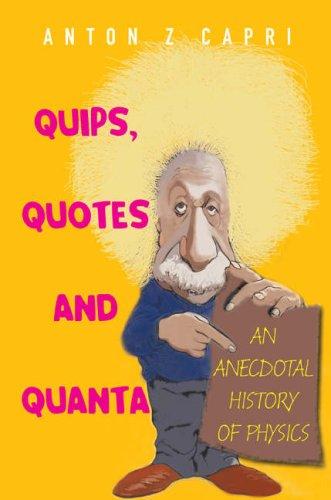
Book review: "Quips, Quotes and Quanta" by Anton Z. Capri

Quips, Quotes, and Quanta: An Anecdotal History of Physics
By Anton Z. Capri
World Scientific Publishing (2007)

I came across Capri's book "Quips, Quotes and Quanta" while searching fodder for our 2011 advent calendar with anecdotes about physicists. It took a while for the book to arrive, but I finally received it a few days before Christmas.

Capri's book is a collection of stories and quotations from the history of physics of the late 19th and early 20th century. The author uses these stories to embed the physics of that time and covers some parts of thermodynamics, quantum mechanics and atomic physics around the lives of Dirac, Schrödinger, Pauli, Bohr, Boltzmann, Ehrenfest, Hilbert, Heisenberg, Planck, to only mention the usual suspects. I will admit on not reading the physics elaborations too carefully, but for all I can tell the scientific content was flawless, if with the superficiality that brevity brings.

While it sounds like a nice idea to get across science with anecdotes, the realization of that idea is poor. The writing is uninspired, sloppy and without style. It is so bad that in parts it reads like copy and pasted from Wikipedia; a list of paragraphs with things soandso allegedly said or did, vaguely collected by name or topic. At least one paragraph appears twice in the book (search inside for "Sommerfeld had this to say about Pauli").

The book does not list a single reference. None of the stories or quotations comes with a source, not even the biographical details. I happened to know some of the sources, and the respective paragraphs appear to me just as scrambled enough so they cannot be identified as exact copies. Bohr's theory of the Wild West for example probably originated in Gamow's recollection. Other anecdotes I know to be wrong, for example that of Bohr and the horseshoe and that Donald Glaser allegedly invented the bubble chamber after watching bubbles raise in beer (which even Wikipedia knows to be made up).

The author, Anton Capri is a retired professor for Engineering Physics. He is not a historian, but as a scientist he should have learned to check and list sources. If you have a scale on which you'd want me to rate this book, mark the lowest possible score. Unless you don't care if an allegedly historical anecdote is entirely fabricated, I recommend you do not spend money on this book.