I can't say I was drawn to theoretical physics because I found it utterly beautiful. Indeed, I found physics in middle school extremely confusing and ugly. We were essentially presented a set of equations, and asked to measure or compute things without any apparent reason. I definitely preferred mathematics, where things seemed to have a relation to each other, and were build up on well defined and reliable axioms.
I was lucky though that I had a very patient teacher who tried to explain me that all these equations actually can be derived from common principles, just that the maths necessary for this was missing in 8th grade. (E.g. the factor 1/2 in the equation
s = 1/2 g t2 suddenly makes sense, when you learn what integration and differentiation is.) I realized only much later that in most of her explanations she was actually talking about differential equations, and the variational principle - what I would call one of the most beautiful concepts in physics.
Some weeks ago I read an article in the October issue of Scientific American Mind
"The Neurology of Aesthetics", which investigated the neurological causes of what humans find beautiful. This post is a very free interpretation of the article, and a comparably free relation to beauty in physics, since I don't think it is necessary to have college level maths skills to see the beauty of it all.
Symmetry/Broken SymmetryThe SciAm article states that allegedly we are attracted to symmetry because it is a property of
'most biological objects' and
'it pays to have an early warning system to draw your attention to symmetry [...] This attraction explains symmetries allure [...]'. Which I can't really agree on, because symmetry apparently is a feature also of non living objects, whereas there exist 'biological' objects that are a)
not symmetrical but worth paying attention (don't worry if you can't read the text, I'm still feeling slightly sick), or b)
symmetrical but doubtful in their aesthetic value (don't click if you suffer from
arachnophobia). But whatever the neurological reason, symmetry is mostly considered as beautiful, which is also the case in physics:
 | There are the obvious examples of crystal growth (see here for more snowflakes) which are based on lattices. Then there is the power of symmetries to classify a confusing amount of particles: the quark model, a brilliant example of how symmetries (in this case SU(3)) allow to explain the observed particle zoo by building them up of only some few constituents. (See here for more info about the Eightfold Way). |
The pictures below show probability distributions of electrons in the hydrogen atom, as one can compute with elementary quantum mechanics (
pictures drawn with this applet, if you want to play around).
The principle of symmetries finds its most powerful application in gauge symmetries, which are the foundation of the standard model of particle physics.
However, as my mother likes to say 'Symmetrie ist die Kunst der Blöden.' -- 'Symmetry is the art of the poor.' Which is true in the sense that perfect symmetry is just boring. From the photos at the beginning of this section, none has perfect symmetry. The breaking of symmetries is essential to the formation of life. It is what makes nature an interesting place.
Patterns and StructuresThe left picture above shows a piece of the Cosmic Microwave Background, the results from the
WMAP measurements. From the sizes and colors (temperature fluctuation) of this pattern one can extract information about the structures at the time of radiation-matter equality.
Another example for structures in physics is closely connected to the search for a theory of quantum gravity. It is generally expected that at smallest scales (close by the Planck length) the spacetime we sit in is not a smooth background but quite messy and quantum foamy, see e.g.
here for a picture and a brief introduction.
Less is More Simplification is one of the primary goals in theoretical physics. Basically the whole search for a theory of everything can be thought of as a search for simplification. Some of the most compelling examples for a successful simplification are maybe the unification of (classical) electric and magnetic phenomena in
Maxwell's equations, and the quantum field theory of
electro-weak interactions.
But simplification is not only a goal. It is also an useful tool. Think about describing the properties of vapor. You don't compute the motions of every single atom, instead you describe the whole system by some few properties like temperature, pressure and volume.
Another well known example is
considering the cow to be a sphere. This might be quite a crude approximation of you think about said cow as your next dinner. But If you want to describe, say, how a
cow drops out of a plane and hit some innocent fisherman, it's completely appropriate to describe it as a sphere.
Simplification is also behind
the cosmological principle, according to which the universe is roughly the same everywhere, and looks the same in every direction. This sounds pretty silly if you look at the screen in front of you, but makes sense if you think of galaxies as particles in a cosmic fluid. The CMB structures shown above are departures from this over-simplified description.
Besides being beautiful, simplification is an extremely powerful concept that can save a lot of brain time.
Amplification
The SciAm article refers to this as
'hypernormal stimuli': an amplified reaction to unusual modifications of a certain property, like high contrast colors, exaggerated shapes etc. They write
'We do not know why this effect occurs but it probably results from the way in which visual neurons encode sensory information' (Which imho is equivalent to saying they don't know anything.)
To come to theoretical physics, it seems that humans are just fascinated by strange thought experiments like: What would happen if you could travel at, or even
faster than the speed of light? If you
fell into a black hole? If the electron mass was only a bit larger? If space-time was made of braids? What if you'd try to
microwave a marshmallow? Describe everything as tiny vibrating strings?
What if you could fly? Travel back in time?
There's no doubt
physicists like extremes.
Problem SolvingI was kind of surprised to see the SciAm article listing problem solving as a factor for beauty, the reason being '
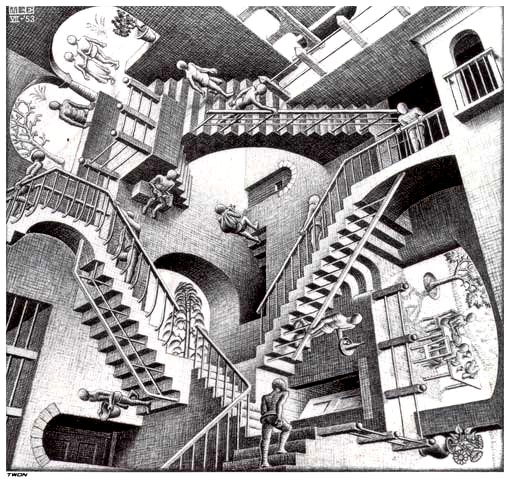
When the correct fragments click into place, we feel a gratifying 'aha'.' This doesn't only make us like the picture whose 'problem we solved', but it is essentially what physics is all about: explaining the underlying concepts of things that look puzzling at first sight.

Another nice example for the fascination caused by problems are maybe also
Esher's impossible pictures.
An additional point that doesn't relate to beauty in theoretical physics is that of a
visual metaphor which draws its relevance from the historical and sociological context.


And if you want to get a perspective of how our concept of beauty is affected through the media,
look at this video.
Don’t the hours grow shorter as the days go by
We never get to stop and open our eyes
One minute you’re waiting for the sky to fall
The next you’re dazzled by the beauty of it all
TAGS: SCIENCE, PHYSICS, BEAUTY