Showing posts with label Dear Dr B. Show all posts

Monday, June 26, 2017

Dear Dr B: Is science democratic?

    “Hi Bee,

    One of the often repeated phrases here in Italy by so called “science enthusiasts” is that “science is not democratic”, which to me sounds like an excuse for someone to justify some authoritarian or semi-fascist fantasy.

    We see this on countless “Science pages”, one very popular example being Fare Serata Con Galileo. It's not a bad page per se, quite the contrary, but the level of comments including variations of “Democracy is overrated”, “Darwin works to eliminate weak and stupid people” and the usual “Science is not democratic” is unbearable. It underscores a troubling “sympathy for authoritarian politics” that to me seems to be more and more common among “science enthusiasts". The classic example it’s made is “the speed of light is not voted”, which to me, as true as it may be, has some sinister resonance.

    Could you comment on this on your blog?

    Luca S.”


Dear Luca,

Wow, I had no idea there’s so much hatred in the backyards of science communication.

Hand count at convention of the German
party CDU. Image Source: AFP
It’s correct that science isn’t democratic, but that doesn’t mean it’s fascistic. Science is a collective enterprise and a type of adaptive system, just like democracy is. But science isn’t democratic any more than sausage is a fruit just because you can eat both.

In an adaptive system, small modifications create a feedback that leads to optimization. The best-known example is probably Darwinian evolution, in which a species’ genetic information receives feedback through natural selection, thereby optimizing the odds of successful reproduction. A market economy is also an adaptive system. Here, the feedback happens through pricing. A free market optimizes “utility” that is, roughly speaking, a measure of the agents’ (customers/producers) satisfaction.

Democracy too is an adaptive system. Its task is to match decisions that affect the whole collective with the electorate’s values. We use democracy to keep our “is” close to the “ought.”

Democracies are more stable than monarchies or autocracies because an independent leader is unlikely to continuously make decisions which the governed people approve of. And the more governed people disapprove, the more likely they are to chop off the king’s head. Democracy, hence, works better than monarchy for the same reason a free market works better than a planned economy: It uses feedback for optimization, and thereby increases the probability for serving peoples’ interests.

The scientific system too uses feedback for optimization – this is the very basis of the scientific method: A hypothesis that does not explain observations has to be discarded or amended. But that’s about where similarities end.

The most important difference between the scientific, democratic, and economic system is the weight of an individual’s influence. In a free market, influence is weighted by wealth: The more money you can invest, the more influence you can have. In a democracy, each voter’s opinion has the same weight. That’s pretty much the definition of democracy – and note that this is a value in itself.

In science, influence is correlated with expertise. While expertise doesn’t guarantee influence, an expert is more likely to hold relevant knowledge, hence expertise is in practice strongly correlated with influence.

There are a lot of things that can go wrong with scientific self-optimization – and a lot of things do go wrong – but that’s a different story and shall be told another time. Still, optimizing hypotheses by evaluating empirical adequacy is how it works in principle. Hence, science clearly isn’t democratic.

Democracy, however, plays an important role for science.

For science to work properly, scientists must be free to communicate and discuss their findings. Non-democratic societies often stifle discussion on certain topics which can create a tension with the scientific system. This doesn’t have to be the case – science can flourish just fine in non-democratic societies – but free speech strongly links the two.

Science also plays an important role for democracy.

Politics isn’t done with polling the electorate on what future they would like to see. Elected representatives then have to find out how to best work towards this future, and scientific knowledge is necessary to get from “is” to “ought.”

But things often go wrong at the step from “is” to “ought.” Trouble is, the scientific system does not export knowledge in a format that can be directly imported by the political system. The information that elected representatives would need to make decisions is a breakdown of predictions with quantified risks and uncertainties. But science doesn’t come with a mechanism to aggregate knowledge. For an outsider, it’s a mess of technical terms and scientific papers and conferences – and every possible opinion seems to be defended by someone!

As a result, public discourse often draws on the “scientific consensus” but this is a bad way to quantify risk and uncertainty.

To begin with, scientists are terribly disagreeable and the only consensuses I know of are those on thousand years-old questions. More important, counting the numbers of people who agree with a statement simply isn’t an accurate quantifier of certainty. The result of such counting inevitably depends on how much expertise the counted people have: Too little expertise, and they’re likely to be ill-informed. Too much expertise, and they’re likely to have personal stakes in the debate. Worse, still, the head-count can easily be skewed by pouring money into some research programs.

Therefore, the best way we presently have make scientific knowledge digestible for politicians is to use independent panels. Such panels – done well – can both circumvent the problem of personal bias and the skewed head count. In the long run, however, I think we need a fourth arm of government to prevent politicians from attempting to interpret scientific debate. It’s not their job and it shouldn’t be.

But those “science enthusiasts” who you complain about are as wrong-headed as the science deniers who selectively disregard facts that are inconvenient for their political agenda. Both of them confuse opinions about what “ought to be” with the question how to get there. The former is a matter of opinion, the latter isn’t.

That vaccine debate that you mentioned, for example. It’s one question what are the benefits of vaccination and who is at risk from side-effects – that’s a scientific debate. It’s another question entirely whether we should allow parents to put their and other peoples’ children at an increased risk of early death or a life of disability. There’s no scientific and no logical argument that tells us where to draw the line.

Personally, I think parents who don’t vaccinate their kids are harming minors and society shouldn’t tolerate such behavior. But this debate has very little to do with scientific authority. Rather, the issue is to what extent parents are allowed to ruin their offspring’s life. Your values may differ from mine.

There is also, I should add, no scientific and no logical argument for counting the vote of everyone (above some quite arbitrary age threshold) with the same weight. Indeed, as Daniel Gilbert argues, we are pretty bad at predicting what will make us happy. If he’s right, then the whole idea of democracy is based on a flawed premise.

So – science isn’t democratic, never has been, never will be. But rather than stating the obvious, we should find ways to better integrate this non-democratically obtained knowledge into our democracies. Claiming that science settles political debate is as stupid as ignoring knowledge that is relevant to make informed decisions.

Science can only help us to understand the risks and opportunities that our actions bring. It can’t tell us what to do.

Thanks for an interesting question.

Wednesday, June 07, 2017

Dear Dr B: What are the chances of the universe ending out of nowhere due to vacuum decay?

    “Dear Sabine,

    my names [-------]. I'm an anxiety sufferer of the unknown and have been for 4 years. I've recently came across some articles saying that the universe could just end out of no where either through false vacuum/vacuum bubbles or just ending and I'm just wondering what the chances of this are occurring anytime soon. I know it sounds silly but I'd be dearly greatful for your reply and hopefully look forward to that

    Many thanks

    [--------]”


Dear Anonymous,

We can’t predict anything.

You see, we make predictions by seeking explanations for available data, and then extrapolating the best explanation into the future. It’s called “abductive reasoning,” or “inference to the best explanation” and it sounds reasonable until you ask why it works. To which the answer is “Nobody knows.”

We know that it works. But we can’t justify inference with inference, hence there’s no telling whether the universe will continue to be predictable. Consequently, there is also no way to exclude that tomorrow the laws of nature will stop and planet Earth will fall apart. But do not despair.

Francis Bacon – widely acclaimed as the first to formulate the scientific method – might have reasoned his way out by noting there are only two possibilities. Either the laws of nature will break down unpredictably or they won’t. If they do, there’s nothing we can do about it. If they don’t, it would be stupid not to use predictions to improve our lives.

It’s better to prepare for a future that you don’t have than to not prepare for a future you do have. And science is based on this reasoning: We don’t know why the universe is comprehensible and why the laws of nature are predictive. But we cannot do anything about unknown unknowns anyway, so we ignore them. And if we do that, we can benefit from our extrapolations.

Just how well scientific predictions work depends on what you try to predict. Physics is the currently most predictive discipline because it deals with the simplest of systems, those whose properties we can measure to high precision and whose behavior we can describe with mathematics. This enables physicists to make quantitatively accurate predictions – if they have sufficient data to extrapolate.

The articles that you read about vacuum decay, however, are unreliable extrapolations of incomplete evidence.

Existing data in particle physics are well-described by a field – the Higgs-field – that fills the universe and gives masses to elementary particles. This works because the value of the Higgs-field is different from zero even in vacuum. We say it has a “non-vanishing vacuum expectation value.” The vacuum expectation value can be calculated from the masses of the known particles.

In the currently most widely used theory for the Higgs and its properties, the vacuum expectation value is non-zero because it has a potential with a local minimum whose value is not at zero.

We do not, however, know that the minimum which the Higgs currently occupies is the only minimum of the potential and – if the potential has another minimum – whether the other minimum would be at a smaller energy. If that was so, then the present state of the vacuum would not be stable, it would merely be “meta-stable” and would eventually decay to the lowest minimum. In this case, we would live today in what is called a “false vacuum.”

Image Credits: Gary Scott Watson.


If our vacuum decays, the world will end – I don’t know a more appropriate expression. Such a decay, once triggered, releases an enormous amount of energy – and it spreads at the speed of light, tearing apart all matter it comes in contact with, until all vacuum has decayed.

How can we tell whether this is going to happen?

Well, we can try to measure the properties of the Higgs’ potential and then extrapolate it away from the minimum. This works much like Taylor series expansions, and it has the same pitfalls. Indeed, making predictions about the minima of a function based on a polynomial expansion is generally a bad idea.

Just look for example at the Taylor series of the sine function. The full function has an infinite number of minima at exactly the same value but you’d never guess from the first terms in the series expansion. First it has one minimum, then it has two minima of different value, then again it has only one – and the higher the order of the expansion the more minima you get.

The situation for the Higgs’ potential is more complicated because the coefficients are not constant, but the argument is similar. If you extract the best-fit potential from the available data and extrapolate it to other values of the Higgs-field, then you find that our present vacuum is meta-stable.

The figure below shows the situation for the current data (figure from this paper). The horizontal axis is the Higgs mass, the vertical axis the mass of the top-quark. The current best-fit is the upper left red point in the white region labeled “Metastability.”
Figure 2 from Bednyakov et al, Phys. Rev. Lett. 115, 201802 (2015).


This meta-stable vacuum has, however, a ridiculously long lifetime of about 10600 times the current age of the universe, take or give a few billion billion billion years. This means that the vacuum will almost certainly not decay until all stars have burnt out.

However, this extrapolation of the potential assumes that there aren’t any unknown particles at energies higher than what we have probed, and no other changes to physics as we know it either. And there is simply no telling whether this assumption is correct.

The analysis of vacuum stability is not merely an extrapolation of the presently known laws into the future – which would be justified – it is also an extrapolation of the presently known laws into an untested energy regime – which is not justified. This stability debate is therefore little more than a mathematical exercise, a funny way to quantify what we already know about the Higgs’ potential.

Besides, from all the ways I can think of humanity going extinct, this one worries me least: It would happen without warning, it would happen quickly, and nobody would be left behind to mourn. I worry much more about events that may cause much suffering, like asteroid impacts, global epidemics, nuclear war – and my worry-list goes on.

Not all worries can be cured by rational thought, but since I double-checked you want facts and not comfort, fact is that current data indicates our vacuum is meta-stable. But its decay is an unreliable prediction based the unfounded assumption that there either are no changes to physics at energies beyond the ones we have tested, or that such changes don’t matter. And even if you buy this, the vacuum almost certainly wouldn’t decay as long as the universe is hospitable for life.

Particle physics is good for many things, but generating potent worries isn’t one of them. The biggest killer in physics is still the 2nd law of thermodynamics. It will get us all, eventually. But keep in mind that the only reason we play the prediction game is to get the best out of the limited time that we have.

Thanks for an interesting question!

Thursday, April 06, 2017

Dear Dr. B: Why do physicists worry so much about the black hole information paradox?

    “Dear Dr. B,

    Why do physicists worry so much about the black hole information paradox, since it looks like there are several, more mundane processes that are also not reversible? One obvious example is the increase of the entropy in an isolated system and another one is performing a measurement according to quantum mechanics.

    Regards, Petteri”


Dear Petteri,

This is a very good question. Confusion orbits the information paradox like accretion disks orbit supermassive black holes. A few weeks ago, I figured even my husband doesn’t really know what the problem is, and he doesn’t only have a PhD in physics, he has also endured me rambling about the topic for more than 15 years!

So, I’m happy to elaborate on why theorists worry so much about black hole information. There are two aspects to this worry: one scientific and one sociological. Let me start with the scientific aspect. I’ll comment on the sociology below.

In classical general relativity, black holes aren’t much trouble. Yes, they contain a singularity where curvature becomes infinitely large – and that’s deemed unphysical – but the singularity is hidden behind the horizon and does no harm.

As Stephen Hawking pointed out, however, if you take into account that the universe – even vacuum – is filled with quantum fields of matter, you can calculate that black holes emit particles, now called “Hawking radiation.” This combination of unquantized gravity with quantum fields of matter is known as “semi-classical” gravity, and it should be a good approximation as long as quantum effects of gravity can be neglected, which means as long as you’re not close by the singularity.

Illustration of black hole with jet and accretion disk.
Image credits: NASA.


Hawking radiation consists of pairs of entangled particles. Of each pair, one particle falls into the black hole while the other one escapes. This leads to a net loss of mass of the black hole, ie the black hole shrinks. It loses mass until entirely evaporated and all that’s left are the particles of the Hawking radiation which escaped.

Problem is, the surviving particles don’t contain any information about what formed the black hole. And not only that, information of the particles’ partners that went into the black hole is also lost. If you investigate the end-products of black hole evaporation, you therefore can’t tell what the initial state was; the only quantities you can extract are the total mass, charge, and angular momentum- the three “hairs” of black holes (plus one qubit). Black hole evaporation is therefore irreversible.


Irreversible processes however don’t exist in quantum field theory. In technical jargon, black holes can turn pure states into mixed states, something that shouldn’t ever happen. Black hole evaporation thus gives rise to an internal contradiction, or “inconsistency”: You combine quantum field theory with general relativity, but the result isn’t compatible with quantum field theory.

To address your questions: Entropy increase usually does not imply a fundamental irreversibility, but merely a practical one. Entropy increases because the probability to observe the reverse process is small. But fundamentally, any process is reversible: Unbreaking eggs, unmixing dough, unburning books – mathematically, all of this can be described just fine. We merely never see this happening because such processes would require exquisitely finetuned initial conditions. A large entropy increase makes a process irreversible in practice, but not irreversible in principle.

That is true for all processes except black hole evaporation. No amount of finetuning will bring back the information that was lost in a black hole. It’s the only known case of a fundamental irreversibility. We know it’s wrong, but we don’t know exactly what’s wrong. That’s why we worry about it.

The irreversibility in quantum mechanics, which you are referring to, comes from the measurement process, but black hole evaporation is irreversible already before a measurement was made. You could argue then, why should it bother us if everything we can possibly observe requires a measurement anyway? Indeed, that’s an argument which can and has been made. But in and by itself it doesn’t remove the inconsistency. You still have to demonstrate just how to reconcile the two mathematical frameworks.

This problem has attracted so much attention because the mathematics is so clear-cut and the implications are so deep. Hawking evaporation relies on the quantum properties of matter fields, but it does not take into account the quantum properties of space and time. It is hence widely believed that quantizing space-time is necessary to remove the inconsistency. Figuring out just what it would take to prevent information loss would teach us something about the still unknown theory of quantum gravity. Black hole information loss, therefore, is a lovely logical puzzle with large potential pay-off – that’s what makes it so addictive.

Now some words on the sociology. It will not have escaped your attention that the problem isn’t exactly new. Indeed, its origin predates my birth. Thousands of papers have been written about it during my lifetime, and hundreds of solutions have been proposed, but theorists just can’t agree on one. The reason is that they don’t have to: For the black holes which we observe (eg at the center of our galaxy), the temperature of the Hawking radiation is so tiny there’s no chance of measuring any of the emitted particles. And so, black hole evaporation is the perfect playground for mathematical speculation.

[Lots of Papers. Img: 123RF]
There is an obvious solution to the black hole information loss problem which was pointed out already in early days. The reason that black holes destroy information is that whatever falls through the horizon ends up in the singularity where it is ultimately destroyed. The singularity, however, is believed to be a mathematical artifact that should no longer be present in a theory of quantum gravity. Remove the singularity and you remove the problem.

Indeed, Hawking’s calculation breaks down when the black hole has lost almost all of its mass and has become so small that quantum gravity is important. This would mean the information would just come out in the very late, quantum gravitational, phase and no contradiction ever occurs.

This obvious solution, however, is also inconvenient because it means that nothing can be calculated if one doesn’t know what happens nearby the singularity and in strong curvature regimes which would require quantum gravity. It is, therefore, not a fruitful idea. Not many papers can be written about it and not many have been written about it. It’s much more fruitful to assume that something else must go wrong with Hawking’s calculation.

Sadly, if you dig into the literature and try to find out on which grounds the idea that information comes out in the strong curvature phase was discarded, you’ll find it’s mostly sociology and not scientific reasoning.

If the information is kept by the black hole until late, this means that small black holes must be able to keep many different combinations of information inside. There are a few papers which have claimed that these black holes then must emit their information slowly, which means small black holes would behave like a technically infinite number of particles. In this case, so the claim, they should be produced in infinite amounts even in weak background fields (say, nearby Earth), which is clearly incompatible with observation.

Unfortunately, these arguments are based on an unwarranted assumption, namely that the interior of small black holes has a small volume. In GR, however, there isn’t any obvious relation between surface area and volume because space can be curved. The assumption that such small black holes, for which quantum gravity is strong, can be effectively described as particles is equally shaky. (For details and references, please see this paper I wrote with Lee some years ago.)

What happened, to make a long story short, is that Lenny Susskind wrote a dismissive paper about the idea that information is kept in black holes until late. This dismissal gave everybody else the opportunity to claim that the obvious solution doesn’t work and to henceforth produce endless amounts of papers on other speculations.

Excuse the cynicism, but that’s my take on the situation. I’ll even admit having contributed to the paper pile because that’s how academia works. I too have to make a living somehow.

So that’s the other reason why physicists worry so much about the black hole information loss problem: Because it’s speculation unconstrained by data, it’s easy to write papers about it, and there are so many people working on it that citations aren’t hard to come by either.

Thanks for an interesting question, and sorry for the overly honest answer.

Wednesday, November 30, 2016

Dear Dr. B: What is emergent gravity?

    “Hello Sabine, I've seen a couple of articles lately on emergent gravity. I'm not a scientist so I would love to read one of your easy-to-understand blog entries on the subject.

    Regards,

    Michael Tucker
    Wichita, KS”

Dear Michael,

Emergent gravity has been in the news lately because of a new paper by Erik Verlinde. I’ll tell you some more about that paper in an upcoming post, but answering your question makes for a good preparation.

The “gravity” in emergent gravity refers to the theory of general relativity in the regimes where we have tested it. That means Einstein’s field equations and curved space-time and all that.

The “emergent” means that gravity isn’t fundamental, but instead can be derived from some underlying structure. That’s what we mean by “emergent” in theoretical physics: If theory B can be derived from theory A but not the other way round, then B emerges from A.

You might be more familiar with seeing the word “emergent” applied to objects or properties of objects, which is another way physicists use the expression. Sound waves in the theory of gases, for example, emerge from molecular interactions. Van-der Waals forces emerge from quantum electrodynamics. Protons emerge from quantum chromodynamics. And so on.

Everything that isn’t in the standard model or general relativity is known to be emergent already. And since I know that it annoys so many of you, let me point out again that, yes, to our current best knowledge this includes cells and brains and free will. Fundamentally, you’re all just a lot of interacting particles. Get over it.

General relativity and the standard model are the currently the most fundamental descriptions of nature which we have. For the theoretical physicist, the interesting question is then whether these two theories are also emergent from something else. Most physicists in the field think the answer is yes. And any theory in which general relativity – in the tested regimes – is derived from a more fundamental theory, is a case of “emergent gravity.”

That might not sound like such a new idea and indeed it isn’t. In string theory, for example, gravity – like everything else – “emerges” from, well, strings. There are a lot of other attempts to explain gravitons – the quanta of the gravitational interaction – as not-fundamental “quasi-particles” which emerge, much like sound-waves, because space-time is made of something else. An example for this is the model pursued by Xiao-Gang Wen and collaborators in which space-time, and matter, and really everything is made of qbits. Including cells and brains and so on.

Xiao-Gang’s model stands out because it can also include the gauge-groups of the standard model, though last time I looked chirality was an issue. But there are many other models of emergent gravity which focus on just getting general relativity. Lorenzo Sindoni has written a very useful, though quite technical, review of such models.

Almost all such attempts to have gravity emerge from some underlying “stuff” run into trouble because the “stuff” defines a preferred frame which shouldn’t exist in general relativity. They violate Lorentz-invariance, which we know observationally is fulfilled to very high precision.

An exception to this is entropic gravity, an idea pioneered by Ted Jacobson 20 years ago. Jacobson pointed out that there are very close relations between gravity and thermodynamics, and this research direction has since gained a lot of momentum.

The relation between general relativity and thermodynamics in itself doesn’t make gravity emergent, it’s merely a reformulation of gravity. But thermodynamics itself is an emergent theory – it describes the behavior of very large numbers of some kind of small things. Hence, that gravity looks a lot like thermodynamics makes one think that maybe it’s emergent from the interaction of a lot of small things.

What are the small things? Well, the currently best guess is that they’re strings. That’s because string theory is (at least to my knowledge) the only way to avoid the problems with Lorentz-invariance violation in emergent gravity scenarios. (Gravity is not emergent in Loop Quantum Gravity – its quantized version is directly encoded in the variables.)

But as long as you’re not looking at very short distances, it might not matter much exactly what gravity emerges from. Like thermodynamics was developed before it could be derived from statistical mechanics, we might be able to develop emergent gravity before we know what to derive it from.

This is only interesting, however, if the gravity that “emerges” is only approximately identical to general relativity, and differs from it in specific ways. For example, if gravity is emergent, then the cosmological constant and/or dark matter might emerge with it, whereas in our current formulation, these have to be added as sources for general relativity.

So, in summary “emergent gravity” is a rather vague umbrella term that encompasses a large number of models in which gravity isn’t a fundamental interaction. The specific theory of emergent gravity which has recently made headlines is better known as “entropic gravity” and is, I would say, the currently most promising candidate for emergent gravity. It’s believed to be related to, or maybe even be part of string theory, but if there are such links they aren’t presently well understood.

Thanks for an interesting question!

Aside: Sorry about the issue with the comments. I turned on G+ comments, thinking they'd be displayed in addition, but that instead removed all the other comments. So I've reset this to the previous version, though I find it very cumbersome to have to follow four different comment threads for the same post.

Wednesday, October 19, 2016

Dear Dr B: Where does dark energy come from and what’s it made of?

“As the universe expands and dark energy remains constant (negative pressure) then where does the ever increasing amount of dark energy come from? Is this genuinely creating something from nothing (bit of lay man’s hype here), do conservation laws not apply? Puzzled over this for ages now.”
-- pete best
“When speaking of the Einstein equation, is it the case that the contribution of dark matter is always included in the stress energy tensor (source term) and that dark energy is included in the cosmological constant term? If so, is this the main reason to distinguish between these two forms of ‘darkness’? I ask because I don’t normally read about dark energy being ‘composed of particles’ in the way dark matter is discussed phenomenologically.”
-- CGT

Dear Pete, CGT:

Dark energy is often portrayed as very mysterious. But when you look at the math, it’s really the simplest aspect of general relativity.

Ahead, allow me to clarify that your questions refer to “dark energy” but are specifically about the cosmological constant which is a certain type of dark energy. For all we know, the cosmological constant fits all existing observations. Dark energy could be more complicated than that, but let’s start with the cosmological constant.

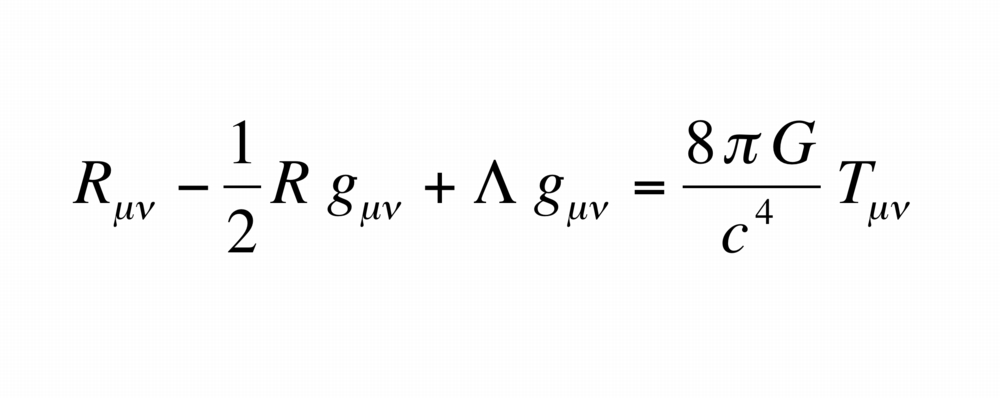
Einstein’s field equations can be derived from very few assumptions. First, there’s the equivalence principle, which can be formulated mathematically as the requirement that the equations be tensor-equations. Second, the equations should describe the curvature of space-time. Third, the source of gravity is the stress-energy tensor and it’s locally conserved.

If you write down the simplest equations which fulfill these criteria you get Einstein’s field equations with two free constants. One constant can be fixed by deriving the Newtonian limit and it turns out to be Newton’s constant, G. The other constant is the cosmological constant, usually denoted Λ. You can make the equations more complicated by adding higher order terms, but at low energies these two constants are the only relevant ones.
Einstein's field equations. [Image Source]
If the cosmological constant is not zero, then flat space-time is no longer a solution of the equations. If the constant is positive-valued in particular, space will undergo accelerated expansion if there are no other matter sources, or these are negligible in comparison to Λ. Our universe presently seems to be in a phase that is dominated by a positive cosmological constant – that’s the easiest way to explain the observations which were awarded the 2011 Nobel Prize in physics.

Things get difficult if one tries to find an interpretation of the rather unambiguous mathematics. You can for example take the term with the cosmological constant and not think of it as geometrical, but instead move it to the other side of the equation and think of it as some stuff that causes curvature. If you do that, you might be tempted to read the entries of the cosmological constant term as if it was a kind of fluid. It would then correspond to a fluid with constant density and with constant, negative pressure. That’s something one can write down. But does this interpretation make any sense? I don’t know. There isn’t any known fluid with such behavior.

Since the cosmological constant is also present if matter sources are absent, it can be interpreted as the energy-density and pressure of the vacuum. Indeed, one can calculate such a term in quantum field theory, just that the result is infamously 120 orders of magnitude too large. But that’s a different story and shall be told another time. The cosmological constant term is therefore often referred to as the “vacuum energy,” but that’s sloppy. It’s an energy-density, not an energy, and that’s an important difference.

How can it possibly be that an energy density remains constant as the universe expands, you ask. Doesn’t this mean you need to create more energy from somewhere? No, you don’t need to create anything. This is a confusion which comes about because you interpret the density which has been assigned to the cosmological constant like a density of matter, but that’s not what it is. If it was some kind of stuff we know, then, yes, you would expect the density to dilute as space expands. But the cosmological constant is a property of space-time itself. As space expands, there’s more space, and that space still has the same vacuum energy density – it’s constant!

The cosmological constant term is indeed conserved in general relativity, and it’s conserved separately from that of the other energy and matter sources. It’s just that conservation of stress-energy in general relativity works differently than you might be used to from flat space.

According to Noether’s theorem there’s a conserved quantity for every (continuous) symmetry. A flat space-time is the same at every place and at every moment of time. We say it has a translational invariance in space and time. These are symmetries, and they come with conserved quantities: Translational invariance of space conserves momentum, translational invariance in time conserves energy.

In a curved space-time generically neither symmetry is fulfilled, hence neither energy nor momentum are conserved. So, if you take the vacuum energy density and you integrate it over some volume to get an energy, then the total energy grows with the volume indeed. It’s just not conserved. How strange! But that makes perfect sense: It’s not conserved because space expands and hence we have no invariance in time. Consequently, there’s no conserved quantity for invariance in time.

But General Relativity has a more complicated type of symmetry to which Noether’s theorem can be applied. This gives rise to a local conservation of stress-momentum when coupled to gravity (the stress-momentum tensor is covariantly conserved).

The conservation law for the density of a pressureless fluid, for example, works as you expect it to work: As space expands, the density goes down with the volume. For radiation – which has pressure – the energy density falls faster than that of matter because wavelengths also redshift. And if you put the cosmological constant term with its negative pressure into the conservation law, both energy and pressure remain the same. It’s all consistent: They are conserved if they are constant.

Dark energy now is a generalization of the cosmological constant, in which one invents some fields which give rise to a similar term. There are various fields that theoretical physicists have played with: chameleon fields and phantom fields and quintessence and such. The difference to the cosmological constant is that these fields’ densities do change with time, albeit slowly. There is however presently no evidence that this is the case.

As to the question which dark stuff to include in which term. Dark matter is usually assumed to be pressureless, which means that for what its gravitational pull is concerned it behaves just like normal matter. Dark energy, in contrast, has negative pressure and does odd things. That’s why they are usually collected in different terms.

Why don’t you normally read about dark energy being made of particles? Because you need some really strange stuff to get something that behaves like dark energy. You can’t make it out of any kind of particle that we know – this would either give you a matter term or a radiation term, neither of which does what dark energy needs to do.

If dark energy was some kind of field, or some kind of condensate, then it would be made of something else. In that case its density might indeed also vary from one place to the next and we might be able to detect the presence of that field in some way. Again though, there isn’t presently any evidence for that.

Thanks for your interesting questions!

Tuesday, September 27, 2016

Dear Dr B: What do physicists mean by “quantum gravity”?

[Image Source: giphy.com]
“please could you give me a simple definition of "quantum gravity"?

J.”

Dear J,

Physicists refer with “quantum gravity” not so much to a specific theory but to the sought-after solution to various problems in the established theories. The most pressing problem is that the standard model combined with general relativity is internally inconsistent. If we just use both as they are, we arrive at conclusions which do not agree with each other. So just throwing them together doesn’t work. Something else is needed, and that something else is what we call quantum gravity.

Unfortunately, the effects of quantum gravity are very small, so presently we have no observations to guide theory development. In all experiments made so far, it’s sufficient to use unquantized gravity.

Nobody knows how to combine a quantum theory – like the standard model – with a non-quantum theory – like general relativity – without running into difficulties (except for me, but nobody listens). Therefore the main strategy has become to find a way to give quantum properties to gravity. Or, since Einstein taught us gravity is nothing but the curvature of space-time, to give quantum properties to space and time.

Just combining quantum field theory with general relativity doesn’t work because, as confirmed by countless experiments, all the particles we know have quantum properties. This means (among many other things) they are subject to Heisenberg’s uncertainty principle and can be in quantum superpositions. But they also carry energy and hence should create a gravitational field. In general relativity, however, the gravitational field can’t be in a quantum superposition, so it can’t be directly attached to the particles, as it should be.

One can try to find a solution to this conundrum, for example by not directly coupling the energy (and related quantities like mass, pressure, momentum flux and so on) to gravity, but instead only coupling the average value, which behaves more like a classical field. This solves one problem, but creates a new one. The average value of a quantum state must be updated upon measurement. This measurement postulate is a non-local prescription and general relativity can’t deal with it – after all Einstein invented general relativity to get rid of the non-locality of Newtonian gravity. (Neither decoherence nor many worlds remove the problem, you still have to update the probabilities, somehow, somewhere.)

The quantum field theories of the standard model and general relativity clash in other ways. If we try to understand the evaporation of black holes, for example, we run into another inconsistency: Black holes emit Hawking-radiation due to quantum effects of the matter fields. This radiation doesn’t carry information about what formed the black hole. And so, if the black hole entirely evaporates, this results in an irreversible process because from the end-state one can’t infer the initial state. This evaporation however can’t be accommodated in a quantum theory, where all processes can be time-reversed – it’s another contradiction that we hope quantum gravity will resolve.

Then there is the problem with the singularities in general relativity. Singularities, where the space-time curvature becomes infinitely large, are not mathematical inconsistencies. But they are believed to be physical nonsense. Using dimensional analysis, one can estimate that the effects of quantum gravity should become large close by the singularities. And so we think that quantum gravity should replace the singularities with a better-behaved quantum space-time.

The sought-after theory of quantum gravity is expected to solve these three problems: tell us how to couple quantum matter to gravity, explain what happens to information that falls into a black hole, and avoid singularities in general relativity. Any theory which achieves this we’d call quantum gravity, whether or not you actually get it by quantizing gravity.

Physicists are presently pursuing various approaches to a theory of quantum gravity, notably string theory, loop quantum gravity, asymptotically safe gravity, and causal dynamical triangulation, for just to name the most popular ones. But none of these approaches has experimental evidence speaking for it. Indeed, so far none of them has made a testable prediction.

This is why, in the area of quantum gravity phenomenology, we’re bridging the gap between theory and experiment with simplified models, some of which motivated by specific approaches (hence: string phenomenology, loop quantum cosmology, and so on). These phenomenological models don’t aim to directly solve the above mentioned problems, they merely provide a mathematical framework – consistent in its range of applicability – to quantify and hence test the presence of effects that could be signals of quantum gravity, for example space-time fluctuations, violations of the equivalence principle, deviations from general relativity, and so on.

Thanks for an interesting question!

Monday, August 29, 2016

Dear Dr. B: How come we never hear of a force that the Higgs boson carries?

    “Dear Dr. Hossenfelder,

    First, I love your blog. You provide a great insight into the world of physics for us laymen. I have read in popular science books that the bosons are the ‘force carriers.’ For example the photon carries the electromagnetic force, the gluon, the strong force, etc. How come we never hear of a force that the Higgs boson carries?

    Ramiro Rodriguez
Dear Ramiro,

The short answer is that you never hear of a force that the Higgs boson carries because it doesn’t carry one. The longer answer is that not all bosons are alike. This of course begs the question just how the Higgs-boson is different, so let me explain.

The standard model of particle physics is based on gauge symmetries. This basically means that the laws of nature have to remain invariant under transformations in certain internal spaces, and these transformations can change from one place to the next and one moment to the next. They are what physics call “local” symmetries, as opposed to “global” symmetries whose transformations don’t change in space or time.

Amazingly enough, the requirement of gauge symmetry automatically explains how particles interact. It works like this. You start with fermions, that are particles of half-integer spin, like electrons, muons, quarks and so on. And you require that the fermions’ behavior must respect a gauge symmetry, which is classified by a symmetry group. Then you ask what equations you can possibly get that do this.

Since the fermions can move around, the equations that describe what they do must contain derivatives both in space and in time. This causes a problem, because if you want to know how the fermions’ motion changes from one place to the next you’d also have to know what the gauge transformation does from one place to the next, otherwise you can’t tell apart the change in the fermions from the change in the gauge transformation. But if you’d need to know that transformation, then the equations wouldn’t be invariant.

From this you learn that the only way the fermions can respect the gauge symmetry is if you introduce additional fields – the gauge fields – which exactly cancel the contribution from the space-time dependence of the gauge transformation. In the standard model the gauge fields all have spin 1, which means they are bosons. That's because to cancel the terms that came from the space-time derivative, the fields need to have the same transformation behavior as the derivative, which is that of a vector, hence spin 1.

To really follow this chain of arguments – from the assumption of gauge symmetry to the presence of gauge-bosons – requires several years’ worth of lectures, but the upshot is that the bosons which exchange the forces aren’t added by hand to the standard model, they are a consequence of symmetry requirements. You don’t get to pick the gauge-bosons, neither their number nor their behavior – their properties are determined by the symmetry.

In the standard model, there are 12 such force-carrying bosons: the photon (γ), the W+, W-, Z, and 8 gluons. They belong to three gauge symmetries, U(1), SU(2) and SU(3). Whether a fermion does or doesn’t interact with a gauge-boson depends on whether the fermion is “gauged” under the respective symmetry, ie transforms under it. Only the quarks, for example, are gauged under the SU(3) symmetry of the strong interaction, hence only the quarks couple to gluons and participate in that interaction. The so-introduced bosons are sometimes specifically referred to as “gauge-bosons” to indicate their origin.

The Higgs-boson in contrast is not introduced by a symmetry requirement. It has an entirely different function, which is to break a symmetry (the electroweak one) and thereby give mass to particles. The Higgs doesn’t have spin 1 (like the gauge-bosons) but spin 0. Indeed, it is the only presently known elementary particle with spin zero. Sheldon Glashow has charmingly referred to the Higgs as the “flush toilet” of the standard model – it’s there for a purpose, not because we like the smell.

The distinction between fermions and bosons can be removed by postulating an exchange symmetry between these two types of particles, known as supersymmetry. It works basically by generalizing the concept of a space-time direction to not merely be bosonic, but also fermionic, so that there is now a derivative that behaves like a fermion.

In the supersymmetric extension of the standard model there are then partner particles to all already known particles, denoted either by adding an “s” before the particle’s name if it’s a boson (selectron, stop quark, and so on) or adding “ino” after the particle’s name if it’s a fermion (Wino, photino, and so on). There is then also Higgsino, which is the partner particle of the Higgs and has spin 1/2. It is gauged under the standard model symmetries, hence participates in the interactions, but still is not itself consequence of a gauge.

In the standard model most of the bosons are also force-carriers, but bosons and force-carriers just aren’t the same category. To use a crude analogy, just because most of the men you know (most of the bosons in the standard model) have short hair (are force-carriers) doesn’t mean that to be a man (to be a boson) you must have short hair (exchange a force). Bosons are defined by having integer spin, as opposed to the half-integer spin that fermions have, and not by their ability to exchange interactions.

In summary the answer to your question is that certain types of bosons – the gauge bosons – are a consequence of symmetry requirements from which it follows that these bosons do exchange forces. The Higgs isn’t one of them.

Thanks for an interesting question!

Peter Higgs receiving the Nobel Prize from the King of Sweden.
[Img Credits: REUTERS/Claudio Bresciani/TT News Agency]


Previous Dear-Dr-B’s that you might also enjoy:

Monday, June 06, 2016

Dear Dr B: Why not string theory?

[I got this question in reply to my last week’s book review of Why String Theory? by Joseph Conlon.]

Dear Marco:

Because we might be wasting time and money and, ultimately, risk that progress stalls entirely.

In contrast to many of my colleagues I do not think that trying to find a quantum theory of gravity is an endeavor purely for the sake of knowledge. Instead, it seems likely to me that finding out what are the quantum properties of space and time will further our understanding of quantum theory in general. And since that theory underlies all modern technology, this is research which bears relevance for applications. Not in ten years and not in 50 years, but maybe in 100 or 500 years.

So far, string theory has scored in two areas. First, it has proved interesting for mathematicians. But I’m not one to easily get floored by pretty theorems – I care about math only to the extent that it’s useful to explain the world. Second, string theory has shown to be useful to push ahead with the lesser understood aspects of quantum field theories. This seems a fruitful avenue and is certainly something to continue. However, this has nothing to do with string theory as a theory of quantum gravity and a unification of the fundamental interactions.

As far as quantum gravity is concerned, string theorist’s main argument seems to be “Well, can you come up with something better?” Then of course if someone answers this question with “Yes” they would never agree that something else might possibly be better. And why would they – there’s no evidence forcing them one way or the other.

I don’t see what one learns from discussing which theory is “better” based on philosophical or aesthetic criteria. That’s why I decided to stay out of this and instead work on quantum gravity phenomenology. As far as testability is concerned all existing approaches to quantum gravity do equally badly, and so I’m equally unconvinced by all of them. It is somewhat of a mystery to me why string theory has become so dominant.

String theorists are very proud of having a microcanonical explanation for the black hole entropy. But we don’t know whether that’s actually a correct description of nature, since nobody has ever seen a black hole evaporate. In fact one could read the firewall problem as a demonstration that indeed this cannot be a correct description of nature. Therefore, this calculation leaves me utterly unimpressed.

But let me be clear here. Nobody (at least nobody whose opinion matters) says that string theory is a research program that should just be discontinued. The question is instead one of balance – does the promise justify the amount of funding spend on it? And the answer to this question is almost certainly no.

The reason is that academia is currently organized so that it invites communal reinforcement, prevents researchers from leaving fields whose promise is dwindling, and supports a rich-get-richer trend. That institutional assessments use the quantity of papers and citation counts as a proxy for quality creates a bonus for fields in which papers can be cranked out quickly. Hence it isn’t surprising that an area whose mathematics its own practitioners frequently describe as “rich” would flourish. What does mathematical “richness” tell us about the use of a theory in the description of nature? I am not aware of any known relation.

In his book Why String Theory?, Conlon tells the history of the discipline from a string theorist’s perspective. As a counterpoint, let me tell you how a cynical outsider might tell this story:

String theory was originally conceived as a theory of the strong nuclear force, but it was soon discovered that quantum chromodynamics was more up to the task. After noting that string theory contains a particle that could be identified as the graviton, it was reconsidered as a theory of quantum gravity.

It turned out however that string theory only makes sense in a 25-dimensional space. To make that compatible with observations, 22 of the dimensions were moved out of sight by rolling them up (compactifying) them to a radius so small they couldn’t be observationally probed.

Next it was noted that the theory also needs supersymmetry. This brings down the number of space dimensions to 9, but also brings a new problem: The world, unfortunately, doesn’t seem to be supersymmetric. Hence, it was postulated that supersymmetry is broken at an energy scale so high we wouldn’t see the symmetry. Even with that problem fixed, however, it was quickly noticed that moving the superpartners out of direct reach would still induce flavor changing neutral currents that, among other things, would lead to proton decay and so be in conflict with observation. Thus, theorists invented R-parity to fix that problem.

The next problem that appeared was that the cosmological constant turned out to be positive instead of zero or negative. While a negative cosmological constant would have been easy to accommodate, string theorists didn’t know what to do with a positive one. But it only took some years to come up with an idea to make that happen too.

String theory was hoped to be a unique completion of the standard model including general relativity. Instead it slowly became clear that there is a huge number of different ways to get rid of the additional dimensions, each of which leads to a different theory at low energies. String theorists are now trying to deal with that problem by inventing some probability measure according to which the standard model is at least a probable occurrence in string theory.

So, you asked, why not string theory? Because it’s an approach that has been fixed over and over again to make it compatible with conflicting observations. Every time that’s been done, string theorists became more convinced of their ideas. And every time they did this, I became more convinced they are merely building a mathematical toy universe.

String theorists of course deny that they are influenced by anything but objective assessment. One noteworthy exception is Joe Polchinski who has considered that social effects play a role, but just came to the conclusion that they aren’t relevant. I think it speaks for his intellectual sincerity that he at least considered it.

At the Munich workshop last December, David Gross (in an exchange with Carlo Rovelli) explained that funding decisions have no influence on whether theoretical physicists chose to work in one field or the other. Well, that’s easy to say if you’re a Nobel Prize winner.

Conlon in his book provides “evidence” that social bias plays no role by explaining that there was only one string theorist in a panel that (positively) evaluated one of his grants. To begin with anecdotes can’t replace data and there is ample evidence that social biases are common human traits, so by default scientists should be susceptible. But even considering his anecdote, I’m not sure why Conlon thinks leaving decisions to non-experts limits bias. My expectation would be that it amplifies bias because it requires drawing on simplified criteria, like the number of papers published and how often they’ve been cited. And what does that depend on? Depends on how many people there are in the field and how many peers favorably reviewed papers on the topic of your work.

I am listing these examples to demonstrate that it is quite common of theoretical physicists (not string theorists in particular) to dismiss the mere possibility that social dynamics influences research decisions.

How large a role play social dynamics and cognitive biases, and how much do they slow down progress on the foundations of physics? I can’t tell you. But even though I can’t tell you how much faster progress could be, I am sure it’s slowed down. I can tell that in the same way that I can tell you diesel in Germany is sold under market value even though I don’t know the market value. I know that because it’s subsidized. And in the same way I can tell that string theory is overpopulated and its promise is overestimated because it’s an idea that benefits from biases which humans demonstrably possess. But I can’t tell you what its real value would be.

The reproduction crisis in the life-sciences and psychology has spurred a debate for better measures of statistical significance. Experimentalists go to length to put into place all kinds of standardized procedures to not draw the wrong conclusions from what their apparatuses measures. In theory development, we have our own crisis, but nobody talks about it. The apparatuses that we use are our own brains and biases we should guard against are cognitive and social biases, communal reinforcement, sunk cost fallacy, wishful thinking and status-quo bias, for just to mention the most common ones. These however are presently entirely unaccounted for. Is this the reason why string theory has gathered so many followers?

Some days I side with Polchinski and Gross and don’t think it makes that much of a difference. It really is an interesting topic and it’s promising. On other days I think we’ve wasted 30 years studying bizarre aspects of a theory that doesn’t bring us any closer to understanding quantum gravity, and it’s nothing but an empty bubble of disappointed expectations. Most days I have to admit I just don’t know.

Why not string theory? Because enough is enough.

Thanks for an interesting question.

Sunday, May 15, 2016

Dear Dr B: If photons have a mass, would this mean special relativity is no longer valid?

Einstein and Lorentz.
[Image: Wikipedia]
“[If photons have a restmass] would that mean the whole business of the special theory of relativity being derived from the idea that light has to go at a particular velocity in order for it to exist/Maxwell’s identification of e/m waves as light because they would have to go at the appropriate velocity is no longer valid?”

(This question came up in the discussion of a recent proposal according to which photons with a tiny restmass might cause an effect similar to the cosmological constant.)

Dear Brian,

The short answer to your question is “No.” If photons had a restmass, special relativity would still be as valid as it’s always been.

The longer answer is that the invariance of the speed of light features prominently in the popular explanations of special relativity for historic reasons, not for technical reasons. Einstein was lead to special relativity contemplating what it would be like to travel with light, and then tried to find a way to accommodate an observer’s motion with the invariance of the speed of light. But the derivation of special relativity is much more general than that, and it is unnecessary to postulate that the speed of light is invariant.

Special relativity is really just physics in Minkowski space, that is the 4-dimensional space-time you obtain after promoting time from a parameter to a coordinate. Einstein wanted the laws of physics to be the same for all inertial observers in Minkowski-space, ie observers moving at constant velocity. If you translate this requirement into mathematics, you are lead to ask for the symmetry transformations in Minkowski-space. These transformations form a group – the Poincaré-group – from which you can read off all the odd things you have heard of: time-dilatation, length-contraction, relativistic mass, and so on.

The Poincaré-group itself has two subgroups. One contains just translations in space and time. This tells you that if you have an infinitely extended and unchanging space then it doesn’t matter where or when you do your experiment, the outcome will be the same. The remaining part of the Poincaré-group is the Lorentz-group. The Lorentz-group contains rotations – this tells you it doesn’t matter in which direction you turn, the laws of nature will still be the same. Besides the rotations, the Lorentz-group contains boosts, that are basically rotations between space and time. Invariance under boosts tells you that it doesn’t matter at which velocity you move, the laws of nature will remain the same. It’s the boosts where all the special relativistic fun goes on.

Deriving the Lorentz-group, if you know how to do it, is a three-liner, and I assure you it has absolutely nothing to do with rocket ships and lasers and so on. It is merely based on the requirement that the metric of Minkowski-space has to remain invariant. Carry through with the math and you’ll find that the boosts depend on a free constant with the dimension of a speed. You can further show that this constant is the speed of massless particles.

Hence, if photons are massless, then the constant in the Lorentz-transformation is the speed of light. If photons are not massless, then the constant in the Lorentz-transformation is still there, but not identical to the speed of light. We already know however that these constants must be identical to very good precision, which is the same as saying the mass of photons must be very small.

Giving a mass to photons is unappealing not because it violates special relativity – it doesn’t – but because it violates gauge-invariance, the most cherished principle underlying the standard model. But that’s a different story and shall be told another time.

Thanks for an interesting question!

Wednesday, April 20, 2016

Dear Dr B: Why is Lorentz-invariance in conflict with discreteness?

Can we build up space-time from
discrete entities?
“Could you elaborate (even) more on […] the exact tension between Lorentz invariance and attempts for discretisation?

Best,

Noa”

Dear Noa:

Discretization is a common procedure to deal with infinities. Since quantum mechanics relates large energies to short (wave) lengths, introducing a shortest possible distance corresponds to cutting off momentum integrals. This can remove infinites that come in at large momenta (or, as the physicists say “in the UV”).

Such hard cut-off procedures were quite common in the early days of quantum field theory. They have since been replaced with more sophisticated regulation procedures, but these don’t work for quantum gravity. Hence it lies at hand to use discretization to get rid of the infinities that plague quantum gravity.

Lorentz-invariance is the symmetry of Special Relativity; it tells us how observables transform from one reference frame to another. Certain types of observables, called “scalars,” don’t change at all. In general, observables do change, but they do so under a well-defined procedure that is by the application of Lorentz-transformations.We call these “covariant.” Or at least we should. Most often invariance is conflated with covariance in the literature.

(To be precise, Lorentz-covariance isn’t the full symmetry of Special Relativity because there are also translations in space and time that should maintain the laws of nature. If you add these, you get Poincaré-invariance. But the translations aren’t so relevant for our purposes.)

Lorentz-transformations acting on distances and times lead to the phenomena of Lorentz-contraction and time-dilatation. That means observers at relative velocities to each other measure different lengths and time-intervals. As long as there aren’t any interactions, this has no consequences. But once you have objects that can interact, relativistic contraction has measurable consequences.

Heavy ions for example, which are collided in facilities like RHIC or the LHC, are accelerated to almost the speed of light, which results in a significant length contraction in beam direction, and a corresponding increase in the density. This relativistic squeeze has to be taken into account to correctly compute observables. It isn’t merely an apparent distortion, it’s a real effect.

Now consider you have a regular cubic lattice which is at rest relative to you. Alice comes by in a space-ship at high velocity, what does she see? She doesn’t see a cubic lattice – she sees a lattice that is squeezed into one direction due to Lorentz-contraction. Who of you is right? You’re both right. It’s just that the lattice isn’t invariant under the Lorentz-transformation, and neither are any interactions with it.

The lattice can therefore be used to define a preferred frame, that is a particular reference frame which isn’t like any other frame, violating observer independence. The easiest way to do this would be to use the frame in which the spacing is regular, ie your restframe. If you compute any observables that take into account interactions with the lattice, the result will now explicitly depend on the motion relative to the lattice. Condensed matter systems are thus generally not Lorentz-invariant.

A Lorentz-contraction can convert any distance, no matter how large, into another distance, no matter how short. Similarly, it can blue-shift long wavelengths to short wavelengths, and hence can make small momenta arbitrarily large. This however runs into conflict with the idea of cutting off momentum integrals. For this reason approaches to quantum gravity that rely on discretization or analogies to condensed matter systems are difficult to reconcile with Lorentz-invariance.

So what, you may say, let’s just throw out Lorentz-invariance then. Let us just take a tiny lattice spacing so that we won’t see the effects. Unfortunately, it isn’t that easy. Violations of Lorentz-invariance, even if tiny, spill over into all kinds of observables even at low energies.

A good example is vacuum Cherenkov radiation, that is the spontaneous emission of a photon by an electron. This effect is normally – ie when Lorentz-invariance is respected – forbidden due to energy-momentum conservation. It can only take place in a medium which has components that can recoil. But Lorentz-invariance violation would allow electrons to radiate off photons even in empty space. No such effect has been seen, and this leads to very strong bounds on Lorentz-invariance violation.

And this isn’t the only bound. There are literally dozens of particle interactions that have been checked for Lorentz-invariance violating contributions with absolutely no evidence showing up. Hence, we know that Lorentz-invariance, if not exact, is respected by nature to extremely high precision. And this is very hard to achieve in a model that relies on a discretization.

Having said that, I must point out that not every quantity of dimension length actually transforms as a distance. Thus, the existence of a fundamental length scale is not a priori in conflict with Lorentz-invariance. The best example is maybe the Planck length itself. It has dimension length, but it’s defined from constants of nature that are themselves frame-independent. It has units of a length, but it doesn’t transform as a distance. For the same reason string theory is perfectly compatible with Lorentz-invariance even though it contains a fundamental length scale.

The tension between discreteness and Lorentz-invariance appears always if you have objects that transform like distances or like areas or like spatial volumes. The Causal Set approach therefore is an exception to the problems with discreteness (to my knowledge the only exception). The reason is that Causal Sets are a randomly distributed collection of (unconnected!) points with a four-density that is constant on the average. The random distribution prevents the problems with regular lattices. And since points and four-volumes are both Lorentz-invariant, no preferred frame is introduced.

It is remarkable just how difficult Lorentz-invariance makes it to reconcile general relativity with quantum field theory. The fact that no violations of Lorentz-invariance have been found and the insight that discreteness therefore seems an ill-fated approach has significantly contributed to the conviction of string theorists that they are working on the only right approach. Needless to say there are some people who would disagree, such as probably Carlo Rovelli and Garrett Lisi.

Either way, the absence of Lorentz-invariance violations is one of the prime examples that I draw upon to demonstrate that it is possible to constrain theory development in quantum gravity with existing data. Everyone who still works on discrete approaches must now make really sure to demonstrate there is no conflict with observation.

Thanks for an interesting question!

Monday, March 28, 2016

Dear Dr. B: What are the requirements for a successful theory of quantum gravity?

“I've often heard you say that we don't have a theory of quantum gravity yet. What would be the requirements, the conditions, for quantum gravity to earn the label of 'a theory' ?

I am particularly interested in the nuances on the difference between satisfying current theories (GR&QM) and satisfying existing experimental data. Because a theory often entails an interpretation whereas a piece of experimental evidence or observation can be regarded as correct 'an sich'.

That aside from satisfying the need for new predictions, etc.

Thank you,

Best Regards,

Noa Drake”

Dear Noa,

I want to answer your question in two parts. First: What does it take for a hypothesis to earn the label “theory” in physics? And second: What are the requirements for a theory of quantum gravity in particular?”

What does it take for a hypothesis to earn the label “theory” in physics?

Like almost all nomenclature in physics – except the names of new heavy elements – the label “theory” is not awarded by some agreed-upon regulation, but emerges from usage in the community – or doesn’t. Contrary to what some science popularizers want the public to believe, scientists do not use the word “theory” in a very precise way. Some names stick, others don’t, and trying to change a name already in use is often futile.

The best way to capture what physicists mean with “theory” is that it describes an identification between mathematical structures and observables. The theory is the map between the math-world and the real world. A “model” on the other hand is something slightly different: it’s the stand-in for the real world that is being mapped by help of the theory. For example the standard model is the math-thing which is mapped by quantum field theory to the real world. The cosmological concordance model is mapped by the theory of general relativity to the real world. And so on.


But of course not everybody agrees. Frank Wilczek and Sean Carroll for example want to rename the standard model to “core theory.” David Gross argues that string theory isn’t a theory, but actually a “framework.” And Paul Steinhardt insists on calling the model of inflation a “paradigm.” I have a theory that physicists like being disagreeable.

Sticking with my own nomenclature, what it takes to make a theory in physics is 1) a mathematically consistent formulation – at least in some well-controlled approximation, 2) an unambiguous identification of observables, and 3) agreement with all available data relevant in the range in which the theory applies.

These are high demands, and the difficulty of meeting them is almost always underestimated by those who don’t work in the field. Physics is a very advanced discipline and the existing theories have been confirmed to extremely high precision. It is therefore very hard to make any changes that improve the existing theories rather than screwing them up altogether.

What are the requirements for a theory of quantum gravity in particular?

The combination of the standard model and general relativity is not mathematically consistent at energies beyond the Planck scale, which is why we know that a theory of quantum gravity is necessary. The successful theory of quantum gravity must achieve mathematical consistencies at all energies, or – if it is not a final theory – at least well beyond the Planck scale.

If you quantize gravity like the other interactions, the theory you end up with – perturbatively quantized gravity – breaks down at high energies; it produces nonsensical answers. In physics parlance, high energies are often referred to as “the ultra-violet” or “the UV” for short, and the missing theory is hence the “UV-completion” of perturbatively quantized gravity.

At the energies that we have tested so far, quantum gravity must reproduce general relativity with a suitable coupling to the standard model. Strictly speaking it doesn’t have to reproduce these models themselves, but only the data that we have measured. But since there is such a lot of data at low energies, and we already know this data is described by the standard model and general relativity, we don’t try to reproduce each and every observation. Instead we just try to recover the already known theories in the low-energy approximation.

That the theory of quantum gravity must remove inconsistencies in the combination of the standard model and general relativity means in particular it must solve the black hole information loss problem. It also means that it must produce meaningful answers for the interaction probabilities of particles at energies beyond the Planck scale. It is furthermore generally believed that quantum gravity will avoid the formation of space-time singularities, though this isn’t strictly speaking necessary for mathematical consistency.

These requirements are very strong and incredibly hard to meet. There are presently only a few serious candidates for quantum gravity: string theory, loop quantum gravity, asymptotically safe gravity, causal dynamical triangulation, and, somewhat down the line, causal sets and a collection of emergent gravity ideas.

Among those candidates, string theory and asymptotically safe gravity have a well-established compatibility with general relativity and the standard model. From these two, string theory is favored by the vast majority of physicists in the field, primarily because it has given rise to more insights and contains more internal connections. Whenever I ask someone what they think about asymptotically safe gravity, they tell me that would be “depressing” or “disappointing.” I know, it sounds more like psychology than physics.

Having said that, let me mention for completeness that, based on purely logical reasoning, it isn’t necessary to find a UV-completion for perturbatively quantized gravity. Instead of quantizing gravity at high energies, you can ‘unquantize’ matter at high energies, which also solves the problem. From all existing attempts to remove the inconsistencies that arise when combining the standard model with general relativity, this is the possibly most unpopular option.

I do not think that the data we have so far plus the requirement of mathematical consistency will allow us to derive one unique theory. This means that without additional data physicists have no reason to ever converge on any one approach to quantum gravity.

Thank you for an interesting question!

Wednesday, March 02, 2016

Dear Dr. B: What is the difference between entanglement and superposition?

The only photo in existence
that shows me in high heels.

This is an excellent question which you didn’t ask. I’ll answer it anyway because confusing entangled states with superpositions is a very common mistake. And an unfortunate one: without knowing the difference between entanglement and superposition the most interesting phenomena of quantum mechanics remain impossible to understand – so listen closely, or you’ll forever remain stuck in the 19th century.

Let us start by decoding the word “superposition.” Physicists work with equations, the solutions of which describe the system they are interested in. That might be, for example, an electromagnetic wave going through a double slit. If you manage to solve the equations for that system, you can then calculate what you will observe on the screen.

A “superposition” is simply a sum of two solutions, possibly with constant factors in front of the terms. Now, some equations, like those of quantum mechanics, have the nice property that the sum of two solutions is also a solution, where each solution corresponds to a different setup of your experiment. But that superpositions of solutions are also solutions has nothing to do with quantum mechanics specifically. You can also, for example, superpose electromagnetic waves – solutions to the sourceless Maxwell equations – and the superposition is again a solution to Maxwell’s equations. So to begin with, when we are dealing with quantum states, we should more carefully speak of “quantum superpositions.”

Quantum superpositions are different from non-quantum superpositions in that they are valid solutions to the equations of quantum mechanics, but they are never being measured. That’s the whole mystery of the measurement process: the “collapse” of a superposition of solutions to a single solution.

Take for example a lonely photon that goes through a double slit. It is a superposition of two states that each describe a wave emerging from one of the slits. Yet, if you measure the photon on the screen, it’s always in one single point. The superposition of solutions in quantum mechanics tells you merely the probability for measuring the photon at one specific point which, for the double-slit, reproduces the interference pattern of the waves.

But I cheated...

Because what you think of as a quantum superposition depends on what you want to measure. A state might be a superposition for one measurement, but not for another. Indeed the whole expression “quantum superposition” is entirely meaningless without saying what is being superposed. A photon can be in a superposition of many different positions, and yet not be in a superposition of momenta. So is it or is it not a superposition? That’s entirely due to your choice of observable – even before you have observed anything.

All this is just to say that whether a particle is or isn’t in a superposition is ambiguous. You can always make its superposition go away by just wanting it to go away and changing the notation. Or, slightly more technical, you can always remove a superposition of basis states just by defining the superposition as a new basis state. It is for this reason somewhat unfortunate that superpositions – the cat being both dead and alive – often serve as examples for quantum-ness. You could equally well say the cat is in one state of dead-and-aliveness, not in a superposition of two states one of which is dead and one alive.

Now to entanglement.

Entanglement is a correlation between different parts of a system. The simplest case is a correlation between particles, but really you can entangle all kinds of things and properties of things. You find out whether a system has entanglement by dividing it up into two subsystems. Then you consider both systems separately. If the two subsystems were entangled, then looking at them separately will inevitably reduce the information. In physics speak, you “trace out” one subsystem and are left with a mixed state for the other subsystem.

The best known example is a pair of particles, each with either spin +1 or -1. You don’t know which particle has which spin, but you do know that the sum of both has to be zero. So if you have your particles in two separate boxes, you have a state that is either +1 in the left box and -1 in the right box, or -1 in the left box and +1 in the right box.

Now divide the system up in two subsystems that are the two boxes, and throw away one of them. What do you know about the remaining box? Well, all you know is that it’s either +1 or -1, and you have lost the information that was contained in the link between the two boxes, the one that said “If this is +1, then this must be -1, and the other way round.” That information is gone for good. If you crunch the numbers, you find that correlations between quantum states can be stronger than correlations between non-quantum states could ever be. It is the existence of these strong correlations that tests of Bell’s theorem have looked for – and confirmed.

Most importantly, whether a system has entanglement between two subsystems is a yes or no question. You cannot create entanglement by a choice of observable, and you can’t make it go away either. It is really entanglement – the spooky action at a distance – that is the embodiment of quantum-ness, and not the dead-and-aliveness of superpositions.

[For a more technical explanation, I can recommend these notes by Robert Helling, who used to blog but now has kids.]

Wednesday, February 17, 2016

Dear Dr Bee: Can LIGO’s gravitational wave detection tell us something about quantum gravity?

“I was hoping you could comment on the connection between gravitational waves and gravitational quanta. From what I gather, the observation of gravitational waves at LIGO do not really tell us anything about the existence or properties of gravitons. Why should this be the case?”

“Can LIGO provide any experimental signature of quantum gravity?”

“Is gravity wave observation likely to contribute to [quantum] gravity? Or is it unlikely to be sensitive enough?”


It’s a question that many of you asked, and I have an answers for you over at Forbes! Though it comes down to “don’t get your hopes up too high.” (Sorry for the extra click, it’s my monthly contribution to Starts With a Bang. You can leave comments here instead.)

Sunday, December 27, 2015

Dear Dr B: Is string theory science?

This question was asked by Scientific American, hovering over an article by Davide Castelvecchi.

They should have asked Ethan Siegel. Because a few days ago he strayed from the path of awesome news about the universe to inform his readership that “String Theory is not Science.” Unlike Davide however, Ethan has not yet learned the fine art of not expressing opinions that marks the true science writer. And so Ethan dismayed Peter Woit, Lubos Motl, and me in one sweep. That’s a noteworthy achievement, Ethan!

Upon my inquiry (essentially a polite version of “wtf?”) Ethan clarified that he meant string theory has no scientific evidence speaking for it and changed the title to “Why String Theory Is Not A Scientific Theory.” (See URL for original title.)

Now, Ethan is wrong with believing that string theory doesn’t have evidence speaking for it and I’ll come to this in a minute. But the main reason for his misleading title, even after the correction, is a self-induced problem of US science communicators. In reaction to an often raised Creationist’s claim that Darwinian natural selection is “just a theory,” they have bent over backwards trying to convince the public that scientists use the word “theory” to mean an explanation that has been confirmed by evidence to high accuracy. Unfortunately, that’s not how scientists actually use the word, have never used it, and will probably never use it.

Scientists don’t name their research programs following certain rules. Instead, which expression sticks is mostly coincidence. Brans-Dicke theory, Scalar-Tensor theory, terror management theory, or recapitulation theory, are but a few examples of “theories” that have little or no evidence speaking in their favor. Maybe that shouldn’t be so. Maybe “theory” should be a title reserved only for explanations widely accepted in the scientific community. But looking up definitions before assigning names isn’t how language works. Peanuts also aren’t nuts (they are legumes), and neither are Cashews (they are seeds). But, really, who gives a damn?

Speaking of nuts, the sensible reaction to the “just a theory” claim is not to conjure up rules according to which scientists allegedly use one word or the other, but to point out that any consistent explanation is better than a collection of 2000 years old fairy tales that are neither internally consistent nor consistent with observation, and thus an entirely useless waste of time.

And science really is all about finding useful explanations for observations, where “useful” means that they increase our understanding of the world around us and/or allow us to shape nature to our benefits. To find these useful explanations, scientists employ the often-quoted method of proposing hypotheses and subsequently testing them. The role of theory development in this is to identify the hypotheses which are most promising and thus deserve being put to test.

This pre-selection of hypotheses is a step often left out in the description of the scientific method, but it is highly relevant, and its relevance has only increased in the last decades. We cannot possibly test all randomly produced hypotheses – we neither have the time nor the resources. All fields of science therefore have tight quality controls for which hypotheses are worth paying attention to. The more costly experimental test of new hypotheses becomes, the more relevant is this hypotheses pre-selection. And it is in this step where non-empirical theory assessment enters.

Non-empirical theory assessment was topic of the workshop that Davide Castelvecchi’s SciAm article reported on. (For more information about the workshop, see also Natalie Wolchover’s summary in Quanta, and my summary on Starts with a Bang.) Non-empirical theory assessment is the use of criteria that scientists draw upon to judge on the promise of a theory before it can be put to experimental test.

This isn’t new. Theoretical physicists have always used non-empirical assessment. What is new is that in foundational physics it has remained the only assessment for decades, which hugely inflates the potential impact of even smallest mistakes. As long as we have frequent empirical assessment, faulty non-empirical assessment cannot lead theorists far astray. But take away the empirical test, and non-empirical assessment requires utmost objectivity in judgement or we will end up in a completely wrong place.

Richard Dawid, one of the organizers of the Munich workshop, has, in a recent book, summarized some non-empirical criteria that practitioners list in favor of string theory. It is an interesting book, but of little practical use because it doesn’t also assess other theories (so the scientist complains about the philosopher).

String theory arguably has empirical evidence speaking for it because it is compatible with the theories that we know, the standard model and general relativity. The problem is though that, for what the evidence is concerned, string theory so far isn’t any better than the existing theories. There isn’t a single piece of data that string theory explains which the standard model or general relativity doesn’t explain.

The reason many theoretical physicists prefer string theory over the existing theories are purely non-empirical. They consider it a better theory because it unifies all known interactions in a common framework and is believed to solve consistency problems in the existing theories, like the black hole information loss problem and the formation of singularities in general relativity. Whether it is actually correct as a unified theory of all interactions is still unknown. And short of a uniqueness proof, no non-empirical argument will change anything about this.

What is known however is that string theory is intimately related to quantum field theories and gravity, both of which are well-confirmed by evidence. This is why many physicists are convinced that string theory too has some use in the description of nature, even if this use eventually may not be to describe the quantum structure of space and time. And so, in the last decade string theory has become regarded less as a “final theory” and more as mathematical framework to address questions that are difficult or impossible to answer with quantum field theory or general relativity. It yet has to prove its use on these accounts.

Speculation in theory development is a necessary part of the scientific method. If a theory isn’t developed to explain already existing data, there is always a lag between the hypotheses and their tests. String theory is just another such speculation, and it is thereby a normal part of science. I have never met a physicist who claimed that string theory isn’t science. This is a statement I have only come across by people who are not familiar with the field – which is why Ethan’s recent blogpost puzzled me greatly.

No, the question that separates the community is not whether string theory is science. The controversial question is how long is too long to wait for data supporting a theory? Are 30 years too long? Does it make any sense to demand payoff after a certain time?

It doesn’t make any sense to me to force theorists to abandon a research project because experimental test is slow to come by. It seems natural that in the process of knowledge discovery it becomes increasingly harder to find evidence for new theories. What one should do in this case though is not admit defeat on the experimental front and focus solely on the theory, but instead increase efforts to find new evidence that could guide the development of the theory. That, and the non-empirical criteria should be regularly scrutinized to prevent scientists from discarding hypotheses for the wrong reasons.

I am not sure who is responsible for this needlessly provocative title of the SciAm piece, just that it’s most likely not the author, because the same article previously appeared in Nature News with the somewhat more reasonable title “Feuding physicists turn to philosophy for help.” There was, however, not much feud at the workshop, because it was mainly populated by string theory proponents and multiverse opponents, who nodded to each other’s talks. The main feud, as always, will be carried out in the blogosphere...

Tl;dr: Yes, string theory is science. No, this doesn’t mean we know it’s a correct description of nature.