
Wednesday, February 09, 2011
A Peek Inside the Perimeter Institute
I almost forgot! Last year, the Canadian Association of Physicists' journal "Physics in Canada" published an issue on Perimeter Institute with a preface by Neil Turok and Rob Myers, and feature articles by PI researchers from all groups. It appeared during the summer, but then it took several months for the articles to appear online, by which time I was distracted by other things and forgot to tell you about it. The articles cover a great selection of topics on a level comparable to that of Physics Today. There is for example Alex Buchel et al on AdS/CFT and the Quark Gluon Plasma, Urbasi Sinha et al on an experiment testing Born's rule (which we previously discussed here), Willam Unruh on Analog Gravity and Black Holes, and Lucien Hardy and Rob Spekkens on Why Physics Needs Quantum Foundations. Just to mention a few. You find all the articles in PDF form here. It's very recommendable - enjoy!

Monday, February 07, 2011
Book review: “The Shape of Inner Space” by Yau and Nadis
 The Shape of Inner Space: String Theory and the Geometry of the Universe's Hidden Dimensions
Shing-Tung Yau and Steve Nadis
Yes, I said I have no intentions reading the book. But then I was offered a copy for free. And, since I had it anyway, I could as well read it, no?
“The Shape of Inner Space” is a curious mixture of Yau’s autobiography, a crash-course in differential geometry, and physics-themed popular science, sandwiched between an introduction to the history of geometry and philosophical considerations about the beauty of mathematical truth. The string that runs through the book and weaves it together are Calabi-Yau manifolds. Shing-Tung Yau, the “Yau” in “Calabi-Yau,” has spent pretty much his whole life on these manifolds and won the Fields Medal in 1982, among other achievements, for his proof of the Calabi conjecture. So the reader learns first hand from the world expert. Steve Nadis is a popular science writer, and the two have joined forces to produce the book.
The result is interesting and also courageous.
After the introduction, it follows a brief history of geometry. From Pythagoras and Plato over Euclid, Descartes, Gauss and Euler to Minkowski, Riemann, Einstein, Kaluza, Klein and, of course, Calabi. As we come closer to the 21st century, we learn about the geometrization of physics and its successes. To move on beyond Platonic solids, the reader is introduced to mathematical lingo in a rapid fire treatment. It starts with the innocent concept of derivative and integrals. From there it goes on to partial derivatives, curve integrals, non-linear partial differential equations, manifolds (differentiable, compact, orientable, product of), complex numbers, metric (in n dimensions, hermitian), parallel transport, geodesics, curvature and Ricci curvature, groups, tangent spaces, fibre bundles, exotic spheres, homeomorphic diffeomorphisms, harmonic equations, Betti numbers, Chern classes, holonomy and cohomology, Ricci flow, Riemann surfaces, Kähler manifolds and of course Calabi-Yau spaces. Just to mention a few. If you're afraid of math, this book is not for you.
In the later chapters follow the contemporary topics, and the connection to string theory is established. The reader learns about the Dirac equation, Yang-Mills theory, mirror symmetry and the Seiberg-Witten equations. We come across Yukawa-couplings, correlation functions, black hole information loss, moduli and the landscape problem. We meet familiar names like Hawking, Penrose, Guth, Strominger, Kachru, Witten, Greene, Gross, Susskind, Vafa, Giddings and more. Nadis has interviewed many researchers in the field and the text is frequently supplemented by quotations from these interviews (and other sources). One might find it an expression of laziness (or maybe cowardice) to export explanations and opinions into quotations from other people. But I found it very readable and interesting to hear the researchers’ comments and explanations of their work, and that of others, in their own words. I liked that a lot.
The mathematical and physical explanations are accomplished basically without equations (though there are a few examples) and without formal definitions. Sometimes the text is accompanied by figures that I found very helpful and well done, but figures only get you so far to understanding six dimensional spaces. Now all the used concepts are explained somewhere, and I was familiar with most of the terminology before reading the book anyway. But I suspect if you don’t know anything about field theory, differential geometry, and topology, “The Shape of Inner Space” is a very heavy read.
With use of the introduced mathematical concepts the reader then learns what Yau proved, what his colleagues proved and how the field has evolved within the last some decades. Then the authors explain how the connection to string theory came about and how this intersection of physics and math has been fruitful for both sides. That I found indeed the most interesting aspect of the book: The interrelation between mathematics and physics and the mutual benefit for both sides. Yau writes:
“[I] like to position myself at the interface between these two fields, math and physics, where a lot of interesting cross-pollination occurs. I’ve hovered around that fertile zone since the 1970s and have managed to get wind of many intriguing developments as a result.”
However, the book is very focused specifically on the cross-pollination between differential and algebraic geometry and string theory that has sprung from Calabi-Yau spaces. It is a pity there was not more about the recent and not-so-recent history of the math-physics exchange in a broader sense.
Towards the end of the book, after a somewhat bizarre interlude about the way you would die through false vacuum decay, we then find a chapter on experimental tests of string theory. Yau is a mathematician and takes the point of view of an interested outsider. His main interest is mathematical truth, and if physicists with their methods can help mathematicians discover previously unknown relationships, then what does it matter if the physics eventually turns out to be a description of reality? But one or the other reader might care.
“At the end of Dorothy’s adventures in the Land of Oz, she learned that she had the powers to get back home all along. After some decades of exploring the Land of Calabi-Yau, string theorists and their math colleagues (even those equipped with the penetrating powers of geometric analysis) are finding it hard to get back home – to the realm of everyday physics (aka the Standard Model) – and, from there, to the physics that we know must lie beyond. If only it were as easy as closing our eyes, tapping our heels together, and saying “There’s no place like home.” But then we’d miss out on all the fun.”
Thus, in the chapter “Back to the real world” we learn about possibilities to test string theory in the early universe, by bubble collisions and their relics, by cosmic strings or – in the case of large extra dimensions – at the LHC. (I guess this is pretty much the last time a popular science book will talk about the latter possibility.)
Unfortunately, it is not very clearly pointed out that all these tests are tests not of string theory itself but of string theory inspired phenomenological models. Finding such evidence would certainly be a boost for string theorists, but not finding it doesn’t need to bother them either. A quotation by McAllister states it very carefully correct: “It’s possible that string theory will predict a finite class of models, none of which are consistent with the observed properties of the early universe, in which case we could say the theory is excluded by observation.” Yes, it is possible. But at the moment it seems like there’s a string theory motivated model to explain whatever the data will be.
Yau and Nadis avoid commenting on the controversy about the usefulness of string theory as a description of reality. On the landscape problem Yau writes “It’s fair to say that things have gotten a little heated. I haven’t really participated in this debate, which may be one of the luxuries of being a mathematician. I don’t have to get torn up about the stuff that threatens to tear up the physics community.”
“Critical treatments of [string theory], such as The Trouble with Physics and Not Even Wrong” are mentioned in the passing, decorated with quotations from Henry Tye saying “string theory is too beautiful, rich, creative, and subtle not to be used by nature,” and Michael Atiyah letting us know that “even if we can’t measure it experimentally, [string theory] appears to have a very rich… mathematical structure. [String theorists] are onto something, obviously. Whether that something is what God’s created for the universe remains to be seen. But if He didn’t do it for the universe, it must have been for something.” (Like, maybe the multiverse?)
It then follows some elaboration on beauty and mathematical truth, and its relevance for physics:
“Of course, if beauty is going to guide us in any way […] that leaves the problem of trying to define it […] There’s no doubt that a blind adherence to mathematical beauty could lead us astray, and even when it does point us in the right direction, beauty alone can never carry us all the way to the goal line. Eventually, it has to be backed up by something […] more substantial, or our theories will never go beyond the level of informed speculation, no matter how well motivated and plausible that speculation may be.”
But Yau and Nadis remove themselves from the debate about physical relevance by focusing on the mathematics:
“Whereas the final proof in physics is in experiment, that is not the case in math… If the mathematics associated with string theory is solid and has been rigorously proven, then it will stand regardless of whether we live in a ten-dimensional universe made of strings or branes.”
And that is what the book is about – it’s a book about the mathematics of Calabi-Yau spaces, not more and not less. Just so you know what to expect should you consider buying “The Shape of Inner Space:” It’s not, in the first line, a book about string theory and certainly not about quantum gravity*. It is a book about a special kind of manifold and the interaction between physicists and mathematicians it has brought.
The book is generally well written, though I found the writing style over long stretches somewhat uninspired. Many pages it goes along the lines that soandso wrote this paper on this, and then soandso wrote a paper on that, and then a student of soandso wrote a paper on this and that, and so on. Also, I found it somewhat disturbing that in several places technical terms are used that are only introduced in later chapters, sometimes with, sometimes without, mentioning of the later explanation (metric and entropy for example). The book has a glossary, but if hadn’t known anyway what they were talking about I’d have found it a quite annoying break in the reading flow.
The book is also discontinuous in the level of explanation. Over many pages it reads almost like a review paper on Calabi-Yau spaces, summarizing who proved what when by which method. And then there comes the occasional pop-sci explanation. Just to give you an impression, here’s a quotation from a randomly chosen page (133):
“The presence of those [covariantly constant] spinors helps ensure the supersymmetry of the manifolds in question, and the demand for supersymmetry of the right sort is what pointed Strominger and Candelas to SU(3) holonomy in the first place. SU(3), in turn, is the holonomy group associated with compact, Kähler manifolds with a vanishing first Chern class and zero Ricci curvature.”
(That supersymmetry partners bosons and fermions is btw explained only some pages later.) The level of the pop sci explanations are for example that of an exchange particle mediating an interaction by the common analogy to a ball being thrown, or for quantum foam by analogy to the British railway. (“The geometry, in other words, would be undergoing shifts so violently it hardly makes sense to call it geometry. It would be like a rail system where the tracks shrink, lengthen, and curve at will –a system that would never deliver you to the right destination and, even worse, would get you there at the wrong time.”).
The impression I had was that Yau wrote a draft, and Nadis then sprinkled pop sci explanations and quotations on it.
Taken together, I enjoyed reading the book more than expected. It is a very comprehensive summary of research I have a peripheral interest in, and Yau and Nadis have presented it very nicely, so I learned some relations that previously hadn't been clear to me. I was surprised though that the AdS/CFT correspondence is only briefly mentioned and its recent applications are not discussed at all. I'd have found it relevant to the question of what string theory is a theory of. And, there's no explanation of what is actually plotted in the omnipresent pictures of Calabi-Yau spaces you find for illustration all over the place.
Reading the book I couldn't help wondering what audience it is aimed at.
Readers should at the very least have read a fair share of popular physics books because they will not get an introduction to general relativity and quantum mechanics, not to mention quantum field theory, though these are essential to understanding big parts of the book. Black holes, entropy, the standard model, dark matter, inflation etc are explained with only a few sentences each. This, I will admit, was a great relieve to me because I’ve read more than enough stories about quantum pets and suicidal astronauts plunging into black holes. I’m just saying you better bring that knowledge along because otherwise you’ll miss big parts of the story. And, given the mathematical rapid fire treatment, the reader should at the very least have a high school exam, preferably a few semesters math in addition.
In summary, the book might be interesting for you if you have some, though not necessarily expert knowledge in math and physics. “The Shape of Inner Space” will give you a good impression about the state of the art, the history, and a glimpse on the possible future of research on Calabi-Yau spaces. You will learn about the interaction between math and physics it has inspired, and it will give you opportunity to ponder eternal truth and beauty in mathematics, and its relevance for Nature.
* In the introduction it is made clear that “Because of our focus on so-called Calabi-Yau manifolds and their potential role in providing the geometry for the universe’s hidden dimensions – assuming such dimensions exist – this book will not explore loop quantum gravity, an alternative to string theory that does not involve extra dimensions […]” And that's the first and last time alternative approaches to quantum gravity are mentioned.
Thursday, February 03, 2011
Sunny with scattered papers
 Seed magazine has an interesting article On Science Transfer. It is about the measurement of scientific success by means of automatized metrics, a topic we have discussed several times on this blog, see eg my posts Science Metrics and Against Measure.
The mentioned article is interesting in that it focuses on measuring scientific activities that are not usually considered for academic purposes, those of communicating science and being relevant for science policies - that's what is meant with “science transfer.” To that end, commonly used measures based on citations are of limited use:
“If we want to know what scientific ideas are influencing decisions and policymaking in the public sphere or in disparate scientific fields, rather than simply the discipline in which an idea originated, citations are of less relevance [...] Writing in the popular press is equally unlikely to garner citations. Even trying to translate research into something more digestible by a lay audience within the academic publishing world is a dead end; editorial and other journalistic material is generally deemed “uncitable.”The article then discusses the possibility of more general measures of impact, based on usage, such as for example MESUR. I am skeptic that usage is an indicator for quality rather than for popularity. Some works arguably score a lot of hits and downloads exactly because they turn out to be utter nonsense.
Though it is by no means the only aspect of scientific culture responsible, the fixation on citations as a measure of scholarly impact has given scientists few reasons to communicate the value of their work to non-scientists.”
But either way, I certainly welcome the attempt to take note of a scientist's impact on informing the public. A few days ago, Vivienne Raper had an interesting blogpost on Science Blogging and Tenure summarizing the pros and cons of blogging next to doing research. She reports an example from innovation-country Canada:
“Cell biologist Alexander Palazzo says his blog helped him secure an assistant professorship. "My department" -- the biochemistry department at the University of Toronto in Canada -- "told me part of the reason they hired me was because of stuff I'd written on my blog," he says. "It wasn't the main reason they hired me, but it helped."”
Another item on the topic of getting science closer to the public and the role of blogging: In the last 3 months or so I received about 5 emails from freelance writers with a record of science-themed articles, asking for a guest post. As you can see I said thanks but no thanks, but I find this an interesting development. It seems there's people for who blogs represent a useful medium to earn career credits.
But back to the Seed article: it is interesting for another reason. As we previously discussed, purely software generated measures can be unreliable, as is shown by the example of a whole university's high ranking going back to the number of publications of one of their researchers (who published several hundred papers in a journal of which he also happened to be editor in chief) and the example of how the h-index of a (not even existent) author can be pimped to that of an exceptional scientist. The Seed article takes note of this problem by acknowledging the need of human interpretation of data - a task for the "science meteorologist"
“Even if we erect massive databases filled with information on how scientific work is being used in real time, for the foreseeable future it seems inescapable that humans must provide oversight to derive actionable knowledge from the data. Modern weather forecasting provides an illustrative example: Copious real-time data on world weather patterns is available to anyone with a computer and an internet connection, but the vast majority of us rely on meteorologists to synthesize and analyze it to produce a daily forecast. Moreover, even more raw data and subsequent analysis are necessary to transform information about weather into knowledge about climate and how human activity has influenced it over the course of centuries.
Well-designed computer programs may be able to compile usage data on scientific discourse and publishing to generate real-time maps of scientific activity, but such maps can only inform our decision making, not replace it. A new skill set that makes use of such tools—a kind of “science meteorology”—will be necessary to serve as a bridge between the academic and public spheres.”
Granted, they are concerned with measuring the impact of scientific work on policy decisions, but I couldn't help wondering what a science meteorologist would "forecast" from data of individual scientists. This candidate is sunny with scattered papers? Clear and cold with a student chill factor of zero K? Partly cloudy with a 10% chance of tenure?
The Seed article also touches on an issue I previously commented on here:
“The problem with evaluating all [scientists] with one fast and easy evaluation system is centralization and streamlining. The more people use the same system, the more likely it becomes everybody will do the same research with the same methods.”
Also Michael Nielsen recently wrote an excellent post on The Mismeasurement of Science making this point:
“I accept that metrics in some form are inevitable – after all [...] every granting or hiring committee is effectively using a metric every time they make a decision. My argument instead is essentially an argument against homogeneity in the evaluation of science: it’s not the use of metrics I’m objecting to, per se, rather it’s the idea that a relatively small number of metrics may become broadly influential. I shall argue that it’s much better if the system is very diverse, with all sorts of different ways being used to evaluate science.”
(Michael is btw writing a book titled “Reinventing Discovery,” about to be published this year. Something for your reading list.) In the Seed article now one finds a quotation from Johan Bollen, associate professor at Indiana University’s School of Informatics and Computing, who is the brain behind the MESUR project:
“If you have a bunch of different metrics, and they each embody different aspects of scholarly impact, I think that’s a much healthier system.”
We can agree on that. Then Bollen continues:
“People’s true value can be gleaned [...]”
Let's hope the day a scientist's “true value” is defined by a software will never come.
Summary:
- Efforts are made to measure scientist's skills of communicating research to the public and policy makers. Useful for evaluating success, as defined by the measure, and for providing incentives. -- Good.
- Measuring success by usage. -- Questionable.
- Noting that data collection still needs human assessment. -- Good.
- Diversifying in measures prevents streamlining and is thus welcome or, in other words, if you have to use metrics at least use them smartly. -- Indeed.
- People's true value can be gleaned... -- Pooh.
- Michael's book is almost done. -- Yeah!
Sunday, January 30, 2011
Most courageous postdoc: Daniel Bedingham
Last year in September, the Foundational Questions Institute, FQXi, called for nominations for the "Most Courageous Postdoc Prize." The candidate should have demonstrated extraordinary passion for unraveling the secrets of the universe and big unsolved problems in FQXi's focus areas. The idea for this price came from my last year's mini-grant proposal.
An external panel of experts reviewed all the nominees... and the winner is: Daniel Bedingham.
The FQXi website features an interesting interview with Daniel, where you can learn more about his work and the path that lead him there. He is one of the very few physicists I know of who have left academia and returned.
Many congratulations to Daniel!
An external panel of experts reviewed all the nominees... and the winner is: Daniel Bedingham.
The FQXi website features an interesting interview with Daniel, where you can learn more about his work and the path that lead him there. He is one of the very few physicists I know of who have left academia and returned.
Many congratulations to Daniel!
Friday, January 28, 2011
This and That
- Katy Börner from the project "Places & Spaces: Mapping Science," who came with her poster exhibition to our 2008 conference on Science, Society and Information Technology, has written a book called "Atlas of Science: Visualizing what we know." I haven't read it, but there's a review in a recent issue of Nature which most of you probably can't access, and another review in Seed Magazine which will give you an impression of what the book is about. If you have an interest in visualizing data and/or the structure of scientific communities and the process of knowledge discovery, this might be interesting for you.
- A PS to my post on Cosmic Strings that summarized a recent study on the gravitational wave emmission from Cosmic Superstrings' cusps. According to the study's results, the presence of extra dimensions would suppresses the signal, possibly too much to be observable. In a new paper, O'Callaghan and Gregory have now studied the signal from kinks, claiming that the suppression is not as pronounced as the one from cusps.
- Some months ago, during one of my hospital stays, I received another inquiry seeking permission to use one of my figures for what I thought would be an illustration of some essay on gravitons. My reply was essentially "yeah, whatever," just in some more words. I now was sent a link to the result, a digital book, in French, called "Du LIVRE de Mallarmé au livre mal armé." The website is here, and you can download the ebook here. It looks to me like a collection of sciency philosophy essays. My figure appears in section "14.59°" - whatever that might mean. If your French is better than mine, please let me know in the comments what this compilation is all about!
- Here's an article I filed in the category "Complete Bullshit:" Daniel Sarewitz in Slate claiming, in a nutshell, that it's a problem Republicans are represented among US scientists in a smaller percentage than among the US population: "No wonder the Republicans are suspicious of the science," he writes and goes on to make a case that "the scientific community should be willing to investigate and discuss the issue" because this situation is clearly politically incorrect. I had the intention to get upset about this article, but it's so completely bullshit it's not even worth the effort, so I just let you read it. Don't miss the comments.
- Something to laugh: And the state of the union is... salmon!
Wednesday, January 26, 2011
Interna
Lara and Gloria are now 4 weeks old. They are gaining weight and are growing and keep us off from sleeping as you'd expect from 4 weeks olds. We've been swamped with congratulations and pink clothes, especially socks which we're using as gloves because the girls keep scratching their cheeks trying to maneuver fingers into direction mouth. We got two EUR 40 vouchers from the state, partly covering attendance of a parenting course which we decided to stay away from as far as possible. We certainly have no lack of advice, and we have meanwhile accumulated several stacks of books on the subject matter "Happy Baby," given to us by friends, relatives and neighbors. Maybe one of these books has advice on the question when to find time to read all these advice books, but till now they've been catching dust.
A month ago, neither Stefan nor I had ever changed a diaper. Meanwhile, we've gotten used to being peed at, spat at and burped at, and we can tell the babies apart by the way they cry. Besides that, in the 21st century becoming parents evidently means reading a lot of manuals. There's the stroller and the car seats and the carrier. There's the bottle warmer and the milk pump and the baby phone and the sterilizer. And then there's, oh my, the baby wrap. It comes with a 40 page manual and 100 or so different options to knot your baby to your front, back, hip, and maybe you can tie it to your head too, I never made it past page 3. After watching the instruction video, I figured the problem was I had forgotten to put that moronic grin on my face. Compared to that the babies seem quite simple at first sight. Stuff goes in one end and comes out the other. At closer look though, digestion is a terribly messy and complicated procedure.
The girls now have their own health insurance and their mommy too has, after more than 6 months fighting bureaucracy, a card from a German health insurance partnering with the Swedish Försäkringskassan. Lara and Gloria are properly registered as newborn German citizens which brings with it loads of forms with stamps and signatures, one of which will hopefully please the Swedish authorities when time comes.
And Stefan will be eternally grateful for me talking him into spending good money on a tumble dryer.

A month ago, neither Stefan nor I had ever changed a diaper. Meanwhile, we've gotten used to being peed at, spat at and burped at, and we can tell the babies apart by the way they cry. Besides that, in the 21st century becoming parents evidently means reading a lot of manuals. There's the stroller and the car seats and the carrier. There's the bottle warmer and the milk pump and the baby phone and the sterilizer. And then there's, oh my, the baby wrap. It comes with a 40 page manual and 100 or so different options to knot your baby to your front, back, hip, and maybe you can tie it to your head too, I never made it past page 3. After watching the instruction video, I figured the problem was I had forgotten to put that moronic grin on my face. Compared to that the babies seem quite simple at first sight. Stuff goes in one end and comes out the other. At closer look though, digestion is a terribly messy and complicated procedure.
The girls now have their own health insurance and their mommy too has, after more than 6 months fighting bureaucracy, a card from a German health insurance partnering with the Swedish Försäkringskassan. Lara and Gloria are properly registered as newborn German citizens which brings with it loads of forms with stamps and signatures, one of which will hopefully please the Swedish authorities when time comes.
And Stefan will be eternally grateful for me talking him into spending good money on a tumble dryer.
Monday, January 24, 2011
Secrets
 Secrecy was arguably one of the hottest topics in 2010. In 2011, Julian Assange will hopefully vanish from the headlines, but how to deal with privacy and freedom of information will remain a central question for modern societies. Assange's story captured public attention but he hasn't impressed by being a particularly deep thinker. He seems motivated in the first line by making himself important, justifying irresponsibility with ideology.
So, let's look at some of the things that have been said about secrecy and the freedom of information. (And if that's too much for you on a Monday, you can instead design a new hairstyle for Assange.) First, what are we talking about? Depending on context, secrecy is sometimes called privacy, but fundamentally it's both the same: the deliberate withholding of information. If not only information is withheld, but it is replaced with faulty information, we'd be dealing with lies. But that's another topic that shell be discussed another time.
"True information does good."~Julian Assange
True information does not always do good, neither for the individual nor for the common good. Competition is an essential ingredient for innovation and progress in our societies, and competition is also essential for ecological and economical systems. But competition doesn't work well with leaking secrets, and even true information doesn't do good in the wrong hands.
Consider for example a company is doing a costly survey to better understand consumer interests, and then invests more money into developing a new product. If this information was shared with a competitor, the competitor would have the advantage without having made the investment. Thus, the company which made the effort would put themselves at a disadvantage by spending money on their studies. Here, the withholding of information is simply necessary for progress.
You can make a similar case for science. As discussed in this earlier post, if you invest time, effort, and money into designing and executing an experiment, you want to get something out of this investment: Be the first to analyze the data obtained, the first to potentially have a Heureka-moment, the one to maybe win a Nobel prize. If your 'true information' was publicly available from the moment you first saw it, what would be the incentive to do the experiment to begin with? What "good" would it do for science to prematurely share information?
Of course, competition isn't always necessary as incentive. The Large Hadron Collider (LHC), this decade's mammoth project, is basically without competition. Instead, it rests on collaboration. The insights that can be won are sufficient incentive in that case. But the LHC is not your average experiment, and whether one likes it or not, competition is a relevant driver of innovation.
"[I]nformation that organizations are spending economic effort into concealing, that's a really good signal that when the information gets out, there's a hope of it doing some good."~Julian Assange
The consequence might be that the organization just goes bankrupt. In general, it's somewhat inappropriate to call that "doing some good."
So much about Assange. Now let's look at somebody else's take on secrecy:
"If you have something that you don't want anyone to know, maybe you shouldn't be doing it in the first place."~Google CEO Eric Schmidt
One of the most stupid remarks on privacy ever. There are many reasons people might not want to share some information with others. You might for example not want a prospective future employer to know about your health problems. You might not want your neighbors to know what you're doing on weekends, because you have zero interest in them chatting you up on your hobbies. You might not want your girlfriend to know you were arguing with your boss again, because she'll worry and get a headache and won't be in the mood tonight. Add your own favorite example. Human culture is complicated, humans don't always act rationally, and when to best share what information with whom is a context-dependent and non-trivial question. You don't want third parties to pass on information you'd rather have passed on yourself when time is right. Instead of doing good, it might just ruin your life.
"Information wants to be free."~Stewart Brand
Often cited, this quotation as it stands doesn't make much sense. Information doesn't "want" to be free any more than muffins "want" to be eaten. To be fair however, this sentence makes more sense within the context:
"On the one hand information wants to be expensive, because it's so valuable [...] On the other hand, information wants to be free, because the cost of getting it out is getting lower and lower all the time. So you have these two fighting against each other."
And indeed, leaving aside the rhetorical trick of assigning a will to unanimated bits and strings rather than admitting it's us who want information this or that way, there's two factors working against each other here and the ideal solution is thus neither extreme. It's as easy as this: Extreme positions are almost always wrong. Free information isn't always beneficial and information doesn't always do good, much like secrecy isn't always justified.
I would argue that the benefit of a piece of information to be publicized depends on the time and the manner in which it is being made public, and the best time and way is case-dependent. So there's no easy solutions and no catchy one-liners as answers.
But let's try and turn things around.
The necessary amount of secrecy tells you something about your society. If your government has secret information about other nations, it's an indicator for mistrust. If you don't want your employer to know about your health problems, it's because you suspect his opinion on your qualification will be affected. If you don't publicize your data before you've analyzed it yourself it's because you think your efforts won't be sufficiently credited. If you don't want a company to raise data about your shopping behavior it's because you're afraid you'll be swamped with ads.
 In all these cases the need for secrecy arises because our societies are imperfect. Maybe, in an fictional world where ideas are credited where credit is due, where we'll all work together rather than compete with each other, where physical and mental conditions are perfectly integrated and not of disadvantage, where people don't have biases and all trust each other, in such a world true information might do good and therefore we'd want it to be free. But we don't live in this world.
Thursday, January 20, 2011
How to improve the world? Quick! In 140 characters or less.
... or so one could paraphrase the Edge Question 2011: "What scientific concept would improve everybody's cognitive toolkit?" Here, a "concept" is meant to be "a single cognitive chunk which can be used as an element in thinking and debate." I'm surprised none of the replies was about the limited use of single cognitive chunks. Going through the list, I was imagining how this debate would go:
Alter: "Humans are blind to many of the processes that shape their mental lives."
Wolpoff: "Garbage in, garbage out."
Hillis: "Think beyond cause and effect!"
Rucker: "The world is unpredictable."
Oxman: "It ain't necessarily so."
Harris: "We are lost in thought."
That is to say, I didn't find the 2011 question too inspiring. Predictably, a lot of the replies target science education. If only people would understand better probabilities (Paulos), possibilities (Hillis), uncertainty (Krauss), rspt the uselessness of certainty (Rovelli) and, gosh, if just everybody could learn to deal better with the unknown (Llyod), realized that a claim is scientific only to the extent that it can be disproved (Gardner), understood the virtue of negative results (Kelly), and knew the scientific concept (Tegmark), science (Randall), risk (Lisi), the use of controlled experiments (Hannay) and replicability (Knutson).
My answer to the question would have been along the same lines: "Finishing the Scientific Revolution." In a nutshell, as I've argued before, we're close to reaching a point where progress of our societies will stall unless the scientific method is used for applications of the social sciences (sociology, politics, economics). The previous mode of operation, trial and error, only gets you so far. When questions become increasingly complex, and there's not enough time to learn from mistakes, and errors are too devastating, more caution than trying and erring is necessary. When it comes to the systems that govern our lives this means we carefully need to disentangle questions of value that are a matter of opinion, and scientific questions about the working of the system. (This also applies to the academic system as we've discussed many times on this blog.)
Among the more amusing replies to the Edge 2011 question, there's psychologist Nicholas Humphrey who makes a case for the multiverse because it implies immortality, architect Stefano Boeri who reminds us that it's all about sex ("In every room, in every house, in every street, in every city, movements, relations and spaces are also defined with regards to logics of attraction-repulsion between the sexuality of individuals."), and Richard Thaler who suggests to use the term "Aether" for "convenient fictions able to "explain" some otherwise ornery facts" and name people who do so "Aetherists."
Scanning through the list, I see that German expressions are still en vogue among the intellectuals. Some suggestions for your cognitive toolkit are Umwelt (lit: "the world around," aka environment or sourrounding), Gedankenexperiment, and the Einstellung Effekt ("Einstellung" translates into "attitude," "hiring," or "adjustment.")
My prize for the most creative reply goes to Eric Weinstein. He suggests the concept of "Kayfabe," describing "an altered reality of layered falsehoods in which absolutely nothing can be assumed to be as it appears" and "a world in which fakery may reliably crowd out the genuine." This concept, so Weinstein argues, would allow us to understand much better what's happening on this planet, including what's going on in quantum gravity research:
My favorite replies are Rushkoff's who reminds us that technologies have biases, and that we shouldn't accept them as given but shape them to suit our needs rather than shape us to suit their needs, and Anthony Aguirre's who suggests the concept of a paradox as a starting point for insight.
Alter: "Humans are blind to many of the processes that shape their mental lives."
Wolpoff: "Garbage in, garbage out."
Hillis: "Think beyond cause and effect!"
Rucker: "The world is unpredictable."
Oxman: "It ain't necessarily so."
Harris: "We are lost in thought."
That is to say, I didn't find the 2011 question too inspiring. Predictably, a lot of the replies target science education. If only people would understand better probabilities (Paulos), possibilities (Hillis), uncertainty (Krauss), rspt the uselessness of certainty (Rovelli) and, gosh, if just everybody could learn to deal better with the unknown (Llyod), realized that a claim is scientific only to the extent that it can be disproved (Gardner), understood the virtue of negative results (Kelly), and knew the scientific concept (Tegmark), science (Randall), risk (Lisi), the use of controlled experiments (Hannay) and replicability (Knutson).
My answer to the question would have been along the same lines: "Finishing the Scientific Revolution." In a nutshell, as I've argued before, we're close to reaching a point where progress of our societies will stall unless the scientific method is used for applications of the social sciences (sociology, politics, economics). The previous mode of operation, trial and error, only gets you so far. When questions become increasingly complex, and there's not enough time to learn from mistakes, and errors are too devastating, more caution than trying and erring is necessary. When it comes to the systems that govern our lives this means we carefully need to disentangle questions of value that are a matter of opinion, and scientific questions about the working of the system. (This also applies to the academic system as we've discussed many times on this blog.)
Among the more amusing replies to the Edge 2011 question, there's psychologist Nicholas Humphrey who makes a case for the multiverse because it implies immortality, architect Stefano Boeri who reminds us that it's all about sex ("In every room, in every house, in every street, in every city, movements, relations and spaces are also defined with regards to logics of attraction-repulsion between the sexuality of individuals."), and Richard Thaler who suggests to use the term "Aether" for "convenient fictions able to "explain" some otherwise ornery facts" and name people who do so "Aetherists."
Scanning through the list, I see that German expressions are still en vogue among the intellectuals. Some suggestions for your cognitive toolkit are Umwelt (lit: "the world around," aka environment or sourrounding), Gedankenexperiment, and the Einstellung Effekt ("Einstellung" translates into "attitude," "hiring," or "adjustment.")
My prize for the most creative reply goes to Eric Weinstein. He suggests the concept of "Kayfabe," describing "an altered reality of layered falsehoods in which absolutely nothing can be assumed to be as it appears" and "a world in which fakery may reliably crowd out the genuine." This concept, so Weinstein argues, would allow us to understand much better what's happening on this planet, including what's going on in quantum gravity research:
"The decades old battle in theoretical physics over bragging rights between the "string" and "loop" camps would seem to be an even more significant example within the hard sciences of a collaborative intra-promotion rivalry given the apparent failure of both groups to produce a quantum theory of gravity."Ouch.
My favorite replies are Rushkoff's who reminds us that technologies have biases, and that we shouldn't accept them as given but shape them to suit our needs rather than shape us to suit their needs, and Anthony Aguirre's who suggests the concept of a paradox as a starting point for insight.
Tuesday, January 18, 2011


Saturday, January 15, 2011
Is the universe fine-tuned for life?
You can say about Don Page's papers what you want, at least they are entertaining. The title of his most recent arXiv submission
pretty much tells you its content. Page argues that the fraction of baryons that condense gravitationally into structures large enough to allow for the development of life depends on the value of the cosmological constant in such a way that the fraction of baryons monotonically decreases for all positive values of the cosmological constant. Thus, Page concludes, the observed value of the cosmological constant is not optimal for the evolution of life - any smaller positive number would be better. He offers an estimate that in fact a small negative number would be the optimal value. Consequently, our universe is not fine-tuned for life.
Besides the relation between the cosmological constant and baryon condensation being more subtle than Page takes it to be, there are other reasons why this conclusion might not hold that Page also mentions in his discussion. It could be for example that there is an unknown constraint preventing an independent variation of the cosmological constant without also altering other constants. Or the fraction of baryons is not monotonically related to the probability of forming life. Though this relation seems plausible, it is an additional assumption.
Page's argument adds to previous studies indicating that life may be possible with other constants of nature, if several of them are changed simultaneously - a possibility that is often left out in the common arguments of the sort "if only [some constant] was a little bit smaller or larger, then [some disaster would happen]." Harnik, Kribs & Perez have for example suggested a model without weak interaction, the "weakless universe," that leaves chemistry and nuclear physics almost unchanged, such that evolution of life could still take place. (See "A Universe Without Weak Interactions," arXiv:hep-ph/0604027.)
So, is the universe fine-tuned for life? Probably not.
- Evidence Against Fine Tuning for Life
Don N. Page
arXiv:1101.2444
pretty much tells you its content. Page argues that the fraction of baryons that condense gravitationally into structures large enough to allow for the development of life depends on the value of the cosmological constant in such a way that the fraction of baryons monotonically decreases for all positive values of the cosmological constant. Thus, Page concludes, the observed value of the cosmological constant is not optimal for the evolution of life - any smaller positive number would be better. He offers an estimate that in fact a small negative number would be the optimal value. Consequently, our universe is not fine-tuned for life.
Besides the relation between the cosmological constant and baryon condensation being more subtle than Page takes it to be, there are other reasons why this conclusion might not hold that Page also mentions in his discussion. It could be for example that there is an unknown constraint preventing an independent variation of the cosmological constant without also altering other constants. Or the fraction of baryons is not monotonically related to the probability of forming life. Though this relation seems plausible, it is an additional assumption.
Page's argument adds to previous studies indicating that life may be possible with other constants of nature, if several of them are changed simultaneously - a possibility that is often left out in the common arguments of the sort "if only [some constant] was a little bit smaller or larger, then [some disaster would happen]." Harnik, Kribs & Perez have for example suggested a model without weak interaction, the "weakless universe," that leaves chemistry and nuclear physics almost unchanged, such that evolution of life could still take place. (See "A Universe Without Weak Interactions," arXiv:hep-ph/0604027.)
So, is the universe fine-tuned for life? Probably not.
This might seem quite depressing for a scientist who sees his God's role becoming ever more constrained by modern research and wishes to let Him at least chose constants of Nature that are "just right" for our existence. Page however does not falter in his belief. Instead, he interprets his argument as support for the multiverse:
"It could be taken as negative evidence for theists who expect God to fine tune the constants of physics optimally for life. However, for other theists, such as myself, it may simply support the hypothesis that God might prefer a multiverse as the most elegant way to create life and the other purposes He has for His Creation."I have nothing to say to this except "Amen."
Wednesday, January 12, 2011
This and That
- In partnership with CERN, The LEGO Group, National Geographic and Scientific American, Google is introducing the first global online science competition: the Google Science Fair. It is open to students around the world who are between the ages of 13-18. More info at the Google Blog.
- If you haven't yet played around with Google's Ngram Viewer, you've missed a great opportunity to waste time. Ngram allows you to search Google Books for words or expressions and display the results, normalized to the total number of books, as a function of the year. You find some great examples here. Also interesting is "absolute" vs "relative" ("relative" took off in 1900 but has dropped sharply since 1980, while "absolute" is constantly in fashion since 1800), "abortion" vs "adoption" ("adoption" is almost constant since 1900, while "abortion" rises in the mid 60s, but interestingly falls again since the mid 90s.), "love" vs "war" ("war" surpassed "love" around 1920 and peaks during the two world wars. Since then, it's been on the decline but still ahead of "love"), "God" vs "science" ("God" has on the average been decreasing since the early 18-hundreds, though it's slighly increasing again since 1980. Science has constantly been on the rise, but still hasn't caught up with "God"), and nobody wrote "hello world" before the first programming languages came up.
- Have a look at our night sky in different wavelengths with the Chromoscope. See here for a video tour. [Thanks to Steven!]
- Wiley's journal on Environmental Microbiology annually publishes some amusing referee's comments. Some examples: "This paper is desperate. Please reject it completely and then block the author’s email ID so they can’t use the online system in future.", "I started to review this but could not get much past the abstract.", "I agreed to review this Ms whilst answering e-mails in the golden glow of a balmy evening on the terrace of our holiday hotel on Lake Como. Back in the harsh light of reality in Belfast I realize that it’s just on the limit of my comfort zone and that it would probably have been better not to have volunteered." Makes me wonder if the prospect of one's comment getting published encourages referees to write such things?
- Something to laugh about: The customer is not always right. [Thanks to Andreas!] Example:
- Bank employee: “And how would you like that $500?”
Customer: “In one bill.”
Bank employee: *trying to be nice* “Would five hundreds do?”
Customer: “No! One bill!”
(Employee gives her five hundreds, and she throws them back. Supervisor comes over.)
Supervisor: “Problem?”
Customer: “Yes, he refuses to give me what I want.”
Supervisor: “There is no $500 bill.”
Customer: “Yes there is!”
Supervisor: “Not since the late 1800′s ma’am.”
Customer: “I remember seeing it!”
Supervisor: “Then might I say you look great for your age!”
Monday, January 10, 2011
Fun with the h-index
The h-index is a widely used measure for a scientist's scientific productivity and impact somewhat more sophisticated than just the number of publications. The h-index is the greatest positive integer number h, such that the scientist has h papers each of which has been cited at least h times. If you're wondering how relevant the h-index is in practice, I have no way of telling in general. I know however that I've been in committees where the h-index evidently was an interesting point of reference for some of its members, and I have also been asked a few times what my h-index is. (Before you ask, according to SPIRES my h-index is either 14 or 16, depending on whether you count all or only published papers.) The absolute number isn't of much importance in most cases, it matters instead how you compare to others in your particular field - as Einstein taught us, everything is relative ;-)
Next time somebody asks for my h-index, I'll refer them to this hilarious paper by Cyril Labbé from the Laboratoire d'Informatique de Grenoble at the Université Joseph Fourier:
Labbé has created a fictional author, Ike Antkare, and pimped Ike's h-index to 94. For this, Labbé created 102 "publications" using a software resembling a dada-generator for computer science called Scigen, and a net of self-citations. Labbé's paper contains an exact description of the procedure. His spoof works for tools that compute the h-index based on Google scholar's data; the best known is maybe Publish or Perish.
What lesson do we learn from that?
First, the Labbé's method works mainly because he uses the h-index computed with a quite unreliable database, Google scholar, to which it is comparably easy to add "fake" papers. While for example the arXiv database also contains unpublished papers, it does have some amount of moderation which I doubt 102 dada-generated papers by the same author would get past. In addition, SPIRES offers the h-index for published papers only. (Considering however that I know more and more people - all tenured of course - who don't bother with journals, restricting to published papers only might in some cases give a very misleading result.)
Second, and maybe more importantly, I doubt that any committee that were faced with Ike's amazing h-index would be fooled, since it only takes a brief look at his publications to set the record straight.
Nevertheless, Labbé's paper is a warning to not use automatically generated measures for scientific success without giving the so obtained results a look. Since the use of metrics in science for evaluation of departments and universities is becoming more and more common, it's an important message indeed, and an excellent example for how secondary criteria (high h-index) deviate from primary goals (good research).
For more on science metrics, see my most Science Metrics and Against Measure. For more on the dynamics of optimization in the academic system, and the mismatch between primary goals and secondary criteria, see The Marketplace of Ideas and We have only ourselves to judge each other.
Next time somebody asks for my h-index, I'll refer them to this hilarious paper by Cyril Labbé from the Laboratoire d'Informatique de Grenoble at the Université Joseph Fourier:
- "Ike Antkare, One of the Great Stars in the Scientific Firmament"
22th newsletter of the International Society for Scientometrics and Informatrics (June 2010)
PDF here
Labbé has created a fictional author, Ike Antkare, and pimped Ike's h-index to 94. For this, Labbé created 102 "publications" using a software resembling a dada-generator for computer science called Scigen, and a net of self-citations. Labbé's paper contains an exact description of the procedure. His spoof works for tools that compute the h-index based on Google scholar's data; the best known is maybe Publish or Perish.
What lesson do we learn from that?
First, the Labbé's method works mainly because he uses the h-index computed with a quite unreliable database, Google scholar, to which it is comparably easy to add "fake" papers. While for example the arXiv database also contains unpublished papers, it does have some amount of moderation which I doubt 102 dada-generated papers by the same author would get past. In addition, SPIRES offers the h-index for published papers only. (Considering however that I know more and more people - all tenured of course - who don't bother with journals, restricting to published papers only might in some cases give a very misleading result.)
Second, and maybe more importantly, I doubt that any committee that were faced with Ike's amazing h-index would be fooled, since it only takes a brief look at his publications to set the record straight.
Nevertheless, Labbé's paper is a warning to not use automatically generated measures for scientific success without giving the so obtained results a look. Since the use of metrics in science for evaluation of departments and universities is becoming more and more common, it's an important message indeed, and an excellent example for how secondary criteria (high h-index) deviate from primary goals (good research).
For more on science metrics, see my most Science Metrics and Against Measure. For more on the dynamics of optimization in the academic system, and the mismatch between primary goals and secondary criteria, see The Marketplace of Ideas and We have only ourselves to judge each other.
Thanks to Christine for drawing my attention to this study.
Friday, December 31, 2010
Welcome Lara and Gloria!
The babies are here! After 38 weeks waiting and 48 hours labor, Lara Lily and Gloria Sophie were born on Wednesday, Dec 29th, in Heidelberg.

We wish all our readers a great start into the year 2011!

We wish all our readers a great start into the year 2011!
Saturday, December 25, 2010
Merry Christmas!
In good tradition, we'll celebrate Christmas with a quiz. It isn't easy to come up with questions that Google won't answer for you! Below you see images of 5 currently operating physics experiments. Write down their names and enumerate the letters as indicated below the pictures, ie the first experiment's name has 7 letters, the second one 5 etc. I apologize that I'll have to temporarily violate some people's copyrights but it wouldn't be of any use did I link to the picture sources now, I'll add them later. Click on an image to get an enlarged version if available.

1-2-3-4-5-6-7

8-9-10-11-12

13-14-15-16-17-18-19-20-21-22-23-24-25-26-27

28-29-30-31

32-33-34-35-36 formerly known as 37-38-39-40-41.
The solution we are looking for is 9-7-30-15-5-12 32-14-37-21-41.
 This year's price is a BackRe(Action) mug and it will go to the first who submits the right answer in the comments. (For the shipment, we'll need your snail-mail address. If you are not willing to provide your address anyway, please do not spoil the fun.)
If it seems the quiz is more difficult than I thought, I'll leave some hints in the comments later.

1-2-3-4-5-6-7

8-9-10-11-12

13-14-15-16-17-18-19-20-21-22-23-24-25-26-27
28-29-30-31

32-33-34-35-36 formerly known as 37-38-39-40-41.
The solution we are looking for is 9-7-30-15-5-12 32-14-37-21-41.
This year's price is a BackRe(Action) mug and it will go to the first who submits the right answer in the comments. (For the shipment, we'll need your snail-mail address. If you are not willing to provide your address anyway, please do not spoil the fun.)If it seems the quiz is more difficult than I thought, I'll leave some hints in the comments later.
Update:
Here's the solution.
1) ICECUBE, a neutrino experiment at the South Pole, picture taken from here, more info here.
2) ATLAS, LHC's largest detector, picture taken from here, more info here.
3) Super-Kamiokande, a neutrino experiment in Japan, picture taken from here, more info here.
4) The Cryogenic Dark Matter Search CDMS in the Soudan Underground Lab, picture taken from here, more info here.
5) Fermi formerly known as GLAST, NASA's Gamma ray space telescope, picture taken from here, more info here


Thursday, December 23, 2010
Interna
 The probably last update from my pregnancy: Contrary to all doctors' expectations I didn't have a preterm delivery. Instead, I'm still pregnant with a bump that's left behind adjectives like huge or enormous; it can now only be described as grotesque. It's not even round anymore because one baby butt hangs out to the left and on the other side one can frequently see feet kicking into my kidneys. I've outgrown even my largest maternity cloths. The trousers keep sliding down while the shirts slip up, flashing unsuspecting passers-by with blue-veined, tightly stretched skin akin the smile of the Cheshire's cat. I can't go anywhere without having to answer always the same questions about due date and gender and complete strangers enthusiastically report the pregnancy of their daughter/neighbor/sister etc.
Ironically, now that I've made it full term, the docs tell me that for the sake of my own health the pregnancy better not continue too much longer. The overstretched tissue, so they claim, brings a heightened risk of severe bleeding or uterine rupture which I'm admittedly not too keen on. Add to this that I've developed some late pregnancy complications that, while at present not of immediate concern, are not beneficial neither for mine nor for the babies' health when they persist longer. Luckily, the girls are both positioned head down, so I'm at least not a priori in need of a cesarean section. I am now scheduled for induction of labor the week after Christmas - unless something happens till then - and I hope this goes well. The babies' weight is now estimated above 2.5 kg each and they are all ready for their first own breath.
That means you'll have to expect it being quiet on this blog for some while till I've recovered and we've accommodated ourselves with the new situation. However, pregnant or not, we will of course still have our annual Christmas quiz! (See here for the ones from 2007, 2008 and 2009). This year's quiz is prescheduled for Dec. 25th, 5pm CET, in the hope that this is a convenient time for the majority of our readers. The price is a BackRe(Action) mug, so don't miss it. We wish you all a happy season and a peaceful Christmas time.
Monday, December 20, 2010
Evidence of Eternal Inflation in the CMB?
Last week, I read on the physics arXiv blog a post titled Astronomers Find First Evidence Of Other Universes, claiming that
This left me deeply puzzled because I had read the paper in question:
yet seemed to have read something completely different out of it. So what's this all about?
Preliminaries
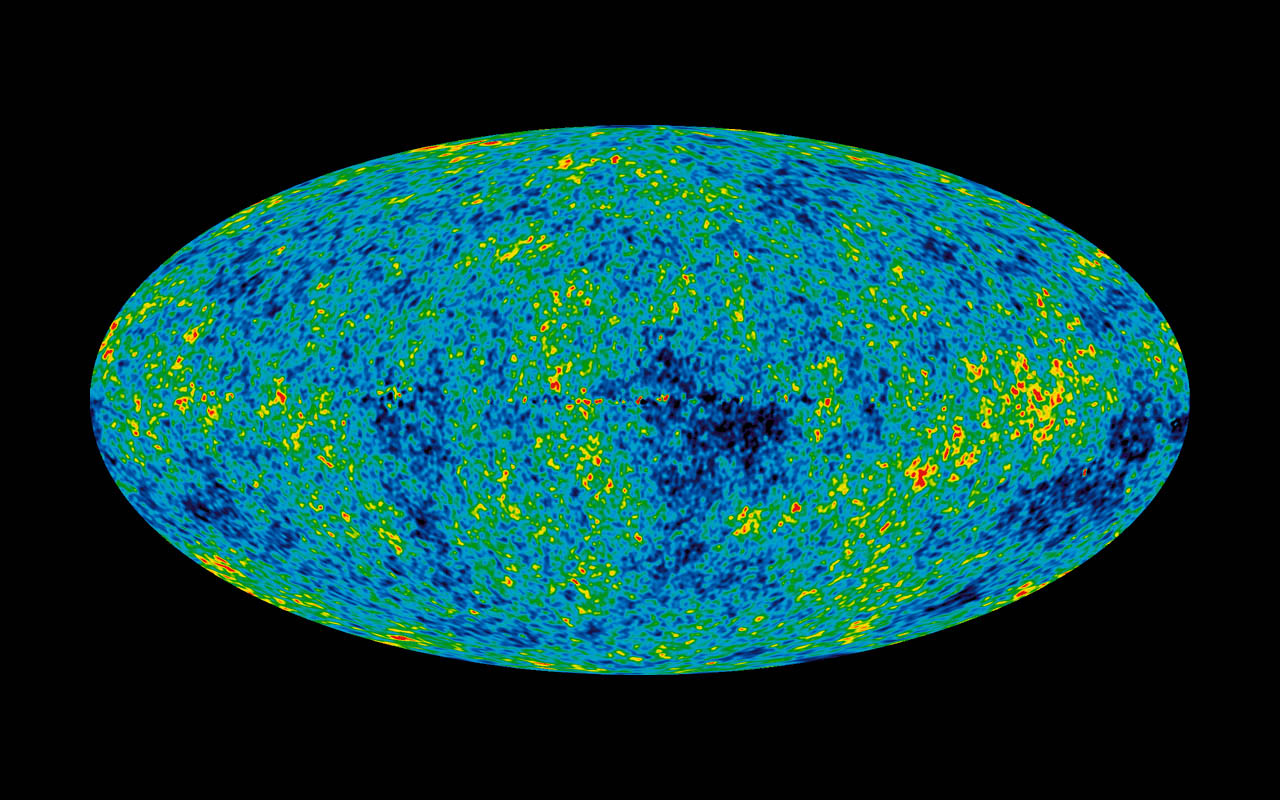
The cosmic microwave background (CMB) we measure today is a relic from the time when the universe was only 300,000 years old and radiation decoupled from matter. Since then, photons could travel almost undisturbed. Thus the radiation, especially the fluctuations around its mean temperature, contain valuable information about the history of the universe. The CMB temperature fluctuations have been measured with great precision by the, now completed, WMAP mission and I'm sure you've all seen their skymap.
Our cosmos was "bruised" in collisions with other universes. Now astronomers have found the first evidence of these impacts in the cosmic microwave background.
This left me deeply puzzled because I had read the paper in question:
- First Observational Tests of Eternal Inflation
By Stephen M. Feeney, Matthew C. Johnson, Daniel J. Mortlock, Hiranya V. Peiris
arXiv:1012.1995 (see here for an extended version)
yet seemed to have read something completely different out of it. So what's this all about?
Preliminaries
The cosmic microwave background (CMB) we measure today is a relic from the time when the universe was only 300,000 years old and radiation decoupled from matter. Since then, photons could travel almost undisturbed. Thus the radiation, especially the fluctuations around its mean temperature, contain valuable information about the history of the universe. The CMB temperature fluctuations have been measured with great precision by the, now completed, WMAP mission and I'm sure you've all seen their skymap.
This data from the CMB temperature fluctuations, often discussed in form of its power spectrum, has allowed us to extract parameters determining the expansion of the universe and complement other data. What we know today, among other things, is that the universe is not only big, but to excellent accuracy spatially flat. That's a feature not naturally achieved with every mode of expansion. It also requires explanation why the CMB temperature is so homogeneous and isotropic, ie essentially the same everywhere with only small fluctuations around it. The currently most widely accepted model that achieves all that easily is inflation. Inflation is basically a phase of early, very rapid expansion that succeeds in solving the problems of flatness and homogeneity (and some others in addition). Inflation then has to end at some time, so matter can form and after that the expansion of the universe proceeds in a more moderate form, allowing the structures to form that surround us today (filaments, galaxies, stars).
There are several models of inflation that differ in the detailed predictions, but the rapid expansion is what they have in common. A particular variant of inflation is called "eternal inflation." As the name says, in that case inflation does not end completely but continues eternally. The way this is thought to happen is that inflation only ends locally when a metastable "false" vacuum state decays into a "true" vacuum state and subsequently continues along a local inflation scenario that ends and results in matter formation and gives rise to a patch like our own, commonly called "bubble universe." However, the areas of false vacuum never decay away completely because they expand more quickly than they can decay. As a result, new bubble universes continue to be formed out of the false vacuum eternally.
There are several models of inflation that differ in the detailed predictions, but the rapid expansion is what they have in common. A particular variant of inflation is called "eternal inflation." As the name says, in that case inflation does not end completely but continues eternally. The way this is thought to happen is that inflation only ends locally when a metastable "false" vacuum state decays into a "true" vacuum state and subsequently continues along a local inflation scenario that ends and results in matter formation and gives rise to a patch like our own, commonly called "bubble universe." However, the areas of false vacuum never decay away completely because they expand more quickly than they can decay. As a result, new bubble universes continue to be formed out of the false vacuum eternally.
Bubble Collisions
While eternal inflation has its proponents, the most well-known probably being Alan Guth, it hasn't been particularly popular, mostly because for what observations are concerned it's a superfluous overhead to the local inflation scenario. It increased in popularity somewhat with string theorists having to face a large number of possible vacuum states, a scenario that seems to fit nicely with the continuing creation of bubble universes that together form what's become known as the "multiverse." Still there remains the question what's it matter if we can't observe it anyway.
It turns out that there are circumstances in which we could find evidence for the existence of other bubbles because initially separate bubble universes might come to overlap during their expansion in a "bubble collision." The probability of there having been a bubble collision in our past, and that bubble collision being observable yet not fatal for the evolution of life in our universe, depends on the parameters of the model.
The Paper
That finally brings us to Feeney et al's paper. Inspired by earlier work by Aguirre et al (Towards observable signatures of other bubble universes, arXiv:0704.3473) they studied the possibility that a bubble collision in our past has left an imprint in the CMB. Their paper basically presents a particular analysis scheme for the CMB temperature fluctuations. Projected on the 2-dimensional surface of last scattering, the leftover signal would have azimuthal symmetry. They assume that a bubble collision has left a mark in the CMB that consists of a slightly different temperature in such an azimuthal patch.
They use an algorithm to analyze the temperature fluctuation that works in three steps. First, search for areas with azimuthal symmetry. Second, search for edges where the temperature makes a slight step. Third, if you've found that, look for the best parameters to reproduce what you've found. They then go on to create fake CMB fluctuations with signals of bubble collisions to quantify how well their algorithm works. The picture below, taken from Feeney et al's paper, depicts the stages of this simulation. Each quarter of the skymap is supposed to show the same area, just mirrored horizontally and vertically. The upper left part shows the patch with the temperature variation from the bubble collision without fluctuations superimposed (the Mollweide projection used to plot the map distorts the shape). The upper right part adds random fluctuations. Now the task is to get the signal back. The lower left part shows the result of looking for patches of azimuthal symmetry, the lower right one the result of looking for edges with temperature steps.

After testing out their algorithm with fake data to understand what features it is able to identify with certainty, they come to the interesting part and analyze the actual CMB data. Their algorithm doesn't find edges, but identifies 4 regions of interest whose features could possibly have been caused by bubble collisions. As the authors put it, these features are "compatible" with having been caused in that way. Two of these spots of interest btw have previously been discussed, one is the well-known CMB "cold spot," the other was identified in this paper which made use of a similar analysis as Feeney et al. It is important to emphasize though that the identification of these spots was based solely on the symmetry and they were not able to find the second identifier, the edge of the spot. For this reason the authors are careful to make clear:
Though it might be that better data from the Planck satellite will allow to extract a less ambiguous signal in the coming years, this is so far clearly no evidence for a bubble collision. Feeney et al's results are just once again evidence that there's some features in the CMB.
One also has to keep in mind that their paper already starts from the assumption that the signal of a bubble collision is of such a particular sort of merely resulting in a small temperature difference. It leaves entirely open the question how likely it is that a particular model of eternal inflation would result in such a signal that is just barely observable rather than in features entirely incompatible with what we've seen so far. It is entirely unclear to me for example what would happen if the vacuum in the other bubble or possibly even its physical constants were different from ours. It seems quite unlikely that a tiny temperature modulation is all that would come out of it. I don't think anybody has at this point a comprehensive picture of what might happen in a general bubble collision. The question is then if not it is extremely improbable that our bubble was subject to a collision and that collision, rather than wiping us out, was just nice enough to reveal itself in the upcoming Planck data.
In any case, the analysis put forward in Feeney et al's paper serves to rule out some regions of the parameter space in models that produce such an imprint in the CMB. Such constraints are always good to have. It is a nice and very straight-forward paper presenting an observer's take on eternal inflation. It's a very worthwhile analysis indeed - imagine how exciting it would be to find evidence for other universes! However, so far the evidence leaves waiting.
Update: See also one of the author's guest post at Cosmic Variance Observing the Multiverse.
The Paper
That finally brings us to Feeney et al's paper. Inspired by earlier work by Aguirre et al (Towards observable signatures of other bubble universes, arXiv:0704.3473) they studied the possibility that a bubble collision in our past has left an imprint in the CMB. Their paper basically presents a particular analysis scheme for the CMB temperature fluctuations. Projected on the 2-dimensional surface of last scattering, the leftover signal would have azimuthal symmetry. They assume that a bubble collision has left a mark in the CMB that consists of a slightly different temperature in such an azimuthal patch.
They use an algorithm to analyze the temperature fluctuation that works in three steps. First, search for areas with azimuthal symmetry. Second, search for edges where the temperature makes a slight step. Third, if you've found that, look for the best parameters to reproduce what you've found. They then go on to create fake CMB fluctuations with signals of bubble collisions to quantify how well their algorithm works. The picture below, taken from Feeney et al's paper, depicts the stages of this simulation. Each quarter of the skymap is supposed to show the same area, just mirrored horizontally and vertically. The upper left part shows the patch with the temperature variation from the bubble collision without fluctuations superimposed (the Mollweide projection used to plot the map distorts the shape). The upper right part adds random fluctuations. Now the task is to get the signal back. The lower left part shows the result of looking for patches of azimuthal symmetry, the lower right one the result of looking for edges with temperature steps.
After testing out their algorithm with fake data to understand what features it is able to identify with certainty, they come to the interesting part and analyze the actual CMB data. Their algorithm doesn't find edges, but identifies 4 regions of interest whose features could possibly have been caused by bubble collisions. As the authors put it, these features are "compatible" with having been caused in that way. Two of these spots of interest btw have previously been discussed, one is the well-known CMB "cold spot," the other was identified in this paper which made use of a similar analysis as Feeney et al. It is important to emphasize though that the identification of these spots was based solely on the symmetry and they were not able to find the second identifier, the edge of the spot. For this reason the authors are careful to make clear:
"Without the corroborating evidence of a circular temperature discontinuity, we cannot claim a definitive detection [...] Azimuthally symmetric temperature modulations are not unique to bubble collisions."
Though it might be that better data from the Planck satellite will allow to extract a less ambiguous signal in the coming years, this is so far clearly no evidence for a bubble collision. Feeney et al's results are just once again evidence that there's some features in the CMB.
One also has to keep in mind that their paper already starts from the assumption that the signal of a bubble collision is of such a particular sort of merely resulting in a small temperature difference. It leaves entirely open the question how likely it is that a particular model of eternal inflation would result in such a signal that is just barely observable rather than in features entirely incompatible with what we've seen so far. It is entirely unclear to me for example what would happen if the vacuum in the other bubble or possibly even its physical constants were different from ours. It seems quite unlikely that a tiny temperature modulation is all that would come out of it. I don't think anybody has at this point a comprehensive picture of what might happen in a general bubble collision. The question is then if not it is extremely improbable that our bubble was subject to a collision and that collision, rather than wiping us out, was just nice enough to reveal itself in the upcoming Planck data.
In any case, the analysis put forward in Feeney et al's paper serves to rule out some regions of the parameter space in models that produce such an imprint in the CMB. Such constraints are always good to have. It is a nice and very straight-forward paper presenting an observer's take on eternal inflation. It's a very worthwhile analysis indeed - imagine how exciting it would be to find evidence for other universes! However, so far the evidence leaves waiting.
Update: See also one of the author's guest post at Cosmic Variance Observing the Multiverse.
Thursday, December 16, 2010
Time to democratize science?
Yesterday, I read this article in New Scientist
Anyway, given this troublesome bias allegedly caused by funding sources Hind concludes
Well, a lot of science funding comes from the national science foundations. And their agenda is set by national politics for control of which we go and cast our vote on election day. That this didn't prevent the issue with economics research demonstrates there's shortcomings in the academic system which spoil objectivity other than bribery. So much about Hind's motivation for his argument.
Leaving aside the shaky reasoning, I am afraid then that what Hind means with "democratic vote" is not a representative democracy. If his "alternative" is supposed to be something new, he must be talking about a grassroots democracy; the wisdom of the masses and all. That interpretation of his proposition of "democratisation" also goes well with him being the author of a book called The Return of the Public that according to the blurb "outlines a way forwards for a new participatory politics." But back to the New Scientist article, Hind explains the benefits of letting the public decide on research funding by referendum:
I have no clue why that should be. In fact, I suspect a public "voting" on what scientific research projects deserve funding would make matters significantly worse rather than better. The main reason is that it would set incentives for researchers to produce results the public wants to hear rather than rely on their own sense of what is important. Hind continues:
The present system does give non-experts the power to set general guidelines, but the details are left to experts. And that is, imho, good as it is. The problem with the academic system is definitely not that "the taxpayer" has too little say in what researcher's study but rather that the system itself suffers from internal problems. I've written on that many times and don't want to repeat the details here. For more check e.g. my posts Science and Democracy III and We have only ourselves to judge each other. The title of the latter says it all: The only people who can plausibly have an informed opinion on what research projects are worth pursuing are working in the field themselves. The problem with the academic system is, in short, that their opinions are unfortunately influenced by all sorts of external pressures which has the result that the grants are not efficiently used. The cure isn't to replace expert's judgement with that of uninformed people, but to make sure the judgement is unbiased.
In contrast to Hind, I can see several good reasons why science funding should not be made subject to public vote, except for setting the general agenda by assigning funds to the respective agencies and their programs. The reasons are the same reasons why pretty much all democracies on the planet are representative democracies. First, the public opinion changes from one day to the next. That's no basis on which one can pursue research. Second, the public opinion is easily influenced by those who have enough money to spend on media relations and search engine optimization. This works completely against Hind's own argument that the problem is the influence of wealthy people and cooperations.
The third and most important point is that the very reason academic research is mostly funded as a public good rather than through individual investments is that despite its recognized relevance for the well-being and progress of our societies it's such a long-term investment that very few people would privately invest money in it. Asking them to then decide on where the money they wouldn't individually invest should be spent, one has zero reason to believe that the money would be well spent.
(A fourth reason why the public opinion may not be suitable to call upon directly for decision making is that it may be inconsistent, but that's not a relevant point here. For more on that see my post The Nature of Laws.)
Hind explains his opinion:
The big problem is that it may take decades or even centuries to figure out what a success or a failure is. The feedback loop in this education is way too long to be effective; it's not something that will lead to an optimization. That's the reason such a lot of research is pursued as public service to begin with.
Let me be very clear here. I write this as a taxpayer myself that I am not qualified to make certain judgements. I preferably delegate my voice to somebody who has the time and makes the effort to obtain and survey all the relevant information on some decision rather than making a sloppy and uninformed decision myself because, after all, I have a job. In other words, I believe representative democracies are a good system (though there's no doubt they could use some improvements). There is place in our societies for direct public votes and we have tools for exactly this purpose. The funding of research projects just clearly isn't one of them.
- Time to democratise science
By Dan Hind
Anyway, given this troublesome bias allegedly caused by funding sources Hind concludes
"[I]t is surely time to consider an alternative. If we are serious about science as a public good, we should give the public control over the ways in which some - and I stress "some" - of its money is spent.
I propose taking a portion of the money that subsidises private industry and giving it to new bodies set up to allocate resources on the basis of a democratic vote. Scientists could apply to these bodies for funding and we could all have a say in what research is given support."
Well, a lot of science funding comes from the national science foundations. And their agenda is set by national politics for control of which we go and cast our vote on election day. That this didn't prevent the issue with economics research demonstrates there's shortcomings in the academic system which spoil objectivity other than bribery. So much about Hind's motivation for his argument.
Leaving aside the shaky reasoning, I am afraid then that what Hind means with "democratic vote" is not a representative democracy. If his "alternative" is supposed to be something new, he must be talking about a grassroots democracy; the wisdom of the masses and all. That interpretation of his proposition of "democratisation" also goes well with him being the author of a book called The Return of the Public that according to the blurb "outlines a way forwards for a new participatory politics." But back to the New Scientist article, Hind explains the benefits of letting the public decide on research funding by referendum:
"Think what such a system could achieve. With public support, the few economists that predicted the financial crash could have gained greater access to publicity as well as more research resources. Public concern with environmental degradation could guide much-needed funds into alternative energy research."
I have no clue why that should be. In fact, I suspect a public "voting" on what scientific research projects deserve funding would make matters significantly worse rather than better. The main reason is that it would set incentives for researchers to produce results the public wants to hear rather than rely on their own sense of what is important. Hind continues:
"There is no good reason I can see why science funding could not be made subject to democratic decision-making. Yes, it will hand power to non-experts, but so does the present system: non-experts in the state and private sector often have a decisive say in what scientists study."
The present system does give non-experts the power to set general guidelines, but the details are left to experts. And that is, imho, good as it is. The problem with the academic system is definitely not that "the taxpayer" has too little say in what researcher's study but rather that the system itself suffers from internal problems. I've written on that many times and don't want to repeat the details here. For more check e.g. my posts Science and Democracy III and We have only ourselves to judge each other. The title of the latter says it all: The only people who can plausibly have an informed opinion on what research projects are worth pursuing are working in the field themselves. The problem with the academic system is, in short, that their opinions are unfortunately influenced by all sorts of external pressures which has the result that the grants are not efficiently used. The cure isn't to replace expert's judgement with that of uninformed people, but to make sure the judgement is unbiased.
In contrast to Hind, I can see several good reasons why science funding should not be made subject to public vote, except for setting the general agenda by assigning funds to the respective agencies and their programs. The reasons are the same reasons why pretty much all democracies on the planet are representative democracies. First, the public opinion changes from one day to the next. That's no basis on which one can pursue research. Second, the public opinion is easily influenced by those who have enough money to spend on media relations and search engine optimization. This works completely against Hind's own argument that the problem is the influence of wealthy people and cooperations.
The third and most important point is that the very reason academic research is mostly funded as a public good rather than through individual investments is that despite its recognized relevance for the well-being and progress of our societies it's such a long-term investment that very few people would privately invest money in it. Asking them to then decide on where the money they wouldn't individually invest should be spent, one has zero reason to believe that the money would be well spent.
(A fourth reason why the public opinion may not be suitable to call upon directly for decision making is that it may be inconsistent, but that's not a relevant point here. For more on that see my post The Nature of Laws.)
Hind explains his opinion:
"Certainly the public will sometimes support research that seems fanciful to informed insiders. We won't always spend our money wisely. But the opportunity to exercise power is a great educator. The successes and failures of democratically funded science would promote a much more vigorous public debate about the purpose of research."
The big problem is that it may take decades or even centuries to figure out what a success or a failure is. The feedback loop in this education is way too long to be effective; it's not something that will lead to an optimization. That's the reason such a lot of research is pursued as public service to begin with.
Let me be very clear here. I write this as a taxpayer myself that I am not qualified to make certain judgements. I preferably delegate my voice to somebody who has the time and makes the effort to obtain and survey all the relevant information on some decision rather than making a sloppy and uninformed decision myself because, after all, I have a job. In other words, I believe representative democracies are a good system (though there's no doubt they could use some improvements). There is place in our societies for direct public votes and we have tools for exactly this purpose. The funding of research projects just clearly isn't one of them.
Wednesday, December 15, 2010
Book review: “Stiff” by Mary Roach
 Stiff: The Curious Lives of Human Cadavers
By Mary Roach
W. W. Norton & Company; Reprint edition (May 2004)
After my previous read on the beginning of life, this one is about the end of it. Mary Roach has collected data, historical facts and curious anecdotes on the fates of human corpses. Despite the unappetizing topic, it is an entertaining read.
Roach discusses decay, burial and its alternatives, giving one's body to science for anatomical studies (where one might serve as a practice for face lifting), organ donation and brain death, plastination, preservation, embalming or becoming a post-mortem crash-test dummy. You, or at least parts of you, can also end up being shot at to study the stopping power of bullets. She further covers the examination of victims of fatal accidents, for example plane crashes, to obtain information about the accident's cause, cannibalism, and experiments that were done to determine whether the shroud of Turin is authentic.
She evidently did a lot of reading and in many cases went to visit the places where experiments were made and talked to the scientists. Roach also does not hold back with her opinion, neither on organ donation nor on the credibility of some scientists or their publications. Thomas Edison for example comes off as “a loopy individual” and she remarks about one author “[He] is not a doctor, or not, at least, one of the medical variety. He is a doctor of the variety that gets a Ph.D. and attaches it to his name on self-help book covers. I found his testimonials iffy as evidence...” One might or might not agree with her opinions, but I found it very refreshing that she speaks her mind and does not leave the reader with a white-washed who-said-what, an unfortunately wide-spread habit among science writers that is sold as balanced reporting but eventually is mostly useless reporting. She also doesn't swallow every story she's read but goes to try verify it herself, as for example in a case of cannibalism reported from China that turns out to be made up. While the report on her travel to China is somewhat pointless in that it doesn't contribute to the theme of the book, it speaks for Roache's fact checking.
The book is full with absurdities from the history of science, such as techniques used in the 18th and 19th century to verify death, among them putting insects into the corpse's ear or rhythmic tongue-pulling for three hours following the suspected death. The reader also learns that the average human stomach bursts when stretched over a volume of approximately 4 liters, and that the Urban Institute in 1991 calculated the value of one human life at US $ 2.7 million. (One is left to wonder whether that's the global average or the value of US citizens.) On some topics I found the coverage thin and would have expected more details, for example on the history of burial or the progress in organ transplantation. I was also surprised that the fate of Einstein's brain didn't even make it into a footnote.
I guess there's only two ways to approach the topic of decaying human remains, either with gravity and philosophy or with humor. Mary Roach does it with humor and she does well, though her jokes become quite foreseeable after a few chapters. A little disturbing I found her tendency to self-degradation and portraying herself as an annoying person who her interview partners must think badly about, reflected in sentences like “[He] throws me a look.... [The look] says I'm a petit bouchon fécal [French, roughly: little piece of shit]” or “She considers this fact. I am feeling more like last week's coleslaw than usual.” It's probably supposed to be funny-ha-ha, but it makes me wonder about the author's self-image.
Taken together, the book is smoothly written, entertaining and covers the topic well. If this was an amazon review, I'd give five stars for flawlessness. Having finished “Stiff” I have to say though that after all the topic isn't one I'm particularly interested in. The book has however provided me with plenty of useless knowledge that is certain to make me a memorable guest when offered at the next dinner party.
Friday, December 10, 2010
This and That
- In my post It comes soon enough I speculated on some future developments, among them:
“I've been thinking... that... it would be possible to grow meat suitable for consumption without having to bother with the whole animal. [A] century from now, we'll have factories with organ bags that resemble nothing like animals at all.”
In an interview of Time Magazine with Ray Kurzweil I read last week:
“We'll grow in vitro cloned meats in factories that are computerized and run by artificial intelligence. You can just grow the part of the animal that you're eating."
For the complete interview, see 10 Questions for Ray Kurzweil - If you want more evidence that I have my thumb on the pulse of time: In my post Why'd you have to go and make things so complicated? I remarked on the the predictability of complex systems:
“You don't need to predict the dynamics of the system. You just need to know what parameter space it will smoothly operate in so optimization works.”
A recent article by Seed Magazine quotes Tom Fiddaman who, in collaboration with MIT and the Sustainability Institute, examines the policy implications of dynamic complexity in climate and economic models:
“You are in a sort of dance with this complicated mess,” he says, explaining that it is impossible to determine the individual steps of this “dance”—and this is in some sense the error of current thinking. Instead, we need to be able to construct robust solutions that provide general guidelines for what style of dance we should be doing. They need to be flexible and capable of withstanding the inevitable unpredictable behaviors of complex systems.
The whole article, titled Knowing sooner, is a very recommendable read. - I just learned that since July 1st, fast internet access is a legal right in Finland. Don't have much to say about it, just find it noteworthy.
- Most concise paper ever: Unsuccessful treatment of writer's block.
- I spoke to a science writer about What's at the center of black holes - and then forgot about it.
“From a theoretical point of view, the singularity is something where something becomes infinitely large,” said physicist Sabine Hossenfelder at the Nordic Institute for Theoretical Physics. [That's not what she wrote, but what I actually said.]
No one can be sure that their singularity doesn't describe a physical reality, Hoss[en]felder told Life's Little Mysteries. But most physicists would say that the singularity, as theorized by equations, doesn't really exist. If the singularity was “really real,” then it would mean that “energy density was infinitely large at one point,” exactly the center of the black hole, she said.
However, no one can know for sure, because no complete quantum theory of gravity exists, and the insides of black holes are impossible to observe. - My recent paper with Xavier Calmet and Roberto Percacci just got published.
I wish you all a nice weekend and don't forget to light the 3rd candle.
Friday, December 03, 2010
The inevitable outcomes from basic research - ?
If you're trying to get into the Christmas mood, I can warmly recommend a recent article in Seed Magazine by Rolf Heuer, Director General of Cern, On Competitive Collaboration. The title is somewhat misleading though; the article is actually a praise of basic research and its merits for our societies. It doesn't really say anything new, and of course for the readers of our blog it's preaching to the choir that basic research was and will continue to be essential for progress. But the essay is such a nice piece of writing I'm sure it will put a smile on your face.
In my earlier post Knowledge for the sake of knowledge, I was complaining that all to often to make a case for the relevance of basic research the argument is that eventually some technology will come out of it. This leaves aside the relevance that knowledge itself has, whether or not it results in some new gadget that you'll find under the tree in a decade, despite the fact that most people working in the field are driven by the gain in knowledge since applications are often too remote to be a tangible personal goal. I think that insights on fundamental questions about the nature of reality themselves have a direct influence on our societies. Consider topics like free will or the multiverse-question whether the physics in our universe is the only one possible or just one of many possibilities. I was thus happy to see that Heuer didn't try to sell the LHC as something that obtains its value merely by its rôle in producing new technologies.
In Canada, basic research is doing well: As you might have read on Peter's blog or in the Globe & Mail, the Bank of Montreal has donated CAN $4 million to Perimeter Institute to establish “the BMO Financial Group Isaac Newton Chair in Theoretical Physics at Perimeter Institute.” Bill Downe, President and Chief Executive Officer of the BMO Financial Group said
So, congratulations to PI! In PI's press release, one also finds a quotation from Mike Lazaridis, founder of Perimeter Institute, who repeats the usual justification for basic research with the prospect of technological applications. In fact, he goes so far to say:
That's quite a bold statement, don't you think?
I completely agree with Heuer that basic research is instrumental for progress, but I'm far from sure that basic research of any sort “inevitably” leads to technological advances. Take for example the recent media fuzz about the re-recycled idea that the universe did not start with the Big Bang, and consider for a moment this turns out to be correct. The question is clearly of high relevance for us to understand our place in the universe, but since the distinction between bang and bounce lies 14 billion years in the past I'm having some trouble imagining what technology might possibly come out of an experimental distinction. I can easily imagine what it might be good for to find superluminal propagation of information to be possible, and could come up with a dozen applications for antigravitation. I can imagine that the development of quantum gravity and/or string theory will one day be of relevance for quantum computing, and that finding the Higgs or some alternative mechanism to generate particle masses will in the remote future play a role for energy generation. But especially when it comes to cosmology, it seems to me the outcome is mainly in the realm of pure knowledge, addressing the eternal questions where we come from and where we go to.
But hey, my imagination is finite, so let your fantasy fly free and tell me what inevitable application a big bounce scenario might have one day. Even better, tell me what, in your wildest dreams, will be the outcome of some basic research of your choice in theoretical physics that is pursued today.
“[A] scientist involved in basic research is by definition motivated: We do what we do because we are passionate about understanding the universe...
Human ingenuity being what it is, the future will undoubtedly bring applications based on discoveries made with the LHC. Although, as with Newton’s gravity, it may be some time before we’re privy to all of them, and to their implications. For our children and grandchildren, however, I am sure that the wait will have been worthwhile.”
In my earlier post Knowledge for the sake of knowledge, I was complaining that all to often to make a case for the relevance of basic research the argument is that eventually some technology will come out of it. This leaves aside the relevance that knowledge itself has, whether or not it results in some new gadget that you'll find under the tree in a decade, despite the fact that most people working in the field are driven by the gain in knowledge since applications are often too remote to be a tangible personal goal. I think that insights on fundamental questions about the nature of reality themselves have a direct influence on our societies. Consider topics like free will or the multiverse-question whether the physics in our universe is the only one possible or just one of many possibilities. I was thus happy to see that Heuer didn't try to sell the LHC as something that obtains its value merely by its rôle in producing new technologies.
In Canada, basic research is doing well: As you might have read on Peter's blog or in the Globe & Mail, the Bank of Montreal has donated CAN $4 million to Perimeter Institute to establish “the BMO Financial Group Isaac Newton Chair in Theoretical Physics at Perimeter Institute.” Bill Downe, President and Chief Executive Officer of the BMO Financial Group said
“The Institute’s ambitious thirst for new knowledge places it at the very frontier of discovery. Its thinkers can change our world by boldly pushing the boundaries of our current understanding of physical laws. We couldn’t be more proud of this association and hope that our unique investment in the BMO Isaac Newton Chair in Theoretical Physics will enhance innovation in Canada and encourage other private sector donors to fund Chairs at PI.”
So, congratulations to PI! In PI's press release, one also finds a quotation from Mike Lazaridis, founder of Perimeter Institute, who repeats the usual justification for basic research with the prospect of technological applications. In fact, he goes so far to say:
“Theoretical physics has driven the most important insights and technological advances in the history of humankind. Although the outcomes from basic research may not be immediate, they are inevitable...”
That's quite a bold statement, don't you think?
I completely agree with Heuer that basic research is instrumental for progress, but I'm far from sure that basic research of any sort “inevitably” leads to technological advances. Take for example the recent media fuzz about the re-recycled idea that the universe did not start with the Big Bang, and consider for a moment this turns out to be correct. The question is clearly of high relevance for us to understand our place in the universe, but since the distinction between bang and bounce lies 14 billion years in the past I'm having some trouble imagining what technology might possibly come out of an experimental distinction. I can easily imagine what it might be good for to find superluminal propagation of information to be possible, and could come up with a dozen applications for antigravitation. I can imagine that the development of quantum gravity and/or string theory will one day be of relevance for quantum computing, and that finding the Higgs or some alternative mechanism to generate particle masses will in the remote future play a role for energy generation. But especially when it comes to cosmology, it seems to me the outcome is mainly in the realm of pure knowledge, addressing the eternal questions where we come from and where we go to.
But hey, my imagination is finite, so let your fantasy fly free and tell me what inevitable application a big bounce scenario might have one day. Even better, tell me what, in your wildest dreams, will be the outcome of some basic research of your choice in theoretical physics that is pursued today.
Subscribe to:
Posts (Atom)