Pages

Wednesday, October 11, 2006

Does String Theory explain Heavy Ion Physics?

Earlier this week, we could follow a quite heated debate about the applications of the AdS/CFT (Anti-deSitter/Conformal Field Theory) correspondence to strongly coupled QCD (Quantum Chromo-Dynamics, the theory of quarks and gluons) as observed in relativistic heavy ion collisions.

Or, in a more catchy phrase, whether or not "string theory explains RHIC physics". Or -- even more provoking -- as it was formulated in the recent Nature issue:

"When the Relativistic Heavy Ion Collider at Brookhaven National Laboratory in Upton, New York, first produced a hot quark gas, it was string theory that correctly predicted, retrospectively, some of the gas's properties. "

Nature 443, 491(5 October 2006), Theorists snap over string pieces, by Geoff Brumfiel, see also here.

(Okay, I take the word 'explain' in the title instead of 'predict', but I want to bring that quotation with the alleged prediction somewhere. - If it's unavoidable. - It is.)

This is quite an experimental post written by both of us, trying to understand what is there about these claims. If you ever want to test how much your marriage can take, try to write a blog post together. When you see remarks in brackets, these were the issues we couldn't settle.

In an earlier post, Bee reported on a talk about the applications of AdS/CFT to heavy ion physics that she heard at the KITP. She was thrilled to see string theorists trying to get in touch with experiments! And isn't it ironic that after several decades string theory has come back to where it started from: explaining features of the strong interaction? That was, before it was promoted to be a promising and promising and promising approach to the theory of everything (TOE), which would become important at unobservable energies. (Isn't that too sloppy? - It is called cynicism.)

The use of the AdS/CFT correspondence for strongly coupled QCD is an extremely interesting and exciting project, and probably one of the hottest and densest topics that is currently out there. (haha - sorry, could not resist the temptation) It can provide us with a lot of important insights into QFT. But one should be realistic here:

From the side of the string theorist, realistic about what it can possibly tell us about string theory as a TOE, and what it can't. From the side of the nuclear physicist, what it can possibly tell us about heavy ion collisions. And what it can't.

So, this is an attempt to explain some of the physics involved, from the point of view of relativistic heavy ion physics - and since since Stefan has some background there, we figured we would make a good team, but he's definitely the one to ask what a horizontal flow is. (I should know that by now, but I keep forgetting it. - Does that mean I have to answer all the comments?!)

Here's the outline:

1. What is this all about?
2. Is it a Hype?
3. What does it mean?


1. What is this all about?

Heavy Ion Collisions have one big goal: To map out the phase diagram of nuclear matter. The question one would like to answer is: Under which conditions of temperature and density is nuclear matter made up of hadrons (of nucleons like neutrons and protons, of hyperons like Sigmas and Lambdas, and so on), and when and how will one find the constituents of hadrons, the quarks and gluons, as the relevant degrees of freedom? Where in this diagram is the phase boundary between the hadron gas and the quark-gluon plasma, as the state where confinement is lifted and quarks and gluons can move freely is called? And moreover, what are the properties (the equation of state, or transport properties such as viscosity) of the quark-gluon plasma?

(Phase diagram here? - Good idea. - Where's the figure from your talk? - Where's yours?)


On the experimental side, there is only one tool available: Accelerate nuclei of heavy atoms such as gold or lead, and let them collide. At the collision, the kinetic energy of the nuclei is dissipated, and goes into the compression and heating of the nucleons in the nuclei. If heating and compression are high enough, a quark gluon plasma can be formed.

On the side of theory, there is QCD which describes the interaction of quarks and gluons. There is only one big problem: QCD is a complicated theory, and its low energy limit, which contains the hadronic ground states, the protons and neutrons and so on, can not be handled analytically. The same is true for the deconfinement transition from the hadronic world to the quark-gluon plasma: There is no analytical method to describe deconfinement and hadronization in QCD. What one can do instead is to use lattice QCD, or apply approximation schemes that approach hadronization from high densities or high temperatures, where the theory is asymptotically free, and perturbative methods can be used. There are different techniques available to describe QCD at temperatures above deconfinement, with hard thermal loop re-summation as one example. This is a very active area of research in current nuclear theory. For the regime of heavy ion collisions, there still remains on problem: At temperatures above the deconfinement temperature Tc, say for T = 1 - 3 Tc, QCD is not yet completely free. Lattice calculations of energy density and pressure show a clear difference to the Stefan-Boltzmann limit, which corresponds to an ideal gas of quarks and gluons. So, this temperature regime is difficult to study with standard QCD techniques. Unfortunately, it is just this temperature regime that is reached in heavy ion collisions at RHIC, the relativistic heavy ion collider at Brookhaven.

(Do you have some fundamental problem with entering paragraphs? - But the context belongs together! - It looks completely unreadable. - Who reads that anyway? - I think I don't like your attitude.)


There was one big surprise in the experimental data from RHIC: it seems that the quark-gluon plasma created in the collisions has a very low viscosity, or is a most ideal liquid. At least, that is what can be concluded from the success of hydrodynamical simulations of RHIC collision simulating the quark-gluon plasma as an ideal liquid.

Here, one point is important to note: There is no way to measure the viscosity of the quark-gluon plasma directly. You have to infer it from the momentum distribution of final state hadrons, in this case, of the anisotropy of the momentum distribution of hadrons in the transverse plane for non-central collisions, which is called the elliptic flow.

(Insert explanation, link, graphics. - Good! Where is it? - I'm at home, can't access the journal. - Okay, lets do that tomorrow.)

Large values of elliptic flow are observed at RHIC, larger than what was expected from an extrapolation of the results from the CERN-SPS, where the collision energy is lower. As mentioned before, this RHIC elliptic flow can be reproduced using a hydrodynamical simulation of an ideal (zero viscosity) fluid for the deconfined phase. So, the conclusion is, the viscosity of the QGP is very low.

Here, there is one point to keep in mind: the actual viscosity is not known for sure, and model assumptions about the QGP go into it: Assumptions about the initial state used for the hydrodynamics simulation, for the equation of state and the properties of the hot and dense system, for hadronization, and for hadronic rescattering, i.e. the interactions of the hadrons in the still dense, but late phase of the collision. Moreover, the hydrodynamics code in use only now start to systematically investigate the effects of actual viscosity on the expansion dynamics.

The simulations using ideal hydrodynamics that are so successful in the reproduction of the elliptic flow use a so-called Glauber-dynamics initial state for the codes to run. But this initial condition is not the only game in town. For example, the so-called colour glass condensate (one model assumption for the high density, high-temperature initial state of the nuclear matter, where gluons are the main players) produces very high initial transverse momenta, which produce an elliptic flow consistent with data only if a viscosity is taken into account which is markedly higher than in the ideal fluid models used so far. So, a definite, uncontroversial answer about the the actual viscosity is still out. Obviously, lots of issues are not yet completely settled here.

When the first data on elliptic flow larger than expected before become known, Edward Shuryak pointed out that the very low viscosity which data seem to imply (but keep in mind that this fact as such is not completely waterproof yet) would be consistent with predictions of a very low viscosity of a supersymmetric Yang-Mills theory, and that this low viscosity corresponds to an absolute minimum of viscosity derived from the AdS/CFT duality and superstring theory. Hence, the term "most ideal liquid" was coined for the QGP created at RHIC, and it was argued that the strongly coupled QGP can be described using the analogy to the supersymmetric Yang-Mills theory.

Shuryak is a brilliant physicist, but it is also fair to say, we would say, that he is known in the community as someone who strongly promotes his ideas. And his ideas are often contested - as in this case, the idea of the "most ideal liquid" has been contested a lot, especially from the side of the promotors of the colour glass condensate. So, there is an ongoing debate in the community about these questions, the press releases about the ideal liquid notwithstanding. Anyway, this is our impression of how AdS/CFT entered the heavy ion community.

(It this the one who...? - Yes. - Do you really want to write that? I mean, I don't usally comment on people. - That is fair to say, believe me. And for the heavy ion people it's a compliment.)

Now, what does the AdS/CFT say, and where can it be applied? In brief - and corrections of experts on this are welcome - it helps to write down correlation functions in strongly coupled gauge theories from a duality to the dynamics of strings in an 10-dimensional AdS background with a boundary. Strings end on the boundary, which is Minkowski space, and end points of strings correspond to particles in the gauge theory. Problems of the mathematical exactness left beside, this is a unique and ingenious way to get information about correlation functions, which are very hard to obtain (or are not obtained yet) by lattice gauge theories or thermal field theory techniques.

Where has this duality been applied? The first case has been mentioned before: To calculate the viscosity of hot gauge theories, with the famous universal lower value of 1/4 pi. There are two more situations where it has been applied: To determine the screening of the interaction potential of a heavy quark-antiquark pair in a system moving in a background of hot gauge theory (An AdS/CFT Calculation of Screening in a Hot Wind by Hong Liu, Krishna Rajagopal, Urs Achim Wiedemann, hep-ph/0607062), and for jet quenching calculations, that is, to determine the energy loss of fast particles travelling through a hot medium. (Calculating the Jet Quenching Parameter from AdS/CFT, by the same authors: Hong Liu, Krishna Rajagopal, Urs Achim Wiedemann, hep-ph/0605178, now accepted as a PRL). As a sidenote, Wiedemann and Rajagopal are not string theorist, but have worked in heavy ion theory, QCD and nuclear theory. Hong Liu and Dam T. Son, one of the authors of the main viscosity reference, and also not a string theories by formation, will have plenary talks at Quark Matter, the main conference of RHIC physics.

Can these things be observed in heavy ion collisions? For the case of viscosity, we have discussed it before: there are some caveats, since viscosity can not be measured directly - you have to reproduce elliptic flow, and the inverse problem is not unique. The hot quark-gluon system may be a most ideal liquid, it may be something else, we do not know yet for sure. Screening of the potential is relevant for the so-called J/Psi suppression, but this is also something that has to be inferred backwards from the measured J/Psi yield, which is influenced by many other factors (the original idea iabout this is twenty years old now - however, there are still many open questions left).

At RHIC, there are chances from photons that may make these signals more waterproof than at CERN-SPS, but currently,. ambiguities remain. Jet quenching and energy loss is also a point where many calculations and models exist, but the inverse problem is very hard. So, we would say in all these three cases, you may have a very beautiful application of AdS/CFT to QCD at strong coupling, but the connection to experimental data is difficult and ambiguous.

You should not be disappointed: that is, unfortunately, very common in heavy ion physics. Take the original idea about J/Psi, or disordered chiral condensates, and many other examples: Signatures to check beautiful ideas are often washed out by lots of dirty QGP soup and hadron gas wind effects.


2.Is it a hype?

Does the Global Positioning System (GPS) work because of General Relativity? One often hears this statement in discussions of General Relativity, and it is meant, we guess, to create an awareness that this arcane theory is true, and moreover has applications to down-to-earth technologies which are in every-day use. And as a matter of fact, it is true: The systematic effects on atomic clocks in orbit when observed from points on the surface of the earth as predicted by GR are incorporated into the system, and it all fits perfectly well!

On the other hand, to say that the GPS work because of General Relativity is an oversimplification which neglects the actual intricate details of the system, and which are, from a practical point of view, equally important for the workings of the GPS. A look in a technical description of the GPS will discuss lots off effects of the ionosphere and the atmosphere on the propagation of the satellite signals that have to be taken into account and corrected for - relativity often is not even mentioned! So, clearly, to say that the GPS work because of General Relativity is not wrong, but it is not the whole story: It is a catch phrase to show that GR is not some abstract mathematics, but plays indeed a role in the real world.

There is also a kind of inverse problem in the GPS example: Could one reconstruct GR from the GPS system alone? Could clever physicists derive GR from the systematic deviations in GPS, if they would not have been taken into account from the beginning? Well, they would only be partially successful, since, in fact, only some form of the equivalence principle is tested with the GPS, and not the full Einstein equations. To establish GR, more observations, such as the perihelion precession, are necessary.

To us, this seems to be very analogous to the situation of AdS/CFT in RHIC physics (To us? It was your comparison. I really like it but I like to point out it was your creativity at work here!) : There are applications of this fundamental duality to the physics of hot and strongly coupled QCD, and they probably contribute to the outcome of experiments. But there are many more, mundane effects coming into play, which influence final state hadronic data, and which make it very difficult to solve the inverse problem - to unambigously conclude an initial state.

For sure, AdS/CFT does not explain all of RHIC physics, so far, it seems, in our understanding, applicable to the regime of strongly coupled QGP above the deconfinement transition. What does it say about hadronisation, for example? Can it say something about this? That would be extremely cool, but it seems that there is no solution yet. Moreover, there seem to be open quastions in how far results derived for the supersymmetric Yang-Mills theory can, indeed, be carried over to QCD, see for example hep-ph/0608062.

These limitations of the AdS/CFT approach should also be mentioned, in our opinion, if only to avoid the misleading impression of string theorists showing up on the scene like the FBI agents with suits and sunglasses, take over the case from the dumb local police, and solve immediately what the locals have been unsuccessfully investigating for years.

(Couldn't find a nice pic of FBI agents, but I wasted some time on that. -- This is great!)

Besides this one should keep in mind that the AdS/CFT correspondence is an outcome of years of research of string theory. But it is not equal to string theory. Even if the current results show the usefulness of this correspondence, and make use of many developed techniques, what could this possibly tell us about string theory as a TOE? And then, the spacetime used there isn't really one that we would be interested in as a description of the world we live in - we come back to this in the last point.

These are some words of caution, but as Clifford pointed out:

"[...] applying string theory ideas - the whole shebang of strings, branes, black holes, gravity, etc - to understanding the new forms of matter being discovered at Brookhaven. This may welll be a great way of testing the remarkably intricate structures that string theory puts together and give us lots of clues about how to develop the theory better."

(You sure that's a good idea? - I don't want that to come out wrong either, I really like his point of view, esp. regarding the teapots and so on. And the fig jam. But I think it's okay, I mean we've made quite clear we aren't anti-string in any regard. - You really sure? - I have the comments forwarded on my BB, you think I want the beeps to keep me up all night?)

And this is understandibly something to get really excited about! Nevertheless, we can't avoid having the impression that string theorists must be pretty desperate if they try to justify their work with the calculation of a viscosity using a conjectured (unproven) side effect of the theory they have been working on. I am not aware of any work on how it would be possible to learn something about string theory as the TOE from observables in heavy ion collisions.

(Isn't that a bit hard, desperate? - Yes. I am not a nice girl in case you haven't mentioned. I want them to get the message. There's no need to be desperate. Nobody wants to kill string theory. But they should stay realistic.)


3. What does it mean?

So, to us, it seems that AdS/CFT is a cool application and we would be happy to understand more about it. (? - !) On the other hand, there are caveats, and experimental verification of great ideas is difficult, as always, in heavy ion physics. But then, there is, we think, a more fundamental question about the ontological status of this duality: It is merely a computational tool, or should we really belief that the quarks and gluons we know and love are just the endpoints of strings in a 10-dimensional AdS×S5 space? (I am not really very much concerned with the ontology, honey. If it's the same, then it's the same, what's the point?)


This is probably a very general question, that can, and should, already be asked for the Ising model and the mother of all dualities, the Kramers-Wannier duality. In an experimental realisation of a two-dimensional Ising system, the elements of reality which are described by the Ising Hamiltonian are the magnetic moments of atoms. Or aren't they? Taking the duality serious, we could as well argue that no, not the magnetic moments are the real thing, but the dual plaquette variables. But does this make sense? Apparently not, especially since duality works for the Ising variables, the magnetic moments, but not for all other real things in the system, the atoms with all their electrons, and their nuclei.

Coming back to AdS/CFT, if it works for strongly coupled QCD, should we believe that the dual side, the strings, are real? Maybe, but then, the duality should work for all kinds of particles, not just strongly coupled quarks and gluons. Then, one could not discern any more between both sides of the duality mirror, and both sides could claim the same right to be the real thing. Or are we fundamentally wrong here? (Are we? What is reality anyhow? - I don't want to get into this right now. Can we just finish this &$%@ post?)

To summarize: Heavy Ion Physics does not equal strongly coupled QCD, and String Theory does not equal AdS/CFT. The calculations done using the AdS/CFT correspondence are wayleading and exciting. But the connections to string theory as a theory of everything, explaining quantum gravity, the parameters of the standard model, and more, are so far very weak and require more investigation.

Update: See also More on Ads/CFT and RHIC


TAGS: , , ,

Monday, October 09, 2006

Happy Thanksgiving!

One of the more pleasant surprises of moving to another country is the unexpected occurrence of holidays. So I noticed yesterday evening that today, the second Monday in October, Canada celebrates Thanksgiving.

What is even less known is that Germany also has a Thanksgiving (Erntedankfest), which is not a national holiday, and I can't recall the appearance of lager amounts of turkeys. It's celebrated in some churches, and around this time of the year there are many markets where the new fruits, vegetables and wines are sold. It's a kind of gathering I like to call Fressfest, which -- I apologize -- is completely untranslatable. In Frankfurt, it will probably take place in the Fressgass.

Yesterday, it was an absolutely gorgeous day, and I took the photos below (click to enlarge). A happy Thanksgiving to all of you, no matter what part of the world you're at.


And just in case there are still people in the world who don't know this, here's


    How to Cook a Turkey

    Directions:

    Go buy a turkey. Take a drink of whiskey (or scotch). Put turkey in the oven. Take another 2 drinks of whiskey . Set the degree at 375 ovens.


    Take 3 more whiskeys of drink. Turn oven the on. Take 4 whisks of drinky. Turk the bastey. Whiskey another bottle of get.


    Stick a turkey in the thermometer. Glass yourself a pour of whiskey. Bake the whiskey for 4 hours.


    Take the oven out of the turkey. Take the oven out of the turkey. Floor the turkey up off of the pick. Turk the carvey. Get yourself another scottle of botch. Tet the sable and pour yourself a glass of turkey.


    Bless the saying, pass and eat out


TAGS: ,

Friday, October 06, 2006

On the couch

Since some weeks I live on the couch. Not only do I sleep on the couch, in the absence of any other furniture, I eat on the couch, I work on the couch, I do literally everything on the couch.

Last weekend, I went for some coffee with a friend, S. Unfortunately, the cafe was pretty crowded so we were offered the last free table in the corner they call 'the living room'. Where I ended up sitting, you get it, on the couch. The waitress was slow, but told us everything we ordered was 'Terrific!'. We spent the afternoon discussing this and that, and at some point the question was raised whether people are more nuts in Canada or California. To make a point for California I told S. a story from my last visit in LA:

I went for a walk in Venice Beach. Yes, it looks like in the movies with all the muscles and bikinis being shown off there, that's already nuts enough if you ask me. But what's much more interesting is the amount of weirdos you meet on the walkway. Like, people offering psychic healing within 2 minutes (guaranteed, only $20, special offer), play Beatles songs backwards (so they say, not that I could tell), or sell incredibly bad 'art' that allegedly their gifted dog painted.

So, I was walking there on the weirdway and came by this white haired guy, who looked like he had never heard of sun protection. He was wearing nothing but a pink mini skirt, standing on an upside-down turned skateboard with one missing wheel, beating with a spoon on the back of a bowl. He asked me how I am, and distractedly I said I'm fine, staring at the amount of white hair and beard falling over clearly visible rips. He asked for my name, and I choose to be Kate, not in the mood to explain the origin of my first name.

"I am Jesus.", he said, stopped beating his bowl to shake my hand, and grinned at me, displaying evidence for a missing dental plan. Okay, well, I mean I've learned that Jesus is quite a common name in Mexico, so I just nodded. Then he added "I died for your sins."

Being a polite person, I said "Thanks.", he definitely looked like recently crucified. I asked how his mother is doing. "Busy, busy" he said. Yeah, I guess, tough job being holy and all. Anyway. Unfortunately Jesus recognized my German accent and began asking me things about the pope. In case you wonder: no, I have never met the pope in person, despite growing up in Germany, but hey, there are roughly 80 Millions of us. And by the way, I am not catholic.

I was trying to get rid of Jesus, who began quoting things from the bible that I didn't understand for one reason or the other, when he suddenly leaned towards me scaringly close and asked:

"If God would answer one question for you, what would you ask?"

Hah! What a question!

Okay, now back on the couch in the cafe with my friend S.

Pretending to be intellectual, I should come up with a sensible answer to that question, shouldn't I? What about: How do we achieve world peace in 3 easy steps? But then, what would all the newspapers write about? I really don't want to be responsible for millions of unemployed journalists. But I thought about the question for quite some while. Eventually, I recalled that this is supposed to be a science blog, so maybe I should ask for the theory of everything or so.

But what if I'd just not understand the answer? What if nobody of us would? What if the human brain is just not capable of grasping the theory of everything, assumed there is one? If it's like your baby cries, and all you do is hand over the car keys. It doesn't help either if you add a map with a clearly visible red X on the closest mall, but car keys taste quite interesting, don't they?

So, what I would really like to know: If there's a theory of everything, are we able to understand it?

If we are, I am sure, sooner or later we will find it. I hope, rather sooner than later, but as always I am quite optimistic there. What really keeps me up at night is the question whether we would realize what we have found, should we stumble across it.

My friend S. began to look concerned as a result of my couch talk, so I felt like I had to explain myself. Yes, I do think that the capacity of the human brain at it's present state of evolution is most likely not able to finally explain everything there is in the universe. I mean, everyone who ever had to fill out a tax income return form, knows that there are things you just can't understand.

To prevent any misinterpretation at this point, I am not advocating intelligent design, instead I like to call it the principle of finite imagination. But like most scientists I know, I don't see any fundamental incompatibility between science and religion (though there is undoubtly some incompatibility between followers of each). I strongly believe that there is a theory of everything, but I also think nature is still way ahead of us. Let me put it this way:

There are more things between strings and loops than are dreamt of in your philosophy.

(Okay, that was the story about my intellectual answer to Jesus' question what I'd ask God. What I actually said was "I'd really like to know is why his son is wearing a pink skirt." )

What would you ask?


TAGS: , ,

Thursday, October 05, 2006

Interna

Update on the status my move: by now I can hum with the music on the hold line of the moving company. My call today actually brought the quite astonishing news that my furniture has made it to Canada! After I was told last week that it is in New York, it is now in Montreal. So, there is a slight chance that by next week it might approach the vicinity of Waterloo. That is, unless they decide that my bed needs an excursion via Vancouver or so. But the bottomline is, I am still sleeping on the couch.

That was the no-news part.

Here is the bad-news-part to the single-ladies: Johnny Depp marries, there goes the last good looking man on earth. And here is the good-news-part "A Simple Show of Hands: Hand-holding couples may be protected from pain and stress, a study shows."

Should you happen to be in Frankfurt/Germany, don't miss to visit the book fair which has opened yesterday. This year's guest of honor is India.

Should you happen to be in Chicago, consider to visit the Adler Planetarium on Friday evening.

And don't forget, Saturday is full moon. If you can't sleep, check Quasar's nice post about the strangeness of moonlight.

Wednesday, October 04, 2006

The Inverse Problem

There have been so many reviews about Lee Smolin's (The Trouble with Physics) and Peter Woit's book (Not Even Wrong) in the last weeks, that I have kind of lost track who said what about whom and why. Besides the reviews, there are comments on the reviews, comments on the comments, psychoanalytic examinations of the author's intentions, or otherwise people who take the opportunity to comment on whatever they think the problem is, or isn't, or what other peoples problems are, or aren't. And if there is no problem, how boring, let's go make one, preferably for somebody else.

Today for instance, I read George Ellis review in Nature (Nature 443, 482, 5 Oct. 2006) about Lee Smolin's book "Unburdened by proof - String theorists are setting a worrying trend by downplaying the need for experimental evidence."

The review itself is very reasonable in my opinion, the biggest part being a summary of the books content, with only spare judgement ("an excellent presentation of the foundations of fundamental physics", "Smolin crystallizes what many in the physics community feel about these extravagances of string theory"). The last paragraph then adds the opinion of George Ellis (so I presume)

What is crucially needed in developing string theory is a serious attempt to engage with the philosophy of science, developing an approach to theory validation that is adequate where insubstantial evidential support has to be supplemented by other principles of inference. So far, this has not been done.

Though I seriously hope that evidential support for or against string theory will arise soon and it won't be necessary, I do agree that in the absence of any contact to reality, we should think about where to draw the line between theoretical physics and mathematical physics. However, this does not only account for string theory. I should also add that I certainly don't mind mathematics, having started up as a student of maths, but one shouldn't sell the one for the other.

The same issue of Nature also features an editorial titled "Power and particles, String theories dominate for good reason." This is probably meant as kind of an antidote, but is so weak that it does completely fail in its intention, ending with the sentence "Critical-mindedness is integral to all scientific endeavour, but the pursuit of string power deserves undaunted encouragement.", which can be easily read as a support for the accusation about the exclusiveness of the string community.

Also in this same issue is a commentary about Lee's and Peter's book by Geoff Brumfiel, titled "Theorists snap over string pieces- Books spark war of words in physics." which quotes Joe Polchinski:

In recent years the theory has contributed significantly to heavy-ion physics, according to Joe Polchinski, a string theorist at the Kavli Institute for Theoretical Physics in Santa Barbara, California. When the Relativistic Heavy Ion Collider at Brookhaven National Laboratory in Upton, New York, first produced a hot quark gas, it was string theory that correctly predicted, retrospectively, some of the gas's properties. "In many ways, I feel the boundaries with other areas of physics are coming down," Polchinski says.

Though I am not sure whether I would call the application of the AdS/CFT correspondence to heavy ion physics a direct prediction of string theory (?!??), I do agree that I think the boundaries to other areas of physics are coming down, and I see this as a very good development. More importantly, it is one that is already taking place.

And this is the purpose of my writing today. In my perception, it is not even a very recent shift in priorities that many of those working on string theory have realized that a connection to what Lee calls 'the real world out there' should be a prime goal in their research. That is, unlike the exploration of all mathematical features of the allegedly beautiful theory, string phenomenology has grown to be an important field, maybe sparked by the idea of large extra dimensions in '98.

I myself know numerous people working on string phenomenology, and even though I personally don't believe that string theory is the-one-and-only theory of everything, this is not a vacuous project. Of course one can now argue how much of string theory does really go into predictions for colliders or the such, or whether any such connection would be unique and what one can learn from that at all. These are all questions that one has to think about, that one can argue about, and to address them is part of the scientific endeavor. E.g. you might want to check the paper I found on the arxiv today:

LHC String Phenomenology
Authors: Gordon L. Kane, Piyush Kumar, Jing Shao
hep-ph/0610038

which addresses the LHC inverse problem, that is: when we see some new physics at the LHC, can we uniquely find out what was its cause? Surprising for me, the authors state that this problem has received little attention until lately. This surprises me because it was my favourite question to ask in whatever talk: if you see these signatures, can you be sure it's what you have predicted and not something else? A question that is widely applicable in almost every talk btw, very handy. And the answer is usually: no.

In the last weeks I have read so many nasty things about 'the string community' that I suddenly feel like I have to state that is a very unbalanced polarization taking place in a public debate. A debate about what theoretical physics means in the 21st century, which in my opinion should not have been lead in public in such an unscientific way. Unfortunately, this has already happened and I can only hope, that it calms down to a level where we can discuss raised concerns without being personal. In my experience, string theorists are not more or less scientifically blinded by their own believes than those working out other believes about how nature fools us. Though I admit that some of them behave kind of strange when they are clustered to groups.

To quote another paragraph from the above mentioned article by Geoff Brumfield:

The books leave string theorists such as Susskind wondering how to approach such strong public criticism. "I don't know if the right thing is to worry about the public image or keep quiet," he says. He fears the argument may "fuel the discrediting of scientific expertise".

This, I'd say depends on whether the arguments are discussed with scientific expertise. Or personal insults.


Note added: Lubos has something to say about the Nature articles as well.

Tuesday, October 03, 2006

2006 Nobel Prize in Physics to Mather and Smoot for COBE measurements of the Cosmic Microwave Background

So, it's official now: the Nobel Prize in Physics for 2006 goes to John C. Mather from NASA's Goddard Space Flight Center and George F. Smoot from Lawrence Berkeley National Laboratory for their discovery of the blackbody form and anisotropy of the cosmic microwave background radiation. Congratulations!

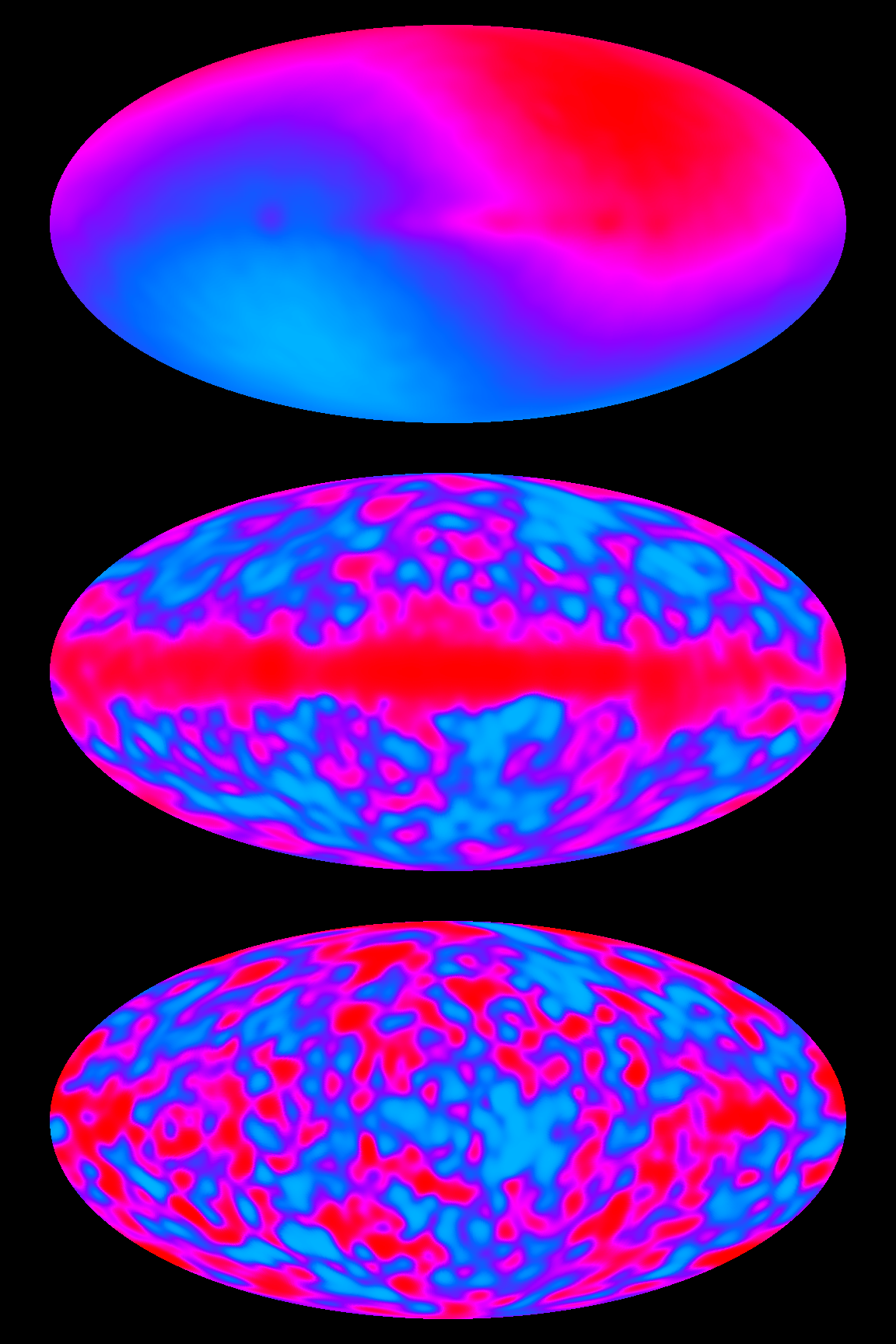
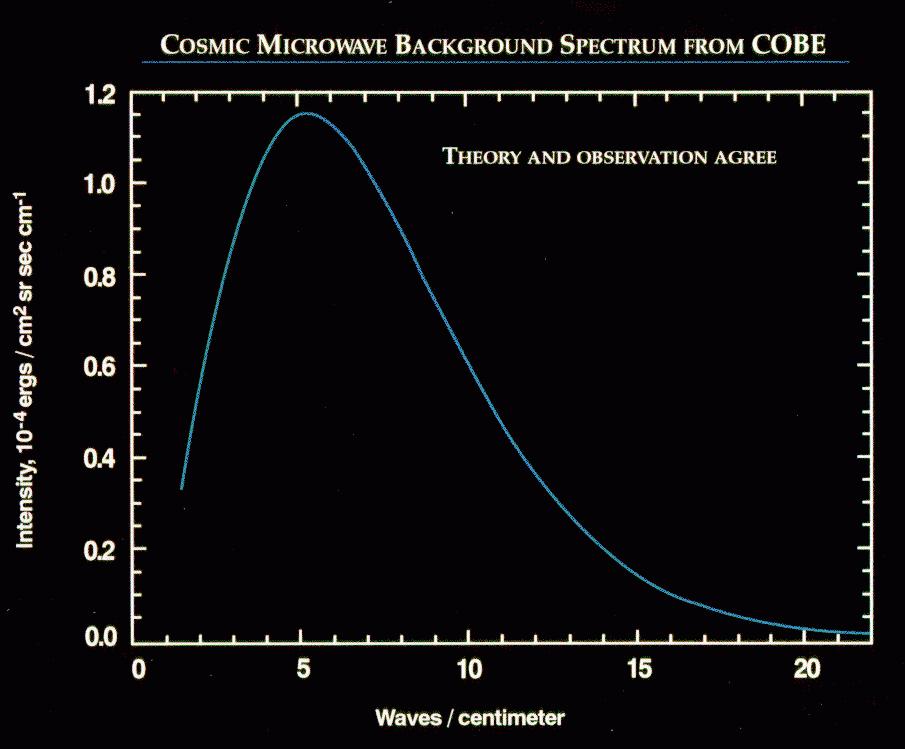
Mather and Smoot were the heads of the COBE satellite experiment. The COsmic Background Explorer measured, in the early 1990s, for the first time anisotropies in the Cosmic Microwave Background which stem from the first large-scale structures in the universe. From the Nobel press release: "John Mather coordinated the entire process and also had primary responsibility for the experiment that revealed the blackbody form of the microwave background radiation measured by COBE. George Smoot had main responsibility for measuring the small variations in the temperature of the radiation." Smoot was, moreover, involved in the first measurement of the dipole anisotropy in the Cosmic Microwave Background, which comes from the motion of the Solar system with respect to the comoving frame of our local cosmic environment - one of the more surprising, and peaceful, applications of a U-2 intelligence aircraft.


From the COBE web site: Temperature fluctuations in the Cosmic Microwave Background as measured by COBE's Differential Microwave Radiometer DMR: The three maps show the whole sky in microwaves, with the plane of the Milky Way as the equator and the centre of the Milky Way in the centre of the map. The upper map shows the dipole anisotropy, which is subtracted in the middle map. The lower map shows the cosmological fluctuations (1 part in 100 000) which are left after the dipole anisotropy and the microwave radiation from the Milky Way have been subtracted.


The "Most perfect Black Body Spectrum", as measured by the Far Infrared Absolute Spectrophotometer (FIRAS) of COBE. Deviations from the Planck curve are smaller than the thickness of the curve.

More information, for the general public and advanvced, can be found on the website of The Nobel Foundation. Moreover, both Nobelists have written popular books about their time with COBE, The Very First Light, and Wrinkles in Time, which seem to be temporary out of print, unfortunately - and I have not read them.

I can imagine that there will be much more comments and information about the Prize in the cosmological corners of the Blogosphere.


Update: I have added two "emblematic figures", the flucutation map (covering Smoot's contribution), and the perfect black body spectrum (covering Mather's contribution)
Update: U-2 and ER-2 planes have been used for several scientific purposes besides microwave cosmology. Thanks to Markk for pointing this out to me!


Friday, September 29, 2006

The Omega-Minus gets a Spin (part 1)

Last Friday, I could not come to any decision which of the many Perimeter photos I could write something sensible about, and browsed through the latest issues of the PRL instead. There, I stumbled across a paper whose title really amazed me: Measurement of the Spin of the Omega-Minus Hyperon, by the BaBar collaboration at SLAC (B. Aubert et al.), Phys. Rev. Lett. 97, 112001 (2006), and hep-ex/0606039.

My first thought was: How comes that such a paper is published as a PRL? I mean, every child knows that the Omega-Minus has spin 3/2 - just read the textbooks! After all, the Omega-Minus is that famous closing particle of the baryon decuplet!

But then, when reading the paper, I was surprised: Although this hyperon was discovered more than 40 years ago, there has not been a really conclusive measurement of its spin so far! And since the story of the Omega-Minus, its discovery, and its spin is, I think, a quite remarkable one, with connections to lots of interesting physics and some twists maybe not known to every child, I had the idea I should post something about it. I started reading more about the history of the Omega-Minus, came across many interesting details which I thought I could mention, and so, eventually, this has become a somewhat longer post... in fact, so long, that I decided to split it in two. So here is something about

  1. The baryon zoo of the 1960's and flavour SU(3)

  2. The prediction of the Omega-Minus by Ne'eman and Gell-Mann


What will follow next will cover

  1. From the Eightfold Way to the quark model and static SU(6)

  2. Quark colour

  3. The spin of the Omega-Minus


The baryon zoo of the early 1960's and flavour SU(3)


After the discovery of the neutron, it became clear that atomic nuclei are built up of two types of particles, protons and neutrons, bound together by the so-called strong force. The number of protons and neutrons does not change in strong interactions, and the corresponding conserved charge was called the baryon number, B. Moreover, proton and neutron are so similar under the strong interaction that they were considered as two different projections of one particle, the nucleon, in an abstract space called isospin space. As a spin-1/2 particle can come in two projections of its spin on an axis, s3=+1/2 and s3-1/2, the nucleon was considered a isospin T=1/2 particle, with the proton having isospin projection T3=+1/2, and the neutron having T3=-1/2. The formalism of isospin is, indeed, completely identical to the formalism of spin.

During the 1950s, more particles with the same baryon number B=1 as the nucleon were discovered: the Λ, named for the V-shaped tracks in a cloud chamber when it decays into a proton and a negative pion, the Σ's, and the "Cascades", Ξ, which got their name because of their cascading decay pattern Ξ → Σ + ... → nucleons + ... The concept of isospin could be applied also to these new baryons: the Λ is a singlet with T=0, the cascades Ξ- and Ξ0 are a doublet, as the neutron and the proton, and the Σ's form a triplet with T=1 - in fact, Murray Gell-Mann predicted the neutral Σ0 based on the assumption of the triplet, once the Σ+ and Σ- were known.

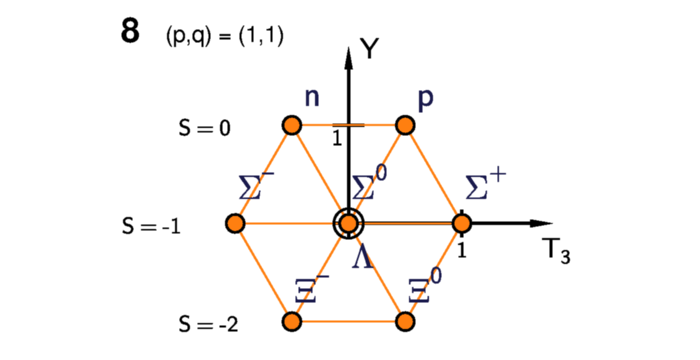
In order to classify these baryons, a new quantum number introduced by Gell-Mann, and called "strangeness", S, was useful. Strangeness (or "hypercharge" Y, which is related to strangeness by Y = B + S) can change in weak decays - similar to the decay of the neutron into proton - but not in strong interactions. Then, the Λ and the Σ's have strangeness S = -1, or hypercharge" Y = 0, while the Ξ's have strangeness S = -2, or hypercharge Y = -1. When trying to cast the description of baryons by isospin and strangeness in a unified, symmetric framework, Gell-Mann discovered that the eight baryons can be identified with the eight-dimensional, adjoint representation of the Lie group SU(3). This group, the group of special unitary transformations of a complex three-dimensional vector space, is an extension of the isospin group SU(2) to include strangeness as one further degree of freedom. It has eight generators, instead of the three generators of SU(2), which span the adjoint representation. Gell-Mann called the classification of baryons as an octet of SU(3) the "eightfold way". The very same classification scheme was discovered, independently of Gell-Mann, by the Israeli physicist Yuval Ne'eman. Ne'eman, who was then an army officer on leave to do his Ph.D. with Abdus Salam in London, died earlier this year. The SU(3) scheme discovered by Gell-Mann and Ne'eman is known today as flavour-SU(3).


The "eightfold way": the baryon octet, corresponding to the weight diagram of the eight-dimensional, adjoint representation of the group SU(3). S is strangeness, Y = B + S = 1 + S is hypercharge, and T3 is the isospin projection. Representations of SU(3) can be labelled by two numbers, p and q, which also determine the shape of the multiplet. There are two states in the centre of the multiplet, corresponding to the Λ and the Σ0. All baryons in the octet have spin 1/2.


The prediction of the Ω- by Ne'eman and Gell-Mann


Tables of elementary particles in the early 1960s were quite crowded, and the eightfold way only a first step on the road to a systematic understanding. There were man more baryonic particles known besides the octet baryons. Most of these are very short lived. Typically, they show up in scattering experiments of pions or kaons, the strange mesons, on octet baryons. There, they are visible as bumps in the scattering cross section as a function of energy. They are called resonances for this reason. The first such particles, the Δ resonances, had been discovered in 1952 by Fermi's team using pion-proton scattering experiments. Δ resonances have spin 3/2, and come in four different electric charges (-, 0, +, and ++) at the same mass of 1232 MeV, so they must belong to a state with isospin T=3/2.

In July 1962, when elementary particle physicists from all over the world met at the 11th International Conference on High-Energy Physics at CERN, there was news about resonances in scattering experiments on strange baryons. Two years before, the Σ* resonances (with isospin 1, then still called Y*) had been discovered when scattering negative kaons on protons (Margaret Alston et al., PRL 5 (1960) 520-524), which had spin 3/2 as the Δ's (Robert P. Ely et al., PRL 7 (1961) 461-464). At CERN, the detection and properties of Ξ* resonances was reported. These resonances with strangeness S=-2 seemed to form an isospin doublet, thus to have isospin 1/2 (G. M. Pjerrou et al., PRL 9 (1962) 114-117), and there were strong hints that their spin was 3/2, as for the Δ's and the Σ*s. Was there a way to make sense of these resonances, or to fit them in a classification scheme?


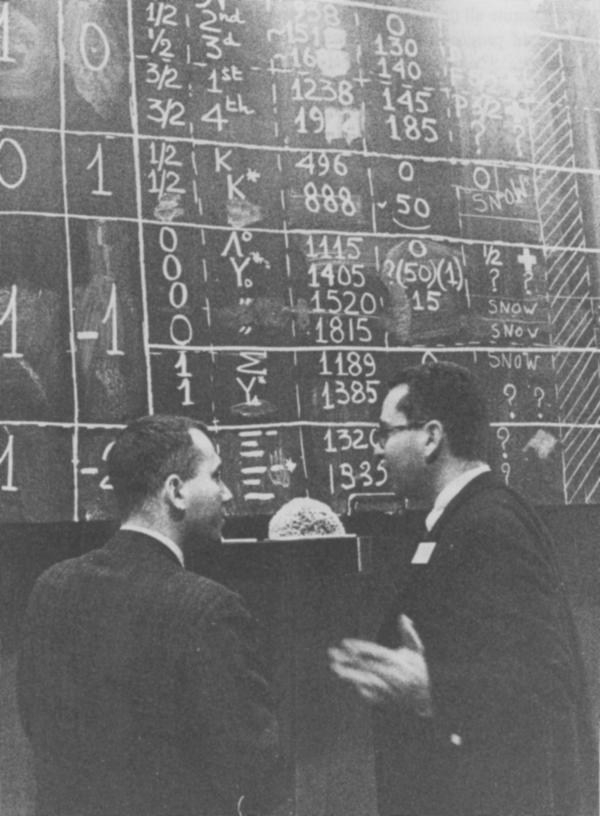
Two physicists (Gell-Mann on the right?) discussing the table of known hadronic particles and resonances at the CERN conference in July 1962. The second column indicates strangeness, the third column isospin. Further columns give mass and width, and the last one, with the many question marks, spin and parity. (Does anyone know what SNOW stands for?) The then recently discovered Σ* resonance is noted as Y1* in the third to last row, and the brand-new Ξ* shows up in the last row. (Credits: CERN, via Rochester Roundabout: The Story of High Energy Physics, by J. C. Polkinghorne)


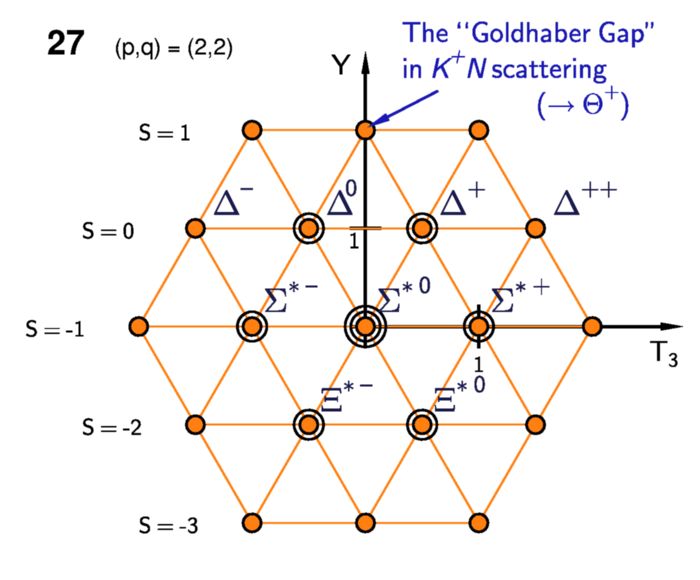
Both Ne'eman and Gell-Mann attended the CERN conference. Ne'eman had submitted an abstract about his work on the SU(3) classification scheme of baryons, but he wasn't given a slot to talk about it. It seems that SU(3) wasn't taken that serious yet. But this didn't stop him from thinking hard about possible ways to integrate the new resonances into his scheme. Several multiplets could, in principle, accommodate for the new resonances: a decuplet, corresponding to (p=3, q=0), a 15-plet, with (p=2, q=1), and a 27-plet, with (p=2, q=2), whose weight diagram would have the same sixfold symmetry as the octet diagram. Ne'eman had no clue about which one to chose, when he met a husband-wive pair of experimentalists originating from Israel on the bus trip from the conference hotel to CERN, Sulamith and Gerson Goldhaber. (Gerson is now involved in the supernova Ia measurements of the Perlmutter group that established cosmic acceleration - that's amazing!). They started talking about physics, the Goldhabers asked him about SU(3), and they told him that they had, without success, tried to repeat the Alston et al. scattering experiments, but using positive kaons on neutrons instead of negative kaons on protons. That was just the piece of information that was missing! Both the 15-plet and the 27-plet, if they were the correct multiplets to classify the baryon resonances, would have required resonances of positive kaons on neutrons! Thus, they were excluded by the negative results of the Goldhaber experiment!


The 27-plet of SU(3), with (p=2, q=2), could, in principle, accommodate all the baryonic resonances known in 1962. But then, there should also be resonances with strangeness S=1, which should show up in scatterings of positive kaons on neutrons. The experiments of the Goldhabers and their group excluded the existence of such resonances. This negative result, later called the Goldhaber Gap, eliminated the 27-plet, and the 15-plet, from the possible multiplets to classify the resonances, leaving only the decuplet. Amusingly, the Goldhaber Gap corresponds exactly to the position of the elusive pentaquark Θ+, which made such a fuss in the last three years, but seems not to exist, after all.


Now, Ne'eman had everything he needed to know to come to a conclusion: The baryon resonances fitted neatly in the decuplet (p=3, q=0) of SU(3). Moreover, most excitingly, there was exactly one resonance still missing in this multiplet, the resonance with strangeness S=-3. This resonance should exist, if the decuplet scheme was right, and he could even say something about its mass, using a formula of Gell-Mann and Okubo. This formula predicted a linear splitting of the masses of the decuplet resonances with strangeness, and, indeed, the mass difference between the the Δ's and the Σ*s was about 150 MeV, as was the mass difference between the Σ*s and the Ξ*s. Thus, Ne'eman was confident that there should be a isosinglet resonance with S=-3, negative electric charge, spin 3/2, and a mass of about 1680 MeV, and he decided to make this point in the discussion following a review talk on the new baryonic resonances.


Sulamith Goldhaber, of the Goldhaber gap, with Yuval Ne'eman, visiting the Goldhabers at Berkeley (Credits: Lawrence Berkeley Lab Magnet, Vol. 8, No. 4, April 1964, p. 2)


He didn't have luck. Gell-Mann had also heard the rumours about the negative results of the Goldhaber experiment, and, consequently, he had come to very the same conclusions as had Ne'eman. So, following the presentation on Strong interactions of strange particles by G. A. Snow, both Ne'eman and Gell-Mann raised their hands to ask for permission to speak. The chairman called Gell-Mann, who was the more eminent physicist of both, and Gell-Mann announced that "[...] we should look for the last particle called, say, &Omega-, with S=-3, I=0. [Here, I is isospin.] At 1685 MeV it would be metastable and should decay by weak interaction [...]". This was the public prediction of the closing resonance of the baryon decuplet, fittingly named after the last letter of the Greek alphabet, and subsequently published in the proceedings of the conference. It seems that Gell-Mann got to know Ne'eman in person for the first time just on the way back to his chair in the auditorium, when he read Ne'emans name on the name tag. And it seems that Ne'eman was not too bitter of being scooped in the last second - at least, they started a long-lasting collaboration, and published together the Eightfold Way.


The SU(3) decuplet of the baryon resonances. The resonances known in 1962 are shown in black. There was one particle missing, at the lower tip of the triangle. This particle was called &Omega- by Gell-Mann, who predicted its strangeness, spin, isospin, and mass. Ne'eman had come to the very same prediction at the same time.


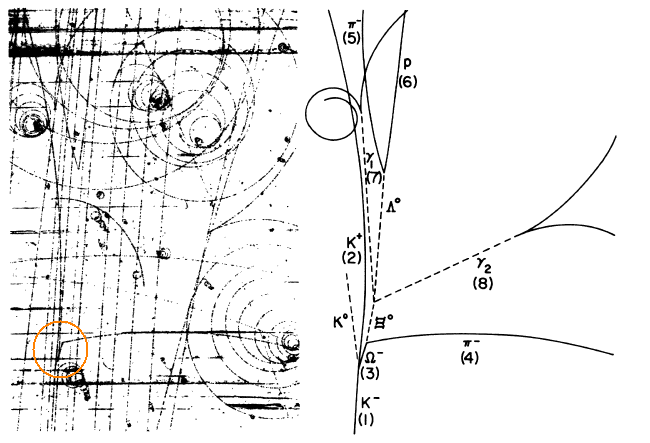
In the break following the talk of Snow, Gell-Mann and Ne'eman discussed with two experimentalists from Brookhaven National Lab, Nicholas Samios, who later became director of BNL, and Jack Leitner. They thought about possible ways to detect the &Omega- in experiment. Indeed, a search program was set up at BNL, which was successful two years later: the &Omega- was found on a bubble chamber picture (V. E. Barnes et al., PRL 12 (1964) 204), and its properties were exactly as predicted by Gell-Mann and Ne'eman.

At that point, there was no more doubt that the SU(3) classification scheme of particles had some truth about it.


The discovery of the &Omega- in a bubble chamber picture. The &Omega- leaves the short, thick track in the lower left corner. (Credits: BNL and V. E. Barnes et al., PRL 12 (1964) 204).


The actual detection of the &Omega- was a big success of the SU(3) classification scheme, but it was not the end of the story. Surprisingly, the spin of the &Omega- could not been measured so easily - even the 2006 particle data book entry on the &Omega- still states on the baryon summary page: JP is not yet measured; 3/2+ is the quark model prediction.

So, stay tuned, and read next time about:

  1. From the Eightfold Way to the quark model and static SU(6)

  2. Quark colour

  3. The spin of the Omega-Minus


and why, maybe, SLAC could have pushed the headline;

Quark model prediction finally proven after 40 years!


The story leading to the prediction of the &Omega- at the 1962 CERN conference is related in several sources. I have used (thanks, in part, goes to Google Search Inside):

  1. The Second Creation: Makers of the Revolution in Twentieth-Century Physics, by Robert P. Crease, Charles C. Mann

  2. The Particle Century, edited by G Fraser, with contributions by Ne'eman and Samios

  3. Strange Beauty: Murray Gell-Mann and the Revolution in Twentieth-Century Physics by George Johnson

  4. Rochester Roundabout: The Story of High Energy Physics by J. C. Polkinghorne

  5. The Periodic Table and Genetic Code of the Hadrons by Yuval Ne'eman

  6. From SU(3) to Gravity: Festschrift in Honor of Yuval Ne'eman edited by Errol Gotsman and Gerald Tauber, with a contribution of Gerson Goldhaber about the encounter in the bus on pages 103-105.

  7. The Eightfold Way, by Murray Gell-Mann, Yuval Ne'eman. The new edition contains the historically oriented survey Hadron Symmetry, Classication and Compositeness by Yuval Ne'eman, first published in Symmetries in Physics (1600-1980): Proceedings of the 1st International Meeting on the History of Scientific Ideas, held at Sant Feliu de Guíxols, Catalonia, Spain, September 20-26, 1983. edited by M. G. Doncel, A. Hermann, L. Michel and A. Pais (Barcelona, 1987).


Tuesday, September 26, 2006

Interna

News on my move: no news. My furniture is still subject to maximal position uncertainty, and nobody is responsible for anything. Meanwhile, I came to the conclusion that the word couch is derived from the word ouch. I felt very grown up buying a couch, really, it is the first time in my now 30 years that I own such an object of settlement! But I wasn't really prepared to sleeping on it for some weeks. I am definitely too old for that.

But here is the true progress report: effective noon today I have high speed internet in my apartment. If nothing else, I am at least connected to the rest of the world.

Seriously, in the old days before internet, I would sometimes pick up the phone receiver and listen to the dial tone when I felt lonely. It was like an open channel to the rest of the world. Nowadays its a high-speed channel, and it doesn't only come with a doooooot, but with emails, photos and videos. Actually, the only thing that's still missing is the transmission of solid objects. Imagine that: instead of getting spam emails, your monitor would throw sample pills in your face when your filter sucks, and Mohammed Send-me-bucks, the son of Emir Nowhereland would drop in and ask for your help.

Besides this I tried to use my stove on the weekend, but had to find out that the oven didn't work. So I called my landlord yesterday, and she had someone come and look at the thing. To my eyes the stove looks like manufactured in the 19st century, but it's actually not even 10 years old as I was told.

Anyway, the guy came in total silence, replaced some fuses, pushed and shoved the stove around a bit. Then he carefully knocked at the clock and the timer which are in the panel. He frowned at me in a really scary way and said: Did-you-push-these-buttons? The one with the timer? Well, when I noticed the stove didn't work I pushed about every button I could find, not that there were so many, and yes, I also turned on the timer (which almost caused me a heart attack when it went off some hours later). So I said yes. Never-push-these-buttons, the guy said, still frowning. I asked: what are they good for? NOTHING! I looked confused. TROUBLE, he said. And then I learned that turning the time makes everything go out of sync.

That's my current problem with time, everything is out of sync.

But the oven works now. I promised I won't try to set the clock.

And here is a picture of my ouch:


Besides this, I encourage you to speculate on the to-be-announced 2006 Nobelprize over at Peter Woit's blog.

Friday, September 22, 2006

Micro Black Holes

Black holes are fascinating! They merge together completely different fields of physics: From General Relativity over thermodynamics and quantum field theory, they do now also reach into the regime of particle and collider physics.

As I discussed in the earlier post about extra dimension, in the presence of additional large compactified dimensions, it would be possible to produce tiny black holes at future colliders. In this case, we would be able to experimentally test Planck scale physics and the onset of quantum gravity with the Large Hadron Collider (LHC), which is scheduled to start next summer.

The formation of black holes is a fairly robust prediction and one of the most general expectations that one can have, even though the details are still subject to research.

For me, it is quite amazing to see how this field has evolved during the last decade. Starting from a smiled upon speculation, it has by now become a widely accepted scenario for physics beyond the standard model, which is included in simulations of LHC events.


1. Micro Black Holes in Large Extra Dimensions

In the standard 3+1 dimensional space-time, the production of black holes requires a concentration of energy-density which can not be reached in the laboratory. But in a higher dimensional space-time, gravity becomes stronger at small distances and therefore the event horizon is located at a larger radius. This radius can be so large that we could bring particles closer together than their horizon. A black hole could be created.

The presence of extra dimensions results in a modification of the predictions of the standard model, which become important from a certain energy scale 'the new fundamental scale', and which might be accessible at the LHC. Due to the Heisenberg uncertainty, it requires a large energy to get particles into a small volume. Only energies close by the new fundamental scale would be sufficient to produce a black hole out of this same energy.

For collider physics one is therefore interested in the case where the black hole has a mass close to the new fundamental scale. This corresponds to a horizon radius close to the inverse of the new fundamental scale, which is much much smaller than the radius of the extra dimensions. To a good approximation, this tiny black hole just does not notice that the extra dimensions are compactified, and one can neglect the boundary condition. (The higher dimensional Schwarzschild-metric for this case has been derived by Myers and Perry in '86)

On the other hand, for astrophysical objects we expect to find back the usual 3-dimensional description. In this case, the horizon radius is much larger than the radius of the extra dimensions and the influence of the extra dimensions is negligible.

Those two case are depicted in the figure below. We will be interested in the case depicted on the right side. R is the radius of the extra dimensions (all of them have the same radius) and RH is the horizon radius of the black hole.


2. Production of Black Holes

Let us consider two elementary particles, approaching each other with a very high kinetic energy in the center-of-mass system close to the new fundamental scale. At those high energies, the particles can come very close to each other since their high energy allows a tightly packed wave package despite the uncertainty relation. If the impact parameter is small enough, which will happen to a certain fraction of the particles, we have the two particles plus their large kinetic energy in a very small region of space time. If the region is smaller than the Schwarzschild radius connected with the energy of the partons, the system will collapse and form a black hole.

The production of a black hole in a high energy collision is probably the most inelastic process one might think of. Since the black hole is not an ordinary particle of the standard model, and its correct quantum theoretical treatment is unknown, it is commonly treated as a metastable state, which is produced and decays according to the semi-classical formalism of black hole physics.

To compute the production details, the cross-section of the black holes can be approximated by the classical geometric cross-section Pi R2. A common approach to improve the naive picture of colliding point particles is to treat the creation of the horizon as a collision of two shock fronts in an Aichelburg-Sexl geometry describing the fast moving particles.

Looking at the figure on the left, we also see that, due to conservation laws, the angular momentum of the formed object only vanishes in completely central collisions with zero impact parameter. In the general case, we will have an angular momentum, and the black hole might also carry an electric charge.


Another assumption which goes into the production details is the existence of a threshold for the black hole formation. From general relativistic arguments, two point like particles in a head on collision with zero impact parameter (the b in the figure above) will always form a black hole, no matter how large or small their energy. At small energies however, we expect this to be impossible due to the smearing of the wave functions by the uncertainty relation. This then results in a necessary minimal energy to allow for the required close approach. This threshold is of order of the new fundamental scale, though the exact value is unknown since quantum gravity effects should play an important role for the wave functions of the colliding particles.

Using the geometrical cross section formula, it is now possible to compute the differential and total cross sections for black hole production. This also allows us to estimate the total number of black holes, that would be created at the LHC per year. Inserting the expected technical details for the collider, one finds a number of approximately 109 created black holes per year! This means, about one black hole per second.


3. Evaporation of Black Holes

It was shown by Hawking in '75 that a black hole emits particles with a temperature that is inverse to its mass. This means, the smaller the black hole, the hotter it will be. Since we are talking about really tiny black holes, they are very hot. The typical temperature of the micro black holes is about 200 GeV or 1016 Kelvin!

The evaporation rate (massloss per time) of the higher dimensional black hole can be computed using the thermodynamics of black holes. Once produced, the black holes will undergo an evaporation process whose thermal properties carry information about the number and the radius of the extra dimension. An analysis of the evaporation will therefore offer the possibility to extract knowledge about the topology of our space time and the underlying theory.

The evaporation process can be categorized in three characteristic stages:


1. Balding phase: In this phase the black hole radiates away the multipole moments it has inherited from the initial configuration, and settles down in a hairless state. During this stage, a certain fraction of the initial mass will be lost in gravitational radiation.


2. Evaporation phase: The evaporation phase starts with a spin down phase in which the Hawking radiation carries away the angular momentum, after which it proceeds with emission of thermally distributed quanta until the black hole reaches Planck mass. The radiation spectrum contains all Standard Model particles, which are emitted on our brane, as well as gravitons, which are also emitted into the extra dimensions. It is expected that most of the initial energy is emitted in during this phase in Standard Model particles.

3. Planck phase: Once the black hole has reached a mass close to the Planck mass, it falls into the regime of quantum gravity and predictions become increasingly difficult. It is generally assumed that the black hole will either completely decay in some last few Standard Model particles or a stable remnant will be left, which carries away the remaining energy.


To perform a realistic simulation of the evaporation process, one has to take into account the various particles of the standard model with the corresponding degrees of freedom and spin statistics. In the extra dimensional scenario, standard model particles are bound too our submanifold whereas the gravitons are allowed to enter all dimensions. For a precise calculation one also has to take into account that the presence of the gravitational field will modify the radiation properties for higher angular momenta through backscattering at the potential well.

These energy dependent greybody factors can be calculated by analyzing the wave equation in the higher dimensional spacetime and the arising absorption coefficients. A very thorough description of these evaporation characteristics has been given by Kanti in 2004 which confirms the expectation that the bulk/brane evaporation rate is of comparable magnitude but the brane modes dominate.


4. Observables of Black Holes

One of the primary observables in high energetic particle collisions is the transverse momentum of the outgoing particles, pT (pee-tee), the component of the momentum transverse to the direction of the beam. Two colliding partons with high energy can produce a pair of outgoing particles, moving in opposite directions with high pT but carrying a color charge, as depicted in the figure to the right.


Due to the quark confinement, the color has to be neutralized. This results in a shower of several bound states, the hadrons, which includes mesons (consisting of a quark and an antiquark, like the pions) as well as baryons (consisting of three quarks, like the neutron or the proton). The number of these produced hadrons and their energy depends on the energy of the initial partons. This process will cause a detector signal with a large number of hadrons inside a small opening angle. Such an event is called a jet.

Typically these jets come in pairs of opposite direction. A smaller number of them can also be observed with three or more outgoing showers. This observable will be strongly influenced by the production of black holes.

To understand the signatures that are caused by the black holes we have to examine their evaporation properties. As we have seen before, the smaller the black hole, the larger is its temperature and so, the radiation of the discussed tiny black holes is the dominant signature caused by their presence. The high temperature results in a very short lifetime such that the black hole will decay close by the collision region and can be interpreted as a metastable intermediate state.

Due to the high energy captured in the black hole, the decay of such an object is a very spectacular event with a distinct signature. The number of decay products, the multiplicity, is high compared to standard model processes and the thermal properties of the black hole will yield a high sphericity of the event. Furthermore, crossing the threshold for black hole production causes a sharp cut-off for high energetic jets as those jets now end up as black holes instead, and are re-distributed into thermal particles of lower energies. Thus, black holes will give a clear signal. A schematic picture of this process is shown on the left.

It is apparent that the consequences of black hole production are quite disastrous for the future of collider physics! Once the collision energy crosses the threshold for black hole production, no further information about the structure of matter at small scales can be extracted. As it was put by Giddings and Thomas, this would be ''the end of short distance physics''.

By now, several experimental groups include black holes into their search for physics beyond the standard model. Ideally, the energy distribution of the decay products allows a determination of the temperature (by fitting the energy spectrum to the predicted shape) as well as of the total mass of the object (by summing up all energies). This then allows to reconstruct the fundamental scale, and the number of extra dimensions.

The quality of the determination depends on the uncertainties in the theoretical prediction as well as on the experimental limits e.g. background from standard model processes. Besides the formfactors of black hole production and the greybody factors of the evaporation, the largest theoretical uncertainties turnout to be the final decay and the time variation of the temperature. In case the black hole decays very fast, it can be questioned whether it has time to readjust its temperature at all or whether it essentially decays completely with its initial temperature. Also, the determination of the properties depends on the number of emitted particles. The less particles, the more difficult the analysis.

However, in my opinion the most crucial uncertainty are the latest stages of the evaporation. For hadron colliders like the LHC, the last stages with black hole masses close by the production threshold will dominate the signature, since most of the black holes are actually produced out of parton collisions with a total center-of-mass energy close by even this threshold. In hadronic collisions there are thus very little black holes which actually capture the total available energy of 14 TeV, since the proton's energy gets distributed on its constituents. Such a problem would not be present for a lepton collider.

See also:


TAGS: , , ,

First Day of Fall

See here for: First Day of Fall 2007

From Wikipedia:

Autumn (also known as fall in North American English) is one of the four temperate seasons, the transition from summer into winter. In the temperate zones, autumn is the season during which most crops are harvested, and deciduous trees lose their leaves. It is also the season where days rapidly get shorter and cooler, the nights rapidly get longer, and of gradually increasing precipitation in some parts of the world.

Fall is an alternative English word for the season of Autumn. In use now only in North American English, the word traces its origins to old Germanic languages. The exact derivation is unclear, the Old English fiæll or feallan and the Old Norse fall all being possible candidates. However, these words all have the meaning to fall from a height and are clearly derived either from a common root or from each other.


[Photo by Ron Day]

        Fall

        I had gotten tired, or maybe just old,
        Had nowhere to go to and noone to hold,
        For one carless moment, I loosened my grip,
        I made a wrong step and time started to slip,
        One careless moment, just one that was all,
        Time slipped away and spring turned into fall.

        I tried to stay focused and not to look down,
        I could not stop thinking that I should have known,
        That things far below me would drop out of sight,
        And I could not tell what was wrong and what right,
        One careless moment, I lost my connection,
        Time slipped and left me without a direction.

        ...more poems


TAGS: , ,

Thursday, September 21, 2006

USA in transit

When looking for flights to see Bee in Canada, I was delighted to learn that Waterloo has, indeed, an International Airport, and that the connection by Northwest/KLM from Frankfurt, either directly or via Amsterdam, is even quite inexpensive. OK, direct means in any case that you have to change planes in Detroit, MI. I do not know whether you are planning to travel to Canada (or to some other country) via the US, but I found the current procedures for transit quite remarkable.

The first, positive thing is that - besides all things fluid or gely outside your body - you are allowed to bring carry-on luggage on board as always. I had the impression that there is quite an incertitude about this among travellers (I was not sure myself before whether I could bring my ibook into the cabin), since I have never before seen the overhead compartments as empty as this time: most overhead compartments on the Amsterdam-Detroit flight were not even half-filled.

But then, the lady at the KLM desk at Frankfurt had told me that my suitcase would be checked through straight to Waterloo. This was not true. At Detroit, all passengers had to collect their luggage at the baggage claim, and go through immigration and customs, including leaving fingerprints and being photographed. Of course, I also had to fill a visa waiver from. I did not really expect to be subject to this whole procedure, since I had a ticket to leave the US two hours later. So, the green from was stapled in my passport, and keeping in mind that you never ever should leave the states with this piece of paper still in your hands to avoid any trouble when you ever should have to go back there, I insisted that the lady at the boarding for the turboprop to Waterloo took it out.

That would not have been necessary, as I learned on my way back. This time, I even had already a boarding pass for the flight to Frankfurt, but immigration and customs were unavoidable. I had to fill, again, a visa waiver form, which I could get neither in Waterloo, nor on the plane to Detroit. Fortunately, there were forms available at the immigration post, and a German speaking Northwest employee was very helpful and even borrowed me her pen. And no Jumbo from Tokyo or so had just arrived, so the huge immigration hall was essentially empty, and the immigration officers quite relaxed and friendly. And, after fingerprinting and photographing, I was told that I can, indeed, keep my visa waiver form in the passport when leaving the US for Canada for a period of less then 30 days. On the other hand, filling that form is no big deal compared to the whole immigration/customs/security recheck procedures...

But this was not the end of the measures necessary for a simple transit: I just had decided, one hour before boarding, to spend the $9.95 for a non-resident access to the Detroit Airport Wireless to transfer my million of Perimeter photos to the Frankfurt server, when a TSA agent informed all of us waiting passengers that right now, fingerprinting and photographing was also required when leaving the US. This is comparably easy, since it is done by machines which scan the passport, give exact instructions what to do with your fingers and where to look for the photo, and finally print out a paper slip with a picture-like pixel code, but you have to walk back the mile or so from the gate to the centre of the terminal, where the machines are located. I was a little upset, since I would have had plenty of time before if anyone had told it me, but now I had to interrupt the file transmission and hurry to these machines, since I did not know how long all this would take...

I the end, all went fine, I got the plane in time, and even all my picture files arrived in Frankfurt 8 hours before me.

However, I really wonder if it is necessary that my fingerprints and my portrait are taken twice within two hours, just because I happen to change planes in Detroit. And, for my next visit in Waterloo, I will probably be looking for affordable flights via Toronto...

,

Blind loops

Okay folks, this is just an extended complaint about the so-called customer service, and I am writing merely for therapeutic reasons, coz otherwise I'll probably go out on the street and bite some innocent pedestrians.

Yesterday I tried to get an internet connection into my new apartment. Since I already have two cellphones, and make most of my calls via skype anyhow, I don't really need another phone line in the apartment. It wasn't difficult to find out that Rogers is apparently the Canadian company who does that stuff. So I went into the next store I could find.

There, I was told a long list of special offers and rate plans for internet over cable, but the guy knew about no technical details except those which end in dollar signs, and they also don't sell wireless routers. But okay, I could just drop into the next Walmart and get one. After the guy began to repeat his list of offers for the third time, I was getting tired and said fine, I'll take that plan, where do I sign. First problem was that last week I had to treat in my pretty California driver's licence for a temporary Ontario one, which doesn't have a photo, and therefore isn't a photo ID. But I convinced them to accept my International Student ID, which I am actually not sure why I have a valid one, since I haven't been a student for 5 years or so.

What then happened was that some 15 year old employee, an original with dental braces, named Tericita of Tiffany or something tried to enter my data in an online form. Which didn't work, and which I could have done by myself in my office btw. She tried that repeatedly, but it still didn't work. Then she called the customer-service hotline, where a tape was apologizing that all representatives are busy, but would you please hold. Tifanny-or-Tericita turned on the speaker, and began surfing the web while I was listening to the tape telling her to hold and hold and hold. After 1/2 hour or so, I asked her how long she thought that would take, but just got a shoulder shrug. After 1 hour, the representative was actually available on the phone but said essentially that his system had crashed down and he couldn't do anything about nothing.

So, after one hour looking at Tiffany browsing the web, I was asked to come back tomorrow.

I went to get some coffee and asked the next person in line which internet service he uses. Bell, he said. So, I went into the next Bell store and asked them to please, please set up internet service in my apartment.

Since I was pretty pissed off, I told the guy who had a funny beard my experience with the Roger's people. This complete incompetence of employees is something that upsets me frequently. I mean, the only thing they do is look up their own website and call customer service. That I can do on my own. Why don't they just put a computer there and a courtesy phone? You know what? That's exactly what you find in the Bell's store. A courtesy phone to call customer-service. But the guy with the funny beard was all sympathetic, and, yes Rogers sucks, good you came to see us.

Funny beard was actually quite nice, but told me they don't do cable stuff, just internet via phone, which is actually much better because blahblahblah. After some back and forth he told me it would be possible to set up what he called a 'blind loop', a phone line from which I couldn't call but get an high-speed internet. Bell actually does wireless networking with their own modems and has a provider called Bell Sympatico.

Again the guy with the funny beard couldn't answer any of my questions regarding security of the wireless or even basic things like the range of the sender. But after he found my Dr. on the credit card, he told me he'd grown the beard because he has this funny rash which wouldn't go away, and if I could give him some advice. I said I couldn't and asked him what internet service he uses at home. Rogers, he said.

Since I was already tired, I just said finefinefine, and could we please set that up now, I need a drink. Then we played the same game again. Funny beard tried to enter data into a form. Which didn't work. Then he went to the courtesy phone and called customer service. And here's the new part of the story: gave me the receiver to talk to the customer service representative. After 1/2 hour I found out that they don't have any wireless offers they can make me on the phone, and I should speak to the store guy, or call another number. The other number turned out to be a tape saying 'this service it not available', even after verifying that the number was correct. Funny beard shrugged his shoulders. I left without having any internet.

This morning I called the Bell's hotline again where they were at least able to tell me that in my apartment there's no high speed internet available anyhow, only dial up.

Then I found a flyer in the drawer of my kitchen with a business card of the local cable guy. I called him, said I need a wireless in my apartment, if possible yesterday. He said yes, no problem, he'll send someone over in the next days.

So, I have actually hope that I will be online again sometime in this century...