Some weeks ago I asked Garrett Lisi to write a contribution to our Inspiration series. He suggested we instead do an interview by email. I found it a good idea because I thought it might be easier to keep these inspiration posts to a manageable length - after all, I could just stop asking, right?
B: Well, let me start with some introductory questions so readers know what they are dealing with. Ten words that describe Garrett Lisi?
- G: "Vell, Zaphod's just this guy, you know?"(I can't follow instructions)
- G: Physics, love, and surfing. I'm only three dimensional -- and no, those aren't in order.
- ... get a girl to like me by showing off.
- ... all one really needs to do is listen.
- ... not listening.
- ... discovering a beautiful T.o.E. that kicks string theory's ass.
- G: Ha!
- G: Because they're the hardest? No, actually, physics and surfing aren't about showing off. I've always been intrigued by the relationship between mathematics and nature. In school, we learn the math first, then later we learn some physics and see that the math relates to what happens in the world. Then we learn more complicated math -- calculus, group theory, differential geometry, and so on -- and see how this all connects up and describes how the universe works; it's quite wonderful. I got hooked. And the surfing... surfing really nice waves is simply the most fun one can have on this planet.
We have these big brains, and a limited amount of time. So what to do? A lot of people spend their time making money, sometimes with the hope that they'll be able to do what they want after they make it. But you never get that time back. Theoretical physics is the most abstractly beautiful and challenging pursuit there is. It's what I want to spend my time thinking about, so that's what I do.
But all thinking and no action would make for a dull life. So I surf.
A lot.
- G: Ha, no, my first highschool physics teacher once told my parents: "I'm afraid Garrett just won't ever get anywhere in physics." I remember arguing with him in class constantly -- at one point he stubbornly claimed the force of gravity grew stronger near the center of the earth. He was a chemist.
As a kid I wanted to be an aerospace engineer. And I was very good at math. Turns out I was too good at math -- I got so interested in math and physics classes that I ditched engineering during my second year of college.
B: And what is the beauty that you are dreaming of?
- G: Currently, this:
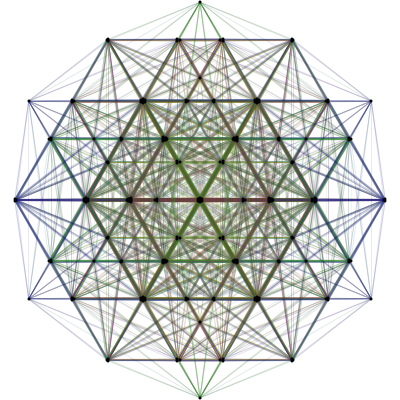
...
B: Sorry for the delay, E8 got stuck in PI's spam filter... Do you think beauty is in symmetry and simplicity, and should be our guide?
- G: I've always found symmetry and complexity to be beautiful. Not complexity in the "random mess" sense, but as a richness of structure... which belies an underlying simplicity. I think nature is a balance of simplicity and complexity in this funny way. Though I do follow one guide for theory building:
"Make everything as simple as possible, but not simpler." - A. Einstein
B: Why then would you want to kick string theory's ass?
- G: Because I think it's probably not how nature works.
We have two very good models in fundamental physics, general relativity and the standard model of particles and interactions. A T.o.E. is a theory that combines these two, reproducing them in some limit. (Whether a T.o.E. exists is a separate debate.) It's a hard thing to build, since the structure of these two theories seems very different. GR is fundamentally geometric, while QFT has algebra all over the place. Nevertheless, if you think there is a T.o.E., and you're guided by simplicity, then there should be a unified theory that gives both of these others.
Now, string theory started out with these same motivations, and had a lot of initial success. Back in the eighties people thought the standard model particles were going to naturally come out of the theory at any moment. But they didn't. In order to match the known particles, people have had to build very elaborate structures of branes and orbifolds using all sorts of contrived assumptions and hundreds of parameters. At this point, string theory is a giant kludge, much messier than the structure of the standard model it's supposed to describe. Because of this, I have to think it's probably just not how nature works.
Now, I would never dictate what other physicists should work on. And I even think string theory is still promising enough that it's good for some people to work on it. It's just not for me. What I've been working on recently, as a T.o.E., is a theory that combines all fields of the standard model and gravity in a purely geometric Yang-Mills theory with a single connection.
B: As much as I think your approach towards a ToE is very interesting, I have to say to me that a connection looks neither simple nor beautiful.
- Yah, I used to feel that way too -- we see all this messy algebra. But what is a Lie group? It's just a large manifold, with a shape and symmetries described by vector fields -- the Lie algebra elements. A connection and its curvature is a description of how this shape twists around our four dimensional spacetime. And that's all there is to it -- it's purely geometric. This isn't the way physicists usually think of a connection, but mathematicians have been thinking of it this way for at least fifty years, and they've been having a lot of fun.
B: So isn't beauty a very subjective requirement?
- G: Yes, it is. But, you know, what makes us physicists and not philosophers is that, at least in principle, our theories need to agree with experiments.
B: You're living on an island, and keep your distance to the academical networks. Do you think that solitude and silence are necessary to our understanding of nature's ways?
- G: To a degree, yes. But mostly I spend time in Maui because it's beautiful and the surf is good. And although I work on my own, my wonderful girlfriend is usually around, painting or knitting. And I have friends to hang out with occasionally. Ideally, I think what one needs in life is balance. I like to spend a few hours a day working on physics in silence, and a few hours playing outside or goofing off.
I've been thinking about what the ideal scientific work environment would be, and the best thing I've been able to come up with is a Science Hostel. I envision a large house where theorists could live and work on their stuff alone or in groups while having their meals and living space provided. The idea is to give researchers time, with an easily accessible but undemanding social atmosphere, and as little responsibility as possible. And, of course, it would have to be somewhere beautiful -- with good hiking and other things to do outside. For the past year I've been living near Lake Tahoe -- a great environment for thinking and playing. Anywhere in the mountains would probably be good for a Science Hostel -- even better if it's next to a good ski hill. :)
The reason I've been out of the scientific network isn't because I thought it was bad, but because I didn't fit in it. I love differential geometry, GR, and QFT, but I don't care for strings. Ten years ago, when I got my Ph.D., the only postdoc positions available in these overlapping areas were in string theory. So, since I had some money saved up, I moved to Maui to work on the puzzle on my own, and learned how to windsurf. Now, ten years later, string theory isn't doing so well and there are starting to be other opportunities in foundational physics. The LQG community has grown significantly -- and they're a wonderful group of people. Also, the FQXi foundation liked what I was doing enough to give me a nice grant. So I felt the time was right to leave my quiet island and start talking with people.
- G: Ah, an epitaph...
Do what you love.
Garrett Lisi is a wandering surfer-physicist, working on nomothetic unification while searching for the perfect wave. After graduating UCLA at the top of his class and getting his Ph.D. from UC San Diego, Garrett took off for Maui to windsurf and do physics on his own. Last year Garrett won a research grant from FQXi, which he spent on food, a laptop, and a new snowboard. His work on unifying general relativity and the standard model as an E8 principal bundle was featured as a recent This Week's Find by John Baez . Impatient with the slow progress of technology, Garrett has been manually uploading his brain to the web as an open-source theoretical research wiki: Deferential Geometry. He also blogs occasionally at FQXi blogs and has a semi-secret personal journal. Garrett recently presented his work at conferences in Mexico and Iceland, is currently hopping around California, and is looking forward to visiting the Perimeter Institute in October.
See also the previous contributions to the inspiration-series byand my related guest post at Asymptotia 'Sabine Hossenfelder: My Inspiration' (most of these are also available as pdf-file).
TAGS: PHYSICS, PHYSICISTS