Pages

Tuesday, July 23, 2013

How stable is the photon? Yes, the photon.

Light. Source: Povray tutorial.
I never really got into the kitten-mania that has befallen the internet. But I do think there’s such a thing as a cute paper, and here is a particularly nice example:
The photon is normally assumed to be massless. While a photon mass breaks gauge invariance and seems unappealing from a theoretical perspective, in the end it’s an experimental question whether photons have a mass. And while the mass of the photon is tightly constrained by experiment, to below about 10-18 eV, the mere possibility that it may be non-zero brings up another very basic question. If the photon has a mass it can decay into other particles, for example a pair of the lightest neutrino and its anti-partner, or other so-far undiscovered particles beyond the standard model. But if decay is possible, what are the bounds on the life-time of the photon? That’s the question Julian Heeck set out to address in his paper.

If the photon is unstable and decays into other particles, then the number density of photons in the cosmic microwave background (CMB) should decrease while the photons are propagating. But then, the energy density of the spectrum would no longer fit the almost perfectly thermal Planck curve that we observe. One can thus use the CMB measurements to constrain the photon lifetime.

If one uses the largest photon mass presently consistent with experiment, the photon lifetime is 3 years in the restframe of the photon. If one calculates the γ-factor (ie, the time dilatation) to obtain the lifetime of light in the visible spectrum it turns out to be at least 1018 years.

It’s rare to find such a straight-forward and readable paper addressing an interesting question in particle physics. “Cute” was really the only word that came to my mind.

Friday, July 19, 2013

You probably have no free will. But don’t worry about it.

Railroad tracks. Image source.
Anybody who believes in reductionism and that the standard model of particle physics is correct to excellent precision must come to the conclusion that free will is an illusion. Alas, denial of this conclusion is widely spread, documented in many attempts to redefine “free will” so that it can somehow be accommodated in our theories. I find it quite amusing to watch otherwise sensible physicists trying to wriggle out of the consequences of their own theories. We previously discussed Sean Carroll’s attempt, and now Carlo Rovelli has offered his thoughts on free will in the context of modern physics in a recent Edge essay.

Free will can only exist if there are different possible futures and you are able to influence which one becomes reality. This necessitates to begin with that there are different possible futures. In a deterministic theory, like all our classical theories, this just isn’t the case - there’s only one future, period. The realization that classically the future is fully determined by the presence goes back at least to Laplace and it’s still as true today as it was then.

Quantum mechanics in the standard interpretation has an indeterministic element that is a popular hiding place for free will. But quantum mechanical indeterminism is fundamentally random (as opposed to random by lack of knowledge). It doesn’t matter how you define “you” (in the simplest case, think of a subsystem of the universe), “you” won’t be able to influence the future because nothing can. Quantum indeterminism is not influenced by anything, and what kind of decision making is that?

Another popular hiding place for free will is chaos. Yes, many systems in nature are chaotic and possibly the human mind has chaotic elements to it. In chaotic systems, even smallest mistakes in knowledge about the present will lead to large errors in the future. These systems rapidly become unpredictable because in practice measurement always contains small mistakes and uncertainties. But in principle chaos is entirely deterministic. There’s still only one future. It’s just that chaotic behavior spoils predictability in practice.

That brings us to what seems to me like the most common free will mirage, the argument that it is difficult if not impossible to make predictions about human behavior. Free will, in this interpretation, is that nobody, possibly not even you yourself, can tell in advance what you will do. That sounds good but is intellectually deeply unsatisfactory.

To begin with, it isn’t at all clear that it’s impossible to predict human behavior, it’s just presently not possible. Since ten thousand years ago people couldn’t predict lunar eclipses, this would mean the moon must have had free will back then. And who or what makes the prediction anyway? If no human can predict your behavior, but a computer cluster of an advanced alien civilization could, would you have free will? Would it disappear if the computer is switched on?

And be that as it may, these distractions don’t change anything about the fact that “you” didn’t have any influence on what happens in the future whether or not somebody else knew what you’ll do. Your brain is still but a machine acting on input to produce output. The evaluation of different courses of action can plausibly be interpreted as “making a choice,” but there’s no freedom to the result. This internal computation that evaluates the results of actions might be impossible to predict indeed, but this is clearly an illusion of freedom.

To add another buzzword, it also doesn’t help to refer to free will as an “emergent property”. Free will almost certainly is an emergent property, unless you want to argue that elementary particles also have free will. But emergent properties of deterministic systems still behave deterministically. In principle, you could do without the “emergent” variables and use the fundamental ones, describing eg the human brain in terms of the standard model. It’s just not very practical. So appealing to emergence doesn’t help, it just adds a layer of confusion.

Rovelli in his essay now offers a new free will argument that is interesting.

First he argues that free will can be executed when external contraints on choice are absent. He doesn’t explain what he means with “external constraints” though and I’m left somewhat confused about this. Is for example, alcohol intoxication a constraint that’s “external” to your decision making unit? Is your DNA an external constraint? Is a past event that induced stress trauma an external constraint? Be that as it may, this part of Rovelli’s argument is a rephrasing of the idea that free will means it isn’t possible to predict what course of action a person will take from exclusively external observation. As we’ve seen above, this still doesn’t mean there are different future options for you to choose from, it just means prediction is difficult.

Then Rovelli alludes to the above mentioned idea that free will is “emergent”, but he does so with a new twist. He argues that “mental states” are macroscopic and can be realized by many different microscopic arrangements. If one just uses the information in the mental states - which is what you might experience as “yourself” - then the outcome of your decisions might not be fully determined. Indeed, that might be so. But it’s like saying if you describe a forest as a lot of trees and disregard the details, then you’ll fail to predict an impending pest infection. Which brings us to the question whether forests have free will. And once again, failure to predict by disregarding part of the degrees of freedom in the initial state doesn’t open any future options.

In summary, according to our best present theories of nature humans don’t have free will in the sense explained above, which in my opinion is the only sensible meaning of the phrase. Now you could dismiss this and claim there must be something about nature then that these theories don’t correctly describe and that’s where free will hides. But that’s like claiming god hides there. It might be possible to construct theories of nature that allow for free will, as I suggested here, but we presently have absolutely zero evidence that this is how nature works. For all we know, there just is no free will.

But don’t worry.

People are afraid of the absence of free will not because it’s an actual threat to well-being, but because it’s a thought alien to our self-perception. Most people experience the process of evaluating possible courses of action not as a computation, but as making a decision. This raises the fear that if they don’t have free will they can no longer make decisions. Of course that’s wrong.

To begin with, if there’s no free will, there has never been free will, and if you’ve had a pleasant and happy life so far there is really no reason why this should change. But besides this, you still make your decisions. In fact, you cannot not make decisions. Do you want to try?

And the often raised concern about moral hazard is plainly a red herring. There’s this idea that if people had no free will “they” could not be made responsible for their decisions. Scare quotes because this suggests there are two different parts of a person, one making a decision and the other one, blameless, not being able to affect that decision. People who commit crimes cause pain to other people, therefore we take actions to prevent and deter crime, for which we identify individuals who behave problematically and devise suitable reactions. But the problem is their behavior and that needs to be addressed regardless of whether “they” have a freedom in their decision.

I believe that instead of making life miserable accepting the absence of free will will improve our self-perception and with it mutual understanding and personal well-being. This acceptance lays a basis for curiosity about how the brain operates and what part of decision making is conscious. It raises awareness of the information that we receive and its effect on our thoughts and resulting actions. Accepting the absence of free will doesn’t change how you think, it changes how you think about how you think.

I hope that this made you think and wish you a nice weekend :o)

Monday, July 15, 2013

More mysteries in cosmic rays, and a proposed solution

The highest energetic particle collisions that we observe on our planet are created by particles from outer space that hit atomic nuclei in Earth’s upper atmosphere. The initial particle produces a large number of secondary particles which decay or scatter again, creating what is called a cosmic ray shower. The shower rains down on the surface where it is measured in large arrays of detectors. The challenge for the theoretical physicist is to reconstruct the cosmic ray shower so that it is compatible with all data. In practice this is done with numerical simulations in which enters our knowledge about particle physics that we have from collider experiments.

Cosmic ray shower, artist's impression. Source: ASPERA

One of the detectors is the Pierre Auger Observatory whose recent data has presented some mysteries.

One mystery we already discussed previously. The “penetration depth” of the shower, ie the location where the maximal number of secondary particles are generated, doesn’t match expectation. It doesn’t match when one assumes that the primary particle is a proton, and Shaham and Piran argued that it can’t be matched either by assuming that the primary is some nuclei or a composite of protons and nuclei. The problem is that using heavier nuclei as primaries would change the penetration depth to fit the data, but on the expenses that the width of the distribution would no longer fit the data. Back then, I asked the authors of the paper if they can give me a confidence level so I’d know how seriously to take this discrepancy between data and simulation. They never came back to me with a number though.

Now here’s an interesting new paper on the arXiv that adds another mystery. Pierre Auger sees too many muons


In the paper the authors go through possible explanations for this mismatch between data and our understanding of particle physics. They discuss the influence of several parameters on the shower simulation and eventually identify one that has the potential to influence both, the penetration depth and the number of muons. This parameter is the total energy in neutral pions.

Pions are the lightest mesons, that is particles composed of a quark and an anti-quark. They get produced abundantly in highly energetic particle collisions. Neutral pions have a very short lifetime and decay almost immediately into photons. This means essentially all energy that goes into neutral pions is lost for the production of muons. Besides the neutral pions there are two charged pions and the more energy is left for these and other hadrons, the more muons are produced in the end. Reducing the fraction of energy in neutral pions also changes the rate at which secondary particles are produced and with it the penetration depth.

This begs the question of course why the total energy in neutral pions should be smaller than present shower simulations predict. In their paper, the authors suggest that a possible explanation might be chiral symmetry restoration.

The breaking of chiral symmetry is what accounts for the biggest part of the masses of nucleons. The pions are the (pseudo) Goldstone bosons of that broken symmetry, which is why they are so light and ultimately why they are produced so abundantly. Pions are not exactly massless, and thus “pseudo”, because chiral symmetry is only approximate. The chiral phase transition is believed to be close by the confinement transition, that being the transition from a medium of quarks and gluons to color-neutral hadrons. For all we know, it takes place at a temperature of approximately 150 MeV. Above that temperature chiral symmetry is “restored”.

In their paper, the authors assume that the cosmic ray shower produces a phase with chiral symmetry restoration which suppresses the production of pions relative to baryons. They demonstrate that this can be used to fit the existing data, and it fits well. They also make a prediction that could be used to test this model, which is a correlation between the number of muons and the penetration depth in individual events.

They make it very clear that they have constructed a “toy model” that is quite ad-hoc and mainly meant to demonstrate that the energy fraction in neutral pions is a promising parameter to focus on. Their model raises some immediate questions. For example it isn’t clear to me in which sense a cosmic ray shower produces a “phase” in any meaningful sense, and they also don’t discuss to what extent their assumption about the chirally restored phase is compatible with data we have from heavy ion physics.

But be that as it may, it seems that they’re onto something and that cosmic rays are about to teach us new lessons about the structure of elementary matter.

Tuesday, July 09, 2013

The unshaven valley

A super model. Simple, beautiful, but not your reality.
If you want to test quantum gravity, the physics of the early universe is promising, very promising. Back then, energy densities were high, curvature was large, and we can expect effects were relevant that we’d never see in our laboratories. It is thus not so surprising that there exist many  descriptions of the early universe within one or the other approach to quantized gravity. The intention is to test compatibility with existing data and, ideally, make new predictions and arrive at new insights.

In a recent paper, Burgess, Cicoli and Quevedo contrasted a number of previously proposed string theory models for inflation with the new Planck data (arXiv:1306.3512 [hep-th]). They conclude that by and large most of these models are still compatible with the data because our observations seem to be fairly generic. In the trash bin goes everything that predicted large non-Gaussianities, and the jury is still out on the primordial tensor modes, because Planck hasn’t yet published the data. It’s the confrontation of models with observation that we’ve all been waiting for.

The Burgess et al paper is very readable if you are interested in string inflation models. It is valuable for pointing out difficulties with some of these approaches that gives the reader a somewhat broader perspective than just data fitting. Interesting for a completely different reason is the introduction of the paper with a subsection “Why consider such complicated models?” that is a forward defense against Occam’s razor. I want to spend some words on this.

Occam’s razor is the idea that from among several hypotheses with the same explanatory power the simplest one is the best, or at least the one that scientists should continue with. This sounds reasonable until you ask for definitions of the words “simple” and “explanatory power”.

“Simple” isn’t simple to define. In the hard sciences one may try to replace it with small computational complexity, but that neglects that scientists aren’t computers. What we regard as “simple” often depends on our education and familiarity with mathematical concepts. Eg you might find Maxwell’s equations much simpler when written with differential forms if you know how to deal with stars and wedges, but that’s really just cosmetics. Perceived simplicity also depends on what we find elegant which is inevitably subjective. Most scientists tend to find whatever it is that they are working on simple and elegant.

Replacing “simple” with the number of assumptions in most cases doesn’t help remove the ambiguity because it just raises the question what’s a necessary assumption. Think of quantum mechanics. Do you really want to count all assumptions about convergence properties of hermitian operators on Hilbert-spaces and so on that no physicist ever bothers with?

There’s one situation in which “simpler” seems to have an unambiguous meaning, which is if there are assumptions that are just entirely superfluous. This seems to be the case that Burgess et al are defending against, which brings us to the issue of explanatory power.

Explanatory power begs the question what should be explained with that power. It’s one thing to come up with a model that describes existing data. It’s another thing entirely whether that model is satisfactory, again an inevitably subjective notion.

ΛCDM for example fits the available data just fine. For the theoretician however it’s a highly unsatisfactory model because we don’t have a microscopic explanation for what is dark matter and dark energy. Dark energy in particular comes with the well-known puzzles of why it’s small, non-zero, and became relevant just recently in the history of the universe. So if you want to shave model space, should you discard all models that make additional assumptions about dark matter and dark energy because a generic ΛCDM will do for fitting the data? Of course you shouldn’t. You should first ask what the model is supposed to explain. The whole debate about naturalness and elegance in particular hinges on the question of what requires an explanation.

I would argue that models for dark energy and dark matter aim to explain more than the available data and thus should not be compared to ΛCDM in terms of explanatory power. These models that add onto the structure of ΛCDM with “unnecessary” assumption are studied to make predictions for new data, so that experimentalists know what to look for. If new data comes in, then what requires an explanation can change one day to the next. What was full with seemingly unnecessary assumptions yesterday might become the simplest model tomorrow. Theory doesn’t have to follow experiment. Sometimes it’s the other way round.

The situation with string inflation models isn’t so different. These models weren’t constructed with the purpose of being the simplest explanation for available data. They were constructed to study and better understand quantum effects in the early universe, and to see whether string theoretical approaches are consistent with observation. The answer is, yes, most of them are, and still are. It is true of course that there are simpler models that describe the data. But that leaves aside the whole motivation for looking for a theory of quantum gravity to begin with.

Now one might try to argue that a successful quantization of gravity should fulfill the requirement of simplicity. To begin with, that’s an unfounded expectation. There really is no reason why more fundamental theories should be simpler in any sense of the word. Yes, many people expect that a “theory of everything” will, for example, provide a neat and “simple” explanation for the masses of particles in the standard model and ideally also for the gauge groups and so on. They expect a theory of everything to make some presently ad-hoc assumptions unnecessary. But really, we don’t know that this has to be the case. Maybe it just isn’t so. Maybe quantum gravity is complicated and requires the introduction of 105 new parameters, who knows. After all, we already know that the universe isn’t as simple as it possibly could be just by virtue of existing.

But even if the fundamental theory that we are looking for is simple, this does not mean that phenomenological models on the path to this theory will be of increasing simplicity. In fact we should expect them to be less simple by construction. The whole purpose of phenomenological models is to bridge the gap between what we know and the underlying fundamental theory that we are looking for. On both ends, there’s parsimony. In between, there’s approximations and unexplained parameter values and inelegant ad-hoc assumptions.

Phenomenological models that are not strictly derived from but normally motivated by some approach to quantum gravity are developed with the explicit purpose to quantify effects that have so far not been seen. This means they are not necessary to explain existing data. Their use is to identify promising new observables to look for, like eg tensor modes or non-Gaussianity.

In other words, even if the fundamental theory is simple, we’ll most likely have to go through a valley of ugly, not-so-simple, unshaven attempts. Applying Occam’s razor would cut short these efforts and greatly hinder scientific progress.

It’s not that Occam’s razor has no use at all, just that one has to be aware it marks a fuzzy line because scientists don’t normally agree on exactly what requires an explanation. For every model that offers a genuinely new way of thinking about an open question, there follow several hundred small variations of the original idea that add little or no new insights. Needless to say, this isn’t particularly conductive to progress. This bandwagon effect is greatly driven by present publication tactics and largely a social phenomenon. Occam’s razor would be applicable, but of course everybody will argue that their contribution adds large explanatory value, and we might be better of to err on the unshaven side.

If a ball rolls in front of your car, the simplest explanation for your observation, the one with the minimal set of assumption, is that there’s a ball rolling. From your observation of it rolling you can make a fairly accurate prediction where it’s going. But you’ll probably brake even if you are sure you’ll miss the ball. That’s because you construct a model for where the ball came from and anticipate new data. The situation isn’t so different for string inflation models. True, you don’t need them to explain the ball rolling; the Planck data can be fitted by simpler models. But they are possible answers to the question where the ball came from and what else we should watch out for.

In summary: Occam’s razor isn’t always helpful to scientific progress. To find a fundamentally simple theory, we might have to pass through stages of inelegant models that point us into the right direction.

Friday, July 05, 2013

Video: The origin of galactic magnetic fields, Oliver Gressel

The third of our videos about researchers at Nordita! Here you meet Oliver Gressel from our astrophysics group. Oliver works on numerical simulations of turbulence and magnetic fields in plasma. We previously discussed how this improves our understanding of sunspots and the solar dynamo. With the same tools, Oliver studies a different plasma, the interstellar plasma that permeates our galaxies. In the video, he explains what we know and don't know about galactic magnetic fields and what we can learn from the numerical simulations.


This video appeared in the recent issue of the Nordita Newsletter, the full version of which you can read here. (The "Feature" might look familiar to readers of this blog...)

I am also excited to let you know that we'll be producing four more videos later that year. One of them will probably be about the 'subatomic' group; appearance of black holes is entirely possible :p

If you have any news items from the Nordic countries that are relevant to research in physics or related fields (eg mathematical physics, biophysics) and that you would like to see included in the next issue of the newsletter (due early October), just send me an email to hossi at nordita dot org.

Wednesday, July 03, 2013

Interna

Last month I gave a seminar in Bielefeld on models with a minimal length scale. This seminar was part of a series organized within the framework of the new research training group "Models of Quantum Gravity". The initiative is funded by the German Science Foundation (DFG), and several universities in Northern Germany take part in it. I find this a very interesting development. The Germans seem to finally have recognized the need to support research in quantum gravity generally, rather than singling out specific approaches, and this initiative looks promising to me. Let's hope it is fruitful.

My trip to Bielefeld was interesting also in another aspect. When I was about to get on the way back to Heidelberg, the car wouldn't start. After some cursing and fruitless attempts to decode the erratic blinking of the panel lights, I called the closest Renault dealer. (Actually, I first called my husband to yell at him, just because that was the first thing that came to my mind.) The Renault guy said, Guten Tag and tough luck, we'll have to tow the car, but it's five to five now so please call back tomorrow morning.

So I unexpectedly had to spend the night out of town, which I took as an excuse to buy really expensive underwear. They towed the car the next morning, figured out that the battery had died in a short-circuit that blew up some wiring, and I made it back home with 24 hours delay. The irony in this was that I had taken Stefan's car because I was afraid mine would break down and I'd get stranded in Bielefeld.

Tomorrow I'm giving a seminar in Aachen and I hope that this time the car won't break down... Later this month I will try to listen in at a black hole conference in Frankfurt. Unfortunately, this happens to be during the week when our daycare place has summer break, so the logistics is nontrivial. In September I'll be in Helsinki for another seminar. In October I'm on a conference in Vienna. In November I'm attending a workshop in the UK, which for all I can tell doesn't have a webpage and I'm not entirely sure what it is about either.

There's been some discussion in the blogosphere lately about the difficulty of combining the necessary travel to seminars and conferences with family demands. And yeah, what do you expect, it's not easy and it's not fun.

Sometime when I'm writing these Internas about work-family issues, I feel like a case study in the making.

The girls are doing fine and have adjusted well to the new daycare place. So far, we're very happy with it. It's a nice and fairly large place with a playground and much space to run around. They're very well organized and it's not exceedingly costly either.

Some weeks ago the kids were ill, and I called in at the daycare place to say we're not coming. When somebody picked up the phone and I heard a male voice, my first thought was that I must have dialed a wrong number. Needless to say, I then felt bad for my own stereotyping, and that I was apparently surprised the childcare business is not exclusively run by women. If you Google for the job description "Kindererzieher" in German, auto-complete gives you as first hit the female ending of the word.

To be fair to myself though, the guy hadn't been there previously. He was only there as a temporary replacement, and normally a woman called Stephanie would answer the phone. In any case, I later had an interesting conversation with him about gender imbalance in education. His explanation for why there are so few men in his profession was simply that it's badly paid. "You can't feed a family from this." I'm not sure that really explains much though.

Lara and Gloria's vocabulary has exponentially grown in the last month. No day passes without them trying out new words. At this point we actually have to be careful what we tell them because they'll go around and tell everybody who'll listen that the mommycar is broken and will shamelessly repeat my complaints that the neighbors don't separate their garbage. They have meanwhile pretty much taken over the whole apartment. There doesn't seem to be any place that's not occupied with toys or other child paraphernalia. And I, I spend a considerable amount of time collecting building blocks and lego pieces, a genuinely sisyphean activity.

In summary, life is busy.


Bedtime!

Tuesday, July 02, 2013

“String theorists have to sit in the back.”

In March, Lawrence Krauss took part in a discussion hosted by an Islamic group at University College London. He evidently did not expect what he saw upon arrival, that all women were sitting in the back and (according to this newspaper report) men were prevented from sitting among the women. This YouTube clip captures Krauss’ refusal to be part of such an event, and his request that the segregation be quit. His demands were eventually met.

There is some disagreement in the newspapers on whether or not the gender segregation was voluntary. Be that as it may, I can understand Krauss’ reaction and would probably have done the same.

Reason I’m telling you this is not that I’ve suddenly become an activist for women’s rights in Islam, but that a month later Krauss’ gave a public lecture in Stockholm (I was not there). He was introduced by a guy called Christer Sturmark, and I recommend you listen to this yourself, at 1:20 – 2:10 min


“I now realize that maybe I should have warned Professor Krauss that our audience here is also segregated. String theorists have to sit in the back. I hope that’s okay.”
So there’s this guy, Sturmark, who tells us on his website that he’s editor of a journal for cultural and intellectual debates and who, on Wikipedia, is described as “prominent debater on religion and humanism in Swedish media.” This “intellectual” evidently thinks it’s funny to pretend that string theorists have to sit in the back of the room, like suppressed and disadvantaged women in certain religious groups. To make matters worse, he is clearly reading his introduction off, so it’s not like that was the kind of spontaneous joke that came out wrong. It was a deliberately made comparison. It was probably made because he thought that it would amuse the audience. And though I can’t say that they were exactly rolling on the floor, you can hear some laughter in the recording.

Sturmark doesn’t seem to have an education in physics (according to Wikipedia he has a BA in computer science), so it appears fair to say that he probably doesn’t know what he’s talking about. And evidently he thought it okay to make jokes about string theory without knowing what he’s talking about. Because everybody does it, right? Imagine he’d have said “Material scientists have to sit in the back. I hope that’s okay.” Haha. Wait. WFT?

My problem isn’t so much with Sturmark himself – the world is full with guys who think they’re oh-so-smart and who need a haircut. He’s hardly the first to make fun of string theorists, and he probably won’t be the last. No, my problem is the impression that jokes and condescending remarks about string theorists have become acceptable in general.

This isn’t an “intellectual debate”. This is a sickening way of making brainless jokes about a whole group of scientists. Yes, some of the stuff that they work on will turn out to have no relevance for our understanding of nature. The same can be said about literally all research areas. Yes, some of them seem to have gone off the deep end. But one shouldn’t extrapolate from single points of data.

No, I’m not a string theorist. No, I’ve never even worked on string theory. No, I’m not married to a string theorist either. Or if, he’s hiding it well. Yes, I think more attention should be paid to making contact to experiment, that’s why I work on the phenomenology of quantum gravity. I want to know how to describe quantum effects of space and time and, whether you like that or not, string theory was and is still among the best candidates.

I think it’s really bad taste to make fun of scientists just because they are interested in certain research questions. What worries me much more than the bad taste though is that scientists of course take note of the public opinion, consciously and unconsciously. Scientists make deliberate efforts to keep discussions and evaluations objective in order to be able to make accurate assessments of the promise of certain research directions. And this strive for objectivity is greatly skewed by publicly ridicule.

In comparison to the struggles for women’s rights this is a petty issue of course. But it’s about a topic, quantum gravity, I care deeply about, even if the biggest part of the world doesn’t.

Having said that, if you watch the first 15 minutes or so of Krauss’ lecture you’ll note that he makes a whole series of jokes and fails to elicit laughter from the Scandinavians, which is quite amusing in its own right. If you’ve ever given a talk somewhere in North Europe, you can probably relate. He didn’t exactly help his situation by self-deprecating remarks about the USA - Italians might have been laughing their butts off, but Swedes are much too polite for this. Be that as it may, Krauss’ lecture is well structured and well delivered, though I guess that most of you won’t actually learn anything new from it.

Thursday, June 27, 2013

Passing through cosmic walls

Foam. Image source: DoITPoMS
Axions are hypothetical particles that are presently being searched for as possible dark matter candidates. The axion is a particle associated with the spontaneous breaking of a symmetry in the early universe. Unlike the case for the Higgs field, there can be a large number of ground states for the axion field. These states all have the same energy, but different values of the field. Since the ground states all have the same energy, they can coexist with each other, filling the universe with patches of different values of the axion fields, separated by boundaries called 'domain walls'.

The best visualization that came to my mind is a foam-like structure that fills the universe, though you shouldn't take this comparison too seriously.

At the domain walls, the axion field has to change values in order to interpolate between the different domains. This position-dependence of the field however creates a contribution to the energy density. Since the energy density of the domain walls decays slower with the expansion of the universe than the energy density of ordinary matter, this can become problematic, in the sense that it's in conflict with observation.

There are various ways to adjust these models or to pick the parameter ranges so that the domain walls do not appear to begin with, decay quickly, or are unlikely to be present in our observable universe. These are the most commonly used strategies for those interested in the axion as a particle. But in the recent years there has also been an increasing interest in using the domain walls themselves as gravitational sources, and so it has been suggested that they might play the role of dark energy or make contributions to dark matter.

In an interesting paper that appeared recently in PRL, Pospelov et al lay out how we could measure if planet Earth passed through such a domain wall
    How do you know if you ran through a wall?
    M. Pospelov, S. Pustelny, M. P. Ledbetter, D. F. Jackson Kimball, W. Gawlik, D. Budker
    Phys. Rev. Lett. 110, 021803 (2013)
    arXiv:1205.6260 [hep-ph]
(Apparently the arXiv-title did not survive peer review.)

The idea is to use the coupling of the gradient of the axion field, which is non-zero at the domain walls, to the spin of particles of the standard model. A passing through the domain wall would oh-so-slightly change the orientation of spins and align them into one direction.

This could be measured with devices normally used for very sensitive measurements of magnetic fields, optical magnetometers. Optical magnetometers consist basically of a bunch of atoms in gaseous form, typically alkali metals with one electron in the outer shell. These atoms are pumped with light into a polarized state of higher angular momentum, and then their polarization is measured again with light. This measurement is very sensitive to any change to the atomic spin's orientation, which may be caused by magnetic fields - or domain walls.

In the paper, and in a more recent follow-up paper, they estimate that that presently existing technology can test interesting parameter ranges of the model when other known constraints (mostly astrophysical) on the coupling of the axion have been taken into account. It should be mentioned though that they consider not a pure QCD axion, but a general axion-like field, in which case the relation between the mass of the particle and its coupling is not fixed.

The sensitivity to the event of a domain wall passing can be increased by not only reading out one particular magnetometer, but by monitoring many of them at the same time. Then one can look for correlations between them. This way one is not only able to better pick out a signal from the noise, but from the correlation time one could also determine the velocity of the passing through the domain wall.

I think this is an interesting experiment that nicely complements existing searches for dark matter. I also like it for its generality. Maybe while searching for axion domain walls, we'll find something else that we're moving through and that happens to couple very weakly to spins.

Monday, June 24, 2013

Science should be more like religion

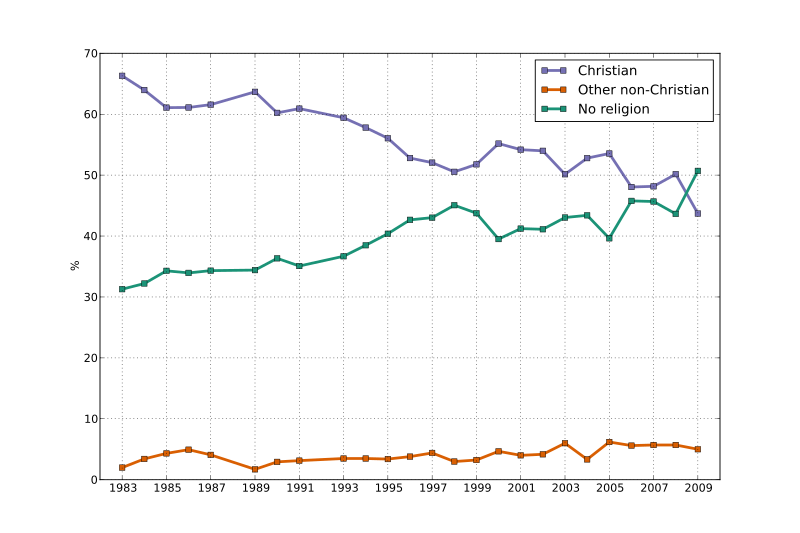
When historians will look back at the 21st century, they’ll refer to it as the century in which religion died and the scientific revolution was completed. I am saying this not despite the battles of ignorance fought by the religious right and fundamentalists’ seeds of violence, but because of them. They fight, with words or with weapons, because they are afraid. And while these fights draw much attention, the number of non-believers is quietly and inevitably rising.
% of Christian, non-Christian religious,
and non-believers, UK, 1983 - 2009.
Source: Wikipedia.

What are they afraid of? They’re afraid of science. And I, I am afraid we have ourselves to blame for that. All we scientists ever do, it seems to me, is to explain how science differs from religion, ignoring the commonalities with science and the benefits that religion brings. Yes, that’s the scientists ignoring the facts.

Scientists aim to develop consistent explanations for the world. They observe and try to understand. Then they try to use what they have learned. They want coherent stories, want to fit the pieces together. They wonder and they seek, they doubt and they improvise. Scientists try and fail, and try again and gradually weave consistent stories to be shared with everybody.

In contrast, many religious stories are not only internally inconsistent, they are also inconsistent with observation and experience. In the best case, they are simply superfluous. Praying does not cure tetanus. The Earth wasn’t created 10,000 years ago. There’s no god sitting on a cloud throwing lightening down on blasphemous bloggers.

Yes, science clashes with religion. We’ve said it often enough.

The human brain excels at finding patterns, solving problems, and developing accurate theories. It abhors inconsistencies so much it will fake facts to remove them. Consciously accepting inconsistency necessitates a constant effort. Religions require the believer to accept these inconsistencies and not to ask. That takes time and energy. Believers must constantly belie themselves. Science doesn’t require you to accept inconsistencies. In fact, it encourages you not to accept them, and thereby frees up all that creative power, the patterns seeking, the story weaving. This clearly speaks for the scientific way. So why are people afraid of science?

They are afraid that science will replace hope with statistical odds, the aurora with equations, and love with oxytocin. They are afraid that science will take the wonder out of life and not give anything back. They are afraid they will have to give up their belief in an immortal soul, in miracle cures, in final answers, and get nothing in return. And we, we’re failing them because we don’t tell them what it is that they get in return.

Almost all scientists I know are atheists. They’re not atheists because they have been rendered unable to believe in God and are now suffering from a meaningless existence. They’re atheists because they don’t need religion. God, as Laplace put it, is an unnecessary hypothesis. And above all, god is a waste of time.

Far from taking the wonder out of human existence, science adds to it. We’re part of nature and science is the only way of understanding our place and our role.

If you’re in love and you read up on what is known on the chemical pathways and neurological activity, far from degrading you to a bundle of synapses, it embeds your love into the course of evolution and the complexity of human culture. If you look at the night sky and know that beyond the Milky Way there are billions of other galaxies, full with solar systems much like our own, your knowledge adds to the wonder. If you are pregnant and you subscribe to one of the dozens of calendars that tells you when your baby’s heart starts beating, how its nervous system develops, and when it is able to hear, then imagine that just 50 years ago you wouldn’t even have gotten an ultrasound image. Now you can have it in 3D. You’re growing a child, in an amazingly intricate and yet virtuously orchestrated process. You’re part of the circle of life. And without science you wouldn’t know much about that circle. You’re part of nature. Enjoy. And don’t forget to take the folic acid.

Religions offer people a community to belong to and a place to go. They offer shared traditions and spiritual guidance. Science doesn’t. Not because we don’t have a community or have nothing to offer. We’re just not letting people know what science has to give, making them believe science will only take away from them. We’re excluding others by not sharing our wonder.

Since the advent of the internet, we’ve gone a long way to making science more human. Scientists speak by themselves and of themselves. But few if any touch ground considered that of religion.

Yalom notes four existential fears: Fear of death, freedom, isolation, and meaninglessness. We all have these fears. They drive many people to religion because it’s the most obvious answer. And while science addresses these fears, scientists shy away from these topics. There are great speakers among the scientists, but most of them preach to the choir of an already scientifically-minded audience. Neil DeGrasse Tyson is one of the few who isn’t afraid crossing this line. He inspires those on both sides. And look how many listen. Carl Sagan did too. I have some more fingers on my hand, tell me who to count.

Most scientists feel awkward if the word “spirituality” is as much as mentioned, and the last thing they want to do is preach. I myself am guilty of course of never writing about living the atheists’ life. I didn’t study physics to be a preacher, and neither did any of my colleagues. So here’s the problem. A communication problem. Who’ll preach the wonders of science to those who most need to hear about them?

Some days ago I buzzed in Jehova’s witnesses thinking it’s DHL. Then I tried to wave them away saying we’re atheists. “Oooh!” said one of the men and raised his arms, pretending to be shocked, “How did this happen?” I asked him what he meant, and he said “Well, one doesn’t get born this way.” He’s wrong of course. We’re all born as atheists. We’re also born being social and in need of each other to talk through our problems. And as long as science doesn’t offer the community that religions provide so effortlessly, as long as scientists stand aloft of spiritual guidance, people will be afraid that their taxes pay scientists to remove the wonder from the world rather than adding to it.

Update: There's an interesting post from Lubos on the topic. He makes some goods points.

Thursday, June 20, 2013

Testing spontaneous localization models with molecular level splitting

Gloria's collapse model.
We in the quantum gravity groups all over the planet search for a unified framework for general relativity and quantum theory. But I have a peripheral interest also in modifications of general relativity and quantum mechanics since altering one of these two ingredients can change the rules of the game. General relativity and quantum mechanics however work just fine as they are, so there is little need to modify them. In fact, modifications typically render them less appealing to the theoretician, for not to say ugly.

Spontaneous localization models for quantum mechanics are, if you ask me, a particularly ugly modification. In these models, one replaces the collapse upon observation in the Copenhagen interpretation by a large number of little localizations that have the purpose of producing eigenstates upon observation. These localizations that essentially focus the spread of the wave-function are built into the dynamics by some stochastic process, and the rate of collapse depends on the mass of the particles (the higher the mass, the higher the localization rate). The purpose of these models is to explain why we measure the effects of superposition, but never a superposition itself, and never experience macroscopic objects in superpositions.

Unfortunately, I have no reason to believe that nature gives a damn what I find ugly or not, and quite possibly you don’t care either. And so, as a phenomenologist, the relevant question that remains is whether spontaneous localization models are a description of nature that agrees with observation.

And, to be fair, on that account spontaneous localization models are actually quite appealing. That is because their effects, or the parameters of the model respectively, can be bounded both from above and below. The reason is that the collapse processes have to be efficient enough to produce eigenstates upon observation, but not so efficient as to wash out the effects of quantum superpositions that we observe.

The former bound on the efficient production of observable eigenstates becomes ambiguous however if you allow for a many worlds interpretation because then you don’t have to be bothered by macroscopic superpositions. Alas, the intersection of the groups of many worlds believers and spontaneous localization believers is an empty set. Therefore, the spontaneous localization approach has a range of parameters with macroscopic superpositions that is “philosophically unsatisfactory,” as Feldman and Tumulka put it in their (very readable) paper (arXiv:1109.6579). In other words, if you allow for a many worlds situation whose main feature is the absence of collapse, then there really is no point to add stochastic localization on top of that. So it’s either-or, and thus requiring absence of macroscopic superpositions bounds possible parameters.

Still, the notion of what constitutes “macroscopic reality” is quite fuzzy. Just to give you an idea of the problem, the estimates by Feldman and Tumulka go along such lines:
“To obtain quantitative estimates for the values [of the model parameters] that define the boundary of the [philosophically unsatisfactory region], we ask under which conditions measurement outcomes can be read off unambiguously... For definiteness, we think of the outcome as a number printed on a sheet of paper; we estimate that a single digit, printed (say) in 11-point font size, consists of 3 x 10¹⁷ carbon atoms or N = 4 x 10¹⁸ nucleons. Footnote 1: Here is how this estimate was obtained: We counted that a typical page (from the Physical Review) without figures or formulas contains 6,000 characters and measured that a toner cartridge for a Hewlett Packard laser printer weighs 2.34 kg when full and 1.54 kg when empty. According to the manufacturer, a cartridge suffices for printing 2 x 10⁴ pages...”
And so on. They also discuss the question whether chairs exist:
“One could argue that the theory actually becomes empirically refuted, as it predicts the nonexistence of chairs while we are sure that chairs exist in our world. However, this empirical refutation can never be conclusively demonstrated because the theory would still make reasonable predictions for the outcomes of all experiments...”
Meanwhile on planet earth, particle physicists calculate next-to-next-to-next-to leading order corrections to the Higgs cross-section.

Sarcasm aside, my main problem with this, and with most interpretations and modifications of quantum mechanics, is that we already know that quantum mechanics is not fundamentally the correct description of nature. That’s why we teach 2nd quantization to students. To make matters worse, most of such modifications of quantum mechanics deal with the non-relativistic limit only. I thus have a hard time getting excited about collapse models. But I’m digressing - we were discussing their phenomenological viability.

In fact, Feldman and Tumulka’s summary of experimental (ie non-philosophic) constraints isn’t quite as mind-enhancing as the nonexistent chair I’m sitting on. (Hard science, my ass.) Some experimental constraints they are discussing: The stochastic process of these models contributes to global warming by injecting energy with each collapse and since there’s some cave in Germany which doesn’t noticeably warm up in July, this gives a constraint. And since we have not heard any “spontaneous bangs” around us that would accompany the collapses in certain parameter ranges, we get another constraint. Then there’s atom interferometry. And then there’s this very interesting recent paper


In this paper the authors calculate how spontaneous localization affects quantum mechanical oscillation between two eigenstates. If you recall, we previously discussed how the observation of such oscillations allows to put bounds on decoherence induced by coupling to space-time foam. For the space-time foam, neutral Kaons make a good system for experimental test. Decoherence from space-time foam should decrease the ability of the Kaons to oscillate into each other. The bounds on parameters are meanwhile getting close to the Planck scale.

For spontaneous localization the effect scales differently with the mass though, and is thus not testable in neutral Kaon oscillation. Since the localization effects get larger with large masses, the authors recommend to instead look for the effects of collapse models in chiral molecules.

Chiral molecules are pairs of molecules with the same atomic composition but with a different spatial arrangement. And some of these molecules can exist in superpositions of such spatial arrangements that can transform into each other. In the small temperature limit, this leads to an observable level splitting in the molecular spectrum. The best known example may be ammonia.

Now if collapse models were correct, then these spatial superpositions of chiral molecules should localize and the level splitting, which is a consequence of superpositions of two eigenstates, become unobservable. The authors estimate that with current measurement precision the bound from molecular level splitting is about comparable to that of atom interferometry (where interference should become unobservable if spontaneous localization is too efficient, thus leading to a bound). Molecular spectroscopy is a presently very active research area and with better resolution and larger molecules, this bound could be improved.

In summary, this nice paper gives me hope that in the soon future we can put the ugly idea of spontaneous localization to rest.

Monday, June 17, 2013

Phenomenological Quantum Gravity

Participants of the 2012 conference on 
Experimental Search for Quantum Gravity.
The search for quantum gravity and a theory of everything captures the public imagination like no other area in theoretical physics. It aims to answer three questions that every two-year old could ask if they would just stop being obsessed with cookies for a minute: What is space? What is time? And what is matter? We know that the answers we presently have to these questions are not fundamentally correct; they are merely approximately correct. And we want to know. We really really want to know. (The cookies. Are out.)

Strictly speaking of course physics will not tell you what reality is but what reality is best described by. Space and time are presently described by Einstein’s theory of general relativity; they are classical entities that do not have quantum properties. Matter and radiation are quantum fields described by the standard model. Yet we know that this cannot be the end of the story because the quantum fields carry energy and thus gravitate. The gravitational field thus must be compatible with the quantum aspects of matter sources. Something has to give, and it is generally expected that a quantization of gravity is necessary. I generally refer to ‘quantum gravity’ as any approach to solve this tension. In a slight abuse of language, this also includes approaches in which the gravitational field remains classical and the coupling to matter is modified.

Quantizing gravity is actually not so difficult. The problem is that the straight-forward, naive, quantization does not give a theory that makes sense as a fundamental theory. The result is said to be non-renormalizable, meaning it is a good theory only in some energy ranges and cannot be taken to describe the very essence of space, time, and matter. There are meanwhile several other, not-so-naïve, approaches to quantum gravity – string theory, loop quantum gravity, asymptotically safe gravity, causal dynamical triangulation, and a handful of others. The problem is that so far none of these approaches has experimental evidence.

This really isn’t so surprising. To begin with, it’s a technically hard problem that has kept some of the brightest minds on the planet occupied for decades. But besides this, returns on investment have diminished with the advent of scientific knowledge. The low hanging fruits have all been picked. Now we have to develop increasingly more complex experiments to find new physics. This takes time, not to mention effort and money. With that, progress slows.

And quantum gravity is a particularly difficult area for experiment. It’s not just a weak force, it’s weaker than the weak force! This grammatical oxymoron is symptomatic of the problem: Quantum effects of gravity are really, really tiny. Most of the time when I estimate an effect, it turns out to be twenty or more orders of magnitude below experimental precision. I’ve sometimes joked I should write a paper on “50 ways one cannot test quantum gravity”, just to make use of these estimates. It’s clearly not a low hanging fruit, and we shouldn’t be surprised it takes time to climb the tree.

Some people have claimed on occasion that the lack of a breakthrough in the area is due to sociological problems in the organization of knowledge discovery. There are indeed problems in the organization of knowledge discovery today. We use existing resources inefficiently, and I do think this hinders progress. But this is a problem which affects all of academia and is not special to quantum gravity.

I think the main reason why we don’t yet know which theory describes gravity in the quantum regime is that we haven’t paid enough attention to the phenomenology.

One reason phenomenological quantum gravity hasn’t gotten much attention so far is that it has long been believed experimental evidence for quantum gravity is inaccessible to experiment (a belief promoted prominently by Freeman Dyson). The more relevant reason is though that in the field of theoretical physics it’s a very peculiar research topic. In all other areas of physics, researchers share either a common body of experimental evidence and aim to develop a good theory. Or they share a theoretical framework and aim to explore its consequences. Phenomenological quantum gravity has neither a shared theory nor a shared set of data. So what can the scientist do in this situation?

Methodology

The phenomenology of quantum gravity proceeds by the development of models that are specifically designed to test for properties of the yet-to-be-found theory of quantum gravity. These phenomenological models are normally extensions of known theories and are developed with the explicit aim of testing for general features. These models do not aim to be fundamental theories on their own.

Examples of such general properties that the fundamental theory might have are: violations or deformations of Lorentz-invariance, additional space-like dimensions, the existence of a minimal length scale or a generalized uncertainty principle, holography, space-time fluctuations, fundamental discreteness, and so on. I discuss a few examples below. If we develop a model that can be constrained by data, we will learn what properties the fundamental theory can have, and which it cannot have. This in turn can serve as guidance for the development of the theory.

In practice, these phenomenological models quantify deviations from general relativity and/or quantum field theory. One expects that the only additional dimensionful scale in these models is the Planck scale, which gives a ‘natural’ range for the expected size of effects in which all dimensionless constants are of order one. The aim is then to find an experiment that is sensitive to this natural parameter range. Since most of these models do not actually deal with quanta of the gravitational field, I prefer to speak more generally of “Planck scale effects” being what we are looking for.

Example: Lorentz-invariance violation

The best known example that demonstrates that effects are measureable even when they are suppressed by the Planck scale are violations of Lorentz-invariance. You expect violations of Lorentz-invariance in models for space-time that make use of a preferred frame that violates observer-independence, for example some regular lattice or condensate that evolves with some special time-slicing.

Such violations of Lorentz-invariance can be described by extensions of the standard model that couple to a time-like vector field and these couplings change the predictions of the standard model. Even though the effects are tiny, many of them are measureable.

The best example is maybe vacuum Cherenkov-radiation: the spontaneous emission of a photon by an electron. This process is normally entirely forbidden which makes it a very sensitive probe. With Lorentz-invariance violation, an electron above a certain energy will start to lose energy by radiating photons. We thus should not receive electrons above this threshold from distant astrophysical sources. From the highest energies of electrons of astrophysical origin that we have measured we can thus derive a bound on the possible violation of Lorentz invariance. This bound is today already (way) beyond the Planck scale, which means that the natural parameter range is excluded.

This shows that we can constrain Planck scale effects even though they are tiny.

Now this is a negative result in the sense that we have ruled out certain properties. But from this we have learned a lot. Approaches which induce such violations of Lorentz-invariance are no longer viable.

Example: Lorentz-invariance deformation

Deformations of Lorentz-invariance have been suggested as symmetries of the ground state of space-time. In contrast to violations of Lorentz-invariance, they do not single out a preferred frame. They generically lead to modifications of the speed of light, which can become energy-dependent.

I have explained a great many times that I think these models are flawed because they bring more problems than they solve. But leaving aside my criticism of the model, it can be experimentally tested. The energy dependence of the speed of light is tiny – a Planck scale effect – but the measurable time-difference adds up over the distance that photons of different energies travel. This is why highly energetic photons from distant gamma ray bursts are presently receiving a lot of attention as possible probes of quantum gravitational effects.

The current status is that we are just about to reach the natural parameter range expected for a Planck scale effect. It is presently a very active research area.

Example: Decoherence induced by space-time foam

If space-time undergoes quantum fluctuations that couple to all matter fields, this may induce decoherence in quantum mechanical oscillations. We discussed this previously in this post. In oscillations of neutral Kaon systems, we are presently just about to reach Planck scale sensitivity.

Misc other examples

There is no lack of creativity in the community! Some other examples of varying plausibility that we have discussed on this blog are Craig Hogan’s quest for holographic noise, Bekenstein’s table-top experiment that searches for Planck-length discreteness, massive quantum oscillators testing Planck-scale modified commutation relations, and searches for evidence for a generalized uncertainty in tritium decay. There is also a vast body of work on leftover quantum gravitational effects from the early universe, captured in various models for string cosmology and loop quantum cosmology, and of course there are cosmic (super) strings. There are further proposed tests for the idea that gravity is just classical (still a little outside the natural parameter range), and suggestions to look for dimensional reduction.

This is not an exhaustive list but just to give you a sense of the breadth of the topics.

Demarcation issues

What counts and what doesn’t count as phenomenological quantum gravity is inevitably somewhat subjective. I do for example not count the beyond the standard model physics of grand unification, though, if you believe in a theory of everything, this might be relevant for quantum gravity. I also don’t count applications of AdS/CFT because these do not describe gravitational systems in our universe, though arguably they are examples for some quantized version of gravity. I also don’t count general modifications of quantum theory or general relativity, though these might of course be very relevant to the problem. I don’t label these phenomenological quantum gravity mostly for practical reasons, not for ideological ones. One has to draw the line somewhere.

Endnote

I often get asked which approach to quantum gravity I believe in. When it comes to my religious affiliation, I’m not only an atheist, I was never Christianized. I have never belonged to any church and I have no intention to join one. The same can be said about my research in quantum gravity. I don’t belong to any church and have never been Christianized. I have on occasion erroneously been called a string theorist and I have been mistaken for working on loop quantum gravity. Depending on the situation, that can be amusing (on a conference) or annoying (in a job interview). For many people it still seems to be hard to understand that the phenomenology of quantum gravity is a separate research area that does not built on the framework of any particular approach.

The aim of my work is to identify the most promising experiments to find evidence for quantum gravity. For that, we need phenomenological models to quantify the effects, and we need to understand the models that we have (for me that includes criticizing them). I follow with interest the progress in various approaches to quantum gravity (presently I’m quite excited about Causal Sets) and I try to develop testable phenomenological models based on these developments. On the practical side, I organize conferences and workshops to bring together theoreticians with experimentalists who have an interest in the topic to stimulate exchange and the generation of new ideas.

What I do believe in, and what I hope the above examples illustrate, is that it is possible for us to find experimental evidence for quantum gravity if we ask the right questions and look in the right places.

Friday, June 14, 2013

Nordita’s First Workshop for Science Writers, Summary

Patrick Sutton
George and I came up with the idea for this workshop one year ago at a reception of an earlier Nordita workshop. Yes, alcohol was involved. We talked about how science writers often feel like they’re running on a treadmill, having to keep up with the frenetic pace of publishing, only seldom getting a chance to take a few days off to gain some broader perspective. And we talked about how researchers too are running on a treadmill, having to keep up with the pace of their colleagues’ publications, and often feel that science writers miss the broader perspective.

And so we set ourselves the goal to get everybody off the treadmill for a few days.

Our “workshop for science writes”, which took place May 27-29, was devised for both, the writers and the physicists: For the writers to hear what topics in astrophysics and cosmology will soon be on the agenda and what science journalists really need to know about them. And for the physicists to share both their knowledge and their motivation, and to caution against common misunderstandings.

We modeled the workshop on “boot camps” organized by the Space Telescope Science Institute, Woods Hole Oceanographic Institute, U.C. Santa Cruz, and other institutions. Our workshop was a very intense and tightly packed meeting, with lectures by experts on selected topics in astrophysics and cosmology, followed by question and answer sessions.

George, wired.
On Tuesday afternoon, we visited the phonetics lab at Stockholm University, which was a fun excursion into a totally different area of science. At the lab, participants could analyze their voice spectra and airflow during speech, and learn the physics behind speech production. They could also take an EEG, which the researchers at the lab use to study which brain areas are involved in language processing and how that changes during infancy.

On Tuesday evening, one of the participants of the workshop, Robert Nemiroff, gave a public lecture at CosmoNova. The fully booked lecture took the audience on a tour through the solar system and beyond, projected on the 17m IMAX screen, while Robert explained the science behind the amazing photos and videos. Besides the stunning images, it was also great to see so many people interested in the laws of physics that shape our universe. (The guy sitting next to me held a copy of Lee Smolin’s new book on his lap which caused me some cognitive dissonance though.)

It was admittedly quite an organizational challenge to find the right level of technical details for an audience that physicists rarely deal with. I think however that the question and answer sessions as well as a large number of breaks were useful for participants to talk to lectures individually. We also had many interesting discussions about the tension between scientific accuracy and popular science writing. As you can guess, I inevitably come down on the side of scientific accuracy.

George turned out to be an excellent organizer, though clearly not used to the physicists compulsive ignorance of deadlines and reminders. I found it quite interesting that when I sent out mass emails to the participants that asked for reply, the first cohort of replies would come almost exclusively from the science writers, frequently within minutes. Among the physicists there were but two who'd answer within 24 hours and meet the deadlines, the rest waited for multiple reminders. The other interesting contrast was that the science writers were considerably more comfortable and engaged with social media.

For me, it was a great pleasure to get to know such an interesting and diverse group of people. I’m neither an astrophysicist nor a cosmologist nor a science writer, and I learned a lot at this workshop - it will probably inspire some more blogposts.

You can find soundbites and links from the meeting on twitter here, and slides of the lectures here.

George Musser, Robert Nemiroff, I, and a bunch of beautiful flowers.

Thursday, June 06, 2013

Quantum gravity phenomenology \neq detecting gravitons

First direct evidence for gravitons.
I’ve never met Freeman Dyson, but I’ve argued with him many times.

Almost every time I give a seminar about my research field, the phenomenology of quantum gravity, I find myself in the bizarre situation of first having to convince the audience that it is a research field. And that even though hundreds of people work on it. I have been organizing and co-organizing a series of conferences on Experimental Search for Quantum Gravity, and in each installment we had to turn away applicants due to space limitations. The arXiv is full with papers on the topic, more than I can keep up with on this blog, and it’s in the popular press more often than I’d like*. Why are my fellow physicists so slow to notice? I make Freeman Dyson responsible for this.

Dyson has popularized the idea that quantum gravity is inaccessible to experiment and thereby discouraged studies of phenomenological consequences of quantum gravity. In a 2004 review of Brian Greene’s book “The Fabric of the Cosmos” he wrote:
“According to my hypothesis [...] the two theories [general relativity and quantum theory] are mathematically different and cannot be applied simultaneously. But no inconsistency can arise from using both theories, because any differences between their predictions are physically undetectable.”
And in a 2012 essay for the Edge Annual Question, he still pushed the idea of quantum gravitational effects being unobservable:
“I propose as a hypothesis... that single gravitons may be unobservable by any conceivable apparatus. If this hypothesis were true, it would imply that theories of quantum gravity are untestable and scientifically meaningless. The classical universe and the quantum universe could then live together in peaceful coexistence. No incompatibility between the two pictures could ever be demonstrated. Both pictures of the universe could be true, and the search for a unified theory could turn out to be an illusion.”
The problem with this argument is that he equates the observation of a single graviton with evidence for a quantization of gravity. But the two are not the same. If single gravitons were unobservable, it would not imply that “theories of quantum gravity are untestable and scientifically meaningless.”

It might indeed be that we will never be able to detect gravitons. One can estimate the probability of detecting gravitons and even with extremely futuristic detectors the size of Jupiter put in orbit around a Newton star, chances would be slim. (See this paper for estimates.) Clearly not an experiment you want to write a grant proposal for.

But we don’t need to detect single gravitons to find experimental evidence for quantum gravity.

Look around. The fact that atoms are stable is evidence for the quantization of the electromagnetic interaction. You don’t need to detect single photons for that. You also don’t need to resolve atomic structures to find evidence for the atomic theory. Brownian motion famously provided this evidence, visible by eye. And Planck introduced what is now known as “Planck’s constant” before Einstein’s Nobel-prize winning explanation for the photoelectric effect.

If we pay attention to the history of physics, it is thus plausible that we can find evidence for quantum gravity without directly detecting gravitons. The quantum theory of gravity might have consequences that we can access in regimes where gravity is weak, as long as we ask the right questions.

Some people have a linguistic problem with calling something a “quantum gravitational effect” if it isn’t actually an effect that directly involves quanta of the gravitational field. This is why I instead often use the expression “Planck scale effects” to refer to effects beyond the standard model that might be signatures of quantum gravity.

Interestingly, Christine recently pointed me to a writeup of a 2012 talk by Freeman Dyson, in which he discusses the possibility of detecting gravitons without jumping to the conclusion that an inability to detect gravitons means that quantum gravity is a subject for philosophers. Instead, Dyson is very careful with stating:
“One hypothesis is that gravity is a quantum field and gravitons exist. A second hypothesis is that the gravitational field is a statistical concept like entropy or temperature, only defined for gravitational effects of matter in bulk and not for effects of individual elementary particles… If a graviton detector is in principle impossible, then both hypotheses remain open.”
A hooray for Dyson!

Unfortunately, there are still other people barking up the same tree, for example by pulling the accelerator argument. For example John Horgan writes:
“String theory, loop-space theory and other popular candidates for a unified theory postulate phenomena far too minuscule to be detected by any existing or even conceivable (except in a sci-fi way) experiment. Obtaining the kind of evidence of a string or loop that we have for, say, the top quark would require building an accelerator as big as the Milky Way.”
Horgan is well known for proclaiming The End of Science, and it seems indeed he’s run out of science when he wrote the above. To begin with, string theory doesn’t “postulate... phenomena,” what would be the point of doing this? It postulates, drums please, strings. And I’m not at all sure what “loop-space theory” is supposed to be. But leaving aside this demonstration of Hogan’s somewhat fuzzy understanding of the subject, if we could build a detector the size of the Milky Way, we’d be able to test very high energies, all right. But that doesn’t mean we can conclude this is the only way to find evidence for quantum gravity.

Luckily Horgan has colleagues who think before they write, like George Musser who put it this way:
“[Q]uantum gravity” and “experiment” are… like peanut butter and chocolate. They actually go together quite tastily.
(I had meant to write a summary of which possible experiments for quantum gravity pheno are presently being discussed and how plausible I think they are to deliver results, but I got distracted by Dyson’s above mentioned paper on graviton detection. The summary will follow some other time. Update: The summary is here.)

*Almost everything I read in the popular press about evidence for quantum gravity is wrong or misleading or both. But then you already knew I would complain about this :p

Monday, June 03, 2013

Why do Science?

I sat down to write a piece explaining why scientific research is essential to our societies and why we should invest in applied and basic science. Then I recalled I don’t believe in free will. This isn’t always easy... So I took out the “should” from the title because it’s not like we have a choice. Evidently, we do science! The question is why? And will we continue?

Natural selection, then and now

Developing accurate theories of nature that allow making predictions about the world are an evolutionary advantage. Understanding our environment and ourselves enables us to construct tools and shape nature to our needs. It makes thus sense that natural selection favors using brains to develop theories of nature.

As it is often the case though, natural selection favored traits that then extend beyond the ones immediately relevant for survival. And so the human brain has become very adept at constructing consistent explanations generally. If we encounter any inconsistency, we mentally chew on it and try to find a solution. This is why we cannot help but write thousands of papers on the black hole information paradox. This is why Dyson’s belief that inconsistencies between quantum mechanics and general relativity will forever remain outside experimental detection does not deter physicists from trying to resolve this inconsistency: It’s nature, not nurture.

In fact, our brain is so eager to create consistent theories that it sometimes does so by denying facts which won’t fit. This is why we are prone to confirmation bias, and in extreme cases paralyzed people deny they are not able to tie their shoes or lift an arm (examples from Ramachandran’s book “Phantoms in the Brain.”)

But leaving aside the inevitable overshooting, evolution has endowed us with a brain that is able and eager to develop consistent explanations. This is why we do science.

The question whether we will continue to do science, and what type of science, is more involved than asking whether scientific thinking has benefitted the reproduction of certain genes. The reason is that we have become so good at using nature to our needs that evolution no longer acts by just selecting the phenotypes best adapted to a given environment. Instead, we can make the environment fit to us.

Today, the major effort of societies is eradicating risks and diseases, optimizing crops and agricultural yields, and developing all kinds of technologies to minimize exposure to natural events. Natural selection of course still proceeds. It’s a process that acts on adaptive systems so generally and unavoidably that Lee Smolin famously uses it to explain the evolution of universes. But what does change is the mechanism that creates the mutations among which the “fittest” has an evolutionary advantage. Since we humans now create large changes on the environment in which we have to survive, the technologies that enable us to make these changes have become part of the random mutations among which selection acts. Backreaction can no longer be neglected.

In other words, natural selection can only act on expressions of genes and ideas together. The innovation provided by scientific progress is now part of the mutations that create species better adapted to the environment.

Applied and basic research

The purpose of scientific research is thus to act as an innovation machine. It enables humans to “fit” better to their environment. This is the case at least for applied research. So what then is the rationale to engage in basic research?

First note that what is usually referred to as “basic research” is rarely “non-applied,” but rather it’s “not immediately applied”. Basic research is commonly pursued on the rationale that it is the precursor of applications in the far future, a future so far that it isn’t yet possible to tell what the application might be. This basic research is necessary to sustain innovation in the long run.

Also note that what is commonly referred to as an “application” doesn’t cover the full scope of innovation that scientific research brings. Scientific insight, especially paradigm shifts, have the potential to entirely reshape the way we perceive of ourselves and our place in the world. This can have major cultural and social impacts that have nothing to do with the development of technologies.

Marxist thought for example has thrived on the belief that we differ only in the chances and opportunities given to us and not by heritable talents that lead to different performances, a fact now known to be scientifically fallacious. Planned economy seems like a good idea if you believe in a clockwork universe in which you can make accurate predictions, an idea that doesn’t seem so good if you know something about chaos theory. Adam Smith’s “invisible hand” is based on the belief that self-organization is natural and leads to desirable outcomes, and we’re only slowly learning the problems in managing risk in complex and highly connected networks. The ongoing change in attitude towards religion is driven by science shining light on inconsistencies in religious storytelling. And many scientists seem to be afraid what it could do to society if people realized that they have no free will. All these are non-technological examples of innovation created by scientific knowledge.

Having said that, we are left to wonder about the scientific research that is neither applied (immediately or in the far future) nor has any other impact on our societies. There very possibly is such research. But we don’t know in advance whether or not a piece of research will become relevant in the future. I previously referred to this research as “knowledge for the sake of knowledge.” Now I am thinking that a better description would have been You-never-know-ledge.

Bottomline

Since we have to manage finite resources on this planet, there is always the question how much energy, time, money, and people to invest into any one human activity for the most beneficial outcome. This is a question which has to be addressed on a case-by-case basis and greatly depends on what is meant with “beneficial”, a word that would bring us back to opinions and “should”s. So the above considerations don’t tell us how much investment into science is enough. But they do tell us that we need continuous investment into scientific research, both applied and basic, to allow mankind to sustain and improve the Darwinian “fit” to the environment that we are changing and creating ourselves.