Pages

Thursday, November 26, 2009

With kisses from Germany

I'm presently in Germany, about to give yet another talk. Yesterday, I had the great idea to get a flu shot with the result that today I feel pretty shitty, like, as if I'm getting the flu. Best conditions to give a seminar. On the upside, I finally managed to get my BlackBerry desktop manager to download the photos I've been taking, so here's some quick blogging.

Yesterday, Stefan and I walked by booths selling Christmas candy and gloves and toys and that stuff. The below photo shows the sign on one of them. It reads "Negerküsse," literally "Negro's kisses." It's a sort of candy, a soft fluffy cream covered by chocolate. They are meanwhile mostly called "chocolate kisses," but occasionally, as you see here, the older word creeps up.


And here's another photo from my BlackBerry. That coffee looked better than it was:

And another image that I found worth taking. This is nearby the parking lot behind the AlbaNova University building

And finally a random shot somewhere in Stockholm during the summer:

Saturday, November 21, 2009

Swedish Research Council requires Open Access

The Swedish Research Council decided some weeks ago that research supported by a grant from their agency has to be made publicly available within 6 months. From the press release:
"To obtain a research grant, the Swedish Research Council now requires researchers to publish their material so as to make it available to all. The public and other researchers should have free access to all material financed by public means.

The thought behind so-called Open Access is that everyone should have free and unrestricted access to scientifically assessed articles. The Research Council has now determined that researchers granted funds by the Authority should publish their scientifically assessed texts in journals and from conferences in this manner.... Researchers will have to guarantee that publications are available according to Open Access within a maximum period of six months."

This requirement is even stronger than that of the US National Institute of Health (NIH), which demands the public has access to the published results of NIH funded research no later than 12 months after publication.

Seems like the Open Access movement has a reason to celebrate :-)

Thursday, November 19, 2009

Causal Diagrams

I once witnessed a physicist explain the universe to an artist. The artist had approached the physicist to learn how to understand extra dimensions, a concept, so he explained, that would undoubtedly enhance the depth of his artwork, and be of great inspirational value for his quest to capture the contextuality of essence. Or maybe essence of contextuality. Or something like that. Either way, the physicist took a piece of chalk and drew a line on the blackboard. "That is our universe," he said. It took several minutes before the artist stopped laughing and said "Now THAT is what I'd call an abstraction."

You see, the fact that our universe is at least 4-dimensional and infinitely large (or damned close to that) creates some problem with visualization. The average blackboard is 2-dimensional, somewhat smaller than infinite, and my female brain already finds 3d plots messy and confusing. Add to this that most physicists aren't particularly great in drawing the universe.

Thus arises the need to picture 4 dimensions in an intuitive and illuminating way. Penrose-Carter diagrams, also called "causal diagrams," do exactly that. Though they do not work for the most general space-times, but only when additional symmetries simplify the scenario, they capture the essence of a 4-dimensional space-time. Or maybe the essence of 4-dimensional contextuality.

Understanding causal diagrams is one of the most basic skills you need if you want to work in General Relativity.
    It works like this.

First, we have the problem of getting 4 dimensions down to 2, where one of the 4 dimensions is time. That's not so complicated. We will assume that space is spherically symmetric, such that when you sit in one point, all directions from that point look similar. This would be the case for example if you sat in the middle of a ball or, to reasonably good precision, if you sat in the middle of the Earth. The only interesting information is then in the change of scenery as a function of the distance from you, who you are sitting in the center of symmetry. We can thus capture the full 3 space dimensions by just considering what happens with the distance to the center of symmetry. This distance is of course just the radial coordinate r. Besides that, we will draw the time-coordinate t, which is usually depicted vertically, whereas r is horizontally. This is shown in the picture below, left. You've seen that before.

An infinitely flat 4-dimensional space-time is then just a half-plane. Note that a flat space is spherically symmetric around every point. (If you want to nitpick, what I mean with "flat" is that the curvature tensor identically vanishes.)

Next thing we do is to notice that if we had a particle moving towards the center of symmetry at r=0, passing through it, and moving away from it again, it would look on the half-plane like a reflection instead. Sometimes we thus mirror the half-plane to the other side, such that the curves of particles just go through. Keep in mind though that r increases in both directions. The world-lines of particles with a fixed velocity move on straight lines in that plane. Don't try to draw curves for particles that do not approach the center radially because the symmetry doesn't allow it. We now adopt the first convention for causal diagrams:
    Light moves on 45° angles.

Curves on which light moves are called "lightlike," or, due to their property of having zero length in a Minkowski-metric, "null curves."

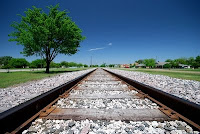
The next step is more tricky, because now we have to deal with the infinitely large space. HowVanishing Point do we get it to fit on a blackboard? If you have ever done perspective drawing, you know the answer already. The "horizon line" and the "vanishing points" depict the infinite distance on a finite sheet of paper. The price to pay is that what is equally spaced far away, moves closer and closer together on the 2-dimensional picture. An example is the photo with railroad tracks to the right.

To draw a picture of an infinite space-time, we do exactly the same: we make infinity finite by squeezing together what is far away. Since the space-time is infinite in more than one direction an additional assumption is that we
    Squeeze infinity equally in all directions.

The resulting squeeze is also called a "conformal transformation," and has the merit of preserving angles, such that most importantly null curves still move on 45°, no matter which Tangent Functionsuch transformation you used. There are many different squeezes, though qualitatively they look all similar. An example for an often used squeeze is the tangent function in the interval [-π/2,π/2], shown to the left. If you take equal spaces on the vertical axis, the corresponding values on the horizontal axis produce a no longer evenly spaced representation of that infinite vertical axis.

If we now go and squeeze our flat space-time what we get is a diamond.


In this diagram, spacelike curves always have angles less than 45°, and timelike curves on which particles can move have angles more than 45° (in every point). All spacelike curves come from and end in the side corners, called "spacelike infinity," whereas timelike curves all come from the bottom corner and end in the upper corner, called "past timelime infinity" and "future timelike infinity," rspt. Light comes from the lower V-shaped boundary and end at the upper Λ-shaped boundary, called "past null infinity" and "future null infinity." The null infinities are usually denoted with an I in a script font, and are thus for short often called "scri minus" for past null infinity and "scri plus" for future null infinity.

So far so good, but flat Minkowski space is admittedly somewhat boring. Let us thus look at something more interesting. The causal diagram of the maximally analytically extended Schwarzschild-solution, describing a static black hole. You have seen it thousands of times in the header of this website.


It is futile trying to explain how to obtain the diagram without telling you what a metric is and what to do with it, but the big advantage of these diagrams is exactly that you can learn something about the space-time properties without bothering with tensor equations, so let's see.

The first thing you will notice is that the diagram contains regions (A and B) that cannot be connected by any lightlike or timelike curve. This means there is no way to send information from one to the other, and A and B are thus causally disconnected. You will also see that there are two spacelike boundaries on the bottom and top where time- and lightlike curves end without having reached infinity. The spacetime is thus geodesically incomplete or, equivalently, has singularities. The maybe most important property to identify is the boundary of the region from which lightlike curves can reach future null infinity. If not at an infinite distance, this boundary it is called a future event horizon. Similarly, the boundary of the region to which light can be send from past null infinity is a past event horizon. These horizons are always lightlike surfaces.

When you're done thinking, take time to see how pretty it is.

This Schwarzschild-metric does not only depict a black hole in the upper part, which contains a region where no information can ever come out to future infinity, but also a region in the lower part where no information can ever get in from past infinity. That second region is called a white hole. It is however a mathematical artifact since this diagram describes an unrealistic situation: a black hole that has been there since forever and will be there until eternity. In reality, black holes are formed from collapsing matter and later evaporate. We will discuss the more realistic diagram in another post, so stay tuned.

Finally, upon Googling for images I found that somebody else had used the same motivation from perspective drawing that I came up with. Well. If one thousand monkeys hit they keyboard for long enough, they will eventually type the complete Misner, Thorne, Wheeler. Not only once, but an infinite amount of time.

If you arrived here by just scrolling down, shame on you. The minimum amount of information you should take home is that Penrose-Carter diagrams, aka "causal diagrams," are used to depict the causal properties of 4-dimensional space-times with additional symmetries.

Tuesday, November 17, 2009

Thoughts and Experiments

Thought BubbleThe other day I got in an argument over what constitutes a "scientific question," after I invoked thought experiments in an attempt to illuminate some features of a model. Is a question that cannot be tested even in principle a scientific question? And thus, if it isn't, should scientists think about it at all?

Forced to take a point of view, I want to offer the possibly only intelligent words the former German chancellor Helmut Kohl ever uttered "Entscheidend ist, was hinten rauskommt." - "What matters is what comes out in the end."

I don't care very much about somebody's personal philosophy or what -ism they classify themselves under, I care whether it's an approach promising to lead to progress. Discarding a question as unscientific when it concerns extreme, and potentially untestable, limits extends the requirement on a theory to be scientific to the method how to get to a good theory. And with that cuts off frequently used methods, not only thought experiments, but also demanding mathematical consistency in regimes we have not tested. I simply think limiting allowable questions to those practically testable constrains our imagination and thus our opportunity to find answers.

One can certainly take such though experiments and the questions they raise for more important than they are. Steve Giddings for example claims that our failure to solve the black hole information loss paradox is akin to the failure of classical electrodynamics to explain the stability of atoms (see this talk or this paper). Well, the only difference is that Bohr's very existence was evidence for the stability of atoms, whereas we have yet to see a single black hole evaporate. Nevertheless, the information loss problem indicates clearly a lack in our understanding of Nature, and, wanting to understand, physicists have turned it inside-out and upside-down for decades. However, whether that eventually leads to something besides loads of papers yet has to be decided.

A more fruitful though experiment was of course Einstein's chase after a photon. And then one should not neglect that thought experiments are not only inexpensive but also fun.
Brain Stretching

Thursday, November 12, 2009

HIT, the Heidelberg Ion-Beam Therapy Center

Last Monday morning, more cars than usually were crowding the road through the Heidelberg "Neuenheimer Feld" Campus. A parking lot had been reserved for guests, and signs all over the Campus showed the way to a "Press Conference". Later I learned that all this gathering was for the opening ceremony of the Heidelberg Ion-Beam Therapy Center (HIT).

With a background in heavy-ion physics from Frankfurt University, it would have been hard for me not to have heard of this project before: Kind of a large spin-off of the GSI facility near Darmstadt, the Heidelberg Ion-Beam Therapy Center is a dedicated heavy-ion accelerator for deployment in radiotherapy to treat tumours. It is the first medical heavy-ion machine in Europe.

The HIT building in Heidelberg. Source: Photo Gallery of the HIT.
The building, half-buried in the ground to minimise radiation exposure for the environment, houses an ion source, a linear accelerator (LINAC) and a synchrotron with a circumference of 65 metres, which can accelerate protons (hydrogen nuclei), alpha particles (helium nuclei), or nuclei of carbon and oxygen to final energies of 50 to 430 MeV/nucleon. For carbon nuclei with 12 nucleons, this means a maximal energy of 5.16 GeV. This energy corresponds to a bit less than half the rest mass of the carbon nucleus, meaning a gamma factor of 1.45, or motion of the nucleus at 73 percent of the speed of light.

HIT accelerator layout. Source: T. Winkelmann et al., Proceedings of ECRIS08 (PDF).
The HIT facility. Source: Photo Gallery of the HIT.
The heavy-ion beam, which is focussed to a diameter of about a millimetre, is steered by the high energy beam transport (HEBT) system to one of two treatment places, or into a big, pivotable installation of bending magnets, the so-called gantry. The gantry allows the beam to be directed from any direction of a vertical plane into one point.

The HIT gantry. Source: Photo Gallery of the HIT.
At the treatment places, the beam, which is focussed to a diameter of about a millimetre, enters the body of patients, and deposits its energy in tumour cells, thereby corrupting the DNA of the tumour cells and stopping their runaway replication.

Treatment place at the focus of the HIT Gantry. Source: Photo Gallery of the HIT.
What is so special about heavy ions for the treatment of cancer that justifies the construction of a large, highly specialised 120 million Euro facility?

It's an effect discovered in 1904 by the Australian physicists William H. Bragg and Richard D. Kleeman, who studied energy energy deposition of alpha particles from radioactive decays when penetrating matter. To their surprise, and different from gamma rays or X rays, alpha particles deposit their energy predominantly around the end point of their track.

The Bragg peak for carbon ions. From Fokas et al.: "Ion beam radiobiology and cancer: Time to update ourselves", Biochimica et Biophysica Acta 1796 (2009) 216–229.)
On a plot showing energy deposition along the path, this pattern shows up as a curve strongly peaked at the end point, in the so-called Bragg peak. (The Bragg peak should not be confused with the Bragg reflections in X ray scattering, which were discovered by William H. Bragg and his son, William Lawrence, in 1913, winning them the 1915 Nobel Prize in physics.)

This strongly localised energy deposition, along with the sharp focus of the beam, makes heavy ions such as carbon an ideal tool to attack tumour cells while doing as less harm as possible to the surrounding tissue. The penetration depth can be controlled by the ion beam energy. Thus, the ion beam hits its target precisely and transfers an exact dosage of energy to the tumour.

HIT will be used to treat tumours which are deeply situated in the body and can hardly be reached by conventional radiation treatment. Tests at GSI so far have been very promising, and there are good chances that a large part of the about 1300 patients per year who will be treated at HIT eventually can be cured.


  • Web page of the Heidelberg Ion-Beam Therapy Center (HIT)
  • Photo Gallery of the HIT
  • HIT Brochure as PDF file
  • For technical details about the accelerator facility, check out T. Winkelmann et al, "Experience at the Ion Therapy Center (HIT) with two years of continuous ECR ion source operation", Proceedings of ECRIS08, Chicago, IL USA (PDF file).
  • About the costs of HIT, check out e.g O. Jäkel et al.: "On the cost-effectiveness of Carbon ion radiation therapy for skull base chordoma.", Radiotherapy and Oncology 83(2) (2007) 133-8.


Sunday, November 08, 2009

Urban Physics Myths

Stefan and I, we had a good laugh at the LHC baguette. I've been wondering whether the PR department made it up to entertain us while waiting. For the next filler, how about the technician who hung his coat on the regulator for the server-room AC and caused a total system breakdown?

The baguette also brought to mind incidents of beer bottles that occasionally appear in beam pipes, and made me scratch my head about other frequently told physics stories. You know, stories of the sort that typically happened to a friend of a friend.

There is for example the story about the postdoc who got scurvy by living from Snickers and Coke out of vending machines for several months. In some cases, it's pizza and Coke instead. In one version said postdoc was located at Fermilab, in another version at Brookhaven. Nobody ever met that postdoc.

Another story that I've heard in several versions circulates around the organizer of an Italian summer school who we don't want to name for his alleged mafia connections. You see, as the story goes, one of the speakers had his bag stolen at the airport. Mentioning this to the organizer, the bag promptly reappeared the next day. In other versions it's been several pieces of baggage, a purse, or a car. The summer school and the organizer remained the same.

Then there's the story of the student who, in a case of utter frustration, adds a sentence to his thesis offering whoever reads this a beer. Needless to say, the thesis gets accepted and printed with the beer-offer. The conditional statement "if and only if Mike's dog really ate his frog," that Eric Weinstein mentioned is a variation on that theme of the not-even-reading advisor.

Add your story in the comments!

Saturday, November 07, 2009

Experimental Search for Quantum Gravity 2010

I'm organizing a workshop!
will take place July 12-16 at Nordita, in the top intelligent city of the world, beautiful Stockholm, Sweden. This is the 2010 installation of our 2007 PI workshop of which you can find my summary here.

We meanwhile have the website up, and a preliminary list of participants.

The purpose of the workshop is to bring together people who study various possibilities to experimentally test quantum gravity in order to assess these possibilities and encourage discussions. Some topics are:

  • Predictions for existent and planned earth based experiments (accelerators, high-precision measurements), possibly in scenarios with a lowered Planck scale.
  • Cosmological measurements: signatures from the universe's early quantum phase (in the cosmic microwave/neutrino/graviton background, large and small scale structure)
  • Astrophysical measurements: cosmic rays, gamma-ray bursts, supernovae.
  • Quantum effects caused by space-time fuzziness (decoherence), status and proposals for experiments.
  • Miscellaneous and other (emergent gravity, non-locality, etc.).

Yesterday, I submitted an application for conference support to the Swedish Research Council. (Many thanks to Thomas for helping with a Swedish title!) If this application goes through, most of the grant is meant to support students or postdocs in the early career stages, who have little or no travel grants available. I would really like to give these young researchers the opportunity to participate and learn something about what is still a very young field. So, if you feel addressed, mark the week July 12-16, and send me a note to be put on the waiting list (hossi at nordita dot org).

Since the topic touches on many different fields the workshop is bound to be interesting, and I'm very much looking forward to it.

Wednesday, November 04, 2009

The Waterloo Institute for Complexity & Innovation

Waterloo, Ontario, once named the Top Intelligent Community of the world, home of the Perimeter Institute for Theoretical Physics and the Center Centre for International Governance Innovation, makes another shot at solving all problems of mankind: The Waterloo Institute for Complexity & Innovation (WICI).

Presently in its planning phase, the WICI's is an interdisciplinary effort, located at the University of Waterloo. According to the website, its goals are to
  • Develop a common, transdisciplinary language and methodology and an integrated, coherent theory for the study and pedagogy of complex adaptive systems; and,

  • Apply these tools to stimulate rapid and beneficial innovation that will increase the resilience of complex adaptive systems worldwide – including social, political, economic, and ecological systems – that are currently under threat.

So far, the activities consist of a seminar series, which, innovation etc, has the talks recorded and uploaded to Google videos. You find there, among others, Stuart Kauffman speaking on "The Evolution of Economic Wealth and Innovation," Thomas Homer-Dixon on "Ingenuity Theory: Adaptation Failure and Societal Crisis," and if you have been waiting for a summary of Lee Smolin's last year's q-fin paper, here's his talk on "Symmetries in Economic Models and their Consequences".

Unfortunately, they have forgotten about another complex system currently under threat, the academic system. Which plays a central role for my virtual institute, and that for a good reason.

Tuesday, November 03, 2009

Einstein's Summer House in Caputh

On our way back from Potsdam last week, Stefan insisted we absolutely should stop to see Einstein's summer house in Caputh. Caputh is a small place South-West of Potsdam, located idyllically at the slope of a hill on the lakefront of Schwielowsee ("See" = "Lake"). Thanks to unexpected one-way traffic, an abundance of construction sites, and a malfunctioning railway crossing gate, it took just an hour drive for the five kilometers from Telegraphenberg to Caputh.


Einstein's summer house in Caputh.

In the summer of 1929, Einstein invested his savings in the construction of a small house to spend the summer there, away from busy Berlin. The site, at the border of a forest, offers a great view over the lake and the Brandenburg landscape. Unfortunately, last week this view was hidden in foggy haze. The house is built out of wood, which is uncommon in Germany, and looks very elegant and modern.

The summer house in Caputh is the only of the places where Einstein has lived in Germany that is left. It has been restored a few years ago, and is used today as a location for a variety of lectures and cultural events.

Einstein and his wife spent four summers in Caputh, before they left Germany in December 1932 never to come back. Einstein later said that he never felt more comfortable and at ease than when in Caputh. TIME magazine told its readers in its "People" column of August 31, 1931, that "last week he was vacationing at Caputh near Potsdam, wearing white linen pajamas, no socks, no shoes."


Unfortunately, last week was a bit to chilly to dispense with socks and shoes.


(If you think the photo looks like I have to use a bathroom really urgently, that's exactly correct.)


See also:

  • Website of the Einstein Forum / Einsteinhaus
  • Website of the Initiativkreis Albert-Einstein-Haus Caputh e.V.


  • Sunday, November 01, 2009

    Are you what you are or what?

      “I'm not aware of too many things
      I know what I know, if you know what I mean”
      ~ Edie Brickell
    Some days ago, I received a complimentary issue of PhysicsToday which contained a letter I wrote in reply to an article by David Mermin “What’s Bad About This Habit” (PhysicsToday, May 2009, page 8). Since the article is subscription only, let me briefly summarize what Mermin wrote.

    Mermin comments on the “bad habit of physicists to take their most successful abstractions to be real properties of our world.” He starts with commenting on the reality of the quantum state:
    [T]he recognition that quantum states are calculational devices and not real properties of a system forces one to formulate the sources of that discomfort in more nuanced, less sensational terms. Taking that view of quantum states can diminish the motivation for theoretical or experimental searches for a “mechanism” underlying “spooky actions at a distance” or the “collapse of the wavefunction”—searches that make life harder than it needs to be.
    He then goes on to distinguish between the real and the abstract on the example of quantum field theory

    I hope you will agree that you are not a continuous field of operators on an infinite-dimensional Hilbert space. Nor, for that matter, is the page you are reading or the chair you are sitting in. Quantum fields are useful mathematical tools. They enable us to calculate things.
    and the spacetime continuum
    [S]pacetime is an abstract four-dimensional mathematical continuum of points that approximately represent phenomena whose spatial and temporal extension we find it useful or necessary to ignore. The device of spacetime has been so powerful that we often reify that abstract bookkeeping structure, saying that we inhabit a world that is such a four- (or, for some of us, ten-) dimensional continuum.
    He warns of the consequences of mistaking abstractions for reality
    So when I hear that spacetime becomes a foam at the Planck scale, I don’t reach for my gun. (I haven’t any.) But I do wonder what that foam has to do with the macroscopic events that spacetime was constructed to represent and the macroscopic means we use to locate events.
    (Referring to Stephen Hawking's remark “When I hear of Schrödinger's cat I reach for my gun.”) Mermin concludes with
    Quantum mechanics has brought home to us the necessity of separating that irreducibly real experience from the remarkable, beautiful, and highly abstract superstructure we have found to tie it all together.
    I completely agree with Mermin. One shouldn't mistake mathematical tools for reality, and mixing up both leads to confusions. Our task as physicists is to explain observations and make predictions for experiments, not to unravel the fundamental nature of reality (wink, wink). However, one should not throw out the baby with the bath water. We have a clear goal, but no map telling us how to get there. And while some might find the philosophy of science a waste of time, and others might say taking abstractions too seriously only creates artificial problems, these considerations could contain the clue, or the inspiration, necessary for progress.

    Thus, while I personally am not too enchanted by taking maths to be reality, I think one should not simply dismiss these studies on the basis of gut-feeling. I was therefore put off, not by the actual opinion Mermin expressed, but by it being uninsightful, and - in its polemic way - potentially counterproductive by encouraging shallow argumentations.

    So I wrote the following letter:
    “I hope you will agree,” David Mermin writes, “that you are not a continuous field of operators on an infinite-dimensional Hilbert space. Nor, for that matter, is the page you are reading or the chair you are sitting in.” His comment is a nice example of the logical fallacy known as “appeal to belief”: Most people believe X is true, so X is true. That many people believe they are not operators in Hilbert spaces, believe they do have free will, or do or don’t believe in global warming makes no difference as to whether a statement is true or false. I have no basis on which to decide what I “really” am. And though I personally think any such argument is a waste of time because it can never be decided anyway, and though I am sympathetic to the opinion Mermin expresses, his article dismisses the relevance of both quantum foundations and the philosophy of science out of hand in a rather polemic and not very insightful way.
    Sabine Hossenfelder
    Waterloo, Ontario, Canada

    To which Mermin replies
    Sabine Hossenfelder takes my rhetorical flourish as an attempt to argue, fallaciously, for the truth of that proposition. That was not my intent any more than I intended, by calling attention to the agreement among most of us that the ether is not real, to establish thereby its unreality. Although Hossenfelder takes my column as a shallow, polemical dismissal of both philosophy of science and quantum foundations, I had viewed it as an amateurish attempt to contribute to both disciplines.
    It leaves me to wonder though why Physics Today prints such amateurish attempts. It's like opening a journal on medicine and reading a column proclaiming talking is a bad habit since, I hope you will agree, the human body is not made of words. And then find it explained as being an amateurish contribution to psychology.

    In any case, I will now go act on some wave-functions.

      “Philosophy is the talk on a cereal box
      Religion is the smile on a dog
      I'm not aware of too many things
      I know what I know, if you know what I mean

      Choke me in the shallow waters
      Before I get too deep

      What I am is what I am
      Are you what you are or what?
      ~Edie Brickel, What I am

    Thursday, October 29, 2009

    The Photon and its Cousins

    Two months ago, we reported on a preprint by the Fermi collaboration. Using the observation of the gamma ray burst GRB090510, the authors claimed to have put a limit on a first order energy dependence in the speed of light that would require such an effect to be absent up to an energy scale more than 100 times the Planck scale. In that case, it would have been very implausible any such effect exists, since one would have expected it to set in at the Planck scale, if at all.

    In our earlier post we discussed why this bound they put forward was based on a weak argumentation. The essential point was assuming the highest energy photon had been emitted during a particular late peak in the low energy spectrum. Since that peak almost coincided with the arrival of the photon the resulting bound was very strong. There is however no knowing exactly when the photon was emitted. The most plausible assumption is that it wasn't emitted before the onset of the burst in the low energy regime. This assumption however gives a much weaker bound, pretty much exactly at the Planck scale.

    The paper got now published in Nature, but it is significantly toned down from the original claim. The "most secure and conservative new limit" is at 1.2 times the Planck scale. The limit of 102 times the Planck scale that arises from associating the 31-GeV photon with the 7th spike is still offered, but explained to be "not very secure." Seems to me the referees did a good job...

    The topic even made it into the New York Times. Dennis Overbye writes that 7.3 Billion Light-Years Later, Einstein’s Theory Prevails, and quotes the eternally optimistic Lee Smolin:
    The good news, astronomers said, is that more data expected from Fermi could decide the question. As Lee Smolin, a quantum gravity theorist from the Perimeter Institute for Theoretical Physics in Waterloo, Ontario, said, “So a genuine experimental test of a hypothesized quantum gravity effect is in progress.”

    New Scientist reports on Giovanni Amelino-Camelina's stomach aches, and SymmetryMagazine explains the why and how in a very recommendable article Gamma-ray burst restricts ways to beat Einstein’s relativity.

    For more details, see also our earlier post Constraining Modified Dispersion Relations with Gamma Ray Bursts.

    Wednesday, October 28, 2009

    Science Park "Albert Einstein" Potsdam

    Stefan and I, we were in Potsdam the past few days where I was visiting the Albert-Einstein Institute in Golm. While in the area, we also stopped at the "Science Park" in Potsdam. Potsdam may be more famous for the parks of Sanssouci and other palaces of the Prussian kings but this park, on a hill not far off the city center, is definitly worth a visit when you are interested in the history of science.

    The park has an interesting past: Named "Telegraphenberg" (Telegraph Hill), it originally was the location of a relais station of an optical telegraph system linking Berlin to the Rhine. The park was designed in the second half of the 19th century, when an Astrophysical Observatory and a Geodetic Institute were installed on the hill.


    The park on Telegraph Hill, Potsdam.

    It was here that in 1880, Albert Michelson made his first interference experiment to test the direction-dependence of the speed of light. He was a guest scientist at the physics institute of Hermann von Helmholtz in Berlin at the time, and had to move his sensitive experimental setup to quiet Potsdam to escape the noise and vibrations of street traffic in the capital. Of course, Michelson didn't find any signs of the expected ether drift at the time, and thought of his experiment as a failure. Back to the US, he convinced his colleague Morley to collaborate on an improved experimental setup, and the rest is history.


    The "Michelson Building" on Telegraph Hill, Potsdam.

    The building where Michelson had installed his interferometer in the basement is now called the "Michelson Building", and accommodates the Potsdam Institute for Climate Impact Research.

    The most famous monument on Telegraph Hill in Potsdam is the "Einstein Tower," housing a solar telescope. Designed by expressionist architect Erich Mendelson and financed in parts by Carl Bosch (the same Bosch who built the "Villa Bosch" in Heidelberg I visited last year), it is a cute looking phallus symbol whose scientific purpose was to test the redshift of spectral lines of sunlight in the Sun's gravitational field, one of the predictions of Einstein's theory of General Relativity.


    The "Einstein Tower" solar observatory on Telegraph Hill, Potsdam.

    Also this experiment failed, due to the thermal broadening of spectral lines and the fluctuations of the Sun's surface which, by the Doppler shift, mask the gravitational redshift and form a source of systematic error much higher than originally expected. Evidence for the "Gravitational Displacement of Lines in the Solar Spectrum" eventually came from other observatories, and unambiguous proof of the gravitational redshift finally was provided by the experiments of Rebka and Pound in 1959, using the Mössbauer effect to detect tiny shifts in the gamma ray frequencies of iron nuclei.

    Nevertheless, the Einstein Tower is the only observatory on Telegraph Hill still in use for active research: The solar telescope and spectrographs now serve to study magnetic fields in the Sun's photosphere.


    The building is quite small. A person in the scene, in this photo Stefan, helps to set a scale.

    Directly in front of the Einstein-Tower, I found, to my surprise, a Boltzmann brain popping out of the ground:


    Wikipedia informed us later that the bronze brain with the imprint "3 SEC" was put in place by the artist Volker März in 2002. It is titled "The 3 SEC Bronze Brain – Admonition to the Now – Monument to the continuous present” and symbolizes the scientific thesis that “the experience of continuity is based on an illusion" and that "continuity arises through the networking of contents, which in each case are represented in a time window of three seconds."

    I wonder what Einstein would have thought of that.

    Sunday, October 25, 2009

    Seminar at the Albert-Einstein Institute

    On Friday, I gave a seminar at the Albert-Einstein Institute in Golm, near Potsdam. I won't bother you with the details since it was an only slightly modified version of my last month's seminar in Uppsala. Though the seminar at AEI was well attended - the audience was much larger than I expected - it didn't go very well. Constantly interrupted by questions, I forgot half of what I wanted to say, run out of time, and had to skip some slides. While that wasn't a disaster, it destroyed what I thought would have been a well-balanced and interesting composition for a seminar. Worse than that however, I didn't even manage to answer some of the questions to which I normally would have known the answers. I'm just terribly slow if you put me on the spot. All in all, it wasn't exactly the best seminar I've given, and I hope the audience got something out of it.


    Stefan was also sitting through the seminar. He indeed drove me all the way to Berlin and back, and carried my laptop around. If you're one of those who don't understand why people get married, that's why ;-) While I was trying to locate the secretary at the institute, Stefan took photos of the whole building. It is located on a hill in between fields, and features a closed inner yard (not yet on the google maps photo) with some plants, tables, chairs and of course blackboards.


    The average age of researchers at AEI seems to be much lower than at typical departments. There is also a strong pipeline going from Perimeter Institute to Golm; we met quite a few people I knew from Waterloo. Bianca Dittrich now leads a group on Canonical and Covariant Dynamics of Quantum Gravity, Daniele Oriti has a group on Microscopic Quantum Structure & Dynamics of Spacetime. My former office-mate, James Ryan, is now in Bianca's group, and Florian Girelli, whose desk I had inherited at PI, was visiting.

    All together it is a very lively and active place in the field of Quantum Gravity, and one that will certainly continue to play a leading role.


    Monday, October 19, 2009

    Q2C

    As previously mentioned, Perimeter Institute presently hosts the Quantum to Cosmos festival to celebrate its 10th anniversary. If you're among those who, like me, can't be there in person, you can follow the festival online. Most of the events are recorded by the media partner TVO, and the website is well organized, well maintained, and even looks well designed. I'm totally impressed.

    The event is also covered in the blogosphere by Martin Durrani from PhysicsWorld who is presently Inside the Perimeter and intrigued by BlackBerries and Blackboards. Sean Carroll talked about time and Neil Turok lets us know that Lee Smolin is working on a new book called "The Reality of Time." Yes, it's about time.

    Yesterday evening, Lee lead a very interesting discussion with Neal Stephenson and Jaron Lanier (recording here), on "Seeing Science Through Fiction."


    They talk about the multiverse, virtual reality, music, anti-intellectualism, the propagation of stupidity, and the future of writing. If you have an hour time on your hand, give it a look. I just want to quote a snippet of the discussion that I found very interesting because it ties to something we have discussed here on this blog previously:

    "Jaron, (min 38:40): I think there is a benefit to having encapsulation around intellectual activity [...] The notion that everything should be opened and mixed all the time is not good because then you can't nurture something long enough to really understand it. And I think that's a sort of a mistake that's going on on the internet, there's this notion that creativity only happens if everything is as open as possible...."

    In my post "And how open would you want your science" I made the same point. Maximal connectivity and exchange of ideas is not necessarily beneficial for scientific progress. I argued that too much exchange bears the risk of washing out differences in approaches too early (I referred to that as "thermalization"), and of streamlining ideas before they have reached maturity. Jaron Lanier has a new book coming out, "You Are Not a Gadget." I suppose I should put it on my reading list.

    If you don't have an hour at hand, what you should definitely check out are Alice and Bob in Wonderland. These are one minute comic-clips addressing some essential physics question. Just lovely and definitely worth the one minute :-)

    Friday, October 16, 2009

    Science, Writers, and the Public - A bizarre love triangle

    Some days ago Dennis Overbye wrote an article for the New York Times, titled "The Collider, the Particle and a Theory About Fate," about a paper by Holger-Bech Nielsen and Masao Ninomiya, (that we discussed more than two years ago here). Peter Woit called it Embarrassing Crackpottery, which prompted Sean Carroll to explain the difference between speculation and crackpottery: "they even admit what they’re doing." Tommaso comments. Two days later, Peter informs us that the arXiv has reclassified the related papers to General Physics.

    I meant to simply ignore the whole issue, for I find it quite bizarre. A major daily newspaper reports on an article that hardly anybody in the community cares about, and thereby promotes it to public attention. That in turn annoys those in the community for the reason that it sheds quite an odd light on their own research field. The topic bounces back and forth, thereby only making it seem even more important. We've seen that happening before. Now, yesterday I had an exchange on Facebook on this phenomenon, and I was wondering for your opinion.

    It seems that science journalists quite frequently pick out the craziest ideas, especially in theoretical physics. That in itself isn't so surprising. I have earlier written about the tension between capitalism and science journalism, and how the internet has worsened the situation. Journalists have a need to entertain that is frequently in conflict with the wish to educate. They need a good story, something that creates a reaction. And Overbye's article did that.

    Is that good or bad? At least it's a way that physics does catch people's attention! One could argue any attention is better than no attention. If you follow this blog you know that I don't share this attitude. I think journalism in general should try to create a realistic picture. If that's dull, well, then that's dull. After all, it's journalism, not fiction. And stories like this recent one, entertaining as they are, just present a very distorted picture of the actual research. And that in a time when more than half of the population doesn't know a laser doesn't work by focusing soundwaves. The laser btw currently celebrates its 50th anniversary. 50 years and they still don't know.

    The issue with dullness is that it's relative. Crazy or scary stories create a need of being topped with ever more crazy and scary stories. Unfortunately, we've been running in that spiral for quite a while already. Meanwhile, to excite people you have to tell them at the very least the Earth is about to be destroyed.

    But then you can ask if not the crazy and the scary stories, what should they write about instead in the newspaper? I will admit that most of our research indeed is quite boring and repetitive. It's just small variations on always the same theme. I bet it's the same in your job.

    When I read popular science articles about other fields than physics, the ones that I appreciate most provide a review on a particular research direction. They tell me what the theories are that are being discussed today, what the evidence is, and what the current controversies are about. They tell me what is presently in the minds of the researchers who work in that field. I suppose if you're among these researchers, that's dull. I also suppose if you're a science journalist who has written about the same thing a dozen of times already, that's also dull. But who are you writing for?

    As far as I am concerned, unsolved questions always make good topics. I want to know what's going on at the frontier of research elsewhere. I don't want to know what the crazy outliers do, I want to know what the central problems are. Give me the big picture, give me a basis. If I want to know more details, I'll look for them. Likewise, I would want it to be better communicated why physicists are interested in what they are interested in. And not articles that make it seem like we spend time with things in fact most of us don't care about.

    So, what would you want to see an article in the NYT about?

      "There's no sense in telling me
      The wisdom of a fool won't set you free
      But that's the way that it goes
      And it's what nobody knows
      While every day my confusion grows"

    Tuesday, October 13, 2009

    125 Years of Greenwich Longitude

    The Prime Meridian at Greenwich Observatory (wikipedia)
    We are used today to give the coordinates of a place on Earth using latitude and longitude, indicating longitude in degrees east or west, respectively, of the Greenwich Prime Meridian.

    Thus, for example, the small amateur observatory Sternwarte Peterberg near the place where I did grow up is located exactly 7 degrees east of Greenwich.

    However, looking up the location on historical maps, I don't find this longitude. Actually, the French engineers who around 1800 drew the first detailed topographic maps of the region did measure longitude with respect to the Paris Observatory. Their Prussian successors used the El Heirro Meridian, which goes back to Ptolemy in the 2nd century, and later switched to coordinates centered at Berlin.

    Actually, in the second half of the 19th century, more than a dozen "Prime Meridians" were in use, creating increasing confusion for transport, trade, and communication around the globe.


    Thus, in October 1884, delegates from 25 nations met in Washington, DC, at a conference to determine a prime meridian, which should be used as a universal reference for measuring longitude, and for a universal time. 125 years ago, on October 13, 1884, the "International Meridian Conference held at Washington for the purpose of fixing a Prime Meridian and a Universal Day" resolved
    "That a meridian proper, to be employed as a common zero in the reckoning of longitude and the regulation of time throughout the world, should be a great circle passing through the poles and the centre of the transit instrument at the Observatory of Greenwich."
    and
    "That the Conference proposes to the Governments here represented the adoption of the meridian passing through the transit instrument at the Observatory of Greenwich as the initial meridian for longitude."

    There was one negative vote, and the delegations from Brazil and France abstained from voting. The French delegation led by astronomer Pierre Jules Janssen, the discoverer of helium, had pleaded for keeping the El Heirro Meridian, but it seems that long tables of data, from tonnages of ships to sales figures of nautical charts and almanachs, all using Greenwich as their reference point, convinced most delegates to officially adopt the de-facto standard.

    In 1911, also the French switched to Greenwich longitude and Greenwich time.


    The complete PROTOCOLS OF THE PROCEEDINGS of the International Meridian Conference are available via the Project Gutenberg. The vote on the adoption of Greenwich meridian is reported on page 99.


    Sunday, October 11, 2009

    This and That

    Thursday, October 08, 2009

    Intellectual Elitism? You get what you give.

    The other day I found out Steve Fuller has joined the bloggers! Fuller is a prof for sociology at the University of Warwick, UK, and probably one of the most prominent figures in the realm of the sociology of science, knowledge discovery and management, and something called "social epistemology" (I apologize for my intellectual insufficiency, but I have no clue what that is). His blog is called "Making the university safe for intellectual life in the 21st century."

    Steve Fuller was one of the participants of our last year's conference "Science in the 21st Century," though he could unfortunately only take part via a video link, due to prior commitments. (Worse than that, the recording failed. Shame on the IT staff.) I had been expecting a charming British accent, but as Wikipedia tells us Fuller is actually from the East Coast. He has also been among the advocates of an initiative called "Academics for Academic Freedom," fighting for the right of academics to offend. You see, he has some experience with offending people. Blogging is also an excellent tool to that end.

    Reason why I'm telling you that

    a) I think the man could need some traffic to his blog, so go and give him a welcome to the blogoshpere, and have an eye on his writing. Or go ask him what "social epistemology" is.

    b) He had a post today that briefly touched upon the question of how to measure scientific success (output/impact/whatever), triggered by a comment in this week's THE by Adam Corner, claiming that the "desire to see research prised away from pragmatic objectives risks a return to intellectual elitism."

    "Intellectual elitism" is one of these words that I find offensive. It is frequently used to express the conviction that academics, if there indeed was such a thing as "academic freedom," would not care whether their work was of any use for the society they live in. They would just levitate above the clouds and waste the taxpayer's money. Thus, so the argument, they need to be forced to produce useful outcome, call it "pragmatic objectives". And "useful" needs to be quantified by a metric, in the best case economical, but in any case something that you can put into Excel. You see, if it doesn't end up being something you can buy at Walmart, then what's all the research good for?

    Everybody who has ever in their life had any actual contact with researchers in academia knows that this picture of the academic mindset is completely wrong. Academics do not feel more or less responsibility to contribute to the social good than any other part of our societies. In fact, the more "basic" their research is and thus the more detached from the average persons day-to-day live, the more they are painfully aware their work is not of immediate use, and there is a high risk it will never be of use. That is not a pleasant position to be in. You wouldn't believe how often I have talked to friends and colleagues about this. Some leave academia because they want their work to be of more immediate use. And for those who stay it will be a question that comes back.

    If you need an example, read what Daniel over at Cosmic Variance wrote just yesterday, when he was comparing his work as a physicist to that of economists. He "confess[es] to a certain amount of envy" because, unlike theoretical physics, "what economists do and say really matters, in an immediate and tangible way."

    That is not to say "intellectual elitism" doesn't exist. It surely does. But it's caused by rather than being a reason for social detachment. The "elitism" you see, hear, and frequently criticize on this blog is not more than a forward defense that is amplified by exactly that criticism. It is a difficult job to work on basic research: non-profit, a very very long-term investment of your society, a job that brings a high risk that nothing of what you do will ever be good for anything.

    In addition to that, most of them have to live in an atmosphere where academic research is over and over again discredited as a waste of money. Long-term investments are never easy to justify in politics. It is even worse if your research is hard to communicate to the general public. As a consequence, researchers start telling themselves and everybody else that they are special, and form communities that are to some extend exclusive to enhance their group identity. They might chose to engage in public outreach to better embed their research into our societies and offer their knowledge - to make themselves more useful. And they make jokes about their own irrelevance, as Daniel ends with saying "maybe I’d rather not have to worry about destroying Iceland while looking for a bug in my code."

    But the fact is, those working in academic research are special. "Elitism" isn't a good word though, maybe one should call it "expertism." Academic research differs from other jobs in many ways, but it is certainly not the only job where people feel special. Politicians I guess suffer from a particularly difficult sort of "specialness." Policemen do too. Look at any job-related community, and you'll find some in-group behavior, some commonly shared ideals that they are proud of. Serving the public. Save neighborhoods. What do academics have to be proud of other than their intellectualism?

    The bottomline is, "Intellectual Elitism" is nothing but a word that's being used to justify limiting academic freedom. Or to express anger about not being part of the "elite" community. But the "elitism" that you see is merely a defense by people in a socially difficult position, who have to cope not only with the knowledge that their work and life can eventually be completely useless, but also with constant public criticism. You get what you give.

      "This whole damn world can fall apart
      You'll be ok, follow your heart"
      ~ New Radicals, You get what you give

    Sunday, October 04, 2009

    Soundbites from the Atlanta Conference

    As previously mentioned, I spent the last days on the Atlanta Conference for Science and Innovation Policy. To apply for a talk, one had to submit a paper already in February. At that time, it wasn't clear to me I'd be living in Sweden when the conference actually took place. Flying from Europe to America for only a few days is very exhausting, plus I have to cover expenses myself. But I am glad I went. The conference has been very interesting, I learned a lot, and got useful feedback on my talk.

    It was a very interdisciplinary meeting with a diverse audience. People were here from engineering, over economics, psychology to various disciplines of the social sciences, from institutions outside academia and from funding agencies. And then there was the theoretical physicist. Participants came from all over the world, many from developing countries, since science policies in the developing world was one of the topics on the program. I spoke to a PhD student who studies science policies in Argentina and Chile, esp. their telescope programs, and talked to some people about Neil Turok's initiative AIMS. I learned about a project called ARGO, a truly international project, which maintains an array of floats to measure water temperature and salinity. I've also never been at a conference where the woman to men ration was so close to 1/2.

    It is pretty much impossible to summarize the conference. You will get a good impression of topics if you look at the lists of talks and abstracts, which you find here. What I found somewhat annoying was the high number of parallel sessions, up to 7, which means no matter what you'd miss several of the talks you wanted to hear.

    The organizers also tried out a new sort of session called "roundtables," that for all I can tell worked badly. They took place in one room with, guess, round tables, with about 8 seats each and a different topic for each table. While this created a nice atmosphere for discussion, the catch was that the people leading the discussion (at least at the tables I was) had applied for a talk and only learned two days earlier they were supposed to be on a round table instead. As a result, they just printed and handed out their presentation or, worse, put their laptop on the table and pointed to it. That sort of format might have some potential though if the topics for discussion are chosen differently. It very efficiently bridges the gap between the speaker and the audience.

    I went to a couple of talks on collaboration- and coauthorship networks, both in the scientific community and for patents, investigating the change in these networks over time and the development of new fields or collaborations. These studies in the area of scientometrics are one of the fields at the intersection of the social, natural and computer sciences that have only become possible within the last decade, because data wasn't available or couldn't be handled before that. I find them tremendously interesting, as they tell a lot about the process of knowledge discovery with the prospect to better understand which conditions are beneficial or counterproductive. Needless to say, funding agencies have a certain interest in this research and in fact, some of these studies were commissioned by the NSF.

    Also here was Bela Nagy from the Santa Fe Institute, who spoke about Comparing forecasts of technological progress. I missed the first half of his talk, but he set up an open database at pcdb.santafe.edu where you can download or play with the data he analyzed yourself. You can also upload your own data. You find an introduction to his research on YouTube.

    Some instances were very amusing. For example, in a panel discussion the first day one of the speakers, Caroline Wagner from SRI International, began with saying she recently heard on the Science Channel that we live in a world with 11 dimensions. Then she compared that to the "multidimensonality" in her field of work. She asked the audience how many had heard of these 11 dimensions. From about 200 people, maybe 5 raised their hand.

    Another speaker, Diana Hicks, renamed normal- and power-law distributions into "hill" and "pipe" distributions, explaining that a quarter pipe is the only real world example for a power law that she could find. Since the curve of said pipe actually falls to zero at a finite value, and certainly has no "fat tail" of any sort, it was somewhat unwillingly comic. In any case, the talk raised an interesting question. Hicks pointed out that the relation between the number of scientists and their output is not a normal distribution, but that instead a few scientists (or institutions respectively) are top and carry a load of the output, and then there are a lot who don't contribute much. The question is then whether funding should be distributed proportionally (to any measure of such scientific output), or more equally.

    Besides "power law," other buzzwords of the conference were "vertical disintegration," "transdisciplinarity" and "complex systems." It is amazing how easily one can get a speaker to stumble by simply asking what they mean with "complex." I also learned that what the NSF calls "transformative research" is called "Frontier Science" in Europe. Somebody pointed out in his talk that support of innovation is almost exclusively on the supply side, by funding basic science, and argued that one should stimulate also the demand side. It's an interesting thought. Presently it seems to me the supply- and demand side for basic science is pretty much identical.

    Several people spoke about their initiatives, institutes, or conferences with the purpose to get science policies across to the governments of various countries. What I find puzzling though is how completely disconnected these studies about science policies, collaboration, group dynamics, interdisciplinarity, and so on, are from the researchers who actually work in these fields. This disconnect was one of the reason for our last years' conference on Science in the 21st Century.

    My own talk on "The Marketplace of Ideas" went very well, despite a cold that I seem to have caught on the plane. I will give you a summary later. Listening to my coughing and sneezing, somebody recommended a homeopathic remedy in the coffee break. She would take it before the fist symptoms set in, and it had helped her to avoid getting a cold in the first place several times. Makes one wonder.

    I'm flying back to Sweden tonight, just in time for the announcement of the Nobel Prize.

    Friday, October 02, 2009

    What is ultimately possible in physics?

    Thanks to my jetlag I woke up hours before sunrise, and used the early morning hours to finish my FQXi essay. This years' topic is "What's ultimately possible in physics?" You find the list with submissions here, the deadline is midnight today. I haven't yet had time to look at any of the other essays, but I'll check these out when I'm back from the conference. It promises to be an interesting contest.

    I had pushed the question the contest raised back and forth for a while, and finally came to the conclusion that it cannot be answered. My essay explains the line of thought that lead me to this conclusion. You find my submission on this website, title and abstract below.

    At the Frontier of Knowledge

    At any time, there are areas of science where we are standing at the frontier of knowledge, and can wonder whether we have reached a fundamental limit to human understanding. What is ultimately possible in physics? I will argue here that it is ultimately impossible to answer this question. For this, I will first distinguish three different reasons why the possibility of progress is doubted and offer examples for these cases. Based on this, one can then identify three reasons for why progress might indeed be impossible, and finally conclude that it is impossible to decide which case we are facing.