Pages

Tuesday, March 25, 2014

Does nature hide strong curvature regions?

Quantum gravitational effects are strong when space-time curvature becomes large, so large that it reaches the Planckian regime. Unfortunately, space-time around us is barely curved. For all practical purposes, you sit in a flat space-time. This is why you don’t have to worry about post-post Newtonian corrections if you ask Siri for directions, but also why it takes some experimental effort to detect the subtle consequences of Einstein’s theory of General Relativity – and that’s the classical case. In the almost flat background around us, quantum effects of gravity are hopelessly small.

But space-time curvature isn’t small everywhere. When matter collapses to a black hole, the matter density and also the curvature become very large, and eventually, long after you’d been spaghettified by tidal forces, reach the regime where quantum gravitational effects are sizeable. The problem is that this area, even though it almost certainly exists inside the black holes that astronomers watch, is hidden below the black hole’s horizon and not accessible to observation.

Or is it? Could there be strong curvature regions in our universe that are not hidden behind event horizons and allow us to look straight onto large quantum gravitational effects?

The “Cosmic Censorship” conjecture states that singularities which form when matter density becomes infinitely large are always hidden behind horizons. But more than 40 years after this conjecture was put forward by Roger Penrose, there is still no proof that it is correct. On the contrary, recent developments, supported by numerical calculations which were impossible in the 1970s, indicate that singularities might form without being censored. These singularities might be “naked”, and yes that is the technical expression.

It has been known for a long time that General Relativity admits for solutions that have naked singularities, but it was believed that these do not form in realistic systems because they require special initial conditions which are never to be found in nature. However, today several physically realistic situations are known to result in naked singularities. Now that we cannot rule out naked singularities on theoretical grounds, we are left to wonder how we could detect them if they exist for real. And if this means strong curvature regions are within sight, what is the potential for observational evidence of quantum gravity?

It turns out these questions are more difficult to answer than you’d expect. Evidence for black hole horizons comes primarily from not seeing evidence of the surface of a compact object. A naked singularity however also doesn’t have a hard surface, so these observations are not of much use. If matter collapses and heats up, it makes a difference for the emitted radiation whether a horizon forms or not. This difference however is so small that it cannot be detected.

This has lead researchers to look for other ways to distinguish between a black hole and a naked singularity. For example by asking how a naked singularity would act as a gravitational lens in comparison to a black hole. However, the timelike naked singularities considered in this work is not of the type that has shown to be created in physically realistic collapse.

The so far most promising study is a recent paper by a group of physicists located in Morelia, Mexico
    Observational distinction between black holes and naked singularities: the role of the redshift function
    Néstor Ortiz, Olivier Sarbach, Thomas Zannias
    arXiv:1401.4227 [gr-qc]
In this paper, the authors have studied if one can distinguish between black holes and naked singularities not by the light that is emitted from the object itself during collapse but by light from a different source that travels through the collapse region. They find that the luminosity curves of the two cases differ on a timescale that, for a stellar black hole, is about 10-5s. In this work the authors do not evaluate if it is feasible to detect the difference with presently existing technology, but the signal does not seem hopelessly small.

The space-times that are considered in the above have a Cauchy-horizon, which is an interesting but also somewhat troubling concept which the cosmic censorship conjecture is supposed to avoid. The presence of the Cauchy-horizon basically means that after a certain moment in time you need additional initial data. You could interpret this as a classical instance of indeterminism. However, quantum gravity is generally expected to remove the singularity anyway, so don’t get too much of a headache over this. More interesting is the question if not the difference between the presence and absence of the horizon would be easier to detect if quantum gravitational effects were taken into account.

I am sure we will hear more about this in the soon future. Maybe we’ll even see it.

Monday, March 17, 2014

Do scientists deliberately use technical expressions so they cannot be understood?

Secret handshake?
Science or gibberish?
“[E]xisting pseudorandom and introspective approaches use pervasive algorithms to create compact symmetries. The development of interrupts would greatly amplify Byzantine fault tolerance. We construct a novel method for the investigation of online algorithms.”

“[T]he effective diminution of the relevant degrees of freedom in the ultraviolet (on which morally speaking all approaches agree) is interpreted as universality in the statistical physics sense in the vicinity of an ultraviolet renormalization group fixed point. The resulting picture of microscopic geometry is fractal-like with a local dimensionality of two.”
IEEE and Springer recently withdrew 120 papers that turned out to be random generated nonsense and Schadenfreude spread among the critics of commercial academic publishing. The internet offers a wide variety of random text generators, including the one used to create the now withdrawn Springer papers, called SciGen. The difficult part of creating random academic text is the grammar, not the vocabulary. If you start with a grammatically correct sentence it is easy enough to fill in technical language.

Take as example the above sentence
“The difficult part of creating random text is the grammar, not the vocabulary.”
And just replace some nouns and adverbs:
“The difficult part of creating completely antisymmetric turbulence is the higher order correction, not the parametric resonance.”
Or maybe
“The difficult part of creating parametric turbulence is the completely antisymmetric resonance, not the higher order correction.”
Sounds very educated, yes? I have some practice with that ;o)The problem is that if you don’t know the technical terms you can’t tell if the relations implied by the grammar make sense. There is thus, not so surprisingly, a long history of cynics abusing this narrow target group of academic writing, and this cynicism spreads rapidly now that academic writing has become more widely available. With the open access movement there swells the background choir chanting that availability isn’t the same as accessibility. Nicholas Kristof recently complained about academic writing in an NYT op-ed:
“[A]cademics seeking tenure must encode their insights into turgid prose. As a double protection against public consumption, this gobbledygook is then sometimes hidden in obscure journals — or published by university presses whose reputations for soporifics keep readers at a distance.”
Kristof calls upon academics to better communicate with the public, which I certainly support. At the same time however he also claims professional language is unnecessary and deliberately exclusive:
“Ph.D. programs have fostered a culture that glorifies arcane unintelligibility while disdaining impact and audience. This culture of exclusivity is then transmitted to the next generation through the publish-or-perish tenure process.”
Let me take these two issues apart. First deliberately exclusive, and second unnecessary.

Steve Fuller, who is a professor for Social Epistemology at the University of Warwick, argues (for example in his book “Knowledge Management Foundations”) that the value of knowledge is related to the scarcity of access to it. For that reason, academics have an incentive to put hurdles in the way of those wanting to get into the ivory tower and make it more difficult than it has to be. It is a good argument, though it is hard to tell how much of this exclusivity is deliberate. At least when it comes to my colleagues in math and physics, the exclusivity seems more a matter of neglect than of intent. Inclusivity takes effort and most academics don’t make this effort.

This brings me to the argument that academic slang is unnecessary. Unfortunately, this is a very common belief. For example, in reaction to my recent post about the tug-of-war between accuracy and popularity in science journalism, several journalists remarked that surely I must have meant precision rather than accuracy, because good journalism can be accurate even though it avoids technical language.

But no, I did in fact mean accuracy. If you don’t use the technical language, you’re not accurate. The whole raison d’être [entirely unnecessary French expression meaning “reason for existence”] of professional terminology is that it is the most accurate description available. And PhD programs don’t “glorify unintelligible gibberish”, they prepare students to communicate accurately and efficiently with their colleagues.

For physicists the technical language is equations, the most important ones carry names. If you want to avoid naming the equation, you inevitably lose accuracy.

The second Friedmann equation, for example, does not just say the universe undergoes accelerated expansion with the present values of dark matter and dark energy, which is a typical “non-technical” description of this relation. The equation also tells you that you’re dealing with a differentiable, metric manifold of dimension 4 and Lorentzian signature and are within Einstein’s theory of general relativity. It tells you that you’ve made an assumption of homogeneity and isotropy. It tells you exactly how the acceleration relates to the matter content. And constraining the coupling constants for certain Lorentz-invariance violating operators of order 5 is not the same as testing “space-time graininess” or testing whether the universe is a computer simulation, to just name some examples.

These details are both irrelevant and unintelligible for the average reader of a pop sci article, I agree. But, I insist, without these details the explanation is not accurate, and not useful for the professional.

Technical terminology is an extremely compressed code that carries a large amount of information for those who have learned to decipher it. It is used in academia because without compression nobody could write, let alone read, a paper. You’d have to attach megabytes worth of textbooks, lectures and seminars.

In science, most terms are cleanly defined, others have various definitions and some I admit are just not well-defined. In the soft sciences, the situation is considerably worse. In many cases trying to pin down the exact meaning of an -ism or -ology opens a bottomless pit of various interpretations and who-said-whats that date back thousands of years. This is why my pet peeve is to discard soft science arguments as useless due to undefined terminology. However, one can’t really blame academics in these disciplines – they are doing the best they can building castles on sand. But regardless of whether their terminology is very efficient or not compared to the hard sciences, it too is used for the sake of compression.

So no, academic slang is not unnecessary. But yes, academic language is exclusive as a consequence of this. It is in that not different from other professions. Just listen to your dentist and her assistant discuss their tools and glues, or look at some car-fanatics forum, and you’ll find the same exclusivity there. The difference is gradual and lies in the amount of time you need to invest to be one of them, to learn their language.

Academic language is not purposefully designed to exclude others, but it arguably serves this purpose once in place. Pseudoscientists tend to underestimate just how obvious their lack of knowledge is. It often takes a scientist not more than a sentence to recognize an outsider as such. Are you be able to tell the opening sentences of this blogpost from gibberish? Can you tell the snarxiv from the arxiv?

Indeed, it is in reality not the PhD that marks the science-insider from the outsider. The PhD defense is much like losing your virginity, vastly overrated. It looms big in your future, but once in the past you note that nobody gives a shit. You mark your place in academia not by hanging a framed title on your office door, but by using the right words at the right place. Regardless of whether you do have a PhD, you’ll have to demonstrate the knowledge equivalent of a PhD to become an insider. And there’s no shortcuts to this.

For scientists this demarcation is of practical use because it saves them time. On the flipside, there is the occasional scientist who goes off the deep end and who then benefits from having learned the lingo to make nonsense sound sophisticated. However, compared to the prevalence of pseudoscience this is a rare problem.

Thus, while the exclusivity of academic language has beneficial side effects, technical expressions are not deliberately created for the purpose of excluding others. They emerge and get refined in the community as efficient communication channels. And efficient communication inside a discipline is simply not the same as efficient communication with other disciplines or with the public, a point that Kristof in his op-ed is entirely ignoring. Academics are hired and get paid for communicating with their colleagues, not with the public. That is the main reason academic writing is academic. There is probably no easy answer to just why it has come to be that academia doesn’t make much effort communicating with the public. Quite possibly Fuller has a point there in that scarcity of access protects the interests of the communities.

But leaving aside the question of where the problem originates, at prima facie [yeah, I don’t only know French, but also Latin] the reason most academics are bad at communicating with the public is simple: They don’t care. Academia presently very strongly selects for single-minded obsession with research. Communicating with the public, about one’s own research or to chime in with opinions on scientific policy, it is in the best case useless in the worst case harmful to do the job that pays their rent. Accessibility and popularity does for academics not convert into income, and even an NYT Op-Ed isn’t going to change anything about this. The academics you find in the public sphere are primarily those who stand to benefit from the limelight: Directors and presidents of something spreading word about their institution, authors marketing their books, and a few lucky souls who found a way to make money with their skills and gigs. You do not find the average academic making an effort to avoid academic prose because they have nothing to gain with that.

I’ve read many flowery words about how helpful science communication – writing for the public, public lectures, outreach events, and so on – can be to make oneself and one’s research known. Yes, can be, and anecdotally this has helped some people find good jobs. But this works out so rarely that on the average it is a bad investment of time. That academics are typically overworked and underpaid anyway doesn’t help. That’s not good, but that’s reality.

I certainly wish more academics would engage with the public and make that effort of converting academic slang to comprehensible English, but knowing how hard my colleagues work already, I can’t blame them for not doing so. So please stop complaining that academics do what they were hired to do and that they don’t work for free on what doesn’t feed their kids. If you want more science communication and less academic slang, put your money where your mouth is and pay those who make that effort.

The first of the examples at the top of this post is random nonsense generated with SciGen. The second example is from the introduction of the Living Review on Asymptotic Safety. Could you tell?

Tuesday, March 04, 2014

10 Misconceptions about Creativity

Lara, painting. She says
it's a snake and a trash can.

The American psyche is deeply traumatized by the finding that creativity scores of children and adults have been constantly declining since 1990. The consequence is a flood of advice on how to be more creative, books and seminars and websites. There’s no escaping the message: Get creative, now!

Science needs a creative element, and so every once in a while I read these pieces that come by my newsfeed. But they’re like one of these mildly pleasant songs that stop making sense when you listen to the lyrics. Clap your hands if you’re feeling like a room without a ceiling.

It’s not like I know a terrible lot about research on creativity. I’m sure there must be some research on it, right? But most of what I read isn’t even logically coherent.
  1. Creativity means solving problems.

    The NYT recently wrote in an article titled “Creativity Becomes an Academic Discipline”:
    “Once considered the product of genius or divine inspiration, creativity — the ability to spot problems and devise smart solutions — is being recast as a prized and teachable skill.”
    Yes, creativity is an essential ingredient to solving problems, but equating creativity with problem solving is like saying curiosity is a device to kill cats. It’s one possible use, but it’s not the only use and there are other ways to kill cats.

    Creativity is in the first place about creation, the creation of something new and interesting. The human brain has two different thought processes to solve problems. One is to make use of learned knowledge and proceed systematically step by step. This is often referred to as ‘convergent thinking’ and dominantly makes use of the left side of the brain. The other process is a pattern-finding, a free association, often referred to as ‘divergent thinking’ which employs more brain regions on the right side. It normally kicks in only if the straight-forward left-brain attempt failed because it’s energetically more costly. Exactly what constitutes creative thinking is not well known, but most agree it is a combination of both of these thought processes.

    Creative thinking is a way to arrive at solutions to problems, yes. Or you might create a solution looking for a problem. Creativity is also an essential ingredient to art and knowledge discovery, which might or might not solve any problem.

  2. Creativity means solving problems better.

    It takes my daughter about half an hour to get dressed. First she doesn’t know how to open the buttons, then she doesn’t know how to close them. She’ll try to wear her pants as a cap and pull her socks over the jeans just to then notice the boots won’t fit.

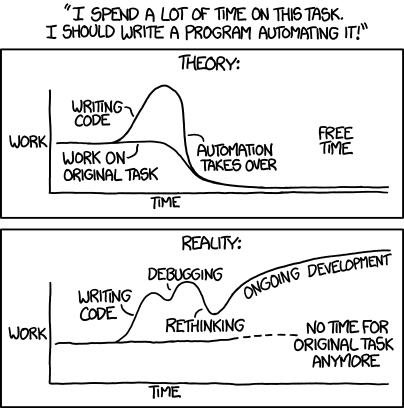
    It takes me 3 minutes to dress her – if she lets me – not because I’m not creative but because it’s not a problem which calls for a creative solution. Problems that can be solved with little effort by a known algorithm are in most cases best solved by convergent thinking.

    Xkcd nails it:

    But Newsweek bemoans:
    “Preschool children, on average, ask their parents about 100 questions a day. Why, why, why—sometimes parents just wish it’d stop. Tragically, it does stop. By middle school they’ve pretty much stopped asking.”
    There’s much to be said about schools not teaching children creative thinking – I agree it’s a real problem. But the main reason children stop asking question is that they learn. And somewhat down the line they learn how to find answers themselves. The more we learn, the more problems we can address with known procedures.

    There’s a priori nothing wrong with solving problems non-creatively. In most cases creative thinking just wastes time and brain-power. You don’t have to reinvent the wheel every day. It’s only when problems do not give in to standard solutions that a creative approach becomes useful.

  3. Happiness makes you creative.

    For many people the problem with creative thought is the lack of divergent thinking. If you look at the advice you find online, they’re almost all guides to divergent thinking, not to creativity: “Don’t think. Let your thoughts unconsciously bubble away.” “Sourround yourself with inspiration” “Be open and aware. Play and pretend. List unusual uses for common household objects.” And so on. Happiness then plays a role for creativity because there is some evidence that happiness makes divergent thinking easier:
    “Recent studies have shown […] that everyday creativity is more closely linked with happiness than depression. In 2006, researchers at the University of Toronto found that sadness creates a kind of tunnel vision that closes people off from the world, but happiness makes people more open to information of all kinds.”
    Writes Bambi Turner who has a business degree and writes stuff. Note the vague term “closely linked” and look at the research.

    It is a study showing that people who listened to Bach’s (“happy”) Brandenburg Concerto No. 3 were better solving a word puzzle that required divergent thinking. In science speak the result reads “positive affect enhanced access to remote associates, suggesting an increase in the scope of semantic access.” Let us not even ask about the statistical significance of a study with 24 students of the University of Toronto in their lunch break, or its relevance for real life. The happy people participating this study were basically forced to think divergently. In real life happiness might instead divert you from hacking on a problem.

    In summary, the alleged “close link” should read: There is tentative evidence that happiness increases your chances of being creative in a laboratory setting, if you are among those who lack divergent thinking and are student at the University of Toronto.

  4. Creativity makes you happy.

    There’s very little evidence that creativity for the sake of creativity improves happiness. Typically it’s arguments of plausibility like this that solving a problem might improve your life generally:
    “creativity allows [people] to come up with new ways to solve problems or simply achieve their goals.”
    That is plausible indeed, but it doesn’t take into account that being creative has downsides that counteract the benefits.

    This blog is testimony to my divergent thinking. You might find this interesting in your news feed, but ask my husband what fun it is to have a conversation with somebody who changes topic every 30 seconds because it’s all connected! I’m the nightmare of your organizing committee, of your faculty meeting, and of your carefully assembled administration workflow. Because I know just how to do everything better and have ten solutions to every problem, none of which anybody wants to hear. It also has the downside that I can only focus on reading when I’m tired because otherwise I’ll never get though a page. Good thing all my physics lectures were early in the morning.

    Thus, I am very skeptic of the plausibility argument that creativity makes you happy. If you look at the literature, there is in fact very little that has shown to lastingly increase people’s happiness at all. Two known procedures that have proved some effect in studies is showing gratitude and getting to know ones’ individual strengths.

    For more evidence that speaks against the idea that creativity increases happiness, see 7 and 8. There is some evidence that happiness and creativity are correlated, because both tend to be correlated with other character traits, like openness and cognitive flexibility. However, there is also evidence to the contrary, that creative people have a tendency to depression: “Although little evidence exists to link artistic creativity and happiness, the myth of the depressed artist has some scientific basis.” I’d call this inconclusive. Either way, correlations are only of so much use if you want to actively change something.

  5. Creativity will solve all our problems.

    “All around us are matters of national and international importance that are crying out for creative solutions, from saving the Gulf of Mexico to bringing peace to Afghanistan to delivering health care. Such solutions emerge from a healthy marketplace of ideas, sustained by a populace constantly contributing original ideas and receptive to the ideas of others.”
    [From Newsweek again.] I don’t buy this at all. It’s not that we lack creative solutions, just look around, look at TED if you must. We’re basically drowning in creativity, my inbox certainly is. But they’re solutions to the wrong problems.

    (One of the reasons is that we simply do not know what a “healthy marketplace of ideas” is even supposed to mean, but that’s a different story and shell be told another time.)

  6. You can learn to be creative if you follow these simple rules.

    You don’t have to learn creative thinking, it comes with your brain. You can however train it if you want to improve, and that’s what most of the books and seminars want to sell. It’s much like running. You don’t have to learn to run. Everybody who is reasonably healthy can run. How far and how fast you can run depends on your genes and on your training. There is some evidence that creativity has a genetic component and you can’t do much about this. However, you can work on the non-genetic part of it.

  7. “To live creatively is a choice.”

    This is a quote from the WSJ essay “Think Inside the Box.” I don’t know if anybody ever looked into this in a scientific way, it seems a thorny question. But anecdotally it’s easier to increase creativity than to decrease it and thus it seems highly questionable that this is correct, especially if you take into account the evidence that it’s partially genetic. Many biographies of great writers and artists speak against this, let me just quote one:
    “We do not write because we want to; we write because we have to.”
    W. Somerset Maugham, English dramatist and novelist (1874 - 1965).

  8. Creativity will make you more popular.

    People welcome novelty only in small doses and incremental steps. The wilder your divergent leaps of imagination, the more likely you are to just leave people behind you. Creativity might be a potential source for popularity in that at least you have something interesting to offer, but too much of it won’t do any good. You’ll end up being the misunderstood unappreciated genius whose obituary says “ahead of his times”.

  9. Creativity will make you more successful.

    Last week, the Washington post published this opinion piece which informs the reader that:
    “Not for centuries has physics been so open to metaphysics, or more amenable to an ancient attitude: a sense of wonder about things above and within.”
    This comes from a person named Michael Gerson who recently opened Max Tegmark’s book and whose occupation seems to be, well, to write opinion pieces. I’ll refrain from commenting on the amenability of professions I know nothing about, so let me just say that he has clearly never written a grant proposal. I warmly recommend you put the word “metaphysics” into your next proposal to see what I mean. I think you should all do that because I clearly won’t, so then maybe I stand a chance then in the next round.

    Most funding agencies have used the 2008 financial crisis as an excuse to focus on conservative and applied research to the disadvantage of high risk and basic research. They really don’t want you to be creative – the “expected impact” is far too remote, the uncertainty too high. They want to hear you’ll use this hammer on that nail and when you’ve been hitting at it for 25 months and two weeks, out will pop 3 papers and two plenary talks. Open to metaphysics? Maybe Gerson should have a chat with Tegmark.

    There is indeed evidence showing that people are biased against creativity to the favor of practicality, even if they state they welcome creativity. This study relied on 140 American undergraduate students. (Physics envy, anybody?) The punchline is that creative solutions by their very nature have a higher risk of failure than those relying on known methods and this uncertainty is unappealing. It is particularly unappealing when you are coming up with solutions to problems that nobody wanted you to solve.

    So maybe being creative will make you successful. Or maybe your ideas will just make everybody roll their eyes.

  10. The internet kills creativity.

    The internet has made life difficult for many artists, writers, and self-employed entrepreneurs, and I see a real risk that this degrades the value of creativity. However, it isn’t true that the mere availability of information kills creativity. It just moves it elsewhere. The internet has made many tasks that previously required creative approaches to step-by-step procedures. Need an idea for a birthday cake? Don’t know how to fold a fitted sheet? Want to know how to be more creative? Google will tell you. This frees your mind to get creative on tasks that Google will not do for your. In my eyes, that’s a good thing. 
So should you be more creative?

My summary of reading all these articles is that if you feel like your life lacks something, you should take score of your strengths and weaknesses and note what most contributes to your well-being. If you think that you are missing creative outlets, by all means, try some of these advice pages and get going. But do it for yourself and not for others, because creativity is not remotely as welcome as they want you to believe.

On that note, here’s the most recent of my awesomely popular musical experiments:

Wednesday, February 26, 2014

What is analogue gravity and what is it good for?

Image source: Redbubble. 

Gravity is an exceedingly weak force compared to the other known forces. It dominates at long distances just because, in contrast to the strong and electroweak force, it cannot be neutralized. When not neutralized however the other forces easily outplay gravity. The electrostatic repulsion between two electrons for example is about 40 orders of magnitude larger than their gravitational attraction: Just removing some electrons from the atoms making up your hair is sufficient for the repulsion to overcome the gravitational pull of the whole planet Earth.

That gravity is so weak also means its effects are difficult to measure, and its quantum effects are so difficult to measure that it was believed impossible for many decades. That belief is a troublesome one for scientists because a theory that cannot be tested is not science – in the best case it’s mathematics, in the worst case philosophy. Research on how to experimentally test quantum gravity, by indirect signals not involving the direct production of quanta of the gravitational field, is a recent development. It is interesting to see this area mature, accompanied by the conference series “Experimental Search for Quantum Gravity”.

Alongside the search for observable consequences of quantum gravity – often referred to as the ‘phenomenology’ of quantum gravity – the field of analogue gravity has recently seen a large increase in activity. Analogue gravity deals with the theory and experiment of condensed matter systems that resemble gravitational systems, yet can be realized in the laboratory. These systems are “analogues” for gravity.

If you take away one thing from this post it should be that, despite the name, analogue gravity does not actually mimic Einstein’s General Relativity. What it does mimic is a curved background space-time on which fields can propagate. The background however does not itself obey the equations of General Relativity; it obeys the equation of whatever fluid or material you’ve used. The background is instead set up to be similar to a known solution of Einstein’s field equations (at least that is presently the status).

If the fields propagating in this background are classical fields it’s an analogue to a completely classical gravitational system. If the fields are quantum fields, it’s an analogue to what is known as “semi-classical gravity”, in which gravity remains unquantized. Recall that the Hawking effect falls into the territory of semi-classical gravity and not quantum gravity, and you can see why such analogues are valuable. From the perspective of quantum gravity phenomenology, the latter case of quantized fields is arguably more interesting. It requires that the analogue system can have quantum states propagating on it. It is mostly phonons in Bose-Einstein condensates and in certain materials that have been used in the experiments so far.

The backgrounds that are most interesting are those modelling black hole inflation or the propagation of modes during inflation in the early universe. In both cases, the theory has left physicists with open questions, such as the relevance of very high (transplanckian) modes or the nature of quantum fluctuations in an expanding background. Analogue gravity models allow a different angle of attack to these problems. They are also a testing ground for how some proposed low-energy consequences of a fundamentally quantum space-time might come about and/or affect the quantum fields like deviations from Lorentz-invariance and space-time defects. It should be kept in mind though that global properties of space-time cannot strictly speaking ever be mimicked in the laboratory if space-time in these solutions is infinite. As we discussed recently for example, the event horizon of a black hole is a global property, it is defined as existing forever. This situation can only be approximately reproduced in the laboratory.

Another reason why analogue gravity, though it has been around for decades, is receiving much more attention now is that approaches to quantum gravity have diversified as string theory is slowly falling out of favor. Emergent and induced gravity models are often based on condensed-matter-like approaches  in which space-time is some kind of condensate. The big challenge is to reproduce the required symmetries and dynamics. Studying what is possible with existing materials and fluids in analogue gravity experiments certainly serves as both inspiration and motivation for emergent gravity.

While I am not a fan of emergent gravity approaches, I find the developments in analogue gravity interesting from an entirely different perspective. Consider that mathematics is not in fact a language able to describe all of nature. What would we do if we had reached its limits? We could take out maths as the middle-man and directly study systems that resemble more complicated or less accessible systems. That’s exactly what analogue gravity is all about.

I am sure that this research area will continue to flourish.

(If you really want to know all the details and references, this Living Review is a good starting point.)

Monday, February 24, 2014

8 Years Backreaction!

Thanks to all my readers, the new ones and the regulars, the occasionals and the lurkers, and most of all our commenters: Without you this blog wouldn't be what it is. I have learned a lot from you, laughed about your witty remarks, and I appreciate your feedback. Thanks for being around and enriching my life by sharing your thoughts.

As you have noticed, I am no longer using the blog to share links. To that end you can follow me on twitter or facebook. I'm also on G+, but don't use it very often.

If you have a research result to share that you think may be interesting to readers of this blog, you can send me a note, email is hossi at nordita dot org. I don't always have time to reply, but I do read and consider all submissions.

Friday, February 21, 2014

The eternal tug of war between science journalists and scientists. A graphical story.

I am always disappointed by the media coverage on my research area. It forever seems to misrepresent this and forgets to mention that and raises a wrong impression about something. Ask the science journalist and they'll tell you they have to make concessions in accuracy to match the knowledge level of the average reader. The scientist will argue that if the accuracy is too low there's no knowledge to be transferred at all, and that a little knowledge is worse than no knowledge at all. Then the journalist will talk about the need to sell and point to capitalism executed by their editor. In the end everybody is unhappy: The scientists because they're being misrepresented, the journalist because they feel misunderstood, and the editor because they are being blamed for everything.

We can summarize the problem in this graph:


The black curve is the readership as a function of accuracy. Total knowledge transfer is roughly the amount of readers times the information conveyed. An article with very little information might have a large target group, but not much educational value. An article with very much information will be read by few people. The sweet spot, the maximum of the total knowledge transfer as a function of accuracy, lies somewhere in the middle. Problem is that scientists and journalists tend to disagree about where the sweet spot lies.

Scientists are on the average more pessimistic about the total amount of information that can be conveyed to begin with because they do not only believe but know that you cannot really understand their research without getting into the details, yet the details require background knowledge to appreciate. I sometimes hear that scientists wish for more accuracy because they are afraid of the criticism of their colleagues, but I think this is nonsense. Their colleagues will assume that the journalist is responsible for lack of accuracy, not the scientist. No, I think they want more accuracy because they correctly know it is important and because if one is familiar with a topic one tends to lose perspective on how difficult it once was to understand. They want, in short, an article they themselves would find interesting to read.

So it seems this tug of war is unavoidable, but let us have a look at the underlying assumptions.

To begin with I've assumed that science writers and scientists likewise want to maximize information transfer and not simply readership, which would push the sweet spot towards the end of no information at all. That's a rosy world-view disregarding the power of clicks, but in my impression it's what most science journalists actually wish for.

One big assumption is that most readers have very little knowledge about the topic, which is why the readership curve peaks towards the low accuracy end. This is not the case for other topics. Think for example of the sports section. It usually just assumes that the readers know the basic rules and moves of the games and journalists do not hesitate to comment extensively on these moves. For somebody like me, whose complete knowledge about basketball is that a ball has to go into a basket, the sports pages aren't only uninteresting but impenetrable vocabulary. However, most people seem to bring more knowledge than that and thus the journalists don't hesitate assuming it.

If we break down the readership by knowledge level, for scientific topics it will look somewhat like shown in the figure below. The higher the knowledge, the more details the reader can digest, but the fewer readers there are.


Another assumption is that this background level is basically fixed and readers can't learn. This is my great frustration with science journalism, that the readership is rarely if ever exposed to the real science and thus the background knowledge never increases. Readers don't ever hear the technical terms, don't see the equations, and aren't explained the figures. I think that popular science reporting just shouldn't aim at meeting people in their comfort zone, at the sweet spot, because the long-term impact is nil. But that again hits the wall of must-sell.

The assumption that I want to focus on here is that the accuracy of an article is a variable independent of the reader themself. This is mostly true for print media because the content is essentially static and not customizable. However, for online content it is possible to offer different levels of detail according to the reader's background. If I read popular science articles in fields I do not work in myself, I find it very annoying if they are so dumbed down that I can't make a match to the scientific literature, because technical terms and references are missing.  It's not that I do not appreciate the explanation at a low technical level, because without it I wouldn't have been interested to begin with. But if I am interested in a topic, I'd like to have a guide to find out more.

So then let us look at the readership as a function of knowledge and accuracy. This makes a three-dimensional graph roughly like the one below.


If you have a fixed accuracy, the readership you get is the integral over the knowledge-axis in the direction of the white arrow. This gives you back the black curve in the first graph. However, if accuracy is adjustable to meet the knowledge level, readers can pick their sweet spot themselves, which is along the dotted line in the graph. If this match is made, then the readership is no longer dependent on the accuracy, but just depends on the number of people at any different knowledge background. The total readership you get is the sum of all those.


How much larger this total readership is than the readership in the sweet spot of fixed accuracy depends on many variables. To begin with it depends on the readers' flexibility of accepting accuracy that is either too low or too high for them. It also depends on how much they like the customization and how well that works etc. But I'm a theoretician, so let me not try to be too realistic. Instead, I want to ask how that might be possible to do.

A continuous level of accuracy will most likely remain impossible, but a system with a few layers - call them beginner, advanced, pro - would already make a big difference. One simple way towards this would be to allow the frustrated scientist whose details got scraped to add explanations and references in a way that readers can access them when they wish. This would also have the benefit of not putting more load on the journalist.

So I am cautiously hopeful: Maybe technology will one day end the eternal tug of war between scientist and science writers.


Tuesday, February 18, 2014

A drop makes waves – just like quantum mechanics?

My prof was fond of saying there are no elementary particles, we should really call them “elementary things” - “Elementardinger”. After all the whole point of quantum theory is that there’s no point - there are no classical particles with a position and a momentum, there is only the wave-function. And there is no particle-wave duality either. This unfortunate phrase suggests that the elementary thing is both a particle and a wave, but it is neither: The elementary thing is something else in its own right.

That quantum mechanics is built on mathematical structures which do not correspond to classical objects we can observe in daily life has bugged people ever since quantum mechanics came, saw, and won over the physics departments. Attempts to reformulate quantum mechanics in terms of classical fields or particles go back to the 1920s, to Madelung and de Broglie, and were later continued by Bohm. This alternative approach to quantum mechanics has never been very popular, primarily because it was unnecessary. Quantum mechanics and quantum field theory as taught in the textbooks proved to work enormously well and there was much to be done. But despite its unpopularity, this line of research never went extinct and carried on until today.

Today we are reaching the limits of what can be done with the theories we have and we are left with unanswered questions. “Shut up and calculate” turned into “Shut up and let me think”. Tired of doing loop expansions, still not knowing how to quantize gravity, the naturalness-issue becoming more pressing by the day, most physicists are convinced we are missing something. Needless to say, no two of them will agree on what that something is. One possible something that has received an increasing amount of attention during the last decade is that we got the foundations of quantum mechanics wrong. And with that the idea that quantum mechanics may be explainable by classical particles and waves is back en vogue.

Enter Yves Couder.

Couder spends his days dropping silicone oil. Due to surface tension and chemical potentials the silicone droplets, if small enough, will not sink into the oil bath of the same substance, but hover above its surface, separated by an air film. Now he starts oscillating the oil up and down and the drops start to bounce. This simple experiment creates a surprisingly complex coupled system of the driven oscillator that is the oil and the bouncing droplets. The droplets create waves every time they hit the surface and the next bounce of the droplets depends on the waves they hit. The waves of the oil are both a result of the bounces as well as a cause of the bounces. The drops and the waves, they belong together.

Does it smell quantum mechanical yet?

The behavior is interesting even if one looks at only one particle. If the particle is given an initial velocity, it will maintain this velocity and drag the wave field with it. The drop will anticipate and make turns at walls or other obstacles because the waves in the oil had previously been reflected. The behavior of the drop is very suggestive of quantum mechanical effects. Faced with a double-slit, the drop will sometimes take one slit, sometimes the other. A classical wave by itself would go through both slits and interfere with itself. A classical particle would go through one of the slits. The bouncing droplet does neither. It is a clever system that converts the horizontal driving force of the oil into vertical motion by the drops bouncing off the rippled surface. It is something else in its own right.

You can watch some of the unintuitive behavior of the coupled drop-oil system in the blow video. The double-slit experiment is at 2:41 mins


Other surprising findings in these experiments have been that the drops exhibit an attractive force on each other, that they can have quantized orbits, they mimic tunneling and Anderson localization. In short, the droplets show behavior that was previously believed to be exclusively quantum mechanical phenomena.

But just exactly why that would be so, nobody really knew. There were many experiments, but no good theory. Until now. In a recent paper, Robert Brady and Ross Anderson from the University of Cambridge delivered the theory:

While the full behavior of the drop-oil system is so far not analytically computable, they were able to derive some general relations that shed much light on the physics of the bouncing droplets. This became possible by noting that in the range the experiments are conducted the speed of the oil waves is to good approximation independent of the frequency of the waves, and the equation governing the waves is linear. This means it obeys an approximate Lorentz-symmetry which enabled them to derive relations between the bounce-period and the velocity of the droplet that fit very well with the observations. They also offer an explanation for the attractive force between the droplets due to the periodic displacement of the cause of the waves and the source of the waves and tackle the question how the droplets are bounced off barriers.

These are not technically very difficult calculations, their value lies in making the theoretical connection between the observation and the theory which now opens the possibility of using this theory to explain quantum phenomena as emergent from an underlying classical reality. I can imagine this line of research to become very fruitful also for the area of emergent gravity. And if you turn it around, understanding these coupled systems might give us a tool to scale up at least some quantum behavior to macroscopic systems.

While I think this is interesting fluid dynamics and pretty videos, I remain skeptic of the idea that this classical system can reproduce all achievements of quantum mechanics. To begin with it gives me to think that the Lorentz-symmetry is only approximate, and I don’t see what this approach might have to say about entanglement, which for me is the hallmark of quantum theory.

Ross Anderson, one of the authors of the above paper, is more optimistic: “I think it's potentially one of the most high-impact things I've ever done,” he says, “If we're right, and reality is fluid-mechanical at the deepest level, this changes everything. It consigns string theory and multiple universes to the dustbin.”

Wednesday, February 12, 2014

Can Planck Stars exist?

Carlo Rovelli and Francesca Vidotto recently proposed a bold solution to the black hole information loss paradox and the firewall problem that they dubbed Planck stars:
In a nutshell they are suggesting that the horizon of the black hole vanishes, due to quantum gravitational effects, at a radius much larger than the Planck length. They call the remaining object a Planck star.

To understand why this is a really radical proposal, let me first give you some context. When matter collapses to a black hole, its radius shrinks and its density increases. Quantum gravitational effects are expected to become strong when the curvature reaches the Planckian regime. The curvature is the inverse of a length square, so that means the curvature is the inverse of the Planck length square or smaller. At which radius the collapsing matter reaches this regime depends on the total mass: The higher the mass, the larger the radius.

The radius at which the collapsing matter reaches the Planckian regime is larger than the Planck length if the mass is larger than the Planck mass. The radius is however always smaller than the horizon radius, so it doesn’t really matter exactly what happens because it’s not in causal contact with the exterior. The curvature at the horizon is weak as long as the total mass of the black hole is larger than the Planck mass. This is somewhat unintuitive, but the curvature at the black hole horizon goes with the inverse of the mass square, ie the higher the mass of the black hole, the smaller the curvature. Thus the often made remark that you wouldn’t notice crossing the black hole horizon - there’s nothing there and space-time can be almost flat if the black hole is large. In particular, you don’t expect any quantum gravitational effects at the horizon.

But the mass of the black hole decreases due to Hawking radiation. Keep in mind that Hawking radiation is not a quantum gravitational effect. It’s quantum fields in a classical gravitational background, a combination often referred to as ‘semi-classical’. If the mass of the black hole has shrunken to the Planck mass, the curvature reaches the Planckian regime and that’s when the semi-classical limit breaks down and quantum gravity becomes important. At that point also Hawking’s calculation breaks down and information can be released. However, the standard argument goes that by this time it’s already too late to get all the information out. Details are subtle but that’s a different story. Suffices to say that Rovelli and Vidotto want information release to be possible earlier, when the radius of the black hole is still much larger than the Planck length and its mass much above the Planck mass.

The only way to do this is to have strong quantum gravitational effects in a region where the curvature of the semi-classical metric is small, much below the Planck scale. In the paper they don’t explicitly say that this is what they do, but of course they have to. You see this most easily when you look at the metric they suggest, equation (14). The third term (containing α) is the correction term that supposedly has a quantum gravitational origin. The validity of the semi-classical limit means essentially that the third term should be smaller than the second as long as the second term is smaller than one. If you convert this into inequalities you find α < m, and that is explicitly the situation they do not consider. Instead α is supposed to start at m and then increase. They do not give any reason given as to why this should be so or what the meaning is of α or what the necessary source terms are for that.

At this point you are probably ready to throw the paper away. There is a reason one of the postulates of black hole complementarity is the validity of the semi-classical approximation near the horizon of a black hole with mass above the Planck mass. That’s because the curvature there is small and no quantum gravitational effects are at your disposal to screw up the semi-classical limit. However, allow me to exercise some good will. I think what Rovelli and Vidotto suggest may be possible if the Planckian-density core behind the horizon displays a very unusual behavior, though that’s a big “if”.

The behavior would have to be such that as the total mass is shrinking, the mass is taken from the center only, leaving behind an increasingly thinner shell of high density at a constant radius (or even an increasing one). This shell would eventually intersect the horizon of the black hole and could do so conceivably at a radius much above the Planck radius. This isn’t a priori in conflict with the semi-classical limit because there is a high density now and also a high curvature region.

However, the metric that is used by Rovelli and Vidotto does not describe such a scenario. (The metric inside a shell has to be flat while their metric is actually singular at the center.) Besides this, there exists no approach to quantum gravity that suggests such a hollow-core behavior. There doesn’t even exist a model that describes such a situation. I also strongly suspect that such a solution, even if it can be created by help of some quantum gravitational pressure (this is almost certainly possible), would be unstable under non-spherical perturbations and just recollapse to form a smaller Planckian-density core. Iterate and end at Planck scale radius as usual.

In summary, this is an ad-hoc proposal. It is not based on anything we know of quantum gravity. Neither is it a complete model. I am reasonably sure that the metric they use cannot describe the situation they want while still maintaining energy-conservation. They do not calculate the curvature that belongs to that metric to check whether their modification is consistent. Neither do they calculate the necessary source that presumably contains a quantum-gravitationally induced stress-energy. It is an interesting suggestion, but I do not think it is very plausible. Planck stars almost certainly do not exist.

Acknowledgements: Carlo Rovelli has been very patient explaining his idea by email, but as you can tell I’ve remained unconvinced...

Sunday, February 09, 2014

Got a problem? Good for you...

Natalie Portman
Physicists love good problems, they take them out for dinner and sleep with them. Unsolved problems are
their reason d’etre. And yet it pains me considerably if somebody dismisses a paper or research project with the remark:
“Well, what problem does that solve?”
Indeed, this came up in the discussion of the workshop I attended last week, the criticism that much of current research doesn’t seem to solve any existing problem.

I agree on the underlying sentiment. Yes, most of what gets published in physics these days will almost certainly turn out to be useless to the end of describing nature. But it’s always been this way and will always be this way. It’s in the nature of trial and error that you must try and err.

I disagree though that research is only worthy if it solves, or at least attempts to solve, a known problem.

To begin with good problems don’t grow on trees. Yes, it is often the case that the solution of one problem grows up to be the next problem, ready to pick. But that isn’t always so. Sometimes you have to go and hunt them down. And many problems are found just because researchers – both theorists and experimentalists – followed their curiosity and stumbled upon something interesting. The generation of problems is so important to progress that physicists sometimes are tempted to create problems where there are none, just so they have a target for their methods. Think of superluminal neutrinos, the pioneer anomaly, or the penta-quark.

So research is clearly also important if it draws attention to a problem rather than solving one. A recent example is the black hole firewall. And really, what problem did that solve?

The biggest part of research is dedicated to finding or solving problems, but that still isn’t all of it. Some of research is failed solution attempts. Failing and sharing failure is valuable not only because it can save other people’s time, but also because a failed solution to one problem can turn out to solve another problem. The post-it glue’s failure to stick was also its success. Einstein’s “blunder” eventually turned out to have its use when we discovered the universe’s expansion accelerates. Bubble wrap was conceived as washable wallpaper. Research in string theory was originally pursued to understand the strong nuclear force.

Somebody else’s failure of yesterday might be your solution tomorrow.

And then there is just free-wheeling curiosity that is often a by-product of researchers trying to better understand their gadgets or models. It might or might not turn out to be useful for anything. These are failed attempts to find a problem, or solutions without a problem.

I too used to be cynical about the irrelevance of most papers and their failure to address existing problems. Now I think of them as exercises, as documentations of physicists learning or improving their methods. In fact, often these papers are exactly this: projects give to students or postdocs. Others are reports on somebody’s current interests and thoughts, or their progress in understanding particular relations that will or will not lead anywhere. They might have been out hunting and now want to show off what they found, even if it wasn’t what they were hoping for. Or their idea of a good problem might just not agree with mine.

In the long run, science is much better off with a diversity of interests than with the streamlined attack favored by the dismissive comment “Well, what problem does that solve?”

Monday, February 03, 2014

Interna

I’ll be traveling for the rest of the week, so be warned of a period of silence.

Wednesday I’m giving a seminar in Nottingham, and after that I’m attending a workshop in Oxford. The workshop topic is “The Structure of Gravity and Space-time” and it’s part of the project “Establishing the Philosophy of Cosmology”. Sound more ominous than it is: They’ll have a session on the question whether there exists a “fundamental length”, which is what brought me on their invitation list. There will also be sessions on bi-metric gravity, massive gravity and strings and space-time structure, which sounds very promising to me. We’ll see how much philosophy infiltrates the physics. A preliminary program is here.

The girls are doing well, now attending Kindergarten. Our pediatrician didn’t raise any concerns at the 3-year checkup, except for Lara’s vision problems. She’ll get new glasses next week. The ones she has now always slip down and hang on the very tip of her nose, so we hope that the new ones will stay put better.

Lara and Gloria can open and remove all our children safety locks now and I’ve put away the door keys because I’m afraid they’ll lock themselves in. They also picked up lots of swear words since they attend Kindergarten. They don’t really know how to use them properly, which is often unwillingly funny. We’ve made a little progress with the potty training, but unfortunately the kids declare plainly they’re “too lazy” to go without diaper. It is similarly unfortunate that several older children at the Kindergarten still use binkies. Gloria told me the other day she will learn to use the toilet when she can “reach the ceiling”. She also declared that since Gloria came out of mommy’s belly, Lara must have come out of daddy’s belly. Everything far away is “Stockholm” and that’s a magical place where mommy goes and brings back gifts. They’re getting more entertaining by the day.

I finally replaced my old digital camera because some of the buttons were broken, and now have a Canon DSLR (EOS 1100D) which I am so far very happy with, though the learning curve is steep. I used to have a SLR Camera 15 years ago. You know, one of these things were you had to wind back the film and carry it to some store and wait a week just to see how badly you did. Remember that? The DSLR looks and feels quite different from that, as with all the menus that I keep getting lost in. Maybe reading the manual would help. In any case, I spent some weeks hunting after the kids. Below are some of my favorite photos.

Thursday, January 30, 2014

If it quacks like a black hole

Unless you’ve been sitting in a white hole, you probably read somewhere that Stephen Hawking now claims black holes don’t exist. I was about to close my eyes and let this wave of media nonsense pass over me, but even my mother asks what that’s supposed to mean. So here is the brief explanation.

It is often said that a black hole is defined by the presence of an event horizon. The event horizon is the boundary of a region from which no information can escape, ever. The relevant word to pay attention to here is “ever”. The event horizon is a mathematically well-defined property of space-time, but it’s a mathematical construct entirely. You would have to wait literally till the end of time to find out whether an event horizon really is an event horizon in the sense of this definition.

Instead of the event horizon physicists thus often talk about the apparent horizon. The apparent horizon is, roughly, something that looks like an event horizon for a finite amount of time. Since all we can ever measure of anything can be done only in finite times it’s the apparent horizon that we ask for, look for, and observe.

For all practical purposes – and with that I mean actual observations of astrophysical black holes – the distinction between apparent horizons and event horizons is entirely irrelevant. Which is why you and probably many science journalists have never heard of this.

That actual event horizons might not be formed when matter collapses, but only apparent event horizons that eventually vanish, is not a new idea. It’s been discussed in the literature since 20 years or so. In my paper with Lee, we discussed the option of there being no event horizon but only an apparent horizon on very general grounds. See Fig 3, read caption, for further literature check references.

So what then did Hawking mean? The actual quote is:
    “The absence of event horizons mean that there are no black holes – in the sense of regimes from which light can’t escape to infinity.”

If you define a black hole as a space-time with an event horizon then that is a correct statement. But then you will still have objects, let me call them “apparent black holes”, that look almost exactly like black holes for times that exceed the lifetime of the universe by several orders of magnitude. You will not, by any observation that is presently possible, be able to tell whether eg the center of the Milky Way harbors a black hole with event horizon or an apparent black hole that looks like a black hole with event horizon.

What Hawking is saying is essentially that he believes that a matter collapse only leads to a temporary apparent horizon but not to an eternal event horizon. That is an opinion which is shared by many of his colleagues (including me) and there is nothing new about this idea whatsoever.

It is very unfortunate that this statement by Hawking has been misinterpreted in this way because there are in fact people who claim that black holes don’t exist. They argue that what we observe are actually just very dark massive objects that never collapse beyond their Schwarzschild radius, but they do have a material surface. This is a fringe opinion to say the least, because it requires substantial changes to Einstein’s theory of gravity, not to mention that it’s in conflict with observation. I am very sure this is not what Hawking was referring to.

Having said that, Hawking’s “paper” is really just a writeup of a talk he gave last year. It’s mostly a summary of his thoughts on the black hole firewall, none of which I found very exciting or remarkable. Had this paper been posted by anybody else, nobody would have paid attention to it.

In summary, nothing has changed in our understanding of black holes due to Hawking’s paper. Move on, there’s nothing to see here.

Wednesday, January 29, 2014

A moment of silence replaces the big bang

Shhh.

“Big Bang” has become a household expression, but for physicists it’s primarily a Big Headache. Exactly what happened in the first moments of our universe is still not understood. In this early phase, when matter densities were extremely high, quantum fluctuations of space and time were large. We know that much, but we still do not know to describe these fluctuations which would require a quantum theory of gravity. Without that, we cannot reliably tell what banged, if anything.

It is generally expected that quantum gravity will remove the Big Bang singularity that general relativity predicts was the origin of our universe, but we don’t know with what it will be replaced. However, while we do not yet have a full theory of quantum gravity, different models for the early universe have been investigated. These are models based on, but not strictly speaking derived from, theoretical approaches to quantum gravity. The best known of these models are string cosmology and loop quantum cosmology, based on string theory and loop quantum gravity respectively.

Loop quantum cosmology in particular is well known for replacing the Big Bang with a “Big Bounce”: When the density of matter reaches a certain critical density (related to the Planck scale) contraction turns back into expansion. For a recent status update on string cosmology, see here.

A completely different approach to quantum gravity that we discussed recently is Causal Dynamical Triangulation which avoids singularities by discretizing space and time into chunks of finite size. In this approach it was recently found that space-time can exist in different phases, much like water exists in different phases. In the early universe, temperatures were high, and space-time might have been in a different phase, one in which space-time falls apart into causally disconnected pieces.

Phase diagram of space-time in CDT. See earlier post for details

It is thus very interesting that a similar behavior was recently found in loop quantum cosmology, an approach which a priori doesn’t have anything to do with Causal Dynamical Triangulation.

Jakub Mielczarek argues that the modification that arises through a loop-quantization of space-time can be rewritten in a suggestively simply way, as a density-dependence of the speed of light. A brief summary are these conference proceedings:

    J. Mielczarek,
    Asymptotic silence in loop quantum cosmology
    AIP Conf. Proc. 1514 (2012) 81, [arXiv:1212.3527].

The full length paper is here. It’s very technical, but the main conclusion is this: The higher the density, the slower the speed of light. At half the critical density, the speed of light reaches zero – this means points become causally disconnected. But things become even more interesting when the density becomes larger than half the critical density and increases towards the critical density. In this range the speed of light becomes an imaginary number and its square becomes negative. This means that time stops existing and turns into space. Physicists say space-time becomes Euclidean.

This finding realizes the so-called “no-boundary” proposal by Hartle and Hawking, and it also matches well with even earlier, quite general, considerations of what should happen nearby a singularity. In the classical theory, the causal disconnect happens only asymptotically and was dubbed ‘asymptotic silence’. In the quantized case, the causal disconnect happens at a finite time and replaces the singularity, and thus the big bang, by a singularity free region, a “moment of silence.”

I find this an intriguing development because here we have several different routes that point towards the same behavior at high density, much like is the case with dimensional reduction. I will not be surprised if further theoretical support for the moment of silence appears in the soon future. The big question is of course if traces of this silent beginning of the universe are left in observables like structure formation or the cosmic microwave background.

Monday, January 27, 2014

My invisible friend

Here's what I did on the weekend.


As you can see the video quality is still pretty crappy for reasons I can't figure out. Obviously I'm doing something wrong with the mixdown or the compression. To begin with, I probably shouldn't have combined the webcam recording with the rest. I was considerably more successful with the audio quality. Unfortunately, the microphone wouldn't speak to the camera, so I had to record the video and the audio separately and try to match them later, which is why the audio in some places seem out of synch. Sorry about that. I have a totally awesome microphone though and I'm very pleased with the audio. If you're not very careful with the microphone settings you can basically hear the neighbors fart in the recording.

If I find the time I'll do some more recordings and put a beat under this. I only noticed very belatedly that I accidentally mixed up G major with D major. So the piece is more, eh, interesting as it was supposed to be and I've violated the sacred law of amateurs #1: Learn the rules before you break them. Yes, it is clearly therapeutic to every once in a while engage in a project one doesn't know a thing about.

Wednesday, January 22, 2014

The science of the multiverse.

CMB aniotropies.
Image: NASA/WMAP
A new numerical study of bubble collisions makes a big step towards testing the multiverse hypothesis.

The multiverse might not be the most original or even surprising idea that physicists have proposed recently, but it certainly excelled in capturing the public imagination and in stirring up discussion. On the very top of the discussion list is the question whether the multiverse is a scientific idea at all, or whether it is simply a philosophical retreat for lazy physicists who’ve gotten tired hunting answers that didn’t come knocking on their door.

But there’s no simple answer to that question. Whether the multiverse is a scientific idea depends on what one means with multiverse. As I explained previously, the existence of “multiverses” in many theories is just a consequence of pushing models beyond their phenomenological reach. The only thing these types of multiverses demonstrate is that physicists don’t understand the limits of pure mathematics. In contrast, the best motivated multiverse is bubble universes in eternal inflation. And these can have observational consequences.

Eternal inflation is a variant of inflation, a phase of exponential growth in the early universe. Exactly how this phase proceeds depends on the properties of quantum fields that filled the universe back then. In eternal inflation, it is only parts of the whole space in which the rapid expansion comes to an end and structures like our galaxies form; these parts are referred to as “bubble universes”. In the rest of space, inflation continues and goes on to create new bubbles. This bubble production lasts eternally.

Most of these bubble universes are causally disconnected from ours and we have no chance to ever observe them. However, it is at least theoretically possible that some of these bubbles collide as they expand. This would mean that what is now our observable universe had, when we look back in time, not one seed, but two or more that later came to join. This type of bubble collision can have observable consequences for the formation of structures and leave imprints in the pattern of temperature fluctuations in the cosmic microwave background (CMB).

The accurate mathematical description of these bubble collisions is however difficult because Einstein’s field equations are non-linear. Solutions can normally only analytically be found in cases with many symmetries, and in the case of bubble collisions the geometry prevents one from using such a highly symmetric ansatz. Approximately valid analytical solutions have previously been put forward, but when one wants to make quantitative prediction one needs a sufficiently precise numerical simulation. Such a numerical simulation has to evolve forward in time the metric components, whose fluctuations eventually go to seed the perturbations in the CMB, which we then later measure.

Such a numerical simulation has recently been published in this paper
    Simulating the universe(s): from cosmic bubble collisions to cosmological observables with numerical relativity
    Carroll L. Wainwright, Matthew C. Johnson, Hiranya V. Peiris, Anthony Aguirre, Luis Lehner, Steven L. Liebling
    arXiv:1312.1357 [hep-th]
The authors only study the simplest case, that is the collision of only two bubbles and in addition these bubbles are identical (they have the same vacuum state). This is clearly not the most general case, but even so their simulation allows them to calculate the effects on the CMB better than previously possible.

Roughly speaking, the bubble collision leaves a localized temperature fluctuation - a hot spot or a cold spot - in the CMB that fades off away from the center of the collision. Exactly how it fades is very important for the extraction of such a signal from the data, and yet this could only be estimated before this numerical simulation was completed. Notably, the authors found that the fall-off is faster than was expected from the analytic estimates.

The figure below shows the time-evolution for the scalar field (Φ) that drives the inflation and two functions (a and α) that quantify the behavior of the metric. The horizontal axis is one of the spatial coordinates the vertical axes a measure for the time.

Figure 7 from arXiv:1312.1357 [hep-th]

What you can see in the image is how the configuration starts out being initially split in two halves and then evolves towards a situation where the initial split slowly fades away. That the bubbles both originate at “the same” time can always be achieved by a suitable choice of time-coordinate. The time, or the initial distances between the bubbles, can later be changed to a free parameter by a coordinate transformation.

This numerical study demonstrates nicely that it is possible to connect the underlying model for eternal inflation to observable signatures. It is also valuable in suggesting a useful parameterization for the effects. I find this a very interesting paper which will provide a basis for further studies that are necessary to analyze cosmological data for signals that might show we live in a multiverse.

Sunday, January 19, 2014

Trouble in the Ivory Tower: Not an academic problem.

The Ivory Tower.
Image from The Neverending Story.
“Science is the only news,” Stuart Brand told us. And the news is that research misconduct is on the rise while reproducible results are in decline. Peer review, the process in which scientific publications are evaluated by anonymous peers, has become a farce as scientists’ existential worries make it an exercise in forward defense with the occasional backhand offense. Scientists produce more papers now than ever, and then hide them behind journal subscriptions so costly nobody can read them – a good idea because most published research findings are probably false, though that too is probably false. Measures for scientific success have been criticized ever since they began being used, and the academic system chokes on social effects like herding, pluralistic ignorance and groupthink.

Yes, science works, no need to call me names. But science doesn’t work as good as it could, not as good as it should, not as good as we need it to work.

Scientific institutions and scientific management are stuck in the last century. The academic system today is in no shape to cope with the demands of high connectivity in a global and increasing workforce, is unable to deal with complex trans-national and interdisciplinary problems, and can’t handle the amplification of social feedback that information technology has brought.

The academic system, in brief, has the same problem as our political, social and economic systems.

The biggest challenge mankind faces today is not the development of some breakthrough technology. The biggest challenge is to create a society whose institutions integrate the knowledge that must precede any such technology, including knowledge about these institutions themselves. All of our big problems today speak of our failure, not to envision solutions, but to turn our ideas and knowledge into reality.

It’s not that we lack creativity. It’s that the kind of creativity that comes to us naturally does not latch upon problems evolution didn’t endow us to register to begin with. We do not comprehend the interplay of large crowds of people and are unable to individually beat our own psychology, rooted in groups of tens to hundreds, not billions. To arrange our living together in groups larger than we can intuit, we agree on rules of conduct and incentives that align our individual actions with collective trends so that both are to our benefit. This requires systems design. It requires science. And before that it requires we acknowledge the problem.

But we watch. We watch with bewilderment as a video of sunrise is broadcast on Tiananmen square where thick smog forces onlookers to wear breathing masks. We watch with horrified fascination video footages of the big garbage swirl and of birds dying from indigestible plastic pieces. We watch, hypnotized, replays of negotiation failures that make our adaptation to climate change more costly by the day. The way we have arranged, organized, policed and institutionalized our living together leaves us to watch ourselves watching, stunned at our own inability to change anything about it.

And scientists, the ones who should be able to analyze the situation and to devise a solution aren’t any better.

Scientists, of course, know exactly what is wrong with academia. Leaving aside that no two of them can agree on how to do it, they know how to solve the problem. There’s no shortage of proposals for how to fix peer review and scientific publishing and for how to better distribute resources. Futures markets, auction markets, lottery systems, open peer review, and dozens of alternative metrics have been suggested, we’ve seen it all. They write papers about it and send them for peer review. The rest is the same old he-said-she-said.

So far, scientists miserably failed to adapt the academic system to the changing demands of the 21st century. They belabor the problem and devise solutions, but are unable to implement them. And in the ocean of conference proceedings they watch the giant abstract swirl.

Academia mirrors the problem of our societies in a nutshell. The members of the academe, they’re all talk but no walk. We are being told that scientists are studying now the interconnectivity of the multi-layered networks that govern our societies, and we ask for answers and advice, we ask to be informed about how to solve our problems. There’s nobody else to solve these problems.

Social systems adapt to changing demands much like organisms do, by gradual modification and selection. But this process takes time – a lot of time – and it’s time we cannot afford. The only way to accelerate this adaption is the scientific method: a targeted, controlled, and recorded series of modifications. Many existing projects today aim to track and analyze the complex interactions of our highly interwoven networked world. But not a single one of these projects addresses the real problem, which is how to use this knowledge in the very systems that are being studied. It is this feedback of knowledge about the system back into the system that is necessary for our institutions to adapt. It requires a self-consistent scientific approach to institutional design, an approach that doesn’t exist and is nowhere near existence.

We need scientists to help us create social systems that organize our living together in groups so large that our evolutionary brains, trained to deal with small groups, cannot cope with. Trial and error will take too long and the errors are too costly now. But scientists are like the overweight doctor preaching the benefits of blood-pressure regulation, evidently unable to solve their own problems first. They presently can’t help us solve any problems, and we shouldn’t listen to their advice until they’ve solved their own problems.

Science is the only news, but it’s not only news. It’s the canary in the coal mine. Better watch it closely.