Pages

Monday, March 28, 2016

Dear Dr. B: What are the requirements for a successful theory of quantum gravity?

“I've often heard you say that we don't have a theory of quantum gravity yet. What would be the requirements, the conditions, for quantum gravity to earn the label of 'a theory' ?

I am particularly interested in the nuances on the difference between satisfying current theories (GR&QM) and satisfying existing experimental data. Because a theory often entails an interpretation whereas a piece of experimental evidence or observation can be regarded as correct 'an sich'.

That aside from satisfying the need for new predictions, etc.

Thank you,

Best Regards,

Noa Drake”

Dear Noa,

I want to answer your question in two parts. First: What does it take for a hypothesis to earn the label “theory” in physics? And second: What are the requirements for a theory of quantum gravity in particular?”

What does it take for a hypothesis to earn the label “theory” in physics?

Like almost all nomenclature in physics – except the names of new heavy elements – the label “theory” is not awarded by some agreed-upon regulation, but emerges from usage in the community – or doesn’t. Contrary to what some science popularizers want the public to believe, scientists do not use the word “theory” in a very precise way. Some names stick, others don’t, and trying to change a name already in use is often futile.

The best way to capture what physicists mean with “theory” is that it describes an identification between mathematical structures and observables. The theory is the map between the math-world and the real world. A “model” on the other hand is something slightly different: it’s the stand-in for the real world that is being mapped by help of the theory. For example the standard model is the math-thing which is mapped by quantum field theory to the real world. The cosmological concordance model is mapped by the theory of general relativity to the real world. And so on.


But of course not everybody agrees. Frank Wilczek and Sean Carroll for example want to rename the standard model to “core theory.” David Gross argues that string theory isn’t a theory, but actually a “framework.” And Paul Steinhardt insists on calling the model of inflation a “paradigm.” I have a theory that physicists like being disagreeable.

Sticking with my own nomenclature, what it takes to make a theory in physics is 1) a mathematically consistent formulation – at least in some well-controlled approximation, 2) an unambiguous identification of observables, and 3) agreement with all available data relevant in the range in which the theory applies.

These are high demands, and the difficulty of meeting them is almost always underestimated by those who don’t work in the field. Physics is a very advanced discipline and the existing theories have been confirmed to extremely high precision. It is therefore very hard to make any changes that improve the existing theories rather than screwing them up altogether.

What are the requirements for a theory of quantum gravity in particular?

The combination of the standard model and general relativity is not mathematically consistent at energies beyond the Planck scale, which is why we know that a theory of quantum gravity is necessary. The successful theory of quantum gravity must achieve mathematical consistencies at all energies, or – if it is not a final theory – at least well beyond the Planck scale.

If you quantize gravity like the other interactions, the theory you end up with – perturbatively quantized gravity – breaks down at high energies; it produces nonsensical answers. In physics parlance, high energies are often referred to as “the ultra-violet” or “the UV” for short, and the missing theory is hence the “UV-completion” of perturbatively quantized gravity.

At the energies that we have tested so far, quantum gravity must reproduce general relativity with a suitable coupling to the standard model. Strictly speaking it doesn’t have to reproduce these models themselves, but only the data that we have measured. But since there is such a lot of data at low energies, and we already know this data is described by the standard model and general relativity, we don’t try to reproduce each and every observation. Instead we just try to recover the already known theories in the low-energy approximation.

That the theory of quantum gravity must remove inconsistencies in the combination of the standard model and general relativity means in particular it must solve the black hole information loss problem. It also means that it must produce meaningful answers for the interaction probabilities of particles at energies beyond the Planck scale. It is furthermore generally believed that quantum gravity will avoid the formation of space-time singularities, though this isn’t strictly speaking necessary for mathematical consistency.

These requirements are very strong and incredibly hard to meet. There are presently only a few serious candidates for quantum gravity: string theory, loop quantum gravity, asymptotically safe gravity, causal dynamical triangulation, and, somewhat down the line, causal sets and a collection of emergent gravity ideas.

Among those candidates, string theory and asymptotically safe gravity have a well-established compatibility with general relativity and the standard model. From these two, string theory is favored by the vast majority of physicists in the field, primarily because it has given rise to more insights and contains more internal connections. Whenever I ask someone what they think about asymptotically safe gravity, they tell me that would be “depressing” or “disappointing.” I know, it sounds more like psychology than physics.

Having said that, let me mention for completeness that, based on purely logical reasoning, it isn’t necessary to find a UV-completion for perturbatively quantized gravity. Instead of quantizing gravity at high energies, you can ‘unquantize’ matter at high energies, which also solves the problem. From all existing attempts to remove the inconsistencies that arise when combining the standard model with general relativity, this is the possibly most unpopular option.

I do not think that the data we have so far plus the requirement of mathematical consistency will allow us to derive one unique theory. This means that without additional data physicists have no reason to ever converge on any one approach to quantum gravity.

Thank you for an interesting question!

Wednesday, March 23, 2016

Hey Bill Nye, Please stop talking nonsense about quantum mechanics.

Bill Nye, also known as The Science Guy, is a popular science communicator in the USA. He has appeared regularly on TV and, together with Corey Powell, produced two books. On Twitter, he has gathered 2.8 million followers, by which he ranks somewhere between Brian Cox and Neil deGrasse Tyson. This morning, a video of Bill Nye explaining quantum entanglement was pointed out to me:


The video seems to be part of a series in which he answers questions from his fans. Here we have a young man by name Tom from Western Australia calling in. The transcript starts as follows:
Tom: Hi, Bill. Tom, from Western Australia. If quantum entanglement or quantum spookiness can allow us to transmit information instantaneously, that is faster than the speed of light, how do you think this could, dare I say it, change the world?

Bill Nye: Tom, I love you man. Thanks for the tip of the hat there, the turn of phrase. Will quantum entanglement change the world? If this turns out to be a real thing, well, or if we can take advantage of it, it seems to me the first thing that will change is computing. We’ll be able to make computers that work extraordinarily fast. But it carries with it, for me, this belief that we’ll be able to go back in time; that we’ll be able to harness energy somehow from black holes and other astrophysical phenomenon that we observe in the cosmos but not so readily here on earth. We’ll see. Tom, in Western Australia, maybe you’ll be the physicist that figures quantum entanglement out at its next level and create practical applications. But for now, I’m not counting on it to change the world.
I thought I must have slept through Easter and it’s already April 1st. I replayed this like 5 times. But it didn’t get any better. So what else can I do but take to my blog in the futile attempt to bring sanity back to earth?

Dear Tom,

This is an interesting question which allows one to engage in some lovely science fiction speculation, but first let us be clear that quantum entanglement does not allow to transmit information faster than the speed of light. Entanglement is a non-local correlation that enforces particles to share properties, potentially over long distances. But there is no way to send information through this link because the particles are quantum mechanical and their properties are randomly distributed.

Quantum entanglement is a real thing, we know this already. This has been demonstrated in countless experiments, and while multi-particle correlations are an active research area, the basic phenomenon is well-understood. But entanglement does not imply a spooky “action” at a distance – this is a misleading historical phrase which lives on in science communication just because it has a nice ring to it. Nothing ever acts between the entangled particles – they are merely correlated. That entanglement might allow faster-than-light communication was a confusion in the 1950s, but it’s long been understood that quantum mechanics is perfectly compatible with Einstein’s theory of Special Relativity in which information cannot be transmitted faster than the speed of light.

No, it really can’t. Sorry about that. Yes, I too would love to send messages to the other side of the universe without having to wait some billion years for a reply. But for all we presently know about the laws of nature, it’s not possible.

Entanglement is the relevant ingredient in building quantum computers, and these could indeed dramatically speed up information processing and storage capacities, hence the effort that is being made to build one. But this has nothing to do with exchanging information faster than light, it merely relies on the number of different states that quantum particles can be brought into, which is huge compared to those of normal computers. (Which also work only thanks to quantum mechanics, but normal computers don’t use quantum states for information processing.)

Now let us forget about the real world for a moment, and imagine what we could do if it was possible to send information faster than the speed of light, even though this is to our best present knowledge not possible. Maybe this is what your question really was?

The short answer is that you are likely to screw up reality altogether. Once you can send information faster than the speed of light, you can also send it back in time. If you can send information back in time, you can create inconsistent histories, that is, you can create various different pasts, a problem commonly known as “grandfather paradox:” What happens if you travel back in time and kill your grandpa? Will Marty McFly be born if he doesn’t get his mom to dance with his dad? Exactly this problem.

Multiple histories, or quantum mechanical parallel worlds, are a commonly used scenario in the science fiction literature and movie industry, and they make for some mind-bending fun. For a critical take on how these ideas hold up to real science, I can recommend Xaq Rzetelny’s awesome article “Trek at 50: The quest for a unifying theory of time travel in Star Trek.

I have no fucking clue what Bill thinks this has to do with harnessing energy from black holes, but I hope this won’t discourage you from signing up for a physics degree.

Dear Bill,

Every day I get emails from people who want to convince me that they have found a way to create a wormhole, harness vacuum energy, travel back in time, or that they know how to connect the conscious mind with the quantum, whatever that means. They often argue with quotes from papers or textbooks which they have badly misunderstood. But they no longer have to do this. Now they can quote Bill The Science Guy who said that quantum entanglement would allow us to harness energy from black holes and to travel back in time.

Maybe you were joking and I didn’t get it. But if it’s a joke, let me tell you that nobody in my newsfeed seems to have found it funny.

Seriously, man, fix that. Sincerely,

B.

Sunday, March 20, 2016

Can we get some sympathy for the nerdy loners please?

“Mommy?”

“What is she doing?” – “She is sitting there.” – “Ye-es. But what is she do-ing?”

“She isn’t doing anything. She is just. Sitting there.”

“How long do we wait?” – “We wait until the clock is 29 and 10.”

I’m sitting there because I have a problem. The problem isn’t that I have children – children who, despite my best efforts, still can’t read the clock. I am sitting there because I have a problem with a differential equation. Actually, several of them.

You’d think two non-stop nagging kids would have cured me from getting eaten up by equations. But they’ve just made me better at zoning out. Hooked on a suitably interesting problem – it’s inevitably something-with-physics – I am basically incommunicable, sometimes for weeks at a time.

Not like that’s news. 20 years ago I was your stereotypical nerd. The student in an oversized hoodie, with glasses and an always overdue haircut. No matter where I went, I dragged around a huge backpack full of books – just in case I had to look up something about that problem I was on. Nobody was surprised I ended up with a PhD in theoretical physics.

I’ve since swapped the hoodies for mommy-wear that doesn’t make it quite as easy for toddlers to hide food in it. I’ve found a way to tie up the mess that is my hair. And I’ve learned to make conversation. Though my attempts at small-talk inevitably seem to start with “I recently read...”

But despite my efforts to hide it, I’m afraid I’m still your stereotypical nerd.

I get often asked if it’s difficult to be one of the few women in a field dominated by men. Yes, sometimes. But leaving aside the inevitable awkwardness that comes with hearing your own voice stand out an octave above everyone else’s, theoretical physics has always been my intellectual home, the go-to place when in need of likeminded people. The stories about the lone genius waiting to be hit by an apple, they didn’t turn me off, they were my aspiration. I just wanted to be left alone solving problems. And for the biggest part I have been left alone.

There’s a price to pay, of course, for wanting to be left alone. Which is that you might be left alone.

Ágnes Móscy is the exact opposite of your stereotypical nerd. She’s as intelligent as artsy, and she dabbles with ease between communities. She seems infinitely energetic and is a wonderful woman, warm and welcoming, cool and clever. In recent years, Ágnes has become very engaged in the good cause of supporting minorities in physics. She has gone about it as you expect of a scientist, with numbers and facts, with data and references, giving lectures and educating her colleagues. I admire her initiative.

I had to say some nice things about Ágnes first because next comes some criticism.

The other day she wrote a piece for Huffpo hitting on the supposed myth of the lonely genius.

I will agree that genius is as word as useless as overused. Nobody really knows what it means, and it has an unfortunate ring of “genetics” to it. That’s unfortunate because a recent study has found evidence that women shy away from fields that are believed to require inborn talent rather than hard work. Then there’s another study which demonstrated that students are more likely to associate “genius” with male professors than with female and black professors. And Ágnes is right of course when she says that most of us in physics aren’t geniuses, whatever exactly you think it means, so why use a label that is neither descriptive nor helpful?

I’d sign a petition to trashcan “genius,” together with “next Einstein.”

Then Ágnes makes a case that the loner in physics is as much a myth as the genius. You won’t be surprised to hear I disagree.

True, scientists always build on other’s work, and once they’ve built, they must tell their colleagues about it. Communication isn’t only a necessary part of research, it’s also the best way to make sure you’re not fooling yourself. That talking to other people about your problems can be useful is a lesson I first had to learn, but even I eventually learned it.

Still, there is a stage of research that remains lonely. That phase in which you don’t really know just what you know, when you have an idea but you can’t put into words, a problem so diffuse you’re not sure what the problem is.

Fields Medalist Michael Atiyah (who I now don’t dare to call a genius because you might think I want to discourage girls from studying math) put it this way in a recent interview with Siobhan Roberts for Quanta Magazine:
“Dreams happen during the daytime, they happen at night. You can call them a vision or intuition. But basically they’re a state of mind—without words, pictures, formulas or statements. It’s “pre” all that. It’s pre-Plato. It’s a very primordial feeling. And again, if you try to grasp it, it always dies. So when you wake up in the morning, some vague residue lingers, the ghost of an idea. You try to remember what it was and you only get half of it right, and maybe that’s the best you can do.”
Tell me how that’s not lonely work.

As I am raising two girls, I am all too aware of occupational stereotypes. Like many academics, my husband and I are fighting the pink/blue divide, the gender segregation that starts already in kindergarten. I don’t want my daughters to think following their interests isn’t socially appropriate because some professions aren’t for women.

I am therefore all in favor of initiatives targeting girls with science toys and educational games, because of course I hope that’s where my kids’ interests are. Also, I get to play with the stuff myself. (I recently bought a microscope that attaches to the phone because I thought the girls might want have a close look at some leaves. Instead my husband used it to inspect our gauze curtains and proceeded to use them as a refraction lattice. I’m still waiting to get my microscope and laser pointer back.)

But while I hope my children will go on to become scientists, I first and foremost want them to find out which profession they will be most happy with, whether that means physicist or midwife. And I don’t want young women to get talked into something they aren’t genuinely into, just because the statistics say there should be more women in physics. I don’t want them to be mislead by marketing physics as something it is not.

So let’s tell it like it is.

Physics isn’t all teamwork and communication skills, it’s not all collaboration and conferences, it’s not all chalk and talk. That’s some of it, but physics is also a lot of reading and a lot of thinking – and sometimes it’s lonely.

There are stages in your research in which you will hit on a problem that no one can help you with. Because that’s what research is all about – finding and solving problems that no one has solved before. And sometimes you will get stuck, annoyed about yourself, frustrated about your own inability to make sense of these equations. You will feel stupid and you will feel lonely and you will feel like nobody can understand you – because nobody can understand you.

That’s physics too.

Science only stands to benefit from more diversity. Different cultural and social backgrounds, different experiences and different personality traits serve to broaden our perspectives and may lead to new approaches to old problems. But attracting new customers shouldn’t scare away the regulars. We have use for the nerdy loners too.

Having reached almost 40 years of age, I’ve survived long enough to no longer care if people think I’m not normal. Not normal for leaving the party early, not normal for scribbling notes on my arm, not normal for spontaneously bursting into lectures about Lorentz-invariance violating operators.

Luckily, I am married to a man who doesn’t only have much understanding for my problems, but also seems to have textbooks on each and every obscure subfield of physics. There’s a reason he’s in the acknowledgements of almost all of my papers.

I hope that you, too, find a niche in life where you fit in. And if you want to be left alone, don’t let anyone tell you there is no place for loners in this world any more.

“29 and 10. That’s 39.”

She can’t yet read the clock. But she’s good at math.

Tuesday, March 15, 2016

Researchers propose experiment to measure the gravitational force of milli-gram objects, reaching almost into the quantum realm.

Neutrinos, gravitational waves, light deflection on the sun – the history of physics is full with phenomena once believed immeasurably small but now yesterday’s news. And on the list of impossible things turned possible, quantum gravity might be next.

Quantum gravitational effects have widely been believed inaccessible by experiment because enormously high energy densities are required to make them comparably large as other quantum effects. This argument however neglects that quantum effects of gravity can also become relevant for massive objects in quantum superpositions. Once we are able to measure the gravitational pull of an object that is in a superposition of two different places, we can determine whether the gravitational field is in a quantum superposition as well.

This neat idea has two problematic aspects. First, since gravity is very weak, measuring gravitational fields of small objects is extremely difficult. And second, bringing massive objects into quantum states is hard because the states rapidly decohere due to interaction with the environment. However, technological advances on both aspects of the problem have been stunning during the last decade.

In two previous posts we discussed some examples of massive quantum oscillators that can create location superpositions of objects as heavy as a nano-gram. The objects under consideration here are typically small disks made of silicon that are bombarded with laser light while trapped between two mirrors. A nano-gram might not sound much, but compared to the masses of elementary particles that’s enormous.

Meanwhile, progress on the other aspect of the problem - measuring tiny gravitational fields – has also been remarkable. Currently, the smallest mass whose gravitational pull has been measured is about 90g. But a recent proposal by the group of Markus Aspelmeyer in Vienna lays out a method for measuring the gravitational force of masses as small as a few milli-gram.
    A micromechanical proof-of-principle experiment for measuring the gravitational force of milligram masses
    Jonas Schmöle, Mathias Dragosits, Hans Hepach, Markus Aspelmeyer
    arXiv:1602.07539 [physics.ins-det]

Their proposal relies on a relatively new field of technology that employs micro-mechanical devices, which basically means you make your whole measurement apparatus as small as you can, piling single atoms on atoms. This trend, which has itself become possible only by the nanotechnology required to to design these devices, allows measurements of unprecedented precision.

The smallest force that has so far been measured with nano-devices is around a zepto-Newton (zepto is 10-21). That’s not yet the world-record in tiny-force measurements, which is currently held by a group in Berkely and lies at about a yocto-Newton (that’s 10-24). But the huge benefit of the nano-devices is that you can get them close to the probe, whereas the experiment holding the record relies on precisely tracking the motion of a cloud of atoms in a trap. Not only doesn’t the cloud-tracking mean that it’s difficult to scale up the mass without ruining precision. The necessity to trap the particles also means that it’s difficult to get the source of the force-field close to the probe. The use of micro-mechanical devices in contrast does not have the same limitations and thus lends itself better to the task of measuring the gravitational force exerted by quantum systems.

The Aspelmeyer group sketches their experiment as shown in the figure below

[From arXiv:1602.07539]

The blue circles are the masses whose gravitational interaction one wants to measure, with the source mass to the right and the test-mass to the left. The test-mass is attached to the micro-mechanical oscillator, whereas the source-mass is driven by another oscillator close by the systems’ resonance frequency. The gravitational pull between the two masses transfers the oscillation of the source-mass to the test-mass, where it can be picked up by the detector.

In their paper, the experimentalists argue that it should be possible by this method to measure the gravitational force of a source mass not heavier than a few milli-grams. And that’s the conservative estimate. With better detector efficiency even that limit could be improved on.

There are still a few orders of magnitude between a milli-gram and a nano-gram, which is the current maximum mass for which quantum superpositions have been achieved. But in typical estimates for quantum gravitational effects you end up at least 30 orders of magnitude away from measurement precision. Now we are talking about five orders of magnitude – and that in a field with rapid technological developments for which there is no fundamental limit in sight.

What is most remarkable about this development is that this proposal relies on technology that until a few years ago literally nobody in quantum gravity ever talked about. It’s not even that the technological development has been faster than anticipated, it’s a possibility that plainly wasn’t on the radar. Now there is a Nobel Prize waiting here, for the first experimental measurement of quantum gravitational effects.

And as the Prize comes within reach, competition will speed up the pace. So stay tuned, I am sure we will hear more about this soon.

Wednesday, March 09, 2016

A new era of science

[img source: changingcourse.com]
Here in basic research we all preach the gospel of serendipity. Breakthroughs cannot be planned, insights not be forced, geniuses not be bred. We tell ourselves – and everybody willing to listen – that predicting the outcome of a research project is more difficult than doing the research in the first place. And half of all discoveries are made while tinkering with something else anyway. Now please join me for the chorus, and let us repeat once again that the World Wide Web was invented at CERN – while studying elementary particles.

But in theoretical physics the age of serendipitous discovery is nearing its end. You don’t tinker with a 27 km collider and don’t coincidentally detect gravitational waves while looking for a better way to toast bread. Modern experiments succeed by careful planning over the course of decades. They rely on collaborations of thousands of people and cost billions of dollars. While we always try to include multipurpose detectors hoping to catch unexpected signals, there is no doubt that our machines are built for very specific purposes.

And the selection is harsh. For every detector that gets funding, three others don’t. For every satellite mission that goes into orbit, five others never get off the ground. Modern physics isn’t about serendipitous discoveries – it’s about risk/benefit analyses and impact assessments. It’s about enhanced design, horizontal integration, and progressive growth strategies. Breakthroughs cannot be planned, but you sure can call in a committee meeting to evaluate their ROI and disruptive potential.

There is no doubt that scientific research takes up resources. It requires both time and money, which is really just a proxy for energy. And as our knowledge increases, new discoveries have become more difficult, requiring us too pool funding and create large international collaborations.

This process is most pronounced in basic research in physics – cosmology and particle physics – because in this area we deal with the smallest and the most distant objects in the universe. Things that are hard to see, basically. But the trend towards Big Science can be witnessed also in other discipline’s billion-dollar investments like the Human Genome Project, the Human Brain Project, or the National Ecological Observatory Network. “It's analogous to our LHC, ” says Ash Ballantyne, a bioclimatologist at the University of Montana in Missoula, who has never heard of physics envy and doesn’t want to be reminded of it either.

These plus-sized projects will keep a whole generation of scientists busy - and the future will bring more of this, not less. This increasing cost of experiments in frontier research has slowly, but inevitably, changed the way we do science. And it is fundamentally redefining the role of theory development. Yes, we are entering a new era of science – whether we like that or not.

Again, this change is most apparent in basic research in physics. The community’s assessment of a theory’s promise must be drawn upon to justify investment in an experimental test of that theory. Hence the increased scrutiny that theory-assessment gets as of recently. In the end it comes down to the question where we should put our money.

We often act like knowledge discovery is a luxury. We act like it’s something societies can support optionally, to the extent that they feel like funding it. We act like it’s something that will continue, somehow, anyway. The situation, however, is much scarier than that.

At every level of knowledge we have the capability to exploit only a finite amount of resources. To unlock new resources, we have to invest the ones we have to discover new knowledge and develop new technologies. The newly unlocked resources can then be used for further exploration. And so on.

It has worked so far. But at any level in this game, we might fail. We might not succeed in using the resources we have smartly enough to upgrade to the next level. If we don’t invest sufficiently into knowledge discovery, or invest into the wrong things, we might get stuck – and might end up unable to proceed beyond a certain level of technology. Forever.

And so, when I look at the papers on hep-th and gr-qc, I don’t think about the next 3 years or 5 years, as my funding agency wants me to. I think about the next 3000 or 5000 years. Which of this research holds the promise of discovering knowledge necessary to get to the next level? The bigger and more costly experiments become, the larger the responsibility of theorists who claim that testing a theory will uncover worthwhile new insights. Do we live up to this responsibility?

I don’t think we do. Worse, I think we can’t because funding pressures force theoreticians to overemphasize the promise of their own research. The necessity of marketing is now a reality of science. Our assessment of research agendas is inevitably biased and non-objective. For most of the papers I see on hep-th and gr-qc, I think people work on these topics simply because they can. They can get this research published and they can get it funded. It tells you all about academia and very little about the promise of a theory.

While our colleagues in experiment have entered a new era of science, we theorists are still stuck in the 20st century. We still believe our task is being fighters for our own ideas, when we should instead be working together on identifying those experiments most likely to advance our societies. We still pretend that science is somehow self-correcting because a failed experiment will force us to discard a hypothesis – and we ignore the troubling fact that there are only so many experiments we can do, ever. We better place our bets very carefully because we won’t be able to bet arbitrarily often.

The reality of life is that nothing is infinite. Time, energy, manpower – all of this is limited. The bigger science projects become, the more carefully we have to direct our investments. Yes, it’s a new era of science. Are we ready?

Wednesday, March 02, 2016

Dear Dr. B: What is the difference between entanglement and superposition?

The only photo in existence
that shows me in high heels.

This is an excellent question which you didn’t ask. I’ll answer it anyway because confusing entangled states with superpositions is a very common mistake. And an unfortunate one: without knowing the difference between entanglement and superposition the most interesting phenomena of quantum mechanics remain impossible to understand – so listen closely, or you’ll forever remain stuck in the 19th century.

Let us start by decoding the word “superposition.” Physicists work with equations, the solutions of which describe the system they are interested in. That might be, for example, an electromagnetic wave going through a double slit. If you manage to solve the equations for that system, you can then calculate what you will observe on the screen.

A “superposition” is simply a sum of two solutions, possibly with constant factors in front of the terms. Now, some equations, like those of quantum mechanics, have the nice property that the sum of two solutions is also a solution, where each solution corresponds to a different setup of your experiment. But that superpositions of solutions are also solutions has nothing to do with quantum mechanics specifically. You can also, for example, superpose electromagnetic waves – solutions to the sourceless Maxwell equations – and the superposition is again a solution to Maxwell’s equations. So to begin with, when we are dealing with quantum states, we should more carefully speak of “quantum superpositions.”

Quantum superpositions are different from non-quantum superpositions in that they are valid solutions to the equations of quantum mechanics, but they are never being measured. That’s the whole mystery of the measurement process: the “collapse” of a superposition of solutions to a single solution.

Take for example a lonely photon that goes through a double slit. It is a superposition of two states that each describe a wave emerging from one of the slits. Yet, if you measure the photon on the screen, it’s always in one single point. The superposition of solutions in quantum mechanics tells you merely the probability for measuring the photon at one specific point which, for the double-slit, reproduces the interference pattern of the waves.

But I cheated...

Because what you think of as a quantum superposition depends on what you want to measure. A state might be a superposition for one measurement, but not for another. Indeed the whole expression “quantum superposition” is entirely meaningless without saying what is being superposed. A photon can be in a superposition of many different positions, and yet not be in a superposition of momenta. So is it or is it not a superposition? That’s entirely due to your choice of observable – even before you have observed anything.

All this is just to say that whether a particle is or isn’t in a superposition is ambiguous. You can always make its superposition go away by just wanting it to go away and changing the notation. Or, slightly more technical, you can always remove a superposition of basis states just by defining the superposition as a new basis state. It is for this reason somewhat unfortunate that superpositions – the cat being both dead and alive – often serve as examples for quantum-ness. You could equally well say the cat is in one state of dead-and-aliveness, not in a superposition of two states one of which is dead and one alive.

Now to entanglement.

Entanglement is a correlation between different parts of a system. The simplest case is a correlation between particles, but really you can entangle all kinds of things and properties of things. You find out whether a system has entanglement by dividing it up into two subsystems. Then you consider both systems separately. If the two subsystems were entangled, then looking at them separately will inevitably reduce the information. In physics speak, you “trace out” one subsystem and are left with a mixed state for the other subsystem.

The best known example is a pair of particles, each with either spin +1 or -1. You don’t know which particle has which spin, but you do know that the sum of both has to be zero. So if you have your particles in two separate boxes, you have a state that is either +1 in the left box and -1 in the right box, or -1 in the left box and +1 in the right box.

Now divide the system up in two subsystems that are the two boxes, and throw away one of them. What do you know about the remaining box? Well, all you know is that it’s either +1 or -1, and you have lost the information that was contained in the link between the two boxes, the one that said “If this is +1, then this must be -1, and the other way round.” That information is gone for good. If you crunch the numbers, you find that correlations between quantum states can be stronger than correlations between non-quantum states could ever be. It is the existence of these strong correlations that tests of Bell’s theorem have looked for – and confirmed.

Most importantly, whether a system has entanglement between two subsystems is a yes or no question. You cannot create entanglement by a choice of observable, and you can’t make it go away either. It is really entanglement – the spooky action at a distance – that is the embodiment of quantum-ness, and not the dead-and-aliveness of superpositions.

[For a more technical explanation, I can recommend these notes by Robert Helling, who used to blog but now has kids.]

Tuesday, March 01, 2016

Tim Gowers and I have something in common. Unfortunately it’s not our math skills.

Heavy paper.
What would you say if a man with British accent cold-calls you one evening to offer money because he likes your blog?

I said no.

In my world – the world of academic paper-war – we don’t just get money for our work. What we get is permission to administrate somebody else’s money according to the attached 80-page guidelines (note the change in section 15b that affects taxation of 10 year deductibles). Restrictions on the use of funds are abundant and invite applicants to rest their foreheads on cold surfaces.

The German Research Foundation for example, will – if you are very lucky – grant you money for a scientific meeting. But you’re not allowed to buy food with it. Because, you must know, real scientists don’t eat. And to thank you for organizing the meeting you don’t yourself get paid – that wouldn’t be an allowed use of funds. No, they thank you by requesting further reports and forms.

At least you can sometimes get money for scientific meetings. But convincing a funding agency to pay a bill for public outreach or open access initiatives is like getting a toddler to eat broccoli: No matter how convincingly you argue it’s in their own interest, you end up eating it yourself. And since writing proposals sucks, I mean, sucks up time, at some point I gave up trying to make a case that this blog is unpaid public outreach that you'd think research foundations should be supportive of. I just write – and on occasion I carefully rest my forehead on cold surfaces.

Then came the time I was running low on income – unemployed between two temporary contracts – and decided to pitch a story to a magazine. I was lucky and landed an assignment instantly. And so, for the first time in my life, I turned in work to a deadline, wrote an invoice, and got paid in return. I. Made. Money. Writing. It was a revelation. Unfortunately, my published masterwork is now hidden behind a paywall. I am not happy about this, you are not happy about this, and the man with the British accent wasn’t happy about it either. Thus his offer.

But I said no.

Because all I could see was time wasted trying to justify proper means of spending someone else’s money on suitable purposes that might be, for example, a conference fee that finances the first class ticket of the attending Nobel Prize winner. That, you see, is an allowed way of spending money in academia.

My cold-caller was undeterred and called again a week later to inquire whether I had changed my mind. I was visiting my mom, and mom, always the voice of reason, told me to just take the damn money. But I didn’t.

I don’t like being reminded of money. Money is evil. Money corrupts. I only pay with sanitized plastic. I swipe a card through a machine and get handed groceries in return – that’s not money, that’s magic. I look at my bank account statements so rarely I didn’t notice for three years I accidentally paid a gym membership fee in a country I don’t even live. In case my finances turn belly-up I assume the bank will call and yell at me. Which, now that I think of it, seems unlikely because I moved at least a dozen times since opening my account. And I’m not good updating addresses either. I did call the gym though and yelled at them – I got my money back.

Then the British man told me he also supports Tim Gowers new journal. “G-O-W-ers?,” I asked. Yes, that Tim. That would be the math guy responsible for the equations in my G+ feed.

Tim Gowers. [Not sure whose photo, but not mine]
Tim Gowers, of course, also writes a blog. Besides that, he’s won the 1998 Fields Medal which makes him officially a genius. I sent him an email inquiring about our common friend. Tim wrote back he reads my blog. He reads my blog! A genius reads my blog! I mean, another genius – besides my mom who gets toddlers to eat broccoli.

Thusly, I thought, if it’s good enough for Gowers, it’s probably good enough for me. So I said yes. And, after some more weeks of consideration, sent my bank account details to the British man. You have to be careful with that kind of thing, says my mom.

That was last year in December. Then I forgot about the whole story and returned to my differential equations.

Tim, meanwhile, got busy setting up the webpage for his new journal “Discrete Analysis” which covers the emerging fields related to additive combinatorics (not to be confused with addictive combinatorics, more commonly known as Sudoku). His open-access initiative has attracted some attention because the journal’s site doesn’t itself host the articles it publishes – it merely links to files which are stored on the arXiv. The arXiv is an open-access server in operation since the early 1990s. It allows researchers in physics, math, and related disciplines to upload and share articles that have not, or not yet, been peer-reviewed and published. “Discrete Analysis” adds the peer-review, with minimal effort and minimal expenses.

Tim’s isn’t the first such “arxiv-overlay” journal – I myself published last year in another overlay-journal called SIGMA – but it is still a new development that is eyed with some skepticism. By relying on the arXiv to store files, the overlays render server costs somebody else’s problem. That’s convenient but doesn’t make the problem go away. Another issue is that the arXiv itself already moderates submissions, a process that the overlay journals have no control over.

Either way, it is a trend that I welcome because overlays offer scientists what they need from journals without the strings and costs attached by commercial publishers. It is, most importantly, an opportunity for the community to reclaim the conditions under which their research is shared, and also to innovate the format as they please:

“I wanted it to be better than a normal journal in important respects,” says Tim, “If you visit the website, you will notice that each article gives you an option to click on the words ‘Editorial introduction.’ If you do so, then up comes a description of the article (not on a new webpage, I hasten to add), which sets it in some kind of context and helps you to judge whether you want to find out more by going to the arXiv and reading it.”

But even overlay journals don’t operate at zero cost. The website of “Discrete Analysis” was designed by Scholastica’s team, and their platform will also handle the journal’s publication process. They charge $10 per submission and there are a couple of other expenses that the editorial board has to cover, such as services necessary to issue article DOIs. Tim wants to avoid handing on the journal expenses to the authors. Which brings in, among others, the support from my caller with the British accent.

In the two months that passed since I last heard from him, I found out that 10 years ago someone proved there is no non-trivial solution to the equations I was trying to solve. Well, at least that explains why I couldn’t find one. My hence scheduled two-day cursing retreat was interrupted by a message from The British Man. Did the money arrive?, he wanted to know. This way forced to check my bank account, it turned out not only didn’t his money arrive, but neither did I ever receive salary for my new job.

This gives me an excuse to lecture you on another pitfall of academic funding. Even after you have filed five copies of various tax-documents and sent the birth dates of the University President and Vice-president to an institution that handles your grant for another institution and is supposed to wire it to a third institution which handles it for your institution, the money might get lost along the way – and frequently does.

In this case they simply forgot to put me on the payroll. Luckily, the issue could be resolved quickly, and the next day also the wire transfer from Great Britain arrived. Good thing because, as mommy guilt reminded me, this bank account pays for the girls’ daycare and lunch. My writer friends won’t be surprised to hear however that I also had to notice several payments for my freelance work did not come through. When I grow up, I hope someone tells me how life works. /lecture

Tim Gowers invited submissions for “Discrete Analysis” starting last September, and the website of the new journal launched todayyou can read his own blogpost here. For the community, they key question is now whether arxiv-overlay journals like Tim’s will be able to gain a status similar to that of traditional journals. The only way to find out is to try.

Public outreach in general, and science blogging in particular, is vital for the communication of science, both within our communities and to the public. And so are open access initiatives. Even though they are essential to advance research and integrate it into our society, funding agencies have been slow to accept these services as part of their mission.

While we wait for academia to finally digest the invention of the world wide web, it is encouraging to see that some think forward. And so, I am happy today to acknowledge this blog is now supported by the caller with the British accent, Ilyas Khan of Cambridge Quantum Computing. Ilyas has quietly supported a number of scientific endeavors. Although he is best known for enabling Wittgenstein's Nachlass to become openly and freely accessible by funding the project that was implemented by Trinity College Cambridge, he is also a sponsor of Tim Gowers' new journal Discrete Analysis.

Friday, February 26, 2016

"Rate your Supervisor" comes to High Energy Physics

A new website called the "HEP Postdoc Project" allows postdocs in high energy physics to rate their supervisors in categories like "friendliness," "expertise," and "accessibility."

I normally ignore emails that more or less explicitly ask me to advertise sites on my blog, but decided to make an exception for this one. It seems a hand-made project run by a small number of anonymous postdocs who want to help their fellows find good supervisors. And it's a community that I care much about.

While I appreciate the initiative, I have to admit being generally unenthusiastic about anonymous ratings on point scales. Having had the pleasure of reading though an estimated several thousand of recommendation letters, I have found that an assessment of skills is only useful if you know the person it comes from.

Much of this is cultural. A letter from a Russian prof that says this student isn't entirely bad at math might mean the student is up next for the Fields Medal. On the other hand, letters from North Americans tend to exclusively contain positive statements, and the way to read them is to search for qualities that were not listed.

But leaving aside the cultural stereotypes, more important are personal differences in the way people express themselves and use point scales, even if they are given a description for each rating (and that is missing on the website). We occasionally used 5 point rating scales in committees. You then notice quickly that some people tend to clump everyone in the middle-range, while others are more comfortable using the high and low scores. Then again others either give a high rating or refuse to have any opinion. To get a meaningful aggregate, you can't just take an average, you need to know roughly how each committee member uses the scale. (Which will require endless hours of butt-flattening meetings. Trust me, I'd be happy being done with clicking on a star scale.)

You could object that any type of online rating suffers from these problems and yet they seem to serve some purpose. That's right of course, so this isn't to say they're entirely useless. Thus I am sharing this link thinking it's better than nothing. And at the very least you can have some fun browsing through the list to see who got the lowest marks ;)

Wednesday, February 24, 2016

10 Years BackRe(action)

Yes, today marks the 10th anniversary of my first post on this blog.

I started blogging while I was in Santa Barbara, in a tiny fifth-floor office that slightly swayed with the occasional Earthquakes. I meant to write about postdoc-life in California, but ended up instead writing mostly about my research interests. Because, well, that's what I'm interested in. Sorry, California.

Those were the years of the String Wars and of Black Holes at the LHC. And since my writing was on target, traffic to this blog increased rapidly -- a somewhat surprising and occasionally disturbing experience.

Over the years, I repeatedly tried to share the work of regularly feeding this blog, but noticed it's more effort trying to convince others to write than to just write myself. And no, it's not zero effort. In an attempt to improve my Germenglish, I have read Strunk's "Elements of Style" forwards and backwards, along with several books titled "Writing Well" (which were written really well!), and I hope you benefit from it. For me, the outcome has been that now I can't read my older blogposts without crying over my own clumsy writing. Also, there's link-rot. But if you have some tolerance for awkward English and missing images, there's 10 years worth of archives totalling more than 1500 entries waiting in the side-bar.

The content of this blog has slightly changed over the years. Notably, I don't share links here any more. For this, I use instead my twitter and facebook accounts, which you can follow to get reading recommendations and the briefer commentaries. But since I can't stand cluttered pages, this blog is still ad-free and I don't make money with it. So if you like my writing, please have a close look at the donate-button in the top-right corner.

In the 10 years that have passed, this blog moved with me through the time-zones, from California to Canada, from Canada to Sweden, and from Sweden eventually back to Germany. It witnessed my wedding and my pregnancy and my daughters turning from babies to toddlers to Kindergartners. And the journey goes on. As some of you know already, I'm writing a book (or at least I'm supposed to be writing a book), so stay tuned, there's more to come.

I want to thank all of you for reading along, especially the commenters. I know that some of you have been around since the first days, and you have become part of my extended family. You have taught me a lot, about life and about science and about English grammar.

A special thank you goes to those of you who have sent me donations since I put up the button a few months ago. It is a great encouragement for me to continue.

Monday, February 22, 2016

Too many anti-neutrinos: Evidence builds for new anomaly

Bump ahead.
Tl;dr: A third experiment has reported an unexplained bump in the spectrum of reactor-produced anti-neutrinos. Speculations for the cause of the signal so far focus on incomplete nuclear fission models.


Neutrinos are the least understood of the known elementary particles, and they just presented physicists with a new puzzle. While monitoring the neutrino flux from nearby nuclear power plants, three different experiments have measured an unexpected bump around 5 MeV. First reported by the Double Chooz experiment in 2014, the excess was originally not statistically significant
5 MeV bump as seen by Double Chooz. Image source: arXiv:1406.7763
Last year, a second experiment, RENO, reported an excess but did not assign a measure of significance. However, the bump is clearly visible in their data
5 MeV bump as seen by RENO. Image source: arXiv:1511.05849
The newest bump is from the Daya Bay collaboration and was just published in PRL

5 MeV bump as seen by Daya Bay. Image source: arXiv:1508.04233

They give the excess a local significance of 4.1 σ – a probability of less than one in ten thousand for the signal being due to pure chance.

This is a remarkable significance for a particle that interacts so feebly, and an impressive illustration of how much detector technology has improved. Originally, the neutrino’s interaction was thought to be so weak that to measure it at all it seemed necessary placing detectors next to the most potent neutrino source known – a nuclear bomb explosion.

And this is exactly what Frederick Reines and Clyde Cowan set out to do. In 1951, they devised “Project Poltergeist” to detect the neutrino emission from a nuclear bomb: “Anyone untutored in the effects of nuclear explosions would be deterred by the challenge of conducting an experiment so close to the bomb,” wrote Reines, “but we knew otherwise from experience and pressed on.” And their audacious proposal was approved swiftly: “Life was much simpler in those days—no lengthy proposals or complex review committees,” recalls Reines.

Briefly after their proposal was approved, however, the two men found a better experimental design and instead placed a larger detector close by a nuclear power plant. But the controlled splitting of nuclei in a power plant needs much longer to produce the same number of neutrinos as a nuclear bomb blast, and patience was required of Reines and Cowan. Their patience eventually paid off: They were awarded the 1995 Nobel Prize in physics for the first successful detection of neutrinos – a full 65 years after the particles were first predicted.

Another Nobel Prize for neutrinos was handed out just last year, this one commemorating the neutrino’s ability to “oscillate,” that is to change between different neutrino types as they travel. But, as the recent measurements demonstrate, neutrinos still have surprises in stock.

Good news first, the new experiments have confirmed the neutrino oscillations. On short base-lines as that of Daya Bay – a few kilometer – the electron-anti-neutrinos that are emitted during nuclear fission change into to tau-anti-neutrinos and arrive at the detector in reduced numbers. The wavelength of the oscillation between the two particles depends on the energy – higher energy means a longer wavelength. Thus, a detector placed at fixed distance from the emission point will see a different energy-distribution of particles than that at emission.

The emitted energy spectrum can be deduced from the composition of the reactor core – a known mixture of Uranium and Plutonium, each in two different isotopes. After the initial split, these isotopes leave behind a bunch of radioactive nuclei which then decay further. The math is messy, but not hugely complicated. With nuclear fission and decay models as input, the experimentalists can then extract from their data the change in the energy-distribution due to neutrino oscillation. And the parameters of the oscillation that they have observed fit those of other experiments.

Now to the bad news. The fits of the oscillation parameters to the energy spectrum do not take into account the overall number of particles. And when they look at the overall number, the Daya Bay experiment, like other reactor neutrino experiments before, falls about 6% short of expectation. And then there is the other oddity: the energy spectrum has a marked bump that does not agree with the predictions based on nuclear models. There are too many neutrinos in the energy range of 5 MeV.

There are four possible origins for this discrepancy: Detection, travel, production, and misunderstood background. Let us look at them one after the other.

Detection: The three experiments all use the same type of detector, a liquid scintillator with Gadolinium target. Neutrino-nucleus cross-sections are badly understood because neutrinos interact so weakly and very little data is available. However, the experimentalists calibrate their detectors with other radioactive sources in near vicinity, and no bumps have been seen in these reference measurements. This strongly speaks against detector shortcomings as an explanation.

Travel: An overall lack of particles could be explained with oscillation into a so-far undiscovered new type of ‘sterile’ neutrino. However, such an oscillation cannot account for a bump in the spectrum. This could thus at best be a partial explanation, though an intriguing one.

Production: The missing neutrinos and the bump in the spectrum are inferred relative to the expected neutrino flux from the power plant. To calculate the emission spectrum, the physicists rely on nuclear models. The isotopes in the power plant’s core are among the best studied nuclei ever, but still this is a likely source of error. Most research studies of radioactive nuclei investigate them in small numbers, whereas in a reactor a huge number of different nuclei are able to interact with each other. A few proposals have been put forward that mostly focus on the decay of Rubidium and Yttrium isotopes because these make the main contribution to the high energy tail of the spectrum. But so far none of the proposed explanations has been entirely convincing.

Background: Daya Bay and RENO both state that the signal is correlated with the reactor power which makes it implausible that it’s a background effect. There aren’t many details in the paper about the time-dependence of the emission though. It would seem possible to me that reactor power depends on the time of the day or on the season, both of which could also be correlated with background. But this admittedly seems like a long shot.

Thus, at the moment the most conservative explanation is a lacking understanding of processes taking place in the nuclear power plant. It presently seems very unlikely to me that there is fundamentally new physics involved in this – if the signal is real to begin with. It looks convincing to me, but I asked fellow blogger Tommaso Dorigo for his thoughts: “Their signal looks a bit shaky to me - it is very dependent on the modeling of the spectrum and the p-value is unimpressive, given that there is no reason to single out the 5 MeV region a priori. I bet it's a modeling issue.”

Whatever the origin of the reactor antineutrino anomaly, it will require further experiments. As Anna Hayes, a nuclear theorist at Los Alamos National Laboratory, told Fermilab’s Symmetry Magazine: “Nobody expected that from neutrino physics. They uncovered something that nuclear physics was unaware of for 40 years.”

Wednesday, February 17, 2016

Dear Dr Bee: Can LIGO’s gravitational wave detection tell us something about quantum gravity?

“I was hoping you could comment on the connection between gravitational waves and gravitational quanta. From what I gather, the observation of gravitational waves at LIGO do not really tell us anything about the existence or properties of gravitons. Why should this be the case?”

“Can LIGO provide any experimental signature of quantum gravity?”

“Is gravity wave observation likely to contribute to [quantum] gravity? Or is it unlikely to be sensitive enough?”


It’s a question that many of you asked, and I have an answers for you over at Forbes! Though it comes down to “don’t get your hopes up too high.” (Sorry for the extra click, it’s my monthly contribution to Starts With a Bang. You can leave comments here instead.)

Monday, February 15, 2016

What makes an idea worthy? An interview with Anthony Aguirre

That science works merely by testing hypotheses has never been less true than today. As data have become more precise and theories have become more successful, scientists have become increasingly careful in selecting hypotheses before even putting them to test. Commissioning an experiment for every odd idea would be an utter waste of time, not to mention money. But what makes an idea worthy?

Pre-selection of hypotheses is especially important in fields where internal consistency and agreement with existing data are very strong constraints already, and it therefore plays an essential role in the foundation of physics. In this area, most new hypotheses are born dead or die very quickly, and researchers would rather not waste time devising experimental tests for ill-fated non-starters. During their career, physicists must thus constantly decide whether a new ideas justifies spending years of research on it. Next to personal interest, their decision criteria are often based on experience and community norms – past-oriented guidelines that reinforce academic inertia.

Philosopher Richard Dawid coined the word “post-empirical assessment” for the practice of hypotheses pre-selection, and described it as a non-disclosed Bayesian probability estimate. But philosophy is one thing, doing research another thing. For the practicing scientist, the relevant question is whether a disclosed and organized pre-selection could help advance research. This would require the assessment to be performed in a cleaner way than is presently the case, a way that is less prone to error induced by social and cognitive biases.

One way to achieve this could be to give researchers incentives for avoiding such biases. Monetary incentives are a possibility, but to convince a scientist that their best path of action is putting aside the need to promote their own research would mean incentives totaling research grants for several years – an amount that adverts on nerd pages won’t raise, and thus an idea that seems one of these ill-fated non-starters. But then for most scientists their reputation is more important than money.

Anthony Aquirre.
Image Credits: Kelly Castro.
And so Anthony Aquirre, Professor of Physics at UC Santa Cruz, devised an algorithm by which scientists can estimate the chances that an idea succeeds, and gain reputation by making accurate predictions. On his website Metaculus, users are asked to evaluate the likelihood of success for various scientific and technological developments. In the below email exchange, Antony explains his idea.

Bee: Last time I heard from you, you were looking for bubble collisions as evidence of the multiverse. Now you want physicists to help you evaluate the expected impact of high-risk/high-reward research. What happened?

Anthony: Actually, I’ve been thinking about high-risk/high-reward research for longer than bubble collisions! The Foundational Questions Institute (FQXi) is now in its tenth year, and from the beginning we’ve seen part of FQXi’s mission as helping to support the high-risk/high-reward part of the research funding spectrum, which is not that well-served by the national funding agencies. So it’s a long-standing question how to best evaluate exactly how high-risk and high-reward a given proposal is.

Bubble collisions are actually a useful example of this. It’s clear that seeing evidence of an eternal-inflation multiverse would be pretty huge news, and of deep scientific interest. But even if eternal inflation is right, there are different versions of it, some of which have bubble and some of which don’t; and even of those that do, only some subset will yield observable bubble collisions. So: how much effort should be put into looking for them? A few years of grad student or postdoc time? In my opinion, yes. A dedicated satellite mission? No way, unless there were some other evidence to go on.

(Another lesson, here, in my opinion, is that if one were to simply accept the dismissive “the multiverse is inherently unobservable” critique, one would never work out that bubble collisions might be observable in the first place.)

B: What is your relation to FQXi?

A: Max Tegmark and I started FQXi in 2006, and have had a lot of fun (and only a bit of suffering!) trying to build something maximally useful to community of people thinking about the type of foundational, big-picture questions we like to think about.

B: What problem do you want to address with Metaculus?

Predicting and evaluating (should “prevaluating” be a word?) science research impact was actually — for me — the second motivation for Metaculus. The first grew out of another nonprofit I helped found, the Future of Life Institute (FLI). A core question there is how major new technologies like AI, genetic engineering, nanotech, etc., are likely to unfold. That’s a hard thing to know, but not impossible to make interesting and useful forecasts for.

FLI and organizations like it could try to build up a forecasting capability by hiring a bunch of researchers to do that. But I wanted to try something different: to generate a platform for soliciting and aggregating predictions that — with enough participation and data generation — could make accurate and well-calibrated predictions about future technology emergence as well as a whole bunch of other things.

As this idea developed, my collaborators (including Greg Laughlin at UCSC) and I realized that it might also be useful in filling a hole in our community’s ability to predict the impact of research. This could in principle help make better decisions about questions ranging from the daily (“Which of these 40 papers in my “to read” folder should I actually carefully read”) to the large-scale (“Should we fund this $2M experiment on quantum cognition?”).

B: How does Metaculus work?

The basic structure is of a set of (currently) binary questions about the occurrence of future events, ranging from predictions about technologies like self-driving cars, Go-playing AIs and nuclear fusion, to pure science questions such as the detection of Planet 9, publication of experiments in quantum cognition or tabletop quantum gravity, or announcement of the detection of gravitational waves.

Participants are invited assess the likelihood (1%-99%) of those events occurring. When a given question ‘resolves’ as either true or false, points are award depending upon a user's prediction, the community’s predictions, and what actually happened. These points add a competitive game aspect, but serve a more important purpose of providing steady feedback so that predictors can learn how to predict more accurately, and with better calibration. As data accumulations, predictors will also amass a track record, both overall and in particular subjects. This can be used to aggregate predictions into a single, more accurate, one (at the moment, the ‘community’ predictions is just a straight median).

An important aspect of this, I think is not ‘just’ to make better predictions about well-known questions, but to create lots and lots of well-posed questions. It really does make you think about things differently when you have to come up with a well-posed question that has a clear criterion for resolution. And there are lots of questions where even a few predictions (even one!) by the right people can be a very useful resource. So a real utility is for this to be a sort of central clearing-house for predictions.

B: What is the best possible outcome that you can imagine from this website and what does it take to get there?

A: The best outcome I could imagine would be this becoming really large-scale and useful, like a Wikipedia or Quora for predictions. It would also be a venue in which the credibility to make pronouncements about the future would actually be based on one’s actual demonstrated ability to make good predictions. There is, sadly, nothing like that in our current public discourse, and we could really use it.

I’d also be happy (if not as happy) to see Metaculus find a more narrow but deep niche, for example in predicting just scientific research/experiment success, or just high-impact technological rollouts (such as AI or Biotech).

In either case, it will take continued steady growth of both the community of users and the website’s capabilities. We already have all sorts of plans for multi-outcome questions, contingent questions, Bayes nets, algorithms for matching questions to predictors, etc. — but that will take time. We also need feedback about what users like, and what they would like the system to be able to do. So please try it out, spread the word, and let us know what you think!

Wednesday, February 10, 2016

Everything you need to know about gravitational waves

Last year in September, upgrades of the gravitational wave interferometer LIGO were completed. The experiment – now named advanced LIGO – searches for gravitational waves emitted in the merger of two black holes. Such a merger signal should fall straight into advanced LIGOs reach.

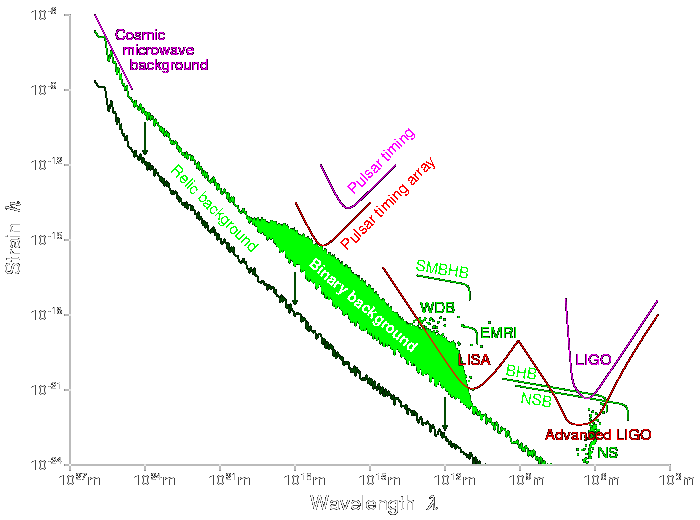
Estimated gravitational wave spectrum. [Image Source]


It was thus expected that the upgraded experiment either sees something immediately, or we’ve gotten something terribly wrong. And indeed, rumors about a positive detection started to appear almost immediately after the upgrade. But it wasn’t until this week that the LIGO collaboration announced several press-conferences in the USA and Europe, scheduled for tomorrow, Thursday Feb 11, at 3:30pm GMT. So something big is going to hit the headlines tomorrow, and here are the essentials that you need to know.

Gravitational waves are periodic distortions of space-time. They alter distance ratios for orthogonal directions. An interferometer works by using lasers to measure and compare orthogonal distances very precisely, thus it picks up even the tiniest space-time deformations.

Moving masses produce gravitational waves much like moving charges create electromagnetic waves. The most relevant differences between the two cases are
  1. Electromagnetic waves travel in space-time, whereas gravitational waves are a disturbance of space-time itself.
  2. Electromagnetic waves have spin 1, gravitational waves have spin two. The spin counts how much you have to rotate the wave for it to come back onto itself. For the electromagnetic fields that’s one full rotation, for the gravitational field it’s only half a rotation.
  3. [Image Credit: David Abergel]
  4. The dominant electromagnetic emission comes from the dipole moment (normally used eg for transmitter antennae), but gravitational waves have no dipole moment (a consequence of momentum conservation). It’s instead the quadrupole emission that is leading.
If you keep these differences in mind, you can understand gravitational waves in much the same way as electromagnetic waves. They can exist at any wavelength. They move at the speed of light. How many there are at a given wavelength depends on how many processes there are to produce them. The known processes give rise to the distribution in the graphic above. A gravitational wave detector is basically an antenna tuned in to a particularly promising frequency.

Since all matter gravitates, the motion of matter generically creates gravitational waves. Every time you move, you create gravitational waves, lots of them. These are, however, so weak that they are impossible to measure.

The gravitational waves that LIGO is looking for come from the most violent events in the universe that we know of: black hole mergers. In these events, space-time gets distorted dramatically as the two black holes join to one, leading to significant emission of gravitational waves. This combined system later settles with a characteristic “ringdown” into a new stable state.


Yes, this also means that these gravitational waves go right through you and distort you oh-so-slightly on their way.

The wave-lengths of gravitational waves emitted in such merger events are typically of the same order as the dimension of the system. That is, for black holes with masses between 10 and 100 times the solar mass, wavelengths are typically a hundred to a thousand km – right in the range that LIGO is most sensitive.

If you want to score extra points when discussing the headlines we expect tomorrow, learn how to pronounce Fabry–Pérot. This is a method for bouncing back light-signals in interferometer arms several times before making the measurments, which effectively increases the armlength. This is why LIGO is sensitive in a wavelength regime far longer than its actual arm length of about 2-4 km. And don’t call them gravity waves. A gravity wave is a cloud phenomenon.

Gravitational waves were predicted a hundred years ago as one of the consequences of Einstein’s theory of General Relativity. Their existence has since been indirectly confirmed because gravitational wave emission leads to energy loss, which has the consequence that two stars which orbit around a common center speed up over the course of time. This has been observed and was awarded the Nobel Prize for physics in 1993. If LIGO has detected the sought-after signal, it would not be the first detection, but the first direct detection.

Interestingly, even though it was long known that black hole mergers would emit gravitational waves, it wasn’t until computing power had increased sufficiently that precise predictions became possible. So it’s not like experiment is all that far behind theory on that one. General Relativity, though often praised for its beauty, does leave you with one nasty set of equations that in most cases cannot be solved analytically and computer simulations become necessary.

The existence of gravitational waves is not doubted by anyone in the physics community, or at least not by anybody I have met. This is for good reasons: On the experimental side there is the indirect evidence, and on the theoretical side there is the difficulty of making any theory of gravity work that does not have gravitational waves. But the direct detection of gravitational waves would be tremendously exciting because it opens our eyes to an entirely new view on the universe.

Hundreds of millions of years ago, a primitive form of life crawled out of the water on planet Earth and opened their eyes to see, for the first time, the light of the stars. Detecting gravitational waves is a momentous event just like this – it’s the first time we can receive signals that were previously entirely hidden from us, revealing an entirely new layer of reality.

So bookmark the webcast page and mark your calendar for tomorrow 3:30 GMT  –  it might enter the history books.

Update Feb 11: The rumors were all true. They have a 5.1 σ signal of a binary black hole merger. The paper is published in PRL, here is the abstract.

Friday, February 05, 2016

Much Ado around Nothing: The Cosmological non-Constant Problem

Tl;dr: Researchers put forward a theoretical argument that new physics must appear at energies much lower than commonly thought, barely beyond the reach of the LHC.
The cosmological constant is the worst-ever prediction of quantum field theory, infamously off by 120 orders of magnitude. And as if that wasn’t embarrassing enough, this gives rise to, not one, but three problems: Why is the measured cosmological constant neither 1) huge nor 2) zero, and 3) Why didn’t this occur to us a billion years earlier? With that, you’d think that physicists have their hands full getting zeroes arranged correctly. But Niayesh Afshordi and Elliot Nelson just added to our worries.
In a paper that made it third place of this year’s Buchalter Cosmology Prize, Afshordi and Nelson pointed out that the cosmological constant, if it arises from the vacuum energy of matter fields, should be subject to quantum fluctuations. And these fluctuations around the average are still large even if you have managed to get the constant itself to be small.

The cosmological constant, thus, is not actually constant. And since matter curves space-time, the matter fluctuations lead to space-time fluctuations – which can screw with our cosmological models. Afshordi and Nelson dubbed it the “Cosmological non-Constant Problem.”

But there is more to their argument than just adding to our problems because Afshordi and Nelson quantified what it takes to avoid a conflict with observation. They calculate the effect of stress-energy fluctuations on the space-time background, and then analyze what consequences this would have for the gravitational interaction. They introduce as a free parameter an energy scale up to which the fluctuations abound, and then contrast the corrections from this with observations, like for example the CMB power spectrum or the peculiar velocities of galaxy clusters. From these measurements they derive bounds on the scale at which the fluctuations must cease, and thus, where some new physics must come into play.

They find that the scale beyond which we should already have seen the effect of the vacuum fluctuations is about 35 TeV. If their argument is right, this means something must happen either to matter or to gravity before reaching this energy scale; the option the authors advocate in their paper is that physics becomes strongly coupled below this scale (thus invalidating the extrapolation to larger energies, removing the problem).

Unfortunately, the LHC will not be able to reach all the way up to 35 TeV. But a next larger collider – and we all hope there will be one! – almost certainly would be able to test the full range. As Niayesh put it: “It’s not a problem yet” – but it will be a problem if there is no new physics before getting all the way up to 35 TeV.

I find this an interesting new twist on the cosmological constant problem(s). Something about this argument irks me, but I can’t quite put a finger on it. If I have an insight, you’ll hear from me again. Just generally I would caution you to not take the exact numerical value too seriously because in this kind of estimate there are usually various places where factors of order one might come in.

In summary, if Afshordi and Nelson are right, we’ve been missing something really essential about gravity.