
Showing posts with label Biochemistry. Show all posts
Showing posts with label Biochemistry. Show all posts
Friday, August 07, 2026
Our Most Dangerous Labs Have a Problem No One Wants to Fix
A worker at a US government lab got bitten by a monkey carrying a deadly virus, and it turned out nobody knew what to do about it. Around the same time, someone from the same lab tried to smuggle outbreak samples into the country. All of this while everyone's worried about AI making bioweapons. Let's take a look.

Tuesday, May 19, 2026
Biologists Say They Cracked One of Life’s Biggest Mysteries
Life on Earth has a peculiar property – many biological molecules have a handedness, or a “chirality.” DNA twists one way and not the other, and all the rest of life must fit to this reality. In a new paper, researchers say they know why: It all comes down to physics! The answer could change our understanding of life across the universe. Let’s take a look.
Wednesday, October 15, 2025
Quantum Healing Might Be Real – But Not Like We Thought
Quantum biology is an area of research at the intersection of biology, chemistry, and physics which examines how organisms use quantum effects in their bodily functions. The field is quickly gaining momentum in the scientific community, and a recent (not-yet-peer-reviewed) study has revealed how quantum mechanics play a role in wound healing. Let’s take a look.
Wednesday, June 11, 2025
We Have An Aura of Visible Light, Scientists Show
Has anybody ever told you that they like your aura? Well, maybe they weren’t as crazy as you thought. According to a new study, living beings do indeed have an aura in the visible range of the spectrum. What colour is it? I’ve had a look.
Wednesday, April 16, 2025
Researchers find major clue to consciousness
We still don’t know what “consciousness” actually means. But in a new study, researchers have used the equations of quantum mechanics to determine a brain’s “criticality,” a measure which allows them to separate waking brains from sleeping ones. I think they’re onto something. Let’s take a look.
Friday, March 22, 2024
Why is life left-handed? We might finally know
Everyone knows the classic double helix-shape of DNA, but no one knows why the DNA twists one way and not the other. Scientists have been trying to figure out why organic molecules have the particular orientation that they do - this so-called “handedness”. It seems like one of those questions that we'll never answer, but to my surprise recently there's been some progress on answering the question.
Saturday, April 16, 2022
How serious is antibiotic resistance?
[This is a transcript of the video embedded below. Some of the explanations may not make sense without the animations in the video.]
Antibiotics save lives. But increasingly more bacteria are becoming resistant to antibiotics. As a result, some infections can simply no longer be treated. Just a few weeks ago an international team of scientists lead by researchers at the University of Washington published a report in the Lancet, according to which antibiotic resistance now kills more than a million people worldwide each year. And the numbers are rising.
How serious is the situation? What are scientists doing to develop new antibiotics? Did you know that bacteria are not the most abundant organism on earth? And what do rotten eggplants have to do with all of that? That’s what we will talk about today.
First things first, what are antibiotics? Literally the word means “against life” which doesn’t sound particularly healthy. But “antibiotic” just refers to any type of substance that kills bacteria (bactericidal) or inhibits their growth (bacteriostatic). Antibiotics are roughly categorized either as “broad spectrum”, which target many types of bacteria, or “narrow spectrum” which target very specific bacteria.
The big challenge for antibiotics is that you want them to work in or on the body of an infected person, without killing the patient along with the bacteria. That’s what makes things difficult.
There are various ways antibiotics work, and most of them target some difference between bacteria and cells, so that the antibiotic harms the bacteria but not the cell.
For example, our cells have membranes, but they don’t have cell walls, which is a rigid protective layer that covers the membrane. But bacteria do have cell walls. So one way that antibiotics work is to destabilize the cell wall. Penicillin for example does that.
Another thing you can do is to prevent bacterial cells from producing certain enzymes that the bacteria need for replication, or inhibit their synthesis of folic acid which they need to grow.
As you can see, antibiotics work in a number of entirely different ways. And each of them can fight some bacteria but not others. You also have to take into account w*here the bacterial infection is, because not all antibiotics reach all parts of the body equally well. This is why you need a prescription for antibiotics – they have to fit to the infection you’re dealing with, otherwise they’re in the best case useless. In the worst case you may breed yourself a tough strain that will resist further treatment.
This problem was pointed out already by the Scottish physician Alexander Fleming who discovered the first antibiotic, penicillin, 1928. Penicillin is still used today, for example to treat scarlet fever. According to some estimates, it has saved about 200 million lives, so far.
But already in 1945, Fleming warned the world of what would happen next, namely that bacteria would adapt to the antibiotics and learn to survive them. They become “resistant”. Fleming wrote
The world didn’t listen to Fleming’s warning. One big reason was that in the 1940s, scientists discovered that antibiotics were good for something else: They made farm animals grow faster, regardless of whether those animals were ill.
On average, livestock that were fed antibiotic growth promoters grew 3-11% faster. So farmers began feeding antibiotics to chickens, pigs, and cattle because that way they would have more meat to sell.
Things were pretty crazy at the time. By the 1950’s the US industry was “painting” steaks with antibiotics to extend their shelf life. They were washing spinach with antibiotics. Sometimes they even mixed antibiotics into ground meat. You could buy antibiotic soap. The stuff leaked everywhere. Studies at the time found penicillin even in milk and some people promptly developed an allergy to it.
It wasn’t until 1971 that the UK banned the use of some antibiotics for animal farming. But it’s only since 2006 that the use of antibiotics as growth promoters in animals is generally forbidden in the European Union. In the USA it took until 2017 for a similar ban to come into effect.
Using antibiotics for meat production isn’t the only problem. Another problem is over-prescription. According to the American Center for Disease Control, about 30 percent of prescriptions for antibiotics in the USA are unnecessary or useless, in most cases because they are mistakenly prescribed against respiratory infections that are caused by viruses, against which antibiotics do nothing.
A 2018 paper found that the global consumption of antibiotics per person has increased by 39% from 2000 to 2015 and it’s probably still increasing, though the increase is largely driven by low and middle income countries which are catching up. And with that, antibiotic resistance is on the rise.
Already in 2019, the World Health Organization (WHO) declared that antimicrobial resistance (which includes antibiotic resistance) is currently one of the top 10 global public health threats. They say that “antibiotics are becoming increasingly ineffective as drug-resistance spreads globally leading to more difficult to treat infections and death”.
According to the recent study from the Lancet which I mentioned in the introduction, the number of people who die from treatment-resistant bacterial infections is currently about 1.27 million per year. That’s about twice as many people who die from malaria. They also estimate that antibiotic resistance indirectly contributes to as many as 4.95 million deaths each year. The Lancet article also found that young children below 5 years are at the highest risk.
So the situation is not looking good. What are scientists doing?
First there are a couple of obvious ideas, like bringing back old antibiotics that have gone out of use, because bacteria may have lost their resistance to them, and keep looking for new inspirations in nature. For example, in 2016, a group of researchers from Denmark reported they’d found that leaf-cutting ants use natural antibiotics. The next one you probably guessed: Artificial Intelligence to the rescue.
2 years ago, researchers from MIT published a paper in the magazine Cell in which they explain how they used deep learning to find new antibiotics. They first trained their software on 2500 molecules whose antibiotic functions are known and also taught it to recognize structures that are known to be toxic.
Then they rated 6000 other molecules with scores from 0 to 1 for how likely the molecules were to make good antibiotics. Among the molecules with high scores they focused on those whose structure was different from that of the known antibiotics because they were hoping to find something really new.
They found one molecule that fit the bill: halicin. Halicin is not a new drug, they just renamed what was previously known under the catchy name c-Jun N-terminal kinase inhibitor SU3327. They called it halicin after HAL from the Space Odyssey, I am guessing because their Artificial Intelligence is exploring a big “chemical space” or otherwise I’m too dumb to get it.
They did an experiment and found that indeed halicin worked against some multiresistant bacteria, both in a petri dish and in in mice. Then they repeated the process but with a much bigger library of more than ten million molecules. They identified some promising candidates for new antibiotics and are now doing further tests.
It’s a long way from the petri dish to the market, but this seems really promising, though it has the usual limitations of artificial intelligence: software can only learn if there’s something to train on, so this is unlikely to discover entirely new pathways of knocking out bacteria.
Another avenue that researchers are pursuing is the revival of phage therapy. Phages are viruses that attack bacteria. They are about 100 times smaller than bacteria and are the most abundant organism in the planet. There are an estimated 10 million trillion trillion of them around us, that’s ten to the 31. And phages are everywhere: on surfaces, in soil, on our skin, even inside our body. They enter a bacterium and replicate inside of it, until the bacterium bursts and dies in the process. You can see the potential: breed phages that infect the right bacteria and you’ve solved the problem.
One great benefit of phages is that they target very specific bacteria so they spare the beneficial bacteria in our body. The question is, where do you get the right phage for an infection? The first successful phage treatment was done in 1919, however, the method was never widely adopted because breeding the right phages is slow and cumbersome and when antibiotics were discovered they were just vastly more convenient.
However, with antibiotic resistance on the rise, phage treatments are getting new attention. Researchers now hope that genetic engineering will make it faster and easier to breed the right phages. The first successful treatment with genetically modified phages was reported in 2019 in Nature Medicine by a group of researchers from the United States and the UK. They bred a cocktail of three phages, one of which they found on a rotting eggplant from South Africa.
The group around Dr. Strathdee at the University of California San Diego hopes that one day we will have an open source library for genetically engineered phages which is accessible to everyone and she’s currently raising funds for that. Strathdee and her team don’t think that phage therapy will ever replace antibiotics altogether but that it will be an important contribution for particularly hopeless cases.
Another new method to fight bacteria was proposed in 2019 by researchers from Texas. They have found a way to kill bacteria while they are passive, so while they are not replicating. This can’t be done with normal antibiotics that usually target growth or replication. But the researchers have found substances that open a particularly large channel in the membrane on the surface of the bacterium. The bacterium then basically leaks out and dies. Another good thing about this method is that even if it doesn’t kill a bacterium it can make it easier for antibiotics to enter. They have tested this in a petri dish and seen good results.
To name one final line of research that scientists are pursuing: Several groups are looking for new ways to use antimicrobial peptides. Peptides are part of our innate immune system. They are natural broad spectrum antibiotics and earlier studies have shown that they’re effective even against bacteria that resist antibiotics.
Problem is, peptides break down quickly when they come into contact with bodily fluids, such as blood. But researchers from Italy and Spain have found a way to make peptides more stable by attaching them to nanoparticles that fight off certain enzymes which would otherwise break down the peptides. These peptide nanoparticles can for example be inhaled to treat lung infections. They tested it successfully in mice and rats and published their results in a 2020 paper. And just last year, researchers from Sweden have developed a hydrogel that contains these peptides and that can be put on top of skin wounds.
It is hard to overstate just how dramatically antibiotics have changed our life. Typhus, tuberculosis, the plague, cholera, leprosy. These are all bacterial infections, and before we had antibiotics they regularly killed people, especially children. During World War I more people died from bacterial infection than from the fights.
As you have seen, bacterial resistance is a real problem and it’ll probably get worse for some more time. But scientists are on the case, and some recent research looks quite promising.
Antibiotics save lives. But increasingly more bacteria are becoming resistant to antibiotics. As a result, some infections can simply no longer be treated. Just a few weeks ago an international team of scientists lead by researchers at the University of Washington published a report in the Lancet, according to which antibiotic resistance now kills more than a million people worldwide each year. And the numbers are rising.
How serious is the situation? What are scientists doing to develop new antibiotics? Did you know that bacteria are not the most abundant organism on earth? And what do rotten eggplants have to do with all of that? That’s what we will talk about today.
First things first, what are antibiotics? Literally the word means “against life” which doesn’t sound particularly healthy. But “antibiotic” just refers to any type of substance that kills bacteria (bactericidal) or inhibits their growth (bacteriostatic). Antibiotics are roughly categorized either as “broad spectrum”, which target many types of bacteria, or “narrow spectrum” which target very specific bacteria.
The big challenge for antibiotics is that you want them to work in or on the body of an infected person, without killing the patient along with the bacteria. That’s what makes things difficult.
There are various ways antibiotics work, and most of them target some difference between bacteria and cells, so that the antibiotic harms the bacteria but not the cell.
For example, our cells have membranes, but they don’t have cell walls, which is a rigid protective layer that covers the membrane. But bacteria do have cell walls. So one way that antibiotics work is to destabilize the cell wall. Penicillin for example does that.
Another thing you can do is to prevent bacterial cells from producing certain enzymes that the bacteria need for replication, or inhibit their synthesis of folic acid which they need to grow.
As you can see, antibiotics work in a number of entirely different ways. And each of them can fight some bacteria but not others. You also have to take into account w*here the bacterial infection is, because not all antibiotics reach all parts of the body equally well. This is why you need a prescription for antibiotics – they have to fit to the infection you’re dealing with, otherwise they’re in the best case useless. In the worst case you may breed yourself a tough strain that will resist further treatment.
This problem was pointed out already by the Scottish physician Alexander Fleming who discovered the first antibiotic, penicillin, 1928. Penicillin is still used today, for example to treat scarlet fever. According to some estimates, it has saved about 200 million lives, so far.
But already in 1945, Fleming warned the world of what would happen next, namely that bacteria would adapt to the antibiotics and learn to survive them. They become “resistant”. Fleming wrote
“The greatest possibility of evil in self-medication is the use of too-small doses, so that, instead of clearing up infection, the microbes are educated to resist penicillin and a host of penicillin-fast organisms is bred out which can be passed on to other individuals.”To some extent antibiotic resistance is unavoidable – it’s just how natural selection works. But the problem becomes significantly worse if one doesn’t pull through an antibiotic treatment at full force, because then bacteria will develop resistance much faster.
The world didn’t listen to Fleming’s warning. One big reason was that in the 1940s, scientists discovered that antibiotics were good for something else: They made farm animals grow faster, regardless of whether those animals were ill.
On average, livestock that were fed antibiotic growth promoters grew 3-11% faster. So farmers began feeding antibiotics to chickens, pigs, and cattle because that way they would have more meat to sell.
Things were pretty crazy at the time. By the 1950’s the US industry was “painting” steaks with antibiotics to extend their shelf life. They were washing spinach with antibiotics. Sometimes they even mixed antibiotics into ground meat. You could buy antibiotic soap. The stuff leaked everywhere. Studies at the time found penicillin even in milk and some people promptly developed an allergy to it.
It wasn’t until 1971 that the UK banned the use of some antibiotics for animal farming. But it’s only since 2006 that the use of antibiotics as growth promoters in animals is generally forbidden in the European Union. In the USA it took until 2017 for a similar ban to come into effect.
Using antibiotics for meat production isn’t the only problem. Another problem is over-prescription. According to the American Center for Disease Control, about 30 percent of prescriptions for antibiotics in the USA are unnecessary or useless, in most cases because they are mistakenly prescribed against respiratory infections that are caused by viruses, against which antibiotics do nothing.
A 2018 paper found that the global consumption of antibiotics per person has increased by 39% from 2000 to 2015 and it’s probably still increasing, though the increase is largely driven by low and middle income countries which are catching up. And with that, antibiotic resistance is on the rise.
Already in 2019, the World Health Organization (WHO) declared that antimicrobial resistance (which includes antibiotic resistance) is currently one of the top 10 global public health threats. They say that “antibiotics are becoming increasingly ineffective as drug-resistance spreads globally leading to more difficult to treat infections and death”.
According to the recent study from the Lancet which I mentioned in the introduction, the number of people who die from treatment-resistant bacterial infections is currently about 1.27 million per year. That’s about twice as many people who die from malaria. They also estimate that antibiotic resistance indirectly contributes to as many as 4.95 million deaths each year. The Lancet article also found that young children below 5 years are at the highest risk.
So the situation is not looking good. What are scientists doing?
First there are a couple of obvious ideas, like bringing back old antibiotics that have gone out of use, because bacteria may have lost their resistance to them, and keep looking for new inspirations in nature. For example, in 2016, a group of researchers from Denmark reported they’d found that leaf-cutting ants use natural antibiotics. The next one you probably guessed: Artificial Intelligence to the rescue.
2 years ago, researchers from MIT published a paper in the magazine Cell in which they explain how they used deep learning to find new antibiotics. They first trained their software on 2500 molecules whose antibiotic functions are known and also taught it to recognize structures that are known to be toxic.
Then they rated 6000 other molecules with scores from 0 to 1 for how likely the molecules were to make good antibiotics. Among the molecules with high scores they focused on those whose structure was different from that of the known antibiotics because they were hoping to find something really new.
They found one molecule that fit the bill: halicin. Halicin is not a new drug, they just renamed what was previously known under the catchy name c-Jun N-terminal kinase inhibitor SU3327. They called it halicin after HAL from the Space Odyssey, I am guessing because their Artificial Intelligence is exploring a big “chemical space” or otherwise I’m too dumb to get it.
They did an experiment and found that indeed halicin worked against some multiresistant bacteria, both in a petri dish and in in mice. Then they repeated the process but with a much bigger library of more than ten million molecules. They identified some promising candidates for new antibiotics and are now doing further tests.
It’s a long way from the petri dish to the market, but this seems really promising, though it has the usual limitations of artificial intelligence: software can only learn if there’s something to train on, so this is unlikely to discover entirely new pathways of knocking out bacteria.
Another avenue that researchers are pursuing is the revival of phage therapy. Phages are viruses that attack bacteria. They are about 100 times smaller than bacteria and are the most abundant organism in the planet. There are an estimated 10 million trillion trillion of them around us, that’s ten to the 31. And phages are everywhere: on surfaces, in soil, on our skin, even inside our body. They enter a bacterium and replicate inside of it, until the bacterium bursts and dies in the process. You can see the potential: breed phages that infect the right bacteria and you’ve solved the problem.
One great benefit of phages is that they target very specific bacteria so they spare the beneficial bacteria in our body. The question is, where do you get the right phage for an infection? The first successful phage treatment was done in 1919, however, the method was never widely adopted because breeding the right phages is slow and cumbersome and when antibiotics were discovered they were just vastly more convenient.
However, with antibiotic resistance on the rise, phage treatments are getting new attention. Researchers now hope that genetic engineering will make it faster and easier to breed the right phages. The first successful treatment with genetically modified phages was reported in 2019 in Nature Medicine by a group of researchers from the United States and the UK. They bred a cocktail of three phages, one of which they found on a rotting eggplant from South Africa.
The group around Dr. Strathdee at the University of California San Diego hopes that one day we will have an open source library for genetically engineered phages which is accessible to everyone and she’s currently raising funds for that. Strathdee and her team don’t think that phage therapy will ever replace antibiotics altogether but that it will be an important contribution for particularly hopeless cases.
Another new method to fight bacteria was proposed in 2019 by researchers from Texas. They have found a way to kill bacteria while they are passive, so while they are not replicating. This can’t be done with normal antibiotics that usually target growth or replication. But the researchers have found substances that open a particularly large channel in the membrane on the surface of the bacterium. The bacterium then basically leaks out and dies. Another good thing about this method is that even if it doesn’t kill a bacterium it can make it easier for antibiotics to enter. They have tested this in a petri dish and seen good results.
To name one final line of research that scientists are pursuing: Several groups are looking for new ways to use antimicrobial peptides. Peptides are part of our innate immune system. They are natural broad spectrum antibiotics and earlier studies have shown that they’re effective even against bacteria that resist antibiotics.
Problem is, peptides break down quickly when they come into contact with bodily fluids, such as blood. But researchers from Italy and Spain have found a way to make peptides more stable by attaching them to nanoparticles that fight off certain enzymes which would otherwise break down the peptides. These peptide nanoparticles can for example be inhaled to treat lung infections. They tested it successfully in mice and rats and published their results in a 2020 paper. And just last year, researchers from Sweden have developed a hydrogel that contains these peptides and that can be put on top of skin wounds.
It is hard to overstate just how dramatically antibiotics have changed our life. Typhus, tuberculosis, the plague, cholera, leprosy. These are all bacterial infections, and before we had antibiotics they regularly killed people, especially children. During World War I more people died from bacterial infection than from the fights.
As you have seen, bacterial resistance is a real problem and it’ll probably get worse for some more time. But scientists are on the case, and some recent research looks quite promising.
Friday, April 26, 2013
The Enantiomers’ Swimming Competition
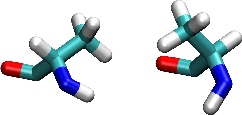 |
| Image Source. |
Many chemical reactions depend not only on the atomic composition of molecules but also on their spatial arrangement, and thus enantiomers can have very different chemical behaviors. Since organisms are not chirally neutral, medical properties of drugs made from enantiomers depend on which chirality of the active ingredient is present. One enantiomer might have a beneficial effect, while the other one is harmful. This is the case for example for Ethambutol (one enantiomer treats tuberculosis, the other causes blindness), or Naproxen (one enantiomer treats arthritis pain, the other causes liver poisoning).
The chemical synthesis of molecules however typically produces molecules of both chiralities in approximately equal amounts, which creates the need to separate them. One way to do this is to use chemical reactions that are sensitive to the molecules’ chirality. Such a procedure has the disadvantage though that it is specific to one particular molecule and cannot be used for any other.
Now three physicists have shown, by experimental and numerical analysis, that there may be a universal way to separate enantiomers
- Separation of chiral colloidal particles in a helical flow field
Maria Aristov, Ralf Eichhorn, and Clemens Bechinger
Soft Matter, 2013,9, 2525-2530
They have shown this as follows.
Molecules are typically of the size of some nanometers or so, and the swimming performance for molecules of different chirality is difficult to observe. Instead, the authors used micrometer-sized three-dimensional particles made of a type of polymer (called SU-8) by a process called photolithography. The particles created this way are the simplest example of configurations of different chirality. They labeled the right-handed particles with a blue fluorescent dye, and the left-handed particles with a green fluorescent dye. This allows taking images of them by a fluorescent microscope. Below you see a microscope image of the particles

Next you need a narrow channel through which water flows under some pressure. The swirl is created by gratings in the wall of the channel. The length of this channel is about a meter, but its height and width is only of the order 150 μm. Then you let bunches of the mixed chiral particles flow through the channel and photograph them on a handful of locations. From the amount of blue and green that you see in the image, you can tell how many of each type were present at a given time. Here’s what they see (click to enlarge)

This figure is an overlay of measurements at 5 different locations as a function of time (in seconds). The green shade is for molecules with the chirality that matches the water swirl orientation, the blue shade is for those with the opposite chirality. They start out, at x=32.5mm, in almost identical concentration. Then they begin to run apart. Look at the left tail of the x=942.5 mm measurement. The green distribution is almost 200 seconds ahead of the blue one.
If you aren’t impressed by this experiment, let me show you the numerical results. They modeled the particles as rigidly coupled spheres in a flow field with friction and torque, added some Gaussian white noise, and integrated the equations. Below is the result of the numerical computation for 1000 realizations (click to enlarge)

I am seriously amazed how well the numerical results agree with the experiment! I’d have expected hydrodynamics to be much messier.
The merit of the numerical analysis is that it provides us with understanding of why this separation is happening. Due to the interaction of the fluid with the channel walls, the flow is slower towards the walls than in the middle. The particles are trying to minimize their frictional losses with the fluid, and how to best achieve this depends on their chirality relative to the swirl of the fluid. The particles whose chirality is aligned with the swirl preferably move towards the middle where the flow is faster, while the particles of the opposite chirality move towards the channel walls where the flow is slower. This is what causes them to travel at different average velocities.
This leaves the question whether this study of particles of micrometer size can be scaled down to molecules of nanometer size. To address this question, the authors demonstrate with another numerical simulation that the efficiency of the separation (the amount of delay) depends on the product of the length of the channel and the velocity of the fluid, divided by the particle’s diffusion coefficient in the fluid. This allows one to estimate what is required for smaller particles. If this scaling holds, particles of about 120 nm size could be separated in a channel of about 3cm length and 3.2 μm diameter, at a pressure of about 108 Pa, which is possible with presently existing technology.
Soft matter is not anywhere near by my area of research, so it is hard for me to tell whether there are effects at scales of some hundred nanometers that might become relevant and spoil this simple scaling, or whether more complicated molecule configurations alter the behavior in the fluid. But if not, this seems to me a tremendously useful result with important applications.
Friday, April 06, 2012
Book Review: "The Quest for the Cure" by B.R. Stockwell
 The Quest for the Cure: The Science and Stories Behind the Next Generation of Medicines
 By Brent R. Stockwell
Columbia University Press (June 1, 2011)
As a particle physicist, I am always amazed when I read about recent advances in biochemistry. For what I am concerned, the human body is made of ups and downs and electrons, kept together by photons and gluons - and that's pretty much it. But in biochemistry, they have all these educated sounding words. They have enzymes and aminoacids, they have proteases, peptides and kineases. They have a lot of proteins, and molecules with fancy names used to drug them. And these things do stuff. Like break up and fold and bind together. All these fancy sounding things and their interactions is what makes your body work; they decide over your health and your demise.
With all that foreign terminology however, I've found it difficult to impossible to read any paper on the topic. In most cases, I don't even understand the title. If I make an effort, I have to look up every second word. I do just fine with the popular science accounts, but these always leave me wondering just how do they know this molecule does this and how do they know this protein breaks there, fits there, and that causes cancer and that blocks some cell-function? What are the techniques they use and how do they work?
When I came across Stockwell's book "The Quest for the Cure" I thought it would help me solve some of these mysteries. Stockwell himself is a professor for biology and chemistry at Columbia university. He's a guy with many well-cited papers. He knows words like oligonucleotides and is happy to tell you how to pronounce them: oh-lig-oh-NOOK-lee-oh-tide. Phosphodiesterase: FOS-foh-dai-ESS-ter-ays. Nicotinonitrile: NIH-koh-tin-oh-NIH-trayl. Erythropoitin: eh-REETH-roh-POIY-oh-ten. As a non-native speaker I want to complain that this pronunciation help isn't of much use for a non-phonetic language; I can think of at least three ways to pronounce the syllable "lig." But then that's not what I bought the book for anyway.
The starting point of "The Quest for the Cure" is a graph showing the drop in drug approvals since 1995. Stockwell sets out to first explain what is the origin of this trend and then what can be done about it. In a nutshell, the issue is that many diseases are caused by proteins which are today considered "undruggable" which means they are folded in a way that small molecules, that are suitable for creating drugs, can't bind to the proteins' surfaces. Unfortunately, it's only a small number of proteins that can be targeted by presently known drugs:
"Here is the surprising fact: All of the 20,000 or so drug products that ever have been approved by the U.S. Food and Drug Administration interact with just 2% of the proteins found in human cells."And fewer than 15% are considered druggable at all.
Stockwell covers a lot of ground in his book, from the early days of genetics and chemistry to today's frontier of research. The first part of the book, in which he lays out the problem of the undruggable proteins, is very accessible and well-written. Evidently, a lot of thought went into it. It comes with stories of researchers and patients who were treated with new drugs, and how our understanding of diseases has improved. In the first chapters, every word is meticulously explained or technical terms are avoided to the level that "taken orally" has been replaced by "taken by mouth."
Unfortunately, the style deteriorates somewhat thereafter. To give you an impression, it starts more reading like this
"Although sorafenib was discovered and developed as an inhibitor of RAF, because of the similarity of many kinases, it also inhibits several other kinases, including the patelet-derived growth factor, the vascular endothelia growth factor (VEGF) receptors 2 and 3, and the c-KIT receptor."
Now the book contains a glossary, but it's incomplete (eg it neither contains VEGF nor c-KIT). With the large number of technical vocabulary, at some point it doesn't matter anymore if a word was introduced, because if it's not something you deal with every day it's difficult to keep in mind the names of all sorts of drugs and molecules. It gets worse if you put down the book for a day or two. This doesn't contribute to the readability of the book and is somewhat annoying if you realize that much of the terminology is never used again and one doesn't really know why it was necessary to use to begin with.
The second part of the book deals with the possibilities to overcome the problem of the undruggable molecules. In that part of the book, the stories of researchers curing patients are replaced with stories of the pharmaceutical industry, the start-up of companies and the ups and downs of their stock price.
Stockwell's explanations left me wanting in exactly the points that I would have been interested in. He writes for example a few pages about nuclear magnetic resonance and that it's routinely used to obtain high resolution 3-d pictures of small proteins. One does not however learn how this is actually done, other than that it requires "complicated magnetic manipulations" and "extremely sophisticated NMR methods." He spends a paragraph and an image on light-directed synthesis of peptides that is vague at best, and one learns that peptides can be "stapled" together, which improves their stability, yet one has no clue how this is done.
Now the book is extremely well referenced, and I could probably go and read the respective papers in Science. But then I would have hoped that Stockwell's book saves me exactly this effort.
On the upside, Stockwell does an amazingly good job communicating the relevance of basic research and the scientific method, and in my opinion this makes up for the above shortcomings. He tells stories of unexpected breakthroughs that came about by little more than coincidence, he writes about the relevance of negative results and control experiments, and how scientific research works:
"There is a popular notion about new ideas in science springing forth from a great mind fully formed in a dazzling eureka moment. In my experience this is not accurate. There are certainly sudden insights and ideas that apear to you from time to time. Many times, of course, a little further thought makes you realize it is really an absolutely terrible idea... But even when you have an exciting new idea, it begins as a raw, unprocessed idea. Some digging around in the literature will allow you to see what has been done before, and whether this idea is novel and likely to work. If the idea survives this stage, it is still full of problems and flaws, in both the content and the style of presenting it. However, the real processing comes from discussing the idea, informally at first... Then, as it is presented in seminars, each audience gives a series of comments, suggestions, and questions that help mold the idea into a better, sharper, and more robust proposal. Finally, there is the ultimate process of submission for publication, review and revision, and finally acceptance... The scientific process is a social process, where you refine your ideas through repeated discussions and presentations."
He also writes in a moderate dose about his own research and experience with the pharmaceutical industry.
The proposals that Stockwell has how to deal with the undruggable proteins have a solid basis in today's research. He isn't offering dreams or miracle cures, but points out hopeful recent developments, for example how it might be possible to use larger molecules. The problem with large molecules is that they tend to be less stable and don't enter cells readily, but he quotes research that shows possibilities to overcome this problem. He also explains the concept of a "privileged structure," structures that have been found with slight alterations to bind to several proteins. Using such privileged structures might allow one to sort through a vast parameter space of possible molecules with a higher success rate. He also talks about using naturally occurring structures and the difficulties with that. He ends his book by emphasizing the need for more research on this important problem of the undruggable proteins.
In summary: "The Quest for the Cure" is a well-written book, but it contains too many technical expressions, and in many places scientific explanations are vague or lacking. It comes with some figures which are very helpful, but there could have been more. You don't need to read the blurb to figure out that the author isn't a science writer but a researcher. I guess he's done his best, but I also think his editor should have dramatically sorted out the vocabulary or at least have insisted on a more complete glossary. Stockwell makes up for this overdose of biochemistry lingo with communicating very well the relevance of basic research and the power of the scientific method.
I'd give this book four out of five stars because I appreciate Stockwell has taken the time to write it to begin with.
Subscribe to:
Posts (Atom)