Pages

Thursday, October 29, 2015

What is basic science and what is it good for?

Basic science is, above all, a stupid word. It sounds like those onions we sliced in 8th grade. And if people don’t mistake “basic” for “everybody knows,” they might think instead it means “foundational,” that is, dedicated to questioning the present paradigms. But that’s not what the word refers to.

Basic science refers to research which is not pursued with the aim of producing new technologies; it is sometimes, more aptly, referred to as “curiosity driven” or “blue skies” research. The NSF calls it “transformative,” the ERC calls it “frontier” research. Quite possibly they don’t mean exactly the same, which is another reason why it’s a stupid word.

A few days ago, Matt Ridley wrote an article for the Wall Street Journal in which he argues that basic research, to the extent that it’s necessary at all, doesn’t need governmental funding. He believes that it is technology that drives science, not the other way round. “Deep scientific insights are the fruits that fall from the tree of technological change,” Ridley concludes. Apparently he has written a whole book with this theme, which is about to be published next week. The WSJ piece strikes me as shallow and deliberately provocative, published with the only aim of drawing attention to his book, which I hope has more substance and not just more words.

The essence of the article seems to be that it’s hard to demonstrate a correlation, not to mention causation, between tax-funded basic science and economic growth. Instead, Ridley argues, in many examples scientific innovations originated not in one single place, but more or less simultaneously in various different places. He concludes that tax-funded research is unnecessary.

Leaving aside for a moment that measures for economic growth can mislead about a countries’ prosperity, it is hardly surprising that a link between tax-funded basic research and economic growth is difficult to find. It must come as a shock to nationalists, but basic research is the possibly most international profession in existence. Ideas don’t stop at country borders. Consequently, to make use of basic research, you don’t yourself need to finance it. You can just wait until a breakthrough occurs elsewhere and then pay your people to jump on it. The main reason we so frequently see examples of simultaneous breakthroughs in different groups is that they build on more or less the same knowledge. Scientists can jump very quickly.

But the conclusion that this means one does not need to support basic research is just wrong. It’s a classic demonstration of the “free rider” problem. Your country can reap the benefits of basic research elsewhere, as long as somebody else does the thinking for you. But if every country does this, innovation would run dry, eventually.

Besides this, the idea that technology drives science might have worked in the last century but it does no longer work today. The times where you could find new laws of nature by dabbling with some equipment in the lab are over. To make breakthroughs today, you need to know what to build, and you need to know how to analyze your data. Where will you get that knowledge if not from basic resarch?

The technologies we use today, the computer that you sit in front of – semiconductors, lasers, liquid crystal displays – are based on last century’s theories. We still reap the benefits. And we all do, regardless of whether our nation paid salary for one of quantum mechanics’ founding fathers. But if we want progress to continue in the next century, we have to go beyond that. You need basic research to find out which direction is promising, which is a good investment. Or otherwise, you’ll waste lots of time and money.

There is a longer discussion that one can have whether some types of basic research have any practical use at all. It is questionable, for example, that knowing about the accelerated expansion of the universe will ever lead to a better phone. In my perspective the materialistic focus is as depressing as meaningless. Sure, it would be nice if my damned phone battery wouldn’t die in the middle of a call, and, yeah, I want to live forever watching cat videos on my hoverboard. But I fail to see what it’s ultimately good for. The only meaning I can find in being thrown into this universe is to understand how it works and how we are part of it. To me, knowledge is an end unto itself. Keep your hoverboard, just tell me how to quantize gravity.

Here is a simple thought experiment. Consider all tax-funded basic research were to cease tomorrow. What would go missing? No more stories about black holes, exoplanets, or loophole-free tests of quantum entanglement. No more string theory, no multiverses, no theories of everything, no higgsinos, no dark matter, no cosmic neutrinos, extra-dimensions, wormholes, or holographic universes. Except for a handful of lucky survivors at partly privately funded places – like Perimeter Institute, the KAVLI institutes, and some Templeton-funded initiatives, who in no way would be able to continue all of this research – all this research would die quickly. The world would be a poorer place, one with no hope of ever understanding this amazing universe that we live in.

Democracy is a funny thing, you know, it’s kind of like an opinion poll. Basic research is tax-funded in all developed countries. Could there be any clearer expression of the people’s opinion? They say: we want to know. We want to know where we come from, and what we are made of, and what’s the fate of our universe. Yes, they say, we are willing to pay taxes for that, but please tell us. As someone who works in basic research, I see my task as delivering to this want.

Monday, October 26, 2015

Black holes and academic walls

Image credits: Paul Terry Sutton
According to Einstein you wouldn’t notice crossing a black hole horizon. But now researchers argue that a firewall or brickwall would be in your way. Have they entirely lost their mind?

Tl;dr: Yes.

It is hard, sometimes, to understand why anyone would waste time on a problem as academic as black hole information loss. And I say that as someone who spent a significant part of the last decade pushing this very problem around in my head. Don’t physicists have anything better to do, in a world that is suffering from war and disease, bad grammar even? What drives these researchers, other than the hope to make headlines for solving a 40 years old conundrum?

Many physicists today work on topics that, like black hole information loss, seem entirely detached from reality. Black holes only succeed in destroying information once they entirely evaporate, and that won’t happen for the next 100 billion years or so. What drives these researchers is not making tangible use of their insights, but the recognition that someone today has to pave way for the science that will become relevant in a hundred, a thousand, or ten thousand years from now. And as I scan the human mess in my news feed, the unearthly cleanliness of the argument, the seemingly inescapable logic leading to a paradox, admittedly only adds to its appeal.

If black hole information loss was a cosmic whodunit, then quantum theory would be the victim. Stephen Hawking demonstrated in the early 1970s that when one combines quantum theory with gravity, one finds that black holes must emit thermal radiation. This “Hawking radiation” is composed of particles that besides their temperature do not contain any information. And so, when a black hole entirely evaporates all the information about what fell inside must ultimately be destroyed. But such destruction of information is incompatible with the very quantum theory one used to arrive at this conclusion. In quantum theory all processes can happen both forward and backward in time, but black hole evaporation, it seems, cannot be reversed.

This presented physicists with a major conundrum, because it demonstrated that gravity and quantum theory refused to combine. It didn’t help either to try to explain away the problem alluding to the unknown theory of quantum gravity. Hawking radiation is not a quantum gravitational process, and while quantum gravity does eventually become important in the very late stages of a black hole’s evaporation, the argument goes that by this time it is too late to get all the information out.

The situation changed dramatically in the late 1990s, when Maldacena proposed that certain gravitational theories are equivalent to gauge theories. Discovered in string theory, this famed gauge-gravity correspondence, though still mathematically unproved, does away with the problem because whatever happens when a black hole evaporates is equivalently described in the gauge theory. The gauge theory however is known to not be capable of murdering information, thus implying that the problem doesn’t exist.

While the gauge-gravity correspondence convinced many physicists, including Stephen Hawking himself, that black holes do not destroy information, it did not shed much light on just exactly how the information escapes the black hole. Research continued, but complacency spread through the ranks of theoretical physicists. String theory, it seemed, had resolved the paradox, and it was only a matter of time until details would be understood.

But that wasn’t how things panned out. Instead, in 2012, a group of four physicist, Almheiri, Marolf, Polchinski, and Sully (AMPS) demonstrated that what was thought to be a solution is actually also inconsistent. Specifically they demonstrated that four assumptions, generally believed by most string theorists to all be correct, cannot in fact be simultaneously true. These four assumptions are that:
  1. Black holes don’t destroy information.
  2. The Standard Model of particle physics and General Relativity remain valid close by the black hole horizon.
  3. The amount of information stored inside a black hole is proportional to its surface area.
  4. An observer crossing the black hole horizon will not notice it.
The second assumption rephrases the statement that Hawking radiation is not a quantum gravitational effect. The third assumption is a conclusion drawn from calculations of the black hole microstates in string theory. The fourth assumption is Einstein’s equivalence principle. In a nutshell, AMPS say that at least one of these assumptions must be wrong. One of the witnesses is lying, but who?

In their paper, AMPS suggested, maybe not quite seriously, giving up on the least contested of these assumptions, number 4). Giving up on 4), the other three assumptions imply that an observer falling into the black hole would encounter a “firewall” and be burnt to ashes. The equivalence principle however is the central tenet of general relativity and giving it up really is the last resort.

For the uninitiated observer, the lying witness is obviously 3). In contrast to the other assumptions, which are consequences of theories we already know and have tested to high precision, number 3) comes from a so-far untested theory. So if one assumption has to dropped then maybe it is the assumption that string theory is right about the information content of black holes, but that option isn’t very popular with string theorists...

And so within a matter of months the hep-th category of the arxiv was cluttered with attempts to reconcile the disagreeable assumptions with another. Proposed solutions included everything from just accepting the black hole firewall to the multiverse to elaborated thought-experiments meant to demonstrate that an observer wouldn’t actually notice being burnt. Yes, that’s modern physics for you.

I too of course have an egg in the basket. I found the witnesses all to be convincing, none of them seemed to be lying. And taking them at face value, it finally occurred to me that what made the assumptions seemingly incompatible was an unstated fifth assumption. Like witnesses’ accounts might suddenly all make sense once you realize the victim wasn’t killed at the same place the body was found, the four assumptions suddenly all make sense when you do not require the information to be saved in a particular way (that the final state is “typical” state). Instead the requirement that energy must be locally conserved near the horizon makes the firewall impossible and at the same time also told me exactly just how the black hole evaporation remains compatible with quantum theory.

I think nobody really liked my paper because it lead you to the rather strange conclusion that somewhere near the horizon there is a boundary which does alter the quantum theory, yet in a way that isn’t noticeable for any observer near by the black hole. It is possible to measure its effects, but only in the far distance. And while my proposal did resolve the firewall conundrum, it didn’t do anything about the black hole information loss problem. I mentioned in a side-note that in principle one could use this boundary to hand information into the outgoing radiation, but that would still not explain how the information would get into the boundary to begin with.

After publishing this paper, I vowed once again to never think about black hole evaporation again. But then last month, an arxiv preprint appeared by ‘t Hooft. One of the first to dabble in black hole thermodynamics, in his new paper ‘t Hooft proposes that the black hole horizon acts like a boundary that reflects information, a “brick wall” as New Scientist wants it. This new idea has been inspired by Stephen Hawking’s recent suggestion that much of the information falling into black holes continues to be stored on the horizon. If that is so, then giving the horizon a chance to act can allow the information to leave again.

I don’t think that bricks are much of an improvement over fire and I’m pretty sure that this exact realization of the idea won’t hold up. But after all the confusion, this might eventually allow us to better understand just exactly how the horizon interacts with the Hawking radiation and how it might manage to encode information in it.

Fast forward a thousand years. At the end of the road there is a theory of quantum gravity that will allow us to understand the behavior of space and time on shortest distance scales and, so many hope, the origin of quantum theory itself. Progress might seem incremental and sometimes history leads us in circles, but what keeps physicists going is the knowledge that there must be a solution.

[This post previously appeared at Starts with a Bang.]

Monday, October 19, 2015

Book review: Spooky Action at a Distance by George Musser

Spooky Action at a Distance: The Phenomenon That Reimagines Space and Time--and What It Means for Black Holes, the Big Bang, and Theories of Everything
By George Musser
Scientific American, To be released November 3, 2015

“Spooky Action at a Distance” explores the question Why aren’t you here? And if you aren’t here, what is it that prevents you from being here? Trying to answer this simple-sounding question leads you down a rabbit hole where you have to discuss the nature of space and time with many-world proponents and philosophers. In his book, George reports back what he’s found down in the rabbit hole.

Locality and non-locality are topics as confusing as controversial, both in- and outside the community, and George’s book is a great introduction to an intriguing development in contemporary physics. It’s a courageous book. I can only imagine how much headache writing it must have been, after I once organized a workshop on nonlocality and realized that no two people could agree on what they even meant with the word.

George is a very gifted writer. He gets across the most relevant concepts the reader needs to know on a nontechnical level with a light and unobtrusive humor. The historical background is nicely woven together with the narrative, and the reader gets to meet many researchers in the field, Steve Giddings, Fotini Markopoulou, and Nima Arkani-Hamed, to only mention a few.

In his book, George lays out how the attitude of scientists towards nonlocality has gone from acceptance to rejection and makes a case that now the pendulum is swinging back to acceptance again. I think he is right that this is the current trend (thus the workshop).

I found the book somewhat challenging to read because I was constantly trying to translate George’s metaphors back into equations and I didn’t always succeed. But then that’s a general problem I have with popular science books and I can’t blame George for this. I have another complaint though, which his that George covers a lot of different research in rapid succession without adding qualifiers about these research programs’ shortcomings. There’s quantum graphity and string theory and black holes in AdS and causal sets and then there’s many worlds. The reader might be left with the mistaken impression that these topics are somehow all related with each other.

Spooky Action at a Distance starts out as an Ode to Steve Giddings and ends as a Symphony for Arkani-Hamed. For my taste it’s a little too heavy on person-stories, but then that seems to be the style of science writing today. In summary, I can only say it’s a great book, so go buy it, you won’t regret it.

[Disclaimers: Free review copy; I know the author.]

Fade-out ramble: You shouldn’t judge a book by its subtitle, really, but whoever is responsible for this title-inflation, please make it stop. What’s next? Print the whole damn book on the cover?

Monday, October 12, 2015

A newly proposed table-top experiment might be able to demonstrate that gravity is quantized

Tl;dr: Experimentalists are bringing increasingly massive systems into quantum states. They are now close to masses where they might be able to just measure what happens to the gravitational field.

Quantum effects of gravity are weak, so weak they are widely believed to not be measurable at all. Freeman Dyson indeed is fond of saying that a theory of quantum gravity is entirely unnecessary, arguing that we could never observe its effects anyway. Theorists of course disagree, and not just because they’re being paid to figure out the very theory Dyson deems unnecessary. Measurable or not, they search for a quantized version of gravity because the existing description of nature is not merely incomplete – it is far worse, it contains internal contradictions, meaning we know it is wrong.

Take the century-old double-slit experiment, the prime example for quantum behavior. A single electron that goes through the double-slit is able to interact with itself, as if it went through both slits at once. Its behavior is like that of a wave which overlaps with itself after passing an obstacle. And yet, when you measure the electron after it went through the slit it makes a dot on a screen, like a particle would. The wave-like behavior again shows up if one measures the distribution of many electrons that passed the slit. This and many other experiments demonstrate that the electron is neither a particle nor a wave – it is described by a wave-function from which we obtain a probability distribution, a formulation that is the core of quantum mechanics.

Well understood as this is, it leads to a so-far unsolved conundrum.

The most relevant property of the electron’s quantum behavior is that it can go through both slits at once. It’s not that half of the electron goes one way and half the other. Neither does the electron sometimes take this slit and sometimes the other. Impossible as it sounds, the electron goes fully through both slits at the same time, in a state referred to as quantum superposition.

Electrons carry a charge and so they have an electric field. This electric field also has quantum properties and moves along with the electron in its own quantum superposition. The electron also has a mass. Mass generates a gravitational field, so what happens to the gravitational field? You would expect it to also move along with the electron, and go through both slits in a quantum superposition. But that can only work if gravity is quantized too. According to Einstein’s theory of General Relativity though, it’s not. So we simply don’t know what happens to the gravitational field unless we find a theory of quantum gravity.

It’s been 80 years since the question was first raised, but we still don’t know what’s the right theory. The main problem is that gravity is an exceedingly weak force. We notice it so prominently in our daily life only because, in contrast to the other interactions, it cannot be neutralized. But the very reason that planet Earth doesn’t collapse to a black hole is that much stronger forces than gravity prevent this from happening. The electromagnetic force, the strong nuclear force, and even the supposedly weak nuclear force, are all much more powerful than gravity.

For the experimentalist this means they either have an object heavy enough so its gravitational field can be measured. Or they have an object light enough so its quantum properties can be measured. But not both at once.

At least that was the case so far. But the last decade has seen an enormous progress in experimental techniques to bring heavier and heavier objects into quantum states and measure their behavior. And in a recent paper a group of researchers from Italy and the UK propose an experiment that might just be the first feasible measurement of the gravitational field of a quantum object.

Almost all researchers who work on the theory of quantum gravity expect that the gravitational field of the electron behaves like its electric field, that is, it has quantum properties. They are convinced of this because we have a well-working theory to describe this situation. Yes, I know, they told you nobody has quantized gravity, but that isn’t true. Gravity has been quantized in the 1960s by DeWitt, Feynman, and others using a method known as perturbative quantization. However, the result one gets with this method only works when the gravitational field is weak, and it breaks down when gravity becomes strong, such as at the Big Bang or inside black holes. In other words, this approach, while well understood, fails us exactly in the situations we are interested in the most.

Because of this failure in strong gravitational fields, perturbatively quantized gravity cannot be a fundamentally valid theory; it requires completion. It is this completion that is normally referred to as “quantum gravity.” However, when gravitational fields are weak, which is definitely the case for the little electron, the method works perfectly fine. Whether it is realized in nature though, nobody knows.

If the gravitational field is not quantized, one has instead a theory known as “semi-classical gravity,” in which the matter is quantized but gravity isn’t. Though nobody can make much sense of this theory conceptually, it’s infuriatingly hard to disprove. If the gravitational field of the electron remained classical, its distribution would follow the probability of the electron taking either slit rather than itself going through the slits with this probability.

To see the difference, consider you put a (preferably uncharged) test particle in the middle between the slits to see where the gravitational pull goes. If the gravitational field is quantized, then in half of the cases when the electron goes through the slit, the test particle will move left, in the other half of cases it would move right (it would also destroy the interference pattern). If the gravitational field is classical however, the test particle won’t move because it’s pulled equally to both sides.


So the difference between quantized and semi-classical gravity is observable. Unfortunately, even for the most massive objects that can be pushed through double slits, like large molecules, the gravitational field is far too weak to be measurable.

In the new paper now, the researchers propose a different method. They consider a tiny charged disk of osmium with a mass of about a nano-gram, held by electromagnetic fields in a trap. The particle is cooled down to some hundred mK which brings it into the lowest possible energy state. Above this ground-level there are now discrete energy levels for the disk, much like the electron orbits around the atomic nucleus, except that the level spacing is tiny. The important point is that the exact energy values of these levels depend on the gravitational self-interaction of the whole object. Measure the spacing of the energy levels precisely enough, and you can figure out whether the gravitational field was quantized or not.

Figure 1 from arxiv:arXiv:1510.01696. Depicted are the energy levels of the disk in the potential, and how they shift with the classical gravitational self-interaction taken into account, for two different scenarios of the distribution of the disk’s wave-function.


For this calculation they use the Schrödinger-Newton equation, which is the non-relativistic limit of semi-classical gravity incorporated in quantum mechanics. In an accompanying paper they have worked out the description of multi-particle systems in this framework, and demonstrated how the system approximately decomposes into a center-of-mass variable and the motions relative to the center of mass. They then calculate how the density distribution is affected by the gravitational field caused by its own probability distribution, and finally the energy levels of the system.

I haven’t checked this calculation in detail, but it seems both plausible that the effect should be present, and that it is large enough to potentially be measurable. I don’t know much about these types of experiments, but two of the authors of the paper, Hendrik Ulbricht and James Bateman, are experimentalists and I trust they know what current technology allows to measure.

Suppose they make this measurement and they do, as expected, not find the additional shift of energy levels that should exist if gravity was unquantized. This would not, strictly speaking, demonstrate that perturbatively quantized gravity is correct, but merely that the Schrödinger-Newton equation is incorrect. However, since these are the only two alternatives I am aware of, it would in practice be the first experimental confirmation that gravity is indeed quantized.

Tuesday, October 06, 2015

Repost in celebration of the 2015 Nobel Prize in Physics: Neutrino masses and angles

It was just announced that this year's Nobel Prize in physics goes to Takaaki Kajita from the Super-Kamiokande Collaboration and Arthur B. McDonald from the Sudbury Neutrino Observatory (SNO) Collaboration “for the discovery of neutrino oscillations, which shows that neutrinos have mass.” On this occasion, I am reposting a brief summary of the evidence for neutrino masses that I wrote in 2007.


Neutrinos come in three known flavors. These flavors correspond to the three charged leptons, the electron, the muon and the tau. The neutrino flavors can change during the neutrino's travel, and one flavor can be converted into another. This happens periodically. The neutrino flavor oscillations have a certain wavelength, and an amplitude which sets the probability of the change to happen. The amplitude is usually quantified in a mixing angle θ. In this, sin2(2 θ) = 1, or θ = π/4 corresponds to maximal mixing, which means one flavor changes completely into another, and then back.

This neutrino mixing happens when the mass-eigenstates of the Hamiltonian are not the same as the flavor eigenstates. The wavelength λ of the oscillation turns out to depend (in the relativistic limit) on the difference in the squared masses Δm2 (not the square of the difference!) and the neutrino's energy E as λ = 4E/Δm2. The larger the energy of the neutrinos the larger the wavelength. For a source with a spectrum of different energies around some mean value, one has a superposition of various wavelengths. On distances larger than the typical oscillation length corresponding to the mean energy, this will average out the oscillation.

The plot below from the KamLAND Collaboration shows an example of an experiment to test neutrino flavor conversion. The KamLAND neutrino sources are several Japanese nuclear reactors that emit electron anti-neutrinos with a very well known energy and power spectrum, that has a mean value around some MeV. The average distance to the reactors is ~180 km. The plot shows the ratio of the observed electron anti-neutrinos to the expected number without oscillations. The KamLAND result is the red dot. The other data points were earlier experiments in other locations that did not find a drop. The dotted line is the best fit to this data.


[Figure: KamLAND Collaboration]


One sees however that there is some kind of redundancy in this fit, since one can shift around the wavelength and stay within the errorbars. These reactor data however are only one of the measurements of neutrino oscillations that have been made during the last decades. There are a lot of other experiments that have measured deficites in the expected solar and atmospheric neutrino flux. Especially important in this regard was the SNO data that confirmed that indeed not only there were less solar electron neutrinos than expected, but that they actually showed up in the detector with a different flavor, and the KamLAND analysis of the energy spectrum that clearly favors oscillation over decay.

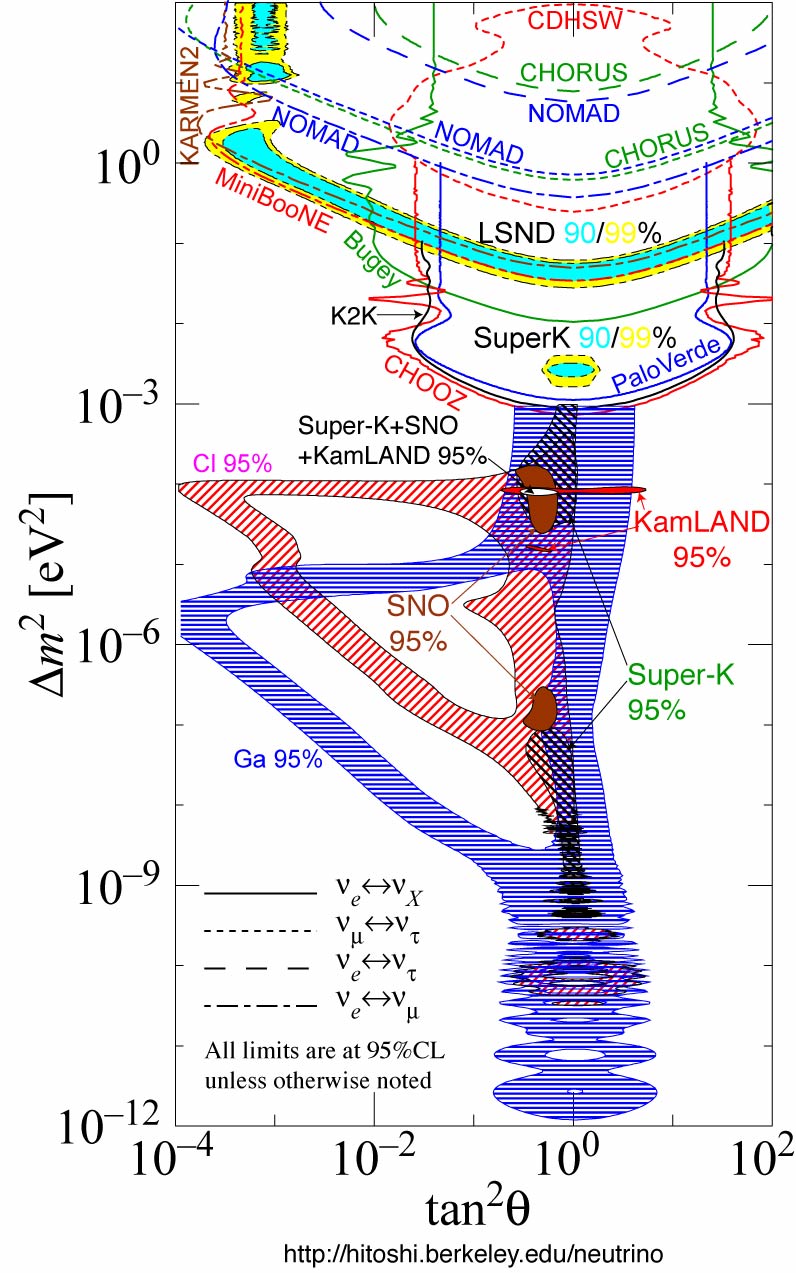
The plot below depicts all the currently available data for electron neutrino oscillations, which places the mass-square around 8×10⁻⁵ eV2, and θ at about 33.9° (i.e. the mixing is with high confidence not maximal).


[Figure: Hitoshi Murayama, see here for references on the used data]


The lines on the top indicate excluded regions from earlier experiments, the filled regions are allowed values. You see the KamLAND 95%CL area in red, and SNO in brown. The remaining island in the overlap is pretty much constrained by now. Given that neutrinos are so elusive particles, and this mass scale is incredibly tiny, I am always impressed by the precision of these experiments!

To fit the oscillations between all the known three neutrino flavors, one needs three mixing angles, and two mass differences (the overall mass scale factors out and does not enter, neutrino oscillations thus are not sensitive to the total neutrino masses). All the presently available data has allowed us to tightly constrain the mixing angles and mass squares. The only outsider (that was thus excluded from the global fits) is famously LSND (see also the above plot), so MiniBooNE was designed to check on their results. For more info on MiniBooNE, see Heather Ray's excellent post at CV.


This post originally appeared in December 2007 as part of our advent calendar A Plottl A Day.

Friday, October 02, 2015

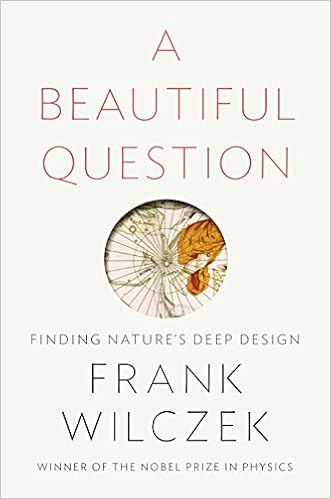
Book Review: “A Beautiful Question” by Frank Wilczek

A Beautiful Question: Finding Nature's Deep Design
By Frank Wilczek
Penguin Press (July 14, 2015)

My four year old daughter recently discovered that equilateral triangles combine to larger equilateral triangles. When I caught a distracted glimpse of her artwork, I thought she had drawn the baryon decuplet, an often used diagram to depict relations between particles composed of three quarks.

The baryon decuplet doesn’t come easy to us, but the beauty of symmetry does, and how amazing that physicists have found it tightly woven into the fabric of nature itself: Both the standard model of particle physics and General Relativity, our currently most fundamental theories, are in essence mathematically precise implementations of symmetry requirements. But next to being instrumental for the accurate description of nature, the appeal of symmetries is a human universal that resonates in art and design throughout cultures. For the physicist, it is impossible not to note the link, not to see the equations behind the art. It may be a curse or it may be a blessing.


For Frank Wilczek it clearly is a blessing. In his most recent book “A Beautiful Question,” he tells the success of symmetries in physics, and goes on to answer his question whether “the world embodies beautiful ideas” with a clear “Yes.”

Lara’s decuplet
Wilczek starts from the discovery of basic mathematical relationships like Pythagoras’ theorem (not shying away from explaining how to prove it!) and proceeds through the history of physics along selected milestones such as musical harmonies, the nature of light and the basics of optics, Newtonian gravity and its extension to General Relativity, quantum mechanics, and ultimately the standard model of particle physics. He briefly touches on condensed matter physics, graphene in particular, and has an interesting digression about the human eye’s limited ability to decode visual information (yes, the shrimp again).

In the last chapters of the book, Wilczek goes into quite some detail about the particle content of the standard model, and in just which way it seems to be not as beautiful as one may have hoped. He introduces the reader to extended theories, grand unification and supersymmetry, invented to remedy the supposed shortcomings of the standard model. The reader who is not familiar with the quantum numbers used to classify elementary particles will likely find this chapter somewhat demanding. But whether or not one makes the effort to follow the details, Wilczek’s gets his message across clearly: Striving for beauty in natural law has been a useful guide, and he expects it to remain one, even though he is careful to note that relying on beauty has on various occasions lead to plainly wrong theories, such as the attempt to explain planetary orbits with the Platonic solids, or to the idea to develop a theory of atoms based on the mathematics of knots.

“A Beautiful Question” is a skillfully written reflection, or “meditation” as Wilczek puts it. It is well structured and accompanied by many figures, including two inserts with color prints. The book also contains an extensive glossary, recommendations for further reading, and a timeline of the discoveries mentioned in the text.

My husband’s decuplet.
The content of the book is unique in the genre. David Goldberg’s book “The Universe in the Rearview Mirror: How Hidden Symmetries Shape Reality,” for example, also discusses the role of symmetries in fundamental physics, but Wilzcek gives more space to the connection between aesthetics in art and science. “A Beautiful Question” picks up and expands on the theme of Steven Weinberg’s 1992 book “Dreams of a Final Theory” that also expounded the relevance of beauty in the development of physical theories. More than 20 years have passed, but the dream is still as elusive today as it was back then.

For all his elaboration on the beauty of symmetry though, Wilczek’s book falls short of spelling out the main conundrum physicists face today: We have no reason to be confident that the laws of nature which we have yet to discover will conform to the human sense of beauty. Neither does he spend many words on aspects of beauty beyond symmetry; Wilczek only briefly touches on fractals, and never goes into the rich appeal of chaos and complexity.

My mother used to say that “symmetry is the art of the dumb,” which is maybe a somewhat too harsh criticism on the standard model, but seeing that reliance on beauty has not helped us within the last 20 years, maybe it is time to consider that the beauty of the answers might not reveal itself as effortlessly as does the tiling of the plane to a 4 year old. Maybe the inevitable subjectivity in our sense of aesthetic appeal that has served us well so far is about to turn from a blessing to a curse, misleading us as to where the answers lie.

Wilczek’s book contains something for every reader, whether that is the physicist interested to learn how a Nobel Prize winner thinks of the connection between ideas and reality, or the layman wanting to know more about the structure of fundamental law. “A Beautiful Question” reminds us of the many ways that science connects to the arts, and invites us to marvel at the success our species has had in unraveling the mysteries of nature.

[An edited version of this review appeared in the October issue of Physics Today.]

Service Announcement: Backreaction now on facebook!

Over the years the discussion of my blogposts has shifted over to facebook. To follow this trend and to make it easier for you to engage, I have now set up a facebook page for this blog. Just "like" the page to get the newest blogposts and other links that I post :)


Thursday, October 01, 2015

When string theorists are out of luck, will Loop Quantum Gravity come to rescue?

Tl;dr: I don’t think they want rescuing.

String theorists and researchers working on loop quantum gravity (LQG) like to each point out how their own attempt to quantize gravity is better than the others’. In the end though, they’re both trying to achieve the same thing – consistently combining quantum field theory with gravity – and it is hard to pin down just exactly what makes strings and loops incompatible. Other than egos that is.

The obvious difference used to be that LQG works only in 4 dimensions, whereas string theory works only in 10 dimensions, and LQG doesn’t allow for supersymmetry, which is a consequence of quantizing strings. However, several years ago the LQG framework has been extended to higher dimensions, and they can now also include supergravity, so that objection is gone.

Then there’s the issue with Lorentz-invariance, which is respected in string theory, but its fate in LQG has been subject of much debate. As of recently though, some researchers working on LQG have argued that Lorentz-invariance, used as a constraint, leads to requirements on the particle interactions, which then have to become similar to some limits found in string theory. This should come as no surprise to string theorists who have been claiming for decades that there is one and only one way to combine all the known particle interactions...

Two doesn’t make a trend, but I have a third, which is a recent paper that appeared on the arxiv:
Bodendorfer argues in his paper that loop quantization might be useful for calculations in supergravity and thus relevant for the AdS/CFT duality.

This duality relates certain types of gauge theories – similar to those used in the standard model – with string theories. In the last decade, the duality has become exceedingly popular because it provides an alternative to calculations which are difficult or impossible in the gauge theory. The duality is normally used only in the limit where one has classical (super)gravity (λ to ∞) and an infinite number of color charges (Nc to ∞). This limit is reasonably well understood. Most string theorists however believe in the full conjecture, which is that the duality remains valid for all values of these parameters. The problem is though, if one does not work in this limit, it is darned hard to calculate anything.

A string theorist, they joke, is someone who thinks three is infinitely large. Being able to deal with a finite number of color charges is relevant for applications because the strong nuclear force has 3 colors only. If one keeps the size of the space-time fixed relative to the string length (which corresponds to fixed Î»), a finite Nc however means taking into account string effects, and since the string coupling gs ~ λ/Nc goes to infinity with λ when Nc remains finite, this is a badly understood limit.

In his paper, Bodendorfer looks at the limit of finite Nc and λ to infinity. It’s a clever limit in that it gets rid of the string excitations, and instead moves the problem of small color charges into the realm of super-quantum gravity. Loop quantum gravity is by design a non-perturbative quantization, so it seems ideally suited to investigate this parameter range where string theorists don’t know what to do. But it’s also a strange limit in that I don’t see how to get back the perturbative limit and classical gravity once one has pushed gs to infinity. (If you have more insight than me, please leave a comment.)

In any case, the connection Bodendorfer makes in his paper is that the limit of Nc to ∞ can also be obtained in LQG by a suitable scaling of the spin network. In LQG one works with a graph that has a representation label, l. The graph describes space-time and this label enters the spectrum of the area operator, so that the average quantum of area increases with this label. When one keeps the network fixed, the limit of large l then blows up the area quanta and thus the whole space, which corresponds to the limit of Nc to infinity.

So far, so good. If LQG could now be used to calculate certain observables on the gravity side, then one could further employ the duality to obtain the corresponding observables in the gauge theory. The key question is though whether the loop-quantization actually reproduces the same limit that one would obtain in string theory. I am highly skeptical that this is indeed the case. Suppose it was. This would mean that LQG, like string theory, must have a dual description as a gauge theory still outside the classical limit in which they both agree (they better do). The supersymmetric version of LQG used here has the matter content of supergravity. But it is missing all the framework that in string theory eventually give rise to branes (stacks thereof) and compactifications, which seem so essential to obtain the duality to begin with.

And then there is the problem that in LQG it isn’t well understood how to get back classical gravity in the continuum limit, which Bodendorfer kind of assumes to be the case. If that doesn’t work, then we don’t even know whether in the classical limit the two descriptions actually agree.

Despite my skepticism, I think this is an important contribution. In lack of experimental guidance, the only way we can find out which theory of quantum gravity is the correct description of nature is to demonstrate that there is only one way to quantize gravity that reproduces the General Relativity and the Standard Model in the suitable limits while being UV-finite. Studying how the known approaches do or don’t relate to each other is a step to understanding whether one has any option in the quantization, or whether we do indeed already have enough data to uniquely identify the sought-after theory.

Summary: It’s good someone is thinking about this. Even better this someone isn’t me. For a theory that has only one parameter, it seems to have a lot of parameters.

Monday, September 28, 2015

No, Loop Quantum Gravity has not been shown to violate the Holographic Principle

Didn't fly.
Tl;dr: The claim in the paper is just wrong. Read on if you want to know why it matters.

Several people asked me for comments on a recent paper that appeared on the arxiv, “Violation of the Holographic Principle in the Loop Quantum Gravity” by Ozan Sargın and Mir Faizal. We have met Mir Faizal before; he is the one who explained that the LHC would make contact to parallel universes [spoiler alert: it won’t]. Now, I have recently decided to adapt a strict diet of intellectual veganism: I’ll refuse to read anything produced by making science suffer. So I wouldn’t normally have touched the paper, not even with a fork. But since you asked, I gave it a look.

The claim in the paper is that Loop Quantum Gravity (LQG), the most popular approach to quantum gravity after string theory, must be wrong because it violates the Holographic Principle. The Holographic Principle requires that the number of different states inside a volume is bounded by the surface of the volume. That sounds like a rather innocuous and academic constraint, but once you start thinking about it it’s totally mindboggling.

All our intuition tells us that the number of different states in a volume is bounded by the volume, not the surface. Try stuffing the Legos back into your kid’s toy box, and you will think it’s the volume that bounds what you can cram inside. But the Holographic Principle says that this is only approximately so. If you would try to pack more and more, smaller and smaller Legos into the box, you would eventually fail to get anything more inside. And if you would measure what bounds the success of your stuffing of the tiniest Legos, it would be the surface area of the box. In more detail, the amount of different states has to be less then a quarter of the surface area measured in Planck units. That’s a huge number and so far off our daily experience that we never notice this limit. What we notice in practice is only the bound by the volume.

The Holographic Principle is a consequence of black hole physics, which does not depend on the details of quantizing gravity, and it is therefore generally expected that the entropy bound must be obeyed by all approaches to quantum gravity.

Physicists have tried, of course, to see whether they can find a way to violate this bound. You can consider various types of systems, pack them as tightly as possible, and then calculate the number of degrees of freedom. In this, it is essential that you take into account quantum behavior, because it’s the uncertainty principle that ultimately prevents arbitrarily tight packing. In all known cases however, it was found that the system will collapse to a black hole before the bound is saturated. And black holes themselves saturate the bound. So whatever physicists tried, they only confirmed that the bound holds indeed. With every such thought-experiment, and with every failure of violating the entropy bound, they have grown more convinced that the holographic principle captures a deep truth about nature.

The only known exception that violates the holographic entropy bound are the super-entropic monster-states constructed by Hsu and collaborators. These states however are pathological in that not only will they inevitably go on to collapse to a black hole, they also must have come out of a white hole in the past. They are thus mathematically possible, but not physically realistic. (Aside: That the states come out of a white hole and vanish into a black hole also means you can’t create these super-entropic configurations by throwing in stuff from infinity, which should come as a relief to anybody who believes in the AdS/CFT correspondence.)

So if Loop Quantum Gravity would violate the Holographic Principle that would be a pretty big deal, making the theory inconsistent with all that’s known about black hole physics!

In the paper, the authors redo the calculation for the entropy of a particular quantum system. With the usual quantization, this system obeys the holographic principle. With the quantization technique from Loop Quantum Gravity, the authors get an additional term but the system still obeys the holographic entropy bound, since the additional term is subdominant to the first. They conclude “We have demonstrated that the holographic principle is violated due to the effects coming from LQG.” It’s a plain non-sequitur.

I suspect that the authors mistook the maximum entropy of the quantum system under consideration, previously calculated by ‘t Hooft, for the holographic bound. This is strange because in the introduction they have the correct definition for the holographic bound. Besides this, the claim that in LQG it should be more difficult to obey the holographic bound is highly implausible to begin with. LQG is a discretization approach. It reduces the number of states, it doesn’t increase them. Clearly, if you go down to the discretization scale, the number of states should drop to zero. This makes me think that not only did the authors misinterpret the result, they probably also got the sign of the additional term wrong.

(To prevent confusion, please note that in the paper they calculated corrections to the entropy of the matter, not corrections to the black hole entropy, which would go onto the other side of the equation.)

You might get away with the impression that we have here two unfortunate researchers who were confused about some terminology, and I’m being an ass for highlighting their mistakes. And you would be right, of course, they were confused, and I’m an ass. But let me add that after having read the paper I did contact the authors and explained that their statement that the LQG violates the Holographic Principle is wrong and does not follow from their calculation. After some back and forth, they agreed with me, but refused to change anything about their paper, claiming that it’s a matter of phrasing and in their opinion it’s all okay even though it might confuse some people. And so I am posting this explanation here because then it will show up as an arxiv trackback. Just to avoid that it confuses some people.

In summary: Loop Quantum Gravity is alive and well. If you feed me papers in the future, could you please take into account my dietary preferences?

Thursday, September 24, 2015

The power of words – and its limit

What images does the word “power” bring to your mind? Weapons? Bulging muscles? A mean-looking capitalist smoking cigar? Whatever your mind’s eye brings up, it is most likely not a fragile figure hunched over a keyboard. But maybe it should.

Words have power, today more than ever. Riots and rebellions can be arranged by text-messages, a single word made hashtag can create a mass movement, 140 characters will ruin a career, and a video gone viral will reach out to the world. Words can destroy lives or they can save them: “If you find the right tone and the right words, you can reach just about anybody,” says Cid Jonas Gutenrath who worked for years at the emergency call center of the Berlin police force [1]:

“I had worked before as a bouncer, and I was always the shortest one there. I had an existential need, so to speak, to solve problems through language. I can express myself well, and when that’s combined with some insights into human nature it’s a valuable skill. What I’m talking about is every conversation with the police, whether it’s an emergency call or a talk on the street. Language makes it possible for everyone involved to get out of the situation in one piece.”

Words won’t break your bones. But more often than not, words – or their failure – decide whether we take to weapons. It is our ability to convince, cooperate, and compromise that has allowed us to conquer an increasingly crowded planet. According to recent research, what made humans so successful might indeed not have been superior intelligence or skills, but instead our ability to communicate and work together.

In a recent SciAm issue, Curtis W. Marean, Professor for Archeology at Arizona State University, lays out a new hypothesis to explain what was the decisive development that allowed humans to dominate Earth. According to Marean, it is not, as previously proposed, handling fire, building tools, or digesting a large variety of food. Instead, he argues, what sets us apart is our willingness to negotiate a common goal.

The evolution of language was necessary to allow our ancestors to find solutions to collective problems, solutions other than hitting each other over the head. So it became possible to reach agreements between groups, to develop a basis for commitments and, eventually, contracts. Language also served to speed up social learning and to spread ideas. Without language we wouldn’t have been able to build a body of knowledge on which the scientific profession could stand today.

“Tell a story,” is the ubiquitous advice given to anybody who writes or speaks in public. And yet, some information fits badly into story-form. In popular science writing, the reader inevitably gets the impression that much of science is a series of insights building onto each other. The truth is that most often it is more like collecting puzzle pieces that might or might not actually belong to the same picture.

The stories we tell are inevitably linear; they follow one neat paragraph after the other, one orderly thought after the next, line by line, word by word. But this simplicity betrays the complexity of the manifold interrelations between scientific concepts. Ask any researcher for their opinion on a news report in their discipline and they will almost certainly say “It’s not so simple…”

Links between different fields of science.
Image Source: Bollen et al, PLOS ONE, March 11, 2009.
There is a value to simple stories. They are easily digestible and convey excitement about science. But the reader who misses the entire context cannot tell how well a new finding is embedded into existing research. The term “fringe science” is a direct visual metaphor alluding to this disconnect, and it’s a powerful one. Real scientific progress must fit into the network of existing knowledge.

The problem with linear stories doesn’t only make the writing about science difficult, but also the writing in science. The main difficulty when composing scientific papers is the necessity to convert a higher-dimensional network of associations into a one-dimensional string. It is plainly impossible. Many research articles are hard to follow, not because they are badly written, but because the nature of knowledge itself doesn’t lend itself to the narrative.

I have an ambivalent relation to science communication because a good story shouldn’t make or break an idea. But the more ideas we are exposed to, the more relevant good presentation becomes. Every day scientific research seems a little less like a quest for truth, and a little more like a competition for attention.

In an ideal world maybe scientists wouldn’t write their papers themselves. They would call for an independent reporter and have to explain their calculations, then hand over their results. The paper would be written up by an unbiased expert, plain, objective, and comprehensible. Without exaggerations, without omissions, and without undue citations to friends. But we don’t live in an ideal world.

What can you do? Clumsy and often imperfect, words are still the best medium we have to convey thought. “I think therefore I am,” Descartes said. But 400 years later, the only reason his thought is still alive is that he put into writing.


[1] Quoted in: Evonik Magazine 2015-02, p 17.

Wednesday, September 23, 2015

Can dark matter cause cancer?

Image Credits: Agnis Schmidt-May
Tl;dr: Yes. But it’s exceedingly unlikely.

Yesterday, a new paper appeared on the arxiv, provocatively titled “Dark matter as a cancer hazard.” It is a comment on an earlier paper by Freese and Savage, which I previously wrote about here.

Freese and Savage in their 2012 paper estimated the interaction rate of dark matter with the human body for weakly interacting massive particls (WIMPs). They came to the conclusion that the risk of getting cancer from damage caused by dark matter to the genetic code is much smaller than the risk posed by the cosmic radiation we are constantly exposed to.

Yes, dark matter can cause cancer. That’s because literally everything can cause cancer: The probability that a particle collision breaks a molecular bond is never strictly speaking zero, and such damage can potentially turn a cell into a cancerous reproduction machine. Even doing nothing at all can cause cancer, just because a bond may break simply due to quantum fluctuations. It’s not fair, I know. It’s also so unlikely to happen that it didn’t even make it onto the Daily Mail’s List of Things That Can Give You Cancer. Should dark matter go onto the list? After all, the idea that dark matter may lead to “biological phenomena having sometimes fatal late effects” dates back at least to 1990.

In the new paper the authors estimate the interaction probability with the human body for a different type of dark matter. They looked specifically at mirror dark matter whereas Freese and Savage had looked at one of the presently most popular dark matter models, the WIMPs. I can see a whole industry growing out of this.

But what is mirror dark matter and why have you never heard of it?

Mirror dark matter is a complex type of dark matter, a complete copy of the standard model that describes our normal matter. The mirror dark matter interacts only gravitationally with us, or at least only very weakly. This sounds like a nice idea, the next best thing you may think of after just having a single particle. The problem is that we know dark matter does not behave just like normal matter, which renders mirror dark matter immediately implausible.

To begin with there is more dark matter in the universe than normal matter. But more importantly, observations tell us that dark matter must be weakly interacting with itself, otherwise the cosmic microwave background would not have the observed spectrum of temperature fluctuations. Our normal matter interacts much too strongly with itself to achieve that. Then there are case studies like the Bullet Cluster, whose gravitational lensing images reveal that dark matter does not have as much friction among itself as normal dark matter. Dark matter also doesn’t form galaxies in the same way that normal matter does, but rather it acts as a seed for our galaxies. If it didn’t, structure formation wouldn’t come out correctly.

So clearly, dark matter that just does the same as normal matter doesn’t work. On the other hand, a copy of the standard model is a large set of particles with many emergent parameters (like particle abundances) that allow a lot of freedom to make the model fit the data.

You can try for example to adapt the mirror matter model by making changes to the initial conditions, so that they differ from the initial condition of normal matter. The mirror dark matter is assumed to start in the early universe from a specifically chosen configuration, that in particular implies that the two types of matter do not have the same temperature later on. This can solve some problems and make mirror dark matter fit many of our observations. It brings up the question though Why these initial conditions?

As has been argued, probably most vocally by Paul Davies, the distinction between initial conditions and evolution laws is fuzzy. If you fabricate your initial conditions smartly enough, you can make pretty much any model fit the data. (You can take the state that we observe today and evolve it backwards time. Then pick whatever you get as initial state. Voila.) So I don’t actually doubt that it is possible to explain the observations with mirror dark matter. But cherry picking initial conditions doesn’t seem very convincing to me.

In any case, leaving aside that mirror dark matter is not particularly popular because dark matter just doesn’t seem to behave anything like normal matter, it’s a model, and it has equations and so on, and now you can go and calculate things.

To estimate the cancer risk from mirror dark matter, the authors assume that the mirror dark matter forms atoms, which can bind together to “mirror micrometeorites” that contain about 1015 mirror atoms. They then estimate the energy deposited by the mirror micrometeorites in the human body and find that they can leave behind more energy than weakly interacting single-particle dark matter. These mirror-objects can thus damage multiple bonds on their path. The reason is basically that they are larger.

So how likely is mirror dark matter to give you cancer? Well, unfortunately in the paper they only estimate the energy deposited by the micrometeorites, but not the probability for these objects to hit you to begin with. I wrote an email to one of the authors and inquired if there is an estimate for the flux of such objects through earth, but apparently there is none. But one thing we know about dark matter is how much there has to be of it in total. So if dark matter is clumped to pieces larger than WIMPs this means that there must be fewer of these pieces. In other words, the flux of the mirror nuclei relative to that of WIMPs should be lower. Without a concrete model though, one really can’t say anything more.

In the new paper, the authors further speculate that dark matter may account for some types of cancer
“We can thus speculate that the mirror micrometeorite, when interacting with the DNA molecules, can lead to multiple simultaneous mutations and cause disease. For instance, there is an evidence that individual malignant cancer cells in human tumors contain thousands of random mutations and that normal mutation rates are insufficient to account for these multiple mutations found in human cancers [...]”
Whatever the risk of getting cancer from dark matter however, it probably hasn’t changed much for the last billion years or so. One could then try to turn the argument around and argue that if there were too many of such mirror micrometeorites then the dinosaurs would have died from cancer, or something like that. I am not very excited about such biological constraints, the uncertainties are much too large in this area. You almost certainly get better accuracy looking at traces in minerals or actual particle detectors.

In summary, the paper doesn’t estimate the cancer risk for an unconfirmed model. And in any case, short of moving to the center of the Earth there isn’t anything you could do about it anyway.

Tuesday, September 15, 2015

10 Things you should know about Dark Matter

Dark matter filaments. Image Credits:
John Dubinski (U of Toronto).
1. “Dark” doesn’t just mean we don’t see it.

It means it doesn’t emit any electromagnetic radiation for all we can tell. Astronomers haven’t been able to find neither light visible to the eye, nor radiation in the radio range or x-ray regime, and not at even higher energies either.

2. “Matter” doesn’t just mean it’s stuff.

What physicists classify as matter must behave like the matter we are made of, at least for what its motion in space and time is concerned. This means in particular dark matter dilutes when it spreads into a larger volume, and causes the same gravitational attraction as ordinary, visible, matter. It is easy to think up “stuff” that does not do this. Dark energy for example does not behave this way.

3. It’s not going away.

You will not wake up one day and hear physicists declare it’s not there at all. The evidence is overwhelming: Weak gravitational lensing demonstrates that galaxies have a larger gravitational pull than visible matter can produce. Additional matter in galaxies is also necessary to explain why stars in the outer arms of galaxies orbit so quickly around the center. The observed temperature fluctuations in the cosmic microwave background can’t be explained without dark matter, and the structures formed by galaxies wouldn’t come out right without dark matter either.

Even if all of this was explained by a modification of gravity rather than an unknown type of matter, it would still have to be possible to formulate this modification of gravity in a way that makes it look pretty much like a new type of matter. And we’d still call it dark matter.

4. Rubin wasn’t the first to find evidence for dark matter.

Though she was the first to recognize its relevance. A few decades before Vera Rubin noticed that stars rotate inexplicably fast around the centers of galaxies, Fritz Zwicky pointed out that a swarm of about a thousand galaxies which are bound together by gravity to the “Coma Cluster” also move too quickly. The velocity of the galaxies in a gravitational potential depends on the total mass in this potential, and the too large velocities indicated already that there was more mass than could be seen. However, it wasn’t until Rubin collected her data that it became clear this isn’t a peculiarity of the Coma Cluster, but that dark matter must be present in almost all galaxies and galaxy clusters.

5. Dark matter doesn’t interact much with itself or anything else.

If it did, it would slow down and clump too much and that wouldn’t be in agreement with the data. A particularly vivid example comes from the Bullet Cluster, which actually consists of two clusters of galaxies that have passed through each other. In the Bullet Cluster, one can detect both the distribution of ordinary matter, mostly be emission of x-rays, and the distribution of dark matter, by gravitational lensing. The data demonstrates that the dark matter is dislocated from the visible matter: The dark matter parts of the clusters seem to have passed through each other almost undisturbed, whereas the visible matter was slowed down and its shape was noticeably distorted.

The same weak interaction is necessary to explain the observations on the cosmic microwave background and galactic structure formation.

6. It’s responsible for the structures in the universe.

Since dark matter doesn’t interact much with itself and other stuff, it’s the first type of matter to settle down when the universe expands and the first to form structures under its own gravitational pull. It is dark matter that seeds the filaments along which galaxies later form when visible matter falls into the gravitational potential created by the dark matter. If you look at some computer simulation of structure formation, what is shown is almost always the distribution of dark matter, not of visible matter. Visible matter is assumed to follow the same distribution later.

7. It’s probably not smoothly distributed.

Dark matter doesn’t only form filaments on supergalactic scales, it also isn’t entirely smoothly distributed within galaxies – at least that’s what the best understood models say. Dark matter doesn’t interact enough to form objects as dense as planets, but it does have ‘halos’ of varying density that move around in galaxies. The dark matter density is generally larger towards the centers of galaxies.

8. Physicists have lots of ideas what dark matter could be.

The presently most popular explanation for the puzzling observations is some kind of weakly interacting particle that doesn’t interact with light. These particles have to be quite massive to form the observed structures, about as heavy as the heaviest particles we know already. If dark matter particles weren’t heavy enough they wouldn’t clump sufficiently, which is why they are called WIMPs for “Weakly Interacting Massive Particles.” Another candidate is a particle called the axion, which is very light but leaves behind some kind of condensate that fills the universe.

There are other types of candidate particles that have more complex interactions or are heavier, such Wimpzillas and other exotic stuff. Macro dark matter is a type of dark matter that could be accommodated in the standard model; it consists of macroscopically heavy chunks of unknown types of nuclear matter.

Then there are several proposals for how to modify gravity to accommodate the observations, such as MOG, entropic gravity, or bimetric theories. Though very different by motivation, the more observations have to be explained the more similar the explanations through additional particles have become to the explanations through modifying gravity.

9. And they know some things dark matter can’t be.

We know that dark matter can’t be constituted by dim brown dwarfs or black holes. The main reason is that we know the total mass dark matter brings into our galaxy, and it’s a lot, about 10 times as much as the visible matter. If that amount of mass was made up from black holes, we should constantly see gravitational lensing events – but we don’t. It also doesn’t quite work with structure formation. And we know that neutrinos, even though weakly interacting, can’t make up dark matter either because they are too light and they wouldn’t clump strongly enough.

10. But we have no direct experimental evidence.

Despite decades of search, nobody has ever directly detected a dark matter particle and the only evidence we have is still indirectly inferred from gravitational pull. Physicists have been looking for the rare interactions of proposed dark matter candidates in many Earth-based experiments starting already in the 1980s. They also look for astrophysical evidence of dark matter, such as signals from the mutual annihilation of dark matter particles. There have been some intriguing findings, such as the PAMELA positron excess, the DAMA annual modulation, or the Fermi gamma-ray excess, but physicists haven’t been able to link any of these convincingly to dark matter.


[This article previously appeared at Starts With a Bang.]

Friday, September 11, 2015

How to publish your first scientific paper

I get a lot of email asking me for advice on paper publishing. There’s no way I can make time to read all these drafts, let alone comment on them. But simple silence leaves me feeling guilty for contributing to the exclusivity myth of academia, the fable of the privileged elitists who smugly grin behind the locked doors of the ivory tower. It’s a myth I don’t want to contribute to. And so, as a sequel to my earlier post on “How to write your first scientific paper”, here is how to avoid roadblocks on the highway to publication.

There are many types of scientific articles: comments, notes, proceedings, reviews, books and book chapters, for just to mention the most common ones. They all have their place and use, but in most of the sciences it is the research article that matters most. It’s what we all want, to get our work out there in a respected journal, and it’s what I will focus on.

Before we start. These days you can publish literally any nonsense in a scam journal, usually for a “small fee” (which might only be mentioned at a late stage in the process, oops). Stay clear of such shady business, it will only damage your reputation. Any journal that sends you an unsolicited “call for papers” is a journal to avoid (and a sender to put on the junk list). When in doubt, check Beall’s list of Potential, Probable and Possible Predators.

1. Picking a good topic

There are two ways you can go on a road trip: Find a car or hitchhike. In academic publishing, almost everyone starts out a hitchhiker, coauthoring a work typically with their supervisor. This moves you forward quickly at first, but sooner or later you must prove that you can drive on your own. And one day, you will have to kick your supervisor off the copilot seat. While you can get lucky with any odd idea as topic, there are a few guidelines that will increase your chances of getting published.

1.1 Novelty

For research topics as with cars it holds that a new one will get you farther than an interesting one. If you have a new result, you will almost certainly eventually get it published in a decent journal. But no matter how interesting you think a topic is, the slightest doubt that it’s new will prevent publication.

As a rule of thumb, I therefore recommend you stay far away from everything older than a century. Nothing reeks of crackpottery as badly as a supposedly interesting find in special relativity or classical electrodynamics or the foundations of quantum mechanics.

At first, you will not find it easy to come up with a new topic at the edge of current research. A good way to get ideas is to attend conferences. This will give you an overview on the currently open questions, and an impression where your contribution would be valuable. Every time someone answers a question with “I don’t know,” listen up.

1.2. Modesty

Yes, I know, you really, really want to solve one of the Big Problems. But don’t claim in your first paper that you did, it’s like trying to break a world record first time you run a mile. Except that in science you don’t only have to break the record, you also have to convince others you did.

For the sake of getting published, by all means refer to whatever question it is that inspires you in the introductory paragraph, but aim at a solid small contribution rather than a fluffy big one. Most senior researchers have a grandmotherly tolerance for the exuberance and naiveté of youth, but forgiveness ends at the journal’s front door. As encouraging as they may be in personal conversation, a journal reference serves as quality check for scientific standard, and nobody wants to be the one to blame for not keeping up the standard. So aim low, but aim well.

1.3. Feasibility

Be realistic about what you can achieve and how much time you have. Give your chosen topic a closer look: Do you already know all you need to know to get started, or will you have to work yourself into an entirely or partially new field? Are you familiar with the literature? Do you know the methods? Do you have the equipment? And lastly, but most importantly, do you have the motivation that will keep you going?

Time management is chronically hard, but give it a try and estimate how long you think it will take, if only to laugh later about how wrong you were. Whatever your estimate, multiply it by two. Does it fit in you plans?

2. Getting the research done

Do it.


3. Preparing the manuscript 

Many scientists dislike the process of writing up their results, thinking it only takes time away from real science. They could not be more mistaken. Science is all about the communication of knowledge – a result not shared is a result that doesn’t matter. But how to get started?

3.1. Collect all material

Get an overview on the material that you want your colleagues to know about: calculations, data, tables, figures, code, what have you. Single out the parts you want to publish, collect them in a suitable folder, and convert them into digital form if necessary, ie type off equations, make vector graphics of sketches, render images, and so on.

3.2. Select journals

If you are unsure what journals to choose, have a look at the literature you have used for your research. Most often this will point you towards journals where your topic will fit in. Check the website to see whether they have length restrictions and if so, if these might become problematic. If all looks good, check their author guidelines and download the relevant templates. Read the guidelines. No, I mean, actually read them. The last thing you want is that your manuscript gets returned by an annoyed editor because your image captions are in the wrong place or similar nonsense.

Select the four journals that you like best and order them by preference. Chances are your paper will get rejected at the first, and laying out a path to continue in advance will prevent you from dwelling on your rejection for an indeterminate amount of time.

3.3. Write the paper

For how to structure a scientific paper, see my earlier post.

3.4. Get feedback

Show your paper to several colleagues and ask for feedback, but only do this once you are confident the content will no longer substantially change. The amount of confusion returning to your inbox will reveal which parts of the manuscript are incomprehensible or, heaven forbid, just plainly wrong.

If you don’t have useful contacts, getting feedback might be difficult, and this difficulty increases exponentially with the length of the draft. It dramatically helps to encourage others to actually read your paper if you tell them why it might be useful for their own research. Explaining this requires that you actually know what their research is about.

If you get comments, make sure to address them.

3.5. Pre-publish or not?

Pre-print sharing, for example on the arxiv, is very common in some areas and less common in others. I would generally recommend it if you work in a fast moving field where the publication delay might limit your claim to originality. Pre-print sharing is also a good way to find out whether you offended someone by forgetting to cite them, because they’ll be in your inbox the next morning.

3.6. Submit the paper

The submission process depends very much on the journal you have chosen. Many journals now allow you to submit an arxiv link, which dramatically simplifies matters. However, if you submit source-files, always check the complied pdf “for your approval”. I’ve seen everything from half-empty pages to corrupted figures to pdfs that simply didn’t load.

Some journals allow you to select an editor to whom the manuscript will be sent. It is generally worth checking the list to see if there is someone you know. Or maybe ask a colleague who they have made good or bad experience with. But don’t worry if you don’t know any one of them.

4. Passing peer review

After submission your paper will generally first be screened to make sure it fulfills the journal requirements. This is why it is really important that the topic fits well. If you pass this stage your paper is sent to some of your colleagues (typically two to four) for the dreaded peer review. The reviewers’ task is to read the paper, send back comments on it, and to assign it one of four categories: publish, minor changes, major changes, reject. I have never heard of any paper that was accepted without changes.

In many cases some of the reviewers are picked from your reference list, excluding people you have worked with yourself or who are in the acknowledgements. So stop and think for a moment whether you really want to list all your friends in the acknowledgements. If you have an archenemy who shouldn’t be commenting on your paper, let the editor know about this in advance.

Never submit a paper to several journals at the same time. Also don’t do this if the papers have even partly overlapping content. You might succeed, but trying to boost your publication count by repeating yourself is generally frowned upon and not considered good practice. The exception is conference proceedings, which often summarize longer paper’s content.

When you submit your paper you will be asked to formally accept the ethics code of the journal. If it’s your first submission, take a moment to actually read it. If nothing else, it will make you feel very grown up and sciency.

Some journals ask you to sign a copyright form already with submission. I have no clue what they are thinking. I never sign a copyright form until the revisions are done.

Peer review can be annoying, frustrating, infuriating even. To keep your sanity and to maximize your chance of passing try the following:

4.1. Keep perspective

This isn’t about you personally, it’s about a manuscript you wrote. It is easy to forget, but in the end you, the reviewers, and the editor have the same goal: to advance science with good research. Work towards that common end.

4.2. Stay polite and professional

Unless you feel a reviewer makes truly inappropriate comments, don’t complain to the editor about strong wording – you will only waste your time. Inappropriate comments are everything that refers to your person or affiliation (or absence thereof), any type of ideological arguments, and opinions not backed up by science. All other comments you should go through and address them one by one, in a reply attached to the resubmission and by changes to the manuscript where appropriate. Never ignore a question posed by a referee, it provides a perfect reason to reject your manuscript.

In case a referee finds an actual mistake in your paper, be reasonable about whether you can fix it in the time given until resubmission. If not, it is better to withdraw the submission.

4.3. Revise, revise, revise

Some journals have a maximum number of revisions that they allow after which an editor will make a final decision. If you don’t meet the mark and your paper is eventually rejected, take a moment to mull over the reason of rejection and revise the paper one more time before you submit it to the next journal.

Goto 3.6. Repeat as necessary.

5. Proofs

If all goes well, one day you will receive a note saying that your paper has been accepted for publication and you will soon receive page proofs. Congratulations!

It might feel like a red light five minutes from home when you have to urgently pee, but please read the page proofs carefully. You will never forgive yourself if you don’t correct that sentence which a well-meaning copy editor rearranged to mean the very opposite of what you intended.

6. And then…

… it’s time to update your CV! Take a walk, and then make plans for the next trip.

Monday, September 07, 2015

Macro Dark Matter

[Some background info on the recent New Scientist feature I wrote with Naomi Lubick.]

I'm the half-face 2nd from the right.
In June I attended the “Continuation of the Space-time Odyssey,” a meeting dedicated to the “celebration of the remarkable advances in the fields of particle physics and cosmology from the turn of the millennium to the present day.” At least that’s what the website said. In reality the meeting was dedicated to celebrate Katie Freese’s arrival in Stockholm. She spared no expenses; pricy hotels, illustrious locations, and fancy food was involved. So of course I went.

It was an “invitation only” conference, but it wasn’t difficult to get on the list because, for reasons mysterious to me, the conference system listed me as a “chair” of the meeting, whatever that might mean. I assure you I didn’t have anything to do neither with the chairs nor with the organization, other than pointing out some organization might be beneficial. So please don’t blame me that there was no open registration.

So much about academia. Now let me say something about the science.
Two talks from the conference were particularly memorable for they stood in stark contrast to each other. The one talk was by Lisa Randall, the other by Glenn Starkman. Both spoke about dark matter, but that’s about where the similarities end.
Randall talked about her recent work on “Partially Interacting Dark Matter” (slides here). Her research in collaboration with JiJi Fan, Andrey Katz, and Matthew Reece is based on a slightly more complicated version of existing particle dark matter models. They consider some so-far undetected particles which are not in the Standard Model. But in contrast to most of the presently used models, these additional particles are not, as commonly assumed, unable to interact with each other. Instead, the particles exert forces among themselves, which has a several consequences.

First, it allows them to explain why dark matter hasn’t been seen in direct detection experiments: the stuff just isn’t as simple as assumed for the estimates of detection rates. Second, it means that dark matter has friction and thus at least partly forms rotation disks during galaxy formation, the “dark disks.” If they are right, our galaxy too should have a dark disk, and our solar system would traverse it periodically every 35 million years or so. If you trust Nature News, which maybe you shouldn’t, then this can explain the extinction of the dinosaurs. Right or wrong, it’s a story catchy enough to spread like measles, and equally spotty. Third, and most important, the partially interacting dark matter introduces additional parameters which you can use to fit unexplained data like the 130 GeV Fermi gamma ray line.

If the model they are using has any theoretical motivation, Randall didn’t mention it. Instead her motivation was that it’s a model which might be testable in the soon future. It’s a search under the lamp post, phenomenological model building at its worst. You do it because you can and you’ll get it published – it certainly won’t harm your peer review assessment if you are one of the best-cited particle physicists ever. But just exactly why this interaction model and not some other that won’t be observed until the return of the Boltzmann brains, I don’t know.

In other words, I wasn’t very convinced that partially interacting dark matter is anything more than something you can publish papers about.

 Now to Starkman (slides here).

He set out alluding to Odysseus’ odyssey, which lead to strange and distant countries that Starkman likened to the proposed dark matter particles like WIMPS and axions. In the end though, Starkman pointed out, Odysseus returned to where he started from. Maybe, he suggested, things have gotten strange enough and it is time to return to where we started from: the Standard Model.

His talk was about “macro dark matter,” a dark matter candidate that has received little if no attention. I had only become aware of it briefly before, through a paper by Starkman together with David Jacobs and Amanda Weltman. Unlike the commonly considered particle dark matter, macro dark matter isn’t composed of single particles, but of macroscopically heavy chunks of matter with masses that are a priori anywhere between a gram and the mass of the Sun.

It is often said that observations indicate dark matter must be made of weakly interacting particles, but that is only true if the matter is thinly dispersed into light, individual particles. What we really know isn’t that the particles are weakly interacting but that are rarely interacting; you never measure a cross-section without a flux. Dark matter could be rarely interacting because it is weakly interacting. That’s the standard assumption. Or it could be rarely interacting because it is clumped together to tiny and dense blobs that are unlikely to meet each other. That’s macro dark matter.

But what is macro dark matter made of? It might for example be a type of nuclear matter that hasn’t been discovered so far, blobs of quarks and gluons that were created in the early universe and lingered around ever since. These blobs would be incredibly dense; at this density the Great Pyramid of Giza would fit inside a raindrop!

If you think nuclear matter is last-century physics, think again. The phases and properties of nuclear matter are still badly understood and certainly can’t be calculated from first principles even today.

Physicists were stunned for example when the quark gluon plasma turned out to have lower viscosity than anybody expected. They still argue about the equations governing the behavior of matter in neutron stars. Nobody has any idea how to calculate lifetimes of unstable isotopes. I recently talked to a nuclear physicist who told me that the state-of-the-art for composites is 20 nucleons. Twenty. This brings you just about up to neon in the periodic table. And that is, needless to say, using an effective model, not quarks and gluons. The Standard Model interactions are well-understood at LHC energies or higher, yes. But once quarks start binding together physicists are back to comparing models with data, rather than making calculations in the full theory.

So matter of nuclear density containing some of the heavier quarks is a possibility. But Starkman and his collaborators prefer to not make specific assumptions and keep their search as model-independent as possible. They were simply looking for constraints on this type of dark matter which are summarized in the figure below

Constraints on macro dark matter. Fig 3 from arxiv:1410.2236

On the vertical axis you have the cross-section, on the horizontal axis the mass of the macros. The grey and green diagonal lines are useful references marking atomic and nuclear density. In general the macro could be made up of a mixture, and so they wanted to keep the density a variable to be constrained by experiment. The shaded regions are excluded by various experiments.

To arrive at the experimental constraints one takes into account two properties of the macros that can be inferred from existing data. The one is the total amount of dark matter which we know from a number of observations, for example gravitational lensing and the CMB power spectrum. This means if we look at a particular mass of the macro, we know how many of them there must be. The other property is the macros’ average velocity which can be estimated from the mass and the strength of the gravitational potential that the particles move in. From the mass and the density one gets the size, and together with the velocity one can then estimate how often these things hit each other – or us.

The grey-shaded left upper region is excluded because the stuff would interact too much, causing it to clump too efficiently, which runs into conflict with the observed large scale structures.

The red regions are excluded by gravitational lensing data. These would be the macros that are so heavy they’d result in frequent strong gravitational lensing which hasn’t been observed. These constraints are also the reason why neutron stars, brown dwarfs, and black holes have long been excluded as possible explanations for dark matter. There are two types of lensing constraints from two different lensing methods, and right now there is a gap between them, but it will probably close in the soon future.

The yellow shaded region excludes macros of small mass, which is possible because these would be hitting Earth quite frequently. A macro with mass 109g for example would pass through Earth about once per year, the lighter ones more frequently. Searches for such particles are similar to searches for magnetic monopoles. One makes use of natural particle detectors, such as the sediment mica that forms neatly ordered layers in which a passing heavy particle would leave a mark. No such marks have been found, which rules out the lighter macros.

What about that open region in the middle? Could macros hide there? Starkman and his collaborators have some pretty cool ideas how to look for macros in that regime, and that’s what my New Scientist piece with Naomi is about. (Want me to keep interesting stories on this blog? Please use the donate button that’s in your face in the top right corner, thank you.)

Macro dark matter of course leaves many open questions. As long as we don’t really know what it’s made of, we have no knowing whether it can form in sufficient amounts or is stable enough. But its big advantage is that it doesn’t necessarily require us to construe up new particles.

Do I like this idea? Holy shit, no, I hate it! Like almost all particle physicists, I prefer my interactions safely in the perturbative regime where I can calculate cross-sections the way I learned it in kindergarten. I fled from the place where I made my PhD because everybody there was doing nuclear physics and I wanted nothing of that. I wanted elementary particles, grand unification and fundamental truths. I would be deeply disappointed if dark matter wasn’t a hint for physics beyond the standard model, but instead would drift into the realm of lattice qcd.

But then I was thinking. If everybody feels this way we might be missing the solution to a 80 year old puzzle because we focus on answer that we like and answers that are simple, not answers that are in our face yet complicated. Yes, macros are the most conservative and in a sense most depressing dark matter model around. But at least they didn’t kill the dinosaurs.