Pages

Showing posts sorted by relevance for query inflation. Sort by date Show all posts

Friday, October 13, 2017

Is the inflationary universe a scientific theory? Not anymore.

Living in a Bubble?
[Image: YouTube]
We are made from stretched quantum fluctuations. At least that’s cosmologists’ currently most popular explanation. According to their theory, the history of our existence began some billion years ago with a – now absent – field that propelled the universe into a phase of rapid expansion called “inflation.” When inflation ended, the field decayed and its energy was converted into radiation and particles which are still around today.

Inflation was proposed more than 35 years ago, among others, by Paul Steinhardt. But Steinhardt has become one of the theory’s most fervent critics. In a recent article in Scientific American, Steinhardt together with Anna Ijjas and Avi Loeb, don’t hold back. Most cosmologists, they claim, are uncritical believers:
“[T]he cosmology community has not taken a cold, honest look at the big bang inflationary theory or paid significant attention to critics who question whether inflation happened. Rather cosmologists appear to accept at face value the proponents’ assertion that we must believe the inflationary theory because it offers the only simple explanation of the observed features of the universe.”
And it's even worse, they argue, inflation is not even a scientific theory:
“[I]nflationary cosmology, as we currently understand it, cannot be evaluated using the scientific method.”
As alternative to inflation, Steinhardt et al promote a “big bounce” in which the universe’s expansion was preceded by a phase of contraction, yielding similar benefits to inflation.

The group’s fight against inflation isn’t news. They laid out their arguments in a series of papers during the last years (on which I previously commented here). But the recent SciAm piece called The Defenders Of Inflation onto stage. Lead by David Kaiser, they signed a letter to Scientific American in which they complained that the magazine gave space to the inflationary criticism.

The letter’s list of undersigned is an odd selection of researchers who themselves work on inflation and of physics luminaries who have little if anything to do with inflation. Interestingly, Slava Mukhanov – one of the first to derive predictions from inflation – did not sign. And it’s not because he wasn’t asked. In an energetic talk delivered at Stephen Hawking’s birthday conference two months ago, Mukhanov made it pretty clear that he thinks most of the inflationary model building is but a waste of time.

I agree with Muhkanov’s assessment. The Steinhardt et al article isn’t exactly a masterwork of science writing. It’s also unfortunate they’re using SciAm to promote some other theory of how the universe began rather than sticking to their criticism of inflation. But some criticism is overdue.

The problem with inflation isn’t the idea per se, but the overproduction of useless inflationary models. There are literally hundreds of these models, and they are – as the philosophers say – severely underdetermined. This means if one extrapolates any models that fits current data to a regime which is still untested, the result is ambiguous. Different models lead to very different predictions for not-yet made observations. Presently, is therefore utterly pointless to twiddle with the details of inflation because there are literally infinitely many models one can think up.

Rather than taking on this overproduction problem, however, Steinhardt et al in their SciAm piece focus on inflation’s failure to solve the problems it was meant to solve. But that’s an idiotic criticism because the problems that inflation was meant to solve aren’t problems to begin with. I’m serious. Let’s look at those one by one:

1. The Monopole Problem

Guth invented inflation to solve the “monopole problem.” If the early universe underwent a phase-transition, for example because the symmetry of grand unification was broken – then topological defects, like monopoles, should have been produced abundantly. We do not, however, see any of them. Inflation dilutes the density of monopoles (and other worries) so that it’s unlikely we’ll ever encounter one.

But a plausible explanation for why we don’t see any monopoles is that there aren’t any. We don’t know there is any grand symmetry that was broken in the early universe, or if there is, we don’t know when it was broken, or if the breaking produced any defects. Indeed, all searchers for evidence of grand symmetry – mostly via proton decay – turned out negative. This motivation is interesting today merely for historical reasons.

2. The Flatness Problem

The flatness problem is a finetuning problem. The universe currently seems to be almost flat, or if it has curvature, then that curvature must be very small. The contribution of curvature to the dynamics of the universe however increases in relevance relative to that of matter. This means if the curvature density parameter is small today, it must have been even smaller in the past. Inflation serves to make any initial curvature contribution smaller by something like 100 orders of magnitude or so.

This is supposed to be an explanation, but it doesn’t explain anything, for now you can ask, well, why wasn’t the original curvature larger than some other number? The reason that some physicists believe something is being explained here is that numbers close to 1 are pretty according to current beauty-standards, while numbers much smaller than 1 numbers aren’t. The flatness problem, therefore, is an aesthetic problem, and I don’t think it’s an argument any scientist should take seriously.

3. The Horizon Problem

The Cosmic Microwave Background (CMB) has almost at the same temperature in all directions. Problem is, if you trace back the origin the background radiation without inflation, then you find that the radiation that reached us from different directions was never in causal contact with each other. Why then does it have the same temperature in all directions?

To see why this problem isn’t a problem, you have to know how the theories that we currently use in physics work. We have an equation – a “differential equation” – that tells us how a system (eg, the universe) changes from one place to another and one moment to another. To make any use of this equation, however, we also need starting values or “initial conditions.”*

The horizon problem asks “why this initial condition” for the universe. This question is justified if an initial condition is complicated in the sense of requiring a lot of information. But a homogeneous temperature isn’t complicated. It’s dramatically easy. And not only isn’t there much to explain, inflation moreover doesn’t even answer the question “why this initial condition” because it still needs an initial condition. It’s just a different initial condition. It’s not any simpler and it doesn’t explain anything.

Another way to see that this is a non-problem: If you’d go back in time far enough without inflation, you’d eventually get to a period when matter was so dense and curvature so high that quantum gravity was important. And what do we know about the likelihood of initial conditions in a theory of quantum gravity? Nothing. Absolutely nothing.

That we’d need quantum gravity to explain the initial condition for the universe, however, is an exceedingly unpopular point of view because nothing can be calculated and no predictions can be made.

Inflation, on the other hand, is a wonderfully productive model that allows cosmologists to churn out papers.

You will find the above three problems religiously repeated as a motivation for inflation, in lectures and textbooks and popular science pages all over the place. But these problems aren’t problems, never were problems, and never required a solution.

Even though inflation was ill-motivated when conceived, however, it later turned out to actually solve some real problems. Yes, sometimes physicists work on the wrong things for the right reasons, and sometimes they work on the right things for the wrong reasons. Inflation is an example for the latter.

The reasons why many physicists today think something like inflation must have happened are not that it supposedly solve the three above problems. It’s that some features of the CMB have correlations (the “TE power spectrum”) which depend on the size of the fluctuations, and implies a dependence on the size of the universe. This correlation, therefore, cannot be easily explained by just choosing an initial condition, since it is data that goes back to different times. It really tells us something about how the universe changed with time, not just where it started from.**

Two more convincing features of inflation are that, under fairly general circumstances, the model also explains the absence of certain correlations in the CMB (the “non-Gaussianities”) and how many CMB fluctuations there are of any size, quantified by what is known as the “scale factor.”

But here is the rub. To make predictions with inflation one cannot just say “there once was exponential expansion and it ended somehow.” No, to be able to calculate something, one needs a mathematical model. The current models for inflation work by introducing a new field – the “inflaton” – and give this field a potential energy. The potential energy depends on various parameters. And these parameters can then be related to observations.

The scientific approach to the situation would be to choose a model, determine the parameters that best fit observations, and then revise the model as necessary – ie, as new data comes in. But that’s not what cosmologists presently do. Instead, they have produced so many variants of models that they can now “predict” pretty much anything that might be measured in the foreseeable future.

It is this abundance of useless models that gives rise to the criticism that inflation is not a scientific theory. And on that account, the criticism is justified. It’s not good scientific practice. It is a practice that, to say it bluntly, has become commonplace because it results in papers, not because it advances science.

I was therefore dismayed to see that the criticism by Steinhardt, Ijas, and Loeb was dismissed so quickly by a community which has become too comfortable with itself. Inflation is useful because it relates existing observations to an underlying mathematical model, yes. But we don’t yet have enough data to make reliable predictions from it. We don’t even have enough data to convincingly rule out alternatives.

There hasn’t been a Nobelprize for inflation, and I think the Nobel committee did well in that decision.

There’s no warning sign you when you cross the border between science and blabla-land. But inflationary model building left behind reasonable scientific speculation long ago. I, for one, am glad that at least some people are speaking out about it. And that’s why I approve of the Steinhardt et al criticism.


* Contrary to what the name suggest, the initial conditions could be at any moment, not necessarily the initial one. We would still call them initial conditions.

** This argument is somewhat circular because extracting the time-dependence for the modes already presumes something like inflation. But at least it’s a strong indicator.

This article was previously published on Starts With A Bang. 

Saturday, March 05, 2022

Did the early universe inflate?

[This is a transcript of the video embedded below. Some of the explanations may not make sense without the animations in the video.]


One of the most amazing discoveries of the past century has been that the universe expands. This is one of the insights physicists derived from Einstein’s theory of General Relativity. Yes, that guy again! But after this discovery, physicists made the theory more complicated. They added the hypothesis that not only does the universe expand, but that early on, right after the big bang, it expanded exponentially, blowing up space by 30 orders of magnitude in a fraction of a second.

This rapid exponential expansion in the early universe is called “inflation” and it does not follow from Einstein’s theory. Why did physicists add this complication? How does it work? And do we have any evidence that it’s actually correct? That’s what we’ll talk about today. Did the early universe inflate?

In the popular science media, inflation is sometimes presented as if it was established fact. It isn’t. Its status is similar to that of particle dark matter. They are both unconfirmed hypotheses. But while most physicists agree that particle dark matter has yet to be empirically confirmed, opinions about inflation are extremely polarized.

On the one hand you have people like Alan Guth, one of the inventors of inflation theory, arguing that the theory has made many correct predictions and that evidence speaks for it. On the other hand, you have people like Paul Steinhardt, interestingly enough also one of the inventors of inflation, who argue that inflation doesn’t make any predictions and isn’t even science. In an essay some years ago, Steinhardt together with Anna Ijjas and Avi Loeb wrote “inflationary cosmology, as we currently understand it, cannot be evaluated using the scientific method.”

Which side is right? They’re both right and they’re both wrong. Stay with me for some minutes and I hope it’ll start making sense.

The major disagreement between the two sides is philosophical, and we have to get this out of the way before we can talk about the science.

Guth, and most of his colleagues really, argue that physicists have used models of inflation to make predictions which were later confirmed, such as some properties of the large scale structure and the cosmic microwave background, notably the scalar spectral index which is somewhat smaller than one, and that space is on average flat, to good precision. This agrees with observation and they think this is evidence in favor of inflation. Steinhardt’s side holds against this that inflation models really predicted anything so that *those predictions which turned out to fit to observations can’t speak in favor of inflation.

On that count, Steinhardt’s people are clearly correct. Just because someone made a correct prediction doesn’t mean they have a good scientific theory. They may just have been lucky. And if you make sufficiently many different predictions, the chance that one of them later fits to observations is very high. Predictions are really overrated. Whether a scientific theory is good or not has nothing to do with the time at which one does a calculation with it. What matters instead is how much data you can correctly explain with it, so Guth’s argument doesn’t hold water.

What Steinhardt’s people are arguing in an nutshell is that inflation is such a flexible hypothesis that it can be made to fit any data. To see why they say this, let us have a look at how inflation works. You conjecture that in the early universe there was no matter but a new type of field called the inflaton field. The inflaton field has a potential energy and it has an initial condition. This potential energy and the initial condition – here comes the problem – are described by a bunch of parameters and functions.

The potential energy gives rise to the exponential expansion of the universe. But as the universe expands, the field sheds its potential energy. And when it’s done with that, the field decays into the normal particles of the standard model. And dark matter, if you think it exists. Which it may not. In any case, the inflaton field disappears so we can’t see it today. And once the inflaton field is gone, you take what’s left and from this you calculate what we should observe.

So the way inflation works is that you put in some parameters, initial values, and functions and out come numbers for what we should measure. There are literally hundreds of models for inflation and each makes somewhat different predictions.

Steinhardt and his people now argue, that regardless of what we observe, you can always fumble together an inflationary model that would fit to the observations. Therefore, the idea has no predictive power.

Guth and his side have two answers to this which actually contradict each other. First, you often hear them claim that inflation has made unambiguous predictions, as I said earlier, that the spectral index is somewhat smaller than one and that the curvature density of space is small today, indeed so small that at present it’s consistent with zero.

Problem is, this is patently untrue. If you look at the old literature, before we had the data, it’s easy enough to find inflationary models that predicted a spectral index larger than one. And inflation doesn’t predict the curvature at all. Inflation merely decreases the initial value that you picked for the curvature. But for any value that we observe today, there is *some initial value.

The second answer you will hear from the defenders of inflation is that, yes, we have a lot of inflationary models and they predict anything, so, contradicting the first argument. But we just determine the correct parameters and the potential from observations and that’s the same we do with the standard model of particle physics. For example, in a recent podcast to which I leave you a link below, Alan Guth made the following claim.
“It is certainly true that there are many different versions of inflation which you describe well, that depends on what you assume about the potential energy function for the inflaton field. That could be models there are models with many inflaton fields, more complicated potentials and interactions between them. So there’s a large variety there. But that’s exactly the same situation as one has in quantum field theory and how it relates to the standard model of particle physics.”
Another example, in response to the SciAm article by Steinhardt and coauthors, a group of cosmologists wrote a letter. This letter was signed by a lot of big shots in the field, Alan Guth and Andrei Linde and David Kaiser, but also Steven Weinberg and Frank Wilczek and Ed Witten. They wrote
“the testability of a theory in no way requires that all its predictions be independent of the choice of parameters. If such parameter independence were required, then we would also have to question the status of the Standard Model, with its empirically determined particle content and 19 or more empirically determined parameters.”
It is correct of course that for a theory to be testable not all its predictions have to be independent of the parameters. But it does require that you predict more data points than you have parameters. A scientific theory requires that you get more out than you put in, otherwise you don’t explain anything, you’re overfitting data.

And when it comes to fitting data, the situation for inflation is not remotely comparable to the standard model of particle physics. In particle physics, those 19 parameters explain literally terabytes of data. This means it’s a model with extraordinarily high explanatory power. But for inflation, the data you’re trying to predict comes down to a few numbers. In this case, the input of the models is actually more complicated than the output. This means they’re crappy models without explanatory power.

That you use the same procedure as for the standard model is completely irrelevant. That in my understanding is what Steinhardt’s side claims. And they are clearly correct on this count, too. Inflation predicts anything, and no this is not standard scientific methodology. Standard scientific methodology would require you to stick with models that have explanatory power.

Steinhardt by the way argued exactly the opposite 20 years ago. The reason he changed his mind seems to have been that many cosmologists have argued that inflation leads to a multiverse and Steinhardt doesn’t like the multiverse. So now he has made up his own alternative to inflation which is a type of cyclic cosmology. This didn’t really do his argument any favor.

Not that Guth’s side did any better. Another “argument” which the defenders of inflation raised in their letter was this:
“According to the high-energy physics database INSPIRE, there are now more than 14,000 papers in the scientific literature, written by over 9,000 distinct scientists, that use the word “inflation” or “inflationary” in their titles or abstracts. By claiming that inflationary cosmology lies outside the scientific method, [Ijjas, Steinhardt, and Loeb] are dismissing the research of not only all the authors of this letter but also that of a substantial contingent of the scientific community.”
This argument sadly shows that social reinforcement is a real problem in physics. Some of the biggest names in the community signed up to what is basically an argument from popularity, clearly a logical fallacy. It’s because of arguments like this that people don’t trust scientists.

In any case, that’s it with the philosophy, now let’s talk about the science. I just told you why Steinhardt’s people are right, so now let me tell you why they’re wrong.

They’re wrong because that there are many physicists who have fumbled together complicated models for inflation is correct but beside the point. Of course it means there’s a colossal waste of time and money going on. But for what the science is concerned really you should ask whether there is *any* simple model of inflation from which you get out more than you put in. And the answer to this is yes. You just have to look at the right models and the right data.

The most impressive data which simple inflationary models explain is a peculiar correlation in the cosmic microwave background, that between the temperature and the E modes, called the ET correlation. Doesn’t really matter if you don’t exactly know what this is, the point is it’s something which has been observed, and it a non-trivial correlation in the data which you can calculate from bunch of simple inflationary models. These models are good explanations for observations.

An example of such a simple model that fits with all current data is Starobinski inflation. In this figure you see that it’s right in the middle of the experimentally allowed region. But some other simple models are good too.

That there are also many other models which don’t work doesn’t really matter. Unless I guess you’re one of the 9000 or so people who have published papers on that.

So to summarize. Guth is right in saying that inflation is good science. But he is wrong with the reason for why that’s the case. Steinhardt is right with pointing out that Guth’s argument doesn’t hold up. But his conclusion is wrong because there are other reasons for why inflation is good science.

However, that doesn’t mean inflation is right. Physicists have proposed many other theories for the early universe, for example cyclic cosmology, and those can also explain observations. And maybe in the end one of those other theories will be the better explanation. We’ll talk about some of those alternatives another time, so don’t forget to subscribe.

Friday, March 08, 2019

Inflation: Status Update

Model of Inflation.
img src: umich.edu
The universe hasn’t always been this way. That the cosmos as a whole evolves, rather than being eternally unchanging, is without doubt one of the most remarkable scientific insights of the past century. It follows from Einstein’s theory of general relativity: Einstein’s theory tells us that the universe must expand. As a consequence, in the early universe matter must have been compressed to high density.

But if you follow the equations back in time, general relativity eventually stops working. Therefore, no one presently knows how the universe began. Indeed, we may never know.

Since the days of Einstein, physicists have made much progress detailing the history of the universe. But the deeper they try to peer into our past, the more difficult their task becomes.

This difficulty arises partly because new data are harder and harder to come by. The dense matter in the early universe blocked light, so we cannot use light to look back to any time earlier than the formation of the cosmic microwave background. For even earlier times, we can make indirect inferences, or hope for new messengers, like gravitational waves or neutrinos. This is technologically and mathematically challenging, but these are challenges that can be overcome, at least in principle. (Says the theorist.)

The more serious difficulty is conceptual. When studying the universe as whole, physicists face the limits of the scientific method: The further back in time they look, the simpler their explanations become. At some point, then, there will be nothing left to simplify, and so there will be no way to improve their explanations. The question isn’t whether this will happen, the question is when it will happen.

The miserable status of today’s theories for the early universe makes me wonder whether it has already happened. Cosmologists have hundreds of theories, and many of those theories come in several variants. It’s not quite as bad as in particle physics, but the situation is similar in that cosmologists, too, produce loads of ill-motivated models for no reason other than that they can get them published. (And they insist this is good scientific practice. Don’t get me started.)

The currently most popular theory for the early universe is called “inflation”. According to inflation, the universe once underwent a phase in which volumes of space increased exponentially in time. This rapid expansion then stopped in an event called “reheating,” at which the particles of the standard model were produced. After this, particle physics continues the familiar way.

Inflation was originally invented to solve several finetuning problems. (I wrote about this previously, and don’t want to repeat it all over again, so if you are not familiar with the story, please check out this earlier post.) Yall know that I think finetuning arguments are a waste of time, so naturally I think these motivations for inflations are no good. However, just because the original reason for the idea of inflation doesn’t make sense doesn’t mean the theory is wrong.

Ever since the results of the Planck in 2013 it hasn’t looked good for inflation. After the results appeared, Anna Ijjas, Paul Steinhardt, and Avi Loeb argued in a series of papers that the models of inflation which are compatible with the data themselves require finetuning, and therefore bring back the problem they were meant to solve. They popularized their argument in a 2017 article in Scientific American, provocatively titled “Pop Goes the Universe.”

The current models of inflation work not simply by assuming that the universe did undergo a phase of exponential inflation, but they moreover introduce a new field – the “inflaton” – that supposedly caused this rapid expansion. For this to work, it is not sufficient to just postulate the existence of this field, the field also must have a suitable potential. This potential is basically a function (of the field) and typically requires several parameters to be specified.

Most of the papers published on inflation are then exercises in relating this inflaton potential to today’s cosmological observables, such as the properties of the cosmic microwave background.

Now, in the past week two long papers about all those inflationary models appeared on the arXiv:
and

The first paper, by Jerome Martin alone, is a general overview of the idea of inflation. It is well-written and a good introduction, but if you are familiar with the topic, nothing new to see here.

The second paper is more technical. It is a thorough re-analysis of the issue of finetuning in inflationary models and a response to the earlier papers by Ijjas, Steinhardt, and Loeb. The main claim of the new paper is that the argument by Ijjas et al, that inflation is “in trouble,” is wrong because it confuses two different types of models, the “plateau models” and the “hilltop models” (referring to different types of the inflaton potential).

According to the new analysis, the models most favored by the data are the plateau models, which do not suffer from finetuning problems, whereas the hilltop models do (in general) suffer from finetuning but are not favored by the data anyway. Hence, they conclude, inflation is doing just fine.

The rest of the paper analyses different aspects of finetuning in inflation (such as quantum contributions to the potential), and discusses further problems with inflation, such as the trans-planckian problem and the measurement problem (as pertaining to cosmological perturbations). It is a very balanced assessment of the situation.

The paper uses standard methods of analysis (Bayesian statistics), but I find this type of model-evaluation generally inconclusive. The problem with such analyses is that they do not take into account the prior probability for the models themselves but only for the initial values and the parameters of the model. Therefore, the results tend to favor models which shove unlikeliness from the initial condition into the model (eg the type of function for the potential).

This is most obvious when it comes to the so-called “curvature problem,” or the question why the universe today is spatially almost flat. You can get this outcome without inflation, but it requires you to start with an exponentially small value of the curvature already (curvature density, to be precise). If you only look at the initial conditions, then that strongly favors inflation.

But of course inflation works by postulating an exponential suppression that comes from the dynamical law. And not only this, it furthermore introduces a field which is strictly speaking unnecessary to get the exponential expansion. I therefore do not buy into the conclusion that inflation is the better explanation. On the very contrary, it adds unnecessary structure.

This is not to say that I think inflation is a bad idea. It’s just that I think cosmologists are focusing on the wrong aspects of the model. Finetuning arguments will forever remain ambiguous because they eventually depend on unjustifiable assumptions. What’s the probability for getting any particular inflaton potential to begin with? Well, if you use the most common measure on the space of all possible function, then all so-far considered potentials have probability zero. This type of reasoning just does not lead anywhere. So why waste time talking about finetuning?

Instead, let us talk about those predictions whose explanatory value does not depend on finetuning arguments, of which I suspect (but do not know) that ET-correlations in the CMB power spectrum are an example. Since finetuning debates will remain unsolvable, it would be more fruitful to focus on those benefits of inflation that can be quantified unambiguously.

In any case, I am sure the new paper will make many cosmologists happy, and encourage them to invent many more models for inflation. Sigh.

Tuesday, October 17, 2017

I totally mean it: Inflation never solved the flatness problem.

I’ve had many interesting reactions to my recent post about inflation, this idea that the early universe expanded exponentially and thereby flattened and smoothed itself. The maybe most interesting response to my pointing out that inflation doesn’t solve the problems it was invented to solve is a flabbergasted: “But everyone else says it does.”

Not like I don’t know that. But, yes, most people who work on inflation don’t even get the basics right.

Inflation flattens the universe like
photoshop flattens wrinkles. Impressive!
[Img Src]


I’m not sure why that is so. Those who I personally speak with pretty quickly agree that what I say is correct. The math isn’t all that difficult and the situation pretty clar. The puzzle is, why then do so many of them tell a story that is nonsense? And why do they keep teaching it to students, print it in textbooks, and repeat it in popular science books?

I am fascinated by this for the same reason I’m fascinated by the widely-spread and yet utterly wrong idea that the Bullet-cluster rules out modified gravity. As I explained in an earlier blogpost, it doesn’t. Never did. The Bullet-cluster can be explained just fine with modified gravity. It’s difficult to explain with particle dark matter. But, eh, just the other day I met a postdoc who told me the Bullet-cluster rules out modified gravity. Did he ever look at the literature? No.

One reason these stories survive – despite my best efforts to the contrary – is certainly that they are simple and sound superficially plausible. But it doesn’t take much to tear them down. And that it’s so simple to pull away the carpet under what motivates research of thousands of people makes me very distrustful of my colleagues.

Let us return to the claim that inflation solves the flatness problem. Concretely, the problem is that in cosmology there’s a dynamical variable (ie, one that depends on time), called the curvature density parameter. It’s by construction dimensionless (doesn’t have units) and its value today is smaller than 0.1 or so. The exact digits don’t matter all that much.

What’s important is that this variable increases in value over time, meaning it must have been smaller in the past. Indeed, if you roll it back to the Planck epoch or so, it must have been something like 10-60, take or give some orders of magnitude. That’s what they call the flatness problem.

Now you may wonder, what’s problematic about this. How is it surprising that the value of something which increases in time was smaller in the past? It’s an initial value that’s constrained by observation and that’s really all there is to say about it.

It’s here where things get interesting: The reason that cosmologists believe it’s a problem is that they think a likely value for the curvature density at early times should have been close to 1. Not exactly one, but not much smaller and not much larger. Why? I have no idea.

Each time I explain this obsession with numbers close to 1 to someone who is not a physicist, they stare at me like I just showed off my tin foil hat. But, yeah, that’s what they preach down here. Numbers close to 1 are good. Small or large numbers are bad. Therefore, cosmologists and high-energy physicists believe that numbers close to 1 are more likely initial conditions. It’s like a bizarre cult that you’re not allowed to question.

But if you take away one thing from this blogpost it’s that whenever someone talks about likelihood or probability you should ask “What’s the probability distribution and where does it come from?”

The probability distribution is what you need to define just how likely each possible outcome is. For a fair dice, for example, it’s 1/6 for each outcome. For a not-so-fair dice it could be any combination of numbers, so long as the probabilities all add to 1. There are infinitely many probability distributions and without defining one it is not clear what “likely” means.

If you ask physicists, you will quickly notice that neither for inflation nor for theories beyond the standard model does anyone have a probability distribution or ever even mentions a probability distribution for the supposedly likely values.

How does it matter?

The theories that we currently have work with differential equations and inflation is no exception. But the systems that we observe are not described by the differential equations themselves, they are described by solutions to the equation. To select the right solution, we need an initial condition (or several, depending on the type of equation). You know the drill from Newton’s law: You have an equation, but you only can tell where the arrow will fly if you also know the arrow’s starting position and velocity.

The initial conditions are either designed by the experimenter or inferred from observation. Either way, they’re not predictions. They can not be predicted. That would be a logical absurdity. You can’t use a differential equation to predict its own initial conditions. If you want to speak about the probability of initial conditions you need another theory.

What happens if you ignore this and go with the belief that the likely initial value for the curvature density should be about 1? Well, then you do have a problem indeed, because that’s incompatible with data to a high level of significance.

Inflation then “solves” this supposed problem by taking the initial value and shrinking it by, I dunno, 100 or so orders of magnitude. This has the consequence that if you start with something of order 1 and add inflation, the result today is compatible with observation. But of course if you start with some very large value, say 1060, then the result will still be incompatible with data. That is, you really need the assumption that the initial values are likely to be of order 1. Or, to put it differently, you are not allowed to ask why the initial value was not larger than some other number.

This fineprint, that there are still initial values incompatible with data, often gets lost. A typical example is what Jim Baggot writes in his book “Origins” about inflation:
“when inflation was done, flat spacetime was the only result.”
Well, that’s wrong. I checked with Jim and he totally knows the math. It’s not like he doesn’t understand it. He just oversimplifies it maybe a little too much.

But it’s unfair to pick on Jim because this oversimplification is so common. Ethan Siegel, for example, is another offender. He writes:
“if the Universe had any intrinsic curvature to it, it was stretched by inflation to be indistinguishable from “flat” today.”
That’s wrong too. It is not the case for “any” intrinsic curvature that the outcome will be almost flat. It’s correct only for initial values smaller than something. He too, after some back and forth, agreed with me. Will he change his narrative? We will see.

You might say then, but doesn’t inflation at least greatly improve the situation? Isn’t it better because it explains there are more values compatible with observation? No. Because you have to pay a price for this “explanation:” You have to introduce a new field and a potential for that field and then a way to get rid of this field once it’s done its duty.

I am pretty sure if you’d make a Bayesian estimate to quantify the complexity of these assumptions, then inflation would turn out to be more complicated than just picking some initial parameter. Is there really any simpler assumption than just some number?

Some people have accused me of not understanding that science is about explaining things. But I do not say we should not try to find better explanations. I say that inflation is not a better explanation for the present almost-flatness of the universe than just saying the initial value was small.

Shrinking the value of some number by pulling exponential factors out of thin air is not a particularly impressive gimmick. And if you invent exponential factors already, why not put them into the probability distribution instead?

Let me give you an example for why the distinction matters. Suppose you just hatched from an egg and don’t know anything about astrophysics. You brush off a loose feather and look at our solar system for the first time. You notice immediately that the planetary orbits almost lie in the same plane.

Now, if you assume a uniform probability distribution for the initial values of the orbits, that’s an incredibly unlikely thing to happen. You would think, well, that needs explaining. Wouldn’t you?

The inflationary approach to solving this problem would be to say the orbits started with random values but then some so-far unobserved field pulled them all into the same plane. Then the field decayed so we can’t measure it. “Problem solved!” you yell and wait for the Nobel Prize.

But the right explanation is that due to the way the solar system formed, the initial values are likely to lie in a plane to begin with! You got the initial probability distribution wrong. There’s no fancy new field.

In the case of the solar system you could learn to distinguish dynamics from initial conditions by observing more solar systems. You’d find that aligned orbits are the rule not the exception. You’d then conclude that you should look for a mechanism that explains the initial probability distribution and not a dynamical mechanism to change the uniform distribution later.

In the case of inflation, unfortunately, we can’t do such an observation since this would require measuring the initial value of the curvature density in other universes.

While I am at it, it’s interesting to note that the erroneous argument against the heliocentric solar system, that the stars would have to be “unnaturally” far away, was based on the same mistake that the just-hatched chick made. Astronomers back then implicitly assumed a probability distribution for distances between stellar objects that was just wrong. (And, yes, I know they also wrongly estimated the size of the stars.)

In the hope that you’re still with me, let me emphasize that nevertheless I think inflation is a good theory. Even though it does not solve the flatness problem (or monopole problem or horizon problem) it explains certain correlations in the cosmic-microwave-background. (ET anticorrelations for certain scales, shown in the figure below.)
Figure 3.9 from Daniel Baumann’s highly recommendable lecture notes.


In the case of these correlations, adding inflation greatly simplifies the initial condition that gives rise to the observation. I am not aware that someone actually has quantified this simplification but I’m sure it could be done (and it should be done). Therefore, inflation actually is the better explanation. For the curvature, however, that isn’t so because replacing one number with another number times some exponential factor doesn’t explain anything.

I hope that suffices to convince you that it’s not me who is nuts.

I have a lot of sympathy for the need to sometimes oversimplify scientific explanations to make them accessible to non-experts. I really do. But the narrative that inflation solves the flatness problem can be found even in papers and textbooks. In fact, you can find it in the above-mentioned lecture notes! It’s about time this myth vanishes from the academic literature.

Thursday, January 25, 2018

More Multiverse Madness

The “multiverse” – the idea that our universe is only one of infinitely many – enjoys some credibility, at least in the weirder corners of theoretical physics. But there are good reasons to be skeptical, and I’m here to tell you all of them.

Before we get started, let us be clear what we are talking about because there isn’t only one but multiple multiverses. The most commonly discussed ones are: (a) The many worlds interpretation of quantum mechanics, (b) eternal inflation, and (c) the string theory landscape.

The many world’s interpretation is, guess what, an interpretation. At least to date, it makes no predictions that differ from other interpretations of quantum mechanics. So it’s up to you whether you believe it. And that’s all I have to say about this.

Eternal inflation is an extrapolation of inflation, which is an extrapolation of the concordance model, which is an extrapolation of the present-day universe back in time. Eternal inflation, like inflation, works by inventing a new field (the “inflaton”) that no one has ever seen because we are told it vanished long ago. Eternal inflation is a story about the quantum fluctuations of the now-vanished field and what these fluctuations did to gravity, which no one really knows, but that’s the game.

There is little evidence for inflation, and zero evidence for eternal inflation. But there is a huge number of models for both because available data don’t constraint the models much. Consequently, theorists theorize the hell out of it. And the more papers they write about it, the more credible the whole thing looks.

And then there’s the string theory landscape, the graveyard of disappointed hopes. It’s what you get if you refuse to accept that string theory does not predict which particles we observe.

String theorists originally hoped that their theory would explain everything. When it became clear that didn’t work, some string theorists declared if they can’t do it then it’s not possible, hence everything that string theory allows must exist – and there’s your multiverse. But you could do the same thing with any other theory if you don’t draw on sufficient observational input to define a concrete model. The landscape, therefore, isn’t so much a prediction of string theory as a consequence of string theorists’ insistence that theirs a theory of everything.

Why then, does anyone take the multiverse seriously? Multiverse proponents usually offer the following four arguments in favor of the idea:

1. It’s falsifiable!

Our Bubble Universe.
Img: NASA/WMAP.
There are certain cases in which some version of the multiverse leads to observable predictions. The most commonly named example is that our universe could have collided with another one in the past, which could have left an imprint in the cosmic microwave background. There is no evidence for this, but of course this doesn’t rule out the multiverse. It just means we are unlikely to live in this particular version of the multiverse.

But (as I explained here) just because a theory makes falsifiable predictions doesn’t mean it’s scientific. A scientific theory should at least have a plausible chance of being correct. If there are infinitely many ways to fudge a theory so that the alleged prediction is no more, that’s not scientific. This malleability is a problem already with inflation, and extrapolating this to eternal inflation only makes things worse. Lumping the string landscape and/or many worlds on top of doesn’t help parsimony either.

So don’t get fooled by this argument, it’s just wrong.

2. Ok, so it’s not falsifiable, but it’s sound logic!

Step two is the claim that the multiverse is a logical consequence of well-established theories. But science isn’t math. And even if you trust the math, no deduction is better than the assumptions you started from and neither string theory nor inflation are well-established. (If you think they are you’ve been reading the wrong blogs.)

I would agree that inflation is a good effective model, but so is approximating the human body as a bag of water, and see how far that gets you making sense of the evening news.

But the problem with the claim that logic suffices to deduce what’s real runs deeper than personal attachment to pretty ideas. The much bigger problem which looms here is that scientists mistake the purpose of science. This can nicely be demonstrated by a phrase in Sean Carroll’s recent paper. In defense of the multiverse he writes “Science is about what is true.” But, no, it’s not. Science is about describing what we observe. Science is about what is useful. Mathematics is about what is true.

Fact is, the multiverse extrapolates known physics by at least 13 orders of magnitude (in energy) beyond what we have tested and then adds unproved assumptions, like strings and inflatons. That’s not science, that’s math fiction.

So don’t buy it. Just because they can calculate something doesn’t mean they describe nature.

3. Ok, then. So it’s neither falsifiable nor sound logic, but it’s still business as usual.

The gist of this argument, also represented in Sean Carroll’s recent paper, is that we can assess the multiverse hypothesis just like any other hypothesis, by using Bayesian inference.

Bayesian inference a way of probability assessment in which you update your information to arrive at what’s the most likely hypothesis. Eg, suppose you want to know how many people on this planet have curly hair. For starters you would estimate it’s probably less than the total world-population. Next, you might assign equal probability to all possible percentages to quantify your lack of knowledge. This is called a “prior.”

You would then probably think of people you know and give a lower probability for very large or very small percentages. After that, you could go and look at photos of people from different countries and count the curly-haired fraction, scale this up by population, and update your estimate. In the end you would get reasonably accurate numbers.

If you replace words with equations, that’s how Bayesian inference works.

You can do pretty much the same for the cosmological constant. Make some guess for the prior, take into account observational constraints, and you will get some estimate for a likely value. Indeed, that’s what Steven Weinberg famously did, and he ended up with a result that wasn’t too badly wrong. Awesome.

But just because you can do Bayesian inference doesn’t mean there must be a planet Earth for each fraction of curly-haired people. You don’t need all these different Earths because in a Bayesian assessment the probability represents your state of knowledge, not the distribution of an actual ensemble. Likewise, you don’t need a multiverse to update the likelihood of parameters when taking into account observations.

So to the extent that it’s science as usual you don’t need the multiverse.

4. So what? We’ll do it anyway.

The fourth, and usually final, line of defense is that if we just assume the multiverse exists, we might learn something, and that could lead to new insights. It’s the good, old Gospel of Serendipity.

In practice this means that multiverse proponents insist on interpreting probabilities for parameters as those of an actual ensemble of universes, ie the multiverse. Then they have the problem of where to get the probability distribution from, a thorny issue since the ensemble is infinitely large. This is known as the “measure problem” of the multiverse.

To solve the problem, they have to construct a probability distribution, which means they must invent a meta-theory for the landscape. Of course that’s just another turtle in the tower and will not help finding a theory of everything. And worse, since there are infinitely many such distributions you better hope they’ll find one that doesn’t need more assumptions than the standard model already has, because if that was so, the multiverse would be shaved off by Occam’s razor.

But let us assume the best possible outcome, that they find a measure for the multiverse according to which the parameters of the standard model are likely, and this measure indeed needs fewer assumptions than just postulating the standard model parameters. That would be pretty cool and I would be duly impressed. But even in this case we don’t need the multiverse! All we need is the equation to calculate what’s presumably a maximum of a probability distribution. Thus, again, Occam’s razor should remove the multiverse.

You could then of course insist that the multiverse is a possible interpretation, so you are allowed to believe in it. And that’s all fine by me. Believe whatever you want, but don’t confuse it with science.


The multiverse and other wild things that physicists believe in are subject of my upcoming book “Lost in Math” which is now available for preorder.

Monday, December 20, 2010

Evidence of Eternal Inflation in the CMB?

Last week, I read on the physics arXiv blog a post titled Astronomers Find First Evidence Of Other Universes, claiming that
Our cosmos was "bruised" in collisions with other universes. Now astronomers have found the first evidence of these impacts in the cosmic microwave background.

This left me deeply puzzled because I had read the paper in question:
    First Observational Tests of Eternal Inflation
    By Stephen M. Feeney, Matthew C. Johnson, Daniel J. Mortlock, Hiranya V. Peiris
    arXiv:1012.1995 (see here for an extended version)

yet seemed to have read something completely different out of it. So what's this all about?

Preliminaries

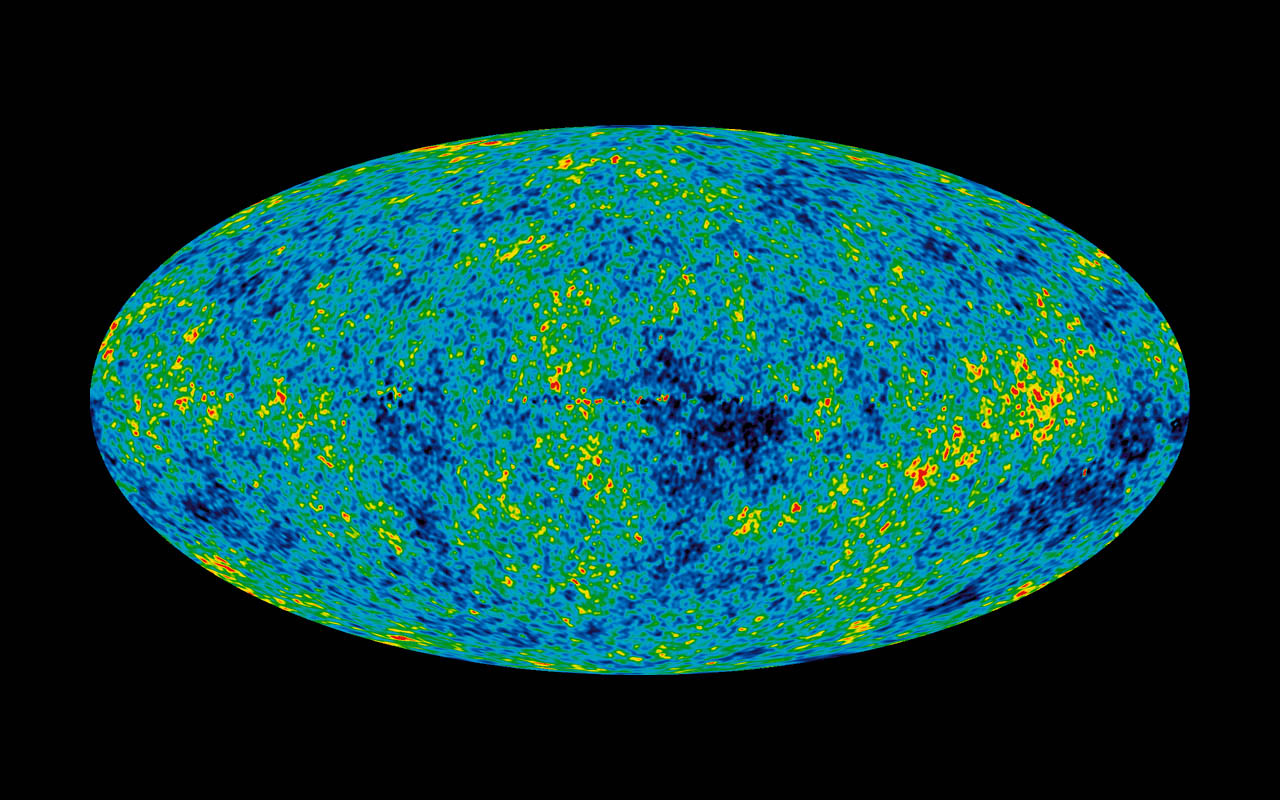
The cosmic microwave background (CMB) we measure today is a relic from the time when the universe was only 300,000 years old and radiation decoupled from matter. Since then, photons could travel almost undisturbed. Thus the radiation, especially the fluctuations around its mean temperature, contain valuable information about the history of the universe. The CMB temperature fluctuations have been measured with great precision by the, now completed, WMAP mission and I'm sure you've all seen their skymap.

This data from the CMB temperature fluctuations, often discussed in form of its power spectrum, has allowed us to extract parameters determining the expansion of the universe and complement other data. What we know today, among other things, is that the universe is not only big, but to excellent accuracy spatially flat. That's a feature not naturally achieved with every mode of expansion. It also requires explanation why the CMB temperature is so homogeneous and isotropic, ie essentially the same everywhere with only small fluctuations around it. The currently most widely accepted model that achieves all that easily is inflation. Inflation is basically a phase of early, very rapid expansion that succeeds in solving the problems of flatness and homogeneity (and some others in addition). Inflation then has to end at some time, so matter can form and after that the expansion of the universe proceeds in a more moderate form, allowing the structures to form that surround us today (filaments, galaxies, stars).

There are several models of inflation that differ in the detailed predictions, but the rapid expansion is what they have in common. A particular variant of inflation is called "eternal inflation." As the name says, in that case inflation does not end completely but continues eternally. The way this is thought to happen is that inflation only ends locally when a metastable "false" vacuum state decays into a "true" vacuum state and subsequently continues along a local inflation scenario that ends and results in matter formation and gives rise to a patch like our own, commonly called "bubble universe." However, the areas of false vacuum never decay away completely because they expand more quickly than they can decay. As a result, new bubble universes continue to be formed out of the false vacuum eternally.

Bubble Collisions

While eternal inflation has its proponents, the most well-known probably being Alan Guth, it hasn't been particularly popular, mostly because for what observations are concerned it's a superfluous overhead to the local inflation scenario. It increased in popularity somewhat with string theorists having to face a large number of possible vacuum states, a scenario that seems to fit nicely with the continuing creation of bubble universes that together form what's become known as the "multiverse." Still there remains the question what's it matter if we can't observe it anyway.

It turns out that there are circumstances in which we could find evidence for the existence of other bubbles because initially separate bubble universes might come to overlap during their expansion in a "bubble collision." The probability of there having been a bubble collision in our past, and that bubble collision being observable yet not fatal for the evolution of life in our universe, depends on the parameters of the model.

The Paper

That finally brings us to Feeney et al's paper. Inspired by earlier work by Aguirre et al (Towards observable signatures of other bubble universes, arXiv:0704.3473) they studied the possibility that a bubble collision in our past has left an imprint in the CMB. Their paper basically presents a particular analysis scheme for the CMB temperature fluctuations. Projected on the 2-dimensional surface of last scattering, the leftover signal would have azimuthal symmetry. They assume that a bubble collision has left a mark in the CMB that consists of a slightly different temperature in such an azimuthal patch.

They use an algorithm to analyze the temperature fluctuation that works in three steps. First, search for areas with azimuthal symmetry. Second, search for edges where the temperature makes a slight step. Third, if you've found that, look for the best parameters to reproduce what you've found. They then go on to create fake CMB fluctuations with signals of bubble collisions to quantify how well their algorithm works. The picture below, taken from Feeney et al's paper, depicts the stages of this simulation. Each quarter of the skymap is supposed to show the same area, just mirrored horizontally and vertically. The upper left part shows the patch with the temperature variation from the bubble collision without fluctuations superimposed (the Mollweide projection used to plot the map distorts the shape). The upper right part adds random fluctuations. Now the task is to get the signal back. The lower left part shows the result of looking for patches of azimuthal symmetry, the lower right one the result of looking for edges with temperature steps.

After testing out their algorithm with fake data to understand what features it is able to identify with certainty, they come to the interesting part and analyze the actual CMB data. Their algorithm doesn't find edges, but identifies 4 regions of interest whose features could possibly have been caused by bubble collisions. As the authors put it, these features are "compatible" with having been caused in that way. Two of these spots of interest btw have previously been discussed, one is the well-known CMB "cold spot," the other was identified in this paper which made use of a similar analysis as Feeney et al. It is important to emphasize though that the identification of these spots was based solely on the symmetry and they were not able to find the second identifier, the edge of the spot. For this reason the authors are careful to make clear:
"Without the corroborating evidence of a circular temperature discontinuity, we cannot claim a definitive detection [...] Azimuthally symmetric temperature modulations are not unique to bubble collisions."

Though it might be that better data from the Planck satellite will allow to extract a less ambiguous signal in the coming years, this is so far clearly no evidence for a bubble collision. Feeney et al's results are just once again evidence that there's some features in the CMB.

One also has to keep in mind that their paper already starts from the assumption that the signal of a bubble collision is of such a particular sort of merely resulting in a small temperature difference. It leaves entirely open the question how likely it is that a particular model of eternal inflation would result in such a signal that is just barely observable rather than in features entirely incompatible with what we've seen so far. It is entirely unclear to me for example what would happen if the vacuum in the other bubble or possibly even its physical constants were different from ours. It seems quite unlikely that a tiny temperature modulation is all that would come out of it. I don't think anybody has at this point a comprehensive picture of what might happen in a general bubble collision. The question is then if not it is extremely improbable that our bubble was subject to a collision and that collision, rather than wiping us out, was just nice enough to reveal itself in the upcoming Planck data.

In any case, the analysis put forward in Feeney et al's paper serves to rule out some regions of the parameter space in models that produce such an imprint in the CMB. Such constraints are always good to have. It is a nice and very straight-forward paper presenting an observer's take on eternal inflation. It's a very worthwhile analysis indeed - imagine how exciting it would be to find evidence for other universes! However, so far the evidence leaves waiting.

Update: See also one of the author's guest post at Cosmic Variance Observing the Multiverse.

Thursday, February 09, 2017

New Data from the Early Universe Does Not Rule Out Holography

[img src: entdeckungen.net]
It’s string theorists’ most celebrated insight: The world is a hologram. Like everything else string theorists have come up with, it’s an untested hypothesis. But now, it’s been put to test with a new analysis that compares a holographic early universe with its non-holographic counterpart.

Tl;dr: Results are inconclusive.

When string theorists say we live in a hologram, they don’t mean we are shadows in Plato’s cave. They mean their math says that all information about what’s inside a box can be encoded on the boundary of that box – albeit in entirely different form.

The holographic principle – if correct – means there are two different ways to describe the same reality. Unlike in Plato’s cave, however, where the shadows lack information about what caused them, with holography both descriptions are equally good.

Holography would imply that the three dimensions of space which we experience are merely one way to think of the world. If you can describe what happens in our universe by equations that use only two-dimensional surfaces, you might as well say we live in two dimensions – just that these are dimensions we don’t normally experience.

It’s a nice idea but hard to test. That’s because the two-dimensional interpretation of today’s universe isn’t normally very workable. Holography identifies two different theories with each other by a relation called “duality.” The two theories in question here are one for gravity in three dimensions of space, and a quantum field theory without gravity in one dimension less. However, whenever one of the theories is weakly coupled, the other one is strongly coupled – and computations in strongly coupled theories are hard, if not impossible.

The gravitational force in our universe is presently weakly coupled. For this reason General Relativity is the easier side of the duality. However, the situation might have been different in the early universe. Inflation – the rapid phase of expansion briefly after the big bang – is usually assumed to take place in gravity’s weakly coupled regime. But that might not be correct. If instead gravity at that early stage was strongly coupled, then a description in terms of a weakly coupled quantum field theory might be more appropriate.

This idea has been pursued by Kostas Skenderis and collaborators for several years. These researchers have developed a holographic model in which inflation is described by a lower-dimensional non-gravitational theory. In a recent paper, their predictions have been put to test with new data from the Planck mission, a high-precision measurement of the temperature fluctuations of the cosmic microwave background.


In this new study, the authors compare the way that holographic inflation and standard inflation in the concordance model – also known as ΛCDM – fit the data. The concordance model is described by six parameters. Holographic inflation has a closer connection to the underlying theory and so the power spectrum brings in one additional parameter, which makes a total of seven. After adjusting for the number of parameters, the authors find that the concordance model fits better to the data.

However, the biggest discrepancy between the predictions of holographic inflation and the concordance model arise at large scales, or low multipole moments respectively. In this regime, the predictions from holographic inflation cannot really be trusted. Therefore, the authors repeat the analysis with the low multipole moments omitted from the data. Then, the two models fit the data equally well. In some cases (depending on the choice of prior for one of the parameters) holographic inflation is indeed a better fit, but the difference is not statistically significant.

To put this result into context it must be added that the best-understood cases of holography work in space-times with a negative cosmological constant, the Anti-de Sitter spaces. Our own universe, however, is not of this type. It has instead a positive cosmological constant, described by de-Sitter space. The use of the holographic principle in our universe is hence not strongly supported by string theory, at least not presently.

The model for holographic inflation can therefore best be understood as one that is motivated by, but not derived from, string theory. It is a phenomenological model, developed to quantify predictions and test them against data.

While the difference between the concordance model and holographic inflation which this study finds are insignificant, it is interesting that a prediction based on such an entirely different framework is able to fit the data at all. I should also add that there is a long-standing debate in the community as to whether the low multipole moments are well-described by the concordance model, or whether any of the large-scale anomalies are to be taken seriously.

In summary, I find this an interesting result because it’s an entirely different way to think of the early universe, and yet it describes the data. For the same reason, however, it’s also somewhat depressing. Clearly, we don’t presently have a good way to test all the many ideas that theorists have come up with.

Tuesday, May 28, 2013

Have your multiverse and eat it

The recent results from the Planck mission have caused a flurry of activity among theoretical physicists, documented on the arXiv in an increasing amount of papers with updates on constraints on various cosmological models. Of particular interest is the question which models of inflation are favored by the data. Interestingly, the simplest potentials for the scalar field that causes inflation are ruled out or disfavored already. For a summary, see Jester’s post Planck about inflation.

Paul Steinhardt and collaborators have taken this as a reason to argue that the data actually hints at cyclic models.
    Inflationary paradigm in trouble after Planck2013
    Anna Ijjas, Paul J. Steinhardt, Abraham Loeb
    1304.2785

    Planck 2013 results support the simplest cyclic models
    Jean-Luc Lehners, Paul J. Steinhardt
    1304.3122
The argument in these papers goes as follows.

The potentials for the inflaton field that are necessary to fit the Planck data are not simple in that they require finetuning, ie delicately adjusted parameters. The finetuning has to produce a suitably flat plateau in the potential, and a power law with coefficients of order one isn’t going to do this. If you’d random pick the potential, it would be very unlikely you’d get a suitably finetuned one.

This, Steinhardt et al argue, is a serious problem because the “inflationary paradigm” draws its justification from our universe being a “likely” outcome of quantum fluctuations that are blown up to produce the structures we see. If the potential, or the initial value of the scalar field, is unlikely, this erodes the basis of believing in the inflationary paradigm to begin with. In the paper this unlikeliness is quantified, and it is noted that the unlikeliness of the initial value of the scalar field can be recast as an unlikeliness of the potential. Then they go on to argue that cyclic models are preferable because in these cases natural parameter ranges for coefficients in the potential are still compatible with the data (they do not comment on how natural these models are in other respects). They then identify observables that could further solidify the case.

There are two gaps in this argument. The first gap is between “inflation” and “inflationary paradigm.”

Inflation is a model that describes very well the observations in our universe by using a familiar framework that makes use of quantum field theory and general relativity. The inflationary paradigm that they refer to (not an expression that is common in the scientific literature) adds requirements beyond the explanation of observation, that being the likeliness of the model.

To begin with, speaking about probabilities makes only sense if one has an ensemble. So to even refer to unlikeliness you have to believe in a distribution over set of possibilities, a multiverse. And for that you must have faith in your model, faith that extends beyond and before and beneath our universe, faith that the model holds outside everything we have ever observed, and that you can actually use it to make a statement about likeliness.

Besides this, the inflaton potential is normally not expected to be fundamental, but some effective limit a few orders of magnitude below the Planck scale. If you want to say anything about the probability of finding a particular potential, you would first have to know the fundamental degrees of freedom and the UV-completion of the theory. Just taking potentials and attempting to assign them a probability doesn’t make a lot of sense.

So talking about probabilities is already a bad starting position. From this starting position then Steinhardt et al argue that the inflationary paradigm says that we should find our universe to be likely. But by going from inflation to the inflationary paradigm, one is no longer talking about testing a model that explains observations. In their own words
“The usual test for a theory is whether experiment agrees with model predictions. Obviously, inflationary plateau-like models pass this test.”
That should be the last sentence of a scientific paper. Alas, there’s a next sentence, and it starts with “However…”
“However, this cannot be described as a success for the inflationary paradigm, since, according to inflationary reasoning, this particular class of models is highly unlikely to describe reality.”
Note the leap from “theory” to “paradigm”. (Let me not ask what “reality” means, I know it’s an unfair question.)

The second gap in the argument is that you could use it to rule out pretty much any model anybody has ever proposed.

In this earlier post I explained that all presently existing theories inevitably lead to a multiverse, a large space of possibilities. It’s just that this multiverse is more apparent in some approaches than in others.

The reason a multiverse is inevitable is that we always need something to specify a theory to begin with. Call it basic axioms or postulates. We need something to start with. And in the context of the theory you’re working with, that postulated basis is an uncaused cause: It was written down with the explicit purpose to explain observations. If you take away that purpose because you’ve misunderstood what science is all about, you are left with only mathematical consistency. And then, layer by layer, you are forced to include everything into your theory that is mathematically consistent. That’s what Tegmark called the “Mathematical Universe.”

Steinhardt et al’s elaboration about the possible shape of potentials is an example of this mathematical multiverse beneath the basis. They take away one postulate and replace it by a larger space of mathematical possibilities. Instead of postulating a specific (purpose bound) real-valued, differentiable, scalar function, they replace them with the space of all continuous functions (though they’re not too explicit on the requirements). But why stop there? Why not take the space of all functions and random pick one of these? Almost all functions on the real axis are discontinuous in infinitely many places, which is a fancy way of saying that the probability to get a continuous one upon random picking is zero. Look, I just ruled out both the “inflationary paradigm” and Steinhardt’s cyclic models without referring to any data at all.

To be fair however, Steinhardt et al are just fighting inflation with its own weapons. It is arguably true that the literature is full of arguments about naturalness and how inflation solves this or that philosophical conundrum. If you believe in the multiverse, or eternal inflation specifically, I think you should take the argument put forward in these papers seriously. For the rest of us, those who see inflation as a model with the purpose to describe observations in our universe, there’s no reason to make these leaps of faith. And that’s what they are - at least for now. One never knows what the data will bring.

Monday, August 15, 2016

The Philosophy of Modern Cosmology (srsly)

Model of Inflation.
img src: umich.edu
I wrote my recent post on the “Unbearable Lightness of Philosophy” to introduce a paper summary, but it got somewhat out of hand. I don’t want to withhold the actual body of my summary though. The paper in question is


Before we start I have to warn you that the paper speaks a lot about realism and underdetermination, and I couldn’t figure out what exactly the authors mean with these words. Sure, I looked them up, but that didn’t help because there doesn’t seem to be an agreement on what the words mean. It’s philosophy after all.

Personally, I subscribe to a philosophy I’d like to call agnostic instrumentalism, which means I think science is useful and I don’t care what else you want to say about it – anything from realism to solipsism to Carroll’s “poetic naturalism” is fine by me. In newspeak, I’m a whateverist – now go away and let me science.

The authors of the paper, in contrast, position themselves as follows:
“We will first state our allegiance to scientific realism… We take scientific realism to be the doctrine that most of the statements of the mature scientific theories that we accept are true, or approximately true, whether the statement is about observable or unobservable states of affairs.”
But rather than explaining what this means, the authors next admit that this definition contains “vague words,” and apologize that they “will leave this general defense to more competent philosophers.” Interesting approach. A physics-paper in this style would say: “This is a research article about General Relativity which has something to do with curvature of space and all that. This is just vague words, but we’ll leave a general defense to more competent physicists.”

In any case, it turns out that it doesn’t matter much for the rest of the paper exactly what realism means to the authors – it’s a great paper also for an instrumentalist because it’s long enough so that, rolled up, it’s good to slap flies. The focus on scientific realism seems somewhat superfluous, but I notice that the paper is to appear in “The Routledge Handbook of Scientific Realism” which might explain it.

It also didn’t become clear to me what the authors mean by underdetermination. Vaguely speaking, they seem to mean that a theory is underdetermined if it contains elements unnecessary to explain existing data (which is also what Wikipedia offers by way of definition). But the question what’s necessary to explain data isn’t a simple yes-or-no question – it’s a question that needs a quantitative analysis.

In theory development we always have a tension between simplicity (fewer assumptions) and precision (better fit) because more parameters normally allow for better fits. Hence we use statistical measures to find out in which case a better fit justifies a more complicated model. I don’t know how one can claim that a model is “underdetermined” without such quantitative analysis.

The authors of the paper for the most part avoid the need to quantify underdetermination by using sociological markers, ie they treat models as underdetermined if cosmologists haven’t yet agreed on the model in question. I guess that’s the best they could have done, but it’s not a basis on which one can discuss what will remain underdetermined. The authors for example seem to implicitly believe that evidence for a theory at high energies can only come from processes at such high energies, but that isn’t so – one can also use high precision measurements at low energies (at least in principle). In the end it comes down, again, to quantifying which model is the best fit.

With this advance warning, let me tell you the three main philosophical issues which the authors discuss.

1. Underdetermination of topology.

Einstein’s field equations are local differential equations which describe how energy-densities curve space-time. This means these equations describe how space changes from one place to the next and from one moment to the next, but they do not fix the overall connectivity – the topology – of space-time*.

A sheet of paper is a simple example. It’s flat and it has no holes. If you roll it up and make a cylinder, the paper is still flat, but now it has a hole. You could find out about this without reference to the embedding space by drawing a circle onto the cylinder and around its perimeter, so that it can’t be contracted to zero length while staying on the cylinder’s surface. This could never happen on a flat sheet. And yet, if you look at any one point of the cylinder and its surrounding, it is indistinguishable from a flat sheet. The flat sheet and the cylinder are locally identical – but they are globally different.

General Relativity thus can’t tell you the topology of space-time. But physicists don’t normally worry much about this because you can parameterize the differences between topologies, compute observables, and then compare the results to data. Topology is, in that, no different than any other assumption of a cosmological model. Cosmologists can, and have, looked for evidence of non-trivial space-time connectivity in the CMB data, but they haven’t found anything that would indicate our universe wraps around itself. At least so far.

In the paper, the authors point out an argument raised by someone else (Manchak) which claims that different topologies can’t be distinguished almost everywhere. I haven’t read the paper in question, but this claim is almost certainly correct. The reason is that while topology is a global property, you can change it on arbitrarily small scales. All you have to do is punch a hole into that sheet of paper, and whoops, it’s got a new topology. Or if you want something without boundaries, then identify two points with each other. Indeed you could sprinkle space-time with arbitrarily many tiny wormholes and in that way create the most abstruse topological properties (and, most likely, lots of causal paradoxa).

The topology of the universe is hence, like the topology of the human body, a matter of resolution. On distances visible to the eye you can count the holes in the human body on the fingers of your hand. On shorter distances though you’re all pores and ion channels, and on subatomic distances you’re pretty much just holes. So, asking what’s the topology of a physical surface only makes sense when one specifies at which distance scale one is probing this (possibly higher-dimensional) surface.

I thus don’t think any physicist will be surprised by the philosophers’ finding that cosmology severely underdetermines global topology. What the paper fails to discuss though is the scale-dependence of that conclusion. Hence, I would like to know: Is it still true that the topology will remain underdetermined on cosmological scales? And to what extent, and under which circumstances, can the short-distance topology have long-distance consequences, as eg suggested by the ER=EPR idea? What effect would this have on the separation of scales in effective field theory?

2. Underdetermination of models of inflation.

The currently most widely accepted model for the universe assumes the existence of a scalar field – the “inflaton” – and a potential for this field – the “inflation potential” – in which the field moves towards a minimum. While the field is getting there, space is exponentially stretched. At the end of inflation, the field’s energy is dumped into the production of particles of the standard model and dark matter.

This mechanism was invented to solve various finetuning problems that cosmology otherwise has, notably that the universe seems to be almost flat (the “flatness problem”), that the cosmic microwave background has the almost-same temperature in all directions except for tiny fluctuations (the “horizon problem”), and that we haven’t seen any funky things like magnetic monopoles or domain walls that tend to be plentiful at the energy scale of grand unification (the “monopole problem”).

Trouble is, there’s loads of inflation potentials that one can cook up, and most of them can’t be distinguished with current data. Moreover, one can invent more than one inflation field, which adds to the variety of models. So, clearly, the inflation models are severely underdetermined.

I’m not really sure why this overabundance of potentials is interesting for philosophers. This isn’t so much philosophy as sociology – that the models are underdetermined is why physicists get them published, and if there was enough data to extract a potential that would be the end of their fun. Whether there will ever be enough data to tell them apart, only time will tell. Some potentials have already been ruled out with incoming data, so I am hopeful.

The questions that I wish philosophers would take on are different ones. To begin with, I’d like to know which of the problems that inflation supposedly solves are actual problems. It only makes sense to complain about finetuning if one has a probability distribution. In this, the finetuning problem in cosmology is distinctly different from the finetuning problems in the standard model, because in cosmology one can plausibly argue there is a probability distribution – it’s that of fluctuations of the quantum fields which seed the initial conditions.

So, I believe that the horizon problem is a well-defined problem, assuming quantum theory remains valid close by the Planck scale. I’m not so sure, however, about the flatness problem and the monopole problem. I don’t see what’s wrong with just assuming the initial value for the curvature is tiny (finetuned), and I don’t know why I should care about monopoles given that we don’t know grand unification is more than a fantasy.

Then, of course, the current data indicates that the inflation potential too must be finetuned which, as Steinhardt has aptly complained, means that inflation doesn’t really solve the problem it was meant to solve. But to make that statement one would have to compare the severity of finetuning, and how does one do that? Can one even make sense of this question? Where are the philosophers if one needs them?

Finally, I have a more general conceptual problem that falls into the category of underdetermination, which is to which extent the achievements of inflation are actually independent of each other. Assume, for example, you have a theory that solves the horizon problem. Under which circumstances does it also solve the flatness problem and gives the right tilt for the spectral index? I suspect that the assumptions for this do not require the full mechanism of inflation with potential and all, and almost certainly not a very specific type of potential. Hence I would like to know what’s the minimal theory that explains the observations, and which assumptions are really necessary.

3. Underdetermination in the multiverse.

Many models for inflation create not only one universe, but infinitely many of them, a whole “multiverse”. In the other universes, fundamental constants – or maybe even the laws of nature themselves – can be different. How do you make predictions in a multiverse? You can’t, really. But you can make statements about probabilities, about how likely it is that we find ourselves in this universe with these particles and not any other.

To make statements about the probability of the occurrence of certain universes in the multiverse one needs a probability distribution or a measure (in the space of all multiverses or their parameters respectively). Such a measure should also take into account anthropic considerations, since there are some universes which are almost certainly inhospitable for life, for example because they don’t allow the formation of large structures.

In their paper, the authors point out that the combination of a universe ensemble and a measure is underdetermined by observations we can make in our universe. It’s underdetermined in the same what that if I give you a bag of marbles and say the most likely pick is red, you can’t tell what’s in the bag.

I think physicists are well aware of this ambiguity, but unfortunately the philosophers don’t address why physicists ignore it. Physicists ignore it because they believe that one day they can deduce the theory that gives rise to the multiverse and the measure on it. To make their point, the philosophers would have had to demonstrate that this deduction is impossible. I think it is, but I’d rather leave the case to philosophers.

For the agnostic instrumentalist like me a different question is more interesting, which is whether one stands to gain anything from taking a “shut-up-and-calculate” attitude to the multiverse, even if one distinctly dislikes it. Quantum mechanics too uses unobservable entities, and that formalism –however much you detest it – works very well. It really adds something new, regardless of whether or not you believe the wave-function is “real” in some sense. For what the multiverse is concerned, I am not sure about this. So why bother with it?

Consider the best-case multiverse outcome: Physicists will eventually find a measure on some multiverse according to which the parameters we have measured are the most likely ones. Hurray. Now forget about the interpretation and think of this calculation as a black box: You put in math one side and out comes a set of “best” parameters the other side. You could always reformulate such a calculation as an optimization problem which allows one to calculate the correct parameters. So, independent of the thorny question of what’s real, what do I gain from thinking about measures on the multiverse rather than just looking for an optimization procedure straight away?

Yes, there are cases – like bubble collisions in eternal inflation – that would serve as independent confirmation for the existence of another universe. But no evidence for that has been found. So for me the question remains: under which circumstances is doing calculations in the multiverse an advantage rather than unnecessary mathematical baggage?

I think this paper makes a good example for the difference between philosophers’ and physicists’ interests which I wrote about in my previous post. It was a good (if somewhat long) read and it gave me something to think, though I will need some time to recover from all the -isms.

* Note added: The word connectivity in this sentence is a loose stand-in for those who do not know the technical term “topology.” It does not refer to the technical term “connectivity.”