Pages

Thursday, August 09, 2012

Book review: “Thinking, fast and slow” by Daniel Kahneman

Thinking, Fast and Slow
By Daniel Kahneman
Farrar, Straus and Giroux (October 25, 2011)

I am always on the lookout for ways to improve my scientific thinking. That’s why I have an interest in the areas of sociology concerned with decision making in groups and how the individual is influenced by this. And this is also why I have an interest in cognitive biases - intuitive judgments that we make without even noticing; judgments which are just fine most of the time but can be scientifically fallacious. Daniel Kahneman’s book “Thinking, fast and slow” is an excellent introduction to the topic.

Kahneman, winner of the Nobel Price for Economics in 2002, focuses mostly on his own work, but that covers a lot of ground. He starts with distinguishing between two different modes in which we make decisions, a fast and intuitive one, and a slow, more deliberate one. Then he explains how fast intuitions lead us astray in certain circumstances.

The human brain does not make very accurate statistical computations without deliberate effort. But often we don’t make such an effort. Instead, we use shortcuts. We substitute questions, extrapolate from available memories, and try to construct plausible and coherent stories. We tend to underestimate uncertainty, are influenced by the way questions are framed, and our intuition is skewed by irrelevant details.

Kahneman quotes and summarizes a large amount of studies that have been performed, in most cases with sample questions. He offers explanations for the results when available, and also points out where the limits of present understanding are. In the later parts of the book he elaborates on the relevance of these findings about the way humans make decision for economics. While I had previously come across a big part of the studies that he summarizes in the early chapters, the relation to economics had not been very clear to me, and I found this part enlightening. I now understand my problems trying to tell economists that humans do have inconsistent preferences.

The book introduces a lot of terminology, and at the end of each chapter the reader finds a few examples for how to use them in everyday situations. “He likes the project, so he thinks its costs are low and its benefits are high. Nice example of the affect heuristic.” “We are making an additional investment because we not want to admit failure. This is an instance of the sunk-cost fallacy.” Initially, I found these examples somewhat awkward. But awkward or not, they serve very well for the purpose of putting the terminology in context.

The book is well written, reads smoothly, is well organized, and thoroughly referenced. As a bonus, the appendix contains reprints of Kahneman’s two most influential papers that contain somewhat more details than the summary in the text. He narrates along the story of his own research projects and how they came into being which I found a little tiresome after he elaborated on the third dramatic insight that he had about his own cognitive bias. Or maybe I'm just jealous because a Nobel Prize winning insight in theoretical physics isn't going to come by that way.

I have found this book very useful in my effort to understand myself and the world around me. I have only two complaints. One is that despite all the talk about the relevance of proper statistics, Kahneman does not mention the statistical significance of any of the results that he talks about. Now, this is all research which started two or three decades ago, so I have little doubt that the effects he talks about are indeed meanwhile well established, and, hey, he got a Nobel Prize after all. Yet, if it wasn’t for that I’d have to consider the possibility that some of these effects will vanish as statistical artifacts. Second, he does not at any time actually explain to the reader the basics of probability theory and Bayesian inference, though he uses it repeatedly. This, unfortunately, limits the usefulness of the book dramatically if you don’t already know how to compute probabilities. It is particularly bad when he gives a terribly vague explanation of correlation. Really, the book would have been so much better if it had at least an appendix with some of the relevant definitions and equations.

That having been said, if you know a little about statistics you will probably find, like I did, that you’ve learned to avoid at least some of the cognitive biases that deal with explicit ratios and percentages, and different ways to frame these questions. I’ve also found that when it comes to risks and losses my tolerance apparently does not agree with that of the majority of participants in the studies he quotes. Not sure why that is. Either way, whether or not you are subject to any specific bias that Kahneman writes about, the frequency by which they appear make them relevant to understand the way human society works, and they also offer a way to improve our decision making.

In summary, it’s a well-written and thoroughly useful book that is interesting for everybody with an interest in human decision-making and its shortcomings. I'd give this book four out of five stars.

Below are some passages that I marked that gave me something to think. This will give you a flavor what the book is about.

“A reliable way of making people believe in falsehoods is frequent repetition because familiarity is not easily distinguished from truth.”

“[T]he confidence that people experience is determined by the coherence of the story they manage to construct from available information. It is the consistency of the information that matters for a good story, not its completeness.”

“The world in our heads is not a precise replica of reality; our expectations about the frequency of events are distorted by the prevalence and emotional intensity of the messages to which we are exposed.”

“It is useful to remember […] that neglecting valid stereotypes inevitably results in suboptimal judgments. Resistance to stereotyping is a laudable moral position, but the simplistic idea that the resistance is cost-less is wrong.”

“A general limitation of the human mind is its imperfect ability to reconstruct past states of knowledge, or beliefs that have changed. Once you adopt a new view of the world (or any part of it), you immediately lose much of your ability to recall what you used to believe before your mind changed.”

“I have always believed that scientific research is another domain where a form of optimism is essential to success: I have yet to meet a successful scientist who lacks the ability to exaggerate the importance of what he or she is doing, and I believe that someone who lacks a delusional sense of significance will wilt in the fact of repeated experiences of multiple small failures and rare successes, the fate of most researchers.”

“The brains s of humans and other animals contain a mechanism that is designed to give priority to bad news.”

“Loss aversion is a powerful conservative force that favors minimal changes from the status quo in the lives of both institutions and individuals.”

“When it comes to rare probabilities, our mind is not designed to get things quite right. For the residents of a planet that maybe exposed to events no one has yet experienced, this is not good news.”

“We tend to make decisions as problems arise, even when we are specifically instructed to consider them jointly. We have neither the inclination not the mental resources to enforce consistency on our preferences, and our preferences are not magically set to be coherent, as they are in the rational-agent model.”

“The sunk-cost fallacy keeps people for too long in poor jobs, unhappy marriages, und unpromising research projects. I have often observed young scientists struggling to salvage a doomed project when they would be better advised to drop it and start a new one.”

“Although Humans are not irrational, they often need help to make more accurate judgments and better decisions, and in some cases policies and institutions can provide that help.”

Tuesday, August 07, 2012

Why does the baby cry? Fact sheet.

Gloria at 2 months, crying.
Two weeks after delivery, when the husband went back to work and my hemoglobin level had recovered enough to let me think about anything besides breathing, I seemed to be spending a lot of time on The One Question: Why does the baby cry? We had been drowned in baby books that all had something helpful to say. Or so I believe, not having read them. But what really is the evolutional origin of all that crying to begin with? That’s what I was wondering. Is there a reason to begin with?

You don’t need a degree to know that baby cries if she’s unhappy. After a few weeks I had developed a trouble-shooting procedure roughly like this: Does she have a visible reason to be unhappy? Does she stop crying if I pick her up? New diaper? Clothes comfortable? Too warm? Too cold? Is she bored? Is it possible to distract her? Hungry? When I had reached the end of my list I’d start singing. The singing almost always helped. After that, there’s the stroller and white noise and earplugs.

Yes, the baby cries when she’s unhappy, no doubt about that. But both Lara and Gloria would sometimes cry for no apparent reason, or at least no reason that Stefan and I were able to figure out. The crying is distressing for the parents and costs the baby energy. So why, if it’s such an inefficient communication channel, does the baby cry so much? If the baby is trying to tell us something, why haven't hundred thousands of years of evolution been sufficient to teach caregivers what it is that she wants? I came up with the following hypotheses:
    A) She doesn’t cry for any reason, it’s just what babies do. I wasn’t very convinced of this because it doesn’t actually explain anything.

    B) She cries so I don’t misplace or forget about her. I wasn’t very convinced of this either because after two months or so, my brain had classified the crying as normal background noise. Also, babies seem to cry so much it overshoots the target: It doesn’t only remind the caregivers, it frustrates them.

    C) It’s a stress-test. If the family can’t cope well, it’s of advantage for future reproductive success of the child if the family breaks up sooner rather than later.

    D) It’s an adaption delay. The baby is evolutionary trained to expect something else than what it gets in modern western societies. If I’d just treat the baby like my ancestors did, she wouldn’t cry so much.
So I went and looked what the scientific literature has to say. I found a good review by Joseph Soltis from the year 2004 which you can download here. The below is my summary of these 48 pages.

First, let us clarify what we’re talking about. The crying of human infants changes after about 3 months because the baby learns to make more complex sounds and also becomes more interactive. In the following we’ll only consider the first three months that are most likely to be nature rather than nurture.

Here are some facts about the first three months of baby’s crying that seem to be established pretty well. All references can be found in Soltis’ paper.
  • Crying increases until about 6 weeks after birth, followed by a gradual decrease in crying until 3 or 4 months, after which it remains relatively stable. Crying is more frequent in the later afternoon and early evening hours. These crying patterns have been found in studies of very different cultures, from the Netherlands, from South African hunter-gatherers, from the UK, Manilia, Denmark, and North America.
  • Chimpanzees too have a peak in crying frequency at approximately 6 weeks of life, and a substantial decline in crying frequency by 12 weeks.
  • The cries of healthy, non-stressed infants last on the average 0.5-1.5 seconds with a fundamental pitch in the range of 200-600 Hz. The melody is either falling or rising/falling (as opposed to rising, falling/rising or flat).
  • Serious illness, both genetic and acquired, is often accompanied by abnormal crying. The most common cry characteristic indicating serious pathology is an unusually high pitched cry, in one case study above 2000 Hz, and in many other studies exceeding 1500 Hz. (That’s higher than most sopranos can sing.) Examples are: bacterial meningitis 750-1000 Hz, Krabbe’s disease up to 1120 Hz, hypoglycemia up to 1600 Hz. Other abnormal cry patters that have been found in illness is biphonation (the simultaneous production of two fundamental frequencies), too low pitch, and deviations from the normal cry melodies.
  • Various studies have been conducted to find out how well adults are able to tell the reason for a baby’s cry by playing them previously recorded cries. These studies show mothers are a little bit better than random chance when given a predefined selection of choices (eg pain, anger, other, in one study), but by and large mothers as well as other adults are pretty bad at figuring out the reason for a baby’s cry. Without being given categories, participants tend to attribute all cries to hunger.
  • It has been reported in several papers that parents described a baby’s crying as the most proximate cause triggering abuse and infanticide. It has also been shown that especially the high pitched baby cries produce a response of the autonomic nervous system, measureable for example by the heart rate or skin conductance (the response is higher than for smiling babies). It has also been shown that abusers exhibit higher autonomic responses to high-pitched cries than non-abusers.
  • Excessive infant crying is the most common clinical complaint of mothers with infants under three months of age.
  • Excessive infant crying that begins and ends without warning is called “colic.” It is often attributed to organic disorders, but if the baby has no other symptoms it is estimated that only 5-10% of “colic” go back to an organic disorder, the most common one being lactose intolerance. If the baby has other symptoms (flexed legs, spasm, bloating, diarrhea), the ratio of organic disorder goes up to 45%. The rest cries for unknown reasons. Colic usually improves by 4 months, or so they tell you. (Lara’s didn’t improve until she was 6 months. Gloria never had any.)
  • Colic is correlated with postpartum depression which is in turn robustly associated with reduced maternal care.
  • Records and media reports kept by the National Center on Shaken Baby Syndrome implicate crying as the most common trigger.
  • In a survey among US mothers, more infant crying was associated with lower levels of perceived infant health, more worry about baby’s health, and less positive emotion towards the infant.
  • Some crying bouts are demonstrably unsoothable to typical caregiving responses in the first three months. Well, somebody has to do these studies.
  • In studies of nurses judging infant pain, the audible cry was mostly redundant to facial activity in the judgment of pain.
Now let us look at the hypotheses researchers have put forward and how well they are supported by the facts. Again, let me mention that everybody agrees the baby cries when in distress, the question is if that’s the entire reason.
  1. Honest signal of need. The baby cries if and only if she needs or wants something, and she cries to alert the caregivers of that need. This hypothesis is not well supported by the facts. Baby’s cries are demonstrably inefficient of bringing the baby the care it allegedly needs because caregivers don’t know what she wants and in many cases there doesn’t seem to be anything they can do about it. This is the scientific equivalent of my hypothesis D which I found not so convincing.
  2. Signal of vigor. This hypothesis says that the baby cries to show she’s healthy. The more the baby cries (in the “healthy” pitch and melody range), the stronger she is and the more the mother should care because it’s a good investment of her attention to raise offspring that’s likely to reproduce successfully. Unfortunately, there’s no evidence linking a high amount of crying to good health of the child. In contrast, as mentioned above, parents perceive children as more sickly if they cry more, which is exactly the opposite of what the baby allegedly “wants” to signal. Also, lots of crying is apparently maladaptive according to the evidence listed above, because it can cause violence against the child. It’s also unclear why, if the baby isn’t seriously sick and too weak to cry, a not-so-vigorous child should alert the caregivers to his lack of vigor and trigger neglect. It doesn’t seem to make much sense. This is the scientific equivalent of my hypothesis B which I didn’t find very convincing either.
  3. Graded signal of distress. The baby cries if she’s in distress, and the more distress the more she cries. This hypothesis is, at least for what pain is concerned, supported by evidence. Pretty much everybody seems to agree on that. As mentioned above however, while distress leads to crying, this leaves open the question why the baby is in distress to begin with and why it cries if caregivers can’t do anything about it. Thus, while this hypothesis is the least controversial one, it’s also the one with the smallest explanatory value.
  4. Manipulation: The baby cries so mommy feeds her as often as possible. Breastfeeding stimulates the production of the hormone prolactin; prolactin inhibits estrogen production, which often (though not always) keeps the estrogen level below the threshold necessary for the menstrual cycle to set it. This is called lactational amenorrhea. In other words, the more the baby gets mommy to feed her, the smaller the probability that a younger sibling will compete for resources, thus improving the baby’s own well-being. The problem with this hypothesis is that it would predict the crying to increase when the mother’s body has recovered, some months after birth, and is in shape to carry another child. Instead however, at this time the babies cry less rather than more. (It also seems to say that having siblings is a disadvantage to one’s own reproductive success, which is quite a bold statement in my opinion.)
  5. Thermoregulatory assistance. An infant’s thermoregulation is not very well developed, which is why you have to be so careful to wrap them warm when it’s cold and to keep them in the shade when it’s hot. According to this hypothesis the baby cries to make herself warm and also to alert the mother that it needs assistance with thermoregulation. It’s an interesting hypothesis that I hadn’t heard of before and it doesn’t seem to have been much studied. I would expect however that in this case the amount of crying depends on the external temperature, and I haven’t come across any evidence for that.
  6. Inadequacy of central arousal. The infant’s brain needs a certain level of arousal for proper development. Baby starts crying if not enough is going on, to upset herself and her parents. If there’s any factual evidence speaking for this I don’t know of it. It seems to be a very young hypothesis. I’m not sure how this is compatible with my finding that the Lara after excessive crying would usually fall asleep, frequently in the middle of a cry, and that excitement (people, travel, noise) were a cause for crying too.
  7. Underdeveloped circadian rhythm. The infant’s sleep-wake cycle is very different from an adult’s. Young babies basically don’t differentiate night from day. It’s only at around two to three months that they start sleeping through the night and develop a daily rhythm. According to this hypothesis it’s the underdeveloped circadian rhythm that causes the baby distress, probably because certain brain areas are not well synched with other daily variations. This makes a certain sense because it offers a possible explanation for the daily return of crying bouts in the late afternoon, and also for why they fade when the babies sleep through the night. This too is a very young hypothesis that is waiting for good evidence.
  8. Behavioral state. The baby’s mind knows three states: Sleep, awake, and crying. It’s a very minimalistic hypothesis, but I’m not sure it explains anything. This is the scientific equivalent of my hypothesis A, the baby just cries.
Apparently nobody ever considered my hypothesis D, that baby cries to move herself into an optimally stable social environment which would have developmental payoffs. It’s probably very difficult a case to make. The theoretical physicist in me is admittedly most attracted to one of the neat and tidy explanations in which the crying is a side-effect of a physical development.

So if your baby is crying and you don’t know why, don’t worry. Even scientists who have spent their whole career on this question don’t actually know why the baby cries.

Sunday, August 05, 2012

Erdös and amphetamines: check

Some weeks ago I wrote a review on Jonah Lehrer's book "Imagine," in which I complained about missing references. Now that it turns out Lehrer fabricated quotes and facts on various occasions (see eg here and here), I recalled that I meant to look up a reference on an interesting story he told, that the famous mathematician Paul Erdös kept up his productivity by taking benzedrine. Benzedrine belongs to the amphetamines, also known as speed. Lehrer did not quote any source for this story.

So I did look it up, and it turns out it's true. In Paul Hoffman's biography of Erdös one finds:
Erdös first did mathematics at the age of three, but for the last twenty-five years of his life, since the death of this mother, he put in nineteen-hour days, keeping himself fortified with 10 to 20 milligrams of Benzedrine or Ritalin, strong espresso, and caffeine tablets. "A mathematician," Erdös was fond of saying, "is a machine for tuning coffee into theorems." When friends urged him to slow down, he always had the same response: "There'll be plenty of time to rest in the grave."
(You can read chapter 1 from the book, which contains this paragraph, here).
Benzedrine was available on prescription in the USA during this time. Erdös lived to the age of 83. During his lifetime, he wrote or co-authored 1,475 academic papers.

Lehrer also relates the following story in his book
Ron Graham, a friend and fellow mathematician, once bet Erdos five hundred dollars that he couldn't abstain from amphetamines for thirty days. Erdos won the wager but complained that the progress of mathematicians had been set back by a month: "Before, when I looked at a piece of blank paper, my mind was filled with ideas," he complained. "Now all I see is a blank piece of paper.
(Omitted umlauts are Lehrer's, not mine.) Lehrer does not mention Erdös was originally prescribed benzedrine to treat depression after his mother's death. I'm not sure exactly what the origin of this story is. It is mentioned in a slightly different wording in this PDF by Joshua Hill:
Erdős's friends worried about his drug use, and in 1979 Graham bet Erdős $500 that he couldn't stop taking amphetamines for a month. Erdős accepted, and went cold turkey for a complete month. Erdős's comment at the end of the month was "You've showed me I'm not an addict. But I didn't get any work done. I'd get up in the morning and stare at a blank piece of paper. I'd have no ideas, just like an ordinary person. You've set mathematics back a month." He then immediately started taking amphetamines again.
Hill's article is not quoted by Lehrer, and there's no reference in Hill's article. It also seems to go back to Paul Hoffman's book (same chapter).

(Note added: I revised the above paragraph, because I hadn't originally seen it in Hoffman's book.)

Partly related: Calculate your Erdős number here, mine is 4.

Friday, August 03, 2012

Interna

Lara and Gloria are presently very difficult. They have learned to climb the chairs and upwards from there; I constantly have to pick them off the furniture. Yesterday, I turned my back on them for a second, and when I looked again Lara was sitting on the table, happily pulling a string of Kleenex out of the box, while Gloria was moving away the chair Lara had used to climb up.

During the last month, the girls have added a few more words to their vocabulary. The one that's most obvious to understand is "lallelalle," which is supposed to mean "empty", and usually a message to me to refill the apple juice. Gloria also has found a liking in the word "Haar" (hair), and she's been saying "Goya" for a while, which I believe means "Gloria". Or maybe yogurt. They both can identify most body parts if you name them. Saying "feet" will make them grab their feet, "nose" will have them point at their nose, and so on. If Gloria wants to make a joke, she'll go and grab her sister's nose instead. Gloria also announces that she needs a new diaper by padding her behind, alas after the fact.

I meanwhile am stuck in proposal writing again. The organization for the conference in October and the program in November is going nicely, and I'm very much looking forward to both events. My recent paper was accepted for publication in Foundations of Physics, and I've wrapped up another project that had been in my drawer for a while. Besides this, I've spent some time reading up the history of Nordita, which is quite interesting actually, maybe I'll have a post on this at some point.

I finally said good bye to my BlackBerry and now have an iPhone, which works so amazingly smoothly I'm deeply impressed.

Below a little video of the girls that I took the other day. YouTube is offering a fix for shaky videos, which is why you might see the borders moving around.


I hope your summer is going nicely and that you have some time to relax!

Wednesday, August 01, 2012

Letter of recommendation 2.0

I am currently reading Daniel Kahneman’s book “Thinking, fast and slow,” which summarizes a truly amazing amount of studies. Among many other cognitive biases, Kahneman explains that it is difficult for people to accept that often algorithms based on statistical data produce better predictions than experts. This is difficult to accept even when one is shown evidence that the algorithm is better. He cites many examples for that, among them forecasting the future success of military personnel, quality of wine, or treatment of patients.

The reason, Kahneman explains, is that humans are not as efficient screening and aggregating data as software. Humans are prone to miss details, especially if the data is noisy, they get tired or fall for various cognitive biases in their interpretation of data. Generally, the human brain does not effortlessly engage in Bayesian inference. In combination with it trying to save energy and effort, this leads to mistakes. Humans are especially bad in making summary judgements of complex information, Kahneman writes, while at the same time being overly confident about the accuracy of their judgement. One of his examples is: “Experienced radiologists who evaluate chest X-rays as “normal or “abnormal” contradict themselves 20% of the time when they see the same picture on separate occasions.”

Interestingly however, Kahneman also cites evidence that expert intuition can be very valuable, provided the expert’s judgement is about a situation where learning from experience is possible. (Expert judgement is an illusion when a data series is entirely uncorrelated.) He thus suggests that judgements should be based on an analysis of statistical data from past performance, combined with expert intuition. We should overcome our disliking of statistical measures, he writes “to maximize predictive accuracy, final decisions should be left to formulas, especially in low-validity environments” (when prediction is difficult due to a large amount of relevant factors).

This made me question my own objections to using measures for scientific success, as scientific success is of the type of prediction that is very difficult to make because luck plays a big role. Part of my disliking arguably stems from a general unease of leaving decisions about people’s future to a computer. While that is the case, and probably part of the reason I don’t like the idea, it’s not the actual problem I have belabored in my earlier blogposts. For me the main problem with using measures for scientific success is that I’d like to see evidence they are actually working, and do not adversely affect research. I am worried particularly that a widely used measure for scientific success would literally redefine what we mean by success in the first place. A small mistake, implemented and streamlined globally, could in this way dramatically slow down progress.

But I am wondering now if not, based on what Kahneman writes, I have to conclude that in addition to asking for letters of recommendation (the “expert’s intuiton”) it would be valuable to judge researchers’ past performance on a point scale. Consider that you’d be asked to fill out a questionnaire for each of your students and postdocs, ranking him or her from 0 to 5 for those characteristics typically named in letters: technical skills, independence, creativity, and so on, and also add your confidence on these judgements. You could update your scores if your opinion changes. What a hiring committee would do with these scores is a different question entirely.

The benefit of this would be the assembly of a data base needed to discover predictors for future performance, if they exist. The difficulty is that the experts in question are rarely offering a neutral judgement; many have a personal interest in seeing their students succeed, so there needs to be some incentive for accuracy. The risk would be that such a predictor might become a self-fulfilling prophecy. At least until a reality check documents that actually, despite all the honors, prices and awards, very little has happened in terms of actual progress.

Either way, now that I think about it, such a ranking would be temptingly useful for hiring committees to sort through large numbers of applicants quickly. I wouldn’t be surprised if somebody tries this rather sooner or later. Would you welcome it?

Monday, July 30, 2012

So I made a video

I've been trying to convince some people here at Nordita that it would be great if we'd have a couple of brief videos explaining what research we're doing in addition to the seminars and lectures that we have online. You can tell that I miss PI's active public outreach program...

After some soul-searching I figured there's no way to avoid that I come up with a video myself. Ideally one that a) leaves plenty of space to do better, and that b) makes it very clear I'm not the person to record or edit any video. So here it is:


There is nothing happening in this video, except me standing there and talking, so don't expect much action.

As you can easily see, I still haven't figured out how to turn off the automatic brightness adjustment. That's because it's not my video camera, I have no manual, and the menu description is cryptic at the best.

While I'm at it, I want to draw your attention to this nice blog run by Claire Thomas, physics graduate student at UC Berkeley, who collects videos of researchers explaining why they do what they do. So, get inspired, turn on your camera and tell us what you're working on!

Saturday, July 28, 2012

ORCID: Working towards a global researcher ID

I didn't change my family name when I got married six years ago; it would have been a complication on my publication list that I didn't want to spend brain time on. Stefan's family name, Scherer, is much more common than mine is. Indeed there is another physicist with name Stefan Scherer, and to make matters worse the other Stefan Scherer actually works on quite similar topics than our Stefan Scherer did before he left academia. A case for middle names then. Still, the occasional mixup has happened.

Thus, while I'm the only Hossenfelder on the arxiv and my Google scholar profile basically assembles itself, I'm sympathetic to the problem of author identification. The arXiv helpfully offers an author ID. I don't know how many people actually use it and anyway, it's of limited use as long as publishers don't use it.

So here's an interesting initiative then: ORCID - the Open Researcher and Contributor ID. The aim of this initiative is to create a global and interdisciplinary registry for authors. It's run by a non-profit organization with a board of directors that seems to bring together several key institutions, and looks quite trustworthy to me. On their website one finds:

"The central goal of the Open Researcher and Contributor ID non-profit organization (ORCID) is to solve the long-standing name ambiguity problem in scholarly communication. Accurate attribution is a fundamental pillar of the scholarly record. Global identification infrastructure exists for content but not for the producers of that content, creating challenges in establishing the identity of authors and other contributors and reliably linking them to their published works.

The core mission of ORCID is to rectify this by creating a central registry of unique identifiers for individual researchers and an open and transparent linking mechanism between ORCID and other current author identifier schemes. This registry will be a centralized identity system for collecting and managing information describing i) contributors themselves and ii) relationships between contributors and their scholarly publications as well as various other types of academic output."
I didn't find much on the website in terms of procedure, so I don't know how they are assembling their database. I guess that as an author you don't actually have to do much yourself. Though at some point you might be sent a notification asking you to have a look at your data and check if it's accurate, at least that would be my guess. There's some information on that website how academic institutions can support this initiative, which vaguely mentions some fee but no details on that. Either way, it looks to me like this global author ID is well under way and has the potential to simplify many researcher's and publishers' lives.

Wednesday, July 25, 2012

Neutral Kaons and Quantum Gravity Phenomenology

Earlier this year, there was an interesting program at the KITP on "Bits, Branes and Black Holes." Unfortunately I couldn't be there for reasons that are presently happily taking apart the new IKEA catalogue. However, many audios and videos are online, and meanwhile there's also some papers on the arxiv picking up the discussions from the program.

One of the maybe most interesting developments is a revival of the idea that black hole evolution might just not be unitary. Recall, if one takes Hawking's semi-classical calculation of black hole evaporation one has a hard time explaining how information that falls into a black hole can come out again. (And if you don't recall, read this.) There is the option to just accept that information doesn't come back out. However, this would be in conflict with unitarity, one of the sacred principles of quantum mechanics. But nothing really is sacred to a theoretical physicist with a headache, so why not do without unitary? Well, there is an argument dating back to the early 80s by Banks, Susskind and Peskin that this would go along with violation of energy conservation.

Each time this argument came up I recall somebody objecting. Personally I am not very convinced that's the right way to go, so I was never motivated enough to look into this option. But interestingly, Bill Unruh has now offered a concrete counter-example showing that it is possible to have decoherence without violating energy conservation (which you can find on the arXiv here), that seems to have gone some way towards convincing people it is possible. It seems to me quite likely at this point that non-unitary black hole evaporation might increase in popularity in the next years again, so this is a good time to tell you about neutral Kaons. Stay with me for some paragraphs and the link will become clear.

Black hole evaporation seems non-unitary when taking Hawking's calculation all the way to the end stage because the outcome is always thermal radiation no matter what one started with - it's a mixed state. One could have started for example with a pure state that collapsed to a black hole. Unitary evolution will never give you a mixed state from a pure state.

But what if we'd take it seriously that black hole evaporation is not unitary? It would mean that if you take into account gravity it might be possible to note decoherence in quantum systems when there shouldn't be any according to normal quantum mechanics. Everything moves through space-time and, in principle, that space-time should undergo quantum fluctuations. So it's not a nice and smooth background, but it is what has become known as "space-time foam" - a dynamic constantly changing background, a background in which Planck scale black holes might be produced and decay all the time.

This idea calls for a phenomenological model, a bottom-up approach that modifies quantum mechanics in such a way as to take into account this decoherence induced by the background. In fact a model for this has been proposed already in the early 80s by Ellis et al in their paper "Search for Violations of Quantum Mechanics." It is relatively straight forward to reformulate quantum mechanics in terms of density matrices and allow for a non-unitary additional term for the Hamiltonian. As usual for phenomenological models, this modification comes with free parameters that quantify the deviations. For quantum gravitational effects, you should expect the parameters to be a number of order one times the necessary powers of the Planck mass. (If that doesn't make sense, watch this video explaining natural units.)

This brings us to the question how to look for such effects.

A decisive feature of quantum mechanics is the oscillation between eigenstates, which is observable if the state in which a particle is produced is a superposition of these eigenstates. Decoherence is the loss of phase information, so the oscillation is sensitive to decoherence. Neutrino oscillations are an example of an oscillation between two Hamiltonian eigenstates. However, neutrinos are difficult to observe - it takes a lot of patience to collect enough data because they interact so weakly. In addition, at the typical energies that we can produce them with the oscillation wavelength is of the order of a kilometer to some hundred kilometers, not really very lab friendly.

Enter the neutral Kaons. The Kaons are hadrons; they are composites of quarks. The two neutral Kaons have the quark content of strange and anti-down, and down and anti-strange. Thus, even though they are neutral, they are not their own anti-particles. Instead, each is the anti-particle to the other. These Kaons are not however eigenstates of the Hamiltonian. Naively, one would expect the CP eigenstates, that can be constructed from them, to be the eigenstates of the Hamiltonian. Alas, the CP eigenstates are not Hamiltonian eigenstates either because the weak interaction breaks CP invariance.

The way you can show this is to construct the CP eigenstates to the eigenvalues +1 and -1 and note that the state with eigenvalue +1 can decay into two pions, which is the preferred decay channel. The one with eigenvalue -1 needs (at least) three pions. Since three is more than two, the three pion decay is less likely, which means that the CP -1 state lives longer.

Experiment shows indeed that there is a long lived and a short lived Kaon state. These measured particles are the mass eigenstates of the Hamiltonian. But if you wait for the short lived states to have pretty much all decayed, you can show that the long lived one still can do a two pion decay. In other words, the CP eigenstates are not identical to the mass eigenstates, and the CP +1 state mixes back in. This indirect proof of CP violation in the weak interaction got Cronin and Fitch the Nobel Price in 1980.

The same process can be used to find signs of decoherence. That's because the additional, decoherence inducing term in the Hamiltonian enters the prediction of the observables, eg the ratio of the decay rates in the two pion channel. The relevant property from the neutral Kaons that enters here is the difference in the decay widths which happens to be really small, of the order 10-14 GeV, times the CP violating parameter ε2 which is about 10-6, and we know these are values that can be measured with presently available technology.

This has to be compared to the expectation for the size of the effect if it was a quantum gravitational effect, which would be of the order M2/mPl, where M is the mass of the Kaons (about 500 MeV) and mPl is the Planck mass. If you put in the numbers, you'll find that they are of about the same order of magnitude. There's some fineprint here that I omitted (most important, there are three parameters so you need several different observables) but roughly you can see that it doesn't take a big step forward in measurement precision to be sensitive to this correction. In fact, presently running experiments are now on the edge of being sensitive to this potential quantum gravitational effect, see eg this recent update.

To come back to the opening paragraphs, the model that is being used here has the somewhat unappealing feature that it does not automatically conserve energy. It is commonly assumed that energy is statistically conserved, for example Ellis et al write "[A]t our level of sophistication the conservation of energy or angular momentum must be put in by hand as a statistical constraint." Mavromatos et al have worked out a string-theory inspired model, the D-particle foam model, in which energy should be conserved if the recoil is taken into account, but the effective model has the same property that individual collisions may violate energy conservation. It will be interesting to see whether these models receive an increased amount of attention now.

I like this example of neutral Kaon oscillations because it demonstrates so clearly that quantum gravitational effects are not necessarily too small to be detected in experiments, and it is likely we'll hear more about this in the soon future.

Monday, July 23, 2012

2012 Statistics from the German Science Foundation

The German Science Foundation (DFG) has recently released statistics and tables about science funding in Germany and, in some cases, the European Union. You can find all the numbers on this website. If they have an English version, I couldn't find it, so let me pick out for you some graphics that I found interesting.

First, here's a graphic for the national investment in research and development as a percentage of the GDP by country (click to enlarge).

From top to bottom the list shows Israel, Finland, Sweden, Japan, Korea, Denmark, Switzerland, Germany, USA, Austria, Iceland, OECD total, France, Australia, Belgium, Canada, EU-27, Great Britain, Slovenia, Netherlands, Norway. I'm not surprised to see Sweden scoring high, but I am surprised that the Netherlands invest less than Great Britain. The color code from top to bottom says universities, other research institutes, industry, private non-profit.

Second graphic shows the distribution of ERC grants by country and field of research. The color code is: orange - humanities and social sciences, red - life sciences, green - natural sciences, blue - engineering. It would be interesting to see these numbers compared to the population, but they have no respective graph. It says in the text however that Israel and Switzerland have secured a very large number of grants relative to population. I have no clue why there's an arrow pointing to Iceland, maybe just so you don't miss it.


Finally, let me pick out a third graphic. It shows the fraction of women among those contributing to DFG projects (principal investigator, co-PI and so on). The fields shown are from left to right: humanities, social sciences, biology, medicine, veterinary medicine, chemistry, physics, mathematics, geology, mechanical engineering, computer science and electronics, architecture. The horizontal line at 15% with the label "Durchschnitt" is the average.


As usual, the female ratio in physics is on the lower end, something like 7 or 8%. I don't know what's wrong with architecture, which seems to have an even lower ratio. In the text to the graphic it says that the fraction is the same or similar to the fraction of woman among the applicants. You can apply for funding with the DFG as soon as you have a PhD. The fraction one sees in the graphic is more representative however of the female ratio in tenured faculty. Not surprisingly so, because it is difficult to get institutional funding (except possibly scholarships) without faculty support, and few try. (I did. Unsuccessfully.)

On the lighter side, I note that the Germans have adopted the English word "gender analysis" and made it into "Gender-Analyse."

Wednesday, July 18, 2012

Watching Ytterbium

Absorption image of Yb ion.
Image source. Via.
If you know anything about atoms you know they're small. And if you know a little more you know that the typical size of an atom sounds Swedish - it's a few Ångström, or 10-10 meters.

First actual images of atoms went around the world two decades or so ago, taken with scanning tunnel microscopes. These microscope images require careful preparation of the sample, and also take time. It is highly desirable to find a method that works faster and is more flexible for small samples, ideally without a lot of preparation and without damaging the sample.

Taking an image with a scanning tunnel microscope doesn't have a lot in common with watching something the way that we are used to. For the average person "watching" means detecting photons that have been scattered off objects. Quantum mechanics sets a limit to how well you can "watch" an atom absorbing and releasing photons of some energy. That's because the absorption of a photon will excite an electron and temporarily put it into a level with higher energy. Alas, these excited levels have some lifetime and don't decay instantaneously. As long as the electron is in the excited state it can't absorb another photon.

So you might conclude it's hopeless trying to watch a single atom. But a group of experimentalists from Australia have found a nifty way to do exactly that. Their paper was published in Nature two weeks ago
So how do you do it? First, get some Ytterbium. Strip off an electron, so you have a positively charged ion, and put it into an ion trap in ultra high vacuum. Then laser cool your ion to a few mK (that's really, really cold).

Ytterbium has a resonance at 370 nm (in the near ultraviolet). At that frequency you can excite an Yb electron from the S ground-state to the P excited state. Alas, if it decays, the electron has a probability of 1/200 to not go back into the ground state, but end up in a metastable D state of intermediate energy. The lifetime of the excited P state is some nanoseconds, but that of the metastable state is much much longer, about 50 microseconds. So if you just keep exciting your atom at 370 nm, after some nanoseconds you'll have kicked it into the metastable state where it stays and you can't watch anything anymore at that frequency. So what's the experimentalist to do? They stimulate the emission with the right wavelength, in this case at 935.2 nm (in the near infrared), to get the electron back from the metastable state into the ground state.

Actually, to excite the atom you don't need incident light of exactly the right frequency, and in fact that's not what they use. The absorption probability has a finite width and is not exactly peaked. That means there's a small probability the atom will absorb light of slightly smaller frequency and then emit it at the resonance frequency. The actual light the experimentalists used is thus not at 370 nm, but at 369.5 nm. That has the merit that you can in principle tell (with a certain probability) which light was absorbed and reemitted and which one was never absorbed to begin with. The detuning also gives you a handle on how strongly you can afford to disturb your atom, for every time a photon scatters off it, it gets a recoil and moves. You don't want it too move too much, otherwise you'll get a blurry image.

So here's then how you take your image. Shine the slightly detuned light on the ion while driving the transition back from the metastable state to the ground state, and measure the photons at the resonance frequency. Do the same thing without driving the transition back from the metastable state. This has the effect that the probability that the ion can absorb anything is really small and you get essentially a background image. Then subtract both images, and voila. While you do that, you better try not to have too much fluctuations in the intensity of the light.

The merit of this method is its flexibility and it's also reasonably fast with illumination times between 0.05 and 1 second. The authors write that with more improvement this method might be useful to study the dynamics of nucleic acids.

Monday, July 16, 2012

Bekenstein-Hawking entropy, strong and weak form

At the recent Marcel Grossmann meeting, I had been invited to give a talk about my 2009 paper with Lee on the black hole information loss paradox. (For a brief summary of the paper, see here.)

It occurred to me in some conversations after my talk that I lost part of the younger audience in the step where I was classifying solution attempts by the strong and weak form of the Bekenstein-Hawking entropy. Rarely have I felt so old as when I realized that the idea that the entropy of the black hole is proportional to its area, and the holographic principle which is based on it, has been beaten into young heads so efficiently that the holographic principle has already been elevated to property of Nature - despite the fact that it has the status of a conjecture, a conjecture based on a particular interpretation of the black hole entropy.

The holographic principle says, in brief, that the information about what happens inside a volume of space is encoded on its surface. It's like the universe is a really bad novel - just by reading the author's the name and the blurb on the cover you can already tell the plot.

The holographic principle plays a prominent role in string theory, gravity is known to have some "holographic" properties, and the idea just fits so perfectly with the Bekenstein-Hawking entropy. So there is this theoretical evidence. But whether or not quantum gravity is actually holographic is an open question, given that we don't yet know which theory for quantum gravity is correct. If you read the wikipedia entry on the holographic principle however you might get a very different impression than it being a conjecture.

The most popular interpretation of the Bekenstein-Hawking entropy is that it counts the number of microstates of the black hole. This interpretation seems to have become so popular many people don't even know there are other interpretations. But there are: Scholarpedia has a useful list that I don't need to repeat here. They come in two different categories, one in which the Bekenstein-Hawking entropy is a property of the black hole and its interior (the strong form), and one in which it is a property of the horizon (the weak form). If it is a property of the horizon there is, most important, no reason why the entropy of the black hole interior, or the information it can store, should be tied to the black hole's mass by the Bekenstein-Hawking formula. If the weak interpretation is true, a black hole of a certain mass can store an arbitrary amount of information.

If Hawking radiation does indeed not contain any information, as Hawking's calculation seems to imply and is the origin of the black hole information loss paradox to begin with, then you're forced to believe in the weak form. That is because if the black hole loses mass then, according to the strong form of the Bekenstein-Hawking entropy, its capacity to store information decreases and that information has to go somewhere if it's not destroyed. So it has to come out, and then one has explaining to do just how it comes out.

There is a neat and simple argument making this point in a paper by Don Marolf, the "Hawking radiation cycle"
"[O]ne starts with a black hole of given mass M, considers some large number of ways to turn this into a much larger black hole (say of mass M′), and then lets that large black hole Hawking radiate back down to the original mass M. Unless information about the method of formation is somehow erased from the black hole interior by the process of Hawking evaporation, the resulting black hole will have a number of possible internal states which clearly diverges as M′ → ∞. One can also arrive at an arbitrarily large number of internal states simply by repeating this thought experiment many times, each time taking the black hole up to the same fixed mass M′ larger than M and letting it radiate back down to M. We might therefore call this the ‘Hawking radiation cycle’ example. Again we seem to find that the Bekenstein-Hawking entropy does not count the number of internal states."

Let me also add that there exist known solutions to Einstein's field equations that violate the holographic bound, though it is unclear if they are physically meaningful, see this earlier post.

While I admit that the strong form of the Bekenstein-Hawking entropy seems more appealing due to its universality and elegance, I think it's a little premature to discard other interpretations. So next time you sit in a talk on the black hole information loss problem, keep in mind that the Bekenstein-Hawking entropy might not necessarily be a measure for the information that a black hole can store.

For a good discussion of these both interpretations and their difficulties, see "Black hole entropy: inside or out?" by Ted Jacobson, Donald Marolf and Carlo Rovelli.

Thursday, July 12, 2012

Cabibbo what?

I recently came across an old report from Nordita, the years 1957-1982. It's in Swedish and for all I can tell it covers the mission, organization and the research areas that were pursued back then, atomic and nuclear physics, condensed matter and astrophysics. Somewhere in the middle of the little booklet one finds this photo


The photo has no caption and I have no clue who the people are. I suspect it was taken sometime in the 70s.  The woman in the photo is the only female face that appears in the whole booklet. Wondering what a caption might have read, I thought it looks like "Cabibbo what? Forget about that, how about tonight?" while the guy on the far right clearly feels like slapping his forehead ;o)

Anyway, Stefan and I couldn't really figure out what the multiplet is they have on the blackboard there, the one with the two L's and the N in the middle. Anybody has a good guess? Or does anybody actually know who's on the photo? Seeing that they look pretty young, they might actually still be alive. Or maybe you have a suggestion for an alternative caption...

Update: Somebody on FB indeed recognized people on the photo! So the person the the very right is Finn Ravndal and the woman's name Cecilia Jarlskog.

Tuesday, July 10, 2012

100 years ago: The discovery of cosmic rays

Already in 1785, Charles Coulomb pointed out a puzzle that would take more than a century to solve: An electrically charged conductor will lose charge with time, even if the only way to decharge is through air, which was generally considered a good insulator.

In 1900 the two Germans Julius Elster and Hans Geitel, and independently the Scotsman Charles Wilson, offered the explanation that air becomes partly conductive by the presence of ionizing radiation. It was known at this time that the Earth contains slightly radioactive substances that create a natural background radiation. This was believed to be the origin of the ionizing radiation.

The meterologist Franz Linke, with support from Geitel and Elster, set out to test this hypothesis. If the radiation is emitted by the Earth, its intensity should drop with distance from the ground. In 1902 and 1903 Linke, on board of  a balloon, found tentative evidence that, after an initial decrease between 1000 and 3000 meters, the intensity of ionizing radiation did increase again. He concluded nevertheless that the origin of ionization in the first line should be sought after on Earth. Linke's research was followed up on by Theodor Wulf, who measured the intensity, among other places, high up in the alps, and found no evidence for the increase of intensity, caused by "cosmic radiation." He was the first to coin the term.

But the situation remained inconclusive. Wulf himself went on to measure the discharge of a charge isolated by air on top of the Eiffel tower. He predicted that in that height (about 300m), the radiation should be about 74% less than on the ground. Instead, he found it to be only 13% less. And in 1910, the Italian physicist Pacini argued that, if the ionizing radiation is emitted by the solids in the Earth, then there should be less of it to find on the sea. That however was not the case either.

On August 7th 1912, Franz Hess and his colleague Kolhorster started for the final one of sevel balloon rides, and this final one lead up to 5350 meter. Despite oxygen mask, Hess reported feeling disoriented, and in fact accidentally turned off one of his detectors already below 4000m. Nevertheless, his measurement clearly showed an increase in the ionization. This was the first conclusive evidence for cosmic radiation.

Then the first world war spelled a time-out for academic curiosity. It wasn't until 1921 that the American  physicist Robert Millikan, together with Ira Bowen, got back to this line of research. Their first balloon ride also found an increase in the ionizing radiation, though less pronounced than what Hess found. The New York Times celebrated him as the discoverer of "Millikan radiation." Needless to say, Hess and Kolhorster were not amused.

The measurement of ionizing radiation dramatically improved with the invention of the Geiger counter in 1928 and the spread of bubble chambers. By 1930 there was little controversy left about the existence of cosmic radiation. Franz Hess was awarded the Nobel Prize in physics in 1936.

Today, cosmic radiation is the true high energy frontier, and has lead to a great many discoveries starting with the positron and the muon, and later the Pion, up to the invaluable knowledge that atmospheric neutrinos have brought to the standard model of particle physics. And, who knows, maybe the first evidence for physics beyond the standard model will come from the cosmic ray frontier too.

Sunday, July 08, 2012

Interna

The past month has been very busy for us, and it will unfortunately remain that way for some more weeks, after which I hope time pressure will ease off.

Our two lovely ladies are still not willing to speak to us. They have however developed other communication channels, or maybe I've just become good at guessing what they want. They now both have four molars and Gloria finally gets her missing front teeth (the outer ones on the bottom, nicely visible in the photo to the right).

The developing brain of the human infant is a mystery as well as a miracle, and one of the least well understood properties of this development is childhood amnesia, the fact that adults' earliest memories normally dates back to the age of 2-4 years, but not before that. We do learn many things before that age of course which remain with us, but they do not come in the form of episodic memory, in which we realize our self being in a certain situation. What exactly is the reason for childhood amnesia, and what are the functions necessary for the formation of episodic memory, nobody really knows. It is generally believed that it is connected to self-awareness and also language development, which comes with the ability to conceive of and understand narratives.

There is, interestingly, some research showing that the onset of memories differs between cultures and also between genders, see eg this pdf (women tend to recall more details). There is a line of research in which it has been suggested that early autobiographical memory formation depends on of the way in which parents talk about the past and encourage their children to do the same. It is also well known that emotionally intense events can be recalled back to very early age. Generally, high emotional impact is conductive to memory formation.

My earliest memory, I believe, is being bitten by a hamster. (I also recall having been told repeatedly to not stick my fingers into the cage, but, well.) I must have been roughly 3 years or so at that time. I also recall falling down the stairs, but that must have been later. I have a bunch of memories of my younger brother when he was old enough to walk, but not old enough to talk, which also dates me at about 3 years. Interestingly enough, I have absolutely no memory of my parents till past the age of 4. Which fits well with my perception that the girls do not so much take note of me as a person, but as a freely available service that's just around, like the air to breathe, but nothing that really requires attention.

Needless to say, I am wondering what one day will be Lara and Gloria's earliest memory.

Wednesday, July 04, 2012

Hello, Higgs. What now?

CMS 7 TeV + 8 TeV diphoton channel CMS.
Source: Phil Gibbs
So they've found the Higgs. Not that this announcement was much of a surprise today, after lots of rumors had trickled into the blogosphere during the last weeks. A milestone, they will write in the history books, a symphony of global collaboration and combined efford, a triumph of the human mind, it was, finding the particle responsible for the origin of mass, roughly where expected with roughly the properties expected.

Roughly, but not exactly as it seems, apparently they have too few tau/anti-tau decays, and, as we've known for some while, the mass is somewhat heavy.

There are some good summaries here, here and here.

There will follow now years and years of analysis of LHC data and theorizing, thousands of papers and hundreds of cubic meters of coffee will be needed to get a clearer picture. We've learned something - now we can revise our understanding of nature. And in the end, we'll be left with a puzzle, an open question, and a theory that requires higher energies to really test it.

And so, strangely, on this sunny day for high energy particle physics, I feel somewhat blue about the prospects. It's been almost two decades since the last discovery of a particle that we presently believe is elementary, the top quark in 1995, which was the year I finished high school. It's been a long way and an enormous effort to that little bump in the above plot. There isn't so much more we can do with hadron colliders. If we try really hard, we can ramp up the energy a little and improve the luminosity a little. Of course what we want next is a lepton collider like the ILC that will complete the picture that the LHC delivers.

But we have a diminishing return on investment. Not so surprisingly - it's the consequence of our increasingly better understanding that it takes more effort to find something new. And to make that effort of blue sky fundamental research, we need societies who can afford it. There's an economic question here, about the way mankind will develop, it's the question whether or not we'll be able to take care of our survival needs, and still continue to have enough resources to push the boundary of nature's secrets back further.

If I look at the ongoing disaster that the European Union has turned into, and at our inability to fix problems with the global financial system, our inability to help billions of people who live in poverty and who lack health care, our inability to find a global perspective on global problems - and our ignorance for most of this issues too - I am far from certain that we will be able to continue to afford that investment. And if we can't, then we lose a major source of innovation, and we risk getting stuck entirely.

So on this day of triumph for fundamental research, I really hope we do get our act together and manage to address the problems we have in governing a global society, for the sake of science.

Sunday, July 01, 2012

Workshop on Nonlocality, Summary

Sorry for the silence. I've been stuck in the workshop on nonlocality that I organized here at Nordita, and it seemed somewhat rude to blog through talks of people I invited to speak.

It all went well, except that my co-organizer cancelled two days before the start of the workshop, so I had to  be the sole entertainer of a group of 27 people. A group that, to my own shame, was almost entirely male except for one student, which however I only realized when I was standing in front of them. I have a public speaking anxiety, one of the most common anxieties there is, but really somewhat unfortunate for a scientist. People tell me my talks are okay, but the more ancient parts of my brain still think the smart thing to do when a group of guys stares at me is to run really fast, and the Scandinavians are a particularly scary audience. Anyway, I think I managed to pull it off, minus the usual projector glitches.

My interest in non-locality comes about because it shows up in different approaches to understand the quantum structure of space time, and it plays a role in many attempts to resolve the black hole information loss problem too. It is, in that, comparable to the minimal length that I've been working on for, ah, a hundred years or so, at least in somebody's reference frame. Nonlocality and the minimal length both seem to be properties of nature deeply connected to quantum gravity, even though we don't yet really understand the details, and they're also related to each other.

Nonlocality comes in many different variants and the purpose of the workshop was to shed some light on the differences and features. The most common forms of nonlocality are

  • Quantum mechanical entanglement. The type of nonlocality that we find in standard quantum mechanics, no information exchange over space-like distances though.
  • Quantum field theory, non-commuting operators on space-like separated points. This can ruin the causal structure of your theory and should be approached with great caution.
  • Quantum field theory, higher-order Lagrangians which show up in many models and approaches but bring a lot of problems with them too. Gariy Efimov and Leonardo Modesto spoke about realizations of this, and how these problems might be remedied. A certain book by Gariy Efimov that was published the year I was born, in Russian, and was never translated into English, plays a central role here. It's so much a clichee I couldn't not mention it - I'll probably end up having to dig out the damned book and learn Russian or at least pipe it into Google (as Leonardo apparently did).
  • Quantum mechanics and quantum field theory, non-commuting operators for space and time themselves, ie non-commutative space time in its many variants. This might or might not be related to the previous two points. The problem is that many approaches towards such a quantum space time are not yet at a point where they can deal with quantum fields, so the relation is not clear. Klaus Fredenhagen gave a very interesting talk about the spectrum of area and volume operators in a non-commutative space-time. Michael Wohlgenannt, Michele Arzano, Jerzy Kowalski-Glikman and his student Tomasz Trzesniewski spoke about other versions of this idea.
  • The whole AdS/CFT bulk-brane stuff, black hole complementarity and so on. Larus Thorlacius spoke about that. Unfortunately, Samir Mathur who had intended to come to the workshop couldn't make it, so the topic was very underrepresented. 
  • It might have passed you by, but Giovanni Amelino-Camelia, Lee Smolin and Kowalski-Glikmann, together with a steadily increasing number of co-workers have cooked up something they call "the principle of relative locality," essentially to cure the problems with nonlocality in DSR (see this earlier post for details). The idea is, roughly, that the notion of what constitutes a point depends on the location of the observer. I've tried and failed to make sense of this - it seems to me just DSR in disguise - but who knows, I might be wrong, and maybe they're onto something big. They too can't do quantum field theory on that space (yet), so it's not well understood how this notion of nonlocality relates to the above ones. Lee went so far to claim relative locality solves the black hole information loss problem, but I think at this point they don't even have a proper definition of what constitutes a black hole in this scenario to begin with, so it seems a little premature to claim victory.
  • A failure to reproduce a local space-time that occurs in lattice or network approaches, that runs under the name of "disordered locality." You can imagine it like tiny wormholes distributed over a nicely smooth space-time, except that the wormholes have no geometry themselves because, fundamentaly, space-time isn't a manifold. Fotini has been on to this for a while, but since she couldn't come the topic only came up once or twice in the discussion.
  • As Ingemar Bengtsson reminded us, trapped surfaces in General Relativity have some non-local features already.
We had a couple of more talks that touched on several of these topics, emergent gravity by Lorenzo Sindoni and Olaf Dreyer, black hole information loss by Jonathan Oppenheim, and Luis Garay who spoke about a stochastic model for nonlocality in quantum mechanics that I found very interesting.

Lastly, I should mention we had two discussion sessions that picked up the topics from the talks, one moderated by George Musser, one by Olaf Dreyer.

It was an interesting group of people that mixed better than I had expected. I had been a little afraid they would just talk past each other, but it seems they found some overlap on many different points. I certainly learned a lot from this meeting, and it has given me food for more thought. 

There are some slides of talks on the website; we hope to receive some more during the next week.

Wednesday, June 27, 2012

Nature = Mathematics?

On the weekend I had to spend some time at the airport. Something about airports has me come back to the question just what is reality anyway. In this case it was a long hallway down the terminal that sparked the thought; it had me think about perspective drawing.

I taught myself perspective drawing in 5th grade, which I recall because my friends asked me to explain how to do it, upon which I went to the library to learn it proper. I was surprised to read how late in the history of painting it was that artists got the perspective right. Upon closer introspection I guess though I didn’t actually learn it from watching the three dimensional world carefully, but by watching carefully images and photos that were already two dimensional.

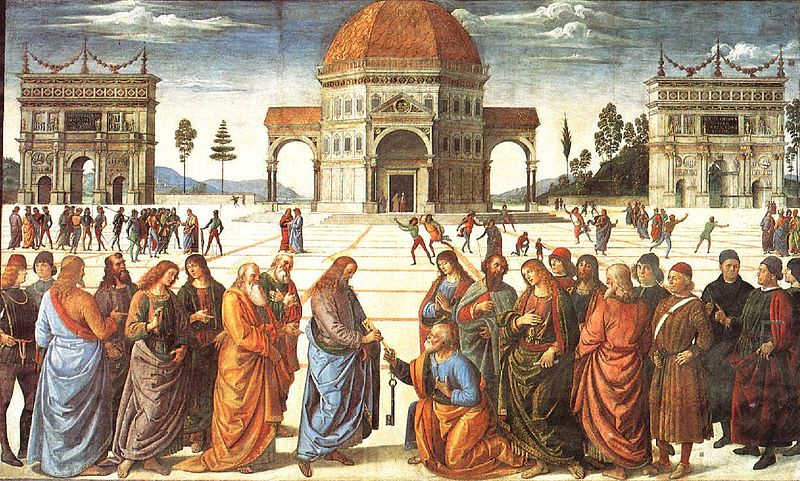
Example of perspective drawing
Pietro Perugino, about 1481
Source: Wikipedia Commons
There are some early examples of perspective in drawing, it was for example widely known that objects in the distance appear smaller, but it wasn’t until the 15th century that the geometrical methods were properly developed and widely used. I don’t think it’s a coincidence that this was briefly before the scientific revolution dramatically changed the way people understood the world.

A painting is, in a very simple sense, a model of the world, and understanding perspective drawing must have had people realize that there is a mathematical basis of the world that’s waiting to be recognized. If you make an accurate drawing of, say, what you see out of your window, if you have sufficient details about how the mountains look like and where the river is, you might be able to “predict” from your drawing that there must be a tree standing over there.

I used to think of our theories as being maps, essentially, from mathematics to reality. I wrote about this earlier and will just reproduce here the accompanying diagram.


There is the world of mathematics, the eternal platonic ideal, and we take a part of it and identify it with the real world. The mathematical part we can call “the model” and “the theory” is the mechanism of identification with the real world, essentially how you compute observables and connect them to data. (I am aware that’s not how other people might be using these words, but arguing about words is pointless.)

This picture of the way we describe the world however raises the question if there is a distinction between these two areas, the question whether mathematics is equally real as that computer screen you are looking at, a question that is some thousand years old, minus the computer. Note that to ask that question, I don’t have to tell you what “real” means. I am just asking if there is a difference between a mathematical object and something that you can throw at me. Max Tegmark famously does not believe there is a distinction.
Most people I know believe there is.

However, it occurred to me, the mapping that the image suggests is actually not what we do if we build a model or apply a theory. What we always do, instead, is that we map one system of the real world to some other system, where the idea is that the one system is better to understand or to use.

Think of the painting: the painting is not a mathematical object. It’s an abstraction, all right, one that can make use of mathematical tools, but it’s not in and by itself a platonic idea. The same is true for all other models that we use. A computer simulation is not a mathematical object, it is a re-building, usually also a simplification, of another part of nature that we want to compare it too. And a calculation that you do in your head is not platonic either, it’s some firing of neurons and a lot of chemical reactions going on, and so on. And it is again, essentially some simulation, approximation, extrapolation, of another part of nature that you want to compare it to, to the end of making a prediction because you want to know if you got it right.

So where does that leave mathematics then? Mathematics is a tool that we use to improve on our models, it’s a technique that we force our thoughts through because it has proven to be incredibly useful. Nevertheless, the point I am trying to make is that this usefulness doesn’t mean a model actually extracts some mathematical “substance” from reality.

You will wonder now what does it matter. The reason it matters to me is that for reasons I elaborated on in this earlier post, I think that the occurrence of the multiverse in its various forms is unavoidable and a consequence of relying exclusively on mathematical consistency. The multiverse tells us that mathematics is not sufficient. What is, I don’t know.

The question is of course if we can conceive of any type of model and a theory to map it that is not mathematical. One thing that came to my mind here is analog gravity, basically the idea to study some types of gravitational phenomena with condensed matter or fluid analogies (thus the name), an idea that has caught on during the last years. I am not terribly excited about this because I don’t really see what we learn from this about quantum gravity. But the point is that it’s an example where you have a model (the “analogue”) that is mapped to the system you want to describe (spacetime) and the model in this case is not a mathematical structure.

Or in other words, if it should be the case that nature cannot be described by mathematics alone, this type of models could still be used.

So much about my latest thoughts on the question whether, at some point in the history of science, we will have to find a way to go beyond mathematics to make progress, and what that could possibly mean.

Friday, June 22, 2012

Catching photons

The Germans have a great history of telling tales, most of which are supposed to teach some type of lesson. One series of such tales is about the citizens of Schilda, the "Schildbürger," who in each story excel in stupidity. One of the best known stories is the construction of a new city hall. Unfortunately, the Schildbürger forget the windows, and then try to carry light into the building with buckets. 


I forgot which lesson one was supposed to learn from that, maybe that the photon number is not a conserved quantity, more likely though that you better don't forget the windows if you build a house. I recall however that I was bugging my poor grandmother with that story over and over again because it wasn't really clear to me exactly why one can't catch light in a box. Surely you could just put mirrors on the inside and visible light would bounce around till you left it out again? 

Well, leaving aside that it's easier to bring light into a dark room by flipping a switch, the problem is that mirrors are imperfect, that is, they don't actually always bounce back photons. The typical mirror in your bathroom, glass with aluminium coating, only reflects about 90% of the infalling light in the visible spectrum, so this wouldn't help the citizens of Schilda very much. (This isn't obvious if you look into a mirror but if you hold two mirrors opposite to each other, you might notice the reflection getting weaker, also, probably getting a little blue/green tint which is from the glass not being perfectly transparent.)

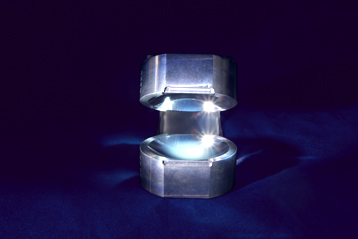
The Schildbürger were on my mind when I came across this paper by a group of French physicists around Serge Haroche who is known for a series of quantum optics experiments. They developed "diamond-machined copper mirrors coated with superconducting niobium."

If you shape the mirrors suitably and arrange them opposite to each other, you can use them to capture photons. And the mind-boggling number that you should take away from here is that the typical decay time of light bouncing back between these mirrors is 0.129 seconds, which corresponds to about 39,000 km light travel time back and forth between the mirrors that have a distance of about 3 cm (a quality factor of more than 1010).

So they would have to run a little, the citizens of Schilda, but they might finally be able to carry light into the city hall. They would also have to cool their buckets to 0.8 K and it would only work in the infrared, but at least it's a start.

The two mirrors of the photon box at ENS
Photo Credits: Photothèque/LKB/Michel BRUNE
Image Source

Tuesday, June 19, 2012

Did the OPERA affair harm or benefit science?

Last year around that time of the year I was working on a draft that re-investigated an old question, whether superluminal information exchange is compatible with special relativity, causality and locality. Just when I had finished the draft and had sent it to a few colleagues, I read the news on the alleged superluminal neutrinos in the OPERA experiment.

Suddenly, the arxiv was flushed with papers on superluminal propagation. My draft didn't have anything to say about neutrinos, but the last thing I wanted was for it to drown in a flood of papers I was convinced would become rapidly irrelevant. So I sat on the draft, but watched the appearance of papers on the arxiv, and the fate of the "OPERA anomaly" closely. Luckily, none of the papers that appeared had any resemblance with mine.

Now that the anomaly vanished into a loose cable that will probably become a running gag in the history of science, I want to return to a question that we already discussed two years ago: Did the attention of the press on what turned out to be a mistake benefit or harm the public perception of science?

A Nature Editorial from two months ago, titled "No Shame," boldly declared everything that happened went perfectly alright:
OPERA's handling of the incident, at least publicly, was a model for how scientists should behave. Ereditato and Auterio acted responsibly when speaking publicly by sticking close to their data and avoiding over-interpretation. They shared their work with their competitors, and did their best to quickly address outside criticism. In the end, it was OPERA's internal checks that found the loose cable. When the error was discovered, physicists on the team wasted no time in publicly announcing the problem, along with others they had exposed during their review.
This elaboration however misses the point that "sharing work" doesn't exactly require to hold a press conference. It would have been perfectly possible for the collaboration to share their results and trouble-shoot without making such a big fuzz about it. The press would probably have heard of it anyway, but the collaboration could have calmly explained them that they're working on it.

The GEO600 collaboration, for example, when faced with their "mystery noise" did not make a secret of it either. They had information on their website and in conference proceedings, and in fact a lot of people knew about it. There were a few reports in the media, but not even NewScientist managed to create a sensation with a collaboration member who just declared that everybody expected the noise to vanish in a rather mundane explanation. Which was exactly what happened.

A lot of my colleagues think that any attention physics receives in the press is good. I don't think so. I understand that it's certainly an ego-boost if you read in the news about a topic on which you are an insider, and suddenly friends and relatives want to hear your opinion. Ah, I'm so knowledgeable, so cool, I'm so up-to date. But there are downsides to this. In my earlier post I listed three points that one should take into account

  • First problem is that while it might draw interest in the short run, it erodes trust as well as interest in the long run. Science lives from accuracy more than any other field. The more often people read claims that something maybe was discovered, but then it wasn't, the less attention they'll pay if they read it again. Quantum gravity in cosmic rays! No wait, nothing to find there. Quantum gravity in gravitational wave interferometers! No wait, nothing to find there. Quantum gravity at the LHC. Sorry, nothing there either. This erosion of trust is exactly why I spent so much time on this blog deflating the headlines.
  • Second problem is one of principle. If rumors or measurement errors are considered a useful tool to draw attention, and attention is a good thing, why not make up a few? 
  • Third problem is that these rumors tend to circle around a few presently particularly popular topics or institutions, and if they dominate the news the vast majority of topics remains uncovered. This, I think, is clearly a disadvantage to education in general and also to the way researchers perceive the relevance of their work.
After having watched the OPERA anomaly come and go, I want to add a fourth point:
  • Fourth problem: The more public attention a topic receives, the more likely scientists in the field are to jump on the train and spend time coming up with contributions, eventually wasting their time and, essentially, taxpayers money.
It is not my intention to blame anybody for anything. It is always easier to point the finger after the facts are on the table. I also do not think people who made mistakes necessarily should resign over them, or should be forced to go. In many instances it seems better to me to keep people who have learned their lesson. If anything, the collaboration should maybe rethink their decision-making procedures. Clearly, they must have thought that it's a mistake that is not on their territory, something that they need outside help with. And they reported it before they had even run all the checks that they had at their disposal. That seems odd to me.

No, the reason for the post is that I think the above points should be taken into account in similar situations because it's not at all clear more attention is always better. Also, I am interested in your opinion.

Related: I saw coincidentally that Giovanni Amelino-Camelia has a paper on physics.hist-ph that discusses the relevance of the OPERA affair for the philosophy of science. I haven't read it, but if you're interested in the details, it might be worth a look.